Showing posts with label Ibbetson Street Press. Show all posts

Sunday, October 09, 2022

What Moments Yield: A poetry collection by Somerville artist Bridget Seley Galway


 What Moments Yield

A poetry collection by Bridget Seley Galway

Reviewed by Susan Isla Tepper

There are past moments that are remembered with pin-point accuracy by those who were involved. And there are others who prefer to bundle away the past into a sealed, locked container, to never see the light of day.

The writer makes a choice.

Poet, painter, writer Bridget Seley Galway is one of the most transparent of artists that I’ve come across. I doubt she could push away her past memories any more than she could push away an invading tank. Her interest in this personal exploration is what makes her tick, and power on, as an artist.

Under one roof (or perhaps no roof), What Moments Yield is an intriguing collection of poems breathing new life: Dear Stranger begins:


Dear Stranger: “If you should happen upon these words, / know I have lived in many daydream moments / with thoughts of you. / This will be our meeting. / What has seemed to be a vast space between us, / is the illusion of our seeming singularity. / My thoughts wonder how it is with you / when I see you walking, / sometimes peering out a window / as I do, / or just the window’s essence of you / through curtains, flower boxes, / night’s amber light or darkness. /… /” (cont).


This is alive poetry by a poet who can absorb every sensory element that crosses her path and those that made up her past. Some poets present the dead/death somewhat stiffly, as I suppose they visualize their past; freeze-framed rather than motion. Something perhaps to be cast in bronze like people used to with baby shoes. For Galway it’s a singularly different process, a kind of balancing act between her sincere wish to engage with the world through her art, and a little sprinkle of worry that perhaps she’s not getting through. She always gets through. I also feel it’s good for an artist to be just a little worried (just a little) to keep everything on balance.


In her poem titled Here, Galway refreshes a memory into a cherished moment.


Here

“Here I recollect you, / in stillness, in a sudden soft breeze, I inhale. / Here / you are the bird / that choreographs the sky, / to wires, / like a note you pose / underlining bright blue possibilities / you left to shine. / Always here, / I look up to you, / in the arrest of the changing light / where clouds adjust the space between us.”


Peppered throughout this book are stunning surreal black and white paintings and drawings by Bridget Seley Galway that illuminate her words and unique thought processes. When I want to know more about a writer, I know I’ve hit on really something good.


the book can be ordered at  http://ibbetsonpress.com

Monday, May 09, 2022

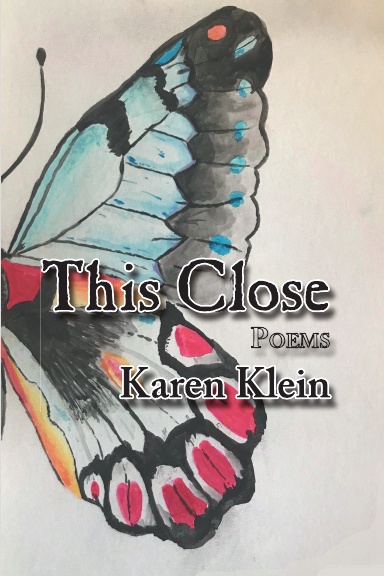
This Close by Karen Klein

This Close 

By

Karen Klein  ( click on to order)


Karen Klein’s This Close is a beautiful read, the poems ranging widely in mood and tone. Her partner’s painful, fatal illness includes a grieving awareness of her own body registering “the meaning of old.” Parthenon presents an excited “First time tourist,” while Tribal Tongues is playful about Yiddish that enriches “…my tribe/those meshugena enough to make poems.” Commitment to Poetry describes her mysterious process of vision: “Poetry made a commitment to me…pulled words out of me…scant rain dew on my face…I melt into it,” an engaging, sensitive collection.— Nina Rubinstein Alonso, author, Riot Wake, editor, Constellations a Journal of Poetry and Fiction

Tuesday, January 14, 2020

Review of Marc D. Goldfinger’s Heroin’s Harbour


Review of Marc D. Goldfinger’s Heroin’s Harbour ( Ibbetson Streeet Press) by Gregory J. Wolos

The Split Man

            Heroin’s harbor is the addict, as Marc D. Goldfinger’s collection of poems and stories, Heroin’s Harbour makes harrowingly clear. Heroin is the body of the addict that craves the drug, and it’s the mind of the addict that cooperates with the insistent body, paradoxically rationalizing any action that might provide safe harbor for a poison. Human beings are frail things, ultimately, Goldfinger’s poems and stories illustrate, too weak to commit to our resolutions or to stave off gratifications that have become needs. Goldfinger’s work does more than merely describe the habits, lifestyle, and thoughts of a junkie; he takes his reader hostage, straps us to the back of his motorcycle so that we do more than simply observe—we participate. Goldfinger’s craft enables us, along with him, to feel the needle and the need.

            In “A Junkie’s Prayer,” one of the first poems in the first section of Heroin’s Harbour, “An Epistle to Opium,” the reader is told what the junkie prays for: not redemption, not relief, not freedom from addiction. The narrator of this poem is so embedded in his world of dependency—the “harbor” of the drug—that what is prayed for are his most immediate needs: “please keep our needles disease free”; “keep us safe from those who would poison our dope”; “keep the police the police from our door”; “keep us free from abscess.” What is prayed for is not an escape, but that “heroin’s sweet sleep” will “ease the pain that lives within our hearts.” The junkie does not beg for a way out and doesn’t seem to want one, asking only that God “keep watch over the farmers and the fields of poppies they tend.”

            A poem like “What Would You Do for a Fix?” lacks a religious core, but uses liturgical “call and response” and repetition to emphasize the all-encompassing nature of a junkie’s need. In this poem, there are sins against the family: “For a fix/ I would steel my mother’s purse; For a fix/ I would take my sister’s coin collection; For a fix/ I would desert my children.” There are sins against the purity of his own body: “For a fix/ I would risk hepatitis; For a fix/ I would shoot toilet water.” There are sins against society: “For a fix/ I would take the money out of the pocket of an unconscious man on the street, For a fix / I would sell dangerous drugs to novices.” Later in the poem, further biblical allusion occurs in another repeated construction: “In the beginning, I got high because I liked it./ In the end I got high because it was all I had left . . . In the beginning I got high because I was searching for the way./ In the end I got high because I was searching for the way out.” As the narrator concludes in “I Have Trouble with Names”: “Some of us name the Gods. / I have trouble with names.”

            Love itself for the junkie isn’t to be found through religion, as Goldfinger testifies in “Drug Store Christ (Heist): “They tell me to turn to Jesus Christ/ Just wait till I do this drug store heist/ . . . ‘Well, we found God/Just sittin’ in the safe of that drug store.’” And True Love for one’s significant other, as described in “Junkie Love” means “giving her the biggest hit,” or when you’re strung out and broke and don’t ask her to hit the streets.”

            Again and again, Goldfinger repeats the message stated in “Death Trippin,” one of the poems written in hard driving couplets that he suggests are “songs” but are all the more frightening in that they come off more as feverish rants: “One thing I know, Heroin’s the best/ For nullifying the pain that’s in my chest.” The shift from reading Goldfinger’s poems to reading his short stories is like a shift from listening to songs to watching a movie that uses those songs as background music. The refrain stated in the poem “Getting Fixed in South Carolina”: “addiction only remembers what it needs” throbs through the prose of stories that describe in detail the underworld of junkies. There are stories about dealing with crooked pharmacists and hard-ass police (“A Controlled Dangerous Substance Act”); stories about navigating life with various women who shared the narrator’s addictions (“Femme Fatale”); stories about obtaining prescriptions from doctors (“Running on Empty in Vermont”); stories about living in filth and failing to care for those innocents for whom you’re responsible (“Two Dogs and a Kitten”). The long poem “Getting Fixed in South Carolina” is itself expanded into a short story that depicts the life-threatening hazards a junkie will undertake to satisfy his habit. These stories powerfully convey the life of addicts whose focus is reduced to remembering “what it needs.” But even detailed stories are insufficiently descriptive, Goldfinger asserts in “The Rocking Chair,” which shows a recovering junkie’s return home to aged and ailing parents: “The imagination is limited when it comes to the real. Things get left out.”

            Recovery for the junkie seems a struggle doomed to Sisyphean failure. In his second section of poems, “The Fight to Stay Clean,” Goldfinger presents several portraits of those lost to drugs (“Medusa with Fire,” “One of the Tough Guys,” “Significant Other,” “Open Casket,” “The Way She Shakes”), or those who will be (“A Couple of Kids”). But there is a whisper of hope in the sisterhood of “The Angels of Gloucester,” who “walk an ancient path now, join hands at signs of trouble, hug each other’s children, knit their families into hot strong blankets with threads of prayer.” Ultimately, Goldfinger points to the necessity of the recovering junkie never losing sight of the fact that he is “The Split Man”: two alternate realities, this poem illustrates, are perpetually present, contending for the junkie’s heart: “I am the happy married man/ the junkie in the street begging/ the house-owner sitting  sitting at my computer/ in the bathroom sticking a needle in my arm . . . / I am a split man, this half of me dances with joy/ I am a split man, this half of me is dying day by day/ I can choose, I can stand by a lake holding the hand of my wife/ or my choices are gone, I probe my arm looking for a vein.”
            With devastating honesty and heartbreaking detail, Marc D. Goldfinger offers in his poems and stories glimpses into the lives of tortured souls who have abandoned themselves to an all-consuming, unsafe harbor. “A junkie’s body never forgets,” he concludes in the poem “All of Me”: “If it was just physical, I would never use dope/ again. It is not my body, it is me, all of me, my body, my soul, my mind/ interlocked in heroin hypnosis, even/ free, I will never be free again.” Goldfinger’s words seem less buoys warning of an unsafe passage than a testament to the hope of a single split man’s survival.

Saturday, August 18, 2018

Spare Change News Poems: An Anthology of Homeless People and those Touched by Homelessness--Edited by Marc Goldfinger and Lee Varon


Spare Change News Poems: An Anthology of Homeless People and those Touched by Homelessness
Editors: Lee Varon and Mark Goldfinger
Ibbetson Street Press ( 2018)
http://ibbetsonpress.com

Review by Doug Holder

In the introduction to the new anthology Spare Change News Poems... editors Lee Varon and Marc Golfinger write:

" The Spare Change News newspaper was founded in 1992 by a group of homeless individuals and a housed advocate. Since its inception, Spare Change News has worked to elevate the voices of the homeless and economically disadvantaged people in the Boston Area.

In these pages you will find the poetry of many people who are who are homeless, or who have been touched by homelessness in some way. You will find the poetry of veterans, of those with mental health issues, or those struggling with substance abuse disorder. You will find poems written by incarcerated or formerly incarcerated  people."

Personally-- I have a real connection to the paper not only for its laudable mission of giving the homeless a voice (and in some cases a chance to make a living by selling the paper),  but years ago I was an arts reporter under the managing editor at the time Linda Larson--and assisted the poetry editor Don DiVecchio. I worked closely with late assistant editor Cynthia Baron, and former editor Marc Goldinger, as well. I learned a lot during my tenure with all these people.  That being said, the poetry you will find in this anthology is not New Yorker-style work. It can be raw as the streets, visceral,  heartbreaking and even heartwarming.

There are many fine poets, with fine poems in this collection like: Martin Espada, Marge Piercy,  Alexis Ivy, the late Sarah Hannah and many more. In a poem by the editor Lee Varon  titled "Colleen,"  the poet uses colors to vividly portray a young woman doomed by her torrid love affair with heroin:

Heroin is white
      but your lips are blue
and blue is seeping into the room
where you passed out last week,
the room
where your head hit the floor,
blue dust is wafting from the ceiling,
oozing froom the floorboards...


In Martin Espada's poem " How We Could Haved Lived and Died This Way," Espada quotes Whitman,

Not songs of loyalty alone are these,
but songs of insurrection also,
For I am the sworn poet of every dauntless rebel the world
over.

Here in hardscrabble detail Espada, like Whitman, takes it all in-and sings a song for the marginal rebels who survive or don't survive the vagaries of the street:

I see the dark -skinned bodies falling in the street as their ancestors fell
before the whip and steel, the last blood pooling, the last breath spitting.
I see the immigrant street vendor flashing his wallet to the cops,
shot so many times there are bullet holes in the side of his feet....
I see the man hawking
a fistful of cigarettes, the cop's chokehold that makes his wheezing
lungs stop wheezing forever. I am in the crowd, at the window,
kneeling beside the body left on the asphalt for hours, covered in a sheet.

From reading this poetry it is evident that there is tragedy, and beauty on these mean streets  and perhaps. ..salvation.


There will be a reading at Porter Square Books in Cambridge  7PM  Aug 22

To order the book go to:  http://lulu.com/ibbetsonpress

Monday, December 29, 2008

MASSBOOKS OF THE YEAR/POETRY: Recommended Reading from the 8th Annual Massachusetts Book Awards--2008


MASSBOOKS OF THE YEAR/POETRY
Recommended Reading from the 8th Annual Massachusetts Book Awards


The Award Books
Blackbird and Wolf by Henri Cole (Farrar, Straus & Giroux). In these poems the writer strives to fuse the mind and the world,meditation and observation, until what is seen becomes what is felt.

If No Moon by Moira Linehan (Southern Illinois UP). This cohesive and brave collection of lyric poetry invites the reader toexplore the author's devotion to embracing life, grieving death, and pursuing creativity.

Gulf Music by Robert Pinsky (Farrar, Straus & Giroux). Former Poet Laureate Robert Pinsky explores the intersections between individual, cultural, and political memory through the idiosyncratic notion of forgetfulness.


Highly Recommended


Lawrence City by Cesar Sanchez Beras (Wellington House Publishing). Set in Lawrence, Massachusetts, the collection explores town landmarks such as the Ayer Mill clock, City Hall, and Bellevue cemetery.

Inconsiderate Madness by Helen Marie Casey (Black Lawrence Press). Casey’s poems focus on Mary Dyer, a Quaker hanged as a heretic in 17th century Massachusetts, and explore themes of belief, devotion, and the relationship between religion and
the state.

The Alchemy of Grief by Emily Ferrara (Bordighera Press). Ferrara incorporates love, loss, friendship, and transformation in poems about the pain and healing of a grieving mother.

Descartes’ Loneliness by Allen Grossman (New Directions). A combination of comedy and tragedy, Grossman’s collection of poetry about death dares to find humor and peace in loss.

Under Sleep by Daniel Hall (U of Chicago Press). Written over a ten year period as an elegy to Hall’s partner, Under Sleep utilizes a variety of poetic forms and styles to relate the effects of a loved one’s death on the living.

From Mist to Shadow by Robert K. Johnson (Ibbetson Street Press). In a poetic exploration of his own life, Johnson shares thoughts on love, literature, family, careers, and the characters who have colored his experiences.

Beloved Idea by Ann Killough (Alice James Books) Killough struggles to understand through metaphor-heavy verse her feelings toward her nation, evoking images from American religion, literature, and politics.

Easy to Keep, Hard to Keep In by David R. Surette (Koenisha Publications). Surette’s musical verses relate autobiographicalstories from his life in and around Boston.

The Situation by John Skoyles (Carnegie Mellon UP). Skoyles addresses the relationship between life and death while incorporating love, loss, and religion.

Saving the Lamb by B.G. Thurston (Finishing Line Press). These poems use images from nature to illustrate aspects of human life and of the life of the poet in particular.

Judges for the 8th MassBooks in Poetry were Claire Buck (Department of English, Wheaton College),Lawrence Raab (Department of English, Williams College) & Vanessa Vargas (Forbes Library, Northampton)