Friday, August 02, 2024

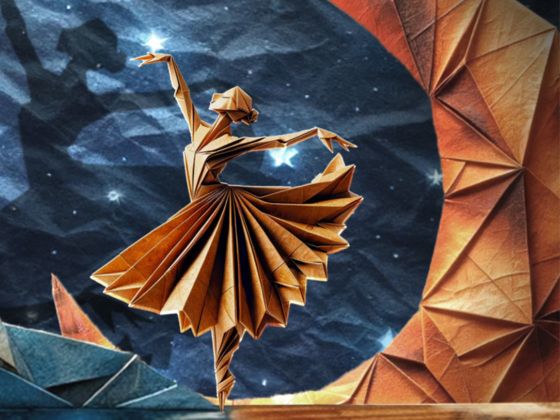
Origami Night—a choreo poem based on the poetry of Pamela Annas.


Origami Night—a choreo poem based on the poetry of Pamela Annas. Performed by Elenaluisa Alvarez; narrated by Luz Nicolàs; choreographed by Graham Cole; libretto, set design and lighting by Christopher Annas-Lee; costumes designed by Virginia Belt. At the Boston Center for the Arts Plaza Black Box Theatre, 539 Tremont Street, Boston, Massachusetts. Remaining performances: Saturday, August 4, 2024 at 2 pm and 8 pm; Sunday, August 5, 2024 at 2 pm. For tickets, go to https://www.bostontheatrescene.com/shows-and-events/origami-night/#performance-picker

review by Tom Daley August 2, 2024

Last night I went to see Origami Night at the Black Box Theater at Boston Center for the Arts. I want to most enthusiastically encourage anyone who is able to brave the heat wave we are enduring in the Boston area to get out and take in this riveting, brain-shimmering, thoroughly engaging fifty minutes of theater, which has three performances remaining (the theater is air-conditioned, in case that wasn’t clear!). Origami Night is a choreo poem composed of excerpts of the poetry of Pamela Annas, a feminist Sylvia Plath scholar and a now-retired professor at U Mass-Boston. Her son, Christopher Annas-Lee and his creative partner, the Portland (Oregon)-based choreographer Graham Cole, conceived of the fifty-minute show which will delight connoisseurs of ballet, modern dance, and performance poetry. The sole live performer of the show (the narration of the poetry was recorded) is the dancer, Elenaluisa Alvarez, a furiously talented movement artist whose aggressively graceful and spiritedly athletic classical ballet and modern dance moves would be enough to enthrall even the most exacting dance critic. But she adds to that expertise the execution of now comical, now melancholic, now exuberantly idiosyncratic gestures—pouts, punts. grimaces, grunting torso twists, wry smiles, spooky shoulder tremors, neck contortions, and withering collapses— all done in precise synchronicity with certain phrases of Annas’ poetry—gestures that demonstrate that she is a marvelous actress as well. Most of these moves were adeptly choreographed by Graham Cole, but one can sense the way in which Alvarez incorporated the precise instruction and wrestled and wrapped her own vigor and elan, her own graciousness, and her own passion and pain into the choreographer’s imagination. Annas’ poetry—full of that kind of nostalgia that purges longing of any sentimentality with its clear-eyed and candid reconnoitering of its subjects—an army brat past, a swing dance-hall denizen’s exhilaration, a mother’s woes and wonders—was narrated, in the sparking soundtrack/libretto dreamed up by Christopher Annas-Lee, by Luz Nicolàs, an actress who has spent most of her career in Spanish-speaking theater (this was her first performance in English). The odd choice of narrator with a Latin-inflected voice for the poetry of a bottle-blonde, sunhat-sporting gringa professor somehow worked just about perfectly—although there were times when it was a little hard to follow all the words. Nicolàs’s elucidation of the poems has the flavor of a sometimes spunky, sometimes affectionately wary abuela (grandmother) ruminating with matter-of-fact sobriety over the bittersweets and the redolent triumphs of a life lived with attitude and attention, with wry perspicuity, and with an insistence that simultaneously flickers and flares through the rigor of her sturdy voice. Hers is an inventive channeling of the spirit of Annas’

storytelling—but with an affecting fidelity to the distinction between the narrator’s background and that of the poet. The difference between the voice of the narrator and the culture of the poet adds a fascinating disruption to the expectations we have for the libretto—the Latin voice complicates and complements the Anglo experience with its implied and ironic resistance in its fond, at times distanced interpretation of the articulations of a poet who is part if not parcel of the dominating culture. The platform on which Elenaluisa Alvarez strutted and whirled and broke and then rearmed herself in a bundle of gyrating gesticulations was designed and built by Christopher Annas-Lee, who also wrote the libretto. Annas-Lee, an up-and-coming theater lighting designer whose talents I first appreciated years ago when he was involved with the young and precocious Circuit Theater company, a Newton (Massachusetts)-based troupe with Broadway production values, fashioned a circular stage replete with an elaborate (and sometimes dizzying) network of LED lights and special effects. These included three overpowering blasts of a thunderstorm that made us forget that we were under the impression that we were seated in a ring around the dance floor of a discotheque. In the final movement of the choreo poem, realizing the choreographer Graham Cole’s cleverness, Alvarez opens a hatch at the center of Annas-Lee’s stage and yanks out a many-yards-long tube charged with white neon light whose severity rivals the marquees of Las Vegas. The actress-dancer pulls the tube offstage where she, a modern-day Eve, seems to be at once caressing and recoiling from the phallic serpentine grip of the glowing hose. The post-Eden, modest Alvarez-Eve is covered in a blouse that was designed by Virginia Belt, one that those of us who know Pamela Annas would recognize as having an apt resonance with Annas’s personal style. While just about everything was done to perfection in this production, I wish that the talents of Elenaluisa Alvarez as an actress had been more emphasized than her extraordinary skills as a practitioner of ballet moves and modern dance gymnastics. The first part of the show was rather top-heavy with a kind of show-offy exhibition of many of the moves in her impressive arsenal of arm stretches and balances and toes pointed at the ceiling—an exhibition in which it was hard to feel a connection with the poetry, except at the level of a kind of a too-generalized, overarching, yet resonant joy. With a performance centered around an Annas poem that references the Brecht-Weill song, “Mack the Knife” (the speakers in the theater blasted out a growling Louis Armstrong’s rendition), the exhibitionism began to slow to a series of facial contortions, wrinkling bows, shimmering and blubbering knee bends—a series in which every raised eyebrow, every hip surge, every sophisticatedly hesitant pirouette seemed to be driven by the pistons of the poetry (and the music), to honor its specificity, its emotional complexity—a deeply satisfying and authentic product of the collaboration between movement artist, choreographer, narrator, stage-and-lighting designer-librettist, and poet that informed most of the rest of this remarkable show.

Thursday, August 01, 2024

Poet Margaret Young Wonders: 'How Else Can We Know What's Beautiful?'


Interview by Doug Holder


Recently I received a chapbook of poetry from Margaret Young, a former colleague of mine at Endicott College. It is titled, "How Else Can We Wonder What's Beautiful." ( Main Street Rag). I decided to send some questions to the poet on a very hot summer's day. Oddly enough, as I was considering when to write the interview questions -- Young's husband Rocco Gangle-- a noted philosophy professor at Endicott College-- greeted me at my table at the Bloc 11 Cafe--my usual haunt in Union Square, Somerville. And indeed, Young  has the touch of a philosopher in her work.  According to Young's website,

Margaret Young grew up in Oberlin, Ohio. She earned a B.A. from Yale and worked in a traveling theater company before earning an M.A. in creative writing at the University of California, Davis. She has taught writing and theater to all ages and been an artist-in residence in schools, and received an Individual Artist Grant from the Ohio Arts Council in 2005. Her poetry collections include Willow from the Willow, Almond Town, Blight Summer, and How Else Can We Know What's Beautiful? Her translations of Sergio Inestrosa's In el espacio improbable de un haiku and Luna que no cesa appeared in 2017 and 2018, respectively. She is one the faculty of the Global Center for Advanced Studies, and lives in Beverly, Massachusetts.


Interview by Doug Holder ( Board of Directors/ New England Poetry Club)

When you taught at Endicott College you had a popular course on Pop Culture. Some might comment that POP Culture is not appropriate for the rarefied air of poetry. I think when poetry is rarefied it is a problem. Your take?


I agree that poetry is doomed if it doesn't embrace pop culture. I include references in my poetry to TV etc. because it's the stuff of life, just like food or grief, (or the inscrutable philosophy my husband studies.) I hope that comparing the color of pokeweed to the T-Mobile campaign brings those two disparities a little closer, not for any moral lesson, but just on an aesthetic basis, helping people pay more attention to both weeds and ads.


I was intrigued by your line in the poem "Art": " We all have regrets. How else can we know what's beautiful?" Explain.


That's one of those poems/lines that came to me unbidden, so I'm not sure how to explain. I think it might be the notion that beauty is less about the ideal than about things flawed, not-figured-out. That we learn more from the latter. Anti-Platonist?


In the poem " International Water Day at Assisted Living" you wonder if the elderly patients who are 'adrift' are dreaming about the sea. We started in the sea of the womb-- the sea is elemental—seminal. In a way we go back to the waters of our birth or youth, and again when we are in our dotage. Your thoughts?


Yes, yes. My dad's now in an assisted living facility, and I read him poems every day. We were just discussing Jaques's speech in "As You Like It" where the 7th (and last) age of man describes a return to helpless infanthood. I think this occurred when he was telling me they call them not bibs, but "clothing protectors," in the dining area, not wanting to remind people of this concept.


The poems in your new collection are not wordy—you have a real economy to your poetry. Is this your signature style?​


I hope so! I had flirtations with Whitman & Lorca in graduate school, and with performance/slam poetry in the 90s, but feel like I really found my truest voice when I whittled things down, got comfortable leaving big gaps.

You are on the faculty of the Global Center for Advance Studies. Can you tell us a bit about this organization?

GCAS website: https://gcas.ie

Their description: "GCAS (The Global Center for Advanced Studies) began in 2013 with over 100 leading writers, philosophers, professors, artists, and filmmakers. We started as a non-profit in the USA but later incorporated in Ireland as a limited company so we could share ownership with faculty and graduates. We are the first debt-free degree granting institution of higher education co-owned by faculty, financial supporters, staff, and graduates on blockchain and our own crypto-token, GCASy. We offer a few accredited degrees in the European Union via Woolf."

And--though it's been mostly my husband teaching in far-flung places (like last summer's hike-the-Alps-while-studying Nietzche course) I've done a series of seminars on ecopoetics, including one about its relationship to permaculture. Gary Snyder once defined bioregionalism as "flying around the world to tell people to stay home..."


Why should we read this book?


Because it's rooted in place(s), because it's fun and weird, because you love language.

Wednesday, July 31, 2024

The Sixth Extinction, Tenth Anniversary Edition by Elizabeth Kolbert


The Sixth Extinction, Tenth Anniversary Edition by Elizabeth Kolbert

Review

By Ed Meek

According to the Cornell Ornithology Lab “3 billion breeding birds have been lost during the last fifty years across Canada and North America.”

Think of the earth as a living organism that is being attacked by billions of bacteria whose number double every forty years. Either the host dies. Or the virus dies, or both die.” —Gore Vidal

Acknowledgment: we acknowledge that England and much of Europe was once inhabited by the Neanderthals and that Homo Sapiens without provocation invaded those lands and engaged in the genocide of all Neanderthals (some of whom Homo Sapiens had sex with). Homo Sapiens also wiped out the Denisovan people of Asia. We further acknowledge that the Clovis people of North America killed and ate all the large mammals who once roamed North America including the saber-toothed tiger, the mastodon, the woolly mammoth, the giant sloth.

If you missed The Sixth Extinction when it came out ten years ago, now is a good time to read it. According to Elizabeth Kolbert, we are in the midst of the sixth mass extinction. The last mass extinction is the one we are all familiar with. Sixty-five million years ago the dinosaurs were destroyed when an asteroid struck the earth and made the climate uninhabitable. The impact resulted in volcanos spread ash that blocked the sun and global freezing killed the plants that fed the herbivores and the dinosaurs that ate them. Prior to that, there were four other mass extinctions. Elizabeth Kolbert argues that we are now living in an era called the Anthropocene in which humans are the dominating force on the planet rather than just one of its inhabitants, and that we are rapidly altering and displacing other forms of life. Part of this process is tied to climate change, but not all of it.

Elizabeth Kolbert is an accomplished writer. Her method is similar to Joan Didion’s. She observes and gathers material to build an argument. She traveled around the world to explore areas where scientists are recording what is happening to animals and their ecosystems. She went to the tropics of Peru, the Great Barrier Reef of Australia, New Jersey, San Diego, Paris and Scotland. What she finds is that humans and climate change are having a devastating effect on ecosystems, altering the habitats of animals and plant life, replacing forests and deserts with cattle ranches and housing developments. “Habitat and species loss leaves just 3% of the world’s ecosystems intact according to CNN.

Critically endangered animals include species of elephants, rhinos, tigers, gorillas, orangutangs. The “merely” endangered list is much bigger. Orangutangs are closest to humans, but more and more research is confirming that many animals are intelligent including dolphins who communicate with each other, elephants who mourn the dead and adopt strays, crows who make their own tools, and octopuses who escape from aquariums. Other animals may not rival us in intelligence but share emotional connections as dog and cat and horse owners will attest. Cows, sheep, pigs and chickens all have feelings and animal rights activists Nussbaum and Grandin have won rights for animals including more humane deaths. Doris Lessing once said that humans in the future will wonder how we could possibly kill and eat sentient animals.

Recently, geologists met and proclaimed we are not living in the Athropocene epoch yet (eras usually last thousands of years and our environment has only been undergoing radical changes since the Industrial Revolution). But the dominance of humans and the catastrophic results of our burning fossil fuels are getting harder and harder to ignore.

Since The Sixth Extinction came out there has been some progress in recognizing the value of animals and plant life. We’ve seen the revival of eagles, condors, pelicans, bison, etc. due to the work of animal rights groups. California has committed to “rewilding” 30% of lands and coastal waters. We’ve also made inroads to slow climate change. According to the World in Data, 30% of the world’s electricity now comes from green energy. When The Sixth Extinction came out, it was both prescient and groundbreaking. Today, it is still well worth reading.

As Kolbert says: “Right now, in the amazing moment that counts as the present, we are deciding without quite meaning to, which evolutionary pathways will remain open, and which will close.”

Friday, July 26, 2024

Red Letter Poem #217

 The Red Letters


In ancient Rome, feast days were indicated on the calendar by red letters.

To my mind, all poetry and art serves as a reminder that every day we wake together beneath the sun is a red-letter day.


––Steven Ratiner


Red Letter Poem #217


A Pact


I make a pact with you, John Berryman.

I have detested you for a long time.

I completely agreed with your mother.

I thought you had no inner resources.

I saw your poems as navel gazing.

I saw you force form on a natural rhyme.

I still can’t believe you were such a child.

I wish I knew nothing of your real life.

I can now see, you had a bad disease.

I come to you now as a grown man.

I am taken by the Shakespeare in you.

I can even hear your Walt Whitman in there.


I see the minstrel in your vaudeville show.

I am old enough, now, to make amends.


                                     ––Kevin Gallagher


You say from Spring Hill: ‘I am not the same.’––

No more am I: I’m neither: without you I

Am not myself. . .


                         ––John Berryman, Berryman’s Sonnets #94


I, the first-person pronoun: how deceptively simple, when it appears in a poem.  Intimate. . .aloof. . .straightforward. . .confounding––this pronoun each one of us lives inside, hides behind, displays like a flag (but of decidedly mixed allegiance.)  Sometimes I signals the ‘confessional’ approach, an honest appeal to the reader, baring the heart.  In other instances, it projects a conception of the self, an aesthetic calculation we want the world to appreciate––hoping (at least in some cases) we, too, might come to believe it over time.  Kevin Gallagher’s new poem sets out a veritable picket fence of I’s as he attempts to make peace with one of modernity’s great and troubling poets (just as every ink-stained son or daughter must with their literary forebears.)  Of course, reading the piece, we’re left to grapple with a host of voices from a variety of poets, whose intentions likely do not coincide.


Let’s begin with some history: if you heard a vague echo in your ear when you first read Kevin’s opening lines, it’s because his piece is an elaborate reworking an older poem: Ezra Pound’s verse by the same name, dating from the beginning of the 20th century.  Here it is in full:


A Pact


I make truce with you, Walt Whitman—
I have detested you long enough.
I come to you as a grown child
Who has had a pig-headed father;
I am old enough now to make friends.
It was you that broke the new wood,
Now is a time for carving.
We have one sap and one root—
Let there be commerce between us.


Pound disliked Whitman’s long breathy lines and American matter-of-fact-ness, both in its subject matter and tone.  But he came at last to admire the Good Gray Poet’s authenticity and the liberating force of his imagination which, over time, helped give birth to what we think of as modern poetry.  When Whitman opens his long masterwork “Song of Myself” with this appeal to readers: “I CELEBRATE myself;/ And what I assume you shall assume;/ For every atom belonging to me, as good belongs to you.”, it takes time to realize this is not the “barbaric yawp” of some raging narcissist but the myth-making proclamation of our country’s first truly native (and radically inclusive) poetic voice.  In the diversity of offshoots that grew from Whitman’s roots, Berryman’s couldn’t have been more different: if Whitman wanted to carve out a dramatic distance from our European literary ancestors, Berryman’s brilliant mind wanted to wholly digest that lineage––Petrarch, Wyatt, Shakespeare, Donne and (notably in his sonnet sequence) Sir Philip Sydney––and blend them with an unlikely 20th century sensibility.  Erudite, often opaque, filled with strange inversions of syntax and kaleidoscopic literary references, the 117 poems of Berryman’s Sonnets (not to mention his even more phantasmagorical Dream Songs) both thrill and overwhelm.


Now, if you’re familiar with Kevin’s poetry, what likely comes to mind is its blue-collar honesty, its links to Irish history and mythology, its muscular and arresting imagery––all things Pound might applaud but which would certainly give Berryman pause.  And so what we have here is a tidal process across the generations: a kind of give and take, a raising up and breaking down––helping to refresh the language, drive the imagination.  It’s a familiar pattern among young poets: to counter their immediate antecedents and strike out in a new direction, building upon the wreckage of the old.  But then, over time (or so we hope), they’ll find themselves entering into a gradual reevaluation that helps us all to appreciate our literary ancestry, embracing the very traditions from which we’d once fought to free ourselves.  Keep in mind, some of these figures are more persona than person: is Walt Whitman of Brooklyn identical to the monumental I in his poetry?  Is the poet speaking in Berryman’s Sonnets the very same man who hoped those poems might entrance his beloved?  And, for that matter, is Dr. Kevin Gallagher––professor, political economist, and Director of Boston University’s Global Development Policy Center––the same mind traversing this bare-boned sonnet?  Or the same as the poet and publisher, author of four fine collections (most recently And Yet It Moves from Madhat Press), who I know from captivating readings around Boston?  No easy answer presents itself.  So as I watch him construct that column of I’s in this poem, and wrestle (as every writer must) with what the head and heart each demand upon the page, I can’t help thinking about all the scores of men and women whose creative visions I, too, have battled with, fed upon.  My desire to know them was always, perhaps, a stand-in for the even-more-daunting desire to eventually know myself.


Red Letters 3.0


* If you would like to receive these poems every Friday in your own in-box – or would like to write in with comments or submissions – send correspondence to:

steven.arlingtonlaureate@gmail.com


* To learn more about the origins of the Red Letter Project, check out an essay I wrote for Arrowsmith Magazine:

https://www.arrowsmithpress.com/community-of-voices


and the Boston Area Small Press and Poetry Scene

http://dougholder.blogspot.com


* For updates and announcements about Red Letter projects and poetry readings, please follow me on Twitter          

@StevenRatiner