Saturday, November 24, 2018

The Sunday Poet: Julia Carlson

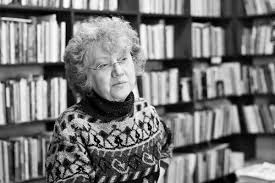
Julia Carlson


Julia Carlson received her BA (Philosophy) and MA (Social Work ) from Boston University, and a Diploma in Linguistics (Universite de Toulouse-Mirail, France). She is author of two chapbooks, Turn of the Century (Cloudkeeper Press, 2008 ) and Drift (March Hare Press, 2012). Her recent collection, Prayer for the Misbegotten was published by Oddball Press in 2017; her next collection will be out in 2019. Her poems have been published in Lyrical Somerville, Wilderness House Literary Review, Bagel Bards Anthologies (& was Editor of #5), and Muddy River Poetry Review. She is the recipient of a Davis-Kidd Poetry Award and the 2017 Poetrykit Summer Competition (UK). She makes her home in Cambridge, MA, likes rock and roll, and a wee dram on a cold night.


MODERN FAMILY 

Mom just lost her job 
but no one knows that 
about that 
yet. 

Millennial son still lives at home 
not paying any rent 
strung out on dope 
but no one knows 
yet. 

Dad is screwing his new secretary 
but only he knows it 
He’ll be damned if  
the wife finds out.   
But she doesn’t know 
yet. 

Outside, rain falls steady and wet. 
Fourteen year old daughter’s 
new boyfriend is thirty 
but the parents don’t  
knows about him 
yet. 

Thank God for the radio 
blasting some unnamed punk tune 
Three bar refrain and heavy bass 
thumps as she dances in the kitchen. 
No one’s told her to  
turn it down. 
yet. 

Soon it will be time  
for dinner, Domino’s take-out. 
They’ll sit in front of the TV 
light up their cell phones 
stare at the blue-lit screens 
while they text and eat the pizza.  
Which hasn’t gotten cold 
yet.

Sunday, November 18, 2018

The Sunday Poet: Bridget Seley Galway

Bridget Seley Galway


Bridget Seley- Galway artist/poet received a Chancellor Artistic Achievement award full merit scholarship at Umass Amherst; earned BFA’s in painting and Art Education. Her poems have been published in Provincetown Magazine’s Poetry Corner, Bagels with the Bards anthologies, Popt Art magazine, The Somerville Times Lyrical, Wilderness House Literary Review online magazine, Soul-Lit online poetry journal, and Ibbetson Press, and Poetry Porch online magazine. Her art has exhibited throughout New England. It has been reviewed and printed in Artist Magazine, Cape Cod Review, Cape Arts Magazine, and Emerson’s Redivider. Her paintings were selected to be on the covers of Bagel with Bards Anthology, several issues of Ibbetson Press, and on the cover of Doug Holder’s “Eating Grief at 3 AM”, and Molly Lynn Watt’s “ On the Wings of Song, A journey into the Civil Rights Era”.


Between You and Me

The throw rug lay in waves
from the in and out of our steps.
Our routine rarely counted
with any conscious thought,
in the depth of what we are-
in this place we created,
which was once bare and full of light.

Now remnants of our separate history
echo through collected and gifted objects,
books read or dog-eared.

The illusion of permanence comforts,
also defines what can be and is lost
in every moment.

When we quietly settle
in our separate observation,
we are together- and
 I aspire to keep
in the measurement of words written down;
an account lasting,
past the throw rug’s waves
from the in and out of our steps,
Into the bare and full of light.

Saturday, November 17, 2018

NYSUMMERFEST PESENTS ANNE FRANK LIVES LAWRENCE KESSENICH


NYSUMMERFEST PESENTS
ANNE FRANK LIVES
LAWRENCE KESSENICH

HUDSON GUILD THEATRE
JULY 2018.
A Review.


Triona Mc Morrow.

In the play Anne Frank Lives by Watertown, MA. based playwright Lawrence Kessenich , the scene is set early on with a powerful monologue from Anne. Her accent is very effective, the lighting and set help to create just the right atmosphere.


This plot is well-conceived. Anne survives Bergen Belsen having been rescued by a Nazi soldier and driven out of the camp. She stays with a couple on her way back home; they nurse her back to health. However, on her trip to Amsterdam the bus she takes crashes, she bangs her head and suffers amnesia. She then goes to New York where she is offered a job and then Anne begins to tell people she is Anne Frank.


She is admitted to a psychiatric hospital with a diagnosis of delusional behavior. We are wondering throughout whether she is Anne Frank; this creates great tension and suspense. We meet other delusional characters at the hospital like Marie Antoinette and FD Roosevelt. This adds to our uncertainty as to whether this is the real Anne Frank. 


The psychiatrist at the hospital played by Preston Fritz Smith has a big role in guiding Anne. He is convinced she is deluded. He plays the part with the gravitas we would expect.


Otto , her father played by Chaz Mc Cormack, is convincing in the role and her encounters with Otto are fraught and very real. She has convinced Otto that she is his daughter, because of details she included in her letters to him. However, although she finally free to leave the hospital she does not go with Otto. She has decided that she does not want to be Anne Frank any longer because she is afraid that people would think that everything about the holocaust was fiction.


Anne does leave the hospital alone. There is a scene, where a nurse silently dresses her for the outside , as if she is empowering her-- it is very effective. This contrasts with the start of the play where the nurse undresses her—a very powerful as a tool of dis-empowerment
.
The ghosts of Peter played by Gabe Calleja , Margot, played by Marine d’Aoure and Marie, played by Megan Grace Martinez work well in the play.

Thirsa van Til plays a very convincing and sustained Anne Frank. The rest of the cast perform well, it is almost a monologue with the rest of the cast supporting Thirsa.

The spare set and lighting were very atmospheric.

There is great attention to detail in the script. There was a small piece of plaid fabric attached with a paper clip to the program. The fabric was similar to the cover of Anne’s diary, the significance of the paper clip was that they were invented by a German Jew.

This was a very enjoyable immersive experience of theater. I believe this play would travel well.


 Triona McMorrow lives in Dun Laoghaire, Co Dublin. She was shortlisted for the International Frances Ledwidge Poetry Competition in 2009, 2011 and 2016. She was shortlisted for the Galway University Hospitals Arts Trust Poetry Competition in 2013 and shortlisted for the Rush Poetry Competition in 2017.


Sunday, November 11, 2018

The Sunday Poet: Deborah Leipziger

 
Deborah Leipziger


Deborah Leipziger is an author, poet, and professor. Her chapbook, Flower Map, was published by Finishing Line Press (2013). In 2014, her poem “Written on Skin” was nominated for a Pushcart Prize. Born in Brazil, Ms. Leipziger is the author of several books on human rights and sustainability. Her poems have been published in Salamander, Voices Israel, POESY, Wilderness House Review, Ibbetson Street, and the Muddy River Poetry Review. http://flowermap.net/


Written on Skin

In cursive and script your kiss
Is indelibly written on skin.

Even now, the cut from your birth
Echoing the rain is written on skin.

The numbers from a time of horror
Are held written on skin.

Just as the rings record the age of the tree
My ages and years are written on skin.

The wood from the forest for the violin
Its music etched in wood, written on skin.

The umbilical cord coiled around my neck
Is still there, pulsating purple, written on skin.

The parchment of history of storied sacrifice
Is written on hides, written on skin.

In ink and dust, blood and bruise
My history is written on skin.

The newspaper stories of massacre
Collapse and famine are written on skin.

Your touch on my earlobe, fingerprints on my face
Words and deeds unbidden, written on skin.


The phrase “Written on Skin” is the title of an opera by George Benjamin.

Published in Muddy River Poetry Review

Tuesday, November 06, 2018

Shot in the Head By Lee Varon


Shot in the Head
By Lee Varon
Sunshot Press
ISBN: 978-1-944977-22-1
65 Pages

Review by Dennis Daly

How can one not read this book? From its provocative title—Shot in the Head, through its narration of adultery, revenge, edgy family lore, religious hatred, and racial violence, Lee Varon leads her readers to a generational promised land of understanding and bone-rattling reconciliation.  

Varon’s verse insights of damaged human beings in a deeply flawed culture are breathtaking. She pieces together her family history by chronicling a close knit, loving, but paradoxically fraught relationship with her undisputedly bigoted grandmother. Poetic short lines and stanza breaks both heighten events and invite atypical considerations of moral dilemmas among kith and kin. As one reads the geographical happenings of Petersburg, Virginia, circa 1930s, one can’t miss the contemporary racial and religious implications. In short Varon seems to have conjured up a psychological portrayal of singular significance.

Beginning at the epicenter of her explosive lineage, Varon opens her collection with a poem entitled Millionaire’s Son Shot. Here she introduces her Grandmother in perhaps her finest dramatic role as the “scorned woman” posturing in the local courthouse. Then comes her dapper grandfather with his “easy smile” offering the joy of new car ownership, in better times, before he was shot. Finally the “other woman” appears with her flirtatious red hair sprinkled with clots of blood in the aftermath of the shooting. The poet leads into those snapshot introductions with a set of lush, sensory images,

Better if he had died
that night at the farmhouse?

I have heirlooms:
quilted satin trimmed with blue velvet,
brilliant cut diamonds,
turquoise cufflinks shot through
with black veins.

But what seeps into my bones
is the story of a marriage:
it began with bluebirds among the crepe myrtle
nearly ended with the smell of gunshot.

In Varon’s poem Grandmother Learned the News, the reader enters the grandmother’s sad, tumultuous world after the shooting of her husband by his lover’s husband. She is appropriately dressed in mourning clothes after coincidently attending the funeral of her father. The dastardly facts are bluntly detailed and etched with ire, but then pathos and wifely duty reign in the moment. Flower buds even bloom. Here is the heart of the poem,

Your husband shot
With that woman,
The redhead with bold green eyes.

Magnolias were opening
with their cream colored
edge of pink lace,
fireflies scattered—
and you were almost a widow.

You helped your husband home
paralyzed on his left side,
taught him to use a spoon
hold a pen
almost write
his name.

To many thoughtful observers of humanity utter randomness governs the logic of life with mail-fisted certainty. Varon’s poem Battlefield buys into that theory by juxtaposing her family’s tragedy with the cataclysmic Battle of the Crater during the Civil War’s Siege of Petersburg. Consider these alternating stanzas,

The bullet split in two
part coming through his left temple
part embedded in his brain

It slashed a great crater in the earth
… filled with screaming, dying men
If Lieutenant Douty and Sergeant Reese
hadn’t volunteered to crawl back in the tunnel
and relight the fuse
the crater would not exist,

if you hadn’t gone to your father’s funeral
your husband would have come home,
eaten his chicken dinner,
sat down with the children
and played dominoes.

I don’t think that I’ve ever read any author of poetry or prose who, in his or her characterizations, exemplifies so well what Hannah Arendt famously called “the banality of evil” than Varon. She weaves in full-throated tones of love and hatred with seeming ease. Both of these tones connect in a poem entitled We Sat Every Night. The piece opens this way,

We sat every night, watched the news
As Freedom Riders boarded buses
In your home state,
Traveled to Montgomery, Birmingham.

I was eleven:
The government says colored people can vote, Nana,
Why are these whites against it?

You:
People up North are always criticizing us southerners
but the colored are still treated
with more respect here
than most anywhere else.

Pictures of a scorched bus, people choking
by the side of the road.
Where is that ‘anywhere else’?

When I argued with you
you chalked it up to my tainted Jewish blood—
something I couldn’t help.

A few pages earlier in the collection, Varon sets her poem Uncle. Another relative. Another tragedy. This uncle, after getting engaged to a prohibited outsider, drops dead at eighteen. The poet recounts her grandmother’s mode of grieving for her departed son in unvarnished terms,

June 1948—
Thalhimers Department Store—
a tuxedo under his arm,
ready to elope
with that Catholic girl.

All Petersburg turned out for his funeral
Grandmother leading the way,
spikes of red gladiolas
at the altar.

After they lowered his casket
She lingered over the grave:
I’d rather see him dead
Than married to that girl.

Late in the collection Varon’s persona sets out independently in a new direction, notwithstanding the flawed relatives who loved and nourished her. Antagonisms have turned to knowledge and resolution. Compassion remains. The poet, addressing both her mother and grandmother, explains,

… I’ve drawn

a different course from you.
I wouldn’t seek it
though I can understand betrayal. True,
You gave me the split

bullet in grandfather’s brain
but half that shot passed through
as I passed through your pain
to the place where love drew

a picture and the dead
are stormless now…

For denizens of today’s troubled world, for those who despair in the face of generational hatred and prejudice, Varon’s perfect-pitched poetry is required reading.  

Friday, November 02, 2018

The Sunday Poet: El Ayala

El Ayala


El Ayala is a freshman at Endicott College majoring in Liberal Studies. She is originally from Norwalk, Connecticut and has been crafting stories and poems since before she could write.


If I Was a Spy…

If I was a spy,
that’d be a delight.
With girls and villains
and slow-motion fights.
I’ll arrive to the party,
pull up in a Rolls Royce.
As the girls all fawn,
they’ll all be my choice.
No one will know
exactly who I am.
Just that I’m important-
yes ma’am, no ma’am.
I’ll be an international spy, from a special agency, yes!
I’ll have shootouts in Paris,
crack a code in Hong Kong.
Sometimes when I’m leaving
I’d hum my theme song.
I’d be renowned, oh baby!
You’d all hear the story
of a lass, in gray converse,
making bad guys sorry.
A famous spy, the best kind.
I’d hide in the crowd.
They’d come for me, angry,
and see me standing all proud.
I’d be the best spy,
a spy like no other,
but I’ll never be a spy.
Instead, I’m a mother.
I’m not out defusing bombs,
I’m defusing tantrums.
I’m not finding empty vaults,
I’m filling empty tums.
I’m not breaking villain’s knuckles,
I’m holding a small hand.
I’m not fighting terrorists,
I’m negotiating demands.
Instead of my Rolls Royce,
I have a Chevy Traverse.
I’m not the best spy in the world,
I’m the best mom in the universe.

Women Musicians Network 22nd annual concert, Thursday, Nov. 8th.


Women Musicians Network 
22nd annual concert, Thursday, Nov. 8th. 

By Kirk Etherton

This may be the most amazingly diverse--plus high-quality--concert you've ever seen. (If you've been to a previous WMN concert, you know what I mean.)

As usual, it's at the Berklee Performance Center, from 8:00 - 9:30 pm., with a focus on Berklee women and their bands from around the world--plus special guests. But every year is different.

This year, you'll see 10 original acts: Rock, Balkan folk, Latin Jazz, Neo-classical, Spirituals....my favorite act this year (I'm "connected," so I see some acts in advance) is probably "Orange Delivery," because it is so simple and charming. Wait: maybe it's "Crossing Reality," which is high-energy big band jazz. Then again, the Taiko drumming act is fantastic. But of course there's....

Well, you get the idea. No wonder this annual show has gotten special commendations from the Cambridge Mayor's Office and the Mass. House of Representatives, and been featured on WGBH's "Eric in the Evening."

NOTE: Check out the fine WMN website, recently created by Claire Mulvaney, the group's student leader. Go to: http://www.berkleewmn.org

For years, a popular headline for this concert has been, "Once a year, there's a once-in-a-lifetime show." In other words, don't miss it!

And if you really can't attend, do the next best thing: watch via Concert Window, as it's live-streamed around the world from the B.P.C. (which has a fantastic sound system, so be there if you can!).

Women Musicians Network

22nd annual concert

Berklee Performance Center

8:00 pm - 9:30 pm

Tickets: only $10 in advance / $15 day of show

www.berklee.edu/BPC

--------------------------

Directed by Lucy Holstedt & Christiane Karam

Supported by Berklee's Center for Diversity, Equity and Inclusion & the Percussion Department, plus Boston Union Realty

Thursday, November 01, 2018

Evolution by Eileen Myles

Eileen Myles


Evolution by Eileen Myles, Grove Press, New York, 222 pages, $23.00.

REVIEW BY ED MEEK


Eileen Myles is the rarest of birds: a celebrity poet. She is well-known, partly by her associations. She hung out with Ginsberg and Berrigan back in the sixties, and in the recent past, she was girlfriends with Jill Soloway, the writer and producer of Transparent (a character on the show was modeled on Myles). A couple of her poems were quoted on the show. Myles wrote an essay about getting paid to write poetry in which she talks about having to ask for money for the poetry used on the show. She also talks about selling a poem in exchange for a room at an inn in North Carolina. Good deal.

Although Myles was born in Cambridge and went to Catholic school in Arlington, she is a New Yorker by temperament and she has that openness in her writing that you will experience if you happen to engage a New Yorker in conversation. A recent piece in the New York Times by Irish transplant Maeve Higgins lamented that in America, there’s no small talk. What she meant was in New York. New Yorkers will jump right in and tell you anything. Myles’ writing is like that. In some cases, this is good because the writer appears both vulnerable and likeable. In other case it can get self-indulgent and narcissistic.

I became an Eileen Myles fan when I read her poem “An American Poem” in which she responds to people in New York, who, upon learning she is from Boston, want to know if she is related to the Kennedys. In the poem, Myles writes as if she is indeed, a reluctant member of the Kennedy clan:

I was born in Boston in
1949. I never wanted
this fact to be known, in
fact I’ve spent the better
half of my adult life
trying to sweep my early
years under the carpet
and have a life that
was clearly just mine
and independent of
the historic fate of
my family.

She goes on from there and ends the poem like this:

It is not normal for
me to be a Kennedy.
But I am no longer
ashamed, no longer
alone. I am not
alone tonight because
we are all Kennedys.
And I am your President.

So it is witty and very informal but fresh and inventive. If you haven’t read the rest of the poem, it is available for free online at the Poetry Foundation site.

Chelsea Girls, a fiction/memoir by Myles is also worth reading, particularly if you are from the Boston area. She starts it with this story about her friend being arrested at a party. Myles chases the arresting officer out of the house and jumps on his back. When she is handcuffed, she tells the police, you can’t arrest me, I’m a poet.

I have a copy of Myles’ new book, Evolution, two hundred pages of mostly poems and a couple of essays. One of the fears of poets and I imagine, all writers, is that you’ll reach a certain age and you’ll run out of gas; like an athlete, you just won’t have it anymore. Stephen King once said that the problem with being famous is that you’ll drink your own Kool-Aid and believe everything you write is good because you wrote it. In Evolution, Myles suffers from both of these problems. Here’s the beginning of the first poem in the book:

Something
unearthly
about
today
so I buy
a diet coke &
a newspaper
a version of “me”
something
about me on the
earth & its sneakers
& feeling like
the earth’s furniture

Is this poetry or a journal entry? Is it interesting? She is writing about being famous I guess. Five pages later the poem ends:

….And
something
new starts
up in
my building
a different
sound.

Myles is using the line breaks with one, or two word lines to create surprise but really there just isn’t much going on here. I was looking forward to reading Evolution but I could have made better use of my time by say, cleaning my room or taking a nap. You just never know what you’ll run into today when it comes to poetry. There is no reliable magazine or journal or website that you can go to and find good writing. I suppose it is like this in any given age. It is only after we’re dead and our descendants have sifted through the rubble that they will figure out who the Emily D and Walt W of our age was.

Monday, October 29, 2018

Art Farm in Somerville


A note from Greg Jenkins--Director of The Somerville Arts Council:


Hello.  I’m writing to request your help and support for our ArtFarm capital project.   As many of you know, or have participated in community meetings (thank you again), ArtFarm is a capital project for the City of Somerville to convert the former 2.1 acre waste transfer site into a “creative commons”   

We conducted over 7 public meetings and have determined to focus on area that would transform the site and serve the broader community.  The site’s utility will provide:

·        2.1 acres of open space/passive recreation that will include;
·        5,500 sq. ft. ArtBarn to provide indoor space for performances, meetings, gallery space, a future/potential café space;
·        Community gardens for the general public
·        Large outdoor civic space for events and passive recreation
·        Urban agricultural initiatives with our current partners of Groundwork, Green City Growers, and the City’s own Shape up Somerville.  (these partnerships and activities are currently operational.)

Just recently we submitted a grant proposal for the third time (we withdrew the application the previous submittals due to construction timelines, etc.) to the Community Preservation Committee to support ArtFarm as we move forward in finalizing design development, construction documents in hopes of starting construction---to complete the ArtBarn and all the landscaping on half of site, next spring. 

I ask for your support and three minutes of time.

Please send a short support email to CPC administrator,  Kristen Stelljes:  kstelljes@somervillema.gov