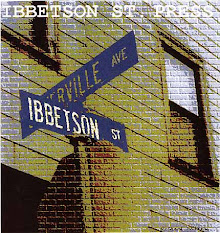
Saturday, July 07, 2007

GUD (greatest uncommon denominator) Autumn 2007


GUD (greatest uncommon denominator)
Issue 1 – Autumn 2007
USD $10
Instigator: Sue Miller
Editors: Julia Bernd, Sal Coraccio, Kaolin Fire, Sue Miller
Pages: 198

This is a dark, wicked, futuristic, funny, brilliant and up/down collection of literature. Some of it pissed me off a bit. I looked up the author of Max Velocity, and, surprised to find she was a female, realized she’d also been anthologized in an L. Ron Hubbard collection so…. Okay then. Now, it’s just I don’t really dig a scenario of no birth control and girlfriends being buried in the earth to undergo labor and having tuberic flesh-eating children. I try not to be judgmental, but a buzzer goes off in me, like, uh if there’s no point to this, isn’t it a bit dangerously misogynistic? But, then, maybe I’m not visionary enough to apprehend the true sci-fi sorcery involved. And that’s cool. It’s cool because the rest of this journal is pretty awesome. And that story was well-written and engrossing. The picture of a female torso growing branches which introduced it, made for a perfect epigraph.

I also grimaced when, at the end of Steve Dines’ “Unzipped” the Iraq War Vet loses his shit completely and smashes a mirror into the face of his well-meaning, stand-by-your-man girlfriend. I got the gritty sarcasm and post traumatic stress disordered telling of Humpty Dumpty dismantled and tortured which he read to his five year old. Again, though, it’s just the violence so exquisitely and bloodlessly drawn that kind of shakes me up these days. I appreciated the long interior monologue which the avenging vet had leading up to his final moments in a park going pervert on a kid as his woman lay in a hospital bed all scarred up. That’s the War. And that is, I’m sure, no exaggeration in some cases. It’s haunting and reflective of how military violence really does warp a soldier’s psyche.

The writing is superb. And these rather grisly tales are kind of exceptions in a sophomore strike that is even better than the journal’s debut. It’s more daring, more surreal and probably more sci-fi. It seems that in almost every case, we’re treated to a tale of life and death, fantasy and fable, reality and hyper-dream. The male violence stories can be balanced thematically against other works in which women are the mysterious and commanding witches, as in “Women of the Doll” – probably my favorite. Or the bonding that develops in an unexpectedly theatrical situation in “Aliens” by Jordan E. Rosenfeld that takes place in an Arizona organic food restaurant when one waitress is fired and the other reveals her fake sexy Russian identity to be one of many shifting personas she dons for fun and transformation. The two dance in front of mirrors in a shack filled with various outfits and wigs.

While I have a feeling that “Arrow” by Nadine Darling will be the popular fave of this collection – how do I guess this – well, my psychic voices and several friends thought so – and it is a genius hilarious conceit to have a woman pierced in the heart by an arrow she can’t remove but that also doesn’t kill her… I like “Women of the Doll.” For me, it would be a perfect short film. It is difficult to handle the subject of the supernatural with deft and earnest detail so it really seems imaginable and also incredibly out of the world, but Nisi Shawl manages to invent such a world. A woman has consecrated her life to the protection of a magical doll named Viola who comes to life on an altar and demand flowers at night and food, and lovingly calls her Auntie Josette. Auntie Josette is a pagan witch who moves from hotel to hotel with a missionary’s focus. Between her beautiful bathing concoctions and invocations, she finds men who desire her physically and then seduces them into contributing to the Doll fund. It’s a story of a woman who’s been abused and is now protected by psychic visions and witchcraft. The doll, Viola, represents a child, a dream-creature, a manifestation of female power. And I suppose, on the other side, Josette, has forfeited the usual comforts of monogamy to care for something that could become a burden, and danger, except for her pure love for the doll.

The poetry sprinkled in Issue 1 is also fine, to mention a few, Sisyphus of the Staircase, by Cami Park – a variation on the Greek myth, Tim Gager’s Your personal Ground Zero (for Franz Wright), and Catholic Girls by Kenneth Clark, among my favorites. The artwork is also special and mythical, befitting a journal with a cover sporting the stained glass Celtic Salmon of creativity.

It is a collection that has weirdness, beauty and excellence peopled by rabid robots, animated dolls, arrow-struck humans, fearless artists, crushed war veterans and wacky waitresses. It is also a cutting edge tribute to fiction as a form and to language as transcendence.

Lo Galluccio
Ibbetson St. Press

Thursday, July 05, 2007

d.a. levy & the mimeograph revolution


_________________________________________________


d.a. levy & the mimeograph revolution

Edited by: Larry Smith & Ingrid Swanberg

Bottom Dog Press

P.O. Box 425

Huron, Ohio 44839

Price: $25 / 264 Pages


Review By: Charles P. Ries


A few months ago I asked Chris Harter, Editor/Publisher of Bathtub Gin who are some the pioneers in the small press movement. He said without a doubt one of them had to be the late d.a. levy of Cleveland, Ohio. This was the first time I had heard of d.a. levy. When levy shot himself in November of 1968, I was fourteen years old. With five older siblings who were all politically active, I was well aware of the Cultural Revolution that was unfolding around me: civil rights, the Viet Nam war, Woodstock….the counter culture. This moment in time was vividly brought back to life for me in the mimeo graph revolution. In his Editor’s Notes in the May-June 2007 Small Press Review, Len Fulton says that the mimeo graph revolution “is almost overwhelming in its reach and passion for its subject. It’s is sobering to think that one young person could accomplish to much in so short a time, while confronting torment from within – and genuine torments from without.” While I enjoyed reading levy’s poetry and seeing his visual art, what I found most compelling were the numerous interviews with him from this time period. They reminded me how ground breaking the free speech movement of the 1960’s was, and what a wonderful, diverse and passionate group of poets were at the forefront of this effort. If you love the small press, poetry, and the freedom of expression we all hold so dear, you must read this book.

The Endicott Review


The Endicott Review,
Vol.24, #1. Spring, 2007.
Edited by Ruth Henderson
4/yr; 80pp; School of Arts
and Sciences, Endicott College,
Beverly, Massachusetts 01915

The Endicott Review consists of creative work from the Endicott
community and friends. (p.1) Which sounds very limited/limiting. But it
ain't necessarily so.

Lots of top-drawer, supra-territorial, universal poets here. Like Harris
Gardner, who has a kick-in-the-shins poem that is one of the most effective
poems I've ever read on death and time: "Pedicures merely provide/short term temporal cures. /Nothing transient endures/past the mortician's lipstick
kiss. /what we live signs our faces, /little changes, though makeup makes it so."(p.78)

And the same goes for master-poet Doug Holder who has one of the
strangest (but on-target) poems he has ever written in this issue: “And he takes her
hand. /And walks into the room, /with all his reluctance, /and all its strange
allure. /And it will be a woman who he will trust. Who will teach/him the right
way, /as he drops his pants/and releases a fine and diffuse spray. (Mother
Leading Her Boy into the Ladies Room, p.27). One of those poems for midnight
meditations, right?

A great political poem "This is the Kind of World I Want to Live In" by
Joseph Cooney, all about the current global war-hate situation, a great
short-short story about simply being by Alex Hart, (Just Over the Horizon A Few
More Times), a deeply existentially-positive poem by Kathleen Kirk based on
William Blake's Jacob's Dream: "Life is a child's toy:/It keeps dripping
endlessly down/from heaven.//If you do it right." (Eternal Levity, p.38).


The art here, too, is top drawer, especially Harriet Henderson's
jump-out-at-you paintings of Haiti or wherever (no bio-data, no lowdown on origins),
Lydia Holt'ss cryptological patchwork portrait, Jen Rheume's bar-scene
photo-painting mixes.

I've got a couple little suggestions to the editor here. Don't confine
the mag to Endicott college students and friends, expand the bios, maybe even
put in some essays....and get the mag out into the big-time literary world.

Hugh Fox


*** Hugh Fox is a poet/archaeologist who has taught at Michigan State University since 1968. Author of 66 books, he is a major figure in the U.S. small press world, serving as editor of Ghost Dance: the International Quarterly of Experimental Poetry from 1968-1995.

Wednesday, July 04, 2007

The Somerville News Writers Festival Nov 2007


Well we have the lineup for The Somerville News Writers Festival for Nov.11, 2007


The Somerville News Witers Festival

Founders: Doug Holder http://authorsden.com/douglasholder/
Tim Gager http://timothygager.com

http://somervillenewswritersfestival.com


FICTION


Tom Perrotta http://www.tomperrotta.net/
Steve Almond http://www.stevenalmond.com/
Stephanie Gayle http://stephaniegayle.com/
Errol Uys http://erroluys.com/
Joe Ann Hart http://www.hachettebookgroupusa.com/authors/61/3724/index.html
Timothy Gager http://timothygager.com


IBBETSON STREET PRESS LIFETIME ACHIEVEMENT AWARD:


Robert Pinsky: http://www.poets.org/poet.php/prmPID/200


POETRY

Gloria Mindock http://wwwcervenabarvapress.com
Dainelle Legros Georges http://www.curbstone.org/ainterview.cfm?AuthID=123
Irene Koronas http://www.haikuhut.com/Irene%20Koronas.htm
Lo Galluccio http://www.logalluccio.com

Monday, July 02, 2007

Teaching Metaphors. Nate Graziano.


Teaching Metaphors. Nathan Graziano. ( sunnyoutside PO BOX 441429 Somerville, Mass. 02144) http://www.sunnyoutside.com

Sunnyoutside, a creative and prolific small press based in Somerville, Mass. has released a new book by poet Nate Graziano. Graziano is a mainstay of their list and for good reason. His work has the flashes of insight, irony, and humor as well as accessibility that makes for an engaging read. Graziano has been a high school English teacher since 1997 and has penned a book of poetry about his experiences. Graziano writes: “Teaching metaphors has literally taken me ten years to write. It is a mosaic of the students and colleagues I’ve worked with in the various schools I taught. These poems are not based solely on any individuals, rather they’re imaginative amalgams. These poems are also not a picturesque depiction of the world of education, but I hope they’re honest—good and bad.”

The book is divided into two sections: the “Student Body” and “The Faculty” I found “The Faculty” section the most compelling. Here Graziano captures the eccentrics, the burnouts, the ‘types” that we find in any faculty. In the poem “Burnout”, a gone-to-seed teacher brutalizes his students with his time-worn film strips and sepia-tinged pop quizzes that he has given to generations of students.

“The students’ heads drop to the desks
like metal balls down greased chutes,
etherized by The Burnout’s filmstrip
and the sustained beeps between frames.

A sedated voice from a scratchy recording
talks of Nero’s orders for matricide,
a question on the multiple-choice pop quiz
The Burnout will give following the filmstrip.
It’s the same quiz the students’ parents
took twenty years ago when they slept
through Western History with The Burnout,
the man rumored to keep a silver flask
beside the fiddle in his desk drawer.

And in “The Devastation of Donuts” Graziano views the cycles of the faculty of the school through donuts and his “glazed” and jaded eyes:

“On Fridays The Administration” springs/ for coffee and donuts in the Teacher’s Lounge/ Most of the Faculty attempts to attend/…despite the fact that most of our bodies/have been devastated by donuts/ The younger faculty slim and wrinkle-free, / and still brimming with college theory, / chocolate-gazed, unfazed… It wasn’t long ago I stood in fresh shoes./…I n those days, I was more forgiving of my frame/ before the donuts took hold,/ latched to my bones and refused to let go.”

Highly Recommended.

Sunday, July 01, 2007

"Poems to Go"


Amy Gumley, a Boston-based writer, contacted me recently. She has an interesting enterprise, "Poems-To-Go." Here is an article in the Boston Globe's Sidekick section:

More than words
By Bobby Hankinson

PoemsToGo.tv

There are certain moments in life that require us to create a memory with words. But since most of us don’t normally consider ourselves the next Shakespeare, putting feelings down on paper is enough to induce cold sweats. One could turn to mass-produced greeting cards, but those don’t always do the trick.

Boston-based writer Amy Gumley is here to help. And this time, it’s personal.

Her site, PoemsToGo.tv, provides personalized poetry and speeches for every occasion — weddings, anniversaries, birthdays, even memorials. Poems and speeches are e-mailed or mailed on stationery within four business days, though customers can have their materials rushed to them in 24 hours for a little extra.

Users specify if they want a customized poem, toast, or speech (from three to five minutes). Then they are e-mailed a list of questions to give the writer a better idea of the personal details to include. The bridal-shower poem questionnaire we looked over was like a game of 20 questions, inquiring about the bride’s characteristics, occupation, favorite foods, and relationship with her fiance.

Gumley used to write greeting cards for an online company. Inspired by her father’s entrepreneurship, she started the business in 2001 with help from her husband, a computer consultant. She now employs seven freelancers from all over the world.

Poems cost $64.95 and candle-lighting poems (for up to 15 candles) are $199.95. A one-minute toast is $99.95; three-to-five-minute speeches run from $149.95 to $249.95.

We think the prices are well worth it to avoid crafting a speech that’s remembered for all the wrong reasons.

Saturday, June 30, 2007

Somerville Poet Taylor Stoehr Participates in “Politics, Writing, and Publishing” panel at U/Mass Boston.


Somerville Poet Taylor Stoehr Participates in “Politics, Writing, and Publishing” panel at U/Mass Boston.

Every June the William Joiner Writers’ workshop convenes at U/Mass Boston for two weeks of workshops, seminars, and panel discussions. I attended the Workshop in 2000 to 2001 and I found it an invaluable experience for anyone interested in enriching his writing life and the practice of his or her craft. Michael Sullivan, the coordinator for the Workshop, and a native Somervillian invited me back to participate on a small press publishing panel, and to attend a panel discussion on politics,writing and publishing.

The “Politics, Writing and Publishing” panel met at the Harbor Art Gallery on the windswept U/Mass campus. The participants were Taylor Stoehr, Demetria Martinez, Bob Nichols, and Lady Borton.

Taylor Stoehr has taught at U/Mass Boston for many years and has a long and accomplished history of publication, translation and activism. His most recent book of ancient Chinese poetry translation: “I Hear My Gate Slam…”was featured recently in the “Lyrical Somerville” column in The Somerville News.

Stoehr feels that the current climate of the publishing industry is less than friendly towards political writing. Even if political writing with a historical context gets out there, there is so much “swamping” in the industry that a book of this nature would be lost in a slush pile of commercial books. Stoehr said: “TV has literally wiped out history.” The industry is interested in books that will make the most money. He feels the political and historical writers of today must like the great Russian writer Tolstoy; make their work come to life to appeal to a wider readership. Tolstoy, according to Stoehr, effectively used the common solider in his fiction to reach a universal audience. In his own class Stoehr tries to take current events and relate them to historical precedents in order to light a fire under his student charges. Stoehr feels that by giving history more a sense of immediacy, this genre of writing has a better chance to flourish.

Lady Borton, a noted translator, feels that “point of view” is very important in political writing. She told the audience the longer she is in a country she is writing about, the less she realizes she knows. Borton for the last ten years has been involved with editing an anthology of Vietnamese poetry “Defiant Muse” The book is to be released by both American and Vietnamese publishing houses, and is translated by Vietnamese Americans. The involvement of indigenous people is essential for the “point of view” and thusly for the spirit of the work to come across, she feels.

Most of the panelists agreed that to some extent or the other everybody is a political writer. If you live in a comfort zone like the suburbs, your writing tends to be more personal than political. The more comfortable the reader is the less likely he is going to read something that breaks convention. Breaking convention is what good political writing does. Publishers for the most part don’t want to take a chance, and that means an almost certain death for the hopeful political poets and writers out there.

Wednesday, June 20, 2007

Drive-ins, Gas Stations, The Bright Motels. Wendy Drexler

Drive-ins, Gas Stations, The Bright Motels. Wendy Drexler. (Pudding House Press 81 Shadymere Lane Columbus, Ohio 43213) http://puddinghouse.com


Belmont, Mass. poet Wendy Drexler has a new poetry collection out with the prolific small press “Pudding House” of Columbus, Ohio. Many of these poems deal with Drexler’s childhood, and the poet has a knack for getting into the head of the child she was through an authentic voice. In the poem “At The Drive-In-I Ask My Father About Sex” the young Drexler has an awakening sexual curiosity, and her queries are answered bluntly but right –on- the- money by her Dad. His answers literally make her flee to the ladies room:

“… At intermission I ask him, you know,
where babies come from. He tells me

there’s another hole that’s not
for peeing where the penis goes in

and where the baby comes out.
I want to see. I run to the ladies room,

lock myself into a stall, brace my knees
against the back of the door.

The floodlights go out and the speakers
crackle tin again. I creep past

the couples in their parked cars.
My gum loses its jolt on my tongue.

My father is generous
with his ladle of small talk.”

The poem “Western Motel” was written in tribute to the painter Edward Hopper. Drexler, like Hopper works with light with striking effects. Here she describes a signature Hopperesque woman, tightly wound and introspective (in Hooper’s painting) residing in a nondescript hotel room looking vacantly out her window to the landscape. Here the poet wishes the painter might have painted her with a different sensibility.


“Let her hair tangle and go wild.
If sunset paint her, let moonlight spill.
Everything is right beyond her vision—

rough leaves, the pink chastity
of blossoms, the buds.

Recommended.

Doug Holder/ Ibbetson Update

Friday, June 15, 2007

Players in the Dream, Dreamers in the Play by Marian K. Shapiro

Players in the Dream, Dreamers in the Play ($14.95) (Plain View Press, P.O. 42255, Austin, TX 78704) plainviewpress.net

By Marian Kaplun Shapiro

Review by Pam Rosenblatt

At the first glance, Marian Kaplun Shapiro’s Players in the Dream, Dreamers in the Play can be viewed as filled with experimental poetry, fun innovative poetry linguistically speaking but not so easy to decode. And the first impression is pretty accurate. The 101 page poetry book contains poems that are visually interesting and aesthetic. Shapiro sculpts each poem as if a block of clay and makes it into a memorable experience. Enjambment, rhythm, lyrics, narratives, and meter are often used to make the reader question what message she is trying to get across and what form of experimental poetry she is using through her gentle flow of words, mixed in with caesuras and ever-changing syntax in her poetry.

Published in 2006, Shapiro’s Players in the Dream, Dreamers in the Play is made up of three parts. In this review, let’s concentrate on the visual poetry.

In Part 1: Hyphen, the book’s first section, Shapiro draws us into her world of experimental poetry with "Introduction" (p. 9), the opening poem consisting of one stanza with five short lines. The poem goes against ordinary train of thought. The poem reads:

I
kite
earth-sky
string pulled taut, exquisite
hyphen between mute boundaries.

What is Shapiro trying to get across? Immediately she has presented us with an experimental piece that becomes more abstract as the reader progresses. In only five lines, Shapiro has caught our interest but hasn’t made the start of the journey an easy read. It’s difficult to decipher, but not impossible. In the first line, the capitalized "I" is a strong and concrete word. In the second line, the lower case "kite" is a visual concrete item that the reader recalls from memory as getting visually smaller and more vulnerable in the sky. The hyphen between the "earth" and "sky" connects both of these words, creating a tension in the poem in the third line, thus leading into the fourth line which reads "string pulled taut, exquisite". Such must be the appearance of the "kite" with its "taut" thin "string" that the "I", or abstracted speaker, holds. The string acts as "hyphen between mute boundaries", or the silent but concrete "earth" and the quiet but sublime "sky", as cited in the fifth and last line in the poem. Our imagination has been set free to enjoy – and to work at – the Players in the Dream, Dreamers in the Play, created for the reader as well as Shapiro herself.

Throughout Part 1: Hyphen, Shapiro shows her more innovative poems, poems that are visually eye-catching, as seen in "Monkey Mind", which is a work of art.

In "Monkey Mind"(p. 10), she goes against traditional syntax, capitalizing on meter, repetition, and rhythm. And her uses of caesuras are very effective, as seen in the first section of the poem which is copied below:

rising
falling
rising wedding
falling
later rising e-mail
falling
rising
what if falling rain
rising
falling
rising
rising
falling
rising lunch

Through imagination and innovation, Shapiro has experimented with language and captured the readers interest through the poem’s unusual form, use of syllable which, when read, actually gives a sense of "falling" and "rising". The reader can almost visualize the "rain" coming down and moving up. The reader gets a feeling of gaining and losing through the up and down of the syllables in the two words "rising" and "falling". Also, Shapiro has effectively used white space as a background for this open form poem.

Shapiro’s poem, "Pure Love" (p.92) is found in Part 3: and, the last section of the book. Dedicated to her grandfather, Edward (Issak) Kaplun, who lived from April 18, 1880 to May 31, 1955, she once again demonstrates her witty, playful, and imaginative ability to use words and make them into a visual poem that goes against traditional poetic form. Through manipulation of caesuras and active, concrete word imagery and repetition of individual letters like "sssssssssss’s" and "mmmmmmmmm’s and nnnnnnnnnnnnn’s", Shapiro makes the reader smile and appreciate her abstract, creative piece which, at the end of the poem, or "On the other side of the invisible world / where we are both perfect, / where you live/ /and where you love me from" shows that the abstracted speaker is curious but secure in the afterworld where her grandfather and she will again meet.

Repetition plays a major part in "Ellipses" (p. 99), the second to last poem in Part 3: and. This poem is about a break up between two lovers. Here Shapiro seems to try to explain allegorically why she doesn’t follow traditional poetic form in this and other poems, emphasized with the repeated use of ellipses through the fragmented phrases, when she writes,

you know how it is…
because, after all… considering…
well, of course… …in those days
not that he meant anything by it…
better to forgive and forget…

On one hand, the speaker is giving excuses about the dissolved relationship, while, at the same time, on the other hand, Shapiro seems to apologize for her method of dissolving sentences, making open form poetry that is visually sublime. The speaker’s train of thought is almost like she is speaking to the reader, creating a one on one relationship.

Players in the Dream, Dreamers in the Play isn’t simply visual experimental poetry. It has socio-political poetry in it too, as seen in Part 2: Holding Truth Still, as in "September 11, 2001" (p. 48) and "Strange Meeting" (p.47). Some of the connotations of the words in the poems are so powerful and vivid that it’s difficult to read without feeling the speaker’s pain, as viewed in "September 11, 2001" when the speaker says,

…. Here
on earth we
need air. Peace
shatters in rainbow
storms of bloody
glass bullets
and severed hands. We
need water….

In this poem, through enjambment and concrete imagery, Shapiro has captured the cruelty of what happened on 9/11.

And in "Strange Meeting II", Shapiro writes, "Words,/ping off my shoulders / insist / around my head / set off short-circuits, storming every orifice. / Neurons fire, landmines in the blood. / This is a war, and I am afraid / You, true friend, become my enemy." In this contemporary poem, Shapiro shows a radical and visual poetic style through concrete imagery and sentence fragmentation, though in various degrees.

All in all, Marian Kaplun Shapiro’s Players in the Dream, Dreamers in the Play has proved herself to truly be a poet who is highly skilled in different forms of experimental poetry media. She is not afraid to experiment with language (especially words, meter, and rhythm) and form. And she has done so in a clever and effective manner.
###


Pam Rosenblatt/ Boston Area Small Press and Poetry Scene


Bibliography -- Online:

Barr, John. "American Poetry in the New Century". Poetry Magazine. June 9, 2007. pp. 1 - 7. .
"Experimental Poetry". Experimental poetry today. June 9, 2007. pp. 1 – 9.
"Experimental Poetry in Spain". Corner Magazine: Number Five / Fall 2001 – Spring 2002. June 10, 2007. pp. 1 - 26. .
"modernism". Answers.com. June 12, 2007. pp. 1 -12.
"Object Permanence magazine, 1994 -1997". Object Permanence, 1994-1997. pp. 1 – 4.
.
Munjal, Savi. "Method in Madness: A study if the Ex-centric Cubist Aesthetics of Pablo Picasso and Gertrude Stein". June 12, 2007. pp. 1 -17.
"Poetry". Poetry – MSN Encarta. June 11, 2007. pp. 1 -4. .
Retallack, Joan. "What is Experimental Poetry & Why Do We Need It?" Jacket 32. June 9, 2007. pp. 1 -13.
________________________________________________________________________________

Bibliography -- Books

Kinzie, Mary. A Poet's Guide to Poetry. Chicago: The University of Chicago Press, 1999. pp. 47, 90 -92, 382, 459, 468.
Raffel, Burton. How to Read A Poem. New York: Penguin Books, 1983. pp. 236.
Timpane, John, PhD. With Maureen Watts. Poetry FOR DUMMIES. New York: Wiley Publishing, Inc., 2001. pp. 10, 30, 58 – 59, 160, 245.
Labels: Rosenblatt on Shapiro

Wednesday, June 13, 2007

"The Hunter's Trance: Nature,Spirit & Ecology." by Carl Von Essen


The Hunter’s Trance: Nature, Spirit, & Ecology Carl Von Essen. (http://www.lindisfarne.org/) ( Lindisfarne Books. 610 Main St. Great Barrington, Mass. 02130 $25.


Carl Von Essen writes in his book “The Hunter’s Trance: Nature, Spirit &Ecology” (Lindisfarne Books 2007) that since he was a child he was beguiled by the sight and sounds of nature. He realized the import of the natural world; the primal, spiritual and physical experience it brings to a life. Von Essen realized that he was not alone. Many people had ecstatic experiences in the wild, be they scientists, fishermen, or mountaineers. With an eye on the negative impact civilization has had on the environment Von Essen writes:

“A vision evolved that a spiritual bond with the natural world can be a potent path toward environmental healing. That vision, undoubtedly shared by many, has taken shape in this book.”

Von Essen, a retired oncologist wants to explore, “… the roads and byways of mystical experiences as they relate to our evolutionary, biological and psychological connection with nature.”

And indeed Von Essen does this and does this well. He uses liberal doses of poetry from Emerson, Longfellow, Whitman, and other poets, as well as the philosophical musings of William James, personal anecdotes about ecstatic experiences in the wild; not to mention hard research data from respected scientists, to illuminate his point.

Von Essen, ideally wants the reader to approach nature in a “Hunter’s Trance.” He writes:

“The hunter’s trance is a total mental and physical concentration whereby extraneous signals internal or external are quenched or diverted, enabling the psyche of the hunter to perceive his quarry and its world with a supernatural alertness. The merging of the world into the mind allows the subject to experience a comprehension that extends beyond the everyday dimensions of perception.’”

This is prudent advice considering all the “white” noise in this febrile world that keeps us from a true meditative sensibility.

Von Essen is a world class traveler and explorer with many exotic locales on his long resume. Provincial in my own travels, be it to a lack of funds, time or ambition; I couldn’t help but wonder if it was possible to experience some of what Von Essen experienced on a verdant part of Highland Ave. rather than the Himalayas.

Still the book is written in a very accessible manner, with very telling selections of poetry, philosophy, etc… In a way Von Essen mourns how far we have moved from our primitive selves, when we were not as divorced from nature as we find ourselves today. He quotes Wordsworth:

“For I have learned
To look on nature, not as in the hour
Of thoughtless youth, but hearing oftentimes
The still sad music of humanity,
Nor harsh or grating, though of ample power
To chasten and subdue. And I have felt a presence…

Whose dwelling is the light of setting suns,
And the round ocean and living air,
And the blue sky, and the mind of man;
A motion and a spirit, that impels
All thinking things, all objects of thought.
And rolls all things…

The guide, the guardian of my heart, and soul
Of all my moral being.”

Von Essen wants society to reconnect with the wonders of the natural world. He hopes when we realize what we have missed and what we will miss, then perhaps this will jumpstart us to stop the rapid destruction of our environment.

Doug Holder

self portrait drawn from many

TO ORDER: http://www.lulu.com/content/929148


New Poetry Collection From Irene Koronas


This is a new Ibbetson Press release from "Wilderness House Literary Review" poetry editor Irene Koronas :

self portrait
drawn from many
65 poems for 65 years

by
Irene Koronas


Irene receives the smallest whispers - a scrap of paper,
a single word, a passing impression and shows
us reflections of the infinite, the holy, the human.
Her writing evokes ancient dream-time meditations
only to return to the mundane details (polish
my toe nails) that bring us back to the particular,
the present. Her poems are peopled by all sorts
of characters; scholars, theologians, children, philosophers,
musicians, painters, gamblers, activists,
artists, monks, saints, lovers, fathers, mothers, and
on. Irene invites us, with this collection of poems,
to think about who we are in relation to others - to
see ourselves in many different shoes.
Ultimately it is an act of great empathy and great
imagination. These poems are never didactic, often
prophetic, always provocative.


- Jennifer Peace, Ph.D. / A founding board member of the United Religions Initiative.


IBBETSON STREET PRESS
25 SCHOOL STREET
SOMERVILLE, MA. 02143
617-628-2313

Tuesday, June 12, 2007

Boston Legend Jack Powers 70th Birthday

http://www.jackpowerspoet.blogspot.com
For Immediate Release: Legendary Boston Jack Powers Poet Celebrates 70th.

(Allston, Mass.) On Sept 15, 2007 at 5P.M at the International Community Church in Allston (30 Gordon St.) celebrated poet Jack Powers will celebrate his 70th birthday with a potluck dinner and reading.

Jack Powers is the founder of Boston’s legendary “Stone Soup Poets.” Founded in 1971 at the Charles Meeting House on Beacon Hill in Boston, Powers has lead this venue of readings, activism and publishing for well over thirty years. Powers was also influential in establishing the Beacon Hill Free School in the 1970’s, which encouraged people to teach and participate in educational courses for no charge.

Stone Soup Poets is almost as well known for its publishing history. Powers has published over 80 titles , including Powers’ personal favorite “Jack of Hearts,” by Lawrence Ferlinghetti. Powers has also published such poets under the Stone Soup imprint as the award-winning Franny Lindsay, and the late Black Mountain School poet John Wieners.

Powers has jumpstarted the careers of many well-known poets including the small press doyenne Lyn Lifshin. Folks like Beat bad boy Gregory Corso, Allen Ginsberg and Robert Bly have passed through Stone Soup’s poetic portal.

Stone Soup Poets has been housed for the last several years at the Out of the Blue Art Gallery in Cambridge, Mass. It meets every Monday at 8PM, and carries on the proud tradition with the help of poet Chad Parenteau.

The well-known Boston street artist and activist Sidewalk Sam, as well as Doug Holder of the Ibbetson Street Press, Rev. Lorraine Cleaves Anderson of the International Community Church, and Margaret Nairn president of Collaborative Artworks Inc, are organizing the celebration.
The reading and potluck dinner will have music provided by Boston -area poet and singer/songwriter Jennifer Matthews, as well as Powers’ sons.

All friends and acquaintances, and anyone who has been touched by Jack in his long literary outreach are invited to come. Bring a poem, a dish for the potluck, and a friend!

* For more information contact: Doug Holder 617-628-2313 dougholder@post.harvard.edu

Monday, June 11, 2007

Ibbetson 21 Release Reading and Reception

The Ibbetson 21 reading at McIntyre and Moore Books in Somerville was a success. Here are some pictures of the reading and at the Burren Pub after the reading. Photos courtesy of Gloria Mindock.


Publisher: Doug Holder


Barbara Bialick, Dianne Robitaille, Irene Koronas


Left to Right: Molly Lynn Watt, Marc Goldfinger


Dianne Robitaille/ Doug Holder


Deb Priestly, Doug Holder, Jim Resnick


Tam Lin Neville, Bert Stern

Review of Mad Hatter's Review by Daniel Y. Harris

Mad Hatters' Review: A Review of Issue #7

www.madhattersreview.com
Review by Daniel Y. Harris
www.danielyharris.com

Lewis Carroll, patron saint of the unsaintly and unpatronized, in bestowing such idiosyncratic mirth to the Hatter's position at the tea party, sets the parameters for Mad Hatters' Review and its Internet and Outernet world. Adorned with Carroll's 19th century vision of the demented hatter as "victim of mercury poisoning" (the poor, working-class hatter "worked with hot solutions of mercuric nitrate, in poorly ventilated rooms"), the Review makes contemporary and metaphorical the plight of the hatters, who suffered "neurological damage, resulting in such symptoms as tremors, slurred speech, irritability, and depression." This enfolding of legacy bestows Mad Hatters' Review with a new canon particularly interested, as publisher Carol Novack says,

"in edgy, experimental, gutsy, thematically broad (i.e., saying something about the world and its creatures), psychologically and philosophically sophisticated writings."

Issue #7 continues to endow this canon. Poets Joe Amato, Gunnar Benediktsson, Bob Marcacci, Sally Molini and Michael Neff are genes spliced from E.E. Cummings and some of his inventive and eloquent ancestors and progeny. Each contributor is granted a vibrant trove of visual and musical accompaniment, if s/he so chooses. Custom-made artworks are provided by staff and guest artists and composers, including (classical) Sandra Scheetz Wise, Quartetto Constanze & Jon Leifs, Suchoon Mo, (jazz) Benjamin Rush Miller, the versatile, melodic Guthrie Lowe, Steve Kane, Paul Toth, and fusion ace Benjamin Tyree. Stay for the mad multimedia spree, a unique experience in the expanding field of cyberitic publishing.
Gryphon, dormouse and dodo metaphorically abound in Mad Hatters' Fiction, Non-Fiction, Whatnots, Dramas and Audio Text Collages. Notables, among the fine work of Claire, Millas, Ratner, Wilson and Wuori, is Brandon Hobson, who retells Hellenistic Alexandria, illuminated by the epochocal art of Peter Schwartz. A King of Hearts (writer Kevin P. Keating) appears to wrestle with Kubricks's demons.
In case you've been beaten by love or have reified sex, pedagogic lessons to redeem erotic neurotics surface in Lynda Schor's "Sex for Beginners 2." Be not dismayed; the end is not near. Check out the Columns, Comics (including "The Perils of Patriotic Polly"), Contests, Galleries, Interviews, Site and Book Reviews, Video clips, and text and visual collages. Pay your nickel and the brilliant Don Bergland's "Mental Theater" comes with 1954 American cheese. You'll stay parked, neck, and miss the movie.
Before sleep, as the rabbit hastens to his black hole, Mad Hatters' Review probes Scottish talent in "Viva Caledonia." Featured artist Calum Colvin was born in Glasgow. It is well-worth perusing Colvin's phantasmagoric visual wit, as you extend your stay with fiction, poetry, and a play by the famous Alastair Gray, selected by associate editor Peter Robertson. Each issue includes a special section devoted to creations from a different part of the world.
Frontispiece "Lamb," by artist Camille Martin, exemplifies the Hatters' daemonic ethos, carried from the inaugural issue. The sublime and the agitated meld in these seven issues. Of note in prior issues: #6, the poems of acclaimed poets Meltzer and Rothenberg, the art of Lynn Schirmer, Art Director Tantra Bensko, associate art editors Peter Schwartz, X-8, and D.K. Macdonald, and the expressionistic art animations of Jean Detheux, who moves colors and primordial forms to music.
The Review's resolute spirit and determination to artfully exploit the expansive possibilities of Internet publishing and offer quality, inventive creations, is manifest in every issue of the journal.


Bio

Daniel Y. Harris, M.Div, is Adjunct Faculty of Holocaust and Genocide Studies at Sonoma State University. His poetry chapbook, Unio Mystica (2007), will be published by Cross-Cultural Communications. His recent publication credits include: Zeek, The Pedestal Magazine, Exquisite Corpse, In Posse Review, Mad Hatters’ Review, Sein und Werden, Poetry Salzburg Review, Poetry Magazine.com, Convergence, The Other Voices International Project, and The Denver Quarterly,. The Jewish Community Library of San Francisco, Market Street Gallery, The Euphrat Museum, The Center for Visual Arts and Dolly Fiterman Fine Arts are among his art exhibition credits. His website is www.danielyharris.com

Sunday, June 10, 2007

"We'll Buy A Purple House and Scream At The Trees"


“We’ll Buy A Purple House And Scream At The Trees.”

* for Dianne

At last
We will do it.
Create a garish home
In the middle
Of a block
Of studied sanity.
Seriously deform
The pro forma.
Smack on our
Lascivious saliva
One pointed finger
In each of our noses
The rest
A wave to
The prudent standards
Of decency.
Yes.
We will buy
A purple house
Scream to the open
Arms of the
Wind-swept trees…

And for once,
Do exactly--
What we
Please.

Wednesday, June 06, 2007

Three Geese In Flight Books Books Lands In Somerville


THREE GEESE IN FLIGHT BOOKS LANDS IN SOMERVILLE

By Doug Holder

While driving down Elm Street on a hot June day, I noticed three geese in flight… No, not our honking avian friends, but a new bookstore with the intriguing name “Three Geese in Flight Books.” The store located just down the block from the Porter Square Shopping Center specializes in Arthurian and Celtic Literature. Arthurian literature for the uninformed concerns anything to do with the legend of King Arthur; very specialized indeed.

However Jean McKeown, the genial manager of the said enterprise explains that the bookstore will have an ample supply of general books, as well as books about Native Americans, the Revolutionary War, etc… But one thing you won’t find in the store are new books. This is a venue with a decidedly antiquarian sensibility.

The owner Samuel Wenger is from Kingston, N.Y. where he ran a bookstore for over thirty years. He holds a B.A. in Celtic Studies, and has been focused and passionate with this arcane nook of the book business. It seems, according to McKeown that Wenger feels the intellectual and bookish climate of Somerville, and his connections to the Harvard University Celtic Studies Dept., will make his store a success.

The store is slated to open this month. McKeown feels that there is a crying need for a new bookstore in the area, in light of all the closings of small independent bookstores.

McKeown and Wenger are not early risers, so they figure the store will be open late mornings to the evening hours. In any case I wish anyone trying to make-a-go of it in the book business—hearty good luck!


* The store is located at 55 Elm St. in Somerville. http://www.threegeeseinflight.com/

Tuesday, June 05, 2007

Interview with Dan Sklar


Poet Dan Sklar: Author of “Hack Writer” is no “Hack”

Poet Dan Sklar seems to be a man who enjoys life. He is not a brooding, booze-swilling tortured artist, but a middle-aged man with an engaging smile, and an unabashed love for the written word. Sklar, the author of the poetry collection “Hack Writer” is the head of Creative Writing at Endicott College in Beverly, Mass, the faculty editor of the undergraduate literary magazine “The Endicott Review,” a published poet, playwright, and kibitzer of the first order. Sklar’s poetry has appeared in the “Harvard Review,” “Ibbetson Street” and many small press journals. Sklar is a great admirer of little magazines, and uses them as a teaching tool in his classes at the college.
I talked with Sklar on my Somerville Community Access TV program: “Poet to Poet: Writer to Writer:”

Doug Holder: Dan being a small press freak myself, I am impressed by use of small press journals in the classroom. What’s the method behind your madness?

Dan Sklar: I think that students really do better when they read poems from people who are alive. There is an urgency there—a real life urgency. They say: “Hey—I know what that person is talking about.” I mean they dig Walt Whitman and Charles Bukowski, but as Gertrude Stein said “the contemporary is the thing.’ What’s happening in our time—that’s what I like to use. There so many gems out there that someday will be classics.

DH: What do you read?

DS: I read every small press magazine I get. I read mostly small press magazines, but yes, I do read “The New Yorker.”

DH: Any favorite small press journals:

DS: I like the “Main St. Rag,” and “Free Verse.”

DH: You have ambitions for an MFA program at Endicott College. You say you want it “non-competitive.” What do you mean by that?

DS: It’s interesting. Many of these MFA programs say: “highly competitive.” The students are competing against themselves. Our feeling is that students write better when they feel safe. You feel safe to express yourself. You take more risks. You don’t have to best the other guy.

DH: You know how brutal workshops can be. How will you foster constructive, supportive criticism?

DS: Someone who is serious about writing will come to it on their own, without me saying anything. The more they read, etc… it will come to pass. I have had students come to me with these poems—and they are bad. They are full of clichés and sentimental. Do you know how many poems end with: “I will love you forever!” With these people, I talk with them and see how serious they are. If they are serious I’ll tell them to take a writing class. I never criticize. Instead of that I ask them to get into details, description etc… If I criticize them too much they will become guarded.

DH: You write that your playwrighting style is in the “Absurdist” school. Explain.

DS: I like characters to be so quirky. I want them to say what they are thinking and feeling at the moment. I am not worried about what goes along with the plot. The characters have to be “characters.” I let the characters be who they fully are. But not ordinary.

The plots always turn out absurd. But they start out ordinary. There are so many plots. But my concern is to have the characters fully imagined.

DH: In your poem “Something to be a Hack” from your collection “Hack Writer” you use the sight of your son putting your manuscript on a shelf to give the reader an insight into your philosophy of your writing life.

DS: I’m not sure why I write. I’m not doing it for fame. I am doing it because I am compelled to do it. I didn’t know where I was going with that poem—I just saw my son stacking manuscripts.

DH: Can you talk about the art/expansion at Endicott, particularly the college’s affiliation with “the new renaissance” lit mag?

DS: When you approached me about a home for tnr at Endicott, I thought it sounded great—not much chance—but I thought I would try. “the new renaissance” is a wonderful, eclectic magazine. It is a magazine that has art, covers politics, and presents poetry.

DH: And the new Arts Center?

DS: Yes a new, big center for the arts is in the making. It will include a Black Box theatre, art studios, high tech publishing workshops, you name it...

Doug Holder

Saturday, June 02, 2007

Ibbetson Street Press Poetry Award


IBBETSON STREET PRESS POETRY AWARD


The Ibbetson Street Press Poetry Award is presented at the annual Somerville News Writers Festival (http://somervillenewswritersfestival.com/ ) held every year at the Jimmy Tingle Off-Broadway Theatre in Davis Square. The festival will be held November 11th this year. In past years poets and writers such as Pulitzer Prize winner Franz Wright, Robert Olen Butler, Oscar-nominated novelist Tom Perotta, Iowa Writer’s Workshop head Lan Samantha Chang, Sue Miller ( author of “The Good Mother”) , Steve Almond, Boston Globe Columnist Alex Beam, poet Nick Flynn, and many others have read in this event. This year former poet/laureate Robert Pinsky will be receiving the Lifetime Achievement award.

Ibbetson Street Press is also pleased to announce the 2nd annual Ibbetson Street Poetry Contest.

The winner of the Ibbetson Street Press Poetry Contest award (must be a Massachusetts resident) will receive a $100 cash award, a framed certificate, publication in the literary journal “Ibbetson Street” http://ibbetsonpress.com/ and a poetry feature in the “Lyrical Somerville,” in The Somerville News.

To enter send 3 to 5 poems, any genre, length, to Doug Holder 25 School St. Somerville, Mass. 02143. Entry fee is $10. Cash or check only. Make payable to “Ibbetson Street Press” or “Doug Holder. Deadline: Sept 15, 2007

The contest will be judged by Richard Wilhelm http://richardwilhelm.blogspot.com/ poet and arts/editor of the Ibbetson Street Press.

The winner will be announced at the festival, and will receive his or her award. A runner up will be announced as well.

Friday, June 01, 2007

Tino Villanueva: A Chicano poet with an eye in many worlds...


Tino Villanueva: A Chicano poet with an eye on many worlds…

Tino Villanueva is a Chicano writer who according to celebrated poet Martin Espada invented (along with Gary Soto), a new genre of poetry. Espada opines that Villanueva conceived: “…serious literature about farm workers. That in itself guarantees Tino a place in literary history.” Villanueva, who earned a PhD in Spanish Literature, and is a professor at Boston University, does not however live in a literary ghetto of Latino literature. Reginald Gibbons, former editor of Tri- Quarterly magazine wrote that Villanueva has: “… found a way, to write of both worlds (Chicano and Anglo) that makes sense, I believe to all readers, even those who might be interested in one of those worlds or the other.”

Villanueva has received a 1994 American Book Award for “Scene for the Movie Giant,” and has penned a number of books, including: “Primera Causa/ First Cause,’ “Shaking off the Dark,” and others. He also edited the literary magazine: “Imagine: International Chicano Poetry Journal.”

I talked with Villanueva on my Somerville Cable Access TV show: “Poet to Poet/Writer to Writer.”

Doug Holder: What is your experience with political poetry? Do you feel it gets mired in dogma?

Tino Villanueva: It’s not an easy genre to write in. I’m very wary about it. And I often think what Pablo Neruda said about political poetry. His warning to a young poet was not to begin writing political poetry until he mastered what poetry “is.”
When you start out you think what you write is poetry but it is sloganeering or just propaganda. What Neruda says is politics as well as love, and I would add religion, are three major things that if you want to write about them, you have to “pass through.” You have to have experience in technique and know what poetry is. You may think you are writing a love poem, but it is just gushy, saccarhine and sentimental.

DH: Were you an “angry young poet?”

TV: I was born in Texas in 1941. I went into the Service. I served in Panama. When I was a freshman in college I was 24 years old. I graduated in three years. I went to college on the G.I. Bill. When I started writing poetry I felt true love for the poetry of Dylan Thomas. If he was writing about birth and death then that was what I was writing about. He became my mentor. I wanted to sound like him…he had a great voice. He was a marvelous reader.

Later I became part of the Chicano Movement on campus. We had a Latino Civil Rights Movement from 1965 to 1975. So my poems from this period may show anger. Those types of poems are in my first book that came out in 1972. They were mostly written as an undergraduate and in graduate school.
DH: Are you embarrassed by these early poems?

TV: There are one or two poems that are salvageable. Some poems I don’t bother reading. With many of the poems I tried to sound like Dylan Thomas. It was important work in that I learned discipline and how to say what I wanted to say. It took me 12 years to write the next book.

DH: In an article in the Texas Observer it states that your poetry has echoes of French Existentialism, where you insist on the possibilities of creating oneself through choice and will. What have you created?

TV: I don’t know what the critic meant there. There are some poems in my last three books that show a transformation of a young man struggling out of a disadvantaged background and making something out of himself. He first wanted to be a baseball player because he thought he had a good curve ball. But the scouts never came. He had no idea back then that he would become a poet. But he would save himself that way.

So in my last two books there are several poems that make reference to this transformation. It is making something out of yourself through sheer will.

So in my last two books there are several poems that make reference to this transformation. Making something out of yourself through sheer will.

DH: In a poem of yours you wrote: “I write. I stop writing. I write.” Is this your definition of the writing life?

TV: When you are hitting it right, yes. When the muse is with you, when the inspiration is with you—those are the moments you have to take advantage of. You hit some dry spots, but you have to get out of it.

DH: What do you do to get out of writer’s block?

TV: Well language produces language. I turn on the radio, even if it is a soap opera. I’ll pick up a newspaper. I might hear something that snaps me out of it—a particular turn of phrase. Sometimes I will pick up a book by Ashbery, Elizabeth Bishop, and read work that inspires me.


DH: You are a very accomplished and learned man. Yet you still take courses at the Boston Center for Adult Education, and attend groups like the “Bagel Bards,” a group of poets that meet at the local Au Bon Pain.

TV: I am always learning something. Intelligent talk always helps me write or snap out of a block.

DH: Do you write in cafes?

TV: I am not a café sitter. When I am in Barcelona or Madrid, but not Boston.

DH: Is writing natural or “organic” for you?

TV: I’ll quote from James Dickey: “We all have ideas about what we want to write about. It takes 10% inspiration and 90% perspiration.” We’ll, you have ideas I am sure—you have to figure out how to express them—you have to figure out how you are going to transfer it on the page. What kind of images you are going to present? I am full of ideas but I have to find the words. I have to work to find the words. It is not easy.

DH: How was it being a Latino-American in the Academy?

TV: Well I had no role models. I was treated well in Buffalo and Boston. I felt welcomed. At Wellesley College I taught the first Chicano Lit. course in 1978.

Thursday, May 31, 2007

THE BAGEL BARDS


THE BAGEL BARDS: A GROUP SHOT
( Click on to enlarge)
Join us at the the Au Bon Pain in Davis Square at 9AM every other Saturday, and Central Square Au Bon Pain-the other Saturday.
June 2: Central Square-- Au Bon Pain
June 9: Davis Square-- Au Bon Pain-- and so on..
Come and go as you please...very informal.
An informal group of poets and writers ... all welcome. Chat, network, get published, make new friends...

Wednesday, May 30, 2007

FOR SARAH ( a poem in memory of Sarah Hannah)

Sarah Hannah


I got this poem from Ibbetson Street poet Ruth Sabath Rosenthal. Ruth was a student of Sarah's when she lived in
New York City, and they kept in touch when Sarah moved back to the Boston- area.


FOR SARAH.

My friend, mine is a beating heart,
a poem bursting to come forth;
yours has stopped. No dormancy
of writer's block. Stopped for good.

O, that yours would still beat out poems.
No matter how dark, we'd listen,
we'd learn, we'd understand & maybe
you'd be here now. Perhaps

a Sonnet with its turn moving to depths
of utter bleakness, assonance resounding
in the second stanza. No resolution fit
for dreamy eyes to rest upon.

Blank verse, rhyme-riddled with
syllabic runs, each iambic line
symbolic unto itself, each stanza break,
a whip crack, a heart breaking.

A Villanelle, whose repeating end-
rhymed lines bleed their way down
to a finale punctuated by a question
mark & dead silence.

A Sestina of razor-sharp repitition
echoing the i in cry. A lament that pierces
through stanza upon stanza, until
reaching biblical heights of irony.

O. that we'd hear more from you. No
matter how dark the sound, we'd listen,
we'd learn, we'd understand & maybe
you'd be here now.

Ruth Sabath Rosenthal -

Tuesday, May 29, 2007

Poet Sarah Hannah Has Passed.

http://www.writersartists.net/shannah.htm


Poet Sarah Hannah Has Passed.

Poet Sarah Hannah, Emerson College instructor and author of “Longing Distance” has passed away. Hannah reportedly committed suicide.

A Newton, Mass. native, she held a PhD. From Columbia University. I had the pleasure to know her, interview her, book her for readings, and publish her in issue 20 of the Ibbetson Street Press. She was a striking woman, wore a nose ring, played the bass in a rock band, and had a brilliant poetic talent.

Ironically she sent me an article she wrote on the poetry of Sylvia Plath; who met the same fate. She said her next book of poetry was to deal with the mental illness of her mother. Tupelo Press is publishing the collection, and it was due out in the next several months. I had booked her for The Somerville News Writers Festival, and she asked me to help book her for a reading at McLean Hospital, which I was close to doing. I sent her an email last week. I was told that she killed herself last week. She was only in her early 40’s. I know her high school teacher. She seemed so happy. Her star was rising. She had been through a divorce. She had everything to live for. I have only clichés. I am sorry. I have worked at McLean Hospital for 25 years, but I am not immune to this. May she rest in peace.

The family is having a private memorial. There will be a public memorial at Emerson College in the fall.

I conducted this interview with Sarah a year ago:
Boston Area Small Press and Poetry Scene

Interview with poet Sarah Hannah: A Poet within “Longing Distance”

Sarah Hannah is an educator, a poet with a PhD from Columbia University, and a sometimes rock musician. Her poems have appeared in “Barrow Street,” “Parnassus,” “Gulf Coast,” “Crab Orchard Review,” and others. Her original manuscript, which became her first poetry collection “Longing Distance,” was a semi-finalist for the “Yale Younger Poets Prize,” in 2002. Anne Dillard describes her collection as: “…an extremely moving work. I’m struck by her intelligence of emotion and her unmistakable voice…Sarah Hannah is a true original.” She currently resides with her husband in Cambridge and teaches at Emerson College in Boston. She was a guest on my Somerville Community Access TV show “Poet to Poet/Writer to Writer.

”Doug Holder: Can you tell us about the “Yale Younger Poets Prize” which “Longing Distance,” was a semi-finalist for?

Sarah Hannah: That was a sort of near miss. That was in 2002. That was the year Tupelo Press accepted my book. I found out I was a runner up by phoning the editor, (not the judge) who was W.S. Merwin. The editor told me he remembered the book, and it was a semi-finalist, and it was a strong book.

Doug Holder: A lot of folks claim a PhD can ruin a poet. You learn how to write academic papers, but you forget how to write poetry. This does not seem to be the case with you.

Sarah Hannah: It ruined me in the sense that while I was writing my dissertation, I felt that I didn’t have time to write poetry. But I think the PhD made me a better poet. It forced me to really study poetry deeply. You have to grapple with ideas that are foreign to you. You read more than just contemporary poets. You learn to become a better writer.Some people become sidetracked. They go into a PhD program and they emerge as critics not poets. There are more people around than you think that are poets and scholars.

Doug Holder: How did you come up with the title for your collection “Longing Distance?”

Sarah Hannah: I was writing a series of sonnets about a messed up love affair. You know “absence makes the heart grow fonder,” an all those clichés. So I came up with a line while I was in the country watching my husband scale a rock. I thought of the line: “I keep you at longing distance.” I thought it was just going to be another sonnet in the sequence. I wrote the sonnet, but then wound up expunging it from the book. I kept “Longing Distance,’ as the title.

Doug Holder: From our email exchanges I get the impression you haven’t had an easy life.

Sarah Hannah: I lived a hardscrabble life. I’ve seen life disintegrate. I wanted to put back my experiences in more metaphysical or formal terms.I grew up in Newton, Mass., in the Waban section. A lot of neurosis going on there. I would say seven out of my eight high school friends were bulimic. I was not. My mother was hospitalized at the same “summer hotel” Anne Sexton visited.

Doug Holder: How does your teaching at Emerson College fit with your poetry?

Sarah Hannah: It’s fitting beautifully because I am teaching poetry, as opposed to composition. I am teaching traditional form to graduate and undergraduate students. I teach a hybrid literature and writing course.

Doug Holder: Why did you move from the bright lights and big city of New York to the more provincial environs of Boston?

Sarah Hannah: I am a lover of the underdog. Boston is the underdog to New York. I felt I had to come back. You know: “My end is my beginning, my beginning my end.” I have always missed Boston. I am a loyal person that way. My husband and I purchased a house in Cambridge. It’s right in the Central Square area. It’s a very diverse city. I often write at the ‘1369” Coffee Shop or ‘Grendel’s Den,” in Harvard Square. I feel rooted here.

Doug Holder: How does the lit scene here compare to the “Big Apple?”

Sarah Hannah: There are a lot of readings here like N.Y. I lived in N.Y. for 17 years. It took me 8 years to get “out” there. It seems much faster out here. I have a book though, that makes a difference. I was worried. It took a long time for me to establish myself in New York City. But I didn’t loose my contacts because I maintained my connection to the journal “Barrow Street,” and now I am an editor there.”

Monday, May 28, 2007

Endicott College: A Hub for the Arts on the North Shore


Endicott College: A Hub for the Arts on the North Shore

By Doug Holder

If someone is artistically inclined, and he or she drives out to the campus of Endicott College in Beverly, Mass., they may very well be tempted to paint a picture or compose a poem. The stately old New England homes, the breathtaking view of Beverly Harbor, the waft of a bracing sea breeze, certainly can conjure up the muse. So it makes sense that Endicott College is focused on bringing on an ambitious program in the arts and writing to its hallowed halls.

Endicott College was founded in 1939 by Dr. Eleanor Tupper and her husband Dr. George O. Bierke, with the idea, (according to the official Endicott history):

“to educate women for greater independence professionally and socially.” Endicott then and now offers a solid classroom experience, as well as a link to the outside work-a-day world through a recognized internship program. From just 20 students in 1941, there are now over 1,800 daytime undergraduates, as well as 1100 adult students in graduate and professional studies programs. This along with a 230 acre, well-appointed estate, completes a very pleasing picture.

But Endicott’s ambitions have not stopped here. Dr. Peter Eden, the new Dean of Arts and Sciences, has a PhD in Microbiology, but is very interested in delivering a complete package for a liberal arts institution such as Endicott College. To this end he has worked with Chairman of the Humanities Dr. Mark Herlihy, and Creative Writing professor Dr. Dan Sklar, to affiliate the college with the prestigious journal of arts and ideas, “the new renaissance.” Headed by Louise Reynolds, the magazine has an illustrious history of presenting the best poetry, fiction, and articles of pressing social concern to a national and international audience. A new office has been set up, and students will intern with the magazine and learn the essentials of writing, reviewing, and what it takes to put out a quality journal.

Mark Herlihy feels that the connection with “the new renaissance”, and the recent creation of the Creative Writing program, can only bolster the liberal arts education. Herlihy says of “the new renaissance:”

“The college’s affiliation connects the college to a broad network of poets, artists, and writers in New England and beyond.”

Dan Sklar, who initially approached Peter Eden and Mark Herlihy with the idea for a residency for “the new renaissance,” is a dyed-in-the-wool published poet, and playwright, who tries to connect the literary world to the academic. In classes he is noted for his use of the work of living writers and poetry from small press journals. He has ambitions for an MFA in Creative Writing at Endicott College, if things go well. Sklar told the NEWS:

“Creative writing is grounded in the love of language, and writing in a natural, spontaneous, and expressive and open way. We feel there is a deep connection between the arts, literature and history as an inspirational light in one’s growth as an artist. The MFA is an extension of this philosophy. Our vision of the MFA is also one that is noncompetitive where students become part of a community of writers who are inspired by the world, everyday life, each other’s work, and by the things we see, and the art we see…”

Mark Herlihy also told the NEWS that the undergraduate literary magazine the “Endicott Review,” (that Dan Sklar is faculty advisor for)), had a poem in “The Best American Poetry 2006” edited by the former poet/Laureate Billy Collins. The college has also added to the faculty Charlotte Gordon, author of “Mistress Bradstreet: The Untold Story of America’s First Poet,” which won a Massachusetts Book Award.

Endicott is also expanding on another front as well. Mark Towner, Dean of the Fine Arts School of Art and Design, says that the Board of Trustees of the college authorized the construction of a 70,000 square foot Center for Visual and Performing Arts at the College. The design will be completed June 15, and construction should begin on July 1, 2007. Towner adds that:

“The new facility will support the visual arts by providing state-of-the-art studios, galleries, and workshops. The latter will include woodwork/model building/ book arts (printmaking/bookbinding), finishing and mounting, computer labs, digital printing, a performance hall and a blackbox theatre. These two major additions will support the growth of both music and theatre arts at Endicott.”


With all this new activity on this campus by-the sea, it seems likely that Endicott will become the arts and cultural hub of the North Shore. Boston and Cambridge watch your backs!

Doug Holder


Modern Lovers: Sherman Cafe- Memorial Day ( Somerville, Mass.)


So there I was having a scone at Sherman's...like I have done on and off for a decade, when I hear someone say : "Hey, I hear you are closing." I asked the counterman, and he said today--Sunday Sept 14, 2014 was the last day of the Sherman Cafe. I guess it wasn't making money--and the owner decided to close it. They are going to morph into a somewhat tony ice cream shop--that will probably fit the high end image the hip and new square will affect in the coming months and years. It was a great cafe-- I have interviewed many local and national writers and artists there like Hugh Fox, Ethan Gilsdorf, Afaa Michael Weaver, too many to name. I also reveled in their oatmeal/cherry scone...it made rare appearances as of late. I also composed many a poem there. This fateful morning I was having breakfast with my old friend Jennifer Matthews--who is relocating to another part of the state, and who I just finished a music,poetry collaboration with. So parting is such sweet/sorrow.. Here is a poem I wrote at the said cafe some years ago--hope you enjoy:


Modern Lovers: Sherman Cafe-Memorial Day-Somerville, Mass.


Lovers

joined at the hip...

they sit.


Across the small table

hand on his mouse

the other on

the folds of her

draping blouse.


He sends an amorous

message

to the inbox

of her wireless

beating heart--


And says the very

same things,

lovers have

always said,

from the start.


Wednesday, May 23, 2007

Somerville Writer Pagan Kennedy: The Woman Makes The Man


Somerville writer Pagan Kennedy: The Woman Makes the Man


Doug Holder

We reinvent ourselves all the time. We change jobs, get a facelift, become born again, get a new mantra or Mercedes, whatever… This country, “The American Dream,” is based on reinvention. But how about reinventing yourself as someone of the opposite sex? How about undergoing years of painful operations; preparing oneself to face intolerance and discrimination society to achieve goals? Writer Pagan Kennedy has tackled such a subject in her new book The First Man-Made Man: The Story of Two Sex Changes, One Love Affair, and a Twentieth Century Medical Revolution (Bloomsbury). Kennedy, a long-time Somerville resident, and the author of a number of critically-acclaimed fiction and nonfiction titles including: Black Livingstone and Spinsters, has written a true account of Laura Dillon, a woman born in England in 1915. Laura, later known as Michael Dillon, became the first person to undergo a sex change from female to male. Dillon’s quest for radical change was at a time when the use of plastic surgery and synthetic hormones were in their seminal stages of development. During Dillon’s long and torturous journey he became a medical doctor, and even had an unrequited love affair with Roberta Cowell, a preoperative male to female he thought would understand him. In the end Dillon began a spiritual quest for acceptance in India and Tibet where he attempted to become an ordained Buddhist monk. Kennedy has tackled this bizarre story in an objective, non-histrionic manner, making for a totally engrossing read. The Beat interviewed Kennedy recently about The First Man- Made Man:


Doug Holder: Laura Dillon started out as a female. But her life was dedicated to her transformation to a male, which was totally unheard of in 1940's and 1950's England. How much do you think this obsession was psychological, and how much physical. How much did the repressive attitude towards women contribute to this?

Pagan Kennedy: Born in 1915, Laura Dillon began to have intimations that she was not really a girl even in the nursery. But her true revelation came at age 17, when a boy held open a gate for her, and she realized that he saw her as a woman. "It was a horrible moment and I felt stunned," Dillon wrote later. "I had never thought of myself as a female despite being technically a girl. People thought I was a woman, but I wasn't. I was just me." From then on, she was compelled to dress and act as a man. She did not know how to explain herself or her urges, given that the word 'transsexual' had still not come into use. So she had to invent the idea for herself. She faced enormous discrimination -- not so much as a woman but as a person who dressed in drag and looked androgynous. This fueled her desire to transform her body into a male's; she wanted other people to stop tormenting her. In the late 1930s, she became the first woman on record to begin taking testosterone, which is an enormously effective drug for changing appearance. By the early 1940s, Laura Dillon had become a male tow-truck driver named Michael Dillon. He wrote one of the first texts ever to argue for the rights of transsexuals. He then earned a medical degree and became a doctor. At the end of his life, he explored India and became one of the first Westerners ever to take vows as a Tibetan Buddhist. The first half of Dillon's adult life was dedicated to changing his body; in the second half, he worked on transforming his own mind and grasping spiritual truths.


Doug Holder: Obviously Dillon felt strongly about being a complete male, to the extent of getting a penis. He didn't seem to be that concenred with the sexual aspect of a relationship. He seemed to be more interested in the trappings of "respectability" Married, house-- the middle class ideal. Your take?


Pagan Kennedy: Yes, his greatest desire was to become invisible and to live an ordinary life. This is a privilege that most of us take for granted. Imagine how exhausting it would be to draw stares and catcalls every time you walk down the street, to be fired from jobs, to be ostracized. Dillon -- like many transgendered people today -- had faced a kind of social torture that ground him down. So once he could pass as a man, he longed to fit in and be accepted, because he'd never had that luxury before. At the same, he hungered to find some spiritual enlightenment and Truth (with a capital T); this urge sent him on a fascinating quest all over the world; he traveled from America to Africa to China, and eventually he found what he was looking for in India. He would end up at a remote monastery in the Himalayas, enduring all kinds of deprivations -- from hunger to hard work -- in order to gain mastery over his own mind.


Doug Holder: Dillon graduated medical school. He was a mediocre student at best. Do you think he would have made the cut if he was a mediocre woman student?


Pagan Kennedy: He went to Trinity medical school in the late 1940s in Dublin. He spent much of those years commuting back to England to have more than a dozen plastic surgeries to transform his body so that he could pass as male in the shower or locker room. Often ill from surgery, he had a ready explanation: he had been injured in the Blitz. The Irish didn't question him on this; they knew too many other Englishman who had been hideously maimed by the bombs that fell on London, Bristol, Cardiff. In fact, Dillon had served bravely during the war as a fire watcher, putting out flames that sprung up from bombs and watching over a building full of gasoline that could have gone up any moment. So he was given allowances as an Englishman who'd been through the war. But I should also emphasized that he performed well enough in med school to pass all his tests and even perform surgeries -- which was miraculous, considering that he spent so much of his time as a patient himself.


Doug Holder:Dillon fled to Tibet, after his failed attempts at a relationship with another transexual, and his outing by the popular press. He sought to be a Buddhist Monk, but he was rejected because he was of the "third sex" I wonder if this was a first case for this order, and did they really have an understanding where this guy was coming from?


Pagan Kennedy: The Buddhist monastic code -- 2,500 years old -- does prohibit people who belong to the "third sex" from becoming monks. However, it's hard to say what exactly religious leaders meant, thousands of years ago, by that term "third sex." Also, the monastic code prohibits people with a zillion other conditions, from goiter to eczema, so a lot of people ignore these bans. Initially, Dillon sought to become a monk in the Theravada tradition, but the leaders blocked him. He found the Tibetan Buddhists to be much more sympathetic. Had he lived a few more years, he surely would have become a monk.

Doug Holder: How would Dillion fare in 2007?


Pagan Kennedy: In 2007 would Dillon have a respectable medical practice, marriage, sexual life or least have a much better chance at it.

In fact, hundreds or thousands of transgendered men are now living the kinds of ordinary lives to which Dillon once aspired: marriage, kids, careers. And many of them are living quite extraordinary lives. For instance, Dr. Ben Barres, now one of the top brain scientists in the country, went through MIT as a woman and transitioned after that. He has spoken out eloquently about discrimination against women in the sciences.


Doug Holder. There is a picture of a pipe on the front cover of the book. Dillon smoke a pipe. Was the pipe a sort of smoke screen (pardon the pun) for Dillon?


Pagan Kennedy: When she was at Oxford in the 1930s, Laura Dillon struggled to figure out who she was. Her friends had told her she was a "homosexual" because she was attracted to other women, and yet Laura knew that her discomfort did not have to do with sex so much as with identity. She needed other people to recognize her as a man -- more particularly, she knew she had to become an Oxford man, an intellectual and thinker. Because she did not have a word, she picked a symbol for her future self; in secret, she bought a pipe and brought it back to her room at Oxford and began puffing on it. The pipe -- that male appendage in the shape of a question mark -- seemed to perfectly sum up what Dillon knew she needed to survive. Eventually, she did become exactly the kind of man she'd picture: Michael Dillon was a pipe-smoking intellectual, an Oxford man and a respected doctor. And then, when he began living at a monastery in India -- and hoped to dissolve his ego in order to find englightment -- he threw the pipe over a cliff. This, for him, was the ultimate sacrifice: he intended to give up not just the pleasure of smoking, but also all his privileges as an Englishman in India.
.....This article originally appeared in the Middlesex Beat / May 2007.

Monday, May 21, 2007

Poet Bob Clawson talks about Anne Sexton at the Wilderness House Literary Retreat


Bob Clawson: Sharing his experience with poet Anne Sexton at the Wilderness House Literary Retreat.

Doug Holder

On May 19 at the Wilderness House Literary Retreat in Littleton, Mass. poet, writer, journalist, educator Bob Clawson talked with a group of literature lovers about his friendship with the acclaimed, Pulitzer-Prize winning poet, the late Anne Sexton. Clawson showered his audience with his fascinating anecdotes and experiences with Sexton, who wrote “To Bedlam and Part Way Back,” among other critically acclaimed poetry collections.

Clawson explained that he was teaching English at Weston High School in Weston, Mass. in 1963. He had students read the works of contemporary poets to stoke the interest of his young charges. While reading Sexton’s poem “Menstruation at 40” in the faculty room, the gym teacher asked Clawson if he was a fan of Sexton. When he answered in the affirmative; the teacher said he was a friend of the poet and he would introduce him to her.

It seems that Sexton lived in Weston, and she eventually invited Clawson for a visit. Clawson described Sexton as being not what he expected for a lady poet of the time. She was certainly not dowdy and was adorned in a shocking pink dress. Eventually Sexton read at Weston High School and was a great hit. They needed a large auditorium to handle the crowd the second time around.

Sexton campaigned to be Poet-In-Residence at Weston High, but it seems the headmaster felt she shamelessly flirted with him and told Clawson, “We can’t have this here!’

Clawson was reluctant to talk of Sexton’s mental illness that eventually lead to her suicide. Clawson recalled: “She wasn’t really diagnosed. She told me she heard voices.. Her husband, a wool merchant, was said to have beaten her, which couldn’t help matters.” According to Clawson, Sexton would sometimes call him around midnight and want him come to her house stating “I’m desperate.”

For such an accomplished poet it is surprising that she never finished college. Clawson said she eloped during junior college and never went back. She was self-educated and widely read. Clawson said he was always under the impression he was speaking with a highly intelligent and knowledgeable person.

Sexton had eclectic tastes, and could not be placed in one particular school of poetry. She respected Allen Ginsberg, and was not a snob about who she admired. And although she had no formal higher education, she was welcomed with open arms by the academy according to Clawson.

Later, Clawson, Sexton, and a couple of musicians put together a “chamber rock” group to put Sexton’s poems to music. The group's name: “Anne Sexton and Her kind.” Her poems were adapted to the demands of musical composition. Sexton read while the musicians complimented her with accomplished guitar and bass accompaniment.”

The group had many gigs from the DeCordova Museum in Lincoln, Mass., Jordan Hall in Boston, to venues throughout the country.

Sexton found the concerts extremely draining, and could only do a limited amount. But from the musical tapes that Clawson brought in, it was evident that she was an accomplished performer with a beautiful and haunting voice, not to mention breathtaking poetry.

Doug Holder

For more information about the Wilderness House Literary Retreat go to: http://wildernesshouse.org/