Showing posts with label Bonnie Bishop. Show all posts

Friday, August 29, 2025

Red Letter Poem #267

The Red Letters

In ancient Rome, feast days were indicated on the calendar by red letters.

To my mind, all poetry and art serves as a reminder that every day we wake together beneath the sun is a red-letter day.

––Steven Ratiner


Red Letter Poem #267


Bullet Points


• Wait before purchase      because rage may subside,

                                          the moment pass, and besides,

                                          what’s the big hurry?


• 21 to buy                          because to vote, drink, sign a lease or

                                           be legally responsible for . . .

                                           because the human brain is still developing . . .

                                           because most shooters are not even . . .


• Ban bump stocks             because concert goers in sundresses,

                                           party shirts, stonewashed jeans

                                           and sandals fell where they danced,

                                           because shoppers with cupcakes in hand,

                                           or choosing fruit or helping someone

                                           load her groceries in the parking lot


• Red flag rules                  because those closest may know

                                          that he has been, or often is,

                                          or might even do . . .


• Background checks         because no child says he wants

                                           to grow up to be a killer,

                                           because the shooter’s posts

                                           may be a plea in disguise,

                                           because we can say NO

                                           to those whose eruptions splatter,

                                           rip apart the bodies of random . . .


• Ban assault rifles             because Star Wars backpack,

                                           pink sneakers, unicorn T-shirt,

                                           and their tender flesh, pulped

                                           beyond recognition in a spray of . . .


----------Bonnie Bishop


Sometime back, I accepted this poem from Bonnie Bishop for the Red Letters. Then I prayed I’d never publish it.

“Bullet Points” was written sometime after the absolutely heartbreaking mass shooting at Robb Elementary School in Uvalde, Texas, back in 2022. Bonnie hesitated to circulate it at the time, but it will appear in her new book Patience, her third full-length collection, forthcoming from Every Other Thursday Press. When she showed the poem to me, I told Bonnie I’d keep the poem in reserve and issue it after yet another shooting at a school: when our hearts would be broken yet again; and when something like a righteous anger would be necessary in the face of what (forgive my cynicism) I fully expect will be the standard response from many state and national leaders. When––for what feels like the thousandth time––the President and government officials appear in public to offer heartfelt prayers and hand-wringing, followed by promises that this time something will be done to prevent this continual nightmare. . .that is, as soon as we’d sufficient time to mourn. . .or another study can be commissioned. . .or when political fevers subside. . .or (and again I’ll beg your pardon) hell freezes over. The fact is as simple as it is unavoidable: there is just too much money, buying too much influence, solidifying passionate constituencies on the Right and the Left, to allow this issue to ever be put to rest––that is, unless we the people demand otherwise. Other countries have mobilized their national will to institute real change, so this is not impossible. Take the case of New Zealand, for example; following the 2019 mass shootings at a mosque in Christchurch, their elected officials, across parties, united to pass comprehensive gun regulations that showed an immediate reduction in firearm violence (though I was saddened to discover, in writing this, that right-wing political parties are now trying to roll back those laws). Up until now, we’ve clearly not shown such resolve. And meanwhile, yet another community will have to endure the unbearable pain

of seeing the most innocent among them forced to live in fear––or far, far worse––laid to rest inside diminutive caskets, while family and friends face the cold heavens and weep.

And I’ll ask your forgiveness yet again for magnifying your grief (or, perhaps, troubling your indifference) at a time of such awful tragedy. But I believe it is, in fact, one of the responsibilities of poets and artists: to convey uncomfortable truths, to challenge the imagination and stir the conscience––anything but simply allowing such violence to become normalized in our society. And so, out of sadness and revulsion, Bonnie assembled a PowerPoint display in fragmentary verse, complete with the ferocious irony of her bullet points. The poem coaxes us to sit with the reality of this situation, even as the media turn it into a pageant of communal suffering (and, let’s not forget, there’s money to be made in that as well). She employs a variety of verbal attacks, assaulting us with our own benign logic (“because to vote, drink, sign a lease or/ be legally responsible for . . .”); or with images we would most certainly rather forget (“and sandals fell where they danced…Star Wars backpack,/ pink sneakers. . .”). She even resorts to the underhanded tactic of simply reminding us that we have a role in all this––“because we can say NO”––hoping we might finally exercise the power that remains in the hands of a democratic electorate. When the poem concludes with the heartrending phrase “pulped/ beyond recognition in a spray of . . .“, it’s as if even the poet hadn’t the heart to complete the sentence, leaving that final ellipsis like bullet holes across window glass.

And so, just before 8:30 a.m., at the Annunciation Catholic School in Minneapolis––while the children were celebrating Mass during the first week of classes––another senseless act of brutality will add Annunciation’s name to the sad roster of places such as Columbine and Sandy Hook and Parkland and Robb Elementary and Virginia Tech and. . .. The inscription at the front of the Annunciation Church read: “House of God and the gate of heaven.” If you and I, my friends and fellow citizens, don’t do something to finally demand that sensible laws be crafted to at least lessen the possibility of further tragedies like this one, we ought not even pretend to ask anyone’s forgiveness. And those celestial gates we are so fond of imagining will never swing open to grant us peace.

The Red Letters

* If you would like to receive these poems every Friday in your own in-box – or would like to write in with comments or submissions – send correspondence to: steven.arlingtonlaureate@gmail.com

* To learn more about the origins of the Red Letter Project, check out an essay I wrote for Arrowsmith Magazine: https://www.arrowsmithpress.com/community-of-voices

and the Boston Area Small Press and Poetry Scene http://dougholder.blogspot.com

* For updates and announcements about Red Letter projects and poetry readings, please follow me on BlueSky

@stevenratiner.bsky.social

and on Twitter

@StevenRatiner

And coming soon:

a new website to house all the Red Letter archives at StevenRatiner.com

Saturday, March 08, 2025

Red Letter Poem #245

 The Red Letters


In ancient Rome, feast days were indicated on the calendar by red letters.

To my mind, all poetry and art serves as a reminder that every day we wake together beneath the sun is a red-letter day.


––Steven Ratiner


Red Letter Poem #245


Travelling Solo


The enveloping comfort of solitude

among strangers, to-do list suspended,

book unopened in my lap. The engine huffs.

Out the window, the station scrolls by.


Figures on the platform wave, turn away.

The urban apron of concrete, abutments,

electric lines and power stations gives way to

shabby backyards, low-rent neighborhoods.


Sofa cushions, a one-wheeled bike,

a blue plastic bucket and orange traffic cone

adorn the embankment. I crack the code in

the balloon letters of the bright, defiant graffiti.


A trance, as if serenity enfolds me as

I become, for once, my own destination.


––Bonnie Bishop


* * *


[Coming to a fork in the path, Alice addresses the Cheshire Cat:]


`Would you tell me, please, which way I ought to go from here?'

`That depends a good deal on where you want to get to,' said the Cat.

`I don't much care where––' said Alice.

`Then it doesn't matter which way you go,' said the Cat.

`––so long as I get somewhere,' Alice added as an explanation.

`Oh, you're sure to do that,' said the Cat, `if you only walk long enough.'


― Lewis Carroll, Alice in Wonderland


We’re a particularly directed species, aren’t we? A sense of purpose, forward momentum, clear goals and chosen destinations––these are prized by humans as keys to life-satisfaction. I’m not disputing their importance––I think I’m as driven as the next creature, negotiating the maze or racing down the track––but I do know how beneficial it is sometimes to. . .well, delay, or wander, or even (hope my mother can’t hear me) idle. I remember discussing, with the esteemed poet William Stafford, the power involved in being lost, even momentarily. It’s an image that had frequently found a place in his poems. His response: “I believe it's kind of an emblem for that deliciousness that I was trying to get into my explanation about the 'delicious writing' of the early morning. That if you're lost enough, then the experience of now is your guide to what comes next.” Of course, we have been taught by the Buddhists about the vitality of simply being present to the moment; and from the Taoists, we’ve been counseled on the importance of allowing the way––the cosmic current that shapes creation––to guide our decisions, carry us along. But let’s be honest: when do we actually permit ourselves the luxury of simply going with the flow? One of the few occasions for many of us is when we depart from our homes, our routines, and surrender ourselves for several hours into the hands of the airline pilot or train engineer. We no longer need to steer; we can avoid the requirement of meetings and work product (though laptops and Zoom connections have encroached upon that too much of late.) We get to be ourselves, to sit quietly inside our own consciousness, and simply look out at the world.


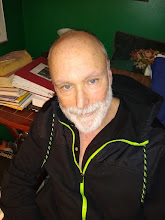
Bonnie Bishop––poet, educator, social activist––has authored a chapbook and two full-length collections, the most recent being River Jazz (Every Other Thursday Press,) a portrait of her beloved New Orleans and its music. Her work is included in EOT’s new anthology, The Heart Off Guard. In today’s Letter, Bonnie has indeed “cracked the code,” as she stares out at the landscape rushing past, barreling down an unnamed Amtrak line to some unspecified station. In the small, even shabby, particulars of our daily experience, we know we are alive. In the used-up, broken-down, cast-off ephemera of lives passing, we grasp the commonality of what writers used to call (with fanfares and dramatic lighting) the human condition. Despite the great beauty and insight which might reside within that novel “unopened in my lap,” the speaker opts instead for the wild-style poetry of graffiti scrawled along the railway, or the flickering frames glimpsed on the passing platforms, the cinema of the ordinary. Reading her poem, I actually felt myself exhaling slowly––ah!­­––as if I were being offered a seat beside her. Then, after three visually-detailed quatrains, the speaker drifts toward the poetic: “A trance, as if serenity enfolds me as/ I become, for once, my own destination.” A lovely thought––but only then it dawned on me: this is an unrhymed sonnet! And here in the volta, or ‘turn’ that’s customary in the closing couplet, a greater meaning is being imposed upon this locomotive idyll. Of course, just like the rest of us, the speaker’s serenity is fleeting; big ideas intrude––and I wonder just when the poet drifted from being a pair of eyes observing to a purposeful mind commanding a ballpoint pen? No longer lost in the moment, she realizes she can employ this lovely now as a ticket to a poet’s much-loved station on the page. Perhaps it is unavoidable; and I’m grateful, not simply for the understated elegance of Bonnie’s verse, but for the honest way she has allowed us the experience of how ephemeral peace morphs into something else. Still, rereading it, the poem remains a space I can travel inside, delaying my arrival at that final couplet. Like Alice, I long to arrive “somewhere”; but perhaps that moment of being “my own destination”––before self-awareness sets in––is what the heart desired all along.


Red Letters 3.0


* If you would like to receive these poems every Friday in your own in-box – or would like to write in with comments or submissions – send correspondence to:

steven.arlingtonlaureate@gmail.com


To learn more about the origins of the Red Letter Project, check out an essay I wrote for Arrowsmith Magazine:

https://www.arrowsmithpress.com/community-of-voices


and the Boston Area Small Press and Poetry Scene

http://dougholder.blogspot.com


For updates and announcements about Red Letter projects and poetry readings, please follow me on BlueSky

@stevenratiner.bsky.social

and on Twitter          

@StevenRatiner


And coming soon:

a new website to house all the Red Letter archives at StevenRatiner.com