Director: Doug Holder
Producer: Ellen Meyers
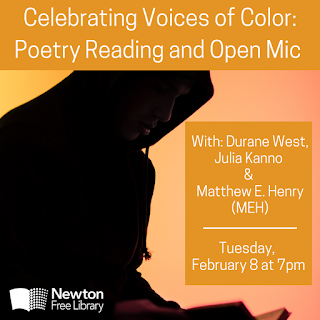
To register for the zoom reading go to: https://newtonfreelibrary.libcal.com/event/7781303
Producer: Ellen Meyers
To register for the zoom reading go to: https://newtonfreelibrary.libcal.com/event/7781303
The Red Letters
In ancient Rome, feast days were indicated on the calendar by red letters. To my mind, all poetry and art serves as a reminder that every day we wake together beneath the sun is a red-letter day.
– Steven Ratiner
Red Letter Poem #94
|
During an interview I did with the late poet Seamus Heaney, he commented: “…Poetry is born out of the superfluity of language's own resources and energy. It's a kind of over-doing it. Enough is not enough when it comes to poetry…This extraness may be subtle and reticent. Or it may be scandalous and overdone. But it is extra...”. But as Western writers have learned from the sensibility at the core of much Asian poetry, it’s possible to achieve that sense of extra by doing, not more, but less. The poet Aram Saroyan made that principle central in his career. I find it curious that, while he is the award-winning author of numerous works of fiction, biography, memoir, drama and, of course, poetry, he is perhaps most famous for a poem consisting of a single word – a piece that became one of the most controversial poems in history.
Son of the novelist William Saroyan, Aram’s literary education began early and, during the 1960’s – a time of revolutionary experiments in verse – he began exploring minimalism and concrete poetry, influenced by poets like Robert Creeley and Louis Zukofsky. Minimalism aims at achieving the maximum compression of a literary experience – not only making every word count, but every line break, punctuation mark, meaning-making device at the poet’s disposal. The practice of concrete poetry extends far beyond the stereotypical ‘tree poem in the shape of a tree’ some of us remember from school projects; it was concerned with the visual field of the page and how the arrangement of letters and words created different forms of significance. As the poet remembers the occasion of this groundbreaking piece, he had a friend visiting his Manhattan apartment who was anxious to head downtown to Le Metro Café, a spot where avant-garde artists and musicians hung out together. But Aram, whose nimble mind was continually turning over possibilities, had an idea simmering, and could not leave before he’d come to a decision. Once the notion took shape, he sat at his Royal manual and typed this single word in the center of a blank page:
lighght
Then they left for the café. Aram was 22 years old at the time; his life was about to be irrevocably changed.
As the poet himself has written: “The difference between “lighght” and another type of poem with more words is that it doesn’t have a reading process…Even a five-word poem has a beginning, middle, and end. A one-word poem doesn’t. You can see it all at once. It’s instant.” In this piece, he crafted an image that is experienced, much like a painting or photograph, rather than decoded. And yet a part of our minds still wants to plumb it for meaning. What did that doubling of the unpronounced gh do to the way we interpret the word? Is there more pulsing radiation? More silence? Something like an elongated sunbeam? Or are those two g’s staring out at us like eyes from a face, bathed in light? Is it, perhaps, simply the sort of exuberant play most had schooled out of us during our so-called educations?
The story might have played out with far less drama except for the convergence of art and politics. The poem was written in 1965, the very year a new federal agency was born: the National Endowment for the Arts. A year or two later, the NEA created its first Literature Program and selected the noted writer/editor George Plimpton to assemble a poetry anthology. At Robert Duncan’s recommendation, Aram’s poem was among the ones he included. Each contributor was awarded $750. – one third going to the magazine that first printed the poem, and the remainder to the poet. But this meant that – to a certain sort of mind – this poet was being paid the princely sum of $500. per word! And that got under the skin of a few conservative Senators like William Scherle and Jesse Helms, and they used this outrageous waste of money as a cudgel for attacking the young arts organization. Years after it was written, Ronald Reagan would still disparage the lighght poem as a symbol of elitist posturing. It seems our culture wars have deeper roots than we may have imagined.
Aram eventually published whole books of minimalist pieces, including many one-word poems. Here are a few favorites of mine:
j;u;n;g;l;e
and I can’t help but see the eyes, the paws of those beasts hiding in the underbrush.
Or this one:
Picassc
– and this inventive spelling depicts, what? An open eye? A Cubist mouth? A simple refusal to play by the old rules (the very spirit of his famous artist-subject?)
Aram even has a poem that the Guinness Book used to call the shortest poem ever written – but, dear reader, I’ve run into a problem in trying to share it with you here. The image he created is the single letter m except made with three humps. Aram told me he was “doing paste-up work in the mid-Sixties at Academy Typing Service in New York. This was before computers allowed you to correct any mistake digitally. You had to correct a typing error by cutting it out of a typescript and pasting in a correct version. As I remember, a big m was part of a layout and I thought: how would it look if I added an extra hump.” It seems the html code just can’t handle this as an image and issues a blank space in its stead. But here is a link to a wonderful article where you can see the Saroyan m and read more about its significance: https://briefpoems.wordpress.com/tag/aram-saroyan/
This one-letter word-sculpture just tickles me to no end. Am I seeing doorways or mountains? Is this the depiction of the labial sound simply drawn out in pleasure? Or, as one writer suggested, are we witnessing the cellular creation of the alphabet, as primordial m and n first pull apart to create their separate selves?
These are playful experiences, to be sure – but they’re what a painter-friend terms serious play, her definition for all art-making. Their purpose is to stretch the boundaries of how we well-trained humans use language as a window on the world – or as a mirror that reflects the inner workings of our own minds. And, in recent years, after Ugly Duckling Presse and Primary Information released the poet’s Complete Minimal Poems, Aram’s poems began attracting interest from a whole new generation of readers and writers who were, perhaps, less bound by the strictures I inherited from my high school English teachers many years ago. Few creatures on this planet seem to possess complex and systematic language; and none but we humans have created our diverse writing systems for preserving that speech, that burgeoning thought. I love how this poet devised his wholly unexpected ways of reminding us of the extra that Mr. Heaney praised, lurking within even the simplest of words.
Want to feel the very neurons tingling as you wade into and begin to decipher one of Aram’s minimalist pieces? I’ll close with another favorite of mine:
Poem Recognizing Someone on the Streete y ? he ? h eh e y !
–– Aram Saroyan
The Red Letters 3.0: A New Beginning (Perhaps)
At the outset of the Covid pandemic, when fear was at its highest, the Red Letter Project was intended to remind us of community: that, even isolated in our homes, we could still face this challenge together. As Arlington’s Poet Laureate, I began sending out a poem of comfort each Friday, featuring the fine talents from our town and its neighbors. Because I enlisted the partnership of seven local arts and community organizations, distribution of the poems spread quickly – and, with subscribers sharing and re-posting the installments, soon we had readers, not only throughout the Commonwealth, but across the country. And I delighted in the weekly e-mails I’d receive with praise for the poets; as one reader recently commented: “You give me the gift of a quiet, contemplative break—with something to take away and reflect on.”
Then our circumstance changed dramatically again: following the murder of George Floyd, the massive social and political unrest, and the national economic catastrophe, the distress of the pandemic was magnified. Red Letter 2.0 announced that I would seek out as diverse a set of voices as I could find – from Massachusetts and beyond – so that their poems might inspire, challenge, deepen the conversation we were, by necessity, engaged in.
Now, with widespread vaccination, an economic rebound, and a shift in the political landscape, I intend to help this forum continue to evolve – Red Letter 3.0. For the last 15 months, I’ve heard one question again and again: when will we get back our old lives? It may pain us to admit it, but that is little more than a fantasy. Our lives have been altered irrevocably – not only our understanding of how thoroughly interdependent we are, both locally and globally, but how fragile and utterly precious is all that we love. Weren’t you bowled over recently by how good it felt just to hug a friend or family member? Or to walk unmasked through a grocery, noticing all the faces? So I think the question we must wrestle with is this: knowing what we know, how will we begin shaping our new life? Will we quickly forget how grateful we felt that strangers put themselves at risk, every day, so that we might purchase milk and bread, ride the bus to work, or be cared for by a doctor or nurse? Will we slip back into our old drowse and look away from the pain so many are forced to endure – in this, the wealthiest nation on the planet? Will we stop noticing those simple beauties all around us? The poet Mary Oliver said it plainly: “Tell me, what is it you plan to do with your one wild and precious life?” I will continue to offer RLP readers the work of poets who are engaged in these questions, hoping their voices will fortify all of ours.
Two of our partner sites will continue re-posting each Red Letter weekly: the YourArlington news blog (https://www.yourarlington.com/easyblog/entry/28-poetry/3091-redletter-123121), and the Boston Area Small Press and Poetry Scene (http://dougholder.blogspot.com). If you would like to receive these poems every Friday in your own in-box – or would like to write in with comments or submissions – send correspondence to: steven.arlingtonlaureate@gmail.com.
Millrat
Poems By Michael Casey
25th Anniversary Edition
Loom Press
Amesbury, Massachusetts www.loompress.com
ISBN: 978-1-7351689-7-5
Review by Dennis Daly
Once upon a time multileveled manufacturing plants with attached smokestacks, called mills or factories grew like mushrooms around waterfalls and river bends. They attracted the able-bodied, both men and women, who sought financial independence and dignity. What these seekers found instead in this soot-filled urban culture was a rite of passage for some, a technological trap for others, and a graveyard or graveyard road for the unlucky remainder.
Humor often got one through the interminable repetitions and the real dangers of modern machinery and toxic chemicals. Michael Casey knows this and nails the details of mill culture in his classic collection of poetic narratives entitled Millrat, which is being republished this year as a 25th Anniversary Edition by Loom Press.
Casey sets the mid-twentieth century atmosphere perfectly by opening with driving while under the influence, a poetic vignette on drunk driving, a common experience, regrettably, for many teenagers of that era. His first-person protagonist is a know-it-all snot-nosed kid, cruising with his friends in what is probably his first car. The car slams into a blinking yellow light, as cars do when driven by snot-nosed kids, who believe they have the grownup world figured out. Casey concludes the poem with just the right amount of irony and gritty dialect,
I get out and hide behind but
by this time I can see the flashing lights
and it was really something
the police cruiser goes around the rotary
takes the exit I took
and comes right to me
I was alone all my friends split
and they get me for leaving the scene
driving under the influence
and being a minor in possession
all kinds of stuff right?
I asked the guy found me
How’d you catch me?
He said he followed the leaking radiator
It leaked after the crash right?
fifty million dumb cops in the world
and this guy
has to be a genius
Throughout the collection Casey positions poems based on company posters intended to boost employee morale and promote work ethics. They effectively deliver their pop psychologies with unintended wry humor. Some are just laugh-out-loud funny. The first of these the poet titles “Positivity Poster.” Here is the heart of the piece,
…just some old fashioned ideas
avoiding waste
pride of craftsmen
work as a team
the worth of experience
all these add to the unequalled quality
at wholesale value
that make our patrons love us so
the new old fashioned
textile business
everyone in the mill
the dye house anyway
reading this stuff
would think of only one word bullshit
you can guess
what wall these posters were on
and without any effort at all
you memorize them
and with some creativity and even art
you write crude phrases
and drawings on them
it was a lot like a team effort
Respect for authority did not jump out at one upon entering the mill culture, and veterans of this work force were even less likely to defer to the demands of a foreman or manager type, at least immediately. Everyone, except new hires, had figured out their place in this society and defined it by the time it took for them to comply with any despotic order conveyed from above. Casey explains this phenomenon in his poem foreman,
Walter walked over to Alfred
and asked him
to mix up the soap
when he got the chance
and Alfred said
sure he’d do it
when he got the chance
but he never did it
so Walter walked over to Ronald
Ron why don’t ya make the soap up
when ya through what ya doin
and Ronald said
fuck you Walter
of course
Ronald went and mixed up the soap
when he got a chance
Between the mill and the neighborhoods that surrounded the mill no clear demarcation existed. Both of these rough-and-tumble inner-city zones fed into each other. Some factories doing government work had hard security to separate the two, like the General Electric in Lynn. Others, like Casey’s mill in Lowell allowed a freer interchange. The poet details a result of this overlap in his poem, the night the fight with Bill happened. The piece opens this way,
that same night
after they beat up Bill
they came back
don’t you know
shithead was mad
because Ray broke up the fight
and so he brought back his gang
a bunch of them
clean out the mill
that’s what he said
I’m gonna clean out the mill
the second shift upstairs
and the dye house
hears all the noise
ands runs down and runs up
and those assholes left fast enough
through the doors
out the windows
Forklifts are not complicated to drive. In any case most company bigwigs assume that their employees have certain basic skills and need not be bothered by training. Of course, postulations like this are terribly wrong and monumental accidents follow. In his poem, forklift driver, Casey laments the havoc that one driver, who guns his vehicle into the elevator door, can do. He says,
do you know how important
that fuckin elevator is?
Gus is up there yelling all over
for yarn and this is holdin up the knitting room
the napping room and the whole place
gonna be backed up now
they tell me Gus is pissin and moanin up there
like he was pissin razor blades
Very few poets chronicle this essential part of our culture’s history, which many of us, or our parents, or our grandparents participated in. Poets who choose mill/factory life and that type of work experience as their subjects are very few indeed. Casey’s wry verse compositions delving into this blue-collar bastion enlighten and exhilarate. His use of local language is spot on. What Casey does, he does very, very well.

Myrna Stone, The Resurrectionist’s Diary. Dos Madres Press. 2021. 86pp. $17.00
REVIEW BY RUTH HOBERMAN
The Red Letters
In ancient Rome, feast days were indicated on the calendar by red letters. To my mind, all poetry and art serves as a reminder that every day we wake together beneath the sun is a red-letter day.
– Steven Ratiner
Red Letter Poem #93
|
Freud thought of art-making as a raid on the unconscious – a way to drag parts of our dreamlike (or nightmarish) processes out into the sunlight where they might be, if not fully understood, then at least experienced and, when necessary, defused. And though I also find beauty in simple descriptives, and strength in the straight-forward voice, some of my favorite poems resemble waking dreams replete with images that seize the attention and meanings that are tantalizing but veiled. And so it is with Bruce Bond’s new piece “Redactions. . .” from his forthcoming collection Invention of the Wilderness (Louisiana University Press.) As in a dream, everything at first glance seems strangely connected and navigable – but then the questions erupt and certain phrases detonate (with shock as well as delight), and we keep moving toward what is just out of reach.
When I saw the poem’s title, I wondered whether this referred to the last presidential debates (well, scrums would be a better word) where, curiously, the health of our environment was rarely mentioned. Or is the ‘last debate’ the ongoing conflict between those who fear irrevocable changes to our global climate and those who disbelieve the dire predictions of scientists? Is the ‘blindness’ mentioned in the opening lines literal or metaphoric? An affliction or a self-inflicted wound? (Perhaps, like me, you heard an echo of your mother’s voice, warning you about running with scissors.) Then come those gut-punch images (darkness falling “like a head into a basket”) and those disembodied voices littering the scene – and I begin to intuit the landscape through which I’m traveling. The poem offers no easy answers because, frankly, there are none. But perhaps, emerging from such a waking dream, I will feel inspired to ask better questions – of myself, of those who make decisions in my name.
Bruce is the author of (hold onto your hats, my fellow poets) thirty collections of poetry, including three new ones on the way; beside Invention…, we can look forward to Choreomania (Madhat Press), and Liberation of Dissonance (which received the Nicholas Schaffner Award for Literature in Music). I was not surprised to learn that Bruce is a classical and jazz guitarist which, I assume, can’t help but strengthen both the musicality of his voice and the improvisational quality of his line. He’s the Regents Emeritus Professor of English at the University of North Texas in Denton, and has received awards from the National Endowment for the Arts and the Texas Commission on the Arts.
Redactions from the Last Debate
When I was a child, one eye went blind
and then, in sympathy, the other.
Twins again with their own twin code.
Scissors, with your spectacles, tell me,
are they open or closed. Are you no
less eyeless, the moment you are used.
Was that you at my window, the chirp
of the screw that holds your blades together.
Was it God who said, let there be light,
and darkness fell like a head into a basket.
Like a floe in the arctic with a heap of cellular phones.
I fear we fear the wrong connections.
The earth on the radio blows a plume
of smoke into the room, blackening the ceiling.
The flies in the icecap long to be released.
What is any fly without the open air,
any blade of grass without the pasture.
When I swear that I am here, the field
there, wind everywhere among the shivers,
a slant of light through the window casts
a thousand tiny threads, a thousand hooks.
I see them, cut them, and the oceans rise.
–– Bruce Bond
The Red Letters 3.0: A New Beginning (Perhaps)
At the outset of the Covid pandemic, when fear was at its highest, the Red Letter Project was intended to remind us of community: that, even isolated in our homes, we could still face this challenge together. As Arlington’s Poet Laureate, I began sending out a poem of comfort each Friday, featuring the fine talents from our town and its neighbors. Because I enlisted the partnership of seven local arts and community organizations, distribution of the poems spread quickly – and, with subscribers sharing and re-posting the installments, soon we had readers, not only throughout the Commonwealth, but across the country. And I delighted in the weekly e-mails I’d receive with praise for the poets; as one reader recently commented: “You give me the gift of a quiet, contemplative break—with something to take away and reflect on.”
Then our circumstance changed dramatically again: following the murder of George Floyd, the massive social and political unrest, and the national economic catastrophe, the distress of the pandemic was magnified. Red Letter 2.0 announced that I would seek out as diverse a set of voices as I could find – from Massachusetts and beyond – so that their poems might inspire, challenge, deepen the conversation we were, by necessity, engaged in.
Now, with widespread vaccination, an economic rebound, and a shift in the political landscape, I intend to help this forum continue to evolve – Red Letter 3.0. For the last 15 months, I’ve heard one question again and again: when will we get back our old lives? It may pain us to admit it, but that is little more than a fantasy. Our lives have been altered irrevocably – not only our understanding of how thoroughly interdependent we are, both locally and globally, but how fragile and utterly precious is all that we love. Weren’t you bowled over recently by how good it felt just to hug a friend or family member? Or to walk unmasked through a grocery, noticing all the faces? So I think the question we must wrestle with is this: knowing what we know, how will we begin shaping our new life? Will we quickly forget how grateful we felt that strangers put themselves at risk, every day, so that we might purchase milk and bread, ride the bus to work, or be cared for by a doctor or nurse? Will we slip back into our old drowse and look away from the pain so many are forced to endure – in this, the wealthiest nation on the planet? Will we stop noticing those simple beauties all around us? The poet Mary Oliver said it plainly: “Tell me, what is it you plan to do with your one wild and precious life?” I will continue to offer RLP readers the work of poets who are engaged in these questions, hoping their voices will fortify all of ours.
Two of our partner sites will continue re-posting each Red Letter weekly: the YourArlington news blog (https://www.yourarlington.com/easyblog/entry/28-poetry/3091-redletter-123121), and the Boston Area Small Press and Poetry Scene (http://dougholder.blogspot.com). If you would like to receive these poems every Friday in your own in-box – or would like to write in with comments or submissions – send correspondence to: steven.arlingtonlaureate@gmail.com.

Louisa Solano Interview with Louisa Solano: Former owner of the Grolier Poetry Bookshop tells it all. By Doug Holder **** This ...