Thursday, January 07, 2016

Magpiety: New and Selected Poems by Melissa Green

Poet Melissa Green


Magpiety: New and Selected Poems
by Melissa Green
Medford, MA: Arrowsmith, 2015
ISBN 9780692403853
136 p., $20

Reviewed by David P. Miller

Melissa Green’s third published collection is a stunning testimony to the need for sharply developed, luxuriant language, as a means of deeply engaging one’s own life and making that life an inevitability for readers. Ms. Green’s first collection, The Squanicook Eclogues (Norton), was published in 1987; her second, Fifty-Two (Arrowsmith), followed twenty years later. She has published two books of memoir: Color is the Suffering of Light (Norton, 1994) and The Linen Way (ebook, Rosa Mira Books, 2013). Magpiety excerpts not only her two published volumes of poetry, but three unpublished collections: Daphne in Mourning, The Heloise, and The Marsh Poems. The title set of poems is drawn from a sequence published in 2012.

Melissa Green’s work has been held in high regard by poets as varied as Derek Wolcott, Tracy K. Smith, Joseph Brodsky, Marie Howe, Robert Pinsky, and Lucie Brock-Broido, among many others. An hour-long tribute to her writing, given on the occasion of Fifty-Two’s publication, can be found at https://www.youtube.com/watch?v=-my4sJ_cFEw. Ms. Green has struggled for decades with depression and mental illness, challenges which at points caused her to abandon writing for years at a time. Her poems do testify to these periods of duress and ongoing difficulty (and childhood suffering detailed more explicitly in her memoirs). However, they simultaneously transcend what for other writers could be serious limitations on subject matter and expression. Her poems are fully engaged with the richness of the world as it is, to a degree that can be breathtaking. This review can only touch on a few of the high points of this collection.

The title cycle from The Squanicook Eclogues consists of twenty poems in four sections, corresponding to April, August, October and January. A long elegy for her father, these are also pastoral poems, set in the region of the Squanicook River in northern Massachusetts, during the time of the poet’s childhood. Although the following description of the cycle’s structure is too schematic, it is intended to give some indication of the patterning involved. The first poem in each section is a landscape-scale observation subtitled “from the sketchbook”. The second recounts walks with her father, acts of close observation and the nature of naming. The third, “from the notebook,” focuses on close observations of plant life.  The fourth continues the second sections’ recounting, but from a more private perspective, rather than highlighting father-daughter interactions. The fifth follows a four-element sequence: water, fire, earth, and air. Here, the seasons manifest feminine personae – “the river’s daughter, dressed in driven skins” (p. 5) or “rising new / As summer’s mistress from a field of corn” (10) – who bring forward reflections from a level below direct observation:

She gathers cones for her own barrow, takes down leaves,
And like the marrow-colored moon in clouds will guard
The huddled valley’s harvest of beliefs. A gourd’s
Faint staving-off of evil is rattling for God.
    (October: Earth, 15)

The sights and sensations from these walks seemed to have impressed themselves into her remembrance more deeply than most of us can imagine. Her language is both sensually descriptive and metaphorically evocative at a sometimes unnerving level of detail. For example, against her father’s prescription, “Don’t ever make things up. Write only what you see. / Name the woods and you’ll have named the world,” she understood the challenge as

[… ] how to write birch when I saw the crumbling, pale tusk
Of a fallen mastodon bridging the path, or ash when the air
Was frenzied with the head of a neighbor’s rain-black mare.
Sycamore waved at me like drowned Ophelia’s hair. (12)

In Greek mythology, the nymph Daphne, pursued by Apollo, prays to Gaia for escape and is transformed into a tree. As such, she experiences safety and enclosure, but is also shut out from humanity, in a frozen condition. The elegiac poems of Daphne in Mourning were written during the 1990s, “many in response to the loss of [Green’s] friend and mentor, Joseph Brodsky” (ix). “A Sea Change,” the first poem in this set, demonstrates the vividness with which she articulates her personal difficulties, including the very processes of language breakdown and recovery:

My handwriting belongs to someone else.
Alzheimer-like, crab-wise, I take down this dictation.
A titian-haired cocker spaniel named Lizzie
Dazzles me, never leaving my side. Anxious. A rescue dog.
Dragged back, I don’t know where my home is either.
Mother, you won’t believe how dark the dark is.

“A January Poem,” inscribed with the date of Brodsky’s death at 55, is a meditation in five sections on the older poet’s relation to Ms. Green. First there is the shock of his loss: “Joseph, I pounded on the studded door of the sky / with my palms, not believing you’ve closed it / behind you forever, the midnight black mahogany / paneling of a private club where all the dead— / and only the dead—are welcome” (45). Quickly, this image of heaven as members-only club becomes a joyful scene of afterlife reunion including Auden, Mandelstam, and Akhmatova: the poet’s first moment of personal desolation is transcended. “A January Poem” ends with an extended metaphor describing the poet’s challenge in rendering Brodsky’s “Flight to Egypt”:

The caravansary arrives, a ten-line
Christmas poem, unburdening itself
under date palms in the desert, blown
sand peppering my eyes. Joseph, save

me as you used to! How am I to feed
there quarreling Russians, interlinears
dressed like émigrés, my alien drafts—
a feud of consonants and vowels!

“Reply to Styron’s Darkness Visible,” in ten sections, is a significant articulation of the descent into depression, the life within that state, and the (provisional) release from it. As is utterly characteristic of Melissa Green, she does not settle for generalized statements of affect, but develops images as idiosyncratic, even vital, as one expects from the writer of The Squanicook Eclogues:

Birds wing slowly past
the window panes,
taking music with them.
Like a pulled plug,
all sounds drain away.
The French clock ticks
and stops, its sweet chimes
covering their mouths. (57)

“I could not hold / life in my own arms,” she writes (56). But there is so much of life in this cycle, in the very language of description, even that of deathly experience: “Reluctant as Lazarus, and weak, I crawl / from the moldy cerements and scowl, / scratching my current-tonsured skull / in disbelief, faces and their daylight cruel” (60). The reader will notice here an instance of Ms. Green’s facility for subtle half-rhyme, evident throughout the collection, seen early in The Squanicook Eclogues with pairs such as trees/Truce, except/escaped, seemed/psalms, scythe/seethed. In the end, it is that “savior language called” (60) and she cannot ultimately refuse to reply.

The poems of Fifty-Two all follow the same idiosyncratic form. Each has five lines, the third line abruptly broken in half, making for six lines visually, with the fourth of those deeply indented. Melissa Green has described the origin of this form: after writing two and a half lines of a new poem, she heard the sound of a sharp crack, like a Ticonderoga pencil snapping in two. As a result, “I felt a kind of fracture in the language and knew I couldn’t continue to write the way I always had” (ix). The two parts of each poem are related by different strategies of dis/association. A couple of examples will have to do here. In “Routine,” the work of writing leaps from the poet’s grim effort to conquer an impossible landscape, to the sudden eruption of a kind of luxurious embodiment:

Tundra of the white paper. Steppes of emptiness and ice. Equipped
with crampons and picks, I notch out a poem on gneiss, frostbitten,
winded, afraid to die.
            Between the typescript’s writhes and raddles,
soft-nostrilled animals of meaning poke inquisitive noses through caesuras,
enjambments, metaphor, to me. I lift a serif, duck under and enter the world.

“In Florida” sets personal foreboding in a rich landscape which suddenly appears archetypal:

Did I tell you I sat out on my sister’s porch in a hammock swing, watching
the evening cardinals weave her cherry laurel into a net of ribboned carmine silk,
convinced I’d live my life alone?
                I saw Eros rise over the osiers, fletching an arrow
filched from Artemis’ quiver and half-lifted up, only to meet his barb
of laughter. I sit back. First dusk comes on, then darkness, then the underworld.

The selections from The Marsh Poems, a set completed in 2011, are composed of long-lined couplets. As with the single form explored in Fifty-Two, Ms. Green here continues to display variety, detail, and a strong power of sensory perception and expression. In “At the Marsh,” the poet’s self is intimately fused with that of a severe June day at the estuary:

Salt hay scorches my feet. Mist lies down under the sun

to be consumed. Phragmites ignite. The beach roses blaze.
I’m sick and can’t live long. I want to soak my marrow

in this cauldron, kindle each incandescent bone in earth’s
hellfire banked with coals, and in this day’s false cremation,

feel for an instant my final burning: the skin’s sizzle,
crackling fat, my hair—a saint’s burnished corona of flame.

The arrival of a summer storm on “The First of July” sets off an extended metaphor in which the poet herself, unexpectedly, becomes a record of music:

[…] When I hear bass notes of thunder

my legs curl under me. I become a treble clef drawn on
a white rock, transcribing the pitch of the sea as the line

of running swells west to east describes a musical stave.

I have tried throughout this review to indicate the multiple triumphs of Melissa Green’s poetry. She has not only compellingly recorded her personal challenges, but has gone far beyond. It is as if the very duress of her situation has enabled a depth and luxuriance of expression rarely found.  And despite long periods of silence, the words have repeatedly broken forth, wildly and irresistably. To conclude, here is “Gambit,” one of my favorites of the shorter poems in this collection.

I close my eyes and breathe. Words enter my body, gold chessmen
carved of flame that take their places on my black-and-white board.

I play against myself, but the contest declares itself older by far
than the Game of Kings. The pieces obey their own arcane rules:

shape-shifting bishops, rooks, knights promptly abandon the Court
for the wild—a burst of wings, fins, talons, tusks, eyeteeth, beaks.

It’s a struggle to tame them. I can’t out-think their tactics, tricks
or strategies. The game is over when pieces simply return to form:

figures of speech cover the page, lay claim to their spaces. When
no moves are left, I lay down my pen. That’s how the Queen wins.

Tuesday, January 05, 2016

P.A.'s Lounge Gives it to you straight no chaser


By Doug Holder

So I am in Union Square, and the cold winter winds are whipping me like a frenzied sadist, when I entered P.A.'s Lounge. I needed a story and P.A.'s seemed to fit the bill. In one corner of the bar Jon Dorsett nursed a beer, and stared at a flat screen. He had the look of a guy who has seen and done that, and has no time for happy horseshit. The bartender and co-owner Tony Amaral, Jr. looked at me with world-weary eyes, as if to say, “ So, what are you selling?” I told him I am Doug Holder from The Somerville Times—he was not impressed. But I sat down, and as the bar was basically empty this afternoon; he agreed to chew the fat.

It seems that Tony runs the bar with his brother Jerry and his old man Tony Sr.  P.A.'s was founded in 1971. It was called the Portuguese American Lounge back in the day. It specialty was seafood, but later the lounge morphed into a live music venue and bar. The restaurant was in its heyday from 1975 to 1989. Tony Jr., told me they served a Spanish/Portuguesa dish Mariscada that Boston Magazine raved about. It was a savory concoction of shrimp and other seafood that made many a mouth tremble and water with delight.

Speaking of Tony Sr. who birthed this lounge, he is a spry 75 years old and still keeps his finger on the pulse of the joint, and keeps his sons in line. In fact P.A.'s is a family affair. Tony Jr's girlfriend works here as well as the brothers.

Tony Jr., is the real McCoy. He was born in Somerville Hospital, and he went to school with Mayor Curatone—who he says stops in now and then to say hello to his old classmate.

The bar is a no-nonsense kind of place. You are probably not going to get a craft beer, more likely a Miller, Guinness or Bud. Dorsett ,the lone patron piped up: “It's sort of like Cheers, where everyone knows your name. And they are always glad you came.” Dorsett has lived in Somerville since 2001 and is a fan of the music and entertainment the joint has to offer.

I noticed a white guitar mounted on the wall. “Makes sense,” I thought. According to Tony Jr.--many an up and coming band has played here. Dorsett said “ Three years ago Arcade Fire played here.” According to Tony Jr., mostly indie rock bands are the standard fare, but they have “Americana Mondays” where Hank Williams-style music is the flavor of the week. Some local bands that have or will play here are  "Big Screen Radio," " Amateur Athletes," " Triax Coalition" to name a few. The bar has also hosted poetry readings, acoustic open mikes, and throughout the week they have different acts.

But it is not only musicians, poets and other stumble-bums who make the scene, but comedians as well. Most notably, according to Tony Jr., and Dorsett, the comedian Eugene Mirman strutted his stuff here. Dorsett told me that Mirman now hosts his own TV show. No joke.

Tony Jr. has seen the neighborhood change in the last 10 to 15 years—for the good and bad. He thinks the Green Line ( If it ever makes it here) will certainly bring new business. But he has seen real estate taxes rise, and many people displaced.

Tony Jr., told me that the family owns the building; so they will be around awhile. He figures they might put more emphasis on food in the future. But I think in this dark and moody gin joint—they will keep it—straight... with no chaser.

Monday, January 04, 2016

Resa Blatman: A Somerville Artist and Arctic Explorer


Resa Blatman: A Somerville Artist and Arctic Explorer

By Doug Holder

Resa Blatman is an adventurous person. Recently this longtime Somerville resident took a trip to the Arctic with other artists on an antique sailing boat.I talked with Blatman about this, the gentrification of Somerville and its impact on artists, and other projects she is involved in. Blatman joined me at my usual seat at the Bloc11 cafe in Union Square

Doug Holder: Tell me about your Somerville connection?

Resa Blatman: My husband and I have lived in Somerville since 1998. We own a home and live near the Vernon Street Studios where I have a studio. I also founded and was president of a non-profit “Short Space.” Our mission was to find and create as many art spaces as possible in the city of Somervillle. And it really didn't bear fruit. Real estate in these parts is just so valuable. I dropped out of the organization. I am still trying to find artist spaces that are affordable.

DH: So what is your take on the gentrification of Somerville?

RB: I don't like it. I think of moving all the time. I have a great life here. If the Green Line ever gets here there will be very little room for artists. I am sure Vernon Street will eventually decide to sell. And where will the 100 artists go? So I am thinking ahead. I am not sure where to go. I want to go to a place where artists can buy a building to work in. I think 10 years down the line Somerville will be a city for the rich. What you need is a mayor who really puts his foot down with developers.

DH: What have you been working on since we last spoke two years ago?

RB: My work has focused on issues that affect climate change. I am painting images like songbirds in the Arctic—where they shouldn't be---flowers blooming in places they shouldn't be. I am still doing work like that but I am doing installations that use layers and layers of painting material. This is my Gaia Series. Gaea is the goddess of Mother Earth. Gaia speaks to the fact that earth is a self-regulator and it can sustain itself and change. The planet will survive—it is humans who are in danger. The earth will go on for a long time after we are gone. In terms of my projects I have produced installations of water. A sort of a wall of ocean. I think it is stunning. It is 3 dimensional and painted. I haven't shown it yet but I am working on it. I am also in a lot of exhibits around the country related to climate change. One exhibit is here locally at the Nave Gallery.

DH: Tell me about the boat trip you took to the Arctic with other artists.

RB: I was involved in that last summer. It was beautiful. The landscape of the Arctic is dessert – like. Nothing grows there but tiny flowers. We were on an antique sailing vessel—we were packed in there. It was called the Arctic Circle Residency. There were artists, poets and writers on the vessel. There was very little room to do artwork on the boat. On land as well. We made land twice-a-day. We were on the boat trip for 15 days. Personally I am used to a lot of solitude. There was none of that on the boat. You were cheek to jowl with other people. The sun was at 12 noon for 24 hours., It messed with you and kept you awake. It confused the body. There was a lot of drinking on board. It was a fairly good group of people but you were surrounded by strangers. And when we went on land we were guarded by three gorgeous Scandinavian women with rifles because of Polar Bears. I brought a long piece of Mylar, a plastic film and wrote and pained on it. I made a visual diary of things that I observed. They were slightly abstract. All in all it was fascinating to be there. I am very glad I went. While there I collected fishing line that washed up on the shore. I brought back a huge net—scrap fishing line, to use in projects. I made drawings based on the fishing lines.

DH: More and more art is viewed as a commodity, as an investment. Your take?

RB Yes. Sometimes this makes it hard to know what to do. I remember my work was in this local gallery, and I remember the owner walk into my studio, and say about a few pieces, “ You know I can't sell that!” I mean you have to make something pretty—something someone would be inclined to put in their home. But I am more selective now. I make challenging work, and more people are willing to buy it.

Friday, January 01, 2016

Bleak Splendor Poems by George Held


Bleak Splendor
Poems by George Held
Muddy River Books
Brookline, MA
ISBN: 978-1-329-65042-8
31 Pages
$12.00

Review by Dennis Daly

In this haunting, yet modest, book of meditations, memories, and mementoes, George Held constructs a makeshift time capsule of neuro-detritus, both profane and numinous. His subjects range from wealth to mortality to nature’s relentlessness to aging to outdated vocations to (even more) outdated heroes to the probable odor of Jesus Christ.

The second poem in this collection, At the Marina, sets the reader up with a self-conscious commentary on social justice and then cuts its neat metaphor with an infusion of wicked irony. Held describes the owner of a yacht docked at ritzy Sag Harbor,

Its proprietor, barefoot in deck chair,

Relishes a cigar.
Gold letters on the stern emblazon
The boat’s name: “Homeless,

Cayman Islands.”

This poet knows what he’s about. His poem Airing It Out, set in a nursing home, weaves absolute magic in fashioning a penultimate “All Souls” moment before death’s looming portal. Held’s opening description marvelously conjures a spell of decrepitude and pre-transfiguration,

The inmates at the old-age home
Are disrobing. In the assembly room
Dressing gowns fall from sunken shoulders,
Foundational garments pool
Around flat arches and twisted toes.

Stats don’t lie: seven of every ten
Seniors are women, but the handful of men
Here drop trou from gaunt flanks, allow
Bellies and scrotums to sag and sway
As women free flat fallen breasts

From all restraint, stand shy or proud
As becomes them, gray or white locks
Freed from caps or bands and spilled
About their faces and down their backs,
Airing out decrepit bodies whose cells

Still continue to replace themselves.

The Dancer in the Box, a favorite poem of mine in this collection, puts death in its place, that place being a containable sonnet that empowers the poet. Held sucks the strength from mortality in this well-engineered dirge and forces death to bow to artistic rules rather than nature’s cruelty. Consider this conclusion,

when someone dear
Dies, I turn to the sonnet for solace, to hold
My grief, lest it run with mercurial death
To some dire end beyond a sonnet’s bounds.

So many sonnets I’ve had to carpenter
These past few months that this year is The Year
Of Death, and still more friends fight for the breath
Of life…

Scary, but I do remember the iceman coming to our family’s door, and his tongs gripping that food-preserving block. Held memorializes his own observations of this once household god in his poem entitled The Ice Man. Children of that age felt awe in the presence of such physically powerful men, men whose hard work demonstrably meant something to civilization. Even as refrigerators superseded their profession, these almighty deities remained iconic to eyewitnesses of that era. Here’s the heart of the poem,

You’d stick your tongs into the block,
Turn your back to the tail-gate and hoist the ice

Onto the burlap towel on your shoulder.
Bent like Atlas, you’d hump your five-foot frame
Upstairs to our kitchen sink, then deftly
Wield your ice pick to chip off enough

To slide the block into the top compartment
Of our icebox. That done, you’d collect your fee
And depart without a word. Your menial work
And your size belied the Colossus in our eyes,

Mr. Galasso, and we held our breath in awe
Each time you made your trek from truck
To kitchen…

Typically, suicides committed by the overly wrought and despondent often mess up families with strong emotions of guilt and recrimination. Details of such self-destructions as a rule are best left unspoken. In Held’s piece In Time and Out the poet relates the untypical (at least in the dramatic sense) suicide of his father. The man was eighty-eight and in pain. Held relates his father’s decision as matter-of-fact and exceedingly rational. The piece is not without irony and ends with a surprising metaphoric twist that works quite well. Here the poet addresses his father in the rather upbeat conclusion,

Alive, you were too feisty to let anyone
put a lid on you, even at eighty-eight.

By the way, the coroner told me that the pain in your gut
wasn’t the cancer you feared but a strangulated
hernia, and since you always refused to see a doctor

it would have grimly killed you through sepsis.
So you were right to do yourself in, and just in time.
I’m writing you now that you’re dead, Dad,

because I want to leave this record behind,
the way you left your bloody corpse
for your son to find.

Held’s final and title poem in this collection, Savior, breaks apart the hypostatic union of god and man. I like this piece a lot. The poet reconstructs the probable stench of the historical Jesus and repositions this contextual Christ in the bleak splendor of Galilee. Each gritty stanza adds perspective and suggests the miraculous in the material. The poem opens with questions,

What did the Savior smell like,
A gaffe with garlic breath,
A hint of death,
Or like a kike?

Did his teeth stink from caries,
His feet from fungus,
His armpits, richly hairy,
Like a leper’s house?

These wide-ranging poetic perceptions stretch from the precise and often provoking particulars narrated by Held to a universal realm of wisdom and timelessness. Discover this remarkable capsular book in the future. The near future.

Monday, December 28, 2015

Poet Richard Fox: A Cancer Survivor Brings His Suffering to Verse


Poet Richard Fox: A Cancer Survivor Brings His Suffering to Verse

By Doug Holder

Richard Fox didn't start out wanting to write about his bout with cancer. It came to him as unexpectedly as the nefarious disease did. Fox has penned a new collection of poetry that deals with his trials and travails titled,” wandering in puzzle boxes” ( Big Table Books)

 Richard H. Fox was born and bred in Worcester MA. He attended Webster University, as much artist colony as college, in the early 1970’s. These diverse cultures shaped his world view and love of words. He is a former President of Poetry Oasis, Inc., a non-profit poetry association dedicated to education and promoting local poets, and was Managing Editor of its journal Diner. Richard’s poems have appeared in numerous journals including Above Place, Boston Literary Magazine, OVS, Poetry Quarterly, Midstream Magazine, and Worcester Review. He is the author of two poetry collections: Time Bomb (2013) and wandering in puzzle boxes (2015). A cancer survivor, many of Richard’s poems focus on cancer from the patient’s point of view drawing on hope, humor, and unforeseen gifts. He seconds Stanley Kunitz’ motion that people in Worcester are “provoked to poetry.”

I talked with him on my Somerville Community Access TV show  " Poet to Poet Writer to Writer"


Doug Holder: You are from Worcester. Stanley Kunitz , the late, acclaimed poet was also from Worcester. He said that people from Worcester are provoked to poetry. What do you think he meant?

Richard Fox: While he was Poet Laureate of the United States he came back to Worcester. His home is out in Worcester. There are a lot of events out at that house. The people who own it now treat it like a museum. Getting back to your question, he was asked by someone from the press why were there so many poets in Worcester. That's when he replied that people in Worcester are provoked to poetry. Worcester has more poets that you think for a city of its size. It has interesting atmosphere of blue collar workers, many ethnic cultures---it turns out a lot of writers. Your dentist could be a poet. Poetry seems to be everywhere.

DH: Did you grow up in a poetry-loving family?

RF: I didn't grow up in a poetic background. I had an uncle who was a Beat and he introduced me to a lot of the Beat art and literature. He was a bombardier on a B24 in WW ll, and went to the Rhode Island School of Design on the G.I. Bill. Later he went to Greenwich Village and supported himself as a painter.

DH: You help found the organization “ Poetry Oasis” in Worcester.

RF: Yes. The Poetry Oasis was a weekly venue. We brought in a large selection of poets from New England and nationally. We sponsored open mikes, workshops, and did outreach in schools and senior centers. There were a lot of poets who developed their voice with us. We had an eclectic mix of Slam poets, religious poets, etc.... There was an acceptance of the diversity and style. There was a lot of support. You know it is a hard thing to get up there and read your poem—here we encouraged it—there was a lot of positive energy. We also had a magazine “ Diner'”that came out four times a year. This was before the Internet was in vogue. We had a wide distribution of poems. Eve Rivkah was one of our poetry editors.

DH: In your poetry collection “ wandering puzzling boxes” you deal with your experience with cancer. Why did you want to revisit such a painful part of your life?
RF: I had a friend who was a medic in Vietnam. I would talk to him on the phone about his experiences. He told me, “ You are fighting a war.” For him—his defining time was his ten months in Vietnam before he got injured. Cancer becomes a defining moment in your life. Some people have asked me,' “Did cancer change you?” It is hard for me to look back at myself before cancer because life is incremental. Sometimes I wake up in the morning and I don't feel good. But then I say to myself “Yeah, but your are alive.” I am really all about not wasting days after seeing people with cancer not make it. It took me about 15 months after my own experience to read and write poetry. I talked to poet John Hodgen,. I asked him to send me prompts. And John is a master at this. I viewed the prompts as a puzzle. I did not intend to write about cancer—but it was in my subconscious. The prompts helped bring it out.

DH: Have you read to other people who have or had cancer?

RF; I have. I have had poetry readings that specifically dealt with cancer. The q and a after is about 50% cancer, and the other half is about poetry. You know if you haven't been through cancer then you can't really understand it. What you have to understand as a cancer victim is that the depression and despair you feel is normal. That is a hard thing to know. Most people who have it feel they have to fight harder. Your body experiences a lot of damage from chemo and radiation. Your strength is greatly diminished. You have to pick your battles.

DH; I have interviewed the playwright and screenwriter Israel Horovitz. I noticed you wrote a poem about his visit to your high school in the late 60s.

RF: In high school I had a great drama teacher. He had worked Off-Broadway as an actor, but he wanted his marriage to work so he came up to Worcester to teach. He treated high school students like professionals. He had play-writing competitions. He had top notch playwrights judge them. He also got playwrights to speak to the students. Israel Horovitz came in 1968, during the Vietnam conflict. He made his talk into a exercise in improvisation, and asked the students “ Will you strike the school?” he even threw a chair across the stage. He created quite a stir. The student body was pro-war . I was anti-war. The interesting thing is when I went to my high school reunion all the pro-war kids came up to tell me how wrong they were.


Chemo Brain

Lost in the grocery store you've shopped in
since you pushed a cart for your Mama? Have
a cup of Peppermint Tea, the red box on the
shelf opposite your belt buckle. Leave your
pants alone, grab a couple of bags, stumble
four aisles left to the household articles,
choose a ceramic mug, #1 DAD or I’M GETTING
TOO OLD FOR THIS SHIT or I FART WHAT’S YOUR
SUPERPOWER? Next to the pharmacy is a water
dispenser with twin taps: boiling and cold.
Put the tea bags in your mug, tags over the
rim. Fill with your preference but hot must
be best because you are shivering suddenly.
Suppose shopping is a spoiled idea when you
wanderlust for two hours to fill a thirteen
item list. Perhaps you should sit down here
on the floor til your wife can pick you up

Sunday, December 27, 2015

Somerville author Stefan Cooke's new book sheds light on a long lost child prodigy Barbara Newhall Follett


Somerville author Stefan Cooke's new book sheds light on a long lost child prodigy Barbara Newhall Follett

Article by Doug Holder

Part of life is losing touch. People disappear from our lives, sometimes never to appear again. Somerville writer Stefan Cooke author of “Barbara Newhall Follett: A Life in Letters” is not satisfied to let the disappearance of his half aunt Barbara disappear into the ether. With his new book he traces Follet's life through her letters. Follett was gifted child prodigy writer, who vanished in 1939 from her home in Brookline, Mass. at age 25. She was never to be heard of again.

Cooke has long been fascinated by Follet's story and writing. He told me over coffee at the Bloc 11 Cafe in Union Square that, “ I love her work, her skill with words, language, vocabulary and imagery.” For the book he researched Follett's papers at the Columbia University's rare book collection in New York City. Cooke said," The book is basically a collection of letters to various correspondents.” Cooke told me that Follet did not have a formal education ( she was home-schooled), and never went to college except for a few dance classes at Mills College. In spite of this Follett had the talents and skills of a master wordsmith.

At he age of eight Follett wrote her first novel “ The House Without Windows.” Follett explained that it was about, “ ...a child who ran away from loneliness, to find companions in the woods—animal friends.” Her father Wilson Follett (the noted critic) sent it to the prestigious New York City publisher Knopf, and in 1927 when Follett was 12 years old it was published. The New York Times lauded the book—calling it, “...truly remarkable.” The Saturday Review of Literature opined that the book was,  "Almost unbearably beautiful.” Later, when Follett was at the advanced age of 13 ( with her parent's consent ) she took to sea as a crewman on a lumber schooner. And of course a book ensued: “ The Voyage of the Norman D.” The Times Literary Supplement raved about the book saying it was,  “... embellished by a literary craftsmanship which would do credit to an experienced writer.”

But as fate would have it Wilson Follett left her mother for a younger woman. The father did not provide much money or support. Eventually Barbara Follet's life unraveled. She got married as a teenager, but the marriage eventually soured. She eventually left her marital home in Brookline, Mass. in December of 1939—never to be heard of again.

Cooke told me he has lived in Somerville for years with his wife artist Resa Blatman. Blatman designed the cover of his book. Cooke works as a web designer as his day job. One of his projects is the “ Afghan Women's Writing Project” that publishes the work of Afghan women, hosts an online workshop, and occasionally publishes books by these women, sometimes in their native language of Dari.

Cooke tells me there is opera planned about Follet's life, and in 2017 Penguin books plans to release a critical study of her work and life. Cooke is quite glad to be part of this conversation about this lost genius.


Cooke shared this with the Times:


Here's an excerpt from a letter Barbara wrote in 1930, when she was 16 and living in New York City; it's what I picked for the back of my book. (The book she was going to write was Lost Island, which I transcribed and posted on Farksolia a few years ago: http://www.farksolia.org/lost-island-part-1/ )

*******
Do you realize that a year ago yesterday I set sail from Honolulu harbor in my beloved Vigilant? I was rather glum all yesterday thinking of it. It hurt. I suppose it will be years before I go to sea again, and I may never even see that schooner. I suppose that I spent about the happiest month of my life during that sea-trip in her. And it lasted even during that week in port, when I took over the cabin-boy's job, and when Helen, Anderson, and I had cherry- and ice-cream-parties in the cabin after everyone had gone ashore, and when we used to walk up into that virgin forest two miles up the road, and eat salmon-berries. Life was beautiful then. This doesn't seem like the same era. Here the beauty consists of great stone towers against the sunset—sublime, symbolic, but away above the plane of us poor ants that hustle along the swarming streets at their feet, so engrossed in ourselves that we never even see a fellow-mortal, but bump into him with a bang, and then hurray and hurry on.
Oh, my God, my God!

It makes one's heart and soul suffer—it stabs them to the quick. Oh, for wings, for wings!
Wings!
That is, in general, the theme not only of my own heart, but of the book I'm going to write. I ought to be able to write it—I live it constantly. My heart is the field of a thousand battles every day.

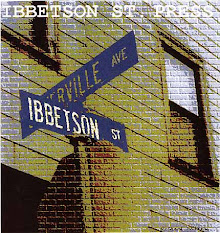
Ibbetson Street Press celebrates the release of the 38th issue of the literary magazine Ibbetson Street-- Jan 13, 2016


Article by Doug Holder

 Somerville, Mass.

In 1998, in a Brueger's Bagel shop in Cambridge, Mass. the Ibbetson Street Press was founded by Doug Holder, Dianne Robitaille, and Richard Wilhelm. Since then the Press has put out 38 issues of the magazine Ibbetson Street, and has published close to 100 collections of poetry and some memoir. Ibbetson Street has been included in the Pushcart Anthology, featured in such noted websites as Poetry Daily and Verse Daily, and has published the work of hundreds of poets since its inception. The press  was located on 33 Ibbetson Street in Somerville until 2001, but now is located on School Street in Union Square in Somerville, Mass. In the current issue you will see poetry by the likes of Marge Piercy, Andrea Cohen, Ted Kooser and many others. We are also grateful to have great photographs on our front and back covers by Glenn Bowie and Jennifer Matthews. Lawrence Kessenich has an insightful review of Endicott Professor Charlotte Gordon’s new book, Romantic Outlaws: The Extraordinary Lives of Mary Wollstonecraft and Her Daughter Mary Shelley.  Our core staff of Harris Gardner ( Poetry Editor), Lawrence Kessenich ( Managing Editor), Rene Schwiesow  (Managing Editor), and Steve Glines ( Designer) have produced another fine issue as usual.

Ibbetson will be having a reading at the Somerville Central Library on Highland Ave. in Somerville. A potluck dinner will be served at 6PM, and the reading will start at 7PM. Open to the public.


**** Ibbetson Street is now affiliated with Endicott College in Beverly, Mass.


Thursday, December 24, 2015

Fall Shoes: An Essay by Elena Harap

FALL SHOES 
  
Centre Street in the Jamaica Plain neighborhood of Boston, an August afternoon: on the sidewalk outside a storefront full of elegant high-heeled shoes and boots, a sandwich board announces Fall Shoes Arriving Daily. In the daze of late summer, a parade approaches me––brand-new sling-backs, platform shoes, patent leather slippers, alligator pumps, silver stilettos, suede winter boots––down the sidewalk with a steady click and tap. Must be coming from the Post Office, I think; they’ve vaulted out of their packing cases to head straight for the shoe store.  
Pair by pair, the New Fall Shoes process sociably along, past the toy store, the yoga studio, the barber shop.  Maybe they are making appraising remarks about ordinary pedestrians’ dusty sneakers and unfashionably blunt-toed pumps; they sneer at my sockless feet in square-cut Birkenstock sandals. ”At least she ought to paint her toenails,” they chatter, in French, Italian, Hebrew, and Chinese; do shoes speak an international language, converse in Esperanto?   
They disappear into the dark alcove of the shoe store doorway, tappity-tap, tappity-tap, leaving me out on the sidewalk with shoppers, kids in strollers, office workers returning to their cubicles, couples on their way to a late lunch. A vision of high fashion has passed among us and vanished, to reemerge on the feet of stylish Boston women.  Trudging home in my sandals, in a different foot-world, I ponder: how does one walk and dance, balanced on those tapered heels?    
In subsequent walks on Centre Street, I observe the sandwich board continuing to announce new  arrivals. I see in the bold black letters the turning of the seasons, a call that demands some response, just as the crying of Canada geese in their great V, flying south, demands that I run outdoors and see them off.  
And so I greet them: Welcome, Fall Shoes, as you sashay down the street, broadcasting your glamour, drumming your challenge in the tapping of your heels, reminding us—It’s a new season, ladies! Streamline your toes, be sexy and daring, risk your accustomed balance.  Next time I’m going to enter the shadowed doorway and get introduced. I’ve already borrowed my granddaughter’s toenail polish. Any day now, I might  be arriving somewhere—chic, au courant, sophisticated, in my new fall shoes.  
Elena Harap E

Sunday, December 20, 2015

The Chintz Age: tales of love and loss for a new new york.


The Chintz Age: tales of love and loss for a new new york.  ( Cervena Barva Press, Somerville, Mass. 2015)

Review by Doug Holder

I was just having breakfast with an artist acquaintance at the Bloc 11 Cafe in Somerville, Mass, when the subject turned to where we would move to if we were forced out of our city. We thought of isolated burgs like North Adams, an old mill in Lawrence, far flung nowherevilles in the western part of the state. But of course none of these places are like our hometown of Somerville, where both of us have lived for many years. Across the country artists, low income folks, and others are being forced out of their communities due to the hungry tendrils of gentrification.

In “ The Chintz Age...” (published by Somerville's Cervena Barva Press), this short story collection gets deep into the heads of punks, beatniks, hipsters, junkies, derelicts, artists and others as they hold on to the threads of their community with its bodegas, bookstores and all night cafeterias  that once heavily peppered the streets of New York City. The author Ed Hamilton knows of  what he writes. Hamilton, the author of “ Legends of the Chelsea Hotel” is still a resident of the Chelsea, known by many as the last bastion for bohemians. It is now gutted and a shell of its former self—as it waits to be turned into a boutique hotel.

Hamilton doesn't abandon his characters, and let them vanish into the ether. They reinvent themselves. They take their careworn carcasses and prop themselves up. Hamilton, in his title story “The Chintz Age,” writes about a middle-aged East Village photographer being forced from her long time  apartment. She is long past the beauty and promise of her youth, but she is able to rekindle  friendship and more with a figure from her past—a minor league comic book artist now gone to seed. Here, with a tender yet brutal honesty Hamilton describes their tryst:

“The battle-scarred warriors looked at each other for a long, silent moment. Then they drew themselves together—all the years dropping away as the barrier between them dissolved. They fumbled like two teenagers, kissing and struggling out of their clothes in a car because there was nowhere else, embarrassed by their middle-aged bodies, their lumps and cellulite, their wrinkles and scars and age spots and sagging skin. It had been a long time for both of them and neither was young any longer, though they felt reborn in those brief few minutes, the lingering sin of betrayed idealism washed away in the surge of quickening blood through their freshly supple limbs, and rapidly-firing brains....When they grasped each other they reached through time to grasp, as well, the final shreds of their forgotten selves.”

In his short piece “ Fat Hippie Books,” a long-time East Village used bookstore owner, an unapologetic acolyte of all things Kerouac and the Beats is being forced out from his hole- in- the- wall bookstore. He manages to find a smaller space and some peace of mind albeit with compromises:

“ His life underground would represent a winnowing, a stripping down, a belt-tightening as he reduced his desires to match his straightened circumstances... He would not need to make as much money... He would lead a smaller, more compact life, subsisting on bare necessities and nourished by the strength of his soul, waiting for the cycle to come back around, enduring middle-age, old age, even death if need be—waiting to take his place in a better world that was ready at long last to listen to him when he emerged lean, and wiry, a Holy Barbarian, a wild-haired prophet of Beatitude, from the solitude of his urban grotto.”

And Hamilton is a keen observer. A master of the telling detail. Here he puts a microscope to the archetypal New York City dive bar; a place where a long gone-to seed failed writer takes refuge in:

“ Past the thin corridor that contained the bar, its row of stools, and not much else, the room opened up sufficiently to hold a pool table, a row of booths along the wall, and a scattering of wood tables and chairs. The back part of the space was dimly lit by a beer light over the pool table and by tiny red lamps on the wall above the booths. There used to be a steam table along the wall of this Ninth Avenue dive, but that was long gone. Instead, on a card table beside the bar sat three warming urns. Taking a plate from the stack, Theo lifted the three lids in turn: chicken wings in a reeking garlic sauce, disgusting-looking stuffed mushroom caps( shriveled, probably poisonous), and frozen pizza squares with crisp little pepperonis on top.”

Hamilton has an uncanny ability to show how the inroads of time, age, etc.. forces choices in our lives. His characters find some sort of redemption, and keep on keepin' on.

Highly recommended. 

Spotlight


Spotlight

Review by   William Falcetano


In the long and distinguished catalogue of Boston movies Spotlight will take its rightful place at or very near the top.  Like that other great Boston movie, The Verdict, it derives its dramatic energy from a clash between a powerful Boston institution, the Roman Catholic Church, and its seemingly powerless victims.  Boston is ground zero for the discovery of the world-wide epidemic of child rape by priests.  It was due to the valiant, dogged efforts of the spotlight team of The Boston Globe, another powerful civic institution, that these ugly crimes were brought to light.  No one wanted to believe it; not even The Globe could digest the information when it first fell into its lap in the 1990s, and Editor Walter “Robby” Robinson, played by Michael Keaton with subtlety and nuance, buried the story on the Metro page.  

            Then a newcomer arrives on the scene to take over editorial management at The Globe – Marty Baron, played with phlegmatic doggedness by Liev Schreiber, is an outsider: he’s not from Boston, he’s not married, he doesn’t even follow baseball, and he’s Jewish in a town run by Irish Catholics.  Baron immediately recognizes the potential of this story and redirects the spotlight team to pursue it.  This is their second chance to get it right.  Enter Phil Saviano, played with intelligence and intensity by Neal Huff; he is head of SNAP (Survivors Network for those Abused by Priests).  He brings to a meeting with the spotlight team a box full of books about pedophilia in the priesthood, documents, court records – all the information is there but no one has bothered to connect the dots.  No one except the attorney for the plaintiffs, the indefatigable Mitchell Garabedian, played by Stanley Tucci with amiable bluntness.  He is “not a people person”; like Marty Baron he is an outsider (“How many Armenians do you know in this town?”); but he’s a careful lawyer and is able, through a mistake of the opposing counsel, to make public sealed documents which prove the complicity and the guilt of the Archdiocese of Boston.  Garabedian has connected the dots; he knows that “if it takes a village to raise a child it takes a village to rape a child”.  Director Thomas McCarthy, who has to his credits another journalism movie: Good Night and Good Luck, about Edward R. Murrow, along with the TV drama, Boston Public, has somehow made a compelling drama out of library research and the hunt for court records.  As we all know the Devil is in the details; and the Devil it seems is alive and well in ye old Puritan stronghold, which has furnished plenty of material from real life and legal proceedings for a long list of gothic horror stories from the Salem witch trials to the Winter Hill gang. 

This is a movie about the importance of information, and the importance of the kind of investigative journalism it takes to discover and piece together fragments of data into a coherent narrative that demands reform, that pricks the conscience of the public, that brings to heel powerful institutions, that sends priests to prison and cardinals into exile.  It is hard to overestimate the importance of this function to a democratic society; and it is easy to take for granted that it will somehow be done by somebody.  One comes away from this movie feeling that a vital function of our democracy – “the Fourth Estate” – hangs by a thread.  The spotlight team is nothing if not a modest bunch – they drive to work in Toyota Camrys, the wear chinos, rumpled sweaters and bad coiffures; but they do some of the most important work in this democracy.  It makes you wonder where things are trending in the age of cable news, the facile mix of opinion and fact, news aggregator services, and slickly produced propaganda presented as fair and balanced journalism.  

Michael Keaton brings a keen intelligence to the role with a clipped Boston accent.  Mark Ruffalo, as Michael Rezendez, from Portuguese East Boston (another outsider), conveys powerful feelings with close ups of his face; just as Rachel McAdams, as Sacha Pfeiffer, with her bad hair and rumpled sweaters, conveys earnestness – they both walk the fine line required of journalists between involvement and objectivity.  John Slattery (of Mad Men) plays Ben Bradlee Jr., whose father was a major player in exposing the Watergate story at The Washington Post.  But it is Michael Cyril Creighton who will make you cry for his portrayal of a victim of child abuse.  He conveys both the vulnerability and the resilience of Joe Crowley, a gay boy who was repeatedly raped by the infamous Paul Shanley, and then passed around to Shanley’s friends.  If you are a human being this movie will bring a tear to your eye and put a gulp in your throat.  If you are a Bostonian, or have once lived in Greater Boston, you absolutely must see this film; it will rip your heart out and make you feel both shame and pride.  Interspersed in the tepid applause at the end were the muffled sounds of catharsis: sniffles, sighs, audible moans.  And for those who have never lived in this great city – you should see this film, which ends with a powerful punch in the gut by silently posting an astonishingly long list of sister cities that have been touched by this scourge, illustrating once again the power of cinema not only to inform but also to enlighten the public.