Saturday, January 25, 2014

Poets in the Asylum: The Poets of McLean Hospital: Mass. Poetry Festival May 2013


Poets in the Asylum: The Poets of McLean Hospital


*****This panel will present during the Mass. Poetry Festival May  May 2 to 4, 2014


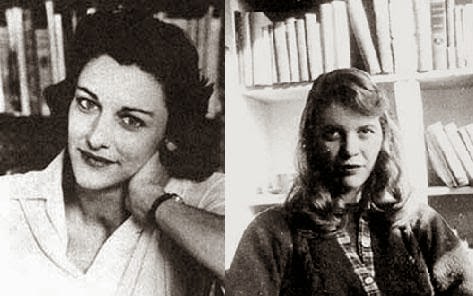
This panel will discuss three noted McLean Hospital associated poets: Robert Lowell, Anne Sexton, and Sylvia Plath. All three of these Confessional poets were psychiatric patients at one time at McLean. Lowell wrote his canonical poem "Waking in the Blue," about his experiences at McLean on Bowditch Hall. Sexton led poetry groups there and was once hospitalized briefly at McLean; Plath was hospitalized at the hospital and her novel The Bell Jar was based on her experiences during her tenure there.

McLean Hospital, a psychiatric hospital in Belmont, Mass. has been declared a national literary landmark, because of the  many creative geniuses afflicted by mental illness that have been treated on its wards. The panel will discuss each of these poets, ((Lowell, Plath and Sexton) their experiences as patients, how their experience is reflected in their work, and how and what they managed to create with such a heavy burden of psychiatric illness.

Panel members will include Lois Ames author of the biographical note to  The Bell Jar and Anne Sexton: A Self-Portrait in Letters,  Kathleen Spivack author of  With Robert Lowell and His Circle... and Bob Clawson--confidante to Sexton and manager of her folk/rock band Anne Sexton and Her Kind.

The moderator will be Doug Holder, a poet, counselor and, author of the poetry collection:  From the Back Bay to the Back Ward... Poems of Boston and Just Beyond  and poetry group leader at McLean Hospital since 1982.


http://masspoetry.org

The Truth that Must Out in The Telling, a new book of poetry by Denise Bergman


The Truth that Must Out in The Telling, a new book of poetry by Denise Bergman


reviewed by Michael Todd Steffen


Denise Bergman’s new book of poetry, The Telling (ISBN: 978-0-9910091-4-5/Cervena Barva Press/
P.O. Box 440357/W. Somerville, MA 02144-3222) with its hushed voice invites the reader to lean into the space of a shared secret that resists being told yet has to be. It is a secret a grandmother imparts to a granddaughter with stunning unexpectancy. It is a shock equal to the breaking of a jug full of water caused by a frail child’s stumble. And in poetry how could this recurrent image of the broken jug in Bergman’s memory of herself as a girl not get confused with the image of the secret, another child lost long ago to the grandmother, because of a premature birth, or because accidently dropped?

Yet the subject of this meditation in poetry undergoes, almost immediately, a shift from that overwhelming loss itself to the difficulty of how to talk about it, what to say. The uncertainty of the circumstances, the event’s remoteness in time, the shock and trauma amplify with an odd grace and relief the act of relating the tragedy, the telling of it, hence the choice of Berman’s title for the book.
   
That was the telling,
    my grandmother fleeing.
    A sepia memory
    mildewed, perhaps, or not

    the telling, as if a coin lifted from a box at the back
    of the bottommost drawer in the darkest
    most airless corner of the shadedrawn room

    her telling

    told to no one but me
    and that time only…            [p. 4]

Circling again and again around the sharing of this secret, echoing a smattering of images – the broken jug, the granddaughter’s “matchstick” thinness, blueberries from muffins, nest of elbow, a coin’s faceless verso – far from affirming the tragedy, Bergman’s task in poetry here is to witness perhaps beyond, or shy of, judgment, hovering at the process, the hashing out of what’s being told and the symbolic surrounding of the moment between grandmother and granddaughter. What surfaces as a result of this patient approach at truth and fleeing from it is an existential innocence wherein happening (verb) has equally violated those (subject) involved in what happened. In a striking sense, Bergman’s sympathy and con-fusion with her teller is a sharing, across generations, of grief’s burden. This book gives us an extended, original undertaking of the compassion and advocacy for the guilty by people of faith. Bergman’s task at the page confronts again and again the buffeting of the guilt involved in what happened to her grandmother in her attempt to understand it.

        Blue finger-
    prints
    on the faceless verso

    coin
    pulled from a place where memory
    is a crime
    and not remembering not
    a possibility.                [p. 52]


There is an imagistic, haiku feel to Bergman’s verse in its surrender of forbidden information, with a stubborn refusal to engage or speculate with the suspensions and deflections of rational discourse in conceptualized language. Through to the other side of the inadmissible and condemnable, the artist in Bergman has found this liberty of constriction, this poetic speech of things and sensations in their associative arrangements:

    Pink, chirping
    round of flesh from the V of her mother’s thighs
    wailing, arms and legs flailing

    drapes over her shoulder, nests in her elbow… [p. 34]


In this dissolving of conceptual boundaries for identity, the act or capacity to sympathize or identify is intensified in its moments of realization. We cannot help but fall in love with Bergman’s birches:

    Feckless trees.

    The leaning-in birch, weeping birch, white and paper
    birch swinging lank empty limbs.

    Spare and spared, undressed.
    Peeled-off pages of bark a mess of blue stain… [P. 50]

The blue of that stain is for the ink all over those “Peeled-off pages.” The trees mirror as it were miscarried humanity and also a troublesome manuscript in disarray.

In her praise of the poet’s originality, Martha Collins has noted Bergman’s resourcefulness, using “something so small to such large effect.” When we read the epithet “weeping birch,” for example, fleetingly somewhere in the back of our minds the usual cognate “willow” for the adjective “weeping” wants to emerge. Birch (willow) birch (willow), one written or spoken, the other implied, omitted, teasing our minds, until a joining of the two words (intentional?) erupts pages later in “a billow of steam” toward the unraveling of the book’s meditation:

    Clear
    cloudless overhead, a dry
    dirt path

    a girl
    crumbling into bitten ground.

    Rain or shine
    a mother’s eyes track a billow of steam

    a blazing red
    sky.                    [p. 69]


The utterance of the word brings the reader an odd sense of resolution that retains its evasive burial. Penetrating the depths of loss and grief, hesitating around and withdrawing from those depths, the whole of what Bergman has shared with the reader here roves amply between the polarity of trauma and survival. It really hurt that bad. It hurt. It hurt. And that’s life. As the grandmother shared the blueberry muffins, something wholesome and sweet, with the granddaughter to sustain the revelation, Bergman graces the reader with shrugs of understanding, “no one dies/from a jug of boiled water” [p. 77].

The edition of The Telling by Cervena Barva Press – not Gallimard or Knopf – is impressive in its presentation of Bergman’s solemnity and silence, at times scarcity, denoting the thoughtfulness of her writing.

Denise Bergman will be reading from The Telling on Thursday January 24 at 7 pm in Basement Room B8 at the Center for the Arts at the Armory, 191 Highland Avenue in Somerville. Poet Kathleen Aguero will also read at this segment of the Červená Barva Press Reading Series.

Wednesday, January 22, 2014

Interview with Somerville Publisher, Poet, Professor Ralph Pennel

Ralph Pennel


Interview with Somerville Publisher, Poet, Professor Ralph Pennel

With Doug Holder

Ralph Pennel, like many Somerville residents I know, has many creative outlets. He brings his creative flair to the classroom at Bunker Hill Community College; he is the fiction editor of a well-regarded online publication the “Midway Journal” and he is a published poet and fiction writer. I recently spoke to Pennel on my Somerville Public TV show  “Poet to Poet: Writer to Writer.”


Doug Holder: Since we last sat down for an interview a couple of years ago, a lot has changed for you. You are now a lecturer at Bunker Hill Community College. How has the teaching experience been for you, and do the students differ in any way from the Midwest where you taught for many years?

Ralph Pennel:  My experience—teaching World Literature at Bunker Hill—has been great. I am always surprised by the experience the students bring to the classroom. The discussions are always lively—it is obvious that they are working towards something.

Many are working to transfer to a four year school. And their efforts to make that happen in terms of how they prepare themselves for class are apparent. A larger percentage of my students in the Boston, than say the Midwest, come prepared and have fewer excuses. At least in the classes I teach they are more than willing to participate.

DH: You told me that the Midway Journal,  which you are the fiction editor for, has been redesigned. How does it differ from the past?

RP: Anything on the internet has got a built destruct button in terms of looks and functionality. When we first went live in the fall of 2007 our site was very indicative of sites that were going up at that time. And if course if you don’t make any changes to your site it looks outdated. So when we redesigned the site we cleared up some of the functionality issues. There were certain problems with navigating the site. The new site makes things easier. The site just looks newer. The person we hired really had her thumb on what was current. Assuming we are around the next two or three years, we will do it again. We are in the process of growing. We brought in new fiction editors. We have an intern to help with Facebook and Twitter.

DH:  Your new poetry manuscript is titled: “The World is Less Perfect for Dying In.”  Tell us a bit about this.

RP: The manuscript is broken into two sections. The themes are loss, rebirth, literally and figuratively. I am grateful to the Cervena Barva Press for agreeing to publish it.

DH: Has your Midwestern sensibility been jaded by your exposure to the Northeast?

RP: Sometimes I forget that I really have been in the East Coast for four and a half years, and that I lived in the Midwest for most of my life. I don’t know if I truly fit in in the Midwest. I tried to be a little more straightforward than folks usually are there—so that brought conflicts. But still people easily identify me as a Midwesterner. Everything in the Midwest is planned on a grid—so it is not as conducive to the out-of-the box creative thinking. When you live on a grid you don’t really need to know how to get places. In New England it is more random type of lifestyle.

DH: I read a poem of yours “Nighthawks” Why do think so many poets are influenced by the paintings of Edward Hopper?

RP: I think it is the paradox that is reflected in his work. He uses bright colors often. The thing he does is set his characters in isolation-- the isolation of the American image. I think that is an interesting idea for poets. There is also an ironic aspect to Nighthawks—it has an everyman level to it. It is heartland America—with failed expectations.

DH: I find in your recent work a premonition of death, and the pull of gravity.  Dark stuff—are you a brooding bard?

RP: I take things hard—I am a poet after all (Smiles). I am emotional. No one is interested in poems where things go well. There is always hope in my work though—after all there is always birth and renewal.

“Planning Our Departure” by Ralph Pennel
Leaving nothing to chance, we start the day
by sharing our only surviving dreams.
Mine is simple.  The two of us driving nowhere
with little regard for the drive.
In yours, we are rowing.  Taking our time.
Taking turns at the oars.
We make nothing more of them than that,
that we have shared them.
You roll away from me, hand dropping
against the box spring,
as if to usher this bed into motion, into
one last feat of greatness though nothing on it stirs.
While we lie here, storm clouds
settle in above us,
rain gathers in their sagging bellies, felled cotton seed
invades every grassless patch of ground below.
I half expect to find this bed covered too,
mistake loose down against my pillow
for some ambitious seed that made it through
the screen beside this bed, seeking some higher,
safer place to land, who knows what falling is,
how it ends where no light reaches and never has.
Not even in the highest noonday sun when
the shadows are but charcoal blemishes no bigger than a sigh.
So much goes unsaid between us now.
The day passes us by slowly, drifts over
the trenches where we lay, the hours ahead
still unfulfilled except by all we cannot manage
the strength to save, by the rain, cold and hard,
falling from the sky to the earth where we wait.
We insist on waging our losses against an hour more
of sleep, against facing our certain departure from this room,
or from any room just like this where we may have landed
seeking shelter from all we can’t possibly begin to begin.

 ****** From the masspoetry.org website

Sunday, January 19, 2014

Stag’s Leap By Sharon Olds


Stag’s Leap
By Sharon Olds
Alfred A. Knopf
New York
ISBN: 978-0-307-95990-4
978-0-375-71225-8
89 Pages
16.95

Review by Dennis Daly

Confessional poetry never caught my imagination. But I do remember some breathtaking exceptions. I’m thinking of the intensity of Sylvia Plath’s Daddy and W.D. Snodgrass’ affecting Heart’s Needle. That’s a bit of my background and part of my peculiar bias.

Sharon Olds’ 2013 Pulitzer Prize winning collection entitled Stag’s Leap (the name and cover logo borrowed from a cheesy wine bottle trademark) spotlights all the worst faults of confessional poetry with few off-setting virtues. One of this book’s blurbs calls Stag’s Leap a “stunningly poignant sequence…contemplative and deep.” I find the same sequence, for the most part, pathetic shallow pabulum.

Poetically chronicling the decline and death of a marriage daunts and dispirits many writers, but it can be done. I know because I recently reviewed two of them. Mary Jo Salter’s Nothing by Design (Knopf) and Owen Lewis’ Sometimes Full of Daylight (Dos Madres) bring very different strengths to the table. Salter filters her sorrow and anger through a breathtaking command of formalist techniques. Her private emotions become public and high art to boot. On the other hand, Lewis is Everyman. He offers his gut wrenching confessions cold turkey in a free ranging way that allows him to connect with the reader, and the reader to then identify with him.  Stag’s Leap, however, provides little technique of interest and no connectivity. In fact Olds’ persona wallows in what seems like staged self-absorption. She seems convinced that her story is unique and has intrinsic value simply because she is who she is.

The collection’s first poem, While He Told Me, I found odd. After the husband informs the narrator that he is leaving her for another woman, they flirt and smile and go to bed in an oh-so-civilized but hackneyed scene. Later she awakes to an artsy image that does not have the right feel to it. Here’s how the poem ends,

…I followed him,
as I often had,
and snoozed on him, while he read, and he laid
an arm across my back. When I opened
my eyes, I saw two tulips stretched
away from each other extreme in the old
vase with the grotto carved out of a hill
and a person in it, underground,
praying, my imagined shepherd in make-believe paradise.

In a poem entitled The Flurry, Olds continues her chronicle with clichéd dialogue and tone-deaf imagery. The poet says,

I tell him I will try to fall out of
love with him, but I feel I will love him
all my life. He says he loves me
as the mother of our children, and new troupes
of tears mount to the acrobat platforms
of my ducts and do their burning leaps…

The term ex (as in ex-husband) is used in a number of these poems. It not only sounds off key in this context, but seems to cut off any subtle feelings that might inhabit these pieces. It sounds absolutely grating in the French Bra. Listen to these lines,

… it’s as if my body has not
heard, or hasn’t believed, the news
it wants to go in there and pick up those wisps,
those Hippolyta harnesses, on its pinkie,
and bring them home to my ex and me,
mon ancient mari et moi

Almost no one came to a seafood banquet Olds and her husband hosted and they both lived on the food for a week. Her husband during this time already had made plans to leave her. Yet Olds speaks of him with what sounds like a mathematically calculated unemotional sympathy. She almost anthropomorphizes her doctor-husband, in the sense that she imbues him with questionable humaneness, and she insists upon motivations and feelings that don’t seem to be evident from the bare sanguinity that she presents. Consider these lines,

…the wasted food was like some kind of
carnage. We lived on it for a week, as we’d been
living, without my seeing it,
on the broken habit of what was not lasting
love. When I remember him
at the stove, the sight pierces me
with tenderness, he was suffering, then,
as I would soon.

I hear the words but I don’t believe them. Is the poet simply deluded?  In her poem Crazy she seems to answer that question. She says,

…it is true that I saw
That light around his head when I’d arrive second
At a restaurant—Oh for God’s sake,
I was besotted by him.

Okay that I believe. But that does not, in itself, make for interesting poetry.

One of three or four decent or better pieces in the book, Olds’ poem Maritime works from start to finish. It is very good and the language dances. I can see why this poet has the reputation she does. The piece begins impressively,

Some mornings, the hem of the forewash had been almost
golden, alaskas and berings of foam
pulled along the tensile casing.
Often the surface was a ship’s grey,
a destroyer’s, flecks of sun, jellies,
sea stars, blood stars men and women of war,
weed Venus hair. A month a year,
for thirty years.

Running Into You, a poem destined to be forgotten, descends again into the pedestrian environs of who-really-cares. Consider these dreadful lines,

It was never in doubt that you had suffered more than I
when young. That moved me so much about you,
the way you were a dumbstruck one
and yet you seemed to know everything
I did not know…

Ugh! Accessible writing with little value added doesn’t deserve the notice that this collection has received. If you value your reading time, avoid Stag’s Leap.

Saturday, January 18, 2014

Interview with Sherill Tippins author of “Inside the Dream Palace:The Life and Times of New York’s Legendary Chelsea Hotel”

Lobby--Chelsea Hotel- In Better Days


I have often called my hometown Somerville, Mass., a burg just outside Boston and Cambridge, the "Paris of New England." And what I mean by this is not that it remotely resembles Paris physically, but that it harbors that same creative energy and that molten core of poets, writers, and artists, all in close proximity. And of course with encroaching gentrification of our town--the new developers, and the desire to attract the upscale folks--rents rise, and the artists will look to cheaper environs that are more inviting to a bohemian sensibility. This may or may not happen here in Somerville, but if we look at history, we will see that it is more or less inevitable. And in some ways the artistic community of the Chelsea Hotel and its fate reminds me of my hometown.

 The Chelsea Hotel in New York City has always been a source of fascination for me. This Victorian-era building, in the Chelsea section of New York City has housed some of the great names of music, literature and the arts since 1884. There was a great cross- fertilization going on here, musicians and poets and painters all influenced each other. Folks like the author Thomas Wolfe, composer Virgil Thomson, playwright Arthur Miller, rocker Patti Smith, Bob Dylan, poet Dylan Thomas, all have walked the dark, melancholy halls that were once peppered with artwork by many famous and not so famous denizens over the many decades.

The hotel is now a shell of its former self. With the gentrification of New York City, and the ousting of the benevolent Bard family who nurtured and protected the many artists who lived here over the years, the hotel is in rapid decline. Ed Hamilton, the author of "The Legends of the Chelsea Hotel" told me in a recent interview that many of the residents have been evicted, the artwork that graced the lobby and halls has been removed to places unknown, and many of the rooms in the hotel have been gutted. History is second to the bottom line.

Recently I had the pleasure to interview Sherill Tippins, author of the book: "Inside the Dream Palace..." The book is a comprehensive history of the hotel and a record of its influence with the arts in New York City and far beyond. The days of rooming houses and affordable housing in our major cities is a distant dream in our collective past. The artists who came to the Chelsea and the vicinity and other gone-to-seed backwaters in many other cities, often revitalized the areas and then ironically they were forced to move on. The Chelsea may well become another boutique hotel surrounded by trendy Thai restaurants, and the prerequisite Starbucks--but I think its legacy will live on because of all the creative tendrils it spread across New York, the country and the world.


Doug Holder: Sherill--you wrote a previous history about the communal Brooklyn home that poets and authors like W.H. Auden, Richard Wright, Carson McCullers and others shared. What is it about this shared space among creative people that attracts you?


Sherill Tippins: I’m interested in looking at artists and their work in the context of their environment – the relationships, working conditions, and activities that affect their work in all kinds of ways. I find it so helpful in terms of understanding, say, Carson McCullers’ The Member of the Wedding, to know that as she began working on the book she was eating breakfast each morning with W. H. Auden, who informed her that she needed to work on developing her intellectual side (as opposed to her intuition), and whose love, Chester Kallman, had as a child actually experienced the central event that McCullers’ protagonist, Frankie, undergoes. Likewise, I gained  a new outlook on Arthur Miller’s play After the Fall, knowing that he wrote it while irritated by what he considered the irresponsible moral relativity of his pop-artist neighbors at the Chelsea Hotel.


I’m also fascinated by the delicate dynamics of these kinds of group creative life – that fact that even a slight shift in the balance between structure and spontaneity can poison the atmosphere so that the work fails to satisfy or the group disbands. What are the specific requirements for creative cohabitation? How can privacy be protected while also leaving room for others’ creative input? Who should do the housework? Should the household be run on a democratic or autocratic basis? How high can the rent be before earning it takes up too much of each resident’s time? These nuts-and-bolts issues are not only interesting as practical experiments from which others can benefit, but they can make for high comedy which makes learning about them enjoyable.


DH: Have you ever lived in an environment -- a bohemian retreat--like the Hotel Chelsea?

ST: Like many of us, I lived in a group house while in college, where I learned how possessive some people can be about their groceries, how important it is to specify who does which chores, how creatively stimulating it can be to stay up until the early morning hours discussing books and playing music together, and so on. Since college, though, I’ve lived a traditional life as part of nuclear family. Documenting bohemian retreats has become a secret fantasy life for me – my real life may be predictable and even dull at times, but in my head I’m dining with Virgil Thomson at the Chelsea or chasing fire engines through the streets of Brooklyn with Gypsy Rose Lee.

DH: A lot of the artists in the Chelsea lived under the benevolent hand of Stanley Bard--whose family owned the building for years. He in essence subsidized many artists--did you ever feel that there was a sense of entitlement among the residents there--that they should receive special treatment because they were "artists?"

ST:  Stanley Bard, and his father David Bard before him, served the residents of the Chelsea with such care and respect that, naturally, they tended to believe over time that they deserved that respect. (It helped, too, that a constant stream of tourists passing through the Chelsea were even more awed by the artists’ presence.) I don’t believe, however, that the artists felt entitled to “special” treatment if that means better treatment than non-artists should receive. What they felt grateful for, at the Chelsea, was the Bards’ understanding that as artists they required had certain needs (privacy, tolerance, connection) and lived under certain conditions (erratic income, erratic hours) that differed from others living in the mainstream. Stanley Bard might allow a filmmaker to go for months or years without paying rent, for example, but he did expect to be repaid eventually – because he understood that a director’s income may be enormous one year and completely nil the next. Any artist knows how difficult it is to manage this fact of life in a society that expects bills to be paid regularly each month. Naturally, once the Chelsea residents had found partial relief from this hardship they didn’t want to give it up – so I’d say their response to losing it was more a case of grief or even panic than a sense of entitlement.

DH:  In your research did you find any similar hotels, etc.. like the Chelsea.. that existed in this country?

ST: As far as I have been able to discern, the Chelsea Hotel is the largest and longest-live artists’ community in the world – and in history, in fact, it would seem. There are other bohemian hotels in the world, of course – such as the former Chateau Marmont in Los Angeles before it got its makeover. And there were other Fourier-influenced cooperatives in the United States – in Boston, for instance, not to mention the earlier Brook Farm and other rural communities. But I know of no other hotel that was intentionally designed as a creative community and that continued to function as one year after year. If one ever did exist, I would love to know about it!

DH: Why do you think Europe is much more receptive to these type of living situations?

ST: The idea of creative community is an integral part of Europe’s social history, and the idea got a huge boost with the advent of the nineteenth-century utopian philosophers. Philip Gengembre Hubert, the Chelsea’s creator and himself a Frenchman who came directly out of this proto-socialist climate and helped transfer its ideas to New York, wrote that Europeans were more comfortable with a communal, economically-mixed climate because they could rely on a rigid social structure to define their social status. Americans, on the other hand, lived in a supposedly classless society where money was the only measure by which they could define their social position. Maintaining one’s social status in America therefore almost requires one to set oneself apart from others of lower economic standing, hoard one’s financial assets, and focus on individual advancement rather than achieving synergy as a group.

DH: There were many eras to the Chelsea--which one do you think cemented its reputation, as an outpost of bohemia and the avant-garde?

ST: It was an outpost of bohemia and the avant-garde from the very beginning, as evidenced by the novelist William Dean Howells’ portrait of it in his 1893 novel The Coast ofBohemia. The American landscape artists who first occupied the Chelsea’s top-floor lofts were as poor, free-living, and artistically adventurous as the artists who live there now. Trying to pinpoint the moment that the building’s bohemian reputation for bohemianism cemented is exactly like trying to pinpoint the moment at which cement hardens – but I guess I would say that by the Depression era the hotel’s reputation was widely known. By this time, for instance, Thomas Wolfe’s editor Maxwell Perkins knew enough to send the author to the Chelsea when Wolfe needed an inexpensive, private, tolerant environment. There, Wolfe found a welcoming community of iconic but impoverished artists and writers, including Edgar Lee Masters and John Sloan (not to mention the slightly-less-impoverished Virgil Thomson). The W.P.A. subsidies greatly enhanced this atmosphere, allowing the residents to worry less about the rent and more about where art was going in America. The richness and excitement of this period carried forward into the 1950s and 1960s – which wouldn’t have been the same without the underlying layer created by the W.P.A. artists.

DH: Residents like the musicologist Harry Smith, Arthur C. Clarke believed that art can change the world. And they tried to do it from their rooms in the Chelsea. Now--looking at the Chelsea --it is a gutted shell of its former self. Is the dream dead? Do you see other bohemian enclaves coming around? Or is it just college graduates posturing in Williamsburg until they get real jobs?


ST: I’m afraid I do feel, personally, that that particular dream is dead for the time being – at least in New York. As I implied in my treatment of Harry Smith’s experience, I feel that in the battle between the bohemian vision of creative community and the capitalist ideals for a market-based society, capitalism won. Commodification kills truth in art; a high cost of living kills artistic productivity. However, there will always be artists and bohemians (just as there will also always be posturers). As Patti Smith herself suggested in a recent interview, the place to find creative communities is now more likely to be in smaller towns near big cities – say, in New Paltz, New York, now nicknamed “the new Brooklyn,” or in failed cities such as Detroit, where the most important element for creative life – a low cost of living – and the second-most-important one – stimulating neighbors -- still exist.

As for the Chelsea, I’m interested in following the current owner’s stated desire to recreate an “artistic climate” at the hotel. Can it be forced into existence, with free rooms for visiting artists, exhibition and performance space downstairs, and expensive rooms to subsidize cheaper ones? One would tend to say no, but on the other hand the original Chelsea was itself an artificial construct. It’s unlikely, but still remotely possible in my opinion, that the Chelsea will reassert its traditional purpose despite the hostile climate in the city surrounding it. And who knows – as New York mayors come and go and the economy continues on its erratic path, this city may hit the skids once again, allowing the bohemians to come rushing in to inhabit the places no one else wants, “like cockroaches,” as the artist and Chelsea Hotel denizen John Sloan once memorably said.
Pickled Dreams Naked poems by Norman Stock


Pickled Dreams Naked
poems by Norman Stock
NYQ Books
New York, New York
Copyright © 2010  by Norman Stock
105 pages, softbound, $14.95
ISBN: 978-1-935520-30-6
Vera Pavlova was born in Moscow. She graduated from the Gnessin Academy, specializing in the history of music, and is the author of fourteen collections of poetry, four opera librettos, and lyrics to two cantatas. Her works have been translated into eighteen languages
Review by Zvi A. Sesling

the smelly feet of poetry
the running nose the ripped trousers
the bleeding pimples the disfigured faces
of the sick is what poetry
is trying to get at, the sonnet about nothing at all that is beautiful
disorganized elbows and old people asleep
the covers covering them the comforts of infants
is what poetry must make itself out of, there isn’t anything else

This is the poem Prosaic from Norman Stock’s volume of poetry.  Poets may or may not agree with Stock’s definition, but it certainly is a thought provoking eight lines which may or may not help one evaluate their own or others poetry. In fact, it is possible the entire book will be liked or not liked, help or not help evaluation of poetry or one’s own lines.

Here is another poem entitled At a Boring Poetry Reading the reader may or may not find humorous or insulting:

They read the audience to death.
These poets use live ammunition, their words, to weaken us.
Are they trying to put us to sleep or are they trying to keep themselves up
by droning on and on? Instead of listening, all I’m doing is waiting for them to stop.
The applause will be like glass breaking, the glass they are enclosing us in.
It is as if they tied their shoes in front of us just to show us they could tie their shows
      in front of us!
O save me from this scatterbrain orderliness, this posture of beheading.
Will this reading never end? Will I have to listen forever
or can I find a chink in the wall of my own mind that I can crawl into, just to get
      away from this disaster, this dying, this voicelessness?


Now this makes me wonder what kind of reading Stock gives and how his audience reacts to his performance.  In fact, how does any audience react to poems read by poets other than those of higher stature, for example, Collins, Oliver, Ostriker, Ashbery, or others? 

Well if you think Stock complains too much, this book is really one of numerous complaints as in Money Song:

money money everywhere
in the sky and in the sea
everywhere, it’s just money
falling from the leaves and trees
all the different currencies
down they come and up they go
it’s a constant undertow
everywhere I look I see
every kind of currency
it’s too much to get and spend
will it ever have an end
only in the grave where you
will have spent all that you’re due


Stock’s view of women is not always, shall we say, politically correct.  In The Tall Woman of Dreams he writes a woman so tall she is invisible—does mean women should be seen and not heard?  Or, as the final line states “…the woman whose size was infinite and who was all over/everything and everywhere”   means they [women] are all pervasive and intruding?

Then again read the night about me restless where the poet completes his three couplets with “the distance and the slowness and veering/her up, so she will not be seen or noticed or known

Now let me say there has been some praise for Stock for being wry, wacky, humorous, and having sardonic wit—these quotes from the back of the book.  And if you like that kind of writing, you might enjoy his offerings.


________________________________________
Zvi A. Sesling
Reviewer for Boston Small Press and Poetry Scene
Author, King of the Jungle (Ibbetson Street Press)
Author,  Across Stones of Bad Dreams (Cervena Barva Press)
Author, Fire Tongue (forthcoming, Cervena Barva Press)
Editor, Muddy River Poetry Review Online Poetry Journal
Editor, Bagel Bards Anthologies 7& 8

Publisher, Muddy River Books