Friday, September 09, 2016

Marc Zegans The Book of Clouds


Marc Zegans
The Book of Clouds
Kite-string Press
Copyright 2016


Review by Lo Galluccio

In Italo Calvino’s ‘Invisible Cities” Marco Polo is a messenger to Kublai Khan and his reports to the Emperor are dream-like and baroque descriptions of cities to which he’s traveled.  In the middle of the book, Polo admits that all of these cities are tropes on Venice, so even though they are all unique in design, style, purpose, essence, they have a Venice-like template.  In short, all the cities are the same city.  


In Marc Zegans latest collection, “The Book of Clouds” he relates an offering made to a loved one-- a friend or lover-- of a flange of clouds.   In this assortment, there are many different kinds of clouds, yet one wonders if they are all variations on the very first cloud in the book, given to the loved one as pleasure, diversion, protection and whim.  

In the first poem, the beloved asks for a “cloud tonight/a cloud hanging over the Pacific/high above the sunset, glowing with dusk.”  At the poem’s end we understand that the author and object of the cloud will be tethered together –“you sit on the beach in a small chair/your stringed toe rocking me on my cloud gently.” It is a beautiful image of a cloud, like a balloon tied to a toe that is rocking, while the lover sits on the beach.  We can picture dusk, perhaps the most lovely time to be on any beach as the sun starts to set.  The second poem is quite simple – “Would you like a cloud tonight?/ I think so./What sort of cloud?/ A simple cloud that you will pull with you as you walk the beach.”  This is a compacted version of the first poem story.  It echoes the first one, like a bell’s resonance.
There are all wonder of clouds in this collection: clouds heavy with night rain, clouds of magnificent colors, clouds of wakefulness and sleep.  Each cloud intended as a lullaby, a cushion, a spectacle for the beloved.  In number 7, denoted by a roman letter, the poet writes:

“As though dropping from a wall/you fall into tonight’s spun grey-cloud/softer than lambs wool, stronger than silk. It stretches around your sides, cradling your leap into dreamless sleep.”
Thus cloud as cradle or hammock leading to a sleep without dreams.  Sometimes we just want to sleep and not be beset with dreams, good or bad.  This is one condition that this poem grants the beloved with a magical grey cloud.  There is also this cloud’s opposite coming right after, “Free and festive, rested now for many days/you ask me for a cloud of vivid dreams/and I give you this cloud of radiant white/from which you can draw a million colors/strand upon strand/on which to weave your dreams.”  

Cloud 14 is a simple play on words: [c]loud/thunder/clap! The loud noise of the thunder is derived from the thunder cloud that claps to herald a storm.  There are thin clouds, and shy clouds that cleanse the day from weary eyes.  The most obvious benefit of these story-book clouds is that they promote sleep.  In cloud 19 the cloud’s colors transmute “From byzantine to aubergine/amethyst through mauve into orchid/eggplant entwined with English violet/the varied purples of your cloud/remove the robes of public office/leaving you only, ready for sleep./

In number 22, we find another cloud offering by the poet: “Your cloud glows Venetian Red/it has the scent of history/and the lushness of ripened fruit./  And in number 24, “Your cloud tonight is a delicious/confection of oranges and lemons/with enough cream to make a Pavlova.”

So the author explores the cloud as being a confection, like cotton candy, or full of cream like the Pavlova cake mentioned.  These poems are delightful offerings to the loved one’s hunger and add a dimension of taste to the clouds.  There is also an overall quality of parfait to these poems.  They are easy to take in, like a light dessert, something that cleanses the palate after a heavy meal or nourishes the dreamer with beauty and devotion.   

In number 25, “this cloud floats over horses/grazing on the salt-breeze grass by Muir Beach./ and it travels “by jet stream to meet you/the scents of eucalyptus and sea sliding you into enchanted sleep. We are keenly aware of the fresh and minty perfume emitted by this cloud and how it provokes a wondrous night’s sleep.

I should mention that this book was set up so that there is only one poem for every page and nothing but space adjoining that page.  The author wants the reader to be able to envision his clouds without any confusing juxtapositions.  So the poem, like a cloud, inhabits its own piece of the sky.  Each page tells a story about a cloud enchanting the beloved’s existence and mainly his/her’s sleep.  There are many delightful stories in this collection, dedicated to those ephemeral yet clearly manifest phenomena, clouds.  In the final poem, number 31, the poet concludes:” Tonight’s cloud is the cloud you have made/the cloud in need of no other/the cloud drawn from the light you have bestowed.”
Marc Zegans is the author of “The Underwater Typewriter,” “Boys in the Woods” and “The Book of Clouds.”  He is also a spoken word artist and an artist’s consultant.  

The book is presently available only at Lulu.  It will go into broader distribution in a few weeks.  Here’s the link to the book page on Lulu.

Wednesday, September 07, 2016

The Launch of the “New Saturday Club” A Literary History Celebration and Re-Creation at The Omni Parker House Hotel Kennedy Room


The Launch of the “New Saturday Club” A Literary History Celebration and Re-Creation 
at The Omni Parker House Hotel Kennedy Room followed by Parker’s Bar Saturday, September 17, 2016, 3:30 p.m.


Program    • Brief Introduction of the New Saturday Club    • Presentation by Susan Wilson, Official House Historian for the Omni Parker House, on the original Saturday Club and its literary members

  • Group discussion of literary conversation then and now at Parker’s Bar  Advisory Committee: William F. Bagley (Director Of Development, St. Mark’s School); Joe Bergin (Poet); Sam Cornish (Boston Poet Laureate Emeritus); Danielle Legros Georges (Boston Poet Laureate); Tom Johnston (Mayor’s Office of Arts and Culture); Susan Wilson (House Historian, Omni Parker House). 
The Original Saturday Club: “Founded by Harvey D. Parker in 1855, the Omni Parker House is the oldest of Boston’s elegant inns and the longest continuously operating hotel in the United States. It was here where the brightest lights of America’s Golden Age of Literature—writers like Emerson, Thoreau, Hawthorne, and Longfellow—regularly met for conversation and conviviality in the legendary nineteenth-century Saturday Club.” —Excerpted from Heaven, By Hotel Standards: The History of the Omni Parker House by House Historian Susan Wilson
          
SUSAN WILSON, the official House Historian of the Omni Parker House, is an award-winning photographer, writer, educator, and lecturer whose stories and images about the arts, entertainment, history, and culture regularly appeared in the Boston Globe from 1978 to 1996. In 1994, she began writing and photographing books on Boston history, including Boston Sites and Insights, The Literary Trail of Greater Boston, Garden of Memories: A Guide to Historic Forest Hills, and Heaven, By Hotel Standards: The History of the Omni Parker House. Susan has long been a consultant to and member of a variety of historic organizations in Boston, including The Boston Women’s Heritage Trail, the Massachusetts Historical Society, the Old South Association, The National Park Service, Boston By Foot, Forest Hills Educational Trust, The Dimock Center, and the City of Boston. She was project director for both Harborwalk signage and the Maritime Museum at Battery Wharf.


  Free Donations welcome for future honoraria. Food and drink at Parker’s Bar not included. RSVP and more information, Joe Bergin: jdbergin@gmail.com or 617-834-7631.  60 School Street, Boston, 02108 Paid Parking available • Near State Street and Government Center Stations

Monday, September 05, 2016

Loom By Kevin Gallagher


Loom
By Kevin Gallagher
MadHat Press
www.madhat-press.com
Asheville, North Carolina
ISBN: 978-1-941196-32-8
101 Pages
$21.95

Review by Dennis Daly

In the pre-dawn hours of August 21, 1863, during the American Civil War, William Quantrill led his infamous raid on Lawrence, Kansas, murdering at least 185 men and boys. The Confederate irregulars rode into the city, about 400 strong, with lists of their intended victims. Once there many of them simply shot any male that they could lay their hands on. Northern abolitionists, who largely populated Lawrence, were the hated targets. This attack culminated years of strife in pre-war “Bleeding Kansas” between the pro-slavery and anti-slavery forces, as well as the strange lead-up to this discord rooted in New England’s textile industry decades earlier.

Kevin Gallagher, in his new book Loom, searches through these Massachusetts mill roots and unmasks the little-known unholy alliance between capitalists of the North and slavers of the South. Gallagher does this by resurrecting a public genre of narrative poetry and then uses it to impart prosaic information (in this case history) with an effective didactic force. Aside from mnemonic considerations, verse employed in this way by a skilled poet can effectively direct emphasis and insert emotion like no prose piece can. And Gallagher is nothing if not a skilled poet.

Pirating the Power Loom opens the poet’s collection by recalling Francis Cabot Lowell’s momentous foray into industrial espionage. Cabot memorized the design of the power loom used in English factories and, with his partners Nathan Appleton and Paul Moody, established his own manufacturing facilities in Massachusetts. Here Lowell details his theft,

I stole their designs with my own two eyes.
I smuggled them to Boston in my mind.

Exporting designs meant jail in Britain.
Workers of looms weren’t allowed to leave.

So I snuck into Manchester myself.
I made it back two days before the war.


I saw iron cards and spinning jennys!

Not too different from the way other industrial countries have stolen manufacturing secrets from the United States. You can also feel the larcenous excitement in Lowell’s words.

When New England’s cotton industry took off it triggered some unintended consequences. Although the international slave trade had officially ended in 1808, slavery within the country was still legal, although a dying institution. Cotton plantations in the South needed workers and a multiplication of existing slaves through breeding seemed the answer. Gallagher’s piece Breeding Negroes captures the banality of these evil times perfectly. Consider this observation,

There’s a cotton nigger
for you!

Genuine! Look at his toes!
Look at his fingers!

There’s a pair
of legs for you!

He’s just as good
at ten bales

as I am for a julep
at eleven o’clock!

Among the textile captains of New England the Lawrence family positioned itself in the first rank of importance. They founded the mill city of Lawrence Massachusetts and nurtured strong connections with the Southern plantation system. Amos A. Lawrence, known as the Prince of the Cotton Whigs, directed the second generation of the family business. Gallagher chronicles a business tour of southern plantations that Lawrence took as a young man in a poem entitled Goodwill Tour—The Prince’s Diaries. Lawrence observes that not all is well in Georgia,

The countryside is very beautiful.
The ladies are pretty and polite.

What I had imagined as the Southern
planter is an exceedingly rare sight.

Some days when it is hot as hell
every man is burning for a fight.

I am finding it very different here.
Shake hands and try not to stare.

Years later the case of fugitive slave Anthony Burns affected this same Amos Lawrence greatly. Burns was captured in Boston and, after a violent attempt to free him by an angry abolitionist mob, the authorities returned Burns, under very heavy guard, to his “master.” Lawrence renounced his family’s ties to the Northern mill/Southern plantation system and became an activist with a vengeance. In his poem, The Stark-Mad Abolitionist, the poet lets Lawrence speak for himself,

I put my hands in my face and I wept.
I went to bed an old-fashioned conservative,
I woke up a stark-mad abolitionist.

Look what you’ve done. I can do nothing less.
You’ve given me a new purpose to live.
I put my hands in my face and I wept,

Then I put myself into his footsteps.
Burns is a hero, not a fugitive.
I am a stark-mad abolitionist.

I will see to it that we free Kansas.

When the Kansas-Nebraska Act passed the US Congress in 1854, the Missouri Compromise was overturned and the game changed. Now popular sovereignty would determine whether new states were slave or free. Amos Lawrence pushed his new abolitionist agenda by bankrolling anti-slavery settlers and building up cities such as Lawrence Kansas—appropriately enough, named after him. In one of my favorite pieces, Gallagher versifies a letter from Amos Lawrence to President Franklin Pierce, another New Englander. Lawrence states his position,

You have a problem with the settlers

from the “free States” opposed
to the introduction of the slave trade.

I note that you have now forced those settlers
to the conclusion that if they be safe

they must defend themselves out there.
I too have come to the same conclusion.

I have therefore rendered them assistance
By furnishing such means of defense.

The pro-slavers fought back by harassing and attacking the new settlers. Lawrence countered, fighting fire with fire. In Gallagher’s poem Farmers Turned Soldiers Lawrence explains,

To protect your freedom I send John Brown.
He has the look of a determined one.
When farmers turn soldiers they must have arms.

This is a simple case of right and wrong.
I send Sharps rifles so the ruffians run.
Never again shall they burn down your barns.

You must defend yourselves. Sound the alarms!

Amos A. Lawrence, like others on the wrong side of history, realized his mistakes, albeit a bit late. And, as often happens, shame and guilt bred brutality or at least the promotion of brutality in the person of Lawrence’s surrogate, John Brown.

Brown met terrorism with terrorism. At Pottawatomie Creek he slaughtered five individuals with pro-slavery ties. None of them, however owned slaves. The bleeding of Kansas had begun in earnest. Quantrill’s villainous exclamation mark on this matter waited for the cover of civil war.

Poetry collections this provocative and informative are rare. Gallagher’s Loom demands a large readership. I predict he’ll get it—and deservedly so.

Saturday, September 03, 2016

The Sunday Poet: Jared Smith


Jared Smith


That Night in '41

It was their eyes that always got me,
flat and unblinking as dinner plates
or as the coins we traded in markets,
but come from the deep with something
horrible endless dredged up to the light,
to be thrown dead naked on dinner plates.
You eat what you can get, I know, but
the scales themselves catch in your throat
when everything you eat comes from dark
and is drawn to the light you spread, and
nothing comes from the land you can see.

That night the blossoms bloomed at sea was
like so many nights our lads set the nets
and lit the diesel driven lights above them,
and the ever hungry water hissed beneath,
as the nets played out and the shrimp rose
drawn to an artificial dawn, and the great fish,
those that knew the eternal darkness of life,
rose to the light that filled their lidless eyes
and thrashed in the final spectacle of death
drawn to the elusive light that gave them life,
trapped thrashing into a world of demons,

The blossoms bloomed at sea distant while
I watched, first one and then an hour later another,
so that I held my girl in wonder on the beach
asking what was that and what was that, holding
each others hands as we watched the fairy lights
those trawlers carried on their rigging burst,
becoming flames that lit those floating cities
on the beaches back in October of 1941. The next
day, that fast, the trawlers knew to dark their lights
but the bodies of some of our Town-folk came in
smelling of the world of commerce and of Europe
and their eyes like those of fish filled with memory.

We read then of the U-Boats off the coast of Coney Island
at night and the shape of freighters caught in the light
of amusement parks, and we learned to eat less
like the Great Depression that blew in from Arizona
and filled the sky over Washington. We were afraid,
but still town is town and you do what you must do.


----Jared Smith  ( Originally published in the Malpais Review) 

*** Smith is an editor at the Turtle Island Quarterly and on the board of the New York Quarterly. His poetry and prose have been widely published.


Thursday, September 01, 2016

The Hatred of Poetry by Ben Lerner


Review by Wendell Smith

The Hatred of Poetry
Copyright 2016 by Ben Lerner
Ferrar Straus and Giroux
New York, NY 10011
IBSN: 9780865478206(paperback)
           9780374712334(e-book)
$12.00


The Hatred of Poetry was presented to me as fortuitously as The Never Ending Story was to Bastian Balthazar Bux, as an apparition the legendary Joe Leaphorn would have told Jim Chee not to dismiss as coincidental. This monograph celebrating our ambivalent dependence upon poetry manifested one Saturday morning on the table of the Bagel Bards at the Au Bon Pain in Davis Square by way of the Canton Public Library. I picked it up preparing a rebuttal that I never got to because, when I discovered that Ben Lerner had first encountered this conundrum we call poetry where I had, in an English class at Topeka High School, I was hooked, and I soon discovered that even with my head start (I graduated from THS in 1960, he in the mid ‘90s) he was way ahead of me.

Lerner begins his essay with an anecdote that sets a comic tone for our shared struggle with poetry. His freshman English teacher, Mrs. X, requires her class to choose a poem to memorize and then recite. Learner, well, let's let him tell the story:

So I went and asked the Topeka High School librarian to direct me to the shortest poem she knew, and she suggested Marianne Moore's "Poetry," which, in the 1967 version, reads in its entirety:

I, too, dislike it.
      Reading it, however, with a perfect contempt for it,
one discovers in
      it, after all, a place for the genuine.

I remember thinking my classmates were suckers for having mainly memorized Shakespeare's eighteenth sonnet, whereas I had only to recite 24 words. Never mind the fact that a set rhyme and iambic pentameter make 14 of Shakespeare's lines easier to memorize then Moore's three, each one of which is interrupted by a conjunctive adverb – a parallelism of awkwardness that basically serves as its form.
* * *
In fact, "Poetry" is a very difficult poem to commit to memory, as I demonstrated by failing to get it right each of the three chances I was given by Mrs. X, who was looking down at the text my classmates cracking up.

He follows his narration of this joke that poetry has played upon him with some 80 pages of cogent prose exploring the implications of those three lines and 24 words. “I too dislike it,” becomes a mantra that brings unity to the variety of his arguments and I am finding his essay more useful in “understanding poetry” than Cleanth Brooks’ and Robert Penn Warren’s tome, Understanding Poetry. One reason I think Lerner’s book is more useful is that he seems to know poems should be experienced, felt not “understood.” This brings to mind a poem about poetry, which we foist upon high school students, Archibald McLeish's, "Ars Poetica"; although I find it too precious by half -- “I, too, dislike it”-- its final two lines "A poem should not mean/But be." support this idea that the “meaning” of poems is somehow beyond comprehension by our reason.

The Hatred of Poetry has a quality that I think good criticism needs; it stimulates your imagination about the poems you already love; it encourages you to freely associate with them, which enlarges their being. For example, as I was contemplating poems above for recruiting youth to The Hatred of Poetry I thought, rather than “Ars Poetica,” we would be more successful if we were to subject them to Ramon Guthrie's, "On Seeing the First Woodchuck of the Spring and the Last Pterodactyl." And, although my reasons for preferring Guthrie are an essay for another day, I think the arrival of Guthrie in the middle of this evaluation of Lerner's monograph demonstrates The Hatred of Poetry’s power of provocation. Why bother to read criticism if it doesn't set you thinking about its subject, set your mind to exploring the territory.

In fact, I think this little monograph (the book is 7.5 X 5 inches and the text blocks are 3 X 5) would make an excellent text for any introduction to poetry. Ironically, before you could subject the tender eyes of sexting adolescents to it, you would have to edit out his one use of "fucking." In spite of how refreshing it would be to have the language of everyday discourse used in a discussion of poetry and how that use might free students to think about how to dislike it, "fucking" would be the excuse censors would use to dismiss Lerner. I think, their real objection might be that his thesis brings him to praise poetry such as Claudia Rankine's with its power to make us feel; in her case its power to breed empathy in our souls for what our racism does to her, how our racism lashes at her sensibility, and to recognized the shear produced in our own souls by our concurrent awareness of our white privilege (I feel your pain and I am simultaneously protected from it.). If our hatred of poetry can lead us to appreciate such poetry, then it will lead us to appreciate our hatreds and the paradox that we can’t do anything about our hatreds until we can appreciate them. And those appreciations lead us to question a social status quo. In other words, The Hatred of Poetry is dangerous. This danger attributed to poetry is another theme dating to Plato, which Lerner explores in parallel with the paradox that poetry has also been reviled for being impotent. 

The Hatred is good criticism because it gets you thinking in new ways about poetry familiar to you while it introduces you to poetry with which you weren’t familiar. Learner has intriguing things to say about a bundle of poets beginning with “Caedmon, the first poet in English whose name we know” to Whitman and Dickinson. As he discusses them he develops his compelling thesis: poets, too, “dislike it” even as they write it, because the imaginative source of the poem can never be realized by either the poet, nor her reader. As a dream is lucid until we wake so the poem is lucid until it is written (Lerner’s metaphor). Thus the poet is doomed to failure (truth perceived is always compromised when translated into words) but also doomed to perpetually attempt that translation. The argument implies that the human condition is a divine imagination, which can’t be expressed fully in a material reality (illusion?). Wordsworth (the irony of allegory): "our birth is but a sleep and a forgetting;" Browning: "Ah, but man's reach should exceed his grasp." You, no doubt, have your own fragments that point to what we might come to know about our selves through poetry once we admit our hatred for it. Here is how Lerner puts it in his concluding paragraph:

There is no need to go on multiplying examples of an impulse that can produce no adequate examples – of a capacity that can't be objectified without falsification. I've written in its defense, and in defense of our denunciation of it, because that is the dialectic of a vocation no less essential for being impossible. All I ask of the haters – and I, too, am one – is that they strive to perfect their contempt, even consider bringing it to bear on poems, where it will be deepened, not dispelled, and where, by creating a place for possibility and present absences (like unheard melodies), it might come to resemble love.

And I’ll close my praise with a cheer, “Hoy! Hoy! Mighty Troy!” that may only be appreciated fully by the 15,000 or so of our fellow graduates because, if he continues writing like this, Ben Lerner could become to 21st century American letters what another Topeka High School alumnus, Dean Smith, became to 20th century American basketball.

Tuesday, August 30, 2016

Doug Holder: Poetic Healing

( The Boston Globe-- Feb. 2000)


This article was on the front page of the Arts Section of the Globe some years ago--about my work as a publisher, poet, and poetry group leader at McLean Hospital-- a national literary landmark and esteemed psychiatric hospital...


Poetic Healing: As the hospital and its clients have changed, counselor Douglas Holder adds another dimension.


THE BOSTON GLOBE: (Living Arts: Feb. 8, 2000.)

Poetic Healing: As the hospital and its clients have changed, counselor Douglas Holder adds another dimension.

By Michael Kenney (Globe Staff)

SOMERVILLE—In the fourth collection of poetry of poetry Douglas Holder has published at his Ibbetson Street Press here, he includes a poem of his own, titled: “ A Simple Nod.”

I saw him in Harvard Square,
happily walking with a friend.
As we passed each other
we exchanged a simple, understated
nod.
Our silence was a friendly conspiracy
a reminder of where he once was
and where he was
now.

The where is never stated—although two words, “the ward,” a few lines further on provide a hint. Holder, 44, is a mental health counselor, and for the past six years he has been conducting poetry workshops at McLean Hospital for its patients.

“ I’d been working there 17 years, and I’d had my poetry published in small journals,” he says. I wanted to add another dimension to my job and help a few folks out.”

While Holder would not think of ranking himself with Anne Sexton, who won the Pulitzer Prize for poetry in 1967, he does invoke the legendary poetry workshops she conducted at McLean in the late 1960s. Sexton, a patient at the Belmont hospital in 1973, committed suicide in October 1974.

Nor does Holder claim that the hospital today resemble the institution of those years. “It’s not like the old McLean,” he says, “with patrician types sitting around drinking tea from bone china.” That was the McLean of Harvard fullbacks, Porcellian Club members, and “ Mayflower screwballs.” That was the McLean that Robert Lowell, a frequent patient there in the 1960’s, memorialized in his poem “Waking in the Blue,” and that writer Susanna Kaysen, a patient in 1967, recalls in her best-selling memoir “Girl Interrupted,” now a major motion picture.

Today, Holder says, the members of his poetry groups are more likely to be the homeless “ coming in with a bit of doggerel.”

He runs two workshops, one on Thursday afternoons for patients in the hospital’s open-ward program, which meets in a converted Victorian mansion, and other Friday evenings for patients on two locked wards where Holder works. Neither is open to an outside visitor.


But whether in the mansion or in the more institutional setting of the locked ward, Holder says, “ I try to sort of have a coffeehouse atmosphere. We’ll have a round of applause when some reads a poem.”

Of course it doesn’t always work out as planned.

Holder remembers reading Allen Ginsberg’s “Howl” at his very first workshop.

“I was pretty enthusiastic then, and a bit naïve,” he says. I thought they’d like it. I saw the poem—with its lament about the “best minds of his generation lost to madness”—as a haunting cry that would be a catalyst for discussion.”

And he says with some self-deprecation, “ I thought they’d think of me as, “ Hey, this guy knows where I am coming from.”

Instead , “they were angry and one of them walked out,” he says. “And one of them told me: “Why do I have to hear this? I live with it.”

Another time, Holder says, a young woman became hysterical and ran out when he read a poem of his own about a kosher butcher in Brookline.

“It turned out the young woman had a painful experience in her life, which she associated with chickens, and she couldn’t take it,” Holder says. “ I had a lot of explaining to do with the clinical staff.”

“You never know,” he adds, “when you might hit a vein.”

The problem is compounded, Holder says, by the fact that today’s hospital stays tend to be shorter—a week or two instead of several months. “You don’t always know what to expect,” he says.

It also means that the workshops aren’t quite they were in Sexton’s day.

“I get in their face about it,” Holder says. “ I’ll go around to the rooms in my wards and ask: “Are you coming to the poetry group tonight?’

“And sometimes, I’ll have a doctor or another staff person tell me that so-and-so is a well-known writer, so I’ll make a special effort to get them to come.”

A number of poems written by patients in these workshops have been published—usually anonymously in the now defunct Boston Poet and other small poetry magazines. But not in his own magazine, which shares the name of his small press, Holder says, because that would violate hospital policy.

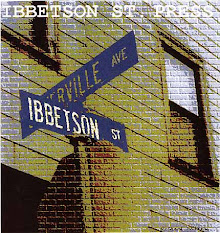
Because he believes that poetry can play a healing role, Holder started Ibbetson Street Press, out of house in Somerville—naming it after the street where he lives with his wife, Dianne Robitaille, a poet and geriatric nurse.

Holder, who got a master’s degree in literature from Harvard’s extension school while working at McLean, has been publishing his poetry in small magazines and especially Spare Change, the monthly journal for the homeless. “I write a lot about homelessness and mental health problems.”

Starting a small press to publish local poets, Holder says, was “ a way to get connected.”

The most recent issue—38 pages on 81/2 by 11 paper with a paper cover, bound with black slip plastic binder—sells for $4 and contains 40 poems; an interview with Ed Galing, an elderly small press poet; and several reviews.

Among the poets are a number of first-time writers and others described as “mainstays” of Holder’s press. There are also two professors of literature—John Hildebidle, who teaches at MIT, and Robert K. Johnson, who teaches at Suffolk University—as well as Don DiVecchio, the poetry editor of Spare Change.

Ibbetson Street Press has also published a number of chapbooks, and old English term for a small collection of poems or ballads, most recently: Poems From 42nd Street” by Rufus Goodwin, a poet and journalist who lives in Boston; and a collection called “ Poems for the Poet, the Working Man and the Downtrodden,” by A.D. Winans, who published a small poetry magazine in San Francisco.

“What distinguishes our journal,” says Holder, “is that it contains poems that anyone can read.” They deal “with everyday life. There’s not a lot of arcane words or funny verse patterns.” Anyone, he adds,” can get something out of them.”


The following is a poem written by an anonymous participant in one of Douglas Holder’s poetry workshops at McLean Hospital:


When The Hunter Arrived.

When the hunter arrived
at the place
where it was unfamiliar
he became the prey
stalked by everything
ever unleashed
by the conspiracy of creation.
to the edge he cantered
idols toppling by his sides
until at last
those that were against him
trusted his insight into their
essential nature
Finally pushing a hole through
God’s left eye
past what had separately
designed the limitless war
streaming beyond infinity.

 * This article came out years ago in The Boston Globe. It was the lead article in the Living/Arts. I found it in my archives and typed it up because it is no longer online. It can be purchased from The Boston Globe archives.

Jazz producer Alan Ringel dishes it out about jazz at Sweet Ginger in Somerville


Alan Ringel


Jazz producer Alan Ringel dishes it out about jazz at Sweet Ginger in Somerville

By Doug Holder


This is my interview with my old pal, Alan Ringel— experimental jazz producer and a founder of About Time Records.  I met Al over 30 years ago at McLean Hospital--where we worked as counselors. Al talks about one of their artists Henry Threadgill–who just won the Pulitzer-Prize, the “jazz loft” scene in the 70s in NYC– the role of improvisation and composition in jazz, misconceptions about Louis Armstrong, jazz writer Stanley Crouch — the jazz clubs in Greenwich Village, and much more… We had our discussion at the Thai restaurant “Sweet Ginger” in Union Square, Somerville.


Doug Holder: What is your definition of experimental jazz?​

Alan Ringel: I think "experimental” is a decent word. It involves improvisation-- a word that scares a lot of people. The idea that you are making it up as you go along—is threatening.

Doug Holder: Why?

Alan Ringel: I think in general it is a type of artistic expression that people don't trust. This is because they think anyone can do it. Like Jackson Pollack-- for instance. People thought he just threw paint on the canvas; and he got famous and rich. Improvisation is actually a skill you have to learn and master. You have to master the arrangement of music, composition, etc... You have to have the basics before you can effectively improvise.

Doug Holder: In the 1970s you experienced the jazz loft scene. Tell me about this. Was it a movement?

Alan Ringel: Everything in hindsight is a movement. When you are actually doing it—you don't think of it that way. When I was living in New Jersey—right outside of New York City in the mid 70s—there were a number of important jazz musicians all living on the Lower East Side. All of the artists on the Lower East Side knew every one else. So the jazz people knew the Abstract Expressionist painters—they all hung out together—they went to bars together, etc... But when you went to a concert—you didn't know there was this social scene of artists. I used to go to this club in Greenwich Village, the Five “Five Spot” It was famous well-before the 70s. It was around the corner from the Fillmore. The Tin Palace and a couple of other spots became popular around this time. Musicians were acquiring loft spaces in industrial buildings. They took these industrial spaces and created jazz lofts. And eventually this became a movement—Jazz Loft Music. It was really contemporary jazz that was happening in New York City at the time. Sam Rivers and his wife had a space in a building that Robert Dinero's mother owned: “ Studio Rivbea” During this time a lot of musicians were coming from the Midwest and California—and they were being recorded by independent jazz labels. An association was created, “The Association for the Advancement of Creative Musicians.” Getting back to the migration of artists to NYC-- folks like Henry Threadgill and the Art Ensemble of Chicago took up roots there. Writers like Stanley Crouch relocated to the city. Later Crouch and Wynton Marsalis started the original Lincoln Center Jazz Repertory Series.

Doug Holder: Years ago you produced work by the celebrated jazz musician Henry Threadgill. Since then—he recently won the Pulitzer. Has there been an upswing in sales for his album?

Alan Ringel: I am sure there was an upswing somewhere. Our records came out years and years ago. They still sell. But we didn't sell a lot more records because he won the Pulitzer. It is hard to find good distribution for independent labels. If we were a big record company we could sell more. Jerry Garcia once said, and I paraphrase, “ Not many people like licorice, but the people that do—really like it a lot.” That includes us—it is more true for us than the Grateful Dead.

Doug Holder: You are married to Lisa Houck—an accomplished print maker, graphic artist, etc... How does this work?

Alan Ringel; Lisa has done two record covers for us. However, Lisa's taste in music is quite different than mine.

Doug Holder: Threadgill—an innovative jazz artist—also uses the traditional jazz music of Jelly Roll Morton, and Scott Joplin. Can you speak about this?

Alan Ringel: Henry has a degree in composition. Threadgill's Album “ Air Raid” was composed with music of the two men you mentioned. Henry's music is steeped in the music of New Orleans. Jazz-- is an American Art that started with African Americans-- and the culture came from New Orleans. And remember-- Louis Armstrong-- who was born in New Orleans was a great jazz innovator. Everyone knew Armstrong in the 70s. He was a creative—avant-garde artist. His music was as easily sophisticated as anything Charlie Parker was doing. His small group sessions in the 1950s were as avant-garde as anything that was done in the 70s.