Tuesday, December 13, 2011

Poesy Magazine-- Due to be released Dec 19, 2011


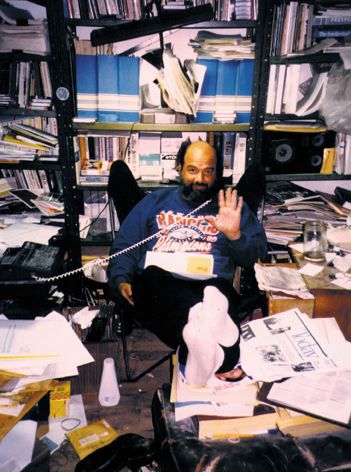
For the past 13 years I have been the Boston editor of Poesy Magazine http://poesy.org. After a 2 year hiatus Poesy should be online around Dec 19, 2011 and is already at the printers. I am glad to have an interview with Boston Poet Laureate Sam Cornish in this upcoming issue. See below:


Message from Brian Morrisey founder of Poesy


December 11, 2011
Final edits on XXXIX


This year I have dealt with death, loss, grievance, re-focus, relationships (friendly and unfriendly)… business triumphs and tragedies… how could poetry not surface from these trying emotions? I have been thinking a lot about purpose… direction…. focus (which is one of the shifts that led me back to publishing POESY this year). We were all put on this earth for a purpose. Most of us spend our life on a quest for true purpose and most of us never find it. If we are lucky enough to be enlightened as to what we are here for, it snaps and comes together perfectly like gluing the seams of disheveled aspects of life. For 22 and a half years, POESY has been been the only justifiable purpose in my life. As much as I ignore her, get angry at her, say bad things about her, she always comes back expecting more out me.

I am in the final edits of issue XXXIX. For the first time in two and a half years, I feel like I can move forward with my life again and continue with my purpose. The issue is in memorium of Scott Wannberg, an amazing poet who knew his purpose and lived to until his last breath. If you can’t say you did all you could for your purpose in this short life, then what’s the point?

About the issue: Conversations with John Drosey (Toledo, OH) and Sam Cornish (Boston, MA) John gives us an in-depth look at what it takes to live only against the means of words and art. Sam Cornish brings down the poet laureate ideals a notch by searching the barkrooms of underground poetry reading outside academia for inspiration. Poems, Poems Poems (not namedropping poets for the sake of the poetry), amazing photos and an in-depth review of t.kilgore splake’s “Facebook” chap along with other reviews by Joe Pachinko.

Sunday, December 11, 2011

A “Teaching Moment:” Jazz and Poetry


Our correspondent Rosie Rosenzweig reviews a performance of jazz and poetry at the Jewish Community Centers of Greater Boston in Newton, Mass... Dec 10, 2011.


-------------------
A “Teaching Moment:” Jazz and Poetry
By Rosie Rosenzweig
Resident Scholar in Women’s Studies Research Center
Brandeis University.


Stan Strickland began with something celestial-sounding on his bass Flute. John Lockwood followed, plucking his Bass Fiddle and Rakalam Bob Moses started caressing his drums with little broomsticks. And they were off painting an unlikely Improv: a full rainbow. This is called the “Be Here Now Suite,” which according to our MC Strickland is “an ongoing composition when each and everyone is present.” I think that’s code for we’ll never play the same stuff twice.

And I was transported back to my first earful at Bird land as a teenage bride, born in a provincial Canadian border town, with my New Yorker bridegroom, transporting me to a world I never heard before. I was educated that night into what was called, in the olden days, “cool jazz.” Only this time in Newton with a trio riffing away and me moving my head, I knew the evening was going to be a winner. I kept asking myself how could that mother of brass sing such soothing notes and then erupt in a chuckle with an unexpected squawk?

After the first set, I asked another question: So now where’s the poet?
As Robert Pinsky entered to a warm crowd of applause, it seemed that the music was a warm up for the talking guy. How so? His poetry was always a gourmet mouthful that I swallowed in a quick gulp. How would this work with these musicians?

Well, first the orator begins and I have the poem I wanted: Ginza Jazz - the terrible horrible history lesson in the life of the Saxophone, beginning with a Belgian named Sax (sic!) in Paris, morphing into an American child of song and then an African instrument.

The boilerplate form is this: Strickland begins with a familiar phrase on his saxophone, which attendee Professor Suzanne Hanser of the Berklee College of Music described as “idiomatic.”

The posse of musicians then listens and voices a chorus of individual call and responses, which in improvisation is a one-of-a-kind experience. Then, after this bit of a tune up, our former Poet Laureate repeats the poem as another voice, sometimes pausing for a bit to listen to his buddies, sometimes repeating a line again and again until slowly he becomes another voice in the riff, until his voice changes from the loner poet to a crooner, sometimes moaning out the words, sometimes even humming them, swinging his arms and knees until folks in the darkened theatre are moving like a chorus of the Blue Men Group, so popular here in Boston.

“A monosyllabic European called Sax
Invents a horn, walla whirled wah, a kind of twisted
Brazen clarinet . . .”
Everyone is listening to everyone else, as they are striffing and strafing with an occasional surprise wise crack in music. We are all smiling as we applaud and hoot.

I goggled the Internet for an appropriate word and found “tunesmithing” to describe their movement of sound. Cantor Lorel Zar-Kessler, at one of the back cabaret tables, later helped me define as a “masterful interweaving of melody.”

And this was only the beginning with Pinsky’s poem “Antique” about his stormy relationships at home growing up. You can imagine the music. Following this, appropriately enough, is a new poem called “Improvisation on Yiddish” describing the language as a
“Tongue of the guts, tongue
Of my heart naked, the guts of the tongue.

Bubbeh Loschen, Tongue of my grandmother
That I can’t spell in these characters I know . . . “

Bubbeh Loschen echoes of “Mama Loschen” the idiom for “Mother Tongue.”
Now I expected a bit of Klezmer, or maybe “Mine Yiddische Mame,” but surprise! Surprise! Play is the name of the game as I see Strickland up what seemed to be a Shekere, a West African gourd surround by seeds. Another subsequent Google search finds it and it’ a recent invention called a Cabasa with “endless loops of steel bead wrapped around a specially textured, stainless steel cylinder.” It can produce a variety of rhythms from scratchy scraping to soft fluid, which the bass and drums seem to love. Pinsky’s description of “previous lives and reincarnations” come to mind as the drums sound voodoo to me.

With Pinsky’s “The Hearts” the music seems to be driving the poet and now everyone’s eyes are closed. And we are expecting more of the same.

Now Boston University’s Professor Robert Pinsky must have recognized a teaching moment by shifting gears to another poet, 17th century dramatist, poet, and actor Ben Jonson, who once accused Shakespeare for “wanting art.” Jonson’s “A Celebration of Charis: His Excuse for Loving, “ which Pinsky calls “candy for the ear,” follows. Listen to this, he says: “here is a natural speaking to the meter of ‘Twinkle, Twinkle, Little Star.’ ”

And a star filled evening is was with Pinsky’s “Street Music” and “Rhyme.”

Flushed with memories, past and present, and an autographed copy of Robert Pinsky Selected Poems (Farrar, Straus, and Giroux, 2011), I head home with my old bridegroom to do what we used to do: reread the poems to one another and find new insights in old forms.


Rosie Rosenzweig, Resident Scholar in Women's Studies
Brandeis University, Mailstop 079, 515 South Street, Waltham MA 02254

Author of A Jewish Mother in Shangri-la (Shambhala)
Current Project: The Sources of Creativity Project

http://www.brandeis.edu/centers/wsrc/scholars/profiles/Rosenzweig.html

Thursday, December 08, 2011

Exhibit of the Forking Paths By James Grinwis


Exhibit of the Forking Paths

By James Grinwis

ISBN: 978-1-56689-280-3

Coffee House Press

800-283-3572

info@coffeehousepress.org

$16.00


Review by Dennis Daly


Artistic forces channel through James Grinwis’s poems in a very unusual way. His book juxtaposes eighteen lined, near conventional poems with twenty-nine prose poems, each one a meditation on an electronic mechanism and the symbol of that mechanism. Both types of poems are heavy on imagery (sometimes surreal). The symbols are simplified but effective pictures of the electronics named, much like Chinese ideograms. Ezra Pound’s imagist theories and Ernest Fenollosa’s studies come to mind.

In the poem, Capacitor, a truck crashes into a wall, and behind that wall are men throwing javelins and thereby unburdening their hearts of violence. The stripped diagram of this action is the symbol for a variable capacitor. A capacitor’s function is to hold a charge, which in this case equates with violence.

In the very next poem the act of aggression is replaced with a defensive mechanism, Achilles shield, and that is ineffective. A man on a moped crashes through and a scene reminiscent of the movie, The Graduate, takes place. Then all are enveloped in a surreal mushroom cloud. Sound a little much. Well, it works. So I, for one, won't quibble.

Note that with javelins, shields, and later dinosaurs, and Aztec accoutrements the dimension of time is easily crossed. In fact in Halo with Bolt Through It, the poet, says, “Many dots coalesce and crawl together or make very small holes in space.” We’re talking worm holes here.

In Thermistor, the poet describes “entering a sphere and being spun about, shot up, shot down, flushed down a drain to emerge in one piece so wet, so new.” In other words, out the worm hole and into a parallel universe.

The poem Awry details more about one of these parallel universes,


Because there are five planets

holding themselves

against a huge bleached face

I write things.

Like hello, and

“I know you from somewhere.”


Cold as some of these images are, there is still some humor here. A Snap Switch springs under tension, joins currents. The narrative follows the snap switch’s diagram thus:


The arrows have struck one another, and the people are pulling

them apart. When he goes to the office, his tie never fits. Then she

whose belt is too large comes to him.


Also, in the Poem, Canine As A Kind Of Tooth,


Oversexed. Under

weather. Some say a microchip

embedded by an alien

is at the root of us.

a trainer of whippets,

a whippet-eer. Nobody being

nobody, she whispers

under her brainstorm.


Many of these poems are populated with ghosts. These figures not only personify the essential soul of an individual, but also the phantom double operating in another world. In Acknowledgement,


a glue stick of a ghost

an area beyond ghostliness

is it the stealth ghost

the one who stares while he moves

eats the legs of gazelles while she sleeps


The care and feeding of ghosts is dealt with in the revealing poem, Of Phantoms:


His face like a tooth blasted apart, though;

only a spike would mess with it.

Still, he is your phantom. Care for him

We must care for the things under our wings…


In Landscape Lento,


… The soul stares at its image in the ghost mirror.

A lantern glows vastly across the ghost mirror, which releases an

eerie whine backed by a far off organ grinder. There is an inter-

mezzo that creates itself and weaves its notes only for you, a

mingling of winds inside: the wind’s own ghost mirror:

Snow…


The poem, Condenser, which is defined as storing a charge, gives a gripping description of life in this mechanized world. Following the pattern of the poem’s symbol,


Four vehicles have taken off from parallel locations and soon pair off

toward an emptiness characterized by large white spaces unless, in

actuality, two pairs of vehicles as they approach one another diverge

and split off into parallel lonelinesses …


This book is not an easy read and certainly not for everyone. That said, once you get used to leaping from imagist construct to mechanist diagram, it becomes a real interesting poetic game, and a fun game at that.

Wednesday, December 07, 2011

Check Points By Michael Casey


Check Points

By Michael Casey

ISBN: 978-0-9838238-1-0

Adastra Press

16 Reservation Road

Easthampton, MA 01027

18.00

Review by Dennis Daly


At its core black humor usually camouflages a tragic reality. These poems by Michael Casey effectively make use of this type of humor, but do more than just camouflage. They provide a serious tool with which one can confront the horror of war, in this case the ill-conceived Vietnam War. The author’s technique allows us to see the logic of madness from inside out. The poem, bolo, cleverly explains,

the captain asks me

were you aiming to shoot

the pistol out of that guy’s hand?

And I said

fuck no, sir

I was aiming

for the finger I shot off.

In another poem entitled Chicom a demolition expert is asked for a favor—to defuse a grenade so that it could be used as a souvenir. The ordinance guy

.. said sure

and tried to pull

the bamboo tube

out of the serrated metal cone

it didn’t work

so he started banging the grenade

viciously against the corner of the jeep.

Fragging, the killing of your own officers, is poetically dealt with here by infusing this definition with an outrageous potion of black humor. The logic in this humor is as inescapable as it is bizarre. The cause of this phenomenon is blurted out in the poem of the same name, Fragging:

…it’s entirely

from electromagnetic disturbances

in the atmosphere

like I’m dumb he yells out

sunspots sunspots.

Makes absolute sense, doesn’t it? Especially since the alternative reality makes no sense at all.

The gravitas of the book in total far outweighs the poignancy of any individual poems. In fact most of the poems need one another and become much better pieces in this context. A good example of this is the obvious character development of the narrator’s fellow MP, John Bagley. Each succeeding poem seems to color him in with more detail. In the title poem, Check Point, Bagley is no more than a punch line. He is a rule breaking MP, who gives the narrator a ration,

Bagley starts the shit

how he’s an MP too

what right I have

tell him what to do.

Then the narrator pounces,

the Captain ask me

make a head count of pees

leaving the LZ

so I point to Bagley

and say

one.

The poem, John John At Chu Lai Airport, paints more endearing qualities onto Bagley’s personality, as he deftly deals with the military bureaucracy using not a little wit,

so I wrote down

the reason I came to Bangkok

was

not the bus tours.

In Turnkey Bagley, Bagley brags how he caught US troops breaking into, not out of, POW security,

I caught them almost right away

from their laughing

which woke me up

just as soon as I heard it

if not earlier

The culmination of all of Bagley’s antics is reached in the poem, Army Commendation, when his character becomes an anti-hero of mythological proportions,

I was in country six months

when the entire unit

everyone in it received

an Army Commendation Medal

everyone but Bagley.

Of course a poetic character of this stature must accomplish some impossible deed with his super powers. Bagley does this by saving the narrator’s life in his own unique way. Says the poet,

… I was gonna go

I arrange for Bagley to wake me up

Bagley forgets all about me

and the theater is blown up

two separate charges

within fifteen minutes

I talk to Bagley at the hospital about it

he says

how’d that gook know

it was such a lousy movie.

Notice that the fact that Bagley is indeed in the hospital as a result of the bombing is glossed over as not worthy of mention, but is consistent with war-logic as portrayed by Casey.

After one of their comrades is killed (Cenerizio’s Service), Bagley copies the technique of another soldier to remove that thought from his head. The scene is both affecting and ironic at once. He hits his ear with a hand

slapping himself hard

and you know

I knew right away exactly

what he wasn’t thinking of.

In the same way we know all too well what Michael Casey is not saying about war’s unspeakable nature in this remarkable book of poems.

Monday, December 05, 2011

Richard Kostelanz: The Avant Garde at Brown University: 1960 (Excerpt only)


Richard Kostelanetz, the noted avant-garde writer, was kind enough to send this excerpt of an interview conducted at Brown University in 2004 to the Boston Area Small Press and Poetry Scene.


I

Richard Kostelanetz, born in New York City in 1940, went to Brown in 1958, graduating with honors in American Civilization early in 1962. He later did graduate work at Columbia University in American history and at King’s College, the University of London, as a Fulbright scholar, taking an M.A. at the former in 1966. Ever since, he has been an independent scholar/writer/media artist residing, until recently, in lower Manhattan. His work in various domains has been recognized with individual entries in Contemporary Poets, Contemporary Novelists, Postmodern Fiction, Baker’s Biographical Dictionary of Musicians, A Reader’s Guide to Twentieth-Century Writers, the Merriam-Webster Encyclopedia of Literature, Webster’s Dictionary of American Authors, The HarperCollins Reader’s Encyclopedia of American Literature, NNDB.com, and Britannica.com, among other distinguished compendia.


The interviewer, whose comments appear here in italics, was Sarah Bird, an undergraduate working with the radical cultural historian Paul Buhle in the American Civilization program at Brown University. She talked with Richard Kostelanetz in November 2004 after RK's lecture to the Coalition of Independent Scholars at the General Society Library in New York City. RK corrected and amended the transcript then and, with brackets, later.


I


The only remotely avant-garde entity on campus around 1960 was the college literary magazine that had been edited by the painter John Willenbecher just before I arrived. In its small office I met Bill Berkson, who left Brown only a few months after I arrived, later becoming a prominent poet and art critic on the West Coast, who remembers our meeting in the literary magazine office in a memoir that I found on the Internet and incidentally reprinted in my CD-Rom Intellectual Correspondence in the 21st Century (2005): “I can hear you now, in the Brunonia office, talking of Dissent, PR [Partisan Review], and other critical journals, of which at the time I knew not one thing.”


In my library is an impressive copy of Brunonia's Fall 1958 issue that contains contributions by Berkson, Richard Foreman, and myself, each of us presaging what we later became. While Bill has a critical review of "beat" poetry, Richard contributes not only a short play that he calls "a cartoon," but also an extended review of Bertolt Brecht's "epic opera," as he calls it, Mahagonny, which Richard was invited to direct decades later in Lille, France. (It didn’t happen, even after being fully prepared, for reasons beyond his control.) My own contribution to Brunonia is a witty aphoristic dictionary that presages the Dictionary I wrote in 1990 and rewrote a decade later. (This issue also has a stylistically unusual story by Peter Goldman, who briefly became an avant-garde filmmaker before doing something else.) May I wonder if other issues of Brunonia and its successors, not to mention undergraduate literary magazines anywhere, are so professionally prophetic?


I knew less Steve Overbeck, perhaps two years ahead of me, who, as S. K. Overbeck, was later a Newsweek cultural staff writer for a while. Only after graduating did I meet Harry Smith, who left Brown just before I came, but as publisher of a literary periodical titled Pulpsmith he became one of the few Brown alumni to publish me.


I took only one course with S. Foster Damon, a great teacher and a sort of underground avant-garde celebrity, whom I saw more off-campus, so to speak. An activist in the art and musical avant-garde dating back to the 1920s, he taught me an awful lot of useful stuff, especially how to be a professional, which is not quite the same thing as “how to write.” There was at Brown around 1960 no conscious political or artistic avant-garde or underground to any degree that Paul Buhle, a few years younger than I, understands the latter term from his own experience at Wisconsin—certainly not when I was there in the late fifties and early sixties. Paul edited an anthology of rich memoirs about the 1950s and 1960s in at the University of Wisconsin that I recall reading with envy [History and the New Left, 1991], because nothing comparable could be written about Brown during those years.


II

For my last three semesters at Brown I lived down Hope Street, next to a local library that became an historical society; that location was at the time really more off-campus than it appeared to be the last time I visited Brown—in the early 1980s. We lived on the edge of a Portuguese slum called Fox Point that was probably slummier then than now. And Foster Damon lived a few blocks away, at a parallel distance from the main campus, at 24 Thayer.


Who is Foster Damon?


Foster was an extraordinary man whom I hope is still remembered in some way or another at Brown. Do a Google search of his name now, and you’ll find a healthy number of references, thousands I think. His influence persists, even though he died decades ago. He founded the Harris Collection of poetry in the library, he knew avant-garde music, and he knew avant-garde literature. As an undergraduate at Harvard before World War I, he had co-founded with other students the Harvard Musical Review (1912-1916), which was meant to appreciate contemporary music ignored by their teachers. One partner in this Review was a man who went on to a more distinguished career, the composer Roger Sessions, whose daughter Elizabeth was my Most Significant Other for many years. Foster’s brother-in-law was the eccentric Boston poet John Brooks Wheelwright, who died too young, whose literary executor Foster became, whose poems are treasured to this day by John Ashbery, among others.


[Since this interview, Ashbery questioned in correspondence with me about New Directions waiting thirty years between announcing in 1939 and finally publishing Wheelwright’s collected poems in 1970, conjecturing that Foster might have been responsible for the delay, speculating further about Foster’s possible dementia. Knowing John, I replied that Foster was quite lucid in 1960-62, when I knew him best, if often pickled. John replied that the Wheelwright papers kept at Brown were a mess. I recalled that though Foster sorted American songs for the Harris Collection he wasn’t skilled at detailed archiving. I didn’t recall Foster discussing Wheelwright, though he often mentioned W.S.B. Braithwaite, who had anthologized Foster; but in 1960 I might not have recognized Wheelwright’s name. I speculated that perhaps publication had to wait for his wife Louise, Wheelwright’s sister, to return from institutionalization, as she did just before he died. Since he, not she, was the official executor, while they didn’t have children, my speculation was admittedly insufficient.]


Foster was important as well for publishing in 1924 the first big book on William Blake in America. In this respect, he influenced my wife-to-be, a Pembroker, who wrote her Columbia doctorate on Blake and, I’m told, gave her son by her next husband the first name of Blake. In the 1930s, Foster compiled a pioneering anthology of American Songs that subsequently influenced the musical compositions of his contemporaries Virgil Thomson and Aaron Copland.


Then roughly that same age that I am now—in his mid-sixties--Foster had been involved in various boys’ clubs in Fox Point, which was then a Portuguese slum behind Power Street. Ed Margolis, long an English professor in Staten Island, remembers that a decade before me Foster taught boxing to the Fox Point kids. Because his wife Louise Wheelwright had been institutionalized for many years, select local kids would become his house helpers. Some of them went on to careers at Brown, like Ernie Costa, who worked in the Brown library until he died young. Though Foster had more connection to Fox Point than I did, perhaps my experience there prepared me for my next address, which was a low-rent public housing project in Harlem, down the hill from Columbia University.


Dinner at his Thayer Street house once a week, first for me and then for both Bunny and myself, was central to our experience of “underground Brown.”


Were you already interested in the avant-garde when you were at Brown?


Not so consciously. I remember reading on my own initiative Harold Rosenberg's The Tradition of the New, which turned me onto the idea of the avant-garde, and then Roger Shattuck’s The Banquet Years. I must have reviewed the Rosenberg book for the undergraduate literary magazine because I received an appreciative letter from the publisher who a few years later did a book of mine. Foster told me a lot, as I said, about the American avant-garde, not only in literature but also in music.


Did you feel at that time that avoiding the Brown writing program was probably a wise move?


As a major yes, but not Foster Damon’s verse writing course for which I signed up, even though I had no ambitions to write poetry at the time and I didn’t much like Damon’s assignments, which required us to write poems in a succession of English verse forms from Beowulf to the present. [A half-century later, long since a devout radical formalist, I wish I could take it again.]


From Foster above all others I probably developed the intellectual ambition for always aiming to take my work to a higher level, to go where no one else has gone or would go, in my case not only in criticism but creative work and even in this interview I hope, much as he and Cummings did in their own careers. Remember that Foster’s big book on William Blake, published in 1924 when Foster was only thirty-one, achieves an extraordinary unraveling. Check it out sometime to be impressed even now by his powers of elucidation, defining clarity in literature that previously seemed inscrutable. Foster would tell that when he was a graduate student in English lit at Harvard in the early 1920s, supplicants were asked what they thought of William Blake. It was enough for the student to say, “Oh Blake, he’s crazy,” for the examiner to move onto another subject. Simply, Foster’s Blake wasn’t crazy, and he’s not been crazy since. When I edited a decade ago an anthology of the more radical Cummings writings, it was appropriate to dedicate that book to Foster. From him and from the Brown history professor Bill [William G.] McLoughlin, as well as other intellectual heroes, such as George Orwell, whom I also discovered in college, also comes the ambition to tell the truth, even an unfamiliar truth, much as I hope to do here.


Though David Kelly continued to major in creative writing, I realized, partly through observing David’s experience, that I should stay away from other Brown writing courses, which I now think were designed to make high school teachers. I have a vague recollection of John Hawkes telling me in my freshmen year that I had “no talent for prose.” Since he dismissed me, I had no reason to take any other courses with him, probably to my good fortune, we could now judge. I must have kept in touch with Hawkes nonetheless because I remember taking him and his wife Sophie to dinner at Foster Damon’s. They hadn’t met before, even though they were Harvard undergraduates thirty years apart. Should we be surprised that Hawkes never contacted me after my graduation, though, need I say, as an alumnus publishing both fiction and fiction criticism that are recognized in histories and encyclopedias. If he mentioned my work or even my name to later Brown students, I’ve never heard about it. Should this be considered another sign of Brown professors’ lack of respect for their more successful students? I remember a close relative of his telling me, perhaps two decades ago, that Jack “hated every minute” of teaching, which may have been true.


Some alumni writers a generation younger than I have acknowledged John Hawkes’s importance to their development. One of them, whom I’ve not met, Jeffrey Eugenides, even successfully appropriated the Hawkes formula of a narrator whose physical abnormalities give him a peculiar perspective on experience. Perhaps by Eugenides’ time Hawkes became more respectful of his better students, not to mention his teaching talents, and thus a more effective writing teacher.


Probably because Hawkes and Edwin Honig didn’t get tenure at Harvard, where they had previously taught, they assumed that even their stronger students were likewise Harvard rejects, as indeed we probably were, though that stigma didn’t disqualify us finally from literary careers.


David Kelly, at any rate, went on to get an Iowa MFA writing degree and is now [was, alas] a prominent West Coast editor, whose book on Secrets of the Old Growth Forest (1990) won an award from northwest booksellers.


******** Kostelanz has an ebook BROWN UNIVERSITY REMEMBERED (Amazon Kindle)


Richard Kostelanetz
1051 Wyckoff Avenue
Ridgewood-SoHo, NY 11385-5751
646-524-3462 tel
718-559-6926 fax

www.richardkostelanetz.com
c 2011 Richard Kostelanetz

Sunday, December 04, 2011

“The Dangerous Islands” (a novel) by Séamas Cain


“The Dangerous Islands” (a novel) by Séamas Cain
The Red Jasper press (The.Red.Jasper.gmail.com)
Kit Fryatt, Curator
26D Saint Brigid’s Road Lower, Drumcondra
Dublin 9, Ireland
--review by Tomas O’Leary—

This book by the Irish writer Séamas Cain poses a serious challenge to the intellectual,aesthetic, philosophical, physical, metaphysical and omni-forbearing wherewithal of a humbly attentive Irish-American poet who’s been entrusted with the task of layingout words in more or less cogent rows, by way of a review that might entice the astute and expansive would-be reader to give it a shot, thereby perhaps expanding even further his or her grasp of the endless battle of language to transcend itself and discover on the far side whatever must otherwise remain quite inaccessible to mortal fiddlesticks who demand of narrative at least some comforting hint which allows them to think from time to time that they know where they are in the long run of the story.

Having just read “The Dangerous Islands” and felt its formidable powers of image
and metaphor, of concepts somehow simultaneously both boggling and elucidating,
of characters who waft wraithlike in and out of plotless conditions wherein they are
rendered pensive or foolish or transubstantiated or bludgeoned or flayed, all in the
undeniable service of metaphor, I confess: I still don’t know where I am.

At sea or not, however, I very much admire the author’s tenacity of vision as he drives his rough beast toward its final watering hole, which reads thus:

‘The Lady O’Handrahaun was singing: “I thought of gems, from gems, antimony,
lotus fringed.” Frank urinated, soundless on the needle-pad, since Jane purged
insects and gems from a lion. The Lady O’Handrahaun arose in the misted sun,
the rainbow sun, bore the sun as weight that binds the transposed cosmic spheres.
Lions were painted as if crouched before the entrance of a chapel. They came to
light in the wide-open snarling night, jaws like red granite. Jane exhaled a cloud of antimony on needle-pads. The mountain was quiet, the snake could not move.
Jane gormandized with lions on the snake. A heavy wagon rumbled by red peonies,
and red insects quivered.’ THE END

The book is presented as (a novel) parenthetically. I would say it IS a novel (paren-thetically) – a heroic 240-page conceit of persistence or insistence transcribed from
the (parenthetical) mind of its creator, whose opening 22 pages serve as first-person manifesto which presents a romp of clowns who manifest the psyche in its throes of deliberation, creation, argumentation and all such ations as may kindle in the reader a fire to fathom what in hell is striving to be born here. Here then a handful of phrases snatched with haphazard intentionality from those pages:

‘I seek form and wait the mold, amorphous and unrealized possibilities, fecundity, fruition. Illusion is the precondition of creativity.’

‘Philosophy must become composition of line and curve. There is a secret delerium in my teeth. I have the illusion of unlimited extent, arbitrary.’

‘Aesthetics is my god. My rugged sides become heated, ripened fruit, rocks and
leaves, sunlight, sleek hides of animals, coloured flowers. All words must be
physical and tangible.’

Then too there are the Troubles, all in metaphor, ethereally poignant, bloody, soul-
searching, sometimes even humorous in way of word play or grotesquery of image:
that seething, writhing reservoir of infinitely mutable images sufficient unto the
writer, the sculptor, the painter, or any harbinger of the imagination’s game reach
beyond itself: Northern Ireland. And yes, there are characters, Frank and Jane and
Alan and Harry, and others as well most surely, but the one that rises up in all her
spectral substance., to bless the novel’s realm with shades of evil, is one called
the Lady O’Handrahaun, of whom it comes to be written:

‘The “there-is” of the Lady O’Handrahaun has no literary or novelistic being, and thus it guarantees, for any ideal novelistic being, the efficacy of its presentational function, its structuring function, which spills and splits, before and after its

effect, the ungraspable plethora, the somnambulistic plethora of being, from the
thinkable cohesion of the reign of number and image over effective literary
situations. Arpeggios hover over the religious paintings of old masters. Forms
float above the urine of a virgin.’

But my pickings, what can they serve of this strange book at large? Minute glimpses,
I’d say, of whatever it is I have seen there. Chapter 16 addresses the notion of Novel and proffers as follows: ‘The Novel is a phallus pierced through by a needle. The Novel is a seagull resting on a pier at the end of the lake. What perfect voice will tell you the truth about my novel? The Novel must be there like the earth when shadow covers the wet grass. I would have liked to have been an otter.’

I wouldn’t mind being an otter myself at the moment, all play and to hell with
profundity, except as one dives deep for the uncomplicated joy of it. Séamas Cain’s
“The Dangerous Islands” is a work of serious genius. Whether or not it draws you
in for the long swim, I do recommend you test the waters and see.

Friday, December 02, 2011

The Measure of Small Gratitudes by Ann Menebroker


The Measure of Small Gratitudes
ann Menebroker
Kamini Press 2011
ISBN 978-91-977437-7-8
order@kaminipress.com


"i'm old style, honey
wax paper wrapped sandwiches
and odd smelling lunch boxes
with handles, a thermos
with o.j. and gin, a banged-up
old portable radio once belonging
to an aunt of mine, playing songs
from the thirties and me, lighting
a cigarette from the matchbox
my mom got from "windows on the world"
when she flew to new york, alone
telling her children we didn't spend
much time with her, had dinner
at the world trade center and got
a little drunk at age seventy-nine."

Menebroker takes the small experiences that life offer so freely
and without any cost, she makes a poem that resonates universally:

"illness is such a distraction, so he puts
headphones on and listens to music
which is also a way to get to go other places.
his dentist has offered it as well as his
surgeon. when he takes the one he loves
into his arms there is music, but also
through its osmosis, a giving back
of the delectable and perceived beat
and the measure of small gratitudes."

Kamini Press has given us the reader another small gem, chapbook full of insight and clarity. The book will make a cherished gift for the poet lover.

irene koronas
poetry editor:
Wilderness House Literary Review
www.whlreview.com
reviewer:
Ibettson Street Press

Thursday, December 01, 2011

Presa 14: Tribute to Hugh Fox


Presa 14
Tribute to Hugh Fox
Presa :S: Press
2011 $8.50

Thirty three writers have given their tribute to the poet/writer Huge Fox. The last verse
of John Marvin's poem, sums it up nicely:

"then splashing in a quiet pool
singing soft songs of silence
treading water toward a center
smooth on its surface
then drifting in a current
growing swifter with depth
grasing waist and ankles
so gentle so caressing
so silent and so swelling
so much swifter and so still
then swifter still"

Hugh Fox was the king of small press and he became known to many of us through Doug Holder
who championed Hugh through out many years of correspondance and friendship. Many of
the writer knew Hugh for many years and some came to know him through his writing and
knew him for a short time. All the writers respect him with a genuine understanding:

R.S.
"can't hear myself think
over the scream
of your cinnamon thighs

as if
a plugged-in appliance were tossed in a bathtub
between us

we teach each other
how to be born
without parents

yours
taught mine
how to rhyme

first night in our house together
no furniture
every night of our lives

when you are away from me
i am
too

Mike Spikes

In the rememberance, Ellaraine Lockie, relates, "a week with Hugh Fox..I didn't know which gender
would arrive at the train station." This is a must read if you want an insight into the multi-faceted man:

"Foxy said his preoccupation now that he's in his seventies
is "death and how to get the maximum out of the little time we have
above ground." I can attest that he lived this philosophy for the
week we were together. Every following day resembled the first one
in its serendipitous and often outrageous course."

Wednesday, November 30, 2011

Ibbetson St Press Sponsors: Jazz at the JCC: Robert Pinsky, Stan Strickland, John Lockwood, Rakalam Bob Moses...


(Stan Strickland)


(Robert Pinsky)


I have been on the Arts/Idea faculty at the Jewish Community Centers of Greater Boston for several years-and I was asked to sponsor Jazz and Poetry at the JCC--This is a great event that combines the music of poetry with the music of Jazz...hope you will attend.--Doug Holder/Ibbetson Street Press


JAZZ AND POETRY AT THE JCC

NEWTON, MA – Former U.S. Poet Laureate Robert Pinsky combines his interest in jazz and poetry in a music-inflected reading with renowned jazz musicians Stan Strickland (saxophone), John Lockwood (bass) and Rakalam Bob Moses (drums) on Saturday, December 10, at 8pm, at the Leventhal-Sidman Jewish Community Center in Newton.

Pinsky, a professor of creative writing at Boston University and author of 19 books, is known for his ability to bring poetry to life. Strickland, a singer, saxophonist, flutist and actor, has performed throughout the world and has opened for jazz greats Miles Davis and Sonny Rollins. John Lockwood has performed with jazz musicians Pharoah Sanders, Joe Pass, and Gary Burton. Rakalam Bob Moses is an American jazz drummer who has performed with Larry Coryell, Pat Metheny and Jack DeJohnette.

The event is part of the Jewish Community Centers of Greater Boston Ryna Greenbaum JCC Center for the Arts. Cost is $24. Students and seniors: $20. For tickets, contact 617-965-5226, boxoffice@jccgb.org or visit www.jccgb.org/arts. Co-sponsored by Boston Jewish Music Festival, Ibbetson Street Press of Somerville and QuickMuse.


Jewish Community Centers of Greater Boston
333 Nahanton Street · Newton, MA 02459 · 617-558-6522 www.jccgb.org

CONTACT: Larry Keller
617-558-6410 lkeller@jccgb.org

Tuesday, November 29, 2011

Hanging Loose 99 // Editors: Robert Hershon, Dick Lourie, Mark Pawlak


Hanging Loose 99

Editors: Robert Hershon, Dick Lourie, Mark Pawlak,

Hanging Loose Press

ISSN: 0440-2316

$9.00

Review by Dennis Daly


Cityscapes as soaring, airy and luscious as any watercolor abstracts I’ve ever seen greet you and draw you into the new issue of Hanging Loose. The watercolors are entitled, “Downtown Windows: Ten Watercolors” and include both the front and back covers in their number. The back cover I especially like because the geometry builds a mirror image causing you to bounce off of it and return to the proper, that is, frontal entrance of this literary magazine. Pretty neat.

As if to counteract the lightness of the art work, the written pieces sit like heavy furniture. Sherman Alexie starts things off with a couple of sonnet-like prose poems on addiction, dating between whites and Indians, and mental illness. Both poems are smart and funny. His third poem, The Naming Ceremony recites a litany of fantasized Indian names, which pretty much describes a hurting and damaged psyche. It’s musical and surprising and continues for five full pages like this,


My Indian name is Fish Bone Choke,

So that means my spirit animal is

Dr. Henry Heimlich.

My Indian name is Bear Hug.

My Indian name is Magic Trick.

My Indian name is Navajo Rug,

Though I’m not Navajo.


And like this,


My Indian name is Doesn’t Sing.

My Indian name is Doesn’t Dance.

My Indian name is Pongs But Won’t Ping.

My Indian name is Hate At First Glance,

Which seems like a cynical name,

I know, but damn, I’m an Indian.


William Corbett, a writer based in Boston Massachusetts, writes a series of short poems called,” Elegies for Michael Gizzi.” He lightens things a bit when he describes a memorial reading for Gizzi this way,


One of our tribe

Will read too long

Check the time

And continue on.

If this doesn’t happen

The night will be unmemorable

Like a wedding absent the drunk

Dentist on all fours barking.


I found Glen Freeman’s poem, “The Atheist Goes Into Surgery,” riveting. Little observations in the operating room take the place of a believer’s prayers; or rather they become the prayers,


His gaze fixed above him, circumscribed

By robotic lights, the sterile

White ceilings & whispers

Of which way he will be turned

When asleep, the checks & hushed

Double checks in single syllables…


Joan Larkin’s poem, “Trough” also grips you by the throat with a portrayal of a poet buried with his poems and dearly- bought pencil in a mass grave. The metaphor of the fusion of bodies with poems is both troubling and effective,


Bitter red and copper

Seep into us

And into us the small

Notebook in his coat


This issue includes quite a few prose pieces by Steven Schrader—all well done. My favorite is “Timex,” which deals with a father- son relationship and a cheap watch. The watch, which replaces a much more expensive timepiece, seems to absorb emotion in an almost magical way and hold onto it. The way the author deals with this complicated relationship during the extreme circumstances of his father’s illness and death is both affecting and revealing. He loses himself in a methodical attention to seemingly unimportant facts to submerge his feelings. For instance, the author notes, “He picked up my watch once to check the time.”

Without question the centerpiece of the issue is a short story by Wang Ping entitled, “Kelisu Diner,” which is set in Lhasa, Tibet. The narrator finds this off-the-beaten- path diner, which serves tea and hot buns. This is the type of place travelers to unusual destinations come across frequently. Each time she leaves the diner, she finds herself drawn back. Mega-issues of social and cultural consequence are faced here, issues that do not lead to easily accessible answers. There is also a wonderful scene that takes place inside the Jokhang Monestery with a monk, who acts as the bouncer. It’s classic. The other details of this story are so right on that you can almost taste the yak butter tea.

The emotional high point of this well balanced issue is a poem by Paul Violi, who has since died, called, “Now I’ll Never Be Able To Finish That Poem to Bob.” The poem is first rate and very clever to boot. In it the poet, ending in a serious tone, praises the editor of Hanging Loose, Bob Hershon, as “a wise man.” From what I can see he may have been on to something.

Monday, November 28, 2011

Greg Delanty: THE NEW CITIZEN ARMY


Greg Delanty: THE NEW CITIZEN ARMY (9”x55/8” =230mm x 143mm, 68pp, #249/300,

Combat Paper Press, Burlington VT USA, 2010, USD$18)


It’s not often that a book’s cover is as or even more interesting than its contents.

This small-press chapbook, I tell my longtime friend & publisher Marshall Brooks

in West Dover VT who sent it to me, shows that “The pkg. is the msg,” McLuhanly,

you don’t really even need to read the book to get the msg. because its cover more

than just appears to replicate a partisan manual.


Its thick grey covers, made from cloth ground up & laid as paper, were “produced

by John La Falce, Drew Matott, Pam DeLuco, John Turner, and Jerry Kovis

using military uniforms. These uniforms carry a lineage of over one hundred

military service members serving from WWII to the current and ongoing conflicts.

The binding was hand-sewn with linen thread. The covers were printed letterpress

at the San Francisco Center for the Book. The cover production and binding were

performed at the Green Door Studio in Burlington VT, where Combat Press resides.”

(from the Colophon, p 68 unnumbered)


You need to know this much to know what this small-press is capable of.


The book’s contents are by an Irish poet you may never have heard of


But first, here’s his 19-line sig. poem:


The New Citizen Army


Today, as every day, you rise up, don your suit

denims, dress, whatever fatigues

Society rigs you out in. You’ll be one among

minions under orders.

You’ll not think of it like this, you’ll not

think once. You will breakfast,

hardly aware that long ago you were drafted,

a soldier in the New Citizen Army,

This is as it should be; all regulars must be

mindless in the execution of duty,

you’ll drive to work, the office, the hospital,

the university -- wherever you make your living.

All day you will make your dying, a good taxpayer.

After you arrive home, you settle back

On the couch, surf the news, the bodies laid out in neat rows.

Men, women, children, parents weeping,

The daily massacre. You have obeyed the command.

You think nothing of it. You have played your part.

You are the good citizen. Sit back. Relax.


Audenish, but moreso; TV-era, Bosnian War, current Afghanistan War. THE NEW CITIZEN ARMY also includes some poems set in classical Greece:


Government


The eight winds blow.

an earthquake shakes Mount Olympus: cholera

ravages the states, drought everywhere, the mysterious

death of bees throughout the country,

the flowers and crops die, the daily

slaughtering of innocents,


and all we do is debate,

in the assembly, cast ostraka – shards of democracy –

regarding our ships, the color of their sails.


Now for the author:


[From Wikipedia]: Delanty was born in Cork, Eire, in 1958, and is generally placed in the Irish tradition. He now lives for most of the year in America. He became an American citizen in 1994, retaining his Irish citizenship. Irish novelist Colum McCann, who has also resettled in America, has described Delanty as the poet laureate of the contemporary Irish-in-America: “Delanty has catalogued an entire generation and its relationship to exile. He is the laureate of those who have gone.” (think of the historic shule agrah, the pre-Eire 'wild swans' of yore.)


Nowadays, they’re what Boston MA calls “The New Irish” Their exile is quasi-voluntary. Some apply for and win green cards in the citizenship lottery, so you can safely assume they left in search of work, not liberty (like the 'wild swans' did.) As a writer-in-residence at St . Michael’s College in Winooski VT, Delanty teaches poetry workshops; Irish Literature; poetry; Introduction to Literary Studies: Modern American Poetry. He’s current President of the Association of Literary Scholars, Critics, and Writers.


~ Bill Costley


Valley Village Bldg.4 apt.4-D
390 N. Winchester Blvd.
Santa Clara CA 95050-6541
(408) 247-1943
www.costleybill7.blogspot.com

Sunday, November 27, 2011

Somerville Poet/Philosopher Jody Azzouni: A Poet who works within his limitations.


Somerville Poet/Philosopher Jody Azzouni: A Poet who works within his limitations.

By Doug Holder


Jody Azzouni is a poet who works within his own limitations. This accomplished bard and Philosophy Professor at Tufts University believes we can't see these limits because of our own "blind spots." And like many writers, Azzouni does quite well within the confines of his own limits.

Azzouni has been writing since he was twelve: Poetry, Fiction, Philosophy. He's been a professor in the philosophy department at Tufts University since 1986, and lives in Somerville. His most recent book of poetry is "Hereafter Landscapes," published with the Poet's Press. I talked with him on my Somerville Community Access TV Show: " Poet to Poet: Writer to Writer."


Doug Holder: You describe yourself as a "New Yorker." Define that.


Jody Azzouni: The first thing I would say about it is that involves a lot of caffeine. There is a high speed element to being a New Yorker. You move more quickly--you react quickly--even if you don't show it. So I see that as an essential element of my personality. That's a more positive thing than saying I have a Attention Deficit Disorder.


DH: In your view, according to one of your philosophy books: Talking About Nothing: Numbers, hallucinations and fictions much that we talk about in poetry and fiction as well as mathematics and science doesn't exist in any sense at all. Explain.


JA: The easiest examples are fictional characters. They don't exist. I also make strange claims. As a philosopher I believe there are no mathematical objects. Yet mathematics is indispensable to the sciences. It shows up everywhere. And yet I claim none of those mathematical terms refer to anything. So in many cases we use things that are not real, to get at things that are real in an indirect way. It is hard too do it directly. Either because what we are trying to get to is too complicated or because we don't know enough about it. Like when we talk about dreams--we are not talking about real events; we are actually talking about certain psychological events or neurological events. We are talking about it in a way we have access to it.


DH: You teach Philosophy at Tufts University, and you are a published poet. Does your academic calling weave into your poetry?


JA: Not really. At least not that I am aware of. It is one person, me, who is writing the short stories, another person who is writing the poetry and another the philosophy. There must be some continuity but I am not aware of it. When I sit down to write a poem I am not thinking about philosophy--although philosophical ideas come up.


DH: Is poetry more intuitive than philosophy?


JA: Officially speaking yes. But the way I do it-- no. Instinct shows up in both fields for me. Craft and the same mixture of conscious and unconscious elements appear.


DH: You say you don't incorporate your past in your poetry. How can you avoid this?


JA: In some sense I am incorporating my memories. What I am not doing is something largely autobiographical. I don't tell stories or borrow characters from my past, etc... I make up a lot of stuff. I am more like a dramatic poet who is masquerading as a Confessional poet. A lot of my poems that I write are in the first person. I am a Dramatic Confessional poet I suppose. I act. I like to do this because I really like to get into different sensibilities.


DH: You say we all work within our limitations. What are yours?


JA: I am the wrong person to ask. I work within them so I really can't see them. We all have blind spots. Like in John Cheever's short stories, I noticed that nobody seems to be friends-no discussion of friends. This is a dimension that does not seem to be part of his work. Whether Cheever knew this or not I have no idea. But with most writers--they can't say which element is missing. Sometime this limitation can make the work unusual. I feel Kafka's writing has many limitations--but that is what makes it unusual.


Intercourse


The small dark, cozy
like holding hands
that block the light between them.
Surprisingly, this is a good thing.
We pond together; skinny-dip beneath the sheets.
Only the eyes, their pupils expanding like hopes,
draw light and offer it pooled and sweetened,
the dim dispersed by twinned glows.


--Jody Azzouni

Wednesday, November 23, 2011

Anne Frank Lives: A Play by Lawrence Kessenich

(Lawrence Kessenich--playwright)


Anne Frank Lives
A Play by Lawrence Kessenich
Reading at Boston Playwrights’ Theater
Boston MA

Review by Zvi A. Sesling

When I first heard of the idea behind the play: Anne Frank survived the Holocaust and was alive in New York circa 1962, I had grave doubts about one of the iconic symbols of the six million who died at the hands of the Nazis being misused or misrepresented by a modern day writer, not Jewish, for the sake of a play. After attending this reading, however, I can attest that playwright/poet Lawrence Kessenich has achieved a marvelous play that brings life – on stage – a double faceted view of what might happened, or not.

The Anne Frank as Kessenich conceives her is also Ann Franklin resident of a mental institution in New York. She claims to be Anna Frank, but her psychiatrist tells her she is Anna Franklin. She does her best to try and convince him, she goes back and forth between her two personae and the audience wonders is she, or isn’t she? Even Anna Frank’s father is torn when he visit’s her at the hospital and she asks, “Why don’t you hug me?” But of course he cannot because he does not believe it can really be her.

The play is interspersed with characters at the hospital who include a patients who believes she is Marie Antoinette, a man who says he is Franklin Delano Roosevelt,
and the ghost of Anne’s mother, who died in a concentration camp.

In the end, Anne Frank’s father comes to accept her, even though the audience probably does not. Is his acceptance mere hope, a desire to have his daughter back or an illusion?

The answers are not always clear, though in one of her final monologues Anne/Ann says she must remain dead because, “It is the least I can do for my people.” She is afraid the Holocaust will be considered a fraud if she is alive. But perhaps it could also be said then that she is doing it for the world, whether real or not.

It is a play I look forward to seeing in full production where it will be worthy of a wide audience.

Tuesday, November 22, 2011

Ploughshares 40th Anniversary Edition


Ploughshares 40th Anniversary Edition

Ploughshares
Emerson College
120 Boylston St.
Boston, MA 02116
(617) 824-3757
pshares@emerson.edu
$14.


Review by Alice Weiss


DeWitt Henry, founder and longtime editor of Ploughshares, has made the adventure of contemporary writing synonymous with his name. 1970’s criticism by conservative critics claimed contemporary literary magazines like Ploughshares served only to promote an institutionalized outlet for mediocrity rather than the Modernist innovation of the magazines of the 1920’s. Dewitt Henry responded: “the question is less one of providing sanctuary for Avant Garde than it is of providing access and recognition for a whole new generation of writers remarkable for their diversity of directions.” That diversity posed deep issues about standards of taste. An audience had to be created that would be able to appreciate not only particular new writers but also the plenitude of new writing. The way the founders established to do this was that each issue would have different guest editor who in choosing the works appearing in his or her issue would indeed create that audience for his or her own work. The assumption is that by choosing a variety of writings that each one likes, honors, learns from or teaches, readers join the adventure of apprehending the guest’s work understanding more deeply his/her concerns and creativity, the work itself.


The 40th anniversary issue reflects this model exquisitely. Henry has made this issue a working summary of the last forty years of Ploughshares. Twenty-five former guest editors--of which Alice Hoffman, Sue Miller, Ellen Bryant Voigt, Lloyd Schwartz, James A. McPherson are only a few--nominated and introduced an emerging writer, gave an account of a turning point in their careers, or contributed a new work. Largely a collection of short stories, parts of novels, poems, memoir, only one of the contributors, Richard Tillinghast, in his essay “Turning Points” provides such an account. It is a quiet piece, episodic, it does not claim a great deal for itself, but I find it a lens for many of the other voices and yearnings that show up in this edition. Tillinghast’s turning point relies on maps, a summer in Turkey, a late permanent residence in Ireland, learning new languages, living in new old environments, all of which give him the chance to create anew, to return, as it were, to the starting point to see who he is now, to start over as often as possible, to produce vigorously perceived art.


It is not just individuals that start over, generations do and culture, as well.The conjunction of introductions by established writers and the new writers they introduce suggests one generation scooping up the following to toss it in the air like a toddler, laughing. In a brief, sort of tossed up in the air introduction, James A. McPherson offers us Nicholas Butler’s story “Apples,” to which Dewitt Henry gives pride of place. An an explicit account of what it’s like to have to start over, it’s the first story in the magazine. The protagonist has lost his job as an appliance salesman and suffers through the shame, the listlessness, the sense of distance from his wife. We observe him working his way through his misery, encountering disappointments along the way. Jobs his brothers hand him run out. Yet there are rituals of engagement he maintains, baseball games, etc. which lead to a job picking apples alone in an orchard and finally an encounter with man whose sense of loss mirrors his own. Except that man’s misery is not about losing a job, rather the wife he loved all his life. It is at this point that we realize that the wife has been the underlying energy in the story and provides the occasion for an unanticipated recovery. It is, incidentally, a wonderful read. Further by placing this story as the first story in the magazine, the editor is using his considerable editorial genius to point to our contemporary losses, really, if you think about it the most pressing issue as we all encounter the loss of jobs, our children’s despair and dislocation at the turn things have taken.


Elizabeth Spires’ introduction to Lindsay Stuart Hill’s poems, is a further example of what I take to be the two implicit themes of the issue: the ongoing attempt to create a taste by which new work can be appreciated, and the exploration of dealing with loss and starting over. Spires points to the loss, especially in “Nanquan Kills a Cat,” but also explains how the poem works in illustrating the ‘fundamental tension between Buddist compassionate detachment and the basic human need to attach.” She does indeed teach us how to read an American poem from a Buddhist perspective. And if you assume that learning something new, starting over, inevitably involves slowing down perception while the world goes on at the same pace, as of course it must, then Susan Falco’s memoir, “Catcher’s Hang,” about learning the art of trapeze, adds further depth to the development of the overriding theme of the collection. Dan Wakefield’s introduction to this piece is quietly the best introduction in the issue; he associates the metaphor of the acrobat with his own yearning for grace, in short, he tells us what the work means to him.
Readers interested in following the theme of loss through the issue should not miss Jynne Dillling Martin’s “Dropped Things Are Bound to Sink.” Beginning with an image of a cricket against “this enormous planet/ attesting to a cosmic order,” the poem sweeps like desert wind through images of nature and history. It is a really smart “Ozymandius” that, in graceful edgy syntactically complex couplets arrives at an image of the end of the world.


Beneath a hot sun that offers nothing I do not already own,
I suck the meat off a great seabird, kick sand over his crooked bones.

Ms. Martin’s poem bears no similarity to the work of Alice Hoffman, yet Hoffman’s piece, published here, ”Treasure,” partakes in a similar aesthetic: twisting a father-daughter relationship such that irrevocable damage is done by the character of the father’s cruelty and longing for the things of science, a father whose avarice “left him charred” in a world where much else is charred beyond recognition. Hoffman is the guest editor of an upcoming issue. This story suggests that issue will be edgier and uncompromising in ways we have not seen in this writer before.


The exerpt from Sue Miller’s new novel, “Burning Summer” about a woman married to a man who is fast losing his mental faculties, also addresses issues of loss and getting by with some sense of self intact, despite the day to day compromises. Howard Norman’s piece “Next Life Might be Kinder” in a background that includes a vivdly if succinctly described exhibit of Robert Frank Photographs, against a story told by a truculent, but ultimately comic, unreliable narrator. Jay Neubegorn’s “Tag Sale” from his novel, The Other Side of World also deals with impending loss, this time though, through the mind of a character convinced of his mediocrity, almost unable to see how funny his version of events is.


Suffice it to say this is an issue with many pleasures and challenges. It is clear to me that whatever else DeWitt Henry is, teacher, writer, innovator, he is a brilliant and exciting editor and that is reflected by the work in this issue.

Saturday, November 19, 2011

Somerville Artist Hope Ricciardi: Paints the Painful Past of her Ancestors


Somerville Artist Hope Ricciardi: Paints the Painful Past of her Ancestors

By Doug Holder

To know what we are, we must know where we come from. The past is often muddled, memory fails us, often familial histories are selective and leave out the painful moments. Somerville artist Hope Ricciardi addresses her ancestral past through her evocative art. Sadly, past generations of her clan were victims of the Armenian Genocide. This tragic event occurred in the early part of the last century when many Armenians were slaughtered or thrown into a diaspora by the Turks. Often this tragedy has been overshadowed by the Jewish Holocaust that was engineered by the nefarious forces of Nazi Germany. Ricciardi's art brings the Genocide in the forefront with her skillful brush, and unique sensibility.

Ricciardi, who has a space at the Joy Street Studios states on her website: " My ancestry and roots in Armenian history are the catalyst for my current work." In 2011 her exhibition "History Ignored" that dealt with her roots in Armenian history was presented at Galatea Fine Art Gallery in Boston. She works in photo transfers and plaster gesso (fluid white coating, composed of plaster of paris, chalk, gypsum, or other whiting mixed with glue, applied to smooth surfaces such as wood panels, plaster, stone, or canvas to provide the ground for tempera and oil painting ) on various surfaces including canvas, linen and panels. She has an exhibit of her work at Arsenal Center of the Arts in Watertown, Mass that will run through Jan. 2, 2011.

Ricciardi lives in Franklin, Mass and commutes to her studio in Somerville. The Joy Street Studios building is a converted factory where a diverse group of artists work. Ricciardi reflected on working in the suburbs, like Franklin as opposed to a city like Somerville: " Working in Franklin is like working in a vacuum. I once tried to exhibit some abstract nudes in the Town Hall and they wound up in some closet. I really need the artistic energy of place like Somerville to keep me going."


Ricciardi trained at the Museum School in Boston and has taught in a number of private schools. She was Dean of Admissions at the tony Walnut Hill School for the Arts in Natick, Mass. She left that position to devote herself to her art.


Her paintings are haunting and in many cases she uses photographs she has seen as the basis for her work. In one painting " Lost Youth," we see a long table of spectral children sitting in the midst of a surreal landscape. The painting depicts the 5,000 or so children who were orphaned and found in the desert in Turkey in 1915--victims of the Armenian Genocide.


Ricciardi who joined me for a famed scone at the Sherman Cafe in Union Square seems like a dedicated artist, who wants to recover her past and move on with a clear eye to the future.

The American Eye by Eric Hoffman


The American Eye
by Eric Hoffman
Copyright 2011 by Dos Madres Press inc.
Dos Madres Press
Loveland OH 45140
Softbound, 71 pages, no price
ISBN 978-1-933675-65-7

Review by Zvi A. Sesling

Found poetry has become a favorite tool for a number of poets. Search through writings of those who not always closely associate with poetry and find in their prose something
akin to poetry and use as poetry. The next best thing is to find someone’s writing and make them into your own poetry.

Eric Hoffman has succeeded admirably with this book in which Hoffman lends his voice and vision to both Ralph Waldo Emerson and his godson William James. In the first set
of poems, “Emerson in Europe,” we find him looking at he ocean, thinking back:

My eye is American.
Like a chemist assembling substances
I bring myself to sea
In search of affinities –

The bubble –
By its birthright – expands –
& my American eye
Is like a child’s again


Later, in Malta, Hoffman envisions Emerson’s view of native women, adding a touch of humanity to his otherwise staid image as a man of the cloth, man of Victorian sensibilities:

A few beautiful faces in the dancing crowd
& a beautiful face is worth going far to see

That which is finest in beauty is moral
& the attraction of a long descended maiden

Is a sort of wild virtue, wild & fragrant
As the violets that surprise the mind
Meeting divinity amidst flowers and trifles

The initial section of the book, therefore, deals with not only Hoffman’s interpretations
of Emerson’s journals, but his poetic view of the emotional Emerson. We also see
Italy through words culled from Emerson’s writings and transposed into the poetic. For example:

In the Sistine Chapel
To see the Pope
Bless his palms
& hear his choir
Chaunt the passion

The second part of the book is entitles “The Vast Practical Engine” in which Hoffman presents various thoughts on philosophy of our innermost self:

what are the physics
of violence? or

are we the embodiment
of need, our tenderness

merely an apparition
approximate

to appetite’s defeat?

“There is no certainty,
only those who are certain”

that the heart is small

that the world
cradles and destroys

that the triumph of breathing
rescues
and buries

In another poem (10.) we find:

nothing is so precise
as imagination
but what demon

hides in the most
precise equations
what infinitesimally

small loss occurs
at that invisible edge
maps the distance

between the mind of God
and the limits of
absolute reason

There is nothing new in Hoffman’s inventions of past writings, however, what he has accomplished is a deep reading of many concepts, the poetry more philosophical and cobbled into ideas that will make readers think twice, go back to the book to discover new ideas, theories, philosophies and changes which he has superbly succeeded in conveying.

Wednesday, November 16, 2011

Bards,Bagels and Co-Existence


I never thought of this when Harris Gardner and I started the Bagel Bards at Finagle- A- Bagel in Harvard Square in 2004. But I happened to be teaching a Creative Writing class at Endicott College and we were studying the poetry of San Francisco poet A.D. Winans. In an interview I conducted with him (that I used for a class discussion) he mentioned a hangout of his: the Co-Existence Bagel Shop. Bagels, Bards and poetry do have an illustrious history. The Co-Existence Bagel Shop in the 1950's and 60's North Beach section of San Francisco was a big hangout for the likes of Ginsberg, Ferlinghetti, Kaufman, Spicer, Winans, and countless other Beat poets, and poets of other schools. So the Bagel Bards, a group of poets and writers that now meets in the Au Bon Pain in Davis Square, Somerville, Mass (Finagle-A Bagel closed years ago)is a sort of a small coda to this...


Here is a description from a Beat travel guide I found:


"Continue along to 1398 Grant Avenue which is Stop 10. This is the former site of the Co-Existence Bagel shop where a delicatessen "collided" with a beer-joint-hangout and news center. It was immortalized by Bob Kaufman in Bagel Shop Jazz who describing its regulars as "shadow people, blueberry-eyed girls in black stockings, smelling vaguely of mint jelly, turtle neck angel guys, coffee-faced ivy Leaguers..."

Review of THE HALLELUJAH OF LISTENING by Preston H. Hood


Review of THE HALLELUJAH OF LISTENING by Preston H. Hood, Cervena Barva Press, PO Box 440357, W. Somerville, MA 02144-3222, www.cervenabarvapress.com, 59 pages, $7, 2011

Review by Barbara Bialick, author of TIME LEAVES

Preston H. Hood’s writing is in a rolling rhythmic voice. Some of his images are powerful, while others are plain and every day. Is he the American Every Man veteran soldier? In some ways yes, but in other ways I doubt it. He has some very strange lines such as in “Opening in the Sky”: “Before the dead crawl out I stitch it up/with the white line of my thinking…” Or, in “Hazy Light”: “For too long you hoarded/two dollar bills of nothing/like the no-light forest/triple canopy of grief…”

Sometimes he loves his grandson or some woman, we assume. But there’s little about human relationships. There’s more about the voices of nature and the ghosts of veterans past. In “To Shadow” he writes “To shadow go the wounded & scarred, each/of their kills smeared in blood…Gone to shadow the cawing crows flapping/with the walking dead/those/dark wings of war.”

In “First Born” he concludes, he’s “dropped from the shared womb of his mother’s drinking/incubated three months/time shafts through him, down-pointing/what’s next/the rain/fog/purification of lather sky…go back/listen/know the fear of his deepest self/talk to it like it’s him, which it is/find what’s lost.”

But what he claims he’ll most remember are his experiences in the Viet Nam War, such as he writes in “Boats Near Hue”: “A sail luffs & I imagine these men, their boats,/bobbing on the South China Sea, Dark clouds shoulder into a gathering storm/Shift of wind, push of boat./One false move might trigger a mine.”

Hood was born in Fall River, MA and grew up in Swansea, MA. He served in Viet Nam with Seal Team2 (1970). He has a BA from UMass-Boston, a BS from the University of Southern, Maine, and an ME from the University of Maine, Orono. After attending the William Joiner Center for the Study of War and Social Consequences for nine years, he co-edited “Summer Home Review” with Jacqueline Loring and Gary Rafferty. He’s currently a retired teacher and administrator

Monday, November 14, 2011

Choir of Day: New and Selected Poems By Robert K. Johnson


Choir of Day: New and Selected Poems

By Robert K. Johnson

ISBN: 978-0-979-5313-3-0

Ibbetson Street Press

$14.00

Review by Dennis Daly


If you like taut moments, touching scenes and wings of sunlight, these tempered yet beautifully written poems are for you. In a Morning to Remember Johnson takes a very ordinary Norman Rockwell-like slice of life memory and injects it with devastating future- knowledge. He describes the arrival and sing-song Halloo of a little boy outside his kitchen door, who

Holds up his ball and mitt—

ready to play catch—

the week before he drowned.

In My View of a New England Autumn, the poet relates the deaths of both his parents with a graphic realism very unlike the details of the gorgeous deepening blaze of his present autumn, “dying/ a few leaves at a time,”

My father waved back to me

as I left his hospital room;

and, a minute later, gasped

in pain and died.

He describes his mother as steadily looking worse until,

while I bent over her bed,

her eyes hardened

like blue water turning to ice.

After portraying his nine year old first-born son making his way through the ordinary world of delivering newspapers and bike riding in his poem, While Driving, the poet loses himself in an instinctual, yet touching moment when he celebrates,

And my brain and pumping blood—

Every part of me says,

That’s my son. My son.

In the poem, Our Daughter’s First Time Away From Home, there is another deceptively simple scene, in which the poet’s daughter discovers a little gesture,

… when we start to drive

away, an impulse leads you

to discover what it feels like

to blow someone a kiss.

In The Speck the winged protests of a fly unable to breech the seasonal impediments are compared to the vain protests of a poet trying to make straight-line sense out of the world’s circularity,

And though, unlike the fly,

I have a mind and it tells me

“In vain,” I—too—protest: despite

the chills of age, I keep

circling—in these straight lines I write.

Choir of Day is filled with sunlight, much of it falling on wings. In The Lecture the poet juxtaposes the techniques of teaching poetry with an actual moment of inspiration,

… And, glancing outside, you see

the sunlight splash a swooping bluejay’s wings

gold-bright… and know no word your students heard

roused what, in you, that flash of sunlight stirred.

In Parvane, a haunting poem, the moment of knowledge comes with winged sunlight this way:

and you will see a distant bird

gliding with sunlight on its wings

across a shining field

where the tip of a tree’s low branch

waits for the bird to alight.

The poem Lover’s Words starts off this way:

Each gliding gull that tips sunlight

across its tilting wings will die

and so will love. …

For Johnson love seems to be yet another poetic moment or time or inspiration only more so. Therefore true love, like poetry’s moment, is fleeting, does not survive death, and possibly not even our life spans, since whenever the gods decree,

the love we share will be as dead

as flowers frozen by an early frost

Johnson’s Choir of Day is chock-full of troubling, touching poems like these and well worth the read.

Sunday, November 13, 2011

Ralph Pennel: From the Twin Cities to the Paris of New England


Ralph Pennel: From the Twin Cities to the Paris of New England

By Doug Holder

Poet and writer Ralph Pennel met me in the comforting confines of the Bloc 11 Café in Union Square, Somerville to talk about the writing life. Pennel has moved from his home in Minneapolis, Minnesota to Somerville, Mass. He lives in the hinterlands of our town, where the Spanish eatery Dali looks across the street to the Wine Cask. Pennel reflected on the differences of the Midwest to that of New England:

“Everything in the Midwest is laid out in a grid—I find the winding and at times irrationally plotted streets in Somerville give it a looser or open vibe. There is a rigidity to the Midwest that I am not comfortable with. The writing community in Somerville is very welcoming. It seems the writing that happens in Minnesota stays in Minnesota—it doesn’t seem to leak out to the greater literary world.”

Pennel views himself equally as a poet and a writer. He has an MFA in Creative Writing from Hamline University, and has taught on the college level for a number of years.

While in Minnesota, he founded with a few other folks, an online literary magazine titled The Midway Journal, coined after a section of Minneapolis that he resided in. He told me the journal publishes work that pushes boundaries— and accepts work in the genres of poetry and flash fiction. The current issue has work from noted local writer Timothy Gager, and past issues have had such Boston area wordsmiths as Steve Almond, Tara Masih and Alden Jones.

For Pennel a poem gets it start with an idea that sparks his agile mind, and then hopefully flames into a working poem.

Pennel most assuredly lives the writer’s life. He resides in a small, inexpensive apartment and edits his journal and teaches an online course or two. He also hits the open mics around town including Stone Soup in the Out of the Blue Gallery in Cambridge, Mass., and Somerville’s First and Last Word Reading Series held at the Arts Armory.

Pennel is planting roots in the community, and where there are roots, hopefully poetry flowers.


CONFIDING IN THE PRISON GUARD

“After me comes one more powerful than I . . . I baptize you with water,

but he will baptize you with the Holy Spirit.” -Mark 1:7-8

You see these garments? I made them.

With these hands. See here? This is the very place

I cut myself on the blade of my knife.

See how it has healed, how the flesh

has closed itself again, grown together, pink and new?

And this belt. I tanned it from the same beast.

She brought me to within sight of these city walls.

Then collapsed. I held her head in my lap,

stroking her neck until the sun set low,

and the night was filled with fire. It is true

what they say about the death of the day.

My soul, too, will rise above the parting sun soon enough.

No doubt you will be the one to set it free.

Ah, these hands. They have touched his head. His hair

filled my palms, slipped over and through my fingers,

until my hands were hidden, as if they, too, grew peaceably from his skin.

He said nothing when I lowered him into the river, his body weightless.

I was afraid I’d lose him to the current, his body swept downstream.

What would come of me then? I swear, when he stood, the water swimming

down his face and plunking into the river around him like fingers

on a harp, the day gave way to night, the sun smeared across

the edge of the earth, then raced across the sky in rivers of light.

I understand I am to lose my head. Will you grant me this then,

that I might wash my face and hair? And would you also share

what I have told you? Not now. But after Herodias has slipped her fingers

through my mane and lifted my bodiless head above her own,

into the light, my blood dripping to the floor, the shadow of night

drifting calmly over everything.


.