Wednesday, February 22, 2023

Home-stay in Pakistan at Boston Playwrights’ Theater


Home-stay in Pakistan at Boston Playwrights’ Theater

Review by Andy Hoffman

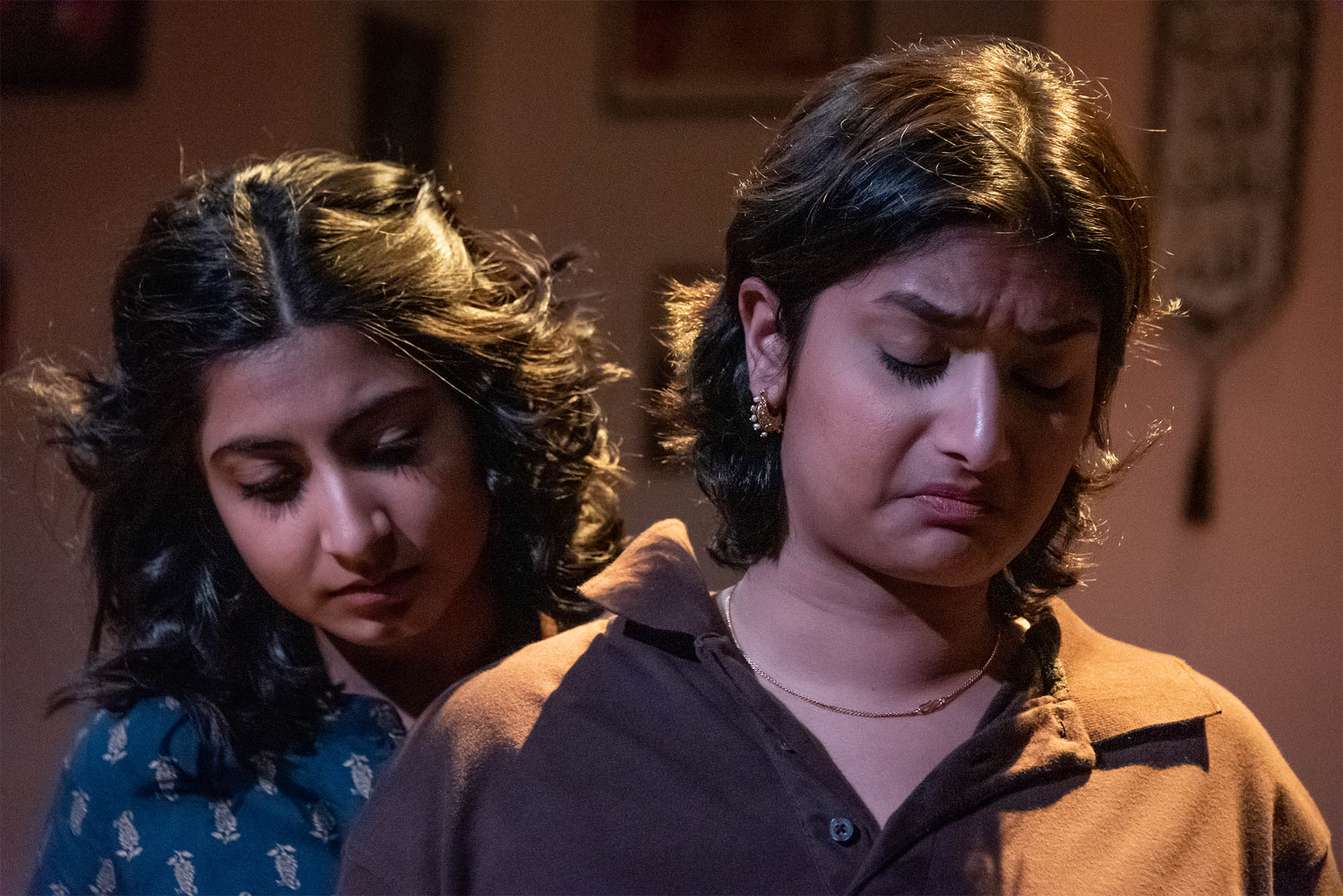
The last time I saw a play like JADO JEHAD, currently on the boards at Boston Playwrights’ Theatre, was never. Set in the living room of a house in Pakistan, the new play concerns three generations of women who have come to roost with Manzoor, the grandmother and owner of the house. Manzoor’s daughter, Kareema, has come home after her husband divorced her. Knowing how distraught her mother would be, Mashal returns to Pakistan from her studies in the United States to offer her support. Mashal had enjoyed the freedom of American society, relished being herself for the first time, and learns quickly that traditional gender roles in her homeland have not kept up with her growth overseas.

I have no knowledge of what queer life is like for young people in Pakistan; I can’t claim to know much about life in Pakistan, period. I also suspect it presumes very little to say that few readers of this review know much more. But that is a great part of the charm of JADO JEHAD, which translates from the Urdu as ‘endeavor’. The play succeeds on several levels. First, it’s a fascinating revelation of a corner of life few American audiences will know. Second, the mix of humor and drama as the three women grow and change to accommodate their altered circumstances is moving, especially in the performances of Vidisha Agarwalla as Mashal and Jyoti Daniere as her ‘Nani’ Manzoor. Throughout the evening, the audience moaned in recognition of the women’s struggles. And lastly, through a combination of a smart script and some deft directing, the alien domestic challenges become extremely relevant even for non-Desi, straight, and male members of the audience.

The universality of the generational divides hits home regardless of which generation you occupy. Manzoor’s hard-earned faith in Allah grows from her loss of her beloved husband, who died a few years prior to the action of the play. Kareema’s clownish attempts to find herself after a soul-killing marriage and confidence-busting divorce are both laugh-out-loud and honestly human. And Mashal’s life driving like a man on Pakistani streets, visiting lesbian bars, and building a new relationship under difficult circumstances carry the night. The women struggle within and between themselves to uncover both peace and identity in their lives together. Unusual though the setting can feel, that very fact emphasizes that families all have the same challenges – finding love, accommodating to traditions, being oneself while tolerating others being themselves – wherever they live and whatever those traditions might be.

In the after-performance discussion, the playwright, Fatima A. Maan, described her current life in Lahore. Like Mashal, her main character, Maan has endeavored to find her own life after her experiences in the United States. Whether or not the rest of JADO JEHAD reveals her personal life makes no difference, but the authenticity of her voice comes through clearly. Bridget Kathleen O’Leary spoke about the very short window the production team and the performers had to understand rework the play. Together they have created a play worth seeing now, as well as one that will grow and change in the next few productions, as anyone should expect from a new play. I suggest that the next production might be stronger if it found a way to break the monologues into dialogues, created more three-way interactions among the generations, and integrated the coda – which appears to take place a few years after the play’s main action – into the body of JADO JEHAD itself.

I recommend seeing the play first and foremost as an excellent evening of theater and as exposure to the power of new plays. The play also serves as a refreshing reminder of our shared humanity while simultaneously introducing us into the particular reality of modern-day Pakistan. The Boston Playwrights’ Theatre requires audience members to wear masks for the remainder of this season, so come prepared. JADO JEHAD runs 90 minutes and has no intermission.

Sunday, February 19, 2023

Red Letter Poem #149

 The Red Letters


In ancient Rome, feast days were indicated on the calendar by red letters.  To my mind, all poetry and art serves as a reminder that every day we wake together beneath the sun is a red-letter day.


                                                                                                          – Steven Ratiner


I am pleased to announce that Christopher Jane Corkery just received a nomination for this year’s Pushcart Prize for her poem "Painter on Scaffolding in Summer" which appeared as Red Letter #113.  The final selections for the yearly anthology of ‘Best of the Small Presses’ will be announced in May – and I know our Community of Voices will be wishing her luck.


Red Letter Poem #149


Today’s reddest of Red Letters is a little Valentine’s Day primer. 


Have you ever wondered where it came from – this ungainly symbol for love: two plump lobes tapering down to a point?  What substantial love-pledge, let alone marriage of true minds, could hope to balance upon such a precarious structure?  I think back to my grade school Valentine’s Days – red construction paper cut-outs pasted onto white doilies; and, of course, the lively trade of those candy Sweethearts, those sugar-fueled oracles.  But a quick glimpse inside an encyclopedia confirmed, even for a fourth grader, this design was nothing like that muscle beating ceaselessly in our chests.  It turns out that heart-shaped leaves – like the fig, ivy, waterlily – were often featured in medieval art and heraldry.  The ivy was intended to symbolize fidelity; did that start this icon on its path to being a universal emoji?


Further back, a host of ancient philosophers believed the heart was the emotional center of our being, the seat of the soul.  And physicians such as Galen, the second-century ‘father of medicine’, described the heart as a three-chambered organ shaped like a pine cone.  Thus, the first known depiction in art of that iconic love-gesture was in the 13th century French manuscript the Roman de la Poire (Romance of the Pear), in which a young man holds out his vaguely pine cone-shaped heart as an offering for his lady love.  Saint Valentine (we mustn’t forget that 3rd century Roman martyr – patron saint of courtly love, but also of epilepsy and beekeeping) would certainly smile upon this expression. . .


. . .As well he might on Cathie Desjardin’s much more biological take on the valentine.  Before I comment further, let’s enjoy her poem:


EKG


We’re together in the kitchen when you say

you talked to your new doctor,

the one who ordered up an EKG

because he said he’d heard a skip, a stutter.


Most likely it’s within a normal range.

What’s normal in our undercover pumps?

Part mystery fist, blossom, cage?

Once I saw a tattooed heart clumped


on a woman’s bare back: not a valentine

but a thick muscle in full spurt,

aortic wad inked in red and blue lines.

She said she loved our corporeal hearts,


the beauty in anatomy. Anyway,

you tell me, my doctor scanned the blips

and says I’m fine. Let’s look, I say.

So you hoist your shirt up from your hips,


I place a palm curved to fit

among your soft gray curling furze,

spider fingers scrying for a tidal beat.

Why had I never sensed a miss


when I so love to lie with you,

nest my palm to feel the thump there?

I touch it now, rueful with what I know:               

ways I thought I could protect, repair—


mistaken. But a new grasp of lubadub:

all unnoticed, our deep rhythms change,

and in what we claim as Hub of Love

imperfect is our normal range.


      ––Cathie Desjardins


The heart in Cathie’s lyric is neither a symbol nor an abstraction, but the actual muscle beating inside her husband’s ribcage.  Isn’t it lovely that her sprung rhythms and off-rhymes conjure both the regularity of form as well as its imperfections – much like her beloved’s EKG?  In fact, don’t we love such things all the more – knowing they are fragile and impermanent?  Cathie – my predecessor as Arlington’s Laureate – is the author of two poetry collections; the most recent, Buddha in the Garden (from Tasora Press) is, like her surname, filled with the life of the garden and the way the mind finds sanctuary there.  Her work has appeared in a number of publications including The Christian Science Monitor, The Boston Globe, Cognoscenti – WBUR’s online magazine, and Pulse – Voices from the Heart of Medicine (where “EKG” first appeared.)  She is a lifelong literacy educator who has taught in elementary and high schools; at Lesley, Suffolk and Boston Universities; and UMass/Boston and UMass/Dartmouth, and more – helping students to find the pulse of their own poetic resources.


The Red Letters 3.0


* If you would like to receive these poems every Friday in your own in-box – or would like to write in with comments or submissions – send correspondence to:

steven.arlingtonlaureate@gmail.com


To learn more about the origins of the Red Letter Project, check out an essay I wrote for Arrowsmith Magazine:

https://www.arrowsmithpress.com/community-of-voices


and the Boston Area Small Press and Poetry Scene

http://dougholder.blogspot.com


For updates and announcements about Red Letter projects and poetry readings, please follow me on Twitter          

@StevenRatiner

Saturday, February 18, 2023

The Poetry of the Eternal Now, in Donald Hall’s The One Day, for three Voices at the Cambridge Public Library


The Poetry of the Eternal Now, in Donald Hall’s The One Day,

for three Voices at the Cambridge Public Library

By Michael Todd Steffen  


The Hastings Room Reading Series is excited to announce its upcoming presentation of Donald Hall’s book-length master poem The One Day, adapted for recitation by Michael Todd Steffen, with readers Mary Buchinger, Lisa DeSiro and Steven Ratiner.The reading will take place at the main Cambridge Public Library, 449 Broadway Street, inthe Lecture Hall, at 7pm, on Thursday March 2nd, 2023. Mark your calendars!

Donald Hall needs no introduction. He served as the 14th U.S. Poet Laureate from 2006to 2007. His many awards include the 1987 Lenore Marshall Poetry Prize and the 1994Ruth Lily Poetry Prize for lifetime achievement.

His first published poems date back to the late 1940s, Hall then in his late teens and early twenties. At age 86 he published his last verse in the Concord Monitor (New Hampshire),a political rhyme which had given Hall great pleasure to write, its subject the opponent of Jeanne Shaheen in the 2014 New Hampshire U.S. Senate race:


Get out of town

You featherheaded carpetbagging Wall Street clown,

Scott Brown.


At the time, Hall commented, he’d stopped writing poetry in the last few years. Poetry was largely sexual, the poet said, and he had run out of testosterone. He was the author of over 50 books across several genres from children’s literature, biography, memoir, essays, including 22 volumes of verse.


The book-length poem The One Day has been described as the greatest achievement in Hall’s poetic career, carrying public power rare in our time, a poetic confidence and inclusiveness that we associate with the major works of Modernism. Yet twenty years after the publication of The One Day, in his memoir Unpacking the Boxes, Hall made reference to his “greatest achievement” in utterly dismissive notes of failure:


Behind my neck roosts a rookery of bad manuscript. To write as much as I have done, I have needed often to fail. There is another book-length poem behind my neck, ten-line stanzas that look like surrealism but are actually bad dada. (page 136)


What is the difference between Surrealism and Dada? Dada is interruptive, unexpected, disjunctive and offensive in order to make criticisms of society and the logic and syntax that give order and direction to society. Surrealism tends to the psychology of dreams and of art. Dada is deliberate and strategic, with social consciousness in its masthead. In presenting an adapted version of The One Day for an audience, our intention is to re-present the generous and brilliant genius that brought Hall to the laborious task of this dark horse of an American masterwork of poetry.


I undertook the adaptation for public presentation with three readers after I’d gone to see The Poets’ Theatre present Dylan Thomas’s radio drama Under Milk Wood at the Sanders Theatre in the autumn of 2015. At the time Hall’s book had become a revelation to me and I was somewhat obsessed by its different voices: mother, son, father and daughter in the first part; in the second part more dramatically the voices, indicated for the text, of Marc and Phyllis in the poem “Pastoral” and the opposition of Senex and Juvenis in the poem “History,” which had won attention by being included in the first (1988) Best American Poetry anthology edited by David Lehman and guests.


Due to its textual length, the diversity of its topical registers from autobiography and the very personal, confessional, to items of modern history and pop culture clashing with ancient literary genres and history – Hall uses anachronism to great effect! – the long poem resists comprehensive analysis. The theme announced by its title (with a possible wink at Joyce’s Ulysses with its echo of epic and action inhabiting the one day, June 16 in Dublin?) suggests in a sense of Eastern mysticism the compression of all the memorable days of one’s life, along with the days recorded in history which become part of a writer’s awareness—all days into the one day of the present, accumulated and ongoing, the never-ending Now.


This involves one of time’s great paradoxes, both what T.S. Eliot named “the ecstasy of the animals,” and the poet/artist’s aspiration for immortality—Shakespeare’s So long as men can breathe or eyes can see…—the timeless expression of the short life through long labor for art:


by these hands I join

the day that will never return. This is the single

day that extends itself, intent as an animal listening

for food, while I chisel at alabaster. All day I know

where the sun is. To seize the hour, I must cast myself

into work that I love, as the keeper hurls

horsemeat to the lion:—I am meat, lion, and keeper…


This passage, and much of the beginning of my adaptation, comes from the beginning of Part III, To Build a House, of the original book-length poem. Initially, editing this manuscript for a public presentation came to me intuitively. Yet as I reflect, I wanted material that welcomed the audience both in theme and in tone. I wanted the reader/listener to get comfortable and settle in before introducing some of the more difficult themes, personal obsessions such as parental indiscretions and failures, as well as social and historical concerns, professional hypocrisies, marital silences, the clash of classes, the awareness of civilization’s rises and ebbs, the apparent inevitability of war, the long-term consequences both of empire and technological advancement, use, dependence, abuse, failure and erosion.


Hall might well have said of this undertaking what Pound said when setting out to write The Cantos: It’s a poem about—everything. In an insightful and very interesting NOTE ON THIS POEM the author imparts to us as a postscript to his book, Hall describes the initial intervention of the whale of inspiration for the poem on him:


The poem began in the fall of 1971. Beginning to emerge from a bad patch of middle-life, I was briefly subject to long and frequent attacks of language. I wrote as rapidly as I could, page after page, loose free verse characterized by abundance and strangeness rather than by anything else, certainly not by art or the discipline of imagination. The meteor shower continued for several weeks. If I drove to the supermarket I carried a notebook: I might stop three times in a ten-minute journey to take dictation…


It would take Hall 17 years to grapple the material into a coherent sequence, which he published as the book The One Day in 1988.The actual recorded intervention of the poem’s inspiration, these “long and frequent attacks of language,” are behind the extraordinary visit to the poet depicted in the poem, toward the beginning of my adaptation, also to treat the audience with something strange and humorous to get the reading going. This passage also is taken from Part III in the poem’s book version:


This afternoon the king and queen of Norway drove

downtown from their consulate to my studio. As we sat

drinking tea together, they were fastidious and democratic;

I had been told: It was not required to curtsy…

When the entourage disappeared into Third Avenue

I changed into jeans and climbed on my sore ankle

to the marble under the skylight. Matisse said, “Work

is paradise”; Rodin, “To work is to live without dying”;

Flaubert, “It passes the time.” For three hours

my mallet tapped while Donatello hovered above me.


Such an extraordinary visit (as unexplained and unsubstantiated as any weird appearance in a dream, which the best poetry models itself on) makes a good equivalence in expression to what Hall describes as the undertow of the especially focused language that came to him emerging from his bad patch of middle-life. We might know and acknowledge the accuracy of the astonishing experience and of its expression. We furthermore may smile at the extraordinary humility of the self-defined realm of the vision upholding the labor of love, listening to Donatello (containing the poet’s first name, Don) hovering above the artist as she taps away with her mallet. In this way, and in so many other ways throughout the poetry of The One Day, the very near and isolated and the utterly present meet with the far away and the far over and lost.


About us:


Mary Buchinger is the author of six poetry collections, including Navigating the Reach (2023), Virology (2022), /klaÊŠdz/ (2021), and einfühlung /in feeling (2018). Her poetry appears in AGNI, Hollins Critic, Interim, Nimrod, PANK, phoebe, Plume, Salt Hill, Seneca Review, Queen Mob’s Teahouse, and elsewhere. She serves on the New England Poetry Club board and teaches at the Massachusetts College of Pharmacy and Health Sciences in Boston.


Lisa DeSiro is a writer and musician. Her poetry collections include Simple as a Sonnet(Kelsay Books, 2021), Labor (Nixes Mate Books, 2018), and Grief Dreams (White Knuckle Press, 2017). Her poems have also been published in many literary magazines and anthologies, and set to music by several composers. Lisa works as a professional accompanist and a freelance editor. She resides in Cambridge, MA. Read more about her at thepoetpianist.com.


Steven Ratiner has published three poetry chapbooks. His work has appeared in scores of journals in America and abroad including Parnassus, Agni, Hanging Loose, Poet Lore, Salamander, QRLS (Singapore), HaMusach (Israel), and Poetry Australia. He's also written poetry criticism for The Washington Post, The Christian Science Monitor, and The San Francisco Chronicle. Giving Their Word – Conversations with Contemporary Poets was re-issued in a paperback edition (University of Massachusetts Press) and features interviews with many of contemporary poetry’s most important figures, including two interviews with Donald Hall. From 2019 through 2022 Ratiner served as the Poet Laureate for Arlington, Massachusetts.


***********************************************************************************  


Michael Todd Steffen is the recipient of a Massachusetts Cultural Council Fellowship and an Ibbetson Street Press Poetry Award. His poems have appeared in journals includingThe Boston Globe, E-Verse Radio, The Lyric, The Dark Horse,and The Concord Saunterer.Of his second book, On Earth As It Is, now available from Cervena Barva Press, Joan Houlihan has noted Steffen’s intimate portraits, sense of history, surprising wit and the play of dark and light…the striking combination of the everyday and the transcendent.


The Hastings Room Reading Series is now in its 10th year of hosting poetry events, featuring area poets. We have also organized a yearly Seamus Heaney Memorial Reading, a Happy 100th Prufrock (2017), and, last November, a centenary celebration reading of T.S. Eliot’s The Waste Land.

Friday, February 17, 2023

Somerville's Greg Jukes: A musician/performer who tangoes with his instruments.


Recently--I caught up with Greg Jukes, the co-founder of the Somerville-based musical performance group   "The Fourth Wall,"  that explores a new hybrid of the performing arts in which musicians are also dancers and actors. According to Jukes, his group "stretches the boundaries of instrumental performance. The Fourth Wall commissions new interdisciplinary works and reimagines established repertoire to make music that leaps off the stage!"

How has it been for you as a performing artist to live and work in Somerville?

Living in Somerville is fun. It’s a vibrant community with interesting things to do and easy access to the greater-Boston area. That said, it’s an expensive city and as a performer, I barely do any local shows. Thanks to grants from the Somerville Arts Council and the Massachusetts Cultural Council, my main trio, The Fourth Wall, was able to self-produce a few shows at the Crystal Ballroom and the Center for Arts at the Armory in the past year. We mostly perform away from home, having found a lot of success on the Fringe festival circuit around the US and Canada along with teaching/performance residencies at colleges and universities, shows on classical music concert series, and in-school performances in other parts of the state through Young Audiences of Massachusetts. Before the pandemic, we organized a series called The Fourth Wall Presents… where we brought in other artists we loved from the Fringe circuit to share a couple evenings of shows at The Lilypad in Inman and the Cambridge YMCA (RIP to their big, old theater as a local, affordable venue). Sharing great performances with our community was wonderful and we had fabulous audience energy, but it always felt like an uphill battle trying to get the word out about the shows. Even at our best selling events, we only ever barely covered venue rental fees plus expenses and an honorarium for our guest artists without paying ourselves. We became a nonprofit in 2020 which opened up new funding opportunities for us with local and state arts councils, without which we couldn’t have put on the local shows we did this past year. Grant support is huge, but money doesn’t inherently solve our challenges in marketing our work and trying to build a local audience. Maybe we’ll keep trying to establish a following for shows in Somerville, but as more national and international bookings come in for The Fourth Wall and other projects I’m involved with, my identity is probably going to remain as a performing artist who lives here and works elsewhere.


You are a co-founder of the Fourth Wall. On your website the you say the mission statement of your group is to " break down the barriers between serious art and serious fun." How do you do that?

We play classical music, but we do it while riding hoverboards, dancing, or hanging upside down! Rather than doing those things for the spectacle and novelty impact of ridiculous juxtapositions of “high art” and silly tricks, we build our shows and repertoire around a desire to give audiences a unique experience where everyone will have their own favorite moments and things that resonate with them. For some it might be the playfulness of hearing a Chopin waltz while watching the performers zoom around on hoverboards, other might appreciate the serenity of Florence Price’s piano music performed in darkness with lights inside and on the ends of our instruments that evoke fireflies in the night sky, others still might be excited to get the inside joke that the lift we do while playing Stars and Stripes Forever is called a flag.


Do you think a staid, older classical music aficionado could appreciate your hybrid approach to music?

I can say with confidence that they do! We’ve got voracious appetites when it comes to classical music and take pride in sharing a diverse spread of pieces in our shows including works by underrepresented composers, living composers, and arrangements that encourage our audiences to rethink what they consider so-called “classical” music. We also take on iconic works from the classical cannon to offer newer listeners something familiar that they may have heard before. For many aficionados, these pieces have lost their sparkle after being overplayed in the public sphere, but our hybrid arts approach gives them new ways to experience something they’ve maybe written off. Erik Satie’s “Gymnopédie No. 1” has become synonymous with “relaxing classical music” to the point that it feels like an innocuous waiting room track, but it’s really a spectacular piece with an interesting chord progression and a beautiful melody that weaves in and out of dissonance with the accompaniment. Our interpretation rearranges the music from a piano solo to a flute and vibraphone duet in which Hilary (playing flute) and Neil (not playing bass trombone) dance a counterbalancing pas de deux that has Hilary hanging upside down on Neil’s back for the whole second half of the piece. The visual interest and acrobatic spectacle give folks who are over-acquainted with the music a new way to connect to a splendid piece that they might have abandoned after hearing it 10 too many times.


You and your band of performers seem to be dance partners with your instruments. It is hard enough to play an instrument; how do you manage it when you are full flight?

Well, we start off by doing it very poorly! Some of our best pieces have been developed following the words “you know what’s a dumb idea?” One of my favorite things about our creative process in The Fourth Wall is that we give ourselves permission to explore the “dumb ideas,” knowing that behind something silly, we often find something striking. It takes a lot of practice and patience to make sure a piece sounds great even when we’re doing a lift, upside down, or riding hoverboards, but that’s all part of our process and one of the greatest ways we connect with our audiences. Choreography often aids musical memory: by embodying the music, we give ourselves another way to connect to what we’re playing and give context to what happens when.


I noticed a video where you ensemble performs in the middle of a highway. Can you tell us a bit about that?

Ha! That’s an oldie! As a gigging percussionist, I’ve spent many hours on the highways of America in my minivan. Sometimes I’d be the only car on the road late at night after a show and for years I thought it would be cool to do a photoshoot or short video in the middle of the road, but it never seemed practical or safe. The perfect opportunity presented itself on I-80 in northern Indiana when traffic came to a full stop and was backed up for miles with no off ramp. We had just passed the turnoff for a rest area when everything came to a full stop. The car in front of us pulled across the grass median to use the facilities which left a perfect, protected stage space for our antics. It was pretty fun to fulfill that little fantasy. My phone ran out of space/battery during that tango, but we played a few more pieces after that since we were getting some supportive honks and cheers from neighboring cars and folks in the rest area.


You offer classes and workshops. How can Somerville folks access this?


The Fourth Wall’s classes and workshops primarily happen at schools, but what we teach about creativity, communication, leader/followership, and exploration can be great for anyone! College and university performing arts departments are our biggest market followed by grade schools, though these programs usually aren’t open to the public. Sorry to say that we don’t have any public programs near Somerville on the calendar as of now.

On a personal level, I teach private drum lessons online and out of my apartment near Davis. I also co-created an electronic bucket drumming workshop program called the Beat Bus that occasionally does public events at festivals and educational events at schools, summer camps, and field days. Folks can certainly reach out to me for bookings and lesson inquiries!


What will people come way with after witnessing one of your performances?

Refreshed feelings of wonder and joy! That’s the goal, at least. We want our audiences to share a delightful experience with a community of others and leave with fun memories of pieces that made them say “How do they do that!”, made them laugh, and touched their hearts.

Tuesday, February 14, 2023

Somerville Writer Daphne Kalotay brings us "The Archivists"


I caught up with Somerville writer Daphne Kalotay, who has a new collection of short stories " The Archivists." Published in 20+ languages, Daphne Kalotay’s books include the award-winning novels Russian Winter, Sight Reading, and Blue Hours, and two story collections: Calamity and Other Stories, shortlisted for The Story Prize, and the Grace Paley Prize-winning The Archivists, forthcoming in April 2023. A recipient of fellowships from the Christopher Isherwood Foundation, MacDowell, and Yaddo, she lives in Somerville, Massachusetts.


You are a Somerville writer and I see you have a story in your new collection that is based in Somerville. It is about the death of a woman who lived with cancer for 9 years. It is, I believe it is about your late friend's life. Setting is so important in fiction--how is Somerville a character in this story?


Yes, multiple stories in the book are set in Somerville, though the town is not named. In the one you refer to, “Heart-Scalded,” the entire story takes place at a party in one of the big old houses I particularly love here—in this case, one that hasn’t yet been fixed up and sold off. The house is inhabited by a few thirty-somethings who rent rooms from the woman’s friend, who also lives there. People at the party include former renters who have moved on—either managed to afford something on their own or taken a job in another state altogether. I think this situation is very real for many folks in Somerville, especially people in the arts, who want to live in town but can’t afford their own place and may eventually have to move away to continue to be able to support themselves (or the more typical “adult” lifestyle we are taught to aspire to). That theme—precarious financial stability in a city that’s been rapidly gentrifying—is a strong throughline in the other story, “Providence,” which addresses gentrification much more explicitly.


I have always been fascinated with food in fiction. Proust had his little madeleine, and you have an obscure French appetizer in your short story " Egg in Aspic."  I remember in graduate school I did my thesis on food in the fiction of Henry Roth. At first my advisor thought my subject would be trivial-- but I proved her wrong. How did you come up with the idea of this morsel as a symbol for the story?


I love that you chose that subject for your thesis! I imagine it was incredibly interesting to write and for your readers. In my case, the idea for this story first came to me through the setting, which then led me to the specific dish. A foodie friend and I had gone to a tiny cramped French restaurant much like the one in the story, and I found it comical that this somewhat physically uncomfortable situation was so coveted. Then, a wonderful artist and thinker living in Somerville at the time, Arlinda Shtuni, invited me to contribute a written component to an art exhibit she was curating for the French Library called “In Search of Lost Memory”—there’s your Proust reference. The theme of the exhibit was how the internet might be affecting our memory, so I had a prompt, and the French tie-in and Proust reference caused me to recall the tiny French restaurant, which I’d always thought would make a great setting for a story. I felt that since the physical space was small, the story itself should be very brief, which would work well with Arlinda’s parameters. I then recalled a dish I’d eaten in France, the oeuf en gelée—or Egg in Aspic—and realized that this amazing concoction perfectly encapsulated what I wanted to say about life and death and our own ephemerality, the way it seems to preserve a tiny scene (with an egg so representative of life and birth) that is then destroyed, and that the people in the restaurant were their own little scene within their own little jellied egg, trying to preserve their moments of experience on their phones, etc. These themes—memory, archives, how we communicate our experience to one another, and what is lost—form much of the connective tissue of The Archivists.


Of course each life will eventually end--you become off the table and out of the game, and then.... gone. But life goes on for the living, for the survivors. In your work you deal with absence--how it affects us-- how it changes our perception--how we need it to truly feel.

 Yes, many of these stories concern survival and perseverance after loss. In some cases, I’m drawing on my own family’s decimation by the Holocaust and what I know of that history from the survivors in my family—what life looks like after. Each person’s way of interpreting the world and moving forward differs from another’s. But absence—whether it’s a namable loss (death, dementia) or just a sense of something missing (loneliness, lovelessness)—certainly has its own shape and effects how we interpret the world around us.


If someone said, "Why should I read this book?" What would be your reply?


To take a break from life and phones and appointments and instead lose yourself in a good story— multiple stories—that will both entertain and move you. To see your familiar world from unfamiliar angles. To enter experiences and mindsets and lives not your own. To laugh and maybe even cry and be transported and nourished.


Kalotay will be reading from her new book in May:


Wednesday, May 17, 7pm at Porter Square Books in Cambridge


Wednesday, May 31st, 7pm at Brookline Booksmith