Friday, June 15, 2018

Endicott College is hosting its second annual workshop for high school students interested in creative writing June 28-9, 2018


Endicott is hosting its second annual workshop for high school students interested in creative writing.

Endicott College has announced plans to host its second annual Young Writers Workshop, June 28-29, 2018 for area high school students interested in creative writing. Participants will develop their writing skills in sessions on poetry, fiction, and playwriting/screenwriting led by the College’s distinguished creative writing faculty members: Charlotte Gordon, Dan Sklar, and Elizabeth Winthrop. 

Students will create and refine new work, learn how to give feedback to their peers, and receive tips on how to promote and publish their work. At the end of the Workshop, participants will present their work publicly.  

“The Workshop is designed to nurture the students’ talent, help them find and refine their voice, and teach them technical aspects of writing that can make their work more compelling,” said Dr. Mark Herlihy, associate dean, arts and sciences and chair of humanities. “While students will develop their own craft over the course of the weekend, they will also experience what it means to belong to a community of writers.”  

Participants will work closely with the College’s renowned faculty members. Gordon’s Romantic Outlaws: The Extraordinary Lives of Mary Wollstonecraft and Mary Shelley won the 2015 National Book Critics Circle Award for Biography, and her Mistress Bradstreet: The Untold Story of America's First Poet, won a Massachusetts Book Award. 

Sklar is a two-time winner of Endicott's Excellence in Teaching Award whose poems have been published widely and whose plays have been staged at the Actors Studio of Newburyport and the Boston Theatre Marathon. 

Winthrop’s fourth novel, The Mercy Seat, will be published this month by Grove Atlantic. Her other novels include Fireworks and December with Knopf, and The Why of Things with Simon and Schuster.  

The Workshop fee of $150 covers all activities, lunch and snacks each day (9 a.m. – 4 p.m.), and a t-shirt. There will be a discounted rate of $125 for Beverly residents and children of Endicott employees. Participants must be entering grades 9-12 in fall 2018.  

To register, go to endicottyoungwritersworkshop2018.eventbrite.com For more information, contact Mark Herlihy at 978-232-2178 or mherlihy@endicott.edu.

The Sunday Poet: Ben Carson

Poet Ben Carson


Benjamin D. Carson is a Professor of English at Bridgewater State University. His creative work has appeared or is forthcoming in Red Fez, The Ampersand Review, Cactus Heart, Free Inquiry, The Bitchin’ Kitsch, and the Charles River Journal.


We Give Birth to Light

The moon rose full over the cemetery
on the night my mother gave birth to her son,
his face round, his lips blue. This will be
the last one, she said. There will be no more.

The sun set an autumn orange over the field
on the night my mother watched my father take to the road,
his face chapped, his hands raw. This will be
the last harvest, she said. There won’t be another.

The North Star, my mother once said to no one, is the only
light that matters, the one that shines and shines
and shines, even after the last breath is taken,
the field abandoned, the lover lost.

We give birth to light, she muttered, so that
darkness too can have its day.

Wednesday, June 13, 2018

In Praise of the Useless Life A Monk’s Memoir


In Praise of the Useless Life
A Monk’s Memoir
By Paul Quenon O.C.S.O.
Ave Marie Press
ISBN: 13 978-1-59471-759-8
142 Pages
$15.95

Review by Dennis Daly

After living six decades in the Cistercian (Trappist) Monastery of Gethsemani, Paul Quenon has written a quiet, self-effacing journal of the heart, which periodically breaks out into syllabic dance and grammatical song. This memoir purports to portray the life of an ordinary man living in an unconventional community, a spiritual haven that attracts both simple penitents and intellectual paragons. However, a man, who keens at the death of trees, claims Emily Dickinson as his soul sister, writes exquisite poetry, and engages in a mysticism that he calls “the choreography of heaven” doesn’t strike me as ordinary at all.

Throughout this personal chronical Quenon weaves in scenes from the life of Thomas Merton, as well as reiterating much of Merton’s counter-cultural wisdom. It could not be otherwise. Early on Quenon had read Merton’s autobiography, The Seven Storey Mountain, and Merton’s stature as a modern-day monk had been one of the draws that convinced him to enter the monastery. Once there Merton became his novice master, adding layers of influence onto the young man. Other novices schooled with Quenon during Merton’s stint as novice master included a university valedictorian, a lawyer (presumably there for repentance), a missionary back from New Guinea, a psychologist, a later-in-life college president, a soon-to-be brain surgeon and Ernesto Cardenal, who was to emerge as an influential poet and controversial Sandinista revolutionary in Nicaragua.

Quenon knows his audience and relates many inside baseball vignettes about Merton. In one lightly humorous story the young Quenon appears at Merton’s door to ask him, “What is the meaning of Zen?” In answer Merton bops Quenon on the head with a book. When Quenon persists in questioning this expert in eastern religion and philosophy, Merton says, “There is a cherry tree outside the window,” and leaves it at that.

Mother Nature apparently took over Quenon’s education where Merton left off. She provides him with daily, twenty-four hour classrooms, stirs his enzymes, raises his energy, and generally nourishes his soul. Going out into the weather is not only part of his life but also a spirit-lifting ritual. “I am governed and made into something larger than myself,” says Quenon. “One morning appears as a Chinese painting,” he continues, “with cloaks of fog concealing here, partly there, revealing hills, trees, and fields. Another morn displays a brilliant sprawl of clarity, the color too good to be true, unbearably perfect, until the sun heightens and the sky blanches in the midday heat.”

One of the chapter sections in Quenon’s book he entitles Eminent Trees I Have Known. Here he voices the affecting kinship he felt upon the demise of two linden trees, killed in order to make room for a new infirmary. He studies his own reaction objectively. “I watched from a distance as they were plowed over with a bulldozer, and the sight provoked my voice to a high, soft pitch,” he says. “Such feelings of kinship were a surprise to me; I had never made that sound before, yet it seemed the only decent thing to do at the moment.”

Quenon, not only sleeps under the stars most nights, but has molded his meditational life around locations with expansive views and open to the weather. Among these sites is the porch of Merton’s old hermitage, about a mile into the woods behind the abbey. Quenon is the caretaker of the hermitage and has escorted many renowned visitors there, including Nobel Prize laureates Seamus Heaney and Czeslaw Milosz. He often sits in a chair with a brass plate attached to the top that says, “Bench of Dreams.” It was affixed there by a man who had been assistant secretary general of the United Nations for forty years.

Monks have built-in models for their style of life. I’m thinking of the desert fathers, St. John of the Cross, St. Teresa of Avila, and St. Therese of Lisieux. Although familiar with the aforementioned, Quenon seems to prefer the poet Emily Dickinson as an exemplar of Trappist life and thought. He quotes many of her poetic lines including these,

Growth of Man—like Growth of Nature,
Gravitates within.
Atmosphere, and sun endorse it—
But it stir—alone.

Each its difficult Ideal
Must achieve—Itself—
Through the solitary prowess
Of a silent life.

My favorite chapter in Quenon’s memoir he entitles Battle of Wits with a Mockingbird. It’s pretty funny. As the monk tries to sleep outside on the porch of the monastery’s lumber shed, a mockingbird begins an unforgettable aria. At first Quenon tries to communicate with the bird like Native Americans were once wont to do, making an oracle out of the creature. Then he begins to yell at the bird. But the bird believes this is a show of positive enthusiasm. Finally, dead tired, the monk begins flapping his blanket, mimicking a bigger bird. This works—for a while. But the next night the bird is back, having figured out the blanket trick. And this epic battle goes on night after night with Quenon using multiple stratagems like setting up a plastic owl decoy to scare the bird or throwing water into the trees. Yet none of these techniques work. Each defeat of monk by mockingbird Quenon memorializes with a haiku, such as,

I wish talent star
with night variety shows
would go off the air.

And this one,

The Mocker, all night
Harasses the neighborhood
—Damn sociopath!

Finally after moving to a new sleeping place the monk planned and carried out a sneak attack, violently shaking the bird’s tree. This successfully startled the bird and he absented himself from the vicinity. Now, however, Quenon exhibits all the telltale signs of remorse. He clearly misses the clever show-off, and says so.

Quenon’s literary window into the everyday life of Trappist monks is anything but useless. It frames the monastery, and, by extension, humanity as a vital buzzing hive of meaningful encounters, with its hooded denizens conjuring up perpetual moments of unique existence and creative imagination. Beware of this book if you’ve lost your sense of childish play, if you live a life without song or dance, or if you feel silly communing with trees. It could change you.

Sunday, June 10, 2018

Alison Pruchansky: Her Art 'Flowers' in Somerville


Alison Pruchansky: Her Art 'Flowers' in Somerville

By Doug Holder

There is a certain vibe in the Bloc 11 Cafe in Union Square, Somerville. You can expect the excited screams of kids with their beleaguered parents in quick pursuit, as the tykes explore the inviting jail cell in the back of the cafe. There are the catcalls from the baristas to the patrons to pick up their fare. There is the smoky and scratched voice of Louis Armstrong singing “ Baby it's cold outside” on a warm morning in May. And on this morning Alison Pruchansky joined me at my table with the remnants of my morning repast—smoked mackerel, a plain, pedestrian bagel—with artisanal tomatoes-- brushed off to the side.

Alsion Pruchansky is a Somerville artist who has a studio at the Vernon St. Studios. She has her own business Ample Art and Design where she now primarily works with corporate clients to select art—often her own—to add to the interior design of their offices. She also works a a gallery coordinator at the Chase Gallery in Boston.

Pruchansky has been trained as an artist at Swarthmore and the Sotheby Institute of Art in London. She does mixed media painting on canvas. I viewed a selection of her small canvases. They primarily focus on flowers. They seem like a dream of florid blossoms, heightened by the backgrounds-- that seem to almost lift the work off the canvas. Her use of vivid color engages the eye.

Pruchansky is mostly a painter. She uses acrylics, watercolors, puffy paints and the like, and experiments with them.

Living in Somerville and working at the Vernon Street Studios with a number of accomplished artists—surely helps her own art.

Pruchanksy shares her concern with the cost of housing in Somerville. She has noticed the displacement of a number of artists because of gentrification, and hopes to some extent this will abate.

She is engaged in the art community. She is the Asst. Coordinator for Somerville Open Studios, and has bought a home with her husband in the city. Like her painting, Pruchanksy is sure to flower—here--in-- the Paris of New England.

For more information go to:
http://ampleartdesign.com

Saturday, June 09, 2018

The Sunday Poet: Tree Riesener


Tree Riesener


Tree Riesener is the author of  Sleepers Awake, a collection of fiction, winner of the Eludia Award (Sowilo Press), The Hubble Cantos (Aldrich Press), and EK (Cervena Barva Press). Angel Fever, a chapbook, has been published by Ravenna Press as part of their Triple series, Triple No. 5. Three previous chapbooks are Liminalog, Angel Poison and Inscapes. Her website is http://www.treeriesener.com.

peeping tom


I like to think about you
in heaven

I’m in the cold black night
under a window
behind me surf booms and crashes
my footsteps slowly fill with water

when I look
through the window
you’re in a warm bright room
nobody sees me looking in

I watch them welcome you
embrace you
the christmas tree
glowing in every color
eggnog in a chinese bowl
some sort of classical music
probably haydn or mozart
softly from a string quartet

everybody hangs on your words
as you tell your story
laughing
every once in a while
patting your hand
when you wipe away tears

I turn away
walk through drifting fog
down the dark road
to that little all-night bar

shaking with cold
I gulp down a strong coffee
with plenty of sugar
have a couple of drinks
to make sure
the coffee won’t keep me awake

then
in that warm room
after the hot drink and the whiskey
I cross my arms on the table
like school kids
when it’s time to rest

lay my head down
and fall asleep

thinking about you in heaven

Friday, June 08, 2018

New book out from the Endicott College/Ibbetson Street Press Young Poet Series.

Talented  Endicott College undergraduate Dan Calnan has a new book out from the Young Poet Series at Endicott College.


 “In this collection, Calnan writes with a wisdom and authority beyond his years. Ranging in tone from witty to profound, these poems all demonstrate his intelligence and affinity with words. He is a writer to watch.” — Elizabeth Winthrop, author of Fireworks, December, and The Mercy Seat.


to order a copy go to http://lulu.com/ibbetsonpress


Thursday, June 07, 2018

Poets/ Artists Ponder 'Breath and Matter' Article by Doug Holder


( Left to Right) Jodi Colella, Chris Frost, Audrey Henderson, David Daniel, Jodi Colella, Julia Shepley


Poets/ Artists Ponder 'Breath and Matter'

Article by Doug Holder

I was pondering a question over my dark ale (with a hint of citrus) at the Remnant Brewery in the new Bow Market in Union Square. It was posed by the poet Robert Pinsky in the foreword of an anthology of poems about sculpture. He asked, “ What has art made of breath to do with art made of matter?” Well—six people joined me at my table to answer that question: Chris Frost—a Somerville-- based sculptor, David Daniel—former editor of Ploughshares magazine, as well as the head of Creative Writing at Fairleigh Dickinson University, Jodi Colella—a sculptor and a mixed-- media artist based in Somerville, Wendy Drexler, a noted poet, Julia Shepely –an artist and one of the founders of the Brickbottom Gallery in Somerville, MA., as well as poet Audrey Henderson -- the author of the collection “Air Stream.”

They were all here to discuss a project they are involved in that will appear at the Boston Sculptor's Gallery in Boston, starting July 18, 2018. The project is titled “ Breath and Matter.” On the website of the gallery it states that they, “... invited poets to partner with artists to create collaborative work combining both of their voices... twenty four pairs of sculptors and writers have taken up the challenges of this timeless question.” These artistic partners respond to each other. The sculptor interprets the words of the poet through concrete material such as silk, steel, bronze, rawhide, granite, wood, glass, etc...

Many distinguished poets will be included like for U.S. Poet Laureate Robert Pinsky, Boston Poet Laureate Danielle Legros Georges, Mary Bonina, and others.

Chris Frost and David Daniel talked about a notebook they are creating--a work still in progress. Frost has provided the illustrations and Daniel-- the poems. Daniel told me, " I hope we capture the process of collaboration. We have found poems easily lead to images."

Now...getting back to that daunting question. When I posed it to them, there were a lot of laughs. David Daniel piped in, “ Maybe I should text Robert.” But the most succinct comment I heard among the gaggle --in regards to why this project matters was, “To make what is intangible—tangible." So sculpture --in a sense-- will give poetry a tangible form.

Jodi Colella, (who I have had the privilege to interview years back) has paired her sculpture with Wendy Drexler's poetry. They both met by a twist of fate, and both came to realize their process is similar. They start their artistic exploration with intense observation as a way to get in the marrow of, or deep meaning of their subjects. So-of all things they turned to MOSS--which they feel shares many of the same traits as humans like: resilience, collaboration, as well as being opportunistic. So Colella created the sculpture  (seen below) and Drexler came up  the words to go with it.  Colella adorned the moss with piercing human eyes. The pair even developed a lesson plan for schools based on their collaboration.


Julia Shepley and poet Audrey Henderson have their work speak to each other. According to the Boston Sculpture Gallery website they  "...have identified common themes and concerns in their respective work: the significance of early memory as it relates to architecture and architecture as repository of meaning and emotion; the residual energy of inhabited space; and the significance of handcrafted objects as expressions of love and affection.  In the dynamic process of passing from one medium to the other, certain shared elements have intensified and accumulated layers of complexity and association."

Muse by Julia Shepley

This should be a unique exhibit at the Boston Sculpture Gallery  486 Harrison Ave, Boston.   For more information about the gallery and artists go to:  http://www.bostonsculptors.com/breath-matter-index

Wednesday, June 06, 2018

Daniel Shapiro / Child with a Swan's Wings

Poet Daniel Shapiro

 Daniel Shapiro
 Child with a Swan's Wings
Publisher: Dos Madres Press, Inc.
Illustration and Book Design: Elizabeth H. Murphy
Executive Editor: Robert J. Murphy
Cover Image: Shulamith Shapiro

Reviewer: Ari Alkalay Appel


Daniel Shapiro's poetry collection, Child with a Swan's Wings, is full of delectable little poems like "White Standard Poodle," “Almost Haiku,” "Arte Poética," and "Street of Chameleons," and darker, yet equally beautiful poems like "Providencia" and "Solitude" which come together to form a remarkable collection. As a whole, the volume masterfully portrays the author's relationship with language, with poetry, and with his content, which does not fall short of encapsulating the universe itself.

In connecting nature and animals with poetry, the author manages to create a sense wonder and amazement which extends to the way he organizes words on the page. Words sometimes curve away from one side of the page, then back toward the other in a cup shape, form a box around other words, or jump around like popcorn. The presence of words in places we do not expect to find them and their absence where we do expect them creates interesting interpretive possibilities. This is not completely original, but Shapiro's use of blank space is especially apt because has a mesmerizing effect.

The poems in this volume explore the infinite and the finite. Lines like, "My words are spokes / spinning to oblivion” invoke infinity, while others like “It's the body giggling, / telling you thank you / for the Chicken Vindaloo” use details to ground the poetry. Then there are lines I find exceptionally beautiful and evocative, like, "I too would emerge from an almond tree / to greet my lover, clasp my arms around his chest, / press his flat belly stippled with moss" and “Each word tactile—hairy or sweet— / will stand / like an obelisk....” Both the interplay between the natural world and the human in the first lines and the commentary on poetry itself in the second are easy to find more of in the volume.


Some of the poems are short while others span pages. The shortest poem, “Almost Haiku,” is only eight words, while the longest, the eponymous and multidimensional “Child With a Swan's Wings” is written across twelve pages, including bold headlines and words “spattered” across the page, to use the author's language. The brilliance of this poem is that it is about its own becoming. A few lines at the beginning state that a poem is born and the rest of the poem tracks its development, including its giving birth to another poem. The poem that we are reading unfolds insofar as the poem we are reading about is described. The poem reaches into infinity, “The poem rejects all designations. / Who says it's even a poem?” and comes back to its mooring, “Chameleon-horse / flick their tails and leap / volcanoes.” This poem is a reflection of the collection as a whole: self-reflexive, imaginative, and driven forward by a sense of amazement, almost as if from a child's perspective.


As an overall collection, Daniel Shapiro has written a work that clearly comes from an experienced poet. It is worth the read not just for its commentary on poetry and language but also for the pleasure that its poems yield. If you are looking for a fresh and exciting collection, buy a copy of Child with a Swan's Wings.

Monday, June 04, 2018

Somerville Artist Marilyn Ranker: An Artist Who Pushes Against Boundaries


Somerville Artist Marilyn Ranker: An Artist Who Pushes Against Boundaries

By Doug Holder

Marilyn Ranker traversed the shoals of the Bloc 11 Cafe to the inner sanctum-- my usual perch in the back of the said eatery in Union Square. I was munching on a bagel—a plain one—though longing for my multigrain -- the very one the store assured me would have a second coming—as soon as it “rises.” Ranker is a thin woman, with refined features and an engaging smile. She had come to my table to talk about her life and work as an accomplished artist.

Ranker has a studio at 57 Central St., across from the Somerville Museum. And with the rapidly gentrifying city, and the hunger of developers of “luxury” condos, she is glad to have an affordable space. Many artists that I have interviewed have been worried about displacement, or have been displaced. Ranker told me, “You have to move out as far as Roxbury to find something that is affordable.

Ranker—who is originally from Pittsburgh, now lives in Cambridge. She was once part of the academy-- on tenure track at Dartmouth. When that hit the skids, she had to look elsewhere for steady work. For years she has held a steady job as a suit salesman at a high-end department store to make the daily nut and feed her art.

Ranker has been trained in sculpture, ceramics and drawing. She said she often uses her drawings on her sculpture. She works with a variety of materials, like: wood, cloth, wire, copper, etc... She often paints with gouache—a water-based pigment.

Ranker describes her work as pushing boundaries. She reflected, “ I often use skeletal systems that uphold a compressed form. There is always a tension in the elements of my work.”

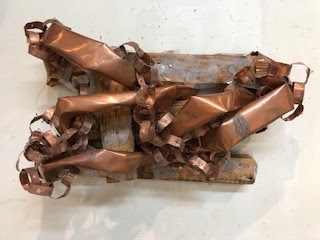
One copper and wood piece titled, “ Emotional Entanglement and Mental Restraints” has copper elements that are folded—emerging from a wood structure. The copper chains weave around the wood foundation. One can clearly see the metaphor the piece evokes.


Ranker told me that she exhibits her work at the studio 314 at 450 Harrison Ave. in Boston. You should visit Ranker there— because the first Friday of each month—  her gallery and many of the commercial galleries open their doors to the public.

To view Ranker's artwork go to:  http://marilynranker.org

Sunday, June 03, 2018

The Sunday Poet: Heather Nelson

 
Poet Heather Nelson

 Heather Nelson is a poet, teacher, mother and recovering attorney based in Cambridge, Massachusetts. She studied writing under the poet C.D. Wright as an undergraduate at Brown University. Most recently she studied poetry with Tom Daley and Barbara Helfgott Hyett. Heather is also a member of Poemworks, the workshop for publishing poets. Her work has been published in Main Street Rag, The Somerville Times, Constellations, Ekphrastic and The Compassion Anthology.


Resilience
On the slim wooden shaft of the women’s room key is a query, in black Sharpie.  Do you identify as female? Literal me, I take all questions seriously, I examine the evidence.  The swelling prow of my chest as I thread my way between the coffee shop tables certainly broadcasts a woman’s body. As I resume my scone, I look out across the tables at all the other solitudes. Is what they see female?  I’m not looking at myself most of the time. I’m not shopping, I’m not dieting, I’m not waxing. I’m not waiting to be asked. I’m feeding my hunger. I live in this soft and solid house, we’re incorporated, this body and I.  I’m 49 and full of questions and desire. As we age, does sex fade or intensify? If my gender’s fluid, could it overflow and lap at the feet of the beautiful barista boys? That would be hot, but it wouldn’t be pretty. Everyone likes to look, but no one really wants to be touched.   Midlife is a second childhood, equally turbulent, but less endearing. If we’re flirting, it’s with ourselves, stretching in front of our mirror.
Resilience means:
opening a mental door,
keeping it ajar.