Tuesday, July 15, 2014

On My Way To Becoming A Man by A.D. Winans

(Left) A.D. Winans with the late Jack Micheline
On My Way To Becoming A Man
by A.D. Winans
© 2014 by A.D. Winans
NYQ Books
New York, NY
ISBN 978-1-935520-25-2
Softbound, no price given, 108 pages


Review by Zvi A. Sesling

I have read that A. D. Winans is the second coming of Charles Bukowski. That he is the new Allen Ginsberg. However, believe me he is neither of these, he is his own world class poet. Bukowski was mostly about himself and his booze or his women. Ginsberg was about everything else.

Winans in his new book On My Way to Becoming a Man shows where he is coming from: speaking out for the working class, the downtrodden, the poor, women, the abused, victims of war and his personal opposition to war.

Often described as the “last of the beats” Winans carries on their tradition with his uncompromising observations and exclamations.

This book begins on military bases where Mr. Winans is quick to learn the hard lessons of military life at Lackland Air Force Base and then Panama.

Many of his poems leave no doubt what they are about: “Growing Up In America,” “The System,” “Reaganites,” “Chinatown Sweatshop,” “We The People,” and his final “I Am San Francisco,” a not to be missed poem in which he combines all of the Beats and pieces of Bob Kaufman, Ginsburg, Bukowski, semblances of Kerouac and others.

What makes Winans poetry so good is that he knows and understands the low and high ends of society and most everything in between. He deals with San Quentin Prison, the Pope, Sitting Bull, Old Poets and more.

Who but Winans can criticize poets we hold near and dear? Who else can skewer politicians and dead presidents? Who would dare go after major corporations, the military, establishment heroes while commenting on the futility and corruption of so much in America?

We (the people) just don’t have any poets around who speak for us the way Winans does, whether you like how he does it or not. Too much poetry has degenerated in self-wallowing pity or self-created failure. This meaningless poetry is offset by the real poetry of Winans assaults on war, politics, religion and the wealthy.

Following are lines from Winans which are difficult to forget and worth remembering:

the IRS is a legal shake down
the Pentagon a slaughter house
--from San Francisco Blues

they cross the border
looking for a piece
of the promised land
entering a country that once
belonged to their ancestors
--from Poem for the Governor of Arizona

he toils on the assembly line
works an eight ten hour shift
leaves a piece of him behind
for every part he helps make
--from Factory Worker

U.S. generals claim substantial
gains and important victories
in the past month while fresh supplies
of bodies are ordered by the Pentagon
for expected vacancies computed
to exist from statistical backlog
and Vietnam (Cong) terrorist activities
--from Dial 890 Remembering The Old
Sixties

I watched the Cavalry charge
the Indian villages
like Attila the Hun
believing Custer a hero
and Sitting Bull a savage
-from Growing Up In America

this poem is for those
who gave their lifeblood
to wash the streets free of oppression
for those who rest in heroic
and not so heroic graves
in the struggle
for human dignity
--from Poem for Roberto Vargas and the
Nicaraguan Freedom Fighters

These are but a few examples extracted from the 52 poems and 108 pages of some of the more meaningful poetic lines written by a surviving member of the generation of poets who provided us with ideas to think about, actions to take and memories to last. You will find this trio of important concepts in A.D. Winans’s On My Way To Becoming A Man. Don’t miss this book
_____________________________________________________
Zvi A. Sesling
Author, King of the Jungle (Ibbetson Street Press)
Author, Across Stones of Bad Dreams (Cervena Barva Press)
Editor, Muddy River Poetry Review
Editor, Bagel Bards Anthology 7
Editor, Bagel Bards Anthology 8
Publisher, Muddy River Books
 

Saturday, July 12, 2014

The Out of the Blue Gallery--To Close and Hopefully Move to New Location!


The Out of the Blue Gallery--Cambridge, Mass.


I got this message from Tom Tipton ,the owner of the Out of the Blue Gallery in Cambridge, Mass. For years I have attended events, hosted readings, and even contributed to an anthology of prose and poetry edited by Timothy Gager and Deborah Priestly The Out of the Blue Gallery Unites under the umbrella of the Out of the Blue. Many Somerville artists, and artist from around the area and the country, have found this venue a welcoming oasis for their creative output. This is a top shelf grassroots organization and I hope it lands in a new location.--Doug Holder. 


After nearly 18 years of providing a home for local artists at our present location, the Out of the Blue Gallery, must find a new home due to real estate issues beyond our control. 

The Gallery has been operating out of Central Square in Cambridge, providing a home for local artists of all genres. We provide a space for writers groups, dance classes, acoustic music and more to meet and showcase their talents. We hang art not only in our own gallery, but at several other Cambridge locations including The Middle East and 1369 Coffee House.

The Gallery has become known as a welcoming starter venue to those whose talents might not otherwise be recognized, as well as a home for more established acts and artists. We provide an intimate atmosphere for everyone, of all abilities, to benefit from each others creative accomplishments.

Thank you for all the love and support for the Gallery, and each other all these years. The plan is to keep it going.

We invite you to join us for a series of benefits to help us raise money to offset the financial burden of relocating. Every penny donated will go toward improving the gallery to better serve the community.

Supporting Out of the Blue Gallery is supporting local artists, musicians and more
--------------------------------------------
Upcoming Benefits:
online fundraiser

http://www.gofundme.com/a8l4uo

Tuesday, July 08, 2014

The Thursday Appointments of Bill Sloan Timothy Gager


The Thursday Appointments of Bill Sloan
Timothy Gager
Big Table Publishing
Release date: Only a few more weeks
$15.00 available as a special order from select books stores
and at most online book retailers

By Rene Schwiesow

A few years ago Timothy Gager contacted me and asked if I might like to read the draft of his novel and offer some edit suggestions. Who am I to turn down the opportunity to read a book, especially a book by a writer I respect and whose work I have admired? I accepted and, once I began reading, I happily took note of its unique formatting style. “The Thursday Appointments of Bill Sloan” showcases Gager’s development of his fearless, individual voice. He introduces us to his well-crafted characters first through the clinical notes taken by Bill Sloan, their more-than-struggling-himself therapist.

Gager offers this one line synopsis: “A story of a man whose job it is to help people, but in reality, he is inept, sarcastic, and each and every day represents something to get through.” Sloan is definitely inept and sarcastic and I’ll throw unethical into the mix. The journey through Bill Sloan’s days, however, brings transformation to Gager’s characters, ultimately also transforming Sloan; but as with all transformational journeys the shifts are not without their tragedies. Gager takes quirky characters experiencing grief, past trauma, and existential angst and adds his unique humor intertwining the characters’ lives through their clinical liason, and a twist on counseling Lucy Van Pelt style when the character Kate Hummingbird Warrior sets up a sidewalk therapy stand.

Sloan is therapist meet greed and self-centered absorption. More concerned with promoting Bill Sloan than healing his clients, he spirals downward and out of control. The question is can alternative healing, angry, self-deprecating clients, and a wolf be enough to save him from himself? Can his demise be enough to save his clients from their own self-absorbed morass?

No, Gager’s work does not follow your typical novel template. How refreshing. The formatting captures the reader’s attention from the get-go. Rusty Barnes, co-founder Night Train Magazine and author of “Reckoning,” calls “The Thursday Appointments of Bill Sloan” a “gangbusters novel.” Meg Tuite, author of “Bound by Blue” says “Get a Copy!” This reviewer agrees on both counts. Do yourself a favor and pick this novel up immediately upon release!

Sunday, July 06, 2014

Monk Eats an Afro by Yolanda Wisher


Monk Eats an Afro
by Yolanda Wisher
Brooklyn: Hanging Loose Press, 2014
978-1-934909-42-3
$18.00

Reviewed by David P. Miller

Poet Yolanda Wisher, a Cave Canem fellow, lives in Philadelphia with her husband and double-bass player Mark Palacio, and their young son Thelonious. As you might guess from that brief bio and the title, her debut volume Monk Eats an Afro is full of music - lively, celebrating, eulogizing, lyric and reflective as the situation calls for it. I find this review to be longer than planned, and still it can’t do justice to this collection. But let’s start.

The first of four sections, “The Myth of Stew,” centers on the family, especially the women, deep and richly formative. As she writes in the title poem for this section, “a pot    don’t call it a cauldron / could feed millions for eternity” with “a woman and her girls / sitting at the table / like thick spoons”, both sustaining and being sustained. “My Family of Women” presents dense imagery in a brief space. The women keep the girl strong, autonomous, and protected, while at the same time opening her mind in ways they didn’t anticipate:

Church women and pinochle sinners
gave me my tutelage in fatherlessness, their tongues
commanded by a ruthless orgy of verbal desire
broke my mind into seven spheres.

In “Violin to Fiddle,” when the girl’s turn in a music recital seems forgotten, or maybe deliberately ignored, by the teacher (“his glass eye grinning / like an overseer / announced the end of the program”), her mother pushes her and the whole room for her claim her part: “you are Black / and have a right to this.” Again there’s an unexpected transformation, hinted by the title, as

a bumblebee found me quick
about three bars in
but I kept on playing
like a can of Raid in that dress

Goaded it seems by the bee, she comes to “this be your fiddle / claim it”.

Monk Eats an Afro includes poems framed as “Songs,” with a distinct layout and a different voice. In the Song titled “Ancestors,” Yolanda Wisher asks where the family has gone, finds them not lost at all but manifest everywhere: “Walt say / in the bubbles of the stew // Pablo say / in the iridescence of fish”.

“Slow Drag,” the second part, moves away from home to neighborhood, lover, future husband, and friends. “5 South 43rd Street, Floor 2” gives us a thick description of the speaker “hungry” for the West Philadelphia neighborhood where she lives:

Once we went into a store sunk into the street,
owned by a Cambodian woman. She sold everything,
from evening gowns to soup. Over to Walnut and 45th,
where the Muslim cat sells this chicken wrapped in pita,
draped in cucumber sauce.

And everything makes her neighborhood, including the adult video store (where “a white man hustles” furtively away), the “shit stain from a wino,” and a murder, which doesn’t constrict the meaning of home, though it happened:

One night, a man was shot and killed on this block,
right outside our thick wood door. But not today.

In the song “Worthy,” stunning imagery tells of the speaker’s joining with the man who would become her husband. Their love was

Deeper than Iraqi oil
Darker than Belgian chocolate
More opaque than midnight sky
More comely than Sheba

And in their devotion,

She saw fingers wrought for good fortune
Locks like the tallest trees
He took her thighs for hymns & mantras
Her scars for heirloom jewelry

I have to mention “English Department Meeting Query,” which opens with one of those godawful classroom study questions: “What is cultural tension? What are some examples that we see in the world, in our neighborhoods, in our school?” Wisher replies to this question in the kind of detail that heightens its basic cringeworthiness: “The working class guy named Jim next door / with his bumper sticker about Unions and his / shit about Puerto Ricans”, just to begin with. It makes me wonder about the rarefied activity of writing this review, even.

The third section, “Harriet,” presents the lengthiest, most complex poems in this collection, First, though, it opens with the song “Melon Rap,” a coming-out from a very particular closet - the love of watermelon:

Can’t indulge in public
Folks might call me coon
So I grow you in my backyard
By the light of the moon

“American Valentine” is a sustained meditation about Phillis Wheatley, whose legacies Wisher plays out in a multiplicity of images without reaching for a single unity. The colonial-era slave woman poet, “who used to be a sellout / who used to dance / that waitress two-step” (II), also

[…] slashes out
pulpit with pen
to sister-friend,
knows a thing or two
about BARBARITY, EVIL
and CRAFTINESS,
and still talkin bout REVOLUTION,
American as the LIBERTY
on her tongue
of Latin-edged lingo.  (I)

There is much more here, suggesting the scent, the resonance, of Wheatley as misplaced transplant who nevertheless perfuses culture and identity, surreptitiously and persistently.

Similarly, “Harriet” presents multiple facets of Harriet Tubman, as a critical historical figure and necessary strength and medicine for every day:

so invoke her
when they belittle you
push you to the fringes
of your own city

invoke her
when you’re feeling
like a credit score
bent and bleeding
from this American
cat’s toying

Following quickly, the prose poem “Dear John Letter to America” is a series of coruscating images of what America keeps promising and can’t get right: “I am a slaveship and you are a skyscraper. […] Used to woo me with roses carved from melons, douches of Colt 45 and holy water, ivory pearls that turned out to be my Grandpa’s wisdom teeth.” And still it seems that if the apostrophized America would only show simple directness and real vulnerability, the relationship might have a chance: “Show me your dirty drawls and your secret birthmark. Maybe then, America, I might give myself to you.”

The epic “Notes from a Slave Ship” begins with an epigraph from Essex Hemphill, imaging a city bus populated with mostly Black riders as a slave ship. Its nine sections play on this theme, mostly using specific transit lines and/or locations as jumping-off points for a wide range of stories, observations, and reflections. This is a poem of great scope.

“Monk Eats an Afro” is the title of the fourth and final section, bringing us back to the family: Wisher’s own family now. “Dawn in East New York” moves from a well-drawn, remembered story from high school, told to her by her husband in high school, to a quiet scene on their bed as she is expecting their child:

[…] And now
lying in bed for the past three nights
he studies the manual of a Nikon F60
holding the camera in lamplight, getting
ready to take a morning portrait of
my belly full of his son.

In “Diane,” there is a moving contrast between the casual disrespect for the body of a deceased friend (maybe a family member?) and her own body full of a new life, a scene at a funeral home:

did you know
they had you lying in a
cardboard box
covered in bedsheets
with tea-covered stains […]

I wanted to tuck you in
wanted to give you
my stomach swollen with promise

And at last the title poem: “Monk Eats an Afro,” funny and full of unsettling imagery, as Thelonious Monk consumes an Afro “on a silver platter / with a choice of two sides”.  As he gives some to her and some to the baby, the scene opens up with pleasurable morphing energy: Ella Fitzgerald puts the leftovers

into her purse
where tiny blues singers
hotcombed them on a conveyor belt
into sheets of butter
with notes of bop

That’s it right there. In Yolanda Wisher’s poetry, nothing need remain fixed or finally identified. Viewed rightly, through memory, observation, or dream, our engagement with world and heritage is a constant source of new life and renewal:

kiss the pyramids and trap doors of history

for me. give my love to the sea bottom and the sharks. (“Notes from a Slave Ship”)

Friday, July 04, 2014

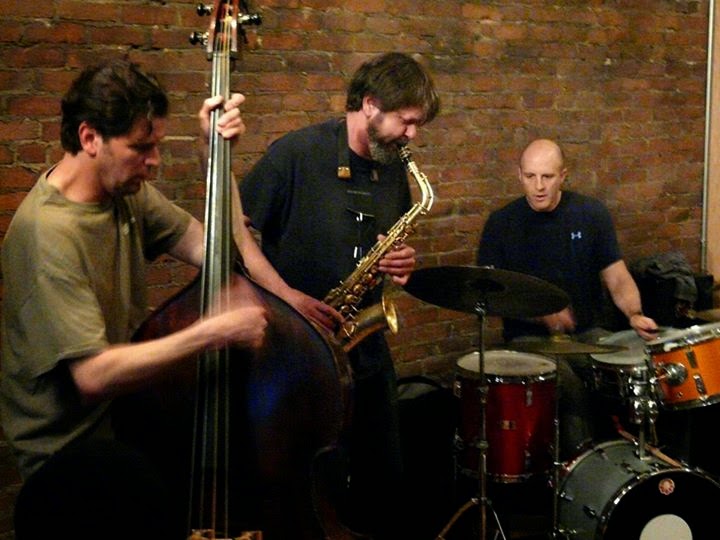
Mark Redmond: A curator of jazz at The Green Room in Somerville.


Jazz at Somerville's Green Room


Mark Redmond: A curator of jazz at The Green Room in Somerville.

Mark Redmond looks more like a lumberjack than a jazz aficionado.  This tall, imposing man with a thick beard joined me at my usual table in the back of the Bloc11 Café in Union Square to talk about his relatively new series: “Jazz at The Green Room.” The Green Room is at 62 Bow St. in Union Square and was founded by Somerville musicians and vocalists Michael and Anney Barrett. The space, according to Redmond, was a former dry cleaning establishment. It hosts a variety of events that lean toward the classical side, but not exclusively.

Redmond said Union Square Somerville is a great place for his venue. The Green Room is an “intimate” space which Redmond feels is a perfect fit for the intimate art of jazz. He likes the vibrant scene here in Somerville, with places like Sally O’Brien’s, Bull McCabe's, P.A.’s Lounge  and others in close proximity. “All these places cater to a variety of musical tastes,” Redmond said.

Redmond told me that his series started in late November of last year. He has hosted many jazz musicians, including a number from Somerville.  Garrison Fewell, a Somerville resident and a noted jazz guitarist and educator, as well as Somerville denizen Jean-marie-Corrois, an accomplished drummer, have been on stage. Another Somerville resident of note is saxophonist Russ Gershon, founder of the famed Either/Orchestra and impresario of the Accurate Records label. He and the pianist Rusty Scott played for Redmond and said of the experience: “The Green Room is like a nano-concert hall—intimate, creative, great sound and good piano.” Other musicians of note who have featured there are Bert Seager, who teaches at the New England Conservatory, as well as Somerville vocalist Laura Grill, who recently appeared at Somerville’s Joe’s Jazz & Blues Festival.  Matt Glaser, a violinist who directed the string department at Berklee for decades and founded their American Roots Music department, will bring a trio in the fall.

Redmond told me he has had a long love affair with jazz. He used to listen to his father’s albums when he was a kid. He listed some of his early influences as: Miles Davis, Charlie Parker, Bill Evans and other classics. I asked Redmond about the genres of jazz has he hosted. He said: “I’ve booked folks who play straight-ahead traditional jazz, avant garde stuff, bebop, Gypsy Jazz. I like a variety of music—I like the energy and creativity it brings.”

Before the interview I did a little research on Redmond. I noticed he works as an existentially-oriented psychotherapist.  Visions of Sartre, the meaningless of existence, and the connection to jazz ran through my pretentious head.  But Redmond, a straight-no-chaser sort of guy, said: “I don’t know about the connection between the two, but live music, that sacred place in time, the energy, the movement, is a vital element for me.”

The good news is that The Green Room is owned by the Barretts—so when the gentrification of Union Square is complete they won’t be forced out by the skyrocketing rents that will displace many others.

Redmond has several events scheduled this summer and into the fall. They are usually held on weekend  evenings, and the admission is ten dollars. To find out more about his series:

 Jazz at The Green Room


Wednesday, July 02, 2014

SINGER/SONGWRITER JENNIFER MATTHEWS: An artist of the road, heart and life.

Jennifer Matthews  (Photo by Syed Zaman)


SINGER/SONGWRITER JENNIFER MATTHEWS: An artist of the road, heart and life.

By Doug Holder

Jennifer Matthews doesn’t walk into a room; it is more like she drifts in like some stray, haunting riff from a distant, deep, deep blue guitar. Matthews, formerly a Somerville resident is an accomplished musician who defies categorization. She told me at the Sherman Cafe as we consumed some tea and scones that she considers herself  "A singer, songwriter and roots/ rock&roll musician.” By “roots” Matthews means she use an acoustic mandolin, foot stomps, hand claps, and her signature acoustic blue guitar. She and her guitar are in a committed and monogamous relationship for the past 12 years. She was shown the guitar at a music store and was not impressed with it at first. She told the clerk, “But it is a Blue guitar!” He told her: “Play it.” And like many affairs of the heart, she reluctantly, but hopelessly fell in love. And this guitar is a perfect conduit for her brand of music.

 There is a word in Yiddish “luftmensch” which means an “air person”—a person who drifts around—is the opposite of materialistic— he or she moves freely with her intellect- seeks the spiritual— tastes philosophy-literature, a range of subjects and interests. This defines Matthews and her music. Her music addresses the ontological questions, the long journeys, the joys and the ephemeral nature of love, with always a look what is beyond this material dimension. Her ever-present wanderlust has taken all over Europe, Alaska, Austin, Texas, and to an off- the- grid, hand built Earthship house in the Ortiz mountains outside Madrid, New Mexico. According to her website, from 2006 to current times she has been touring locally and abroad. When she was in Rome in 2010 she released a DVD “ Live at the Piper Club Rome.” This was one of the venues she played at during her stay in Italy.

Matthews is releasing a 7th CD  "Tales of a Salty Sweetheart."  She has engineered this album herself and it was mixed by Phil Greene ( 25- time Grammy Award-winning engineer) who according to Matthews told her, “Tales of a Salty Sweetheart is one of my favorite records I have mixed in the last 10 years.” Matthews had a number of musician preform on this album including Russell Chudnofsky who played the Dobro slide guitar. The CD will be released by the label Thundamoon Records founded by her manager Rose Gardina, who also founded the Boston Girl Guide website and magazine.

Matthews, who is studying  at Salem State University for her degree in English, said when she writes lyrics she literally locks herself in a room. She smiled "I can’t be disturbed.” And like the poem finding the poet ,the song finds Matthews. Matthews says she is in touch with her “inner voice.” Her lyrics can be ethereal and transcendent and she counts Leonard Cohen and Bob Dylan as spiritual masters who have influenced both her lyrics and music.

Matthews, who lives just across the border from Somerville, but often plays in our city, plans to have a media campaign that will reach college radio stations both locally and nationally. Matthews has lived the life of an artist. At time it was a hand to mouth existence—as  Dylan sang  --“better pawn it babe,” and she did at one time, no doubt.  I remember her telling me a story of when she was a little girl. Once she jumped up on a table and started singing "Somewhere Over the Rainbow” in front of her friends. I can still see that girl in the woman and I have to believe she is somewhere near that place now.


For more information about upcoming events go to:Jennifer Matthews

Tuesday, July 01, 2014

My South By Southwest A Cast Iron Tempo Recollection By Elizabeth Akin Stelling


My South By Southwest
A Cast Iron Tempo Recollection
By Elizabeth Akin Stelling
Red Dashboard LLC
www.redashboard.com
Princeton, NJ
ISBN- 13:978-1494475451
116 Pages

Review by Dennis Daly


I rode in with a posse of northeastern elites ready to make short work of any outlaw poet espousing a “cowboy” perception of all things human. Reckon us artsy-fartsy, highfalutin folk can’t abide shit-kickers, firing their guns in the air after writing a poetic memoir extolling the timeless and utterly personal importance of beans and cornbread.

 Days after discarding the unused hangman’s rope and reading My South By Southwest, Elizabeth Akin Stelling’s collection of poems set in rural Texas, in its entirety for the second time I became a believer in, if not cowboy poetry, at least Stelling’s version of this genre.

Stelling writes with an odd poetic cadence. She mixes the expected caricature of popular movie legend with realistic country diction and then infuses it with jaw-dropping moments of complexity. The book’s front and back covers and its illustrations unabashedly build on the cartoon look. But through it all Stelling’s honesty blasts onto the pages with the withering candor of a west Texas sun.

The book begins with a prologue poem entitled Texas Skies.  The piece is pure enchantment. White clouds shape themselves into dessert plants like mesquite and prickly pear, and then reform themselves into a woman encountering her universal cowboy. Flirtation follows with the predictable “scoot across a sawdust dance floor.” The poem ends transitioning from the messy personal to big picture beauty,

at night’s end,
morning light exposes a scene,
of rustled bed sheets and blankets
in a musky room
    filled with far-flung recollection.

Down the road,
a prettier site to behold:
a backdrop of a country town,
under a big top called Texas,
    a blue one
dotted with pretty white clouds,
scattered and taking on shapes,
always reminding
    of so many boundless things.

In Stelling’s poem, There’s A New Sheriff In Town, she describes her chemical makeup as a toddler in pretty funny terms and how it matches her Texas surroundings. The poem opens this way,

I drove my mother crazy
with my finger-sucking
(left-hand index barrel).
She would place me in a crib jail
and look down.
My “nasty habit” she called it,
crossing her chest
as if  praying to ward off evil.

Her sister advised her
“buy really hot sauces”
like mustard, green chilies
dip my finger in them,
then when she lay me down
to sleep, guaranteed,
I wouldn’t touch them.

Aunt Grace was wrong.
The hotter the better.  

Emotions attach themselves very readily to food I’ve noticed, remembered emotions from childhood even more so. Stelling makes good use of this phenomenon in her poem Corn-bread and beans. The poet details a family going through tough times. A mother prepares poverty’s breakfast in a cold house. The ending tugs at one’s heart,

Tears streamed.
    Each felt the sting—one, two, three
cutting of onions,
a front door slamming
and a father gone.

Leaving them—one, two, three, four
    frail bodies for eternity,
with a smell,
the burning aftertaste,
and a craving
for cornbread and beans.

Hearing the N Word In 1966 breaks through the surface texture of this collection. This poem delivers complexity, pathos, and a bit of thought provoking irony, all in five stanzas. The poet hits all the right notes. She has to. The poem begins harshly,

My father said nigger under his breath
toward some boys, coloured, and both
walking with scraps of lumber. They were dragging
wood along the school fence.
Huckleberry Finn did this jig,
And had fun.

Asking if daddy knew them,
supposing he worked with their fathers—
I was told to shut up
to remember  my place.

Here’s another brief selection from the same poem, highlighting childhood pathos,

Sandra and I came walking down the street.
In a rage Momma flew out our front door,
telling me to go into the house. Watching
through the screen door, I saw my friend’s tears.
Her unkempt afro swung around, then
she had to walk back four blocks
to an empty school.

Not only does this poet have a good ear but she understands the times and how societal bigotry infests otherwise decent people. It’s not that the poet’s persona is throwing her parents under the bus, but rather she seems intent on presenting an honest picture and setting up an ironic twist in the final stanza.

Kit Carson’s name graces a stray boulder and Geronomo metamorphosizes into a wooden Injun in Stelling’s poem Outlaws Still Border Texas. Tourism pleads its case from desolation. On a family road trip the poet notes a number of these incongruities. The poem ends not unreasonably,

“Goyahkla” means “The one who yawns”;
it is one of many trading posts
and totem pole—
riddled smoke shops
along the old Chisholm trail.
When I listened to the wind blowing through my long
auburn hair as Daddy drove,

I thought I heard the Great Spirit
call out: How
on earth did this blasphemy
make it this far?”
Wasn’t this supposed to be
a new frontier?

Beginning her poem, History Calls Out, “A Bullet Gone Wild, Stelling quotes the gunfighter Bat Masterson, who said, “If you want to hit a man in the chest aim for his groin.” I know a bit about Masterson. He later became a sportswriter in New York and railed against the barbarity of football. Somehow that seems appropriate. Stelling mixes a dreamed up meditation with gross reality. Here’s the heart of the poem,

When a man walked out into the street,
his gun packed as tight as possible,
in his belt and not far from his crooked
finger, it might have appeared aggression
looked you square in the eye.
Walk and draw was still a dream.

Civilized men kept a one shooter
deep in the pocket of his trousers.
To prosper, whiskey, and boredom
Brought out the best in a man
In the wilds of the frontier.

Together, the blend of honesty and humorous caricature charm these poems of cowboy sub-culture. Try ‘em out. You’ll like ‘em. Maybe you’ll like ‘em alot. And, dagnabbit, keep your spurs on and watch your back.

**** This review originally appeared in the Fox Chase Review.


Monday, June 30, 2014

Somerville Writer Mitch Evich: A Geography of Peril: Essays About Growing Up in the Northwest.


Somerville Writer Mitch Evich: A Geography of Peril: Essays About Growing Up in the Northwest.

By Doug Holder

Somerville writer Mitch Evich has lived in our burg for many years, but he is originally from the Pacific Northwest. I  had the pleasure of interviewing him years ago about his novel The Clandestine Novelist.  Now Evich has landed with a new collection of essays. A good portion of his collection deals with salmon fishing, and its trials and tribulations. I must admit that my extent of knowledge of the heroic salmon is limited to the Nova on my morning bagel. But after reading Evich’s  A Geography of Peril… I have a better idea of what the agonies and joys are of the life of a fisherman. Evich grew up in Washington State in the 60s and 70s, worked on his dad’s boat the Independence and was privy to frustration of the oh what a tangled web we weave of fishing nets, the endless repairs of the ship, the diminishment of the fishing industry due to the successful claims of native Americans for 50% of the overall catch from salmon runs, and the endless uncertainties of making a living from this seasonal and mercurial business. Here is an evocative passage in which Evich describes his memory of the boat, his dad, the unraveling of the nets, and the fish when he was a mere lad of eight:

“When I awoke…it was to the grind of machinery, the clanging of brass rings, and the squeak of corks as the seine spooled around the enormous steel drum, seawater pattering against the drum’s drainage well. My dad served as a spotter as I climbed the ladder at the back of the cabin, and then he positioned me, with my legs dangling beneath a very low railing, so I could safely watch the machines and the men at work. The oval-shaped ring of corks, longer than a football field, slowly shrunk. After a while a row of the brass rings emerged above the surface of the water, and two men struggled to thread the cluster of rings with a large steel contraption shaped like, and called, the ‘hairpin.’  Once the rings were out of the water, whatever salmon were in the net were trapped. Some minutes later, twenty or thirty of them landed, flapping and gasping on the fish hold covers.”

Evich goes into his family history, his high school football career, his forays into journalism after college—and all of this is informed by the siren call of his boyhood home.

****  A Geography of Peril is published by Village Books in Bellingham, WA.