Friday, September 28, 2012

Review of EARTH LISTENING, Poems by Becky D. Sakellariou


Review of  EARTH LISTENING, Poems by Becky D. Sakellariou, with a CD of the author reading selected poems, Hobblebush Books, 17-A Old Milford Road, Brookline,
New Hampshire 03033, 2010, The Hobblebush Granite State Poetry Series, Volume II, www.hobblebush.com, $15.

Review by Barbara Bialick, author TIME LEAVES

From Euboia, Greece to the state of New Hampshire, Becky Sakellariou meditates on life
“with its depth, its explorations of love and loss (to what) seems to be like one long prayer…” according to reader Patricia Fargnoli. Indeed, as the author says in her own words, “These poems explore what I call the beginning of dying, the way our pores open to the world even more intensely as we age…”

The poem “The Inside of a Prayer” begins with the epigraph:  “We are all descendants of travelers”—William Least Heat Moon. The poem reads:  “Hold still/the translucent moon…Hang it above the blood/scarlet sumac and let it tell us/of the women and men/who boarded wooden ships/who traveled through eons/of other moons/to become you.”

She continues this line of thought in “God Doesn’t Need a Boat”:  Come, ferryman of our fears,/carry our boat across the gap/the one between fire and daylight/…Bear us back into the light.”

To the author, what is most “unexpected is death”.  In the poem “Unexpected”, she concludes “A quick, violent wind/…roars across the fields/…into the tomorrow of worry, fear/another harvest gone,/another year lost.”

Becky D. Sakellariou was born and raised in New England but has lived most of her adult life in Greece. Since 2007, she has been going back and forth to New Hampshire for part of every year.  She has a B.A. in Literature from Antioch College and a M.Ed. in Cross-Cultural Education from Lesley College.  She has published in a variety of journals. In 2005, she won first prize in the Blue Light Press Chapbook contest for THE IMPORTANCE OF BONE. 

Wednesday, September 26, 2012

Interview with Poet Steve Cramer Director of the MFA Program in Creative Writing at Lesley University

 With Doug Holder


****I thought I had lost the following interview--but I just recently found it. It was conducted on my Somerville Community Access TV Show  Poet to Poet: Writer to Writer in 2004.  The audio tape is archived at the Poetry Room at the Lamont Library/Harvard University.


Steve Cramer is the author of four poetry collections, the latest being “Goodbye To The Orchard”  (Sarabande 2004). His poems and criticism have been in the “Partisan Review,” “The New Republic,” “The Paris Review,” among others. He was the recipient of fellowships from the “Mass. Artists Foundation“, and the “National Endowment for the Arts.” He has taught literature and writing at B.U., MIT and Tufts. He currently directs the low-residency MFA program in Creative Writing at Lesley University in Cambridge, Mass.. I talked with him on my Somerville Community Access TV Show “Poet to Poet/Writer To Writer.”


Doug Holder: Steve, the MFA program at Lesley University is barely a year old. Can you talk about it, and what makes the program unique?


Steve Cramer: It’s a low-residency MFA in Creative Writing. We have four genres: Poetry, fiction, non-fiction, and writing for young people. We will have our first graduating class in the Summer of 2005.


Doug Holder: Can you define “low-residency?”


Steve Cramer: The first low-residency program that I know of was at Goddard College in Vermont. The low-residency programs were conceived as programs for older people who had been through college. It was for folks who had perhaps given up on writing, and then had gone back to it later. In our program writing students and experienced writers can work together in the old way, through the mail, in a one to one relationship. In order to fuel-inject this experience this program holds residencies of about ten days twice-a-year; where everyone in the program, students and faculty get together. We hold workshops, there are seminars, readings, so people leave energized both to rework their writing and to experiment as well. It is a collective experience, followed by an intimate experience between a mentor and someone looking for a mentor. The result is a MFA.


Doug Holder: Can you talk about the faculty you hired?

Steve Cramer: In terms of faculty who live in the area we have Michael Lowenthal (fiction), and Rachel Kadish (fiction). We also have Janet Sylvester who teaches poetry at Harvard. A number of our writers are not American writers, but they do write in English. We have a Jamaican writer Wayne Brown, and Rachel Manley, the daughter of the former prime minister of Jamaica. So we have a diverse faculty.


Doug Holder: A former student of yours, who has just joined us, David Sirios, told me your collection “Goodbye to the Orchard” might refer to the orchard at Bennington College where you taught for awhile. Is that true?

Steve Cramer: It’s true and not true. I taught at Bennington for five years. For most of that time my family lived in this seedy apple orchard. There are a number of poems where the orchard figures in. The title poem: "Before the Orchard,”was actually started when we were leaving the orchard. It was a poem I could not finish at the time because I moved out. It was only after a year or two, that I finished the poem “Goodbye To The Orchard.”
Basically the “orchard’ is an emblem for me of a natural state that at first is cultivated, but left alone will revert back to a wild state.

Doug Holder: Can you tell us something about “Sarabande” the house that published your book?

Steve Cramer: It was founded by two poets. I don’t know what drove them to start an independent literary press. They market books well, and they have a great board of directors. They have a chapbook series. They have published chaps by: Frank Bidart, James Tate and others. It is a very canny way to attract people to their press.

Doug Holder: You start and end your book with a “loose” translation of a poem. Can you talk about the structure of this collection?


Steve Cramer: The book begins with a poem that is a loose translation of  " Throw Yourself Like Seed" by Miguel de Unamuno.   My recently deceased mentor, the poet Donald Justice, did this all the time. Whenever there was a period in which he wasn’t writing his own poems, he either worked on a translation of a poem, and tried to improve it, if he felt it was lacking. I knew both translations would form the foundation of the book. The first one sets the terms of the book, and the last one by the same poet “It is Night In My Study" “ was about writing a poem and imagining your own death as the conclusion of writing this poem.
In “Throw Yourself Like Seed” ( the lead translation) I don’t agree with the premise that your work, your art, is the single lasting thing. I was very conscious of starting with a poem I don’t agree with. In terms of what door I would like the reader to enter, I believe it.

Doug Holder: In the poem “Body on the Brain”, you really have another take on the body beautiful. I quote:"When we add our stink to a stranger’s stink from the next stall, two stinks/stink less than one-and isn’t this/ how mind and body mate when we’re in love.” Are you talking about true love as a sort of mating of warts and all?

Steve Cramer: This is a poem that has offended more people than any other that I have written. It was posted on an online magazine called: “Slate.” And it was available for immediate comment after it was posted. A cyber population got involved right away, and had some responses like:’ You ruined my day!’ “Thanks for sharing.” I took it as a badge of honor. Yeats wrote : “ ... and love is pitched in a tent, near the place of excrement.” We are essentially body in almost all of our life experience. We are bodies with sophisticated software, with a little free will mixed in.

Doug Holder: A prominent poet told me if a young student asked him if it was a good idea to attend a MFA program, he would say: “What ... Are you crazy? Go to law school, there are jobs there. Join the Merchant Marines, at least it’s more interesting.” How would you respond to this?

Steve Cramer: MFA programs have been fodder for comments like that since there have been MFA programs. If someone came up to me and said: “Should I go to a MFA program?,” I would not answer it with an answer but with a series of questions. An MFA program is the institutionalization between the master artist and the apprentice. I would tell them if they think they are going to get a teaching job somewhere other than Murray, Kentucky, they are fostering an illusion. To work with people on an art, who are masters of the art, is not a new idea. I don’t think it is a culturally ruinous thing to have a lot of people interested in writing. Very often if they don’t become writers, they become passionate readers.

Doug Holder: David can you tell us about Steven Cramer, the teacher?

David Sirios: I was an older student. I was very serious about poetry. I found Steven to be illuminated and illuminating on the subject of poetry. The way he taught Elizabeth Bishop, Louise Gluck, John Ashbury, was really great. You taught me things I would never of learned on my own.

Doug Holder: Thank you gentleman, for joining me on Poet To Poet/ Writer To Writer.


Doug Holder is the host of Poet to Poet/ Writer To Writer -- airs at 5PM on Tuesdays on SCAT Channel 3 on an irregular basis. http://www.poettopoetwritertowriterblogspotcom


Monday, September 24, 2012

Oppressive Light Selected poems by Robert Walser


Oppressive Light
Selected poems by Robert Walser
Translated & Edited by Daniele Pantano
Black Lawrence Press
ISBN: 978-1-936873-17-3
180 Pages
$19.00

Review by Dennis Daly

“I’m not here to write, I’m here to be mad,” Robert Walser (1878-1956) explained to a friend and admirer who had come to see him at the Herisau asylum in Switzerland. Walser meant it. For the next twenty plus years until his death this famous novelist, short story writer, and self-described poet refrained from writing anything at all. Most who knew Walser best before he entered the asylum thought him mad. Those who visited him after he was committed believed him quite sane. It seems to me that there is a lesson here—somewhere.

As a young man Walser got himself a job as a bank clerk, a job he was very good at and clearly identified with. He later failed at an acting audition, worked at multiple clerical jobs, and trained as a butler, at which he worked and seemed suited to. His little view of the good life, where details are ordered, and emotions are calm, probably stems from these experiences.

For a time Walser even supported himself with his writings. Franz Kafka, for one, delighted in his prose and echoed Walser in his own writings. Hermann Hesse also admired Walser’s art.  But after the First World War Walser’s writings became less popular and he turned into a vagabond of sorts, moving from place to place. He had a position in the National Archives in Bern for a while, but then was fired. He drank too often and too much and finally tried suicide, an attempt which he also numbered among his perceived failures.

During these years Walser wrote some excellent expressionistic poems. Many of these unique, well-crafted miniature pieces were published in prestigious literary magazines. Walser’s madness, if madness it was, did not originate in artistic anonymity or lack of acknowledgement. It came from some place deeper.

Danielo Pantano, himself a Swiss poet, does admirable work in conveying the intensity and starkness of Walser’s darkly euphoric vision. The original German is printed on the opposite pages for those interested in Walser’s rhyme schemes and other mechanics translated into this nicely toned English version.

The first poem in the book, entitled In The Office, entrances with the portrayal of everyman- the- clerk. It’s not a caricature; it’s something else. Reading it is like observing the pinning of a butterfly: intimate and troubling. Here is the better part of the poem,

The moon peers in on us.
He sees me as a miserable clerk
languishing under the strict gaze
of my boss.
Embarrassed, I scratch my neck.
I’ve never known
life’s lasting sunshine.
My flaw is my skill…

Notice also that it’s the moon that observes the clerk in the above poem. We get to watch many of Walser’s poetic creations from above, from outer space. In the poem Rushing we look down on the dynamic of Walser’s world. The poet says,

In the world there’s still this rush,
the rush that never ceases;
I love—and it will never stop,
a love that rushes through the world.

Sometimes the poet zooms in for a closer look. In the truly miniature piece, As Always, a simple lamp and table seem to have the same weight as the poet’s longings and fears. These juxtapositions all take place in a single room, yet strangely there doesn’t seem to be a whit of claustrophobia. Walser describes the scene and ponders,

The lamp is still here,
the table is also still her,
and I’m still in the room,
and my longings, ah,
still sighs, as always.

Cowardice, are you still here?
and Lie, you, too?
I hear a dim, Yes:
Misfortune is still here,
and I’m still in the room,
as always.

Walser often uses the idea of outside meadow and or inside room as geographical points, places of safety where he can demand a kind of sanctuary from nature. One of his most existential poems and one that uses both these geographical havens the poet calls Tryst.  Here are two sections,

…the meadows are fresh and pure,
and a spot in shade and sunshine
like well-behaved children.
Here the strong desire
that is my life dissolves,

And,

… there’s complaining in the room
of such a soft kind, so white, so dreamy,
and again I’m left knowing nothing.
I only know that it’s quiet here,
stripped of all needs and doings,
here it feels good, here I can rest,
for no time measures my time.

The macrocosmic world seems to be hiding something from human kind. In Evening Song the poet hints at it this way,

Something like the weariness of nature
wants to lie down on the houses and fields.

Its subtle smile moves from tree to tree
but you can barely recognize it.

How miserable is the small breeze
that still travels the evening world.

Certain poets by their withdrawal from social and emotional life negate themselves and almost disappear. As they vanish their vision becomes their existence and its intensity becomes overwhelming and even oppressive. It empties them. They become cold, husks of themselves, the remnants left after poetic possession has finished with them. The young Walser somehow knew this. One of his early poems describes the scene,

You do not see me crossing the meadow
stiff and dead from the mist?
I long for that home,
that home that I never had,
and without any hope
that I’ll ever be able to reach it.
For such a home, never touched,
I carry that longing that will
never die, like that meadow dies
stiff and dead from the mist.
You do see me crossing it, full of dread?

On Christmas Day in 1956 a group of children found Walser’s body, frozen stiff, lying dead in the snow. He had walked away from the asylum, across a large meadow, leaving footprints. Those footprints are here in this book.

Saturday, September 22, 2012

I Thought I Felt Myself Crack: Review by DeWitt Henry of From the Umberplatzen: A Love Story by Susan Tepper

I Thought I Felt Myself Crack

Review by DeWitt Henry
 
 
Tepper’s 47 short shorts and/or prose poems (From the Umberplatzen: A Love Story) each one page or less, offer a linear narrative about an ambivalent, two-year relationship. In each section there is a dialogue between the woman narrator, Kitty Kat, who is from America and married, and “M,” her German lover in an unnamed German city with a park and a species of deciduous tree she calls “umberplatzen (“Of course that is not the true name of the tree. I can’t ever remember the true name”).

She has moved to Germany to escape her ex in America, though they are still married.  Her means of support are mysterious.  As she reveals, almost as an aside in the 47th section, M. used to teach physics at the University and travel a lot.  When they first met, presumably in the park, she’d joked about biological warfare chemicals affecting his brain, and he’d picked up on the joke. “They say it’s all chemical,” writes Kitty Kat, remembering. “His chemicals invading mine. Some sort of cross pollination.” The park too “had a kind of force field that drew us together.” They have separate apartments. Neither have children. He is divorced from a woman in France. We learn that he once studied medicine. Also that he’d once been a champion parachutist, but hates flying. He is virile and sexy, but above all he is witty, as is she. Both appear to be Catholic.

Nearly every section is structured on some topic of their disagreement: the trees, favorite movies, favorite paintings, hair styles, bird song, kites, shoes. They start off happily, then either she or he suggests an idea or a preference, the other disagrees, apparent misunderstanding or offense sets in, and they part. Then M. makes amends by sending some token or message across town, which arrives next day, and disarms or further perplexes Kitty Kat. Distance and intimacy are their necessary dialectic.

Kitty Kat can’t give up her past (her husband, her country), but revels in M. as her German holiday. For M. Germany is home and he wants Kitty Kat to share it with him permanently. Every now and then, despite their verbal parrying (much like the couples’ parrying in Hemingway’s “Cat in the Rain” or “Hills Like White Elephants”), there are lines of crisis.  “We stood there facing off. A kind of crossroads”; “You can’t boss me”; “You want a baby by yourself”; “I’m not ready for a ring.” In terms of story, as seasons turn, and as attempts to amuse each other wear thin, there is no big argument or break up scene, no final, bittersweet “wisdom.” But we know from the opening section that Kitty Kat has returned to her ex, who also sent messages and tokens across the time and distance (“My ex had sent me . . . three jars of peanut butter . . . He no longer hated me”), and that the 46 sections that follow, while wonderfully immediate, are fulfilling her promise to M. that “I will remember everything.”

Tepper’s ear is pitch perfect. None of the dialogue is attributed and put between quote marks in the usual way, but the reader is rarely confused about who is speaking. Her packed segments in dramatizing two witty, bright, and sexy individuals even seem to suggest a screenplay (Neil Simon meets Truffaut or perhaps Bertolucci). All the dialogue is there, as in this passage:
It’s my time. I don’t mind he said. I do. Women. And he shook a finger at me. Your body is my body. OK then I’ll buy your body. When my flat gets sold. M had laughed. To the coldest bidder he said. OK We’ll get beer. We’ll get beer and sausage. We’ll dance out the day into the night. He hugged me so hard then. I thought I felt myself crack.
This is a classic, unsentimental love story about ambivalence; it’s often comic; both characters are imaginative. There are moments of whimsy, astonishment, anger, and beauty.
Tepper asks the reader to work, and the work pays off.


****** This review was originally published in the Lit Pub

Friday, September 21, 2012

My Dear Girl: The Art of Florence Hosmer By Helen Marie Casey


My Dear Girl: The Art of Florence Hosmer
By Helen  Marie Casey

Review by Kim Triedman
9/17/2012

“I want us to explore what it means to be an artist, to work as an artist, and to lack acclaim.”  Thus begins author Helen Marie Casey in the preface to her new book, My Dear Girl: The Art of Florence Hosmer, released by Black Lawrence Press earlier this year.  The artist in question, who lived in Sudbury, MA for most of her long and productive life, is a figure of profound interest to Casey, who also lives in the area and is clearly well versed in the art history of the time.  As much meditation as biography, My Dear Girl takes as its task not just the reconstructing of one particular life but also, in a way, its conjuring:  In fashioning her biography, Casey seems to walk through Hosmer’s life as a kind of kindred spirit, hand-in-hand. 

 
Florence Armes Hosmer (1880-1978), lived through huge changes in her world – women’s suffrage, two world wars, the great Depression, and struggles for Civil rights and equal rights – and on a more personal level endured nearly constant financial obstacles and crises of confidence.  Born into a large and supportive family and educated at the Normal Art School in Boston, she went through her adult life unmarried, with “no protective partner or spouse, no mentor in the shadows who took her part for her; no agent,” under constant strain to make ends meet.  Acclaimed at one time as one of the more prominent of Boston portraitists, she “fell off almost all the charts of American women artists of the early 20th century.”  She was not “a path-breaking painter,” writes Casey, “but she was a good one,” and never gave up on “her commitment to the creation of beauty.”  She was simply a woman on her own with the desire and training to paint in a world and a time which made such goals particularly challenging.  

 
In tracing the outlines of Hosmer’s life, Casey opts for a free-form approach, sorting through the “jumble of detritus waiting to be deciphered” (Hosmer’s letters, notebooks, possessions, artwork, etc) and shifting always backward and forward in time.  It is a tack which works well for her.  Casey is an astute observer, and there is a method to her meanderings.  Through repeated and often seemingly incidental appearances of those most intimately involved in Hosmer’s life and work, Casey draws us gradually into her inner circle, developing Hosmer’s persona Rashomon-style, from a multiplicity of angles.


As Casey frames it, the heart of the Florence Hosmer story is really the heart of every artist’s struggle, regardless the medium.  “The subjects here that interest me are twinned,” she writes, “—obscurity and accomplishment.”  What she seeks to explore is the question of whether some alliance between artist and audience is necessary, “some sign of confirmation that a thing is so.”  In Florence Hosmer’s case – as with most artists, it could be argued – the signs were intermittent and often contradictory, though they never stopped her from doing what she loved despite the hardships that that implied.  Her art was her way of assimilating her world and, as such, essential to her.


 In many ways, Casey argues, Hosmer’s life serves as a kind of allegory: no matter the costs, Florence Hosmer – as so many before and after her – “could not choose not to paint,” and ultimately that became its own victory:
The creation of even one beautiful, unforgettable work is enough.  One painting. One poem.  One short story.  One novel.  One quilt.  One equation.  One theory.  One musical composition.  One work of the imagination that won’t let go of us, that gets under our skin, that haunts us because it has everything right.  Florence Armes Hosmer left us hundreds of paintings.  Not all of them are memorable.  But the memorable work is breathtaking.


 **** Kim Triedman is a managing editor for Ibbetson Street and a widely published poet.

Thursday, September 20, 2012

Endicott College/Ibbetson Street Press Visiting Author Series-- Presents Richard Hoffman Sept 27, 2012

                                            ( Click on picture to enlarge)

Merrimack Media Writers: Beer & Books Networking Event


  My friend Jenny Hudson has started a new venture located in Kendall Square in Cambridge, and this is an upcoming event that you should attend!


Beer & Books Networking Event


Calling all writers to join us at Atwood’s Tavern (877 Cambridge Street in Cambridge, MA) on Tuesday October 9th from 6-8 p.m.


If you’ve already published a book, are thinking about publishing a book, or are in the middle of writing a book, you’re perfect for this event! You’ll be able to network with other authors and learn about Merrimack Writers, our newly launched membership-based initiative that offers exclusive promotions, discounts and member events. Bring your books, business cards or just ideas. There will be door prizes, as well as a full kitchen menu available if you’re hungry.


In addition to this event, we’ve got a few others in the works. You can see our full calendar of events here. (http://merrimackmedia.com/event-schedule/} And, please save the date - Saturday October 27th - we’ll be at the Boston Book Festival with our Merrimack Media writers who will be signing books.


To RSVP, join our meetup, The Write, Publish, and Promote Network for free events for the writing community. Click here (http://www.meetup.com/The-Write-Publish-and-Promote-Network/) RSVP


Merrimack Media, sponsor of Merrimack Writers and the Write, Publish, and Promote Network, is a full-service self-publishing, distribution, and promotion company. http://merrimackmedia.com

For more information, please contact: Jenny Hudson at jenny@merrimackmedia.com

Tuesday, September 18, 2012

Flag Day in Detroit by Dawn McDuffie


Flag Day in Detroit

Poems by Dawn McDuffie

Adastra Press

ISBN# 978-0-9838238-3-4


Review by Prema Bangera


Wrapped in a stone-blue textural cover, you will discover poems radiating the after-math of love—the binding of uncertainties, the teachings of “normalcy,” and the willingness and courage to let go of this love. Dawn McDuffie’s latest chapbook, Flag Day in Detroit, captures us by the throat, and gingerly cradles us with the reality of understanding the inexpressible fear of longing, of picking up the shattered pieces for closure, of allowing something to be larger than oneself and unlearning the fabrications around us.


The book opens with “Marriage, It Turned Out, Was a Disappointment,” a poem about the reflection of a dissolving union, where one finds companionship with inanimate objects and invokes life to daily mundane happenings:


How did broken glass get into the sheets?

The biggest question—why did I marry

this man, not a bad man, but dull,

so dull I had to rely on Cherries Flambé

for lively dinner company.

I would pretend the moon had joined us,

an extra light over the candles…

I imagined she radiated appreciation.

Thank you for the beer and the

sweet and sour pork. Thank you

for thinking of moonlight, even when

I’m invisible, or hidden in the clouds. (9)


Here, we see the narrator breathing in the silence of perhaps living day to day without words, with imagining gratitude and acknowledgement of being alive. The narrator, like the moon, wants to be thought about and no longer carry on invisibly.


In order to feel visible and discover a new life within yourself, sometimes you need to rid old possessions. In “I Wanted To Sell Anything That Reminded Me of Bob,” the narrator wants to pawn, sell, and give away anything which carries the essence of her past:


Brave ship, wind that never died

and four continents of fruits and fishes—

he didn’t deserve these gifts.

I sold four deceitful shelves of books

that suggested we had a past and now

we would have a future…

I gave your birthday present to my sister,

but the wedding ring, green gold vine,

pink gold grapes, I returned to the store.

I used the money for a weekend trip

with my new boyfriend, a limited person

who got drunk every night, but didn’t

pretend that our nightly ritual of red wine,

Hungarian carryout, and sex

meant God ordained a marriage. (10)


These objects no longer felt like belongings, only became artifacts of a life filled with pretenses. The narrator compares the mundane daily activities of her current relationship to her marriage, remembering how naïve she once was to believe that these happenings create a happy bond forever. She was not only selling all reminiscent material, but letting go of all fabrications of an ideal life.


Often people imagine an ideal life as a journey simply requiring love of some sort. In “I Married My African-American Lover and Signed Up for a Class in Stained Glass,” McDuffie creates a clear metaphor between the difficulties of being in an interracial couple and working with broken glass:


I paid special attention to interracial couples that year,


like my teachers, a husband and wife team who loved

the transformations possible with glass…


The teachers advocated first aid supplies.

Have band-aids close by, soap and alcohol.

Be ready to bleed if you take on this work. (12)


How closely the narrator examines skin color with colored glass, light transcending through to create a new world. How this new world takes time to construct, takes on wounds and bruises. A marriage of colors appearing on window panes, and sometimes its beauty is demeaned.


Such lack of comfort causes you to lose innocence and faith in the goodness of others. This touching struggle appears in “The Second Mary,” where the needs occur in paradox:


After the adoption,

after the judge, the social worker,

the child protection agent, our own

adoption representative, after we waved

good-bye to all of them, eager

for the happy ending, the child

fought back, a big eleven –year-old

deep into tantrum, kicking her heels

into the mattress to kill the thoughts

that slept there and came out

to whisper insults and threats.

Our child hatched schemes to ditch us

and find a good mother, a good father.

I hate you I hate you I hate you,

she chanted one night. Don’t leave me

don’t leave me don’t leave me. (17)


How small one feels at the image that an abandoned child’s hatred is in actuality her prayer, her plead for someone to stay and love her. This poem grasps you with its raw emotions of this child, pushing away the love she needs, the love she wants.


McDuffie evokes a sense of delicacy in each of her poems, drawing us into the hearts of each of its narrators, and creates shadows of our own souls in her work. She ends this collection of poetry with the book title, “Flag Day in Detroit.” In the poem, Jon, the husband who is born on Flag Day, wonders “what is a flag waving after all, but a demand to love what I love” (24). He is inspired by Bradford’s tribute to La Création du Monde by Milhaud. Together the wife and husband stand and “pledge allegiance to every pure, weightless note.” McDuffie’s book displays the unification of the world, understanding the clefts created, and appreciating its complexities.

Sunday, September 16, 2012

Bagel Bard Anthology Reading Sept 24 8PM


****** The Bagel Bards was founded in 2004 in the basement of a Finagle A Bagel in Harvard Square by Harris Gardner and Doug Holder.


 From a Poets and Writers article by Ifeanyi Menkiti:


Bagel Bards, a seven-year-old group cofounded by Douglas Holder of Ibbetson Street Press and Harris Gardner, is not a writing workshop—though those who come can, if they wish, bring work to share and receive feedback from other members—but rather a dedicated group of area poets and writers who meet every Saturday morning for company and support in Somerville’s Davis Square at the Au Bon Pain (18-48 Holland Street). (They even have a permanent symbolic home at the coffee shop, as management has allowed members to have a plaque in the corner where they meet behind the muffin case.) Important parts of the meetings are recorded for future reference by a designated member with the title of “Word Catcher.” There is no fee to belong or join the Bagel Bards. All that is needed is a willingness to bring oneself to Davis Square on Saturday mornings, maybe purchase a bagel or two, or a steaming cup of coffee, so as to keep the management happy. Last year poet Clayton Eshleman paid a surprise visit to the Bards while he was in town and had warm things to say about the group and its spirit. Other prize-winning authors such as Kathleen Spivack, Afaa Michael Weaver, and Gloria Mindock can be found holding court there. A Bagel Bards anthology is also published annually.


Hosted and organized by Rene Schwiesow


1. Prema Bangera

2. Philip Burnham

3. Heather Campbell

4. Julia Carlson

5. Louisa Clerici

6. Dennis Daly

7. Timothy Gager

8. Bridget Galway

9. Harris Gardner

10. Steve Glines

11. Elizabeth Hanson

12. Doug Holder

13. Abbott Ikeler

14. Irene Koronas

15. Linda Larson

16. Deborah Leipziger

17. Tony Majahad

18. Gloria Mindock

19. Thomas O’Leary

20. Ralph Pennel

21. Janice Rebibo

22. Rosie Rosenzweig

23. Rene Schwiesow

24. Jack Scully

25. Wendell Smith

26. Manson Solomon

27. Paul Steven Stone

28. Chris Warner

29. Alice Weiss

30. Debra Weiss

The 20th Century In Poetry Edited by Michael Hulse and Simon Rae


The 20th Century In Poetry
Edited by Michael Hulse and Simon Rae
Pegasus Books, New York
Collection Copyright © 2011 by Michael Hulse and Simon Rae
ISBN13:  978-1-60598- 364-6
Review Copy, Softbound, 860 pages
Hardcover edition $35.00

Review by Zvi A. Sesling

Where history, politics and war intersect the poet can be found. Words recording daily life, power struggles, bombs dropping. The poet protests, writes words of praise putting down feelings, emotions, observations like a row boat, sometimes, following a river, sometimes peacefully, other times like a white water raft.

 The poet drifts across history, engages war, reminds us of the explosions. There must be a keen eye, a good ear, a quick pen, a long memory and the truth. The poet says what needs to be said, says what is to say, says it so it is understood, remembered.

If a poem says it well enough, it is printed in a magazine or book. The really good ones make it to an anthology of which there are many – some good, some great, some exceptional.  With The 20th Century In Poetry Michael Hulse and Simon Rae have achieved excellence.

The books is divided into logical time periods with names which tell the reader what to expect: 1900-1914, Never such innocence again;  1915-1922, War to Waste Land; 1923-1939, Danger and Hope; 1940-1945, War;  1946-1968, Peace and Cold War; 1969-1988, From the Moon to Berlin 1989-2000.

Each section features names, some easily recognizable, others less well known and a few who have been left behind with the passage of time; overlooked in previous anthologies. This is what makes the volume particularly exciting. But it is not only the poets, it is the selection of poems which the editors chosen to use; many not readily found in other poetry books. Another remarkable aspect is the pairing of poets, sometimes the tripling of them, providing side-by-side comparisons giving new and fascinating views of poems and poets.

For example, in 1910 you will find W. B. Yeats’s No Second Troy with an annotation of his obsession “with the questions of Irish identity and nationality, and through his own poetry and plays contributed strongly to the forging of a modern Irish literature.” There is, of course, more to the annotation. 

On the next page is Linda Bierds White Bears: Tolstoy at Astapovo with an annotation which cites William Nickell’s  The Death of Tolstoy (2010), Roy Fuller, who  also wrote of Tolstoy’s death at Astapovo and Jay Parini’s The Last Station (1990) starring Christopher Plummer and Helen Mirren in the movie version. 
This type of information allows the reader to not only unite time and space, but offers the opportunity to more easily access information on writer and subject or to pursue a particular, previously unfamiliar path.

In the pages under 1917, for example, you find Wilfred Owen, T.S. Eliot, Alan Brownjohn, the known, the famous, the unknown.  1960 finds Randall Jarrell, Galway Kinnell, Ted Hughes, Dom Moraes, Ingrid De Kok which gives you an idea of the depth, breath and quality of poets and poetry.

There are many sections in this anthology. Some 400 or more poets represent different eras. I have deliberately not included selections of poetry for two reasons (a) there are too many great works in this volume and (b) I would prefer readers go out and buy this book which will be a valuable resource for those interested in poetry and history. Indeed Pegasus Books and editors Hulse and Rae have issued a collection which in the 21st and 22nd centuries and beyond will be a valuable reflection of the history and poetics of the English written word.

Friday, September 14, 2012

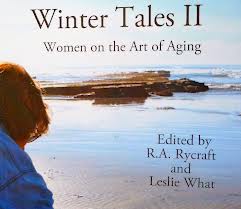
Winter Tales II: Women on the Art of Aging edited by R.A. Rycraft and Leslie What


Winter Tales II: Women on the Art of Aging
            edited by R.A. Rycraft and Leslie What

 Review by Alice Weiss

            If there  is an art to aging it is one we invent as we go along.  Art involves at the very least a particular way of seeing experience.  In this anthology there is a broad variety of such visions in  poems, essays, memoir and cartoons from women writers engaged in the project of inventing their old age.  The intended audience is also women and women “of a certain age.”  But I don’t think this is unjust.  Such an anthology has more than an underlying theme, it has a thrust, a purpose.  That is to counter the messages of the dominant culture. It hardly needs mention that for women age compounds the already difficult project of creating and sustaining an independent and autonomous self.  Speaking, writing words is a way of contending with that.  These are the words of that project.
            The scope of the material is broad and various, but the editors have not explicitly organized the material into themes, nonetheless certain themes do emerge, problems are defined, challenges explored.  Without intending to limit the richness of the individual pieces, I will explore some of these as they thread through the collection.  
            Here is the first theme, the clear challenge of age: the body.  It’s no longer the one you knew.  Every piece deals with this one way or another, some explicitly. Here are only one or two examples. In a poem that regards the body as an ironic “House of Mercy” Hester L. Fury recognizes, “I have to live here/ in these guts, these bones.”  In another poem, “The View from Here,” Betty Lynn Husted’s younger self cries out in horror at “A bent and hobbling woman /crossing the highway. . .”     but now through “joint pain.  Bone loss—lace designs on X-rays” she honors her.  Now she understands something in her “is already broken,” but she is still dancing across the kitchen floor.  Leigh Anne Joshaway in her essay “Facing Facts,” (note the pun) laughs her way through the shock of looking in the mirror and seeing, not her own, but Phyllis Diller’s lined and twisted mug.
            Another challenge: age has a bad reputation. This is nowhere clearer than in Jan Eliot’s comic strip, “Stone Soup,”  three panels of which are included. Grandma announces she is hosting her weekly poker game at their house, and the granddaughter says, “ I thought little old ladies played Bridge.” Grandma  in a last frame, “I could arm wrestle you into the DUST, Missy.”  Despite the bad rep or maybe because of it, age has hidden treasures and they are not here the traditional clichés. Elizabeth Murakowski, “I sin so much harder now.”  Ursula Le Guin; “the expertise of being lame. . . the silent furtive welcome of delay.”  Dorianne Laux, “Eventually the future shows up everywhere. . .[you] name the past and drag it behind/ bag like a lung filled with shadow and song,/dream of running, the keys to lost names.” 
            Michelle Bitting’s poem “Patti Smith after the premiere of ‘Dream of Life,’” takes that bad rep and shakes it like a dog shakes off water.  She builds from complex series of traditional and pop culture allusions.  The movie the title refers to is an account of the life of the seminal rock star as she returns to her career after a two decade break, a woman on stage with a “mannish mug,” “razor chin and dingy teeth,” “unshaven pits,” in short, a woman who defies conventions of female attractiveness yet who still brings an audience to “the hellfire heavens…[belting] the soaring refrain: G—l—o—r—i—a.”  Imagined  at first in the voice of two puzzled Jersey matrons wishing oddly to have been something like her, the speaker turns to her own sense of the singer in the final lines to address Patti Smith with this extraordinary invocation: 
 You are tracking Blake’s ghost
though the cemeteries, parks
and urinals of Paris,
every place his bony
misunderstood ass
is know to have squatted
and scribbled something beautiful
while taking an ordinary
everyday, entirely human piss.

            To evoke Blake’s  ghost is to remind us of another aspect of our lives, How things continue across time no matter what.  Just as we still read long dead poets, our lives contain facts that move through time as if there were no change and yet we see them anew as we change.  Diane McWhorter’s essay, “Stay Calm, Nothing Is Under Control” explores her life as an independent crafts person in a long lasting hippy community in California. She reaps the warmth and inventiveness of a life outside the ordinary institutions, but also recognizes the requirement to reinvent all the time grows wearying and dangerous she grows weaker.  In Lauren Davis’s essay, “Breaking Down”  the writer shows how age magnifies the always strange, strained relationship of mother and daughter.  The disintegration of the mother’s body becomes a metaphor for the difficulty of the relationship.  There is the failure of skin to maintain its protection of the body.  She sees an elbow bone all too clearly as if the  mother’s pain is demanding to be seen, as if that exposure were what love is.
            Pain is not the only continuous thing. Pleasures continue. In Alicia Ostriker’s wonderful long poem, “Approaching Seventy,” she explores the presence of past in the loving relationships with nature and with her husband.   Daring also continues. In ‘White Chin Hair and a Lonely Female Ccardinal,” Roisin McClean’s first person speaker relates an incident: she is masturbating in her bedroom with audible cries and sighs, sure that the house is empty, only to discover that her visiting daughter’s boyfriend had remained in the house and heard everything. This is defiance, the comedy of age.  Everything continues.
            And nothing continues. Finally we come up against the true thing, to age is to approach death.  It is to feel a fear with an intensity only glanced at earlier, perhaps after one has avoided a car crash on a rain slick highway, slipped at the edge of a balcony, or at the Grand Canyon.  In an essay notable for its calm acceptance, Supriya Bhatnagar’s “Memories and Misgivings: Death of a Friend” explores the imminence of  death in the loss of a friend.  She includes a careful and simple discussion of  Ashrama, the four stages of life in the Hindu religion, information added, almost it seems, for our comfort. In Elizabeth Murawsaki’s poem “Incense of the Blythe” she holds on, with humor and beauty, “It kills. . .[ her]. . . to die/ in the midst of orchards.”  And in another  Alicia Ostriker poem, a confession and  subtle metaphor in “Insomnia”
you brag to friends you won’t mind death only dying

what a liar you are—
all the other fears, of rejection, of physical pain,
of losing your mind, of losing your eyes,

they are all part of this!
Pawprints of this!  hair snarls in your comb—
Now notice the clock is the single light in the room—

            What the editors have done with this anthology is to define and redefine the “art” of aging.  It’s unquestionably worth a good read.

Wednesday, September 12, 2012

Terezin B.Z. Niditch


Terezin

B.Z. Niditch

Phrygian Press

58-09 205th Street

Bayside, New York

978-0-932155-20-7

31 Pages


Review by Dennis Daly


These deadening lines of sometimes discerning, sometimes defiling dissonance bestir us, hector us like some Old Testament prophet enumerating past horrors, here and there naming names and, above all, accusing the future, which harbors all of us, of ignorance or worse—complicity.


In the title poem Terezin the Eastern European world of 1942 passes by the cattle cars carrying the stunned Jewish families to the holding town or ghetto of Terezin, where many of them would be sent on to their appointed concentration camps and, of course, their deaths. The poet laments,


I carried my days

until we remain only a body

a historian’s vague nightmare

to a destination marked Terezin

with our aims throwing off

thin suitcases, blankets, towels

up to our waist in human dirt.


And this is just the beginning. The intensity and stridency of horror continues,


my father simply puffed out

by terror and night after nightmare

jumped off the train

from the bare-iced sheets

by howling hysteria

of mother pregnant with another life.


I know of no appropriate frame of mind or mood that can be easily summoned to handle this type of unrelenting assault well. But the insistent poem presses on. The prophet /poet wisely modulates the tone in two places by describing a child with a serious injured eye. Pathos is momentarily accommodated but barely acknowledged. Here is the earlier of these two affecting sections,


a warm boy holds out his hand

with tightly sweated fingers

his injured eye resembling

a yellow flamed torch lamp

no one wishes to acknowledge.


My Century, the very next poem in this disquieting collection, continues the righteous hectoring and the dissonance. It ends this way,


Those who forgive evil are the unforgiven.

Those who are good are known to the unknown.

Statistics cry in the night.

Statisticians of death have clean bureaucratic faces.

Historians move over the bodies.

Theologians move no one, not even

God.


Another poem that reflects on the tyranny of the Nazi years is 1944: Mid Europa. It works as a litany. Here is the Vichy France section,


death angels are desolate

hungary for children’s O negative

Quisling eats a four-course meal

Maurice Chevalier bows

Celine asks for human freight

Genet asks for primal sympathy…


And,


Sartre is recreative

Edith Piaf loses herself.


Niditch’s cumulative jeremiad reaches a crescendo with the poem, Berlin. Here the poet harangues,


Alleys close to joyless beggars.

A mighty fortress topples from metaphysics.

Wittgenstein has a solipsis of schoolboys.

Elan has its own gauntness for Heinrich Heine.

One’s cheekbones show our injustice.

Fashion coexists with fascism.


Believe it or not, the poet does back off for breath on occasion. The result is positively efficacious. The poem Exile of Boston contributes this persona-revealing piece of self-knowledge embedded in a striking image of an immigrant,


What playfulness

or riddled disasters

can I offer Boston

an exile in tentative sadness

when bitchery enthusiasms

self-indulgent necrologies

are put on this shoeless

pawned overcoat of a man

holding up a foreign body…


Also imagistic and a bit romantic is a piece called Boston Waterfront. The poet limns the scene this way,


A stranger’s tongue

squares off

I overheard

the freshness of water

and the fish bleed

in the delirium

of an exiled morning.


In the latitude

of transparent wind the blue-green ocean

outspoken in mortality

in the sanguine port calls

I am not ashamed

to weep along the sea wall

counting voices on the wharf.


In the poem Another Tryst Niditch reveals a well-wrought set of Kafka-like images. Nightmares and long corridors certainly seem to go together. The poet describes,


Now silence

is frozen in a well-lit

night spot

your spiky heels

will offer daily nightmares

and your understanding

creaking blows

of the cold long corridors.


The poet waxes subtlety and even bit of elegance in the poem entitled In Memory of C. Day Lewis. Notice that the subject has not changed, nor has the horror receded. The poet has simply put aside his prophetic gown for the moment. He says,


He was there in the sun

when nothing but a lilac

cold shouldered in the blitz

as the face of the dusk

fought the crime of night


The final poem in this chapbook returns to the poet’s prophetic tone and uses a staccato delivery. Niditch compels us to listen,


A chemical zyclon b2

To hell with D’Annunzio

Red flags us down

Eterna, play the chamber music

Leonardo is not only your cat

Michaelangeli plays Scarlatti

The red bearded snow dances

Where the streets are palmed

boys play boccie thinking of sex

Each generation offered

out from Moloch’s olfactory steel

for bread…


This is the second book of Niditch’s that I have reviewed. The first one—Lorca at Sevilla, filled with imagistic logic, I enjoyed more. In this one, enjoyment is beside the point. The poet here conveys his words with a prophet’s shrillness that overwhelms with its import and uneasy necessity. This chapbook needs to be read.