Friday, September 24, 2010

Where Sanity Begins by Hugh Fox


Where Sanity Begins
by Hugh Fox
Cervena Barva Press
copyright 2010
www.cervenabarvapress.com

Review by Lo Galluccio


Hugh Fox is one of the most prolific and genius voices on the poetry scene in America. His writing spans generations, cultures, cosmos and concepts of time and self. With a deeply subjective eye he manages to orient us as the compass of his heart would, toward people, places and things that flash through his awareness. His poems read like little short stories sometimes, or flash fiction snapshots of the real. There is also a journalistic flavor to some of his best poems, disjointed or elliptical as they may be, a sheer and jumbled travelogue of this wondrous man's life. In “Where Sanity Begins.” he has put together quite a fine collection of these poems and the picture on the title portrays the irony of it. Sanity is important to Hugh Fox, the everyday sanity of childbirth, of worldly transactions, of chit chat, and his grandchildren, but he has his demons too and they edge his poems like the angular play masks on the cover of the book. Sanity is really multifaceted and manifold. And it means seeing things your own way, from different perspectives. What any poet or songwriter must do to succeed.

First, there is the generosity factor of the poet's big heart, in “The Invisible Woman,” who he describes as having “a look of stark terror on her face, like she's face to face with a King-Kong sized spider.” And furthermore “the old lady and her terror totally invisible.” So what does he do but befriend her by picking her up for ice-cream every afternoon at 2 pm? And in a typically beautiful and dissociative way, the poems ends with “as I walk to the top of midnight and over down to dawn.”

And memory. There is much remembrance in these pieces, of a sage older man looking back through time. At one point he remembers how, in his youth, he would marshal a culture brigade in his family to hit the theatre and concert scene, putting these excursions before even the money at hand, “I feel that we're all pulling together toward the cooperative kibbutz realization of The Circle of Light, educated, enlightened, knowledge = Power DREAM..” p 12

Hugh's poems resemble hyper-journal entries replete with lists and sub-dubbed with precise and colorful details of city streets and familiar places. Often threaded in is a movie title like “BONNY AND CLYDE” OR a sign like “CHAMBER OF COMERCE OF GREATER JACKSON AREA.” These are both fixed and moving markers of pop culture, and landscape. All parts of a travelogue of his life where people, places and things are collected, recollected and indemnified.

I love the way he interjects a drop of dialogue in the center of a descriptive-narrative piece, this one not so disjunctive, but following the thread of taking his 1 and half year old grandson (or is it his son?) out to the sandbox in the autumn. The kid sees leaves and wants to eat them. “You don't eatum for god's sakes” cautions the narrator to his beloved boy and then off onto an aria of earth bits: “lilac seeds, pieces of acorns chewed on by squirrels...” Called “The Lowest Layer” Hugh Fox seems to be reaching down through this fragmenting hearth, to see the earth as a home and to tell his legacy that “you'll have a feeling when Fall comes and you're in a place like this, that someone loved you,” “look at things, don't just run away, but stop....” p 21

Another charming poem about his grandson is “Tantric Moon.” Together in the bathtub he “scrambles after the big white soap...” And then “I take him out into the cold late-October dark, the first time I've ever showed him the moon, “Look at the moon!” And the ending, again, pieces on an ethereal wonder: “I'm teaching Night too, Water, doesn't want to go in, dying. Awe.” A bulleting through description of the states he moves through at that moment looking at the moon after the bath.

One fine poem is Irdische/Earthly wherein he defines himself as an “I-Robot remembering when I was a man,” he conjectures “She must remember too. When the girls were born and her body flooded in all the good hormones, centered, the center of love, flowing out, flowing toward her, current and counter current.” It unravels with “sails/gloved/domed/the dew inside continuing skin...” A lyrical treatise on how again and bodies changing remains a constant in our impermanence but how the time of succulence and love-making still hovers by from when it was manifest.

In another portrait poem called, “Fireworks” the poet watches a woman dressed up with “an onyx medallion around her neck,” “trying on flowered pants and holding earrings up to her ears” – in this Fellini-like flashpoint of an image of beauty, there is “only the burst of light in the black Time sky.” In “Houdini Returns” the poet plays escape artist with the illusion or dream of life, its many rooms and the juxtaposition of timelessness and time with the human condition: “the petty but painful “individual neurosis or perversion” – “to walk into the jaguar forest to meet the gods.”

The gods, the moon, Kali, time, seasonal shifts all enter into Fox's poetry as it is in touch with the primordial and cosmic aspects of civilization as well as the contemporary antics of modern man. In an aside in a poem called, “The Light” he writes “I always wanted to write a book about the migration of the morning star symbol out of Asia to the Americas....” p.37 A magnificent poem of many threads, Fox begins with “The light goes so early, fugaz,” and ends with a meditation on the Nazis: “instead of killing the Jews, the Germans should have said LETS DRINK WINE, DO BUSINESS, AND EAT WELL AND BUILD HOMES AND BE JUST AND LIGHT CANDLES AND PRAISE GOD.” p 37

Fox's hunger for life and for loved ones is curdled sometimes by depression. – his consciousness haunted by the great ones who've gone before him. However, in “In the Moment” he writes: “The last fine day before the herds of Winter come and I feel like I've died and almost come all the way back, a spider thread between a dead pine tree and the Design Studio, a bright sag for a moment, then invisible, then bright again, invisible.” p. 40. It is an almost Puck like persona that can flicker back and forth from visible and invisible on the heels of the hell-frost. It seems to refer back to the theatrical masks on the cover of the book, to a man whose real and imaginary lives remain in great balance, neither eclipsing the other, both vivid, devoted and compelling.

Thursday, September 23, 2010

The Ibbetson Street Press/Endicott College Visiting Author Series launches Oct. 6, 2010

(Sam Cornish)


There is a new series on the North Shore at Endicott College directed by Somerville's Ibbetson Street press founder Doug Holder. Its title: "Endicott College/Ibbetson Street Press Visiting Author Series. " It will be held at the Halle Library on the beautiful, sea-breeze infused Endicott College campus in Beverly, Mass. The series is part of the new affiliation that the Ibbetson Street Press of Somerville has formed with Endicott College. The first reader will be the first Boston Poet Laureate Sam Cornish. It will be held at 4P.M. Open mic to follow. Open to the public. Help launch this new literary series at the "Hub of the Arts" on the North Shore.


For directions to Endicott go to the website http://endicott.edu


http://samcornish.com/interviews.htm his website is http://www.samcornish.com


Sam Cornish, poet, essayist, editor of children's literature, photographer, educator, and figure in the Black Arts movement. He is the first City of Boston Poet Laureate.

Cornish served in the U.S. Army Medical Corps (1958–1960), then returned to his native Baltimore, where he published two poetry collections—In This Corner: Sam Cornish and Verses (1961) and People Beneath the Window (1964). While working at the Enoch Pratt Free Library, he became part of Baltimore's political and literary underground, self-publishing a sixteen-page pamphlet entitled Generations and Other Poems (1964). A subsequent edition of Generations (1966) appeared when Cornish was editing Chicory, a literary magazine by children and young adults in the Community Action Target Area of Baltimore. Lucian W. Dixon and Cornish edited a selection from the magazine entitled Chicory: Young Voices from the Black Ghetto (1969). In 1968 Cornish won the Humanities Institute of Coppin State College Poetry Prize for his “influence on the Coppin poets” and a grant from the National Endowment for the Arts. Soon poets as diverse as Maxine Kumin, Clarence Major, and Eugene Redmond would acknowledge Cornish's significance.

By 1970 Cornish was represented in the LeRoi Jones (Amiri Baraka) and Larry Neal anthology Black Fire (1968) as well as in the Clarence Major collection New Black Poetry (1969). He reconsidered his early poems of black historicized kinship, restructuring them into the Beacon Press's Generations (1971). After a brief stay in Boston, Cornish returned to Baltimore to work in secondary school and college writing programs. While there, Cornish published Sometimes (1973) with Cambridge's Pym-Randall Press. Teaching poetry in the schools led to several children's books: Your Hand in Mine (1970), Grandmother's Pictures (1974), and My Daddy's People (1976).

Returning to Boston in the mid-1970s, Cornish worked with the Educational Development Corporation and attended Goddard College in Vermont. He appeared in a host of new anthologies, from George Plimpton and Peter Ardery's American Literary Anthology (1970) and Harry Smith's Smith Poets (1971), to Ted Wilentz and Tom Weatherly's Natural Process (1972) and Arnold One Hundred Years of Black Poetry (1972). Sam's World (1978) continued the historical and genealogical project of Generations.

Since the 1980s Cornish has divided his time between bookselling and teaching creative writing and literature at Emerson College in Boston. Songs of Jubilee: New and Selected Poems, 1969–1983 (1986) recasts earlier work into sequences of a historical and biographical nature. His autobiographical narrative, 1935: A Memoir (1990), blends poetry and prose into a montage of twentieth-century history. The poems of Folks Like Me (1993) offer political and cultural portraits of African Americans from the depression to the early 1960s. Current projects include the next volume of his autobiography, 1955, and a critical study of Langston Hughes. His latest collection of poetry is an "Apron Full of Beans"

Wednesday, September 22, 2010

Ibbetson Street Poetry Award Winners..... Announced 2010!

We are proud to announce the winner of the Ibbetson Street Press Award, poet Kim Triedman. The winner will be given her award at The Somerville News Writers Festival, Nov. 13, 2010. The runner up and honorable mentions will also be announced at the Festival.


About Kim Triedman:


Kim Triedman began writing poetry after working in fiction for several years. In the past year, she's been named winner of the 2008 Main Street Rag Chapbook Competition, finalist for the 2007 Philbrick Poetry Award, finalist for the 2008 James Jones First Novel Fellowship, semi-finalist for the 2008 Black River Chapbook Competition and, most recently, semifinalist for the 2008 Parthenon Prize for Fiction. Her poems have been published widely in literary journals and anthologies here and abroad, including Main Street Rag, Poetry International, Appalachia, The Aurorean, Avocet, The New Writer, Byline Magazine, Poet's Ink, Poetry Salzburg Review, The Journal (U.K.), Asinine Poetry, Poetry Monthly, Current Accounts, Ghoti Magazine, IF Poetry Journal, Great Kills Review, Trespass Magazine, Mature Years, ART TIMES, Literary Bird Journal, and FRiGG Magazine. Additionally, one of her recent poems was selected by John Ashbery to be included in the Ashbery Resource Center’s online catalogue, which serves as a comprehensive bibliography of both Ashbery's work and work by artists directly influenced by Ashbery. This poem has also been included in the John Cage Trust archives at Bard College. Ms. Triedman has been nominated for the anthologies Best New Poets 2009 and Best of the Web 2010. She is a graduate of Brown University and lives in the Boston area with her husband and three daughters. Her first poetry collection -- "bathe in it or sleep" -- was published by Main Street Rag Publishing Company in October of 2008.


Ibbetson Award 2010


Winner: Kim Triedman: "(Captiv)ated"


Runner Up: Linda Larson: "Sweet Dixeyland, Early Sixties"


Honorable Mentions:


Pamela Annas: "Saturday Sock Hop, 1959."


Rose Scherlis: "Poker Circle"


Marilyn Jurich: " My Lost Mothers."

Monday, September 20, 2010

Review of PROFANE UNCERTAINTIES by Luis Raul Calvo


Review of PROFANE UNCERTAINTIES by Luis Raul Calvo, Translated from Spanish into English by Flavia Cosma, Cervena Barva Press, Somerville, Massachusetts, USA, 2010, poetry, 48 pages. Bookstore: www.thelostbookshelf.com

By Barbara Bialick

The book PROFANE UNCERTAINTIES by Luis Raul Calvo, is intriguing in its fascination with things universal, especially considering it’s written profanity-free by a man from Buenos Aires, Argentina and translated by a woman, Flavia Cosma, born in Romania, who lives and writes poetry, children’s books and TV documentaries in Canada in North American English.

Calvo’s philosophical wondering about life and death flows like a river in the tradition of other Latin American writers I have read but am not an expert in. “Real Life”, the first poem in the book starts you thinking right away: “Real life is nothing but a carroded/priesthood/in magnificent cities…But you who disowned the dogma and the customs/and chose the freedom of the blind…/you wander today/…wavering, your head bent/and staggering with your hands tangled/…in a dubious banquet.”

What does this mean? isn’t even a question I asked right away. Rather I just kept reading the book from beginning to end in its gentle language ironically frought with diatribes on death and memory. “When we think we have everything, something reminds us that the void also exists,” he writes, in “Nomadic Beauty (Fragments”). “When we start asking ourselves about love, we have ceased to be in love.”

Then he brings us into “Bajos fondos del alma, The lowest depths of the soul”, a long series of poems. In XIV, he notes “We were obliged to reach an understanding/that neither the world or our parents/resembled our primitive sensations.” In XIX, he says, “There are no memories/that can survive with dignity…the business of living becomes something similar to a fleeting/and fickle absence.”

A poet’s poet, Calvo is someone whose work you’d want to read when looking for inspiration. Indeed, he is a well known poet and essayist who was born in 1955 in Buenos Aires, Argentina. He is editor-in-chief of “Generation Abierta” (Literature-Art-Education), a prominent cultural magazine founded in Buenos Aires in 1988. He’s also director of the weekly radio show “Generacion Abierta”, president of Literary CafĂ© Antonio Alberti, and a member of the Directorate of Argentina para la poesia foundation.
He has published more than six other books and his poems have been translated into English, French, Italian, Romanian and Portuguese.

Sunday, September 19, 2010

At the End of Time: The Incomplete Works of Richard Krech


At the End of Time

The Incomplete Works of Richard Krech

Volume II Poems 2001 - 2009 $20.00

Sunnyoutside Press Buffalo 2010

ISBN: 978-1-934513-27-9


There are seven sections in this book of self realization, of how

worldly interruptions may effect the creative life. Krech breaks

out of his self imposed retreat from poetry, because…


"The statue with no face and broken legs

no longer stares out at the long green valley.

The frightened men have shattered their own

image. They

diminish themselves as they step beyond

their banal legacy of oppression

and turn to destroying the very history of the world.

The statue no longer stares out at Bamiyan valley,

the enlightened gaze takes in the reflection

still."


The collection of poems is a mixture of Buddhist thought, political

treaties, and biographical sketches. The poet places himself outside

the portraits and renders in fine lines the intentions of those he writes

about. The poems are mannered, concise, and full of insights…


"I have accomplished several remarkable

feats in poetry, I thought,

after coming off a 25-year line break.

I wrote a poem about the vibrate mode

of a cell phone;

another about Valerie Solanis

and Enver Hoxha.

I saw old friends and made new ones.

I found out that my spelling

has improved."


There is a stillness within the poems, and are often pulled up from the

ground, gritty, earthy. Krech uses form to express his word play.

The reader can relax with this worthy book, with its sense of history,

personal references and experiences, the poet/monk/activist/teacher,

writes with a wider audience in mind…


"…as yesterday's sun flattens out

and sinks into mountain ridges,

lights twinkling on

in West Oakland,

first evening breeze,

and the adventure continues."


Irene Koronas

Reviewer:

Ibbetson Street Press

Poetry Editor:

Wilderness House Literary Review

Saturday, September 18, 2010

Somerville, Mass Independent Press Ibbetson Street Forms Partnership with Endicott College in Beverly, Mass.


A New Literary Partnership: Endicott College and the Ibbetson Street Press


(Beverly, Mass)


Endicott College of Beverly, Mass. and the Ibbetson Street Press of Somerville, Mass. have announced a literary partnership the other day. The two organizations have agreed to establish an affiliation between the 12-year-old well-regarded independent literary press and the college. Doug Holder, publisher of the Ibbetson Street Press said in regards to his plans for this new partnership: “I hope to bring a number of prominent poets and writers to take part in a reading series we are going to launch. The first Poet Laureate of Boston Sam Cornish will lead off the proceedings, other features will be Gary Metras of the Adastra Press, Gloria Mindock of the Cervena Barva Press, Luke Salisbury, the author of “The Answer is Baseball,” poet Miriam Levin, Bert Stern and others. “I also want to play a mentor role to aspiring poets and writers.” Holder continued: “I want the literary community and the community at large to know about the vital literary and arts programming at Endicott." Holder has published a number of Endicott faculty members including the poetry collection “Bicycles, Canoes and Drums,” by English Professor Dan Sklar, as well as the poetry of Margaret Young, an instructor on the English faculty of the College. Holder also expects to have his brother Donald Holder, a two-time TONY AWARD winner (“Lion King,” South Pacific”), and Paul Stone, Creative Director of W.B. Mason and novelist to be guest speakers at the college.


This initiative will be on a trial basis for the Academic 2010 to 2011 school year. The school has a solid reputation for its business program, nursing, human services, and education, and the college wants to make sure the public knows Endicott as a destination to study the arts and literature. The student who graduates from Endicott College will be literate, well-informed and well-rounded, as well as being highly sought after. This affiliation will be just one component of the mission at Endicott. Doug Holder, who is an adjunct faculty member at Endicott and also the Arts Editor for The Somerville News as well as the Director of the Poetry Series at the Newton Free Library, said “This is a wonderful opportunity to be aligned with a rising academic institution. And with their new Arts Center and their commitment to the arts in general, I am hoping to be involved in the creation of the Hub for the Arts on the North Shore.”

Michael Knoblach: An Antiques Dealer Who "Drums" Up Business, Music, and Poetry.

(Knoblach--far right)


Michael Knoblach: An Antiques Dealer Who "Drums" Up Business, Music, and Poetry.

By Doug Holder


Michael Knoblach met me at my usual table at the Bloc 11 Cafe in the Union Square section of Somerville, Mass. He is a big man, with thinning shoulder length hair, and a deep but somewhat muted voice. He is what I would call a renaissance man, a man with an eclectic range of interests and sensibilities. A graduate of Tufts University, the former Somerville resident still conducts much of his business in the 'ville. Among other things Knoblach is an antiques dealer and used to do a lot of business with " Poor Little Rich Girl" when it was still in Somerville. He deals in a wide range of antiques, but it has turned out his specialty is drums. Vintage drums to be exact. Knoblach started pounding the kettles when he was a mere lad. Since then he has collected over 1,000 drums, from Arabic hand drums to Indian drums, all stored in his cramped Medford condo. I asked him why he is so enamored with this percussion instrument. He said: " I can walk down the street and find a piece of garbage to drum on and it would sound good." And indeed Kornblach has made drums out of things like old artillery shells ( let us pray they are not live!).

Although Knoblach has performed on drums with the group Mission of Burma years ago, to working with members of the Dresden Dolls, he now is basically into the recording of music. He is currently working with Eric Dahlman, a trumpeter, and other artists. Over the years, Knoblach has performed in venues like: Johnny D's, the defunct Club 3, the Paradise, and many others.

Knoblach, ever the renaissance man, also has an interest in poetry. He has a large book collection that is feed by his scouring of yard sales, estate sales, flea markets, all part of his daily routine as an antiques dealer.

Although not widely published, he is working on a poetry collection titled: "Mice Have Been Eating My Poems." The idea behind this was that when the drummer got back into poetry he went to the place he stored his dusty manuscripts. It seems the mice literally ate up his poetry!

During his undergraduate years Knoblach studied with the likes of Deborah Diggs, who tragically committed suicide several years ago. He counts his influences as Robert Bly, Antonio Machado, and Carl Sandburg. He describes his own poetry as dark and moody.

Knobloch said one of the reasons he left Somerville for Medford was that he could not afford to buy a condo in town. The other reason is the new parking regulations. He said many artists are leaving because it is a huge hassle to feed a meter every 15minutes, and when there are gatherings at studios it is next to impossible to park your car for any length of time due to the stringent laws.

Knoblach still hangs in Somerville, and pines for the days of the Someday Cafe. He is a loyal denizen of Davis Square, a customer of the coffee shops, and to use a cliche one of the many artists who contribute to the " Paris of New England."


Mice Have Been Eating My Old Poems


Mice have been eating my old poems.

Once cut crisp,

straight white edges

have tiny tears.

The smallest of holes in words.

What does a vowel taste like?

What part of my poems

were a paper crib

for a litter of mice?

Little millimeters of life

growing between sheetrock,

behind milk crates

crammed with books.

Delicious!

Mice eat all poets,

good and bad alike,

and their teeth are always growing.


So here’s a poem for a mouse

or mice (there are always more in hiding).

Poems keep being written

and time is always hungry.

All skittish creatures

seek shelter,

tiny comforts and distraction.

Every mouse dreams small dreams.

Thursday, September 16, 2010

The Norton Anthology of Latino Literature, edited by Ilan Stavans


*****Tino Villanueva, Boston University professor and one of Somerville's Bagel Bards is included in this new anthology of Latino Literature. Tino presented the book at a recent meeting of the Bards. I asked my old friend and retired University of Michigan professor Hugh Fox to review it. Here is the review of this important work:


The Norton Anthology of Latino Literature, edited by Ilan Stavans, W.W. Norton and Company, 500 Fifth Avenue, NY, NY 10110, $59.95.


The perfect book for right now when most Americans are totally confused about the Latin presence in the U.S. What we have here is a gigantic two thousand, six hundred and sixty-six page volume that overviews the Latino presence in the Americas going back, back back to colonial (and then some) times. It begins by going back to the sixteenth to nineteenth centuries works of the Latino (Spanish) explorers themselves, people inside the whole colonization process, part of it, like Fray BartolomĂ© de las Casas, Alvar Núñez Cabeza de Vaca, Hernando de Sota, “El Inca” Garcilaso de la Vega...on and on, a real trip back into the exploratory colonial past seen through the eyes of the colonizers themselves. Then we move (“Annexations: 1811-1898) into Spanish America becoming independent, breaking with Spain, so it’s not colonial Spain any more but its own independent world. Stavans doesn’t really get into South America much here, but concentrates on the Caribbean, Texas and California. Then Stavans, just as you’re getting to feel you’re inside a totally scholarly-historical work, starts bringing in creative writers like Eusbesio ChacĂłn from Santa Fe who turns it from objective history into personal experience. Lots of writers like that, like Fabiola Cabeza de Baca Gilbert who wrote a book called "We Fed Them Cactus" (1954), which present’s a Latina’s vision of how it was, history seen through a Latina’s eyes. Really bringing it all personally alive, alive, alive.So the book isn’t just libraryish history, but personal-artistic visionary too. And you get some idea of how the whole Latino-American problem looks through Latino eyes. As in JosĂ© Dávila Semprit”s poem “The United States”: “A sublime document that proclaims/the rights of man,/a star-spangled banner,/history that begins/with roar rebelliousness/and ends up smelling of imperialism..../an ally of passions, prejudices,/and entrenched arrogance....” (p.516.) A ton of visionary creative work (like RenĂ© MarquĂ©s’ play The Oxcart) that looks at the whole migrant problem through (in this case) Puerto Rican eyes.


For a while the book becomes an enormous anthology of Latin American creative work, bringing you from the colonial into present time. So you get to see the evolution of the Latino point-of-view from colonial to contemporary times. And Stavans’ commentaries are gems in themselves. Like his comments that preface the section of the book called “Into the Mainstream: 1980-Present”: “In the United States, the civil rights era generally led Anglos to display energetic good will toward both blacks and ethnic minorities...for Latinos, the racism, xenophobia, and anti-Hispanism widely evident in the United State since the mid-nineteenth century remained ingrained...Changes in Latino life were slow in coming.” (p.1461).The book eventually evolves into an anthology of Latin American writing itself, fiction, plays, poetry, contemporary writers like Abraham Rodriguez, Rafael Campo, Manuel Muõz, MarĂ­a Teresa “Mariposa” Fernández, bringing in Latino-American writers who see the whole thing not through “foreign” but Latino-Gringo eyes: “I am the / Meta-morpho-sized/The Reborn/The living phoenix/Rising up out of the ashes/With my conquered people/Not the lost Puerto Rican soul in search of identity/Not the tragic Nuyorican in search of the land of the palm tree/Not fragmented but whole/Not colonized/But free.” (p.2423).

Then at the very end, just so you don’t forget we’re dealing with Big History and not Hip Hop, Stavans brings in a chronology of the whole historical overscene,year by year,from colonial to contemporary times. And throws in some treaties, acts and propositions out of the history book, so the overall context remains serious history.Beautifully done, the single most impressive book I’ve ever read on one of my main interests. I can see it as volume one of a series that next moves more into South America, then back into pre-history and the invasion of the Spaniards. It’s a book that makes you cry out for infinitely more, more, more.

Sunday, September 12, 2010

From the Center by Robert J. Hope


From the Center
by Robert J. Hope
Continuum International Publishing Group Ltd.
New York and London, England
Copyright © 2001 by Robert J. Hope
ISBN: 0-8264-1324-2
Softbound, 111 pages, $13.95

Review by Zvi A. Sesling

Robert J. Hope is/was a Commissioned Presenter of Centering Prayer and a New England Coordinator for Contemplative Outreach. I write is/was because the book presented to me for review was published in 2001 and I was unable (after a quick search) to find if
Mr. Hope is still with the organization.

Interestingly as I write this review just after the Jewish Holy Days of Rosh HaShanah (New Year), I can hear the music of prayer books and bibles that bring comfort to millions. Some of the poetry-meditations remind me of the prayers in the Reform Judaism prayer books. But what I like about this book is not its connection to the Gospels, the King James Version or the Old Testament. It is distinct flavor of peace that reading these poems can bring to the reader.

Since none of the poem-meditations have titles I will cite them by page number.

Page 36 begins with: The power of the present pulls me in,/ Ever gripping, grabbing, drawing./There is a world within a world,/And you are there,...

Page 47:

A single sparrow –
You know when it falls.
And you know, though plentiful,
The hairs of my head,
The myriad isnesses that are one.
And You know each so well.
What fish swims no longer

As you can see, Mr. Hope has his pulse, his heart and his words with his God, and no matter what your religion – or no religion – these poem-meditations will bring some
peace to your heart and mind. They accept the sparrow on the same level as the human,God’s creations watched and cared in Hope’s perceptions of God.

In a number of these poem-meditations Hope refers to his God as You or Beloved and
reading his words one can understand his view and accept Hope’s views of the peacefulness he seeks to pass on through his belief.

Friday, September 10, 2010

What May Have Been: Letters of Jackson Pollock and Dori G by Gary Percesepe and Susan Tepper


What May Have Been: Letters of Jackson Pollock & Dori G

Gary Percesepe & Susan Tepper

Cervena Barva Press September 2010

ISBN 978-0-9844732-8-1

$15.00


The letters in this novel are as tumultuous as Jackson's paintings,

splattered in movements, layer upon layer, as the story reveals

itself the same way the paint speaks abstractly:


"Before you, all I could see was a pit. Dori look what you've

done for me already! I'm partly to blame for your troubles.

I'll never call you a little girl again. Inside your body I reach

the center of the earth."


This is a love story and a story of lust between a seasoned womanizer who is a self-absorbed artist, and a young naĂŻve woman. In places this story feels as if it could be a fairy tale, but in essence, Pollock is speaking to himself, longing for his own youth and the rigor of those early experimentations, in this case through narrative? Yes. There are two voices, Pollock and Dori, but are they really one Pollock?


"Pollock turned back to her. She studied him in the dying

light. It occurred to him that he could share with her the

thoughts he'd pieced together in the car, lay them out in

sequence, with the earliest, tidiest first, just lay them down."


The two authors take an interesting view of who Pollock was and how

he effected a larger audience:


"DORI. YOUR NAME IS DORI. KEEP THAT UNDER

YOUR PRETTY HEAD OF HAIR. No I don't play golf.

I'm a painter. A painter and your lover. That's the sum

total of my life."


Irene Koronas

Poetry Editor:

Wilderness House Literary Review

Reviewer:

Ibbetson Street Press

Tuesday, September 07, 2010

“‘Sez’ Malachy McCourt to Somerville” by Tracy L. Strauss


“‘Sez’ Malachy McCourt to Somerville”
by Tracy L. Strauss

“I like the name ‘Somerville’,” Malachy McCourt said over the phone from his home in upstate New York, “it’s got a nice euphonious ring to it. ‘Somerville’ – sounds like the wind whistling through the trees.”

In fact, as we spoke about his upcoming appearance at the 8th Annual Somerville Writers Festival, to be held November 13, the wind was doing just that.
Malachy McCourt, Frank McCourt’s younger brother, has had a varied career as a writer, actor, and politician. A co-writer (with Frank) of the play A Couple of Blaguards, McCourt has written and published close to ten books of essays, history, and memoir, including The New York Times bestseller A Monk Swimming. His work has also appeared in many magazines including New York Newsday, National Geographic, Conscience Magazine, and New York Times. McCourt’s column, “Sez I To Myself,” appears in Manhattan Spirit, The Westsider, and Our Town in NYC.

However, McCourt does not consider himself a writer: “I happen to be an author,” he said, “but I don’t consider myself a writer. Writers are people who are diligent and disciplined and all that, and I am not.”

When approached to participate in the Festival, McCourt said, “Yes, yes, yes!” Speaking engagements are his passion. “But I don’t consider it speaking or lecturing,” he made the distinction. “I consider it chatting with people. I like sharing whatever looney thoughts I have and then there’s the mischievous part of me that I know is going to piss people off. I like that because people absolutely disagree with you. The constitution gives you that right. Free speech is very expensive. We ought to get as much of it as we can. It’s more important than money. And it’s very important to writers, who don’t make a lot of money.”

In 2006, McCourt was the Green Party candidate for New York State. Running under the slogan “Don’t waste your vote, give it to me,” McCourt promised to recall the New York National Guard from Iraq, to make public education free through college, and to institute a statewide comprehensive “sickness care” system. He lost to Democratic Party candidate Eliot Spitzer.

“I have no formal education,” McCourt said, “so it always amuses me that people ask me questions. I’ll be delighted to share my ignorance with you. I don’t know anything about anything. All I have are opinions.”

McCourt is currently working on a one-man show about H.L. Mencken. “Like myself,” McCourt explained, “Mencken was a non-believer in organized religion, or in a vengeful deity. I believe there’s a plague of organized religion in our country that needs to be stopped. It’s akin to organized crime because they – conservatives – threaten you if you don’t do certain things. They say you will go to hell for eternity, and that various entities will shove red hot pokers up your armpit forever and ever. It’s just torture.”

McCourt has also led a prolific career as an actor on Broadway and Off-Broadway, as well as in regional theaters, movies, and soap operas such as “Ryan’s Hope,” “One Life to Live,” and “All My Children,” on which he has had a recurring Christmas-time role as “Father Clarence,” a priest who shows up to give inspirational advice to the citizens of the fictional town “Pine Valley.”

In the 1970s, McCourt was one of the first talk show hosts on the Christian radio station WMCA, and also worked at WNYC and WABC. He was also a frequent guest on the “Tonight Show,” “Merv Griffin” and “Tom Snyder” shows, and, more recently, “Conan O’Brien” and “The Late, Late Show.”

As someone with public appearance experience, McCourt has advice for those writers preparing for a public reading: “Read monotone, or invest your work with life and drama,” McCourt said. “That’s what you have to think about.”

For aspiring writers, McCourt clarifies focus: “The main thing about writing,” he said, “is don’t edit – there are editors who get paid to do that and you shouldn’t be putting people out of business. Don’t worry about grammar, it’s not your business either. Punctuation is totally a matter of opinion. And don’t ever show any of your work to relatives until you’re published. Then they can argue with you.”
“There are two things to avoid in writing,” McCourt added. “Shame and fear. Don’t be ashamed of anything you’ve done. Well, do be if you want to be, but don’t be afraid of it. Put away fear and never, never judge your work. You will always find it guilty.”


********** Tracy L. Strauss teaches writing at Emerson College in Boston.

Monday, September 06, 2010

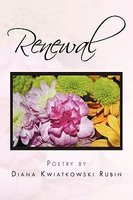
Review of RENEWAL by Diana Kwiatkowski Rubin


Review of RENEWAL by Diana Kwiatkowski Rubin, 123 pages, 2010, Xlibris Corporation, www.Xlibris.com, paperback, $15.99, trade hardback, 24.99, eBook, $9.99

By Barbara Bialick

Diana Kwiatkowski Rubin’s voice in RENEWAL, comes forth as mature, spiritual and rhythmic. Rubin, who comes from Edison, New Jersey, has published in a number of journals, five books of poetry, two books of stories, a cookbook, and a children’s book. Two of her poems were winning entries in the 14th Annual New Jersey Wordsmith contest. But her Xlibris marketing service calls the book “a literary masterpiece that touches on sundry themes.” That is terrible marketing that made me want to dismiss the whole book. But I did find some lines that showed the spark of poetry.

One of the better poems was “Caribbean Ghost Ship,” which begins: “Terrified, for several days/after volcanic eruption,/molten lava,/she clung desperately to life…soon arrived a rainbow of visitors,/a green parrotfish awakened/from its protective cocoon…”
As she often does, she ends the poem with a spiritual slant, “Her sunken bulkhead, setting her free/to start over anew in spirit.”

The two winning poems were “The Waves At Wildwood Crest” and “Swamp Vision.” The first is a short poem, that is similar to her many Haiku entries, which she does pretty well. She writes, “Bold, sienna sunset/to her astonishment/my daughter swims/with dolphins swirling…her clandestine dream/unfolding…”

“Swamp Vision” is a good example of melodic rhythm: “White ducks waddle/across the frozen pond/…One, two, three four…January’s fabulous parade.” But it is a bit too reminiscent of the famous children’s book, “Make Way for Ducklings.”

“Summer Haiku”, which consists of four haikus, is a little more original, and begins: “The sweet taste of pear/combats the blistering sun/late summer delight.” Its third haiku reads: “Bold red ladybug/dotted upon a soft fern--/wonder to behold.”

But that about ends the wonder.

Tuesday, August 31, 2010

The Blue Hour of the Day:Selected Poems by Lorna Crozier


The Blue Hour of the Day
Selected Poems
by Lorna Crozier
McClelland & Stewart
Toronto, Canada
Copyright © 2007 by Lorna Crozier
ISBN: 978-0-7710-2468-9
Softbound, 251 pages, US $17.95

Review by Zvi A. Sesling


Every once in a while I get lucky, like recently in Vancouver where unable to find a small independent bookstore I settled on a Chapters, a national chain in Canada. On the second floor of this attractive and bright light store there was an information person scurrying about so I stopped her in the History section and asked about local poets. She took me to the Poetry section and handed me five or six books. After perusing them I chose Lorna Crozier’s The Blue Hour of the Day, Selected Poems. The woman who had helped me seemed very pleased, “You know, in my opinion, you have picked Canada’s best poet,” she said. She may well be right, even if I am unfamiliar with many Canadian poets.

Crozier has published fourteen books of poetry and in Selected Poems nine of those volumes are represented. They showcase a poet of immense talent with a keen eye for familial relations, love and grief, coupled with humor every reader will relish. There are also very sexy poems, which women seem to make more engaging, enough so to tingle flesh.

Of the some 140 poems in the selection, there are so many that I like I will mention only two or three in this review, though each poem in from The Sex Lives of Vegetables is a gem of observation and humor.

Crozier also writes of the pain of relationships as in “A Man And A Woman” where the prairie is marriage, drought their lives together and rain...

Wind blows from the west.
In a double bed a man and woman
lie side by side, pretending sleep.
Breathe in, breathe out.
When he feels me move, he rolls over,
turns his face to the wall.
Why don’t I tell him it’s okay?
I know he’s awake, I can’t
touch him, can’t speak.
My hand would have to separate
from my body to reach for him.
A country lies between us, a prairie
winter; years and years of drought.
When did it begin?
Wind blows from the west.
Surely even in this dusty room,
this marriage bed,
the small rain down will rain.

Here the frustration, years of boredom and the feeling of being trapped are vented, yet there is always hope.

Crozier also has opening lines that make a reader want to read on. In “Nothing Missing”
four lines engage instantly: Mother and I wait for my father/who has gone into the labyrinth of rooms/where life and death dance like angels/ on the tip of the doctor’s tongue.

There is “Without Hands” which the poet dedicates to the memory of Victor Jara whom she notes was a Chilean musician whose hands were smashed by the military to stop him from playing his guitar and singing for his fellow prisoners in the Santiago stadium [where he and others died in 1973]: All the machines in the world/stop. The textile machines, the paper machines,/the machines in the mines turning stone to fire./Without hands to touch them, spoons, forks and knives/forget their names and uses, the baby is not bathed,...

Oh yes, I love this book for all the wonderful poems Lorna Crozier has written over the years, for the honesty and images that have inspired poets and will continue to do so for future generations of poets. Highly recommended.

Sunday, August 29, 2010

"What an Old Man Sees Sitting Down, A Young Man Cannot See Standing Up" (IBO Proverb)


"What an Old Man Sees Sitting Down, A Young Man Cannot See Standing Up" (IBO Proverb)

By Doug Holder

Somerville resident, Wellesley professor , and Poet Ifeanyi Menkiti celebrated his 70th birthday on Aug 28, 2010. It was a surprise birthday hosted by his family. It started at the Dilboy VFW Hall in Davis Square, and ended with a feast and celebration at his home on Malverne St. just outside Davis Square. Menkiti is a celebrated philosopher as well as poet, and is the owner and some say savior of the famed Grolier Poetry Book Shop in Harvard Square in Cambridge. Originally from Nigeria, Menkiti has taught Philosophy at Wellesley College for many years, and has published numerous collections of poetry, as well as being a loyal friend to poets and writers.

As evidenced by the crowd at the VFW Hall, Menkiti has touched the lives of a wide cross-section of people. There were fellow Nigerians in long, colorful and flowing African robes, as well as staid academics clad in boat shoes and chinos.

There were two featured readers at the festival that was hosted by Menkiti's son Bo. One was the noted poet and translator David Ferry,( Who will be a reader at The Somerville News Writers Festival) and Tomas O'Leary poet, and beloved Bagel Bard. Ferry read some excellent translations of Horace, and O'Leary charmed us with his witty yet profound poems and songs. O'Leary who defected to the Republic of Cambridge years ago, was born and bred in Somerville and was evidently in his element. As always O'Leary had a generous dose of the Irish charm and blarney with everything he read.


Menkiti's children, Nneka, Ndidi, and Enuma, as well as Carol his wife spoke of the man's sense of dignity, his commitment to education, community and his embrace of the cultures of the world. There was also a presentation of an honorary driver's license, a gift from Frances Tingle, the mother of Jimmy Tingle. It seems that Menkiti still does not drive at this ripe age, and takes a bus to work daily.


There were also presentations of Nigerian dance, songs in the native language of IBO and reading from the Nigerian poet Chinnua Achebe. The family put together a multi-media presentation of Menkiti's life that traced his beginnings in Nigeria to the prestigious trappings of his longtime academic appointment.


After there was a dinner and celebration in a large yard outside the Menkiti home on Malverne Street. Here Menkiti greeted many guests, family, friends and neighbors-- a long and varied lineage that has marked this man's rich life.


In many regards attending this celebration was like attending a big reunion for the poetry community. I ran into the poet and novelist Collen Houlihan, Tapestry of Voices founder Harris Gardner, noted poet Kathleen Spivack, President of the New England Poetry Club Diana Der-Hovanessian, novelist and W.B. Mason Creative Director Paul Steven Stone and his wife Amy, performance poet Michael Mack, Grolier Poetry Book Shop staff member and poet Elizabeth Doran and many others.


Menkiti has lived in Somerville, Mass. for many years, and I am glad to count him as a friend. He is one of the major players who has helped Somerville, Mass. become "The Paris of New England."

Lyrical Somerville with Doug Holder in The Somerville News

The Lyrical Somerville is a weekly column in The Somerville News--here is this week's issue.


http://thesomervillenews.com


Cynthia Staples is a Somerville-based writer and photographer. It may have been coincidence, but moving to Somerville a few years ago lit a creative fire that she hopes will burn a long time. Her writing can be found online and in print publications including African Voices, Creativity Portal, Dead Mule, the Seattle Times and Terrain.org. She’s appreciated the opportunities to share her photography at the Nave Gallery and through Somerville Open Studios. You can follow both her words and images at http://www.wordsandimagesbycynthia.wordpress.com/.

The Absence of Color

Does sadness have a color?
Muted blue perhaps tinged with gray,
White with ash layered throughout like Morbier cheese?
Not black. Black is beautiful
As is gold, brown and green. They indicate life.
Sadness equals absence
Of light and color and warmth.
Arctic white then, yes,
That’s the color of sadness.

_______________________________________________
To have your work considered for the Lyrical send it to:
Doug Holder, 25 School St.; Somerville, MA 02143.
dougholder@post.harvard.edu

Tuesday, August 24, 2010

How “I” Write a Poem by Doug Holder


How “I” Write a Poem

By Doug Holder


I am about to embark on another teaching adventure since being laid off from my job at McLean Hospital over a year ago. I will be teaching two creative writing classes at Endicott College. The class will start out with poetry writing, then move on to memoir and end in fiction. Since poetry heads the pack I have been thinking a lot about my writing process. I view myself primarily as a poet and journalist. I have had a fair share of poems published, edited the poetry magazine “ Ibbetson Street” for 12 years, interviewed a slew of poets from the famous, infamous, to the obscure. Of course what works for me won’t necessarily work for you. Poetry is an art that deals with emotion and feeling—and that is the very stuff that can’t be pigeonholed into any scientific formulas.

First off I carry in my back pocket a small notebook. Like a western gunslinger I am ready to take it out at the slightest provocation. If there is a snippet of conversation that gets my tattered red flag up, if the whiff of perfume from a beautiful girl entices me, if the weathered face of the man adjacent to me in the cafĂ© sparks my creative juices—I am ready. For me the essential tools for a poet is walking and reading. Walking you say? Damn straight. And maybe even strolling. We move so fast these days that all we get sometimes is the blur from a car window, the animated advertisement outside the subway window, the flash and bytes on our computer screen. I pick up so much material when I walk. The conversations, the parade of people, the strange way nature sprouts from the cracks in the concrete, etc…

Now reading may seem an obvious point to many. But I am surprised to find at times that aspiring poets often read very little. The only way we start to learn is by example. When we are young we imitate other writers we admire (God knows I beat the Jack Kerouac thing to death!), and as we mature hopefully we find our own voice. Now I don’t mean only read the classics. I mean read everything you can get your hot little hands on. The morning rag for instance. Scans of the daily newspaper are great places to glean ideas. I always read the Arts/Leisure section of the New York Times, book reviews, and obituaries (I love these to “death”). There is always something to use, and make sure you jot it down in your little book. Also-read poets of course-- from Homer to Hollander. Browse through contemporary literary magazines like Poetry, Rattle, Istanbul Literary Review, American Poetry Review, Ibbetson Street, Endicott Review, and others. This of course covers a wide spectrum of magazines. I believe you should read the little magazines, as well as the top shelf ones to see what is out there.

For me, and I think most writers worth their salt will agree; it is important to write every day. Write, write, and write, even if it is gibberish. Keep a journal. This will keep you in the practice of writing. Writing is like a muscle—it gets flabby when it is not used. Make writing a daily ritual, like that 8A.M. cup of java.
I would also advise you to form your own writing groups. Despite the romantic notion that poetry should be written in isolation, while you moodily walk along the beach downing pints of whiskey— well, you can forget that. I mean there are retreats and such, but you need to get feedback from other writers. So form a group with writers you respect and who will be honest about your work. And make sure you have a tough skin. When you are passionate about your work and someone criticizes it can hurt and hurt badly.

Remember first drafts of poems or any writing are seldom finished. I don’t think any poem is truly finished. The famous poet Robert Creeley told me he never revised a poem; if it didn’t work he threw it in the trash. I wouldn’t advise that. Good poems come from bad poems. Great things come from the compost heap of literature. Shakespeare’s “Hamlet” was gleaned from a cheap soap opera of the day for instance. So Revise, Revise, And Revise.

I was once writing an article about Robert Pinsky, the former Poet Laureate of the United States. He said the problem most young writers have is that they are afraid to appear stupid. To compensate they use big words, and high-toned rhetoric that sounds pretentious and stilted. Don’t afraid to be stupid. Success is built from failure. They are opposite sides of the coin, but they are still part of the same coin.

Of course this is just the barebones of poetry writing. But hopefully it will get you in the right frame of mind to write. And remember it won’t be easy at first, but as my cornball uncle used to say “It could be verse!”


***** Doug Holder is the founder of the "Ibbetson Street Press." His work has appeared in Rattle, the new renaissance, The Boston Globe, Endicott Review, and many others. He holds an M.A. in English and American Literature and Language from Harvard University. He teaches writing at Endicott College in Beverly, Mass., and Bunker Hill Community College in Boston.

SUNDAY, AUGUST 8, 2010 A Reading By Mark Pawlak and Mary Bonina in Down East Maine


SUNDAY, AUGUST 8, 2010 A Reading By Mark Pawlak and Mary Bonina

By Chris Cittenden ( "Owl Who Laughs" Blog)


August 2nd marked a special day for poetry in Down East Maine. Editors, writers and literary leaders converged to hear Mark Pawlak and Mary Bonina read at the Machias Public Library. In attendance were: (a) the Salt Coast Sages, a flourishing group of poets based in Machias, led by Jerry George, (b) the editors of Off The Coast, our area’s only world class literary magazine, Valerie Lawson and Michael Brown, (c) various wordsmiths of all backgrounds from near and far, (d) a polyglotism of curious tourists and onlookers. The room was packed, rare for our region, and the atmosphere hummed with expectation.


Pawlak, in a nutshell, could be described as historical, amiable and brilliant. He has edited Hanging Loose Press for thirty years. Also, he hobnobbed with some of the legends of poetry. You’re dealing with someone who studied extensively with Denise Levertov. For detailed information on this wonderful and talented bard, check these
links:


http://www.cervenabarvapress.com/pawlakinterview.htm


http://en.wikipedia.org/wiki/Mark_Pawlak


Over the last five or so years, Pawlak has bestowed an especially great honor on my hometown. He has been using Lubec, Maine as a muse. Happily, there is now an accumulated body of Pawlak work that could be called the Lubec Collection. Some of these poems, each an acute vignette of the people or place, can be found here:

---------- http://www.shampoopoetry.com/ShampooThirtythree/pawlak.html http://www.breakwaterreview.com/index.php?option=com_content&view=category&id=34&Itemid=53 ----------


As if the Down East region weren’t honored enough by the presence of Pawlak, his wife Mary Bonina also read for us in Machias. It was a memorable convergence, indeed! Bonina also studied with Denise Levertov, as well as Ken Smith. She has many publications and seems especially prone to winning grants and awards. One of her pieces, we were informed, had been chosen for a granite monument! I could kick myself for not writing down the details. I believe this immortalized poem is etched on an obelisk somewhere in the Boston region. For more on Bonina’s publications and various accolades, check out her homepage: http://www.marybonina.com/home.html


I would like to mention that Bonina has completed a chapbook for Cervena Barva, one of my favorite small press publishers. Cervena Barva is associated with a group of poets in the Cambridge region. I’m not sure of the whos and hows, but these cool poets participate in a number of literary projects, including the following (as well as Cervena Barva): The Bagel Bards, Wilderness House Literary Review, Istanbul Literary Review, and Ibbestson Street Press. I’ve worked briefly with editors Irene Koronas and Robert K. Johnson, who are affiliated with this group. The experience has been nothing but positive and indelible. They love poetry and painstakingly struggle for vigorous awareness.


At our get-together, Bonina read many poems that could be described as freshly nostalgic. The well-crafted phrases enticed us like fluent and lissome creatures of air. Pawlak’s work was sometimes political, often satiric, and always expert at combining disparate yet connected images. Much of his repertoire consisted of found poems, that is, poems constructed of excerpts from newspapers, books and other media. He proved himself a master at this skill, swinging from humor to sharp insight--or sometimes merging them in a deftly tuned cluster of phrases. I deeply and emphatically thank both Mark Pawlak and Mary Bonina for gracing us with their warm presence and their unimpeachably fine art. Viva Pawlak! Brava Bonina! Excelsior Down East Maine!

Sunday, August 22, 2010

The Place of the Yellow Woodpecker by Hugh Fox


The Place of the Yellow Woodpecker
By Hugh Fox
185 pages (2010)
The Drill Press, Cedar Park TX
ISBN 978-0-9840961-5-2


REVIEW BY STEVE GLINES

Hugh Fox is a perpetual mystery to me. I’ve read about a dozen of his books (and edited one) but, for me, it’s hard to tell where one book ends and another begins. I’m convinced that Hugh Fox sits at his typewriter/computer and types for three or four months or until he thinks he has enough material to fill yet another volume whereupon he cuts it off, slaps a title on it and calls it a book and oddly enough he often finds someone to publish it.

This little volume, The Place of the Yellow Woodpecker, takes place on an island off the coast of Brazil during the course of roughly a year. All the usual suspects are there, Harry Smith, Bernadette, Blythe, and assorted characters (or is it caricatures) from his other books. Hugh slips easily between non-fiction and fiction with the same characters appearing in both and only a disclaimer on the cover informs us of the difference. This is fiction … I think or he thinks. I don’t really know.

Hugh’s style is stream of consciousness. Sometimes descriptive – at one point he spends three pages describing the little hamlet, too small to be a village – that serves as the location for this work – sometimes pure narrative – we learn all about the characters that inhabit this place. My personal favorite is the old man who sits in his kitchen all day reading Thomas Aquinas. Why? We’re never told except that he serves as a foil for his mid thirties daughter, an old maid by local standards – sometimes philosophical – not in any organized way but more like the wise comments your grandfather user to utter at odd moments.

Be warned, reading Fox is not for the faint of heart; strong coffee, a bright light and a willingness to place yourself completely in the hands and mind of this prolific scribbler are required to suck the elusive juice from the page. Fox combines the best (and worst) of Charles Bukowski (of whom Fox is a well renowned scholar) and the worst (and best) of Kerouac. In short, I love him and hate him all at the same time. Your mileage may vary.

Saturday, August 21, 2010

Hereafter Landscapes by Jody Azzouni


Hereafter Landscapes
by Jody Azzouni
The Poet’s Press
Providence RI
Copyright © 2010 by Jody Azzouni
ISBN: 0-922558-42-6
Softbound, 55 pages, no price indicated

Review by Zvi A. Sesling

Always a sci-fi fan, always concerned about the environment, I found myself fascinated by Jody Azzouni’s Hereafter Landscapes. He has visions of the future, the Earth in its final days, the apocalypse of war, the pathos of hunger, nuclear winter – a nightmare of possibilities, a prophet of things to come. Hopefully not in our lifetimes or even in the distant future.

Here are some lines from a few of the poems (I indicate title and lines):

Title: And yet we still wonder where all the fish went
lines: We eat bushmeat now/(with our gloves of blood)

Title: We are trolls
lines: so we live in cans/(like snail)/like hermit crabs

Title: When cardboard will be a step up
lines: (I keep telling you the news no wants to share.)/The extinction wars/(the acid of
ocean; the absence of frog).

Title: When even hurricanes get really big
lines: Shivering our timbers into crunch.
(Can we hear the warnings yet?)

These are just a few of the titles and opening lines of Azzouni’s poetry, more like Nostradamus telling a future we cannot comprehend. Think about it, when Nostradamus wrote 500 years ago only DaVinci could envision airplanes, but no one could foresee atomic bombs, satellites, the weaponry of today, the billions of people, rocket ships tothe edge of the solar system and beyond.

I dare say people can see, even predict, the future Azzouni writes about, but not with his bleak view of mankind, the animal/fish kingdoms and the visions of the horror of the end of not only humanity, but Earth itself.

Friday, August 20, 2010

Decades: A Poem from Jason Wright

( From the 50's-- Horn & Hardart)


The Boston Area Small Press and Poetry Scene got the poem "Decades" from Somerville, Mass. poet Jason Wright

Jason Wright lives in Somerville, and is the Founder and Editor of Oddball Magazine. His goal is to live on a boat some day with his beautiful love Lisa. He enjoys writing poetry, playing music and long walks on the beach. He has written over two thousand unpublished poems. He will be famous for sure posthumously, but does his best to live a poet’s life. You can see more of his work at Oddball Magazine, where he welcomes submissions.


Decades


For Mom


1920-1929


The Sultan of Swat, the King Supreme

The Prince of swing, it’s in a dream.


Fedoras and three-piece-suits,

double breasted


gangsters not arrested,

money golden crested.


Do the Can-Can to a 20’s beat

dance the Charleston, with these swinging feet.


The dance is grooving, a sophisticated cat

Money is swindled, like wood being kindled.


It’s rich in here, poor over there.

Gangsters didn’t worry. Gangsters didn’t care.


The Chicago hit list was growing and thriving

When you pay your debts, the Mob isn’t dying


You’ll live to swing on the dance floor

That’s the roaring 20’s the first of 4.


1930-1939


The Worlds hung-over, and colder then ever

The people look hopeless, they’ll never get better.


More people homeless, due to lack of money

It’s the great depression, cloudy not sunny


The War time boomed, and now were broke

For many living, life is just a joke.


The stock market is crashing, Uncle Sam’s dying.

Depression runs rampant, no one’s trying.


It’s a lowlight, broken wings when birds don’t fly

The 30’s decade (when baby hope cries)


1940-1949


What a decade were starting

With the troops departing and


Our business is booming once again

Our heroes they‘ll fight, and many will die


But well see them all again

Such proud men, proud for the U.S.A


Fighting the Anti-Christ

every single day.


Baseball hasn’t stopped playing

Although our troops are gone


Music hasn’t stopped playing

Although our troops aren’t here


The heart still sings a song

And they know that we all care


We all know where they are

But when will they come back,


To all the men, we’re fine back home

Drop the bombs, Attack!


1950-1959


Be-Bop du bop, singing on top

Elvis, a Nashville boy


Climbing the charts, and breaking the hearts

Rock and Roll can never stop


With a slick hair style

and Chevrolets shining

Parents don’t like this jazz

And they won’t stop pining


Black and White T.V and the Sullivan Show

Keeps us entertained through


Rain, through snow

Baseball, the All American dream


Everyone wants to be on the team


The Beatles, haven’t yet arrived

Probably just forming


“Johnny and the Moondogs”

How long can this dream last?


1960-1969


Started off innocent enough

The Beatles stepped off the plane in 64


Brought history to music

Ellis Island, just off the shore


But something’s changed

Beatniks and Hippies,


Poppers and stoppers, pot and trippies

The President is dead. His brother soon after


What the hell happened in this chapter?

The Civil Rights Leader, when he made the change


He said We had a chance. He said we had a dream!

Birmingham’s child killed


Time heals all pains, but killed in your prime?

Just like the Civil Rights leader


we were ambushed somewhere every day

The Government brought us over there


and that’s where our bodies will lay

Back home their celebrating “Free Love”

Woodstock, and Pot smoking


Over here they don’t support us

And don’t care that we are choking.


Stimulating their minds with music and peace

I want these things, can I have a piece?


So this is what’s happening

Free love and War


Our government corrupt, our hippies too much

our leaders are gone, a new decade


God, we’ve had enough!


1970-1979


Wow, are we hung-over!

The jungle strike has left us spent


and has left love a loather

Our Beatles are broken up


They just don’t care to be together

Bob Dylan sings of “Hurricanes”


But not an anomaly of weather

Jimi and Janis, and the Lizard King


Drugs, and alcohol have taken away all these things

Bell Bottoms are still around, but now they’re even neater


Disco fever is running rampant with Saturday Night Fever

Welcome Back Kotter, where did you go?


A new series of shows, no one cares

And this hangover grows


The Black Panther party is aggravated and with every right they should be

Remember we killed their leader, and time heals everything?


Political Prisoners, and nothing is tolerated

Freedom is dead and in place instead


Free love has become the leader

And don’t forget the pills pink, blue, red


the spoon, the lighter, the acid queen

pass out, the morning after.


1980-1989


It’s a Digital Age, when Pepsi makes commercials

Tight jeans, and Bright threads


The punkers, and the poppers

The rocker non-stoppers


Big hair bands, and lots of hair spray

Men wear the make-up when they’re on the stage


Roller Skates and Mini-Boomers

Carry the boomer over the shoulder


Listening to Billy Jean, Billy Ocean, Billy Joel, Billy Idol

Billy’s run rampant. This is the Digital Age


Hi-tops, Hi-fi speakers, drive-in movie theaters

The losers, the tweakers, and the football team.


Society is colorful, so colorful

The Sugar Hill Gang keeps the teens dancing


And New Age classics appear on the movie screen

Fab Five Freddy delivers the message


Gets rap going into the next dimension

This is the time when they dropped the Bomb


But the bomb was just a song

When the Artist was known as Prince


Michael J. Fox and Michael J

Back to the future, and the future back to you


The Ricker rocked on the Silver Spoons

This is the 80’s like boom boxes and digital tunes


1980 the year this poet was breathing through.


1990-1999


The Time is changing but the future isn’t so shocking

The clock still digital. Still tick-tocking.


By this time, thoughts of flying cars

Hover boards and Stations on Mars


But our cars are on wheels

And big money deals


No space suits, but plenty of lawsuits

Lots and lots of Baggy clothes


Instead of moon boots I suppose

So the future still looks real


So what’s the Big Deal?

with 2000 approaching


Will we be soon flying?

With Robot butlers


with gold plated pilings?

Remote control TV’s all


replaced with RC rooms,

like escalators in every home.


But one thing will change

And that’s the truth


The music will change

will change the youth


The drugs will be more commercial

the THC rising


The Government will still lie

And will never stop lying


But one thing will change, and will change the most

With the ozone gone this world will roast


The heat will rise, and lower the sky

It’s no disguise


The future is in the hands of the youth

It’s sad but that’s the truth.


Jason Wright © 1998