Tuesday, September 19, 2006


Interview with Gloria Mindock

Gloria Mindock is no novice to the world of the small press. Between 1984 and 1994 she was the editor of the “Boston Literary Review,”, and ran a poetry series “BLUR READS.” Gloria has had a couple of chapbooks of poetry published, and her work has appeared in a number of journals such as: PHOEBE, RIVER STYX, BIG HAMMER, etc…

For over 34 years she has been involved in theatre, acting in plays, opera and musicals, and has received grants from the Polaroid Foundation, The Rockefeller Foundation, The Mass. Cultural Council, and the Somerville Arts Council. I talked with Gloria on my Somerville Community Access TV Show: “Poet to Poet: Writer to Writer.”

DSH: Gloria. I have called you a holy fool. Like all of us in the small press you put your own money and time into your enterprise with little compensation. Why do you do it?

GM: I love it. I love to give a voice to established and emerging writers. My main goal with the Cervena Barva Press is to bring writers’ work from other countries over here, because we have a lack of translations. My favorite writers come from Eastern Europe and South America. I just don’t see that type of style here.

DSH: You are an accomplished playwright, and poet. How do you define yourself?

GM: Right now as a poet. I am into political poetry. I pretty much retired from the stage. My interests have gone to writing.

DSH: Do you get anything out of writing that you didn’t get out of performing?

GM: That’s a hard question. I love performing. That’s my first love. There is nothing like that rush, that high…there is nothing like it. With writing my high is a little different. When I share my work at poetry readings it is really wonderful but different.

DSH: Can you talk about the beginnings of the “Boston Literary Review” and your involvement?


GM: It started in Somerville in 1984. The scene back then was not as strong as it is now. There were pockets of writers I think. I think it is stronger now. Everywhere you go there seems to be writers.

Gary Duehr and I started the “Boston Literary Review.” It lasted 10 years. It ceased publication because we went different directions in our life. It was a wonderful experience while it happened.

DSH: Any poets of note you published over the years?

GM: Eric Penkey, Gary Fincke, and William James Austin. Austin is very special to me. We are going to publish him to see how he changed…developed. He’s like my little baby (laughs). Don’t tell him that! He’s teaching at the State College in Farmingdale, N.Y.

DSH: In your collection “Oh, Angel,” and in your work in general, you deal with themes of death. Can you talk about that?

GM Death is a very heavy topic. I have always been fascinated about how different cultures handle death. Some cultures will let birds peck the corpses up. Others wrap the body up. Of course I have lost a lot of people close to me due to death.

DSH: Do you believe in an afterlife?

GM: I’d like to believe there is an afterlife. And I believe in angels. Just a peaceful afterlife is how I would like to think of it. I do believe in God. I have a very strong faith. I don’t go to church though.

DSH: So you are not into organized religion?

GM: I still consider myself a Catholic. I still love the ritual of the Catholic Church. I just don’t attend church.

DSH: Do you consider yourself a political poet?

GM: Yes. I write about the atrocities of the world. I have been working on poetry about the atrocities in El Salvador. When I was in college I worked with a priest with some refugees from El Salvador. That’s when I became very interested. I couldn’t stand what was going on there. The government would do things like hang body parts of dissenters from trees.

DSH: Do you think poetry can have a role in changing things?

GM: Definitely. I think people are listening to poetry more. Like George Held (whose chapbook we published) and people like him are making a difference. Even the simplest of poems can stimulate change. I think it is very important…writing of all sorts. We have to speak out.

DSH: You have a particular affinity with Eastern European writers. Are you a Slav yourself?

GM: I have a little Polish in me. That’s as far as it gets. The writing from Eastern Europe, which was under Communist rule for years, is amazing. The use of it, the way they put words together, the emotion. When I read their stuff I feel like I have a home. It makes me tick. I read everything I can. It is so different from what you get here in America.

DSH: How is it for a woman writer in the male dominated small press?

GM: I have had no problems.. Everyone has been very nice. Once-in- awhile, a writer will make me pull my hair out. That comes with the territory. I know how to stay professional. I don’t give in if I don’t want to. Maybe the big publishers have a problem with male dominated scene. In terms of getting help from other small press publishers—they have been very helpful.

DSH: Who have you been influenced by. Any role models?

GM: Definitely. Neruda. I just love him. My mother always painted, and poetry was always around me. I always had that artistic background. My dad taught 7th and 8th grade English. There are a lot of artists in my family. My sister is a musicologist. My parents are my biggest influence.

DSH: Are you in any particular school of poetry?

GM: No. It’s hard to classify me. Experimental? Sometimes really weird stuff. Maybe lyrical.

DSH: You have a wonderful online newsletter “Cervena Barva Press.” “Cervena Barva” publishing is another enterprise of yours. Can you talk about these?

GM: I wouldn’t have this newsletter if it wasn’t for my partner Bill. He works hard for me, doing all the HTML stuff. He also prints out our chaps. In the newsletter I like to list readings in the area and overseas. I always have interviews.

I also have a poetry postcard series, and we have published a number of chapbooks.

We have a feature “Lost Bookshelf,” that sells books online for writers. I want an outlet for writers to sell their books.

Tuesday, September 12, 2006


Boston Comedy Festival: Somerville’s Emily Singer Has A Few Zingers!

Doug Holder

While waiting in front of the Colonial Theatre in Boston for my companion for the evening; I watched the throngs of newly minted Emerson College students pass by with all their colorful, creative plumage, and sonic bursts of energy. On this crisp September evening I was going to catch the Boston Comedy Festival, at one of its many venues; in this case Dick’s Beantown Comedy Vault in the heart of the Theatre District. Somerville comedian and P.R. gal for Jimmy Tingle’s Off- Broadway Theatre Emily Singer and her cohorts were performing in this basement comedy bistro. Singer and the other performers for the night were trying to ferment a “Comedy Revolution,” the title of their gig.

The “Boston Comedy Festival” is now in its seventh year. Over 150 comics perform in dozens of venues. The festival draws stand-up, as well as national headlining talent from the region. At the close of the fest there is a comedy contest where comics compete for $10,000, and a chance to be seen by national scouts. Best of all the festival raises money for the Red Cross.

Performing this evening, other than Emily Singer, were Dylan Mandlshon, Jon Lincoln, Selena Coppock, Sarah Blodgett, Ted Pettingell, Jon Lincoln; plus a few unexpected guests.

The host John David worked the crowd with a very caustic wit, and used an unsuspecting girl at the front table as a sort of a whipping post for his barbed jokes. David is a well-oiled M.C., with a plethora of misogynist, racial and scatological material.

One thing can be said, David kept the crowd on their toes; and the talent was an engaging and amusing grab bag.

Our girl Emily Singer, played a low-key, slightly world-weary every woman, bringing humor to the banalities of the day to day. Singer bemoaned the state of men in her life. One boyfriend broke up with her in an email. She said, “I always knew he had problems with attachments.” Recently Singer said she ordered a boat online: “It came with free shipping.” Talking of the new Super Wal-Mart, Singer reflected: “They have everything. A florist, a restaurant, a university. I even got a degree; Phi Beta Crappa.” Unlike many of the other comedians Singer stayed away from the sexually explicit and bathroom levity, but effectively won over the crowd.

The other comics included a tall-drink-of-water from Toronto Dylan Mandlshon, who said he was brought up as a non-practicing Jew. He just thought his parents were “Cheap Catholics.” Ted Pettingell cast himself as the classic loser. He told the crowd that if he committed suicide his eulogy would read: “I can see why he did it.” Selena Coppock did a manic take on a vapid Weston party-hearty girl, and Jon Lincoln recited a litany of woes with the girls in his life. Sarah Blodgett talked about the lack of top shelf dating fodder in the underdog city of Worcester.

The show ended late and then the crowd moved to a reception upstairs. This evening provided a much needed dose of cheer on the eve of 9/11.

Doug Holder

Friday, September 01, 2006


The Other Side of Broadway. Selected Poems: 1965-2005. A.D. Winans. ( Presa s Press POBOX 792 Rockford, Michigan 49341) presapress@aol.com http://www.presapress.com/ $18.

I am very familiar with the work of A.D. Winans. I have interviewed him, reviewed his books, published a chap of his, argued with him, learned from him, and I am regularly in touch with him via the internet. A.D. Winans is a straight shooting son-of-a gun, a poet who has lived the life and walked the walk. Like Bukowski, Fox, Catlin, Lifshin, and to a lesser extent Galing, Winans has appeared in many of the small press magazines that have cropped up over the past several decades. The poet/laureate of San Francisco Jack Hirschman, writes (in his introduction to “The Other Side of Broadway…”) about Winans, and his fellow travelers Bukowski, Bob Kaufman and Jack Micheline:

“While the literary “Beats,” were becoming commercially and academically acceptable, those three remained luminaries to those who felt that the real poetry of These States had to be written within and about the nightmare of the American Dream. And even when Bukowski wrote himself out of his dirty paper bag and into a kind of commercial glory…there was still enough in him of street imagination for Winans to pay brotherly tribute.”

Winans is not politically correct, he doesn’t posture, he isn’t affected, and does not breathe rarefied air. He is a tough old bird and proud of it. He’s stingy with praise, so when he gives it to you, you really feel you have earned it. Now in his 70’s, he seems as passionate about his work as he ever was…maybe more so. Although I have read many of these poems before it is great to have them in one collection. Here you can look at Winans holistically; the whole corpus, so to speak.

My favorite section of the book is title “Cityscapes,” where he pays gritty homage to San Francisco, his home. In “City Poet” Winans captures the frenzy of a creative mind on its run savaging the city streets for food for its hungry and visceral art:

“Once addiction sets in
There is no stopping it
You become a serial killer
Attacking the keyboard at will
Your mind working in shifts
Strange creatures live inside your head
Show no mercy give no ground
Forcing your fingers to do their bidding
Writing down your thoughts in your
Loose-leaf notebook.”

In the “Poets and Poetry” section Winans takes on all the Bukowski mimics, and gets to the real core of their need, with the poem: “For All Those Kids Who Couldn’t Get Enough Of Bukowski.”

“These kids could never
Get enough of him
Not in books or magazines
Or on rare occasions in person
They wrote poems for and
About him
They bemoaned the fact that
He hadn’t been accepted
By the Academics
As if this were somehow
A liability
They flailed away
At the establishment
Supposedly on his behalf
But I suspect that getting
Their names in print
Had more than a little
To do with it…”

In a tribute to the late poet d.a. levy, Winans describes how hard it is to try to defeat the system, a theme the late poet tackled: “and we go on too/ like a tired tongue/ resting between the legs of a very bored woman…”

The other sections of the book are titled: “Women,” “Politics,” “Looking Back/Reflections,” “Jazz,” and “Family.”

Jack Hirschman writes of Winans:

“…his is a poetry of information in times of enormous barrages of misinformation and lies, a poetry of witness that records the widespread injustices of contemporary life in a language that is hard-edged, direct and driven by an honesty that insists it is more than honesty, is the moment’s truth, as he sees it.”

And boy does he see it, and he gives it right back to us; right between the eyes.

Doug Holder/ Ibbetson Update/ Somerville, Mass. / Sept. 2006

This new anthology from the http://www.presapress.com/ was reviewed very favorably in the Small Press Review:

"This anthology is the Naked Poetry of our half century, but stronger, without the academic attempt to provide trivial definition to artistic form. It represents the diversity, power and anguish of avant-garde American poetry from the 60's onward, selected by the past editors of Ghost Dance, The Smith, and Pilot Press.... This book is a prime source. Generations to come will use it to learn how writing was lived before the mundane media-centric days of virtual reality. Their work is visceral and drawn from the pain of living, fighting for dignity, rather than pontificating. And working alone, speaking most frequently to each other in the small press, they created much of the muscular, nonlinear immediacy that today's MFA writing programs try to program."--Jared Smith

Contributors; Stanley Nelson, Hugh Fox, Kirby Congdon, Richard Kostelanetz, Lyn Lifshin, Harry Smith, Eric Greinke, John Keene, Lynne Savitt, A.D. Winans, Doug Holder, Mark Sonnenfeld, and Richard Morris.

Jared Smith:Jared Smith is too old and too contrary to be a Yale Younger Poet. His fourth book of poetry, Walking The Perimeters Of The Plate Glass Window Factory (Birch Brook Press, NY, 2002 ) drew a front cover review from Small Press Review and is still available from Birch Brook Press, Amazon, Baker & Taylor, etc. Other books included Keeping The Outlaw Alive ( Erie Street Press , Chicago, 1988;) Dark Wing ( Charred Norton Publishing , New York, 1984;) and Song Of The Blood ( The Smith Press , New York, 1983.)

He has been published hundreds of times in a wide number of literary journals and magazines over the past 25 years, including in Juice during the 1970s, along with its predecessor The White Elephant . His poems and essays have also appeared in The New York Quarterly, Kenyon Review, Spoon River Poetry Review, The Smith, Greenfield Review, Vagabond, Bitterroot, Poet Lore, Telephone , U.T. Review , Small Press Review, Bitter Oleander , and others. His work has been adapted to modern dance at New York's Lincoln Center for the Performing Arts , to stage in the Chicago area, and has been read on nationally syndicated National Public Radio programs. He is moderator of three national online literary forums starting up this spring and funded by The New York Quarterly at http://www.poetscraft.com/ . He is also Poetry Editor of Trail & Timberline , the official journal of The Colorado Mountain Club

Saturday, August 26, 2006


At The Wilderness House Literary Retreat: An Afternoon with Louisa Solano.

Aug. 2006.


picture by Gloria Mindock

From Right to left: Doug Holder, Louisa Solano, Beatriz Alba Del-Rio, Suzanne Owens.

Friday, August 25, 2006


Jasen Sousa: A Young Somerville writer who publishes poetry inspired by pain.

By Doug Holder.

Jasen Sousa, 24, born and bred in Somerville, Mass, is no stranger to the “mean streets.” He saw many of his peers succumb to the perils of drug addiction, and the dead ends that lie on the other-side-of-the- tracks. When Sousa was eighteen years old a friend of his committed suicide and he started to write poetry as a balm to the psychic pain he was experiencing. He wanted to write poetry about a part of Somerville that is distantly removed from the tony environs of Davis Square. He writes of gangs, violence, but also the search for identity and love.

To fund his fledgling poetry publishing enterprise “J -Rock Publishing,” Sousa worked long hours at a variety of jobs, and managed to save $2,000 for his first collection of poetry “Life& Weather.”

Sousa affects a Hip-Hop style of dress, but when he speaks he seems gentle, considerate and articulate. He told the News that he has been influenced by the late Hip-Hop artist Tupac Shakur, as well as Poe’s dark poetry. His poetry tends to rhyme, and is sometimes read in the cadence of a Rap song.

Sousa feels that kids need to see a poet and writer who “looks like them.” And indeed, Sousa has a boyish face that makes it easy for him to pass as a teen. From the revenues of sales from his four books; he takes several local kids to attend an annual poetry convention in Las Vegas. He said that at the convention his book sells extremely well. In fact, in four years he claims to have sold 5,000 copies of his first book; (convention sales and others), an amount that would make any small press publisher salivate over.

His poetry books include: “Life and Weather,” “Almost Forever,” and “Close Your Eyes and Dream With Me,” and are sold at Newbury Comics in Boston and Porter Square Books in Cambridge.

Sousa said he wrote the poems for his collection “Almost Home Free,” in cemeteries in and around Somerville and Boston. He needed the graves to inspire his writing about the losses he has experienced in his hardscrabble life.

Sousa says his family is as supportive as they can be, given that fact they are a traditional Portuguese clan, that are hesitant to talk about their problems and emotions in public, much less in a book. Sousa is an ambitious young man, and currently works three jobs, and is attending Emerson College in Boston. He just completed a course with the noted writer Matthew Pearl.

Sousa hopes that in the future he can create a large publishing concern that prints books for young people all over the world. Right now he is trying to compile an international anthology of children’s writing. According to Sousa he has taken a different path than many of his peers, and he hopes to bring his art to the greater world, but still with an eye on his roots in the ‘Ville.

Doug Holder/ Ibbetson Update

To find out more about Jasen go to http://www.jrockpublishing.com/

Thursday, August 24, 2006


Evidence of Things Seen. Richard Wollman. ( The Sheep Meadow Press POBOX 1345 Riverdale-on-Hudson NY 10471)

Simmons College literature professor Richard Wollman in his new poetry collection: “Evidence Of Things Seen” writes of shucking clams, of Lester Young in a ruminating Paris, of a church that reflects the images of subverted and converted Jews, and he does it with elegiac and evocative language. In his poem “Pressure” Wollman describes his inept attempts to shuck clams. Here is a portrait of a poet who is just as shucked as his crustacean charges:

“but there was no remedy
for dull knife slips in the flesh
of my hand beneath the thumb
where I’d slice myself open
like an unprotected clam.
It was ruining my hands.
The boss knew I didn’t have
to do this for my living
and waited for me to quit,
baited me, making me stand
on the bar to clean the grease…

No one ever poured a drink
until I dragged myself back.
there, the only one who could
no longer smell the liquor
of the fish all over us.”

I have always been a fan of the “ Pres” and “Lady Day,”. In “Lester Young in Paris” we have a portrait of the “Pres” (Young), the famous jazz saxophonist, as deadens his pain, and his ghosts with booze and his art. In some respects the poem reads like a haunting, late night jazz composition:

“In the studio he wore felt slippers.
It was a way to live,

deaden the noise of fists,
the reedy wheeze of his breath

stolen one night in a white barracks.
And the squawk of hospital doors up north.

In curved brass, pain takes
the shape of song, the sense

variously drawn out. What can be made
of the low sounds

of men? He drank deep
until he finally drowned them.”

Recommended.

Doug Holder/ Ibbetson Update/ Aug 2006

Tuesday, August 22, 2006


Helen Bar Lev: A Painter and Poet who is a Voice of Israel.

by Doug Holder


Helen Bar Lev was born in New York City in 1942, but has lived in Jerusalem for over 33 years. She is a well regarded and established artist, and has a world- wide following for her watercolor landscape paintings, especially of Jerusalem. She has been exhibited in London, Paris, New York and Israel. In addition Bar Lev has been commissioned to provide illustrations for books, and many prominent collectors and museums have obtained her artwork. But Bar Lev is not only a visual artist, she is an accomplished poet. She authored and illustrated a book of poems “Animals are Nature’s Poetry,”, and has written about the Holocaust and the emotional pain she experienced hearing about it as a child. She is currently the editor-in-chief of the “Voices Israel Anthology,” and is working on a book project with her partner, the poet John Michael Simon. I talked with both Bar Lev and Simon at the Zaftig Deli in Brookline over bagels and lox.

Doug Holder: Why did you move to Israel from New York?

Helen Bar Lev: I belong there. Everything about it speaks to me. The air, the scenery, the beauty. I studied at Cooper Union in NYC, but I was fed up with the New York scene. This was the time of the POP Art movement. It wasn’t me. I gave up and I studied anthropology. I just couldn’t do that type of art. The minute my foot hit the ground in Israel I knew I was meant to be there.

DH: You have written poetry about the Holocaust. You were a very small child in New York City at the time of the Holocaust. How did it affect you?

HL: I had dreams about it. I remember I was 10 years old and I was looking through a pictorial encyclopedia of the Holocaust. After that I started having nightmares about it.

DH: Did your family tell you about it?

HL: It seeped in. In one of the poems I write about seeing a newspaper in 1945 or 6, when they discovered the mass graves. When I was in Israel in 1959 they were still announcing on the radio” If so and so is still alive will you please contact so and so.”

DH: You lived with the writer Edward Whittemore, who was known for his use of “Magic Realism.” Was his writing an influence on yours?

HL: No. I would describe my style as realistic.

DH: Where do you get your inspiration for your poetry?

HL: When I stand in the shower, when I am walking. I hear the words. This is different from my painting of landscapes. Landscapes are a visual thing. Poetry excited me so much… it just happened.

DH: John how is it having a partner who is a fellow poet?

John Michael Simon: We constantly interact. We collaborated on a number of books. The most recent is a book of children’s rhymes. We also collaborated on a book based on Helen’s exhibits at the Jerusalem Zoo. (“Animals Are Nature’s Poetry). She drew portraits of animals in the zoo. It’s descriptive about the animals, their habitat, and the dangers of extinction. I translated the book. It is in Hebrew and English.

I am often influenced by something that Helen has written. It is always unexpected. I don’t know where it is going to go.

HL: Sometimes we use the same words and ideas…universal things.

JMS: When we wake up in the morning, she says: Have you written anything?” And she won’t do anything till she reads the poem I have written. And then I ask her if she has written anything. And that’s how we start the day.

DH: Do you do readings around Israel?

HL: We belong to “Voices Israel”, an English language poetry group. There are three meetings a month in Tel Aviv, Haifa, and Jerusaleum. It is the group in Haifa that we go to. We do readings there. But readings are not a priority with us. Recently, at the “Artist House,” I exhibited poems with my paintings. This was the first time I did that. You know poems that relate to nature.

DH: When did you start writing Poetry?

HL: Only three years ago. When John and I met, we fell in love…it just happened…the both of us...the poetry.

DH: So your poetry came out of love?

HL: Yes.

JMS: Helen has always been fascinated by writing. But she was never a writer herself. She is more on the artist side. When we met I told he I was a writer. Helen was under the impression I wrote novels or stories. Actually my background is as a technical writer. She asked me if I wrote anything besides technical stuff. I said I have written a few poems. So I read them to her. She liked them. She told me I should do more because they were good. At that stage we both started writing.

DH: You won a Reuben Rose Award?

JMS: The English Poets’ organization: “Voices Israel” runs a competition. Rueben Rose was one of the founders of the group. We always invite someone from overseas to judge. Last year it was a professor of Literature. I won the first prize. Both Helen and I have been published in anthologies and internet publications.

DH: Helen. Is poetry a compliment to your art?

HL: Poetry has overtaken my art. It’s a bit distressing. I have been painting for over thirty years now. I don’t know what’s going to happen. I sketch but I have done that for awhile. The poetry just flows. It is amazing at this age and stage in my life. All of a sudden you become something different from what you were.

DH: Are you going to publish anymore books?

HL: We want to publish some more books. Specifically poems about Israel. We are hoping to interest a publisher. I would like my paintings to illustrate the book.

DH: How did you guys get involved with the “Voices Israel” anthology?

HL: We published poems on their website. We were invited by the editor to contribute. Eventually he stepped down. I have experience editing books so I volunteered. I offered my services.

The first meeting of "Voices Israel” was in 1971. They publish an anthology annually. So they have

35 years of poetry.


To find more about Helen Bar Lev go to http://www.helenbarlev.com/

Monday, August 21, 2006


APART by Vanessa Kittle
Chapbook: 34 pages
Copyright, 2005
March St. Press
http://www.marchstreetpress.com/


The little backstory is this. Vanessa Kittle is still an intriguing new friend and fellow-writer who joined my Myspace page a few months ago. (Yes, I confess, from the epithet, “Internet whore” I became a “Myspace kid.”) I know some things about her: she lives on Long Island with a female partner and kitten, she’s a former lawyer and chef and she studied fiction and poetry, the latter which she feels a strong compulsion to create. In her picture -- also on the cover of APART – she has a kind of compelling wide-eyed mischievous fairy grin. She’s a kind of witch, I guess you would say, from a spiritualist sect called Magick. Long fascinated by female witches and those thusly accused, I’m automatically curious and drawn in. For as little as I know practically about these sects, I intuitively feel connected to the sense of autonomy, mystery and spiritual rituals such women nurture and generate. Maybe that’s why my 2nd CD’s called “Spell on You,” or why it’s always mattered to me that my birthday falls on St. Joan’s birthday and Epiphany, even why I had psychic voices, do yoga, long for the Priestess card in Tarot readings. It’s in my nature, I guess.

So I go to Vanessa’s website, Abramelin: A Journal of Poetry and Magick, and am struck by its governing principle, if you could call it that: It is an interesting and well-designed site with colored balls offering links from a tree of life. Symbolic and economical. One reads:

“Do what thou wilt shall be the whole of the Law.” And underneath this tenet:
“Love is the Law, Love under Will.”

Well, without going into the figure of the Scarlet Woman or Nuit –even some of the Star Wars-like creatures that seem to be icons of her spiritual beliefs, I feel comfortable with those two assertions, especially the second. They are clearly pagan, in some way. But that is fine with me. So I come to expect something nature-oriented and maybe erotic about her work. Vanessa writes:

“My own poetry does not adhere to any school. It’s not academic. It’s not experimental. I guess I’d describe it as literary.”

While I agree with all this, I offered another description of her work as being concrete mysticism, and she seemed to like that description and to agree with it.

APART is an excellent title. It sets us up for a perspective that is outside the box, and perhaps describes Vanessa’s commitment to her beliefs. However, these poems are acutely and wonderfully about day to day moments – not proselytizing prescripts. In ”Snow Covers the Door” she writes:

“The boy is standing over me.
He smells like rotten orange juice.
He’s sitting on my bed,
but I am one of those people waiting
to be found by a big Saint Bernard dog
with a wooden bottle around its neck.”
p 2

This is a woman who is more comfortable with animals and wintertime than with crushing sociability or summer-heat. She writes in “Bug Sex”:

“I long for the silence of winter,
when all the bugs are dead
or the dry brown hills of California,
where there are few insects.”

Maybe it is that she is really an autumnal child, the time associated with the transition between hot and cold, the magic time of Halloween, the fracas of autumn leaves. In “Fall People” she writes:

“Rejoice my brothers and sisters
for there are long shadows
and deep colors.
Grin at your first purchase of hot cocoa.”

This love for the season of fall culminates in “Jack-o- Lantern” in which she frets over the disposal of a pumpkin who’s been turned into a spirit of the holiday and writes:

“The people who live here must be fearless against death.”

“Have we become that small?
Defeated? Prepackaged?
Safety checked for razors?
Who wants a mouthful of blood?
A brain dead halleluiah?
Are any of our people left alive,
Or are they all just fornicating
In sexy mouse-girl costumes
While drinking fruit flavored
Malt liquor and listening
To horror music compilations
chattering their teeth
about their 401ks
and the time of Bauhaus?
P 8-9
Some of my favorite poems in this collection interweave female mythology, angelic presences and rather more intricate imagery and language: “Debris,” “ Where a Lotus Grows,” and “The Difference between Seeing and Being” among them. For she is definitely capable of raising the pitch and switching the planes of her poems.

In “Confessions of a Chi Leech” she begins:

“If I don’t have an orgasm once a week
I turn into a neurotic wolf…”
And in a mad sarcastic humor the last stanza screams:
“This wolf doesn’t have no king.
This wolf needs no king!”

It’s a great come full-circle blusey self-affirming riff.

What strikes me as interesting too, is that for the female eroticism, there is a kind of restrained Puritanism that doesn’t go with mating out of pure lust all the time, or full-scale orgies. No, there is a kind of classical, wintry restraint. There is also a flouting of convention and humor in poems like “Cassandra in a Worn Out Threesome” about an Easter outing to the Ruby restaurant for cheese fries and bloody Marys.

“The guy called it a hedonist’s Easter but we didn’t go home and get naked.” she defends.

Or in “Breeders” – a poem about two mating crabs: “One acts the rooster, one acts the girlie girl even though she ain’t fifteen.” Ending with something that smacks of self-portrait, “And finally, a bitter lobster sits by herself dreaming of seagulls and low tide.”

This is not a bitter young woman, or witch, what have you. And there is a lot of majestic mystical power in her work….always cross-cuttting between the worldly and otherworldly. “Do what thou wilt shall be the whole of the law.” Yes, it is evident in the life she is experiencing, a sensual and metaphysical affair with time and space. In “Postscript” the final poem of the book she throws some weight to the future-side:

We will return to life
in the dust of the last breath
of a broken star.
We will find ourselves
between the particles
revealed by a sun that sneaks
through the blinds
of a dark and stagnant house.
It will be late October
the last warmth. The moment
I call fools summer.
The sun will give us form.
It is R2D2 and we are Princess Leia.
But we are still lighter than air.

Or maybe we will remain empty.
And maybe it is all the same.

Thank you Vanessa for your alchemy, and vision, and verse. I am honored to have been able to share some of your poetry with others. Keep it going.

Reviewed by Lo Galluccio
For Ibbetson St. Press

Sunday, August 20, 2006


"Jim Morris and his Presidential Follies of 2006"
By Doug Holder


Somerville is a city with a lot of residents, but whenever I am at Jimmy Tingle’s Off Broadway Theatre, I am reminded that it still retains its small town charm. So it was no surprise before taking in the show: "Jim Morris and his Presidential Follies of 2006," that I ran into folks who were friends of both my landlord and a poet who I recently published. Jimmy Tingle himself was behind the bar in the lobby, cheerfully dispensing drinks…all was right with the world.
I have always been a fan of impressionists. From David Fry’s wonderful imitations of Dick Nixon to Rich Little’s right- on- the- money mimicry, I am a patron of that art. And Jim Morris doesn’t disappoint. Morris is possessed by his subjects; with his face twisted in their signature expressions, and his speech a right -on replica of their cadences and inflections.

Morris’ specialty is impressions of political figures. He started out locally with the hard r’s of former Mayor Kevin White, to the embarrassing speech impediment of an unfortunate substitute teacher of his youth. Morris is not afraid to get down and dirty. When tackling president Nixon, he imagined Nixon’s sexual encounter with his first lady. Nixon approaches this amorous liaison like a political hack. He tells her: " I would like at this time for you to remain perfectly still, as I caress those fleshy protuberances." Then Morris proceeds to have the audience hear a baritone Henry Kissinger in the midst of orgasm: Kissinger grunts "Oy!" Morris segue ways into Rod Serling of " The Twilight Zone" fame introducing a holier-than-thou Al Gore, as he pontificates about Global Warming.

Perhaps the largest segment of this show was devoted to our current president George Bush. Morris shows a true mastery of his subject. His rubbery face is actually transformed into a stunning Bush mask-- a mixture of frat boy arrogance and pre-senile befuddlement. Bush mangles words, and is unable to hold a thought. He talks of having "heart to tart" talks with his daughters, and threatens to close down their "ports of entry." In the Q and A session with the audience Bush was asked who would he support in 2008, he replied " A man named Marshal Law"

Bush’s imaginary slideshow drags at the end, but there was plenty of levity throughout the show. Morris will remind many of us of those classic impersonators on the Johnny Carson Show, Ed Sullivan, and the Jack Paar show. Check it out!

Doug Holder

Wednesday, August 16, 2006


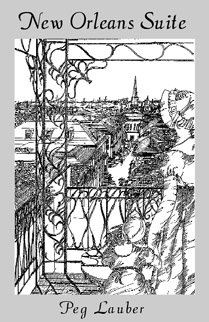
New Orleans Suite by Peg Lauber
Marsh River Editions Chapbook
48 pages, 2006 $10. http://www.marshrivereditions.com
Review by Lo Galluccio http://www.logalluccio.com

Over the course of five or so years, writer Peg Lauber – practically a Wisconsin native, though born in Michigan – gives us her flow-chart of journeys north and south: her main destination., the misgiving and magical city of New Orleans. Like Demeter to her daughter’s Persephone, Peg is pulled into the seasonal work of a mad bird lover, a woman who raises non-migratory sandhill cranes. We see Meaghan with a wild sweet smile in a photo early on in this collection, holding a large feathered animal, who seems settled in her arms but somehow unwieldy and otherworldy. It is an appropriate image to introduce the book’s heart and soul. For in Meaghen --Peg’s own offspring-- lies something beyond the normal, something a little saintly, a little out of control.

“Finally turning east we see
New Orleans on the horizon
Where our daughter waits
To help us unload, get ready
For the Christmas party
At the place where she raises cranes,
Where I’ll wear my Christmas crane shirt.”
On Our Way: December 2001

Perhaps it is transference, but Peg –while her daughter is enraptured by her cranes – scans the landscape to behold many birds, the birds of winter and summer, the birds “of the intercoastal waterway.” And the birds are as variegated in temperment and look as they can be; sacred, scary, mystical creatures of flight. Some are trapped for their own good and fed cuts of fish-meat. Some are “Muscovy ducks gone wild/living on the golf course, steam rising from water traps early….p.2

There are many good poems in the New Orleans Suite, and I detect in Peg and her work, a love and trust for progressions, for sequences, for the simple plot of how we get from here to there. While the birds do dominate much of the book’s story, it is also a book about the city of New Orleans itself. In “The First Parade: Mardi Gras, January 2002”
she takes us from the start of the parade with its police and shriners, though the floats of “gigantic glitter” whose plastic medallions litter the streets in purple, red, gold and green, to the underside of the event; its aftermath:

“At the end march more police – policing convicts dressed in yellow, who scoop piles of garbage into trucks. “Strange parade…” the author comments. And, in the end, as with her Christmas crane shirt, and like the scavenger birds with less discriminating taste, she reaches into the dirt to find, “a plush toy, a red Tabasco bottle with arms: my treasure to remember in the northern summer.” P 5

Unlike Meaghan’s cranes, Peg is herself a migratory creature. In “Feeding Storks” she vividly describes the kind of butchery necessary to debone fish and cut the symbol of Christ, fish, for the birds. She writes”

“It’s a mean thing, taking apart large fish
who bleed as I do, but gleam as I don’t:
silver beauty, slippery bracelets, gigantic rings
but here just daily gifts for those large
ungainly, yet beautiful birds.” P 6

There are also more pedestrian poems concerning the humans around and how they come to bloody ends in the badlands of this City…

“Stray bullets are common in New Orleans, that other country
where almost every day
someone’s child gets in the way
of a bullet intended for someone else,
while someone’s child, in a drive by
shooting, celebrates the phallic power
in his hand, the money in his pocket,
the drugs in his bloodstream –
those, the only things that matter.”
“Coda: Other People’s Guns” p 13

And so, like the weather north to south, we are introduced to the polarity between the sacrifices made for the birds and the surrounding human territorial wars for money and drugs in New Orleans. Side by side these universes co-exist.

There are wonderous snapshots of different birds, as in “Night Bird” whose imagery is almost classical, pitched to opera: “The filthy night is laced with streaks of dawn/ like cream in tea/as the caged night bird stops shrieking./…..She works quietly and with a hard joy, tearing strips from the meat, suddenly bursting into shrieks that carry to the still shore, to the horizon, persisting, persisting, persisting…”

New Orleans is a town rife with holiday parades, history and murder. And Peg describes in her acute and elegant poems these spectacles close up; one can smell the muck, the oil, the blood, the incense. But it is also a City surrounded by these miraculous birds who are fed, and caged, and fretted over. This is the jewel-like secret of Peg’s journey as a writer and mother, shared with us in “New Orleans Suite.” We are treated to visions and flights of many degrees.

Recommended.

Lo Galluccio
Ibbetson St. Press

Tuesday, August 15, 2006


Jennifer Matthews--“Sunroom Sessions” Release and @ The Tir na nOg with her Talent September 10th
By Chiemi http://www.chiemimusic.com


Yes --after tours of England, Southern California, Alaska and other accolades and exciting appearances, the beloved Jennifer Matthews is coming September 10th to a venue near you! She is honoring her Somerville fans as part of the News Poetry and Music Series. Indeed, she is well-known and accomplished in both of those arts.
Since Matthews moved to Boston in 1998, her solo career has brought her icon status. She is a rocker with a Suzanne Vega-like toned down side. Also, her lyrics, whether published in books or albums, ring with an unrelenting realness.
This past June, Matthews released “The Sunroom Sessions” (Thundamoon Records 2006), her self-produced solo follow-up to last year’s “The Wheel.” It was recorded by Jerry Bates at Sunroom Studio in Norton, Mass., with Matthews on vocals, piano, baritone guitar, acoustic guitar and mandolin. Part of Matthew’s style is defined by her signature baritone electric guitar, with which she creates her own special funk and jazz. She also tunes in on her blue Martin.
“[J]ove” (no.1), begins the “Session” with virtual discordance artfully cast by Matthews as a chopping river of guitar over which her serene voice floats like a still sky. The last lines, “lost under the stars again” aptly describe where I am left at the close of this song. The layers of Matthews’s soft singing with Bates’s backing vocals and the underlying light thrumming instrumentation in “1000 miles” (no.2), enfold the listener in a marvelous, textured tapestry comprised of few choice strains of subtly colored feathers laid over one another. “[W]rote u a song” (no. 3) has a self-described catchy rhythm “to increase your heartbeat” coupled with folksy lyrics, while “gospel of love” (no. 4) and “revelation” (no. 7) soothe. “[F]loating” (no. 5) is ethereal and spooky, with a Middle Eastern flair, as Matthews describes longing, waiting and dreaming. The intricate slurs, crafted chords, grace notes and intense cries at the apex of “[D]ogs at the door” (no. 6) demonstrate Matthews’s vocal diversity and musical ingenuity. “[C]onfess” (no. 8), “them bones” (no. 9), “little sister” (no. 10), “[L]emon peels & tangerines” (no. 11) and “sweet as rain” (no. 12) are sighing lullabies. Matthew’s begins “trees in december” (no. 13) with haunting plucked tones and distributes thought-provoking phrases throughout, such as “there’s a wheelbarrow sitting with its heart wide open.” “[W]estern skyline” (no. 14) and “if I ever” (no. 15) gently round out this intimate and sometimes sweetly evanescent experience.
Matthews studied music at the University of Colorado in Boulder and at Denver's School of Music. She began her career as a solo artist while in Colorado, performing in local venues there. This experience led to several awards from the Rocky Mountain Music Association. She then toured Japan, Korea and Hawaii for three months and relocated to New York. "Beautiful Mud," the five-piece band Matthews started, separated after their well-received debut release and performing for several years in New York City.
In 2003, Matthews was nominated for a poetry award by the Cambridge Arts Council for her book of poetry released under Somerville's Ibbetson Street Press, Fairy Tales and Misdemeanors.
May of 2005 brought the release of "The Wheel" (Thundamoon Records )--recorded and mixed at Windham Studios in Vermont. Matthews and producer/engineer Brian Brown took the 13 song record to new levels by adding some electronica and loops to her roots rock sound. "The Wheel" reveals the mystic in Matthews and showcases her guitar talent.
The rest has been Matthews in continuous motion, including a publishing deal with ACM Records, Inc. For more on Matthews check out:

http://www.jennifermatthews.com.
Jennifer will be reading from her poetry Sept 12 2006 7PM at the Newton Free Library, along with Mark Pawlak, and Ifeanyi Menkiti.

Saturday, August 12, 2006


Modern Love. Andrew Scott. (Sunnyoutside POBOX 441429 Somerville, Ma. 02144 USA) $10 http://sunnyoutside.com/

“Modern Love’ by Andrew Scott is the second chapbook of fiction by the Somerville, Mass. small press “sunnyoutside.” As usual Dave McNamara has designed this book, and it is a handsome addition to his list of titles. The artwork in the book was done by Ed Herrera and the font for the text has been digitally interpreted by Robert Slemback. “Modern Love” is a short story about a young couple’s journey from the corn-fed Midwest to the brighter horizons of California. The couple is in search of a better life, but more accurately in search of themselves. The young man wants to make it as a rock band promoter, and his girlfriend Alice seems to be along for the ride. The story moves on in a predictable way: they meet a kindly old man in Tucson, and it ends with a not very profound psychological epiphany. The characters don’t seem sufficiently fleshed out, and the story sort of peters out. I think people in the music biz might find this novella a good read; as there are some amusing riffs on the music industry. Although the writing is competent, the story is not particularly compelling.

Doug Holder/Ibbetson Update/ Somerville, Mass. /Aug 2006
Irene Koronas: An inventive writer and experimental poet


Irene Koronas (left): With Bagel Bards: Doug Holder, Harris Gardner, and Linda Haviland Conte.


Irene Koronas, like many poets in the area, is a denizen of coffee shops. Some years ago we met at Breuger Bagels in Porter Square, Cambridge, Mass. the birthplace of the Ibbetson Street Press. Later Irene became the scribe for the weekly “Bagel Bards” meeting now held at the Au Bon Pain in Davis Square, Somerville, Mass. Irene is currently the poetry editor for the “Wilderness House Literary Review,” has numerous publication credits, and has read extensively in the area.

Koronas, who has been creating since age 12, said in an interview with Cambridge Alewife poetry editor Lo Galluccio , that she first explored language by reading and writing poetry, and eventually fell in love with Octavio Paz, Yannos Ritos, and others. Koronas is also a graduate of the Mass. College of Art, and uses her skills to produce her own handmade chapbooks. Her poetry is often accompanied by her art. Koronas is a self-described experimental poet, and she tries to contemplate the meaning, image and representation of symbols and words in all their infinite forms.

Doug Holder: You describe yourself as an experimental poet. Can you define that?

Irene Koronas: For me experimental means I like to play with words. I like to use words that I haven’t used myself. I want the reader to look up words and think about them. I’ve been thinking more about what I do. It feels like a grid… my poetry that is. I juxtapose words next to each other. Sometimes it is meaningless. But sometimes it means something. It’s like a painting or grid. The colors positioned next to each other—will change each other.

Doug Holder: Can talk about whom influences you.

Irene Koronas. I try to be my own person. I don’t want to be so heavily influenced by everyone else. My mother told me that I was the most gullible child she ever had. Now I am more confident about what I am doing—who I am—and the fact that I like to play. I like to think now. I never had time just to think before. I was always working and raising a family.

Doug Holder: What do you think about?

Irene koronas: I think about what words mean, and how to position them. Right now I don’t use punctuation.

Doug Holder: How has your “outside of the box” work been accepted in the poetry community?

Irene Koronas: It took awhile for some people to accept the way I am writing. I hang out with people who know what I am doing. But I can write narrative poetry—I have for many years. If I am reading somewhere I consider the audience. Even if poetry is experimental they can relate to the rhythm.

Doug Holder: You have talked to me about “ageism” in the poetry scene. You are a woman “of a certain age.” How have you been treated?

Irene Koronas: I will be 65 years old in September. I have gotten used to it. When I turned 60 I really noticed that I wasn’t getting the attention I got when I was younger. It was more physical than anything else. It is not as easy to get younger poets to listen to me. I am a moderator on an experimental poetry internet site. I had to put in my profile that I was a grandmother. I was getting a lot of email from very young experimental poets. I let it go for awhile because it was exciting being exposed to new ideas. It got so that it wasn’t real, so I stopped. It’s hard for some younger people to understand that older poets still experiment.

Doug Holder: You make beautiful handmade chapbooks. Can you talk about this?

Irene Koronas: I like to make things. I like the idea of hand making a book. I like to actually hold a book. Everything is about the computer these days. It’s easy for me. I like the sewing of the book…the texture. I don’t make books as often as I used to.

Doug Holder: Are you as interested in the look of the book as you are the content?

Irene Koronas: I am as interested in the look of the poem as I am in the content. I am interested in the look of the letters on the page—the whole thing.

Doug Holder: You are the “scribe” for the “Bagel Bards,” a group of poets and writers that meets at 9AM every Saturday at the Au Bon Pain in Davis Square, Somerville, Mass. You write a weekly column for the Bards. What does being a group “scribe” entail?

Irene Koronas: Part of my work as an experimental poet is to catch word or phrases on the subway, etc… So at the meetings I catch phrases and conversations and form an essay. Last week we talked about string Theory, prejudice in the 60’s, and then the Holocaust. So I started to think about a single word: “Madness”. I thought about its meaning. When I looked up the word in the dictionary it was defined as “enthusiastic.” That was confusing. So in my column “Word Catcher” I try to make my experimenting interesting.-- Doug Holder/ Ibbetson Update.

Wednesday, August 09, 2006


The Café Review. Summer 2006. (Yes books. 589 Congress St. Portland, Me. 04101) thecafereview@thecafereview.com) http://thecafereview.com $8.

From the city of Portland, Maine (a favorite haunt of mine) comes the well-regarded “The Café Review.” I had the privilege to meet the folks from the Review when I read with them at the “Grolier Poetry Reading Series” at Harvard University. In this issue they have a poem by Ed Sanders (of the “FUGS” and “Tales of Beatnik Glory” fame.) titled: “The Impeachment of George Bush-A World Wide Party.” This is a rollicking and humorous account of the reaction of the world in the wake of a Jr. Bush impeachment:

Today they impeached George Bush
And the world began to party.

Flowers bloomed spontaneously
Trombones cam out of attics by themselves
and began to play the celebration waltz…

Paul Bowles sent a water pipe from Tangier
to Corso, Ginsberg, and Orlovosky,
in room 27 of the Beat Hotel on Rue Git le Coeur
to celebrate the good news.

Cassandra stands on Pennsylvania Avenue
and weeps this time with surprise
because the world at last is listening to her words,
“Goodbye George, your house has fallen without ashes!

There is also fine work by Charles Ries, Dawn Potter, Diane Wakoski, and others. The journal also has a large BOOKS RECEIVED list, as well as artwork and reviews. Highly Recommended.

Ibbetson Update/ Doug Holder

Friday, August 04, 2006


Poet Ed Galing's wife has passed at age 89. Ed was married for 68 years. Ed Galing is a widely published and respected member of our poetry community. Send your condolences to: Ed Galing 3435 Mill Rd. Hatboro, PA. 19040 Ed does not have a computer. Ed sent me a poem "Gently Into The Night."

Here is an excerpt:

one month after she has left me to lie in the cemetery,
and the many friends and good relatives have disappeared
it's just me and her all over again,
and I tell you, she is not dead...

and today she and i are goingfor a long ride,
into the Pocono mountains,
she always liked that ride into hills and valleys;
and perhaps we will find a shady spot somewhere,
and talk about life and how lucky we are
to have each other.

Tuesday, August 01, 2006


Jean Trounstine: A Writer Who Has Braved Many Journeys.

Jean Trounstine is a writer who has taught in prison, survived cancer, has been in a long and successful marriage, and has had the good graces to write about it. Trounstine is a professor of Humanities at Middlesex Community College in Lowell, Mass., and she has worked extensively in the prison system directing inmates in theatrical productions including “The Merchant of Venice” at MCI / Framingham. This experience was the basis for her book “Shakespeare Behind Bars: The Power of Drama In A Women’s Prison.” She is the co-author of “Finding A Voice: The Practice of Changing Lives Through Literature.” Most recently she co-edited the anthology “Why I Am Still Married.” ( Hudson Books)

Doug Holder: You have said that working in prisons has changed you. How?

Jean Trounstine: It’s a hard question but it’s a good one. I always say to my students just going into a prison changes you. You see something that you never imagined to be true. That is the way people are treated behind bars. You just never think about the way people are treated in prison. You never think about what happens to them in prison. At least I didn’t. The women I met behind bars were often wonderfully talented. They had stories and had situations in their lives that lead up to pretty good reasons why they were behind bars. I wanted to help them tell their stories, be it through theatre or writing. I was moved by their stories and I turned into an advocate for women in prison. I wanted to find out about them. A lot of people are behind bars for really lousy reasons. Women serve longer sentences than necessary to rehabilitate them. After a certain time prison becomes counterproductive.

DH: Why did you produce Shakespeare’s “Merchant of Venice”?

JT: I think Shakespeare is something that women in prison thought they couldn’t do. I think you have to make Shakespeare accessible. I think the stories of Shakespeare are incredibly dramatic and traumatic. They are the stories of these women’s’ lives. The questions they live with are in Shakespeare’s plays.

DH: Can you talk about the collection of poetry you penned “Almost Home Free,” that deals with your experience with cancer?

JT: I just had to write it. The writing happened to come out in poetry. When I looked back it wasn’t about illness; it was about family. Illness was a big way to get to questions like mortality. My perceptions of the world were intensified during my creative time. I saw the ironies of everything. Irony is what drove me to poetry. Someone once asked me when I was walking down the hall: “Is that your hair or a wig?” My perceptions of how we live and the way we speak to each other were intensified.

DH: Did cancer make you a better poet?
JT: Well…I tend not to write poetry unless I am driven to. That’s different than my other writing. There is something about poetry that gets to the core for me. I felt invincible up to this point. I was very healthy. My poems are about the fragility of life.

DH: In a poem you wrote “Language of Cancer” you deal with the arcane clinical jargon we use to describe the disease. Do you feel we have to get beyond the clinical language to get to the emotional core?

JT: When we try to connect with someone with cancer the language is a barrier to really connecting with the person. And that ‘s how it was for me. There is a lot of masking that goes on if you are not careful.

DH: You were a contributing editor to the anthology “Why I’M Still Married” with Karen Propp. Do you think this is a question that a lot of us ask ?

JT: I do. I’ve heard people say “I don’t ask that question because I adore my wife or husband, etc…” But for most people, especially for women, they ask that question. Women get sicker; men apparently do better in marriage. Each essay tackles something. Challenges to the marriage. We tried to get people to think deeply about marriage.

DH: Do you think we enter marriage with blinders on?

JT: Absolutely. It’s a tough thing marriage. But I think it is a good thing; it stretches us. I wasn’t able to meet the challenge of my first husband’s heart attack. But today if my husband had a heart attack I would be able to handle it.

DH: Why did you use women writers for this essay anthology?

JT: We wanted writers because we wanted well-written essays. I think there is diversity in the work, in terms of background, culture, age, etc… We did try to get men. We would get responses like; “I’m not brave enough to write this essay.” Our editor told us that men don’t read these types of things. It’s sad really. I think it is a good book for people who are getting married.

DH: Were there any surprises when you were editing this book?

JT: Open marriage was a surprise. It surprised me that I found myself pulling away from it. I didn’t like it. But then I came to understand it.

DH: How does your teaching fit with your writing?

JT: I love teaching. I feel very connected to it.

DH: Any future projects?

JT: A memoir of growing up German/Jewish in Ohio.

Doug Holder/Ibbetson Update

Feeding My Heart To The Wind: Selected Short Poems. 1999-2005 Michael Kriesel. $6. (http://www.sunnyoutside.com/ )


Dave McNamara, the founder of the Somerville independent press “sunnyoutside,” is not only an editor but a very serious designer of books. The look of the book is almost as important as the contents. McNamara writes of the design of “Feeding My Heart… “ The cover text was set by hand in Alternate Gothic No. 2, along with a linocut by Adrian Rodriquez…” And so on. But it’s all over my head.

However…these short poems by Kriesel are accessible, tightly written, economical and well-constructed. Kriesel, seems to have studied the short form and serves it to us on a fully fleshed plate. Here is an inspired little ditty “ Cabbage Moths.”

Walking
Past the garden

Startled
By confetti

Rising
Up


And in “American Haiku” I can’t but stop thinking about our debacle in Iraq:

Bull frogs
Stop
To ponder
That last
Cherry bomb


This is another tasty poetic morsel from the folks at “sunnyoutside”

Doug Holder/ Ibbetson Update/ Aug 2006

Thursday, July 27, 2006


Chiemi: A Lawyer and Singer Songwriter who is “blessed.”


Ingrid Chiemi Schroffner, known by the moniker “Chiemi,” is a 30 something, lawyer/singer/songwriter, and journalist well-known on the Somerville music scene. A native of Hawaii, but a resident of Massachusetts since 1988, Chiemi, (meaning one who is blessed in Japanese), came here to attend college and she eventually earned her law degree from Boston College Law School. In a biographical statement she writes: “I like telling stories which stems in part, from my East/West heritage; work on folktales as an undergraduate, and I further carry it out in my daytime profession as an advocate.”

Chiemi hosts the monthly “Somerville News Music/Poetry Series” currently held at the Sherman Cafe in Union Square, Somerville. She also has a popular column in The Somerville News, titled “Chiemi’s Corner,” that reports on the music scene through incisive interviews and articles.

In 2005 Chiemi released the CD “Living On Two Coasts.” She has played in such Somerville watering holes as “The Burren,” “Toast,” “The Skybar,” and “PA’s Lounge.” I talked with her on my Somerville Community Access TV show “Poet to Poet/Writer to Writer.”


Doug Holder: “Chiemi” means “one who is blessed” in Japanese. Are you blessed?

Chiemi: I guess I can’t complain. I feel lucky to write for The Somerville News, and to host the “Somerville News Poetry Series.” I pen the “Chiemi’s corner” column for the News, and I post it on my website. So the people I interview or write about can send their articles to their friends, etc… “Chiemi’s Corner” deals with the Somerville music scene and the series, and the poets and musicians who populate this milieu. At the” Somerville News Poetry and Music Series” we will have performers and poets like Jennifer Matthews, Colleen Houlihan, Ross Goldberg, and others presenting. On Sept 10 the series will move to the Tir Na Nog in Union Square. I do feature articles on each person in the series. I get to learn about how they write, what their processes are, and what their composition and art are about.

DH: You are half Japanese and half German. You write songs about your mixed heritage. Are these two parts of you in conflict?

C: There is friction between East/West ways of thinking. I covered this in my undergraduate thesis concerning German and Japanese folktales, and how they shape identities through common genres. In the Western mindset there tends to be a focus on moving forward. In the Asian mindset there is a progression that is like a ball or sphere that expands. Asian thought is more about incorporating things as opposed to moving forward and discarding things. So this creates conflict. My mother was brought up in the circular way of thinking, while my father is German and much more pragmatic.

DH: What inspires you when you write lyrics?

C: Turns of phrases, conversations that I have, or that I hear. I like to think of songs as a continuum of thinking about ideas. My thoughts evolve…whether I am using the sea as a metaphor, or thinking about what it means to love someone.

DH: You are a lawyer as well as being a singer/songwriter. Does each of these feed the other?

C: I like to think of them as being related. I don’t like to have lack of continuity. It’s hard to be one way in one role and different in the other. It’s weird.

DH: Does your life as an artist affect your credibility as a lawyer?

C: I don’t tell my clients that I am a musician. People have this idea that musicians are flakes. I’m in family law, so it may be more acceptable to be a performer.

DH You were involved in the “Burren Project.” It revolved around the Burren Pub in Davis Square, Somerville. Can you talk about it?

C: I was involved with it in 2004. It was a fabulous project. It involved a compilation of the regular musicians that performed at the Burren open mic. We made a CD that was representative of a typical night bat the Burren.

DH: Your best friend from law school is the daughter of Ed Sanders. Sanders was a member of the group the FUGS and the author of “Tales of Beatnik Glory.” Did Sanders politically focused songs have any influence on you?

C: The fact that his group incorporated political ideas in their songs had an impact on me. I realized it wasn’t totally off-base to do that. I’ve met him, and he has a very interesting way of thinking. His daughter is now a very conservative lawyer.

Wednesday, July 26, 2006


POETICA:REFLECTIONS OF JEWISH THOUGHT, Publisher/Editor Michal Mahgerefteh,WWW.Poeticamagazine.com or Poetica, P.O.Box 11014, Norfolk, VA 23517.$14.00/year, $5.00/issue. July, 2006. Review by Hugh Fox. hughfoxy@aol.com

Given the current political context, when I started reading Poetica I expected something furious, agitated, militaryish, rebellious, but the main tone here is a kind of Jewish almost-Buddhism. Sometimes even Jewish-Buddhistic impressionism: "Morning fog unfurls, brushing Pacific cliffs.... Houses and cars must exist somewhere, but not in this world filled with soft silence. Dim shapes might be cypress or cedars, birds, butterflies or nothing. Hummingbirds may be hovering, lilies may be blooming, but I stand alone, wrapped in a tallit woven of lavendar, rosemary, sea mist and far away light." (Davi Walders, Mendocino Sabbath, p. 52)

Most of the time here Judaism here seems remote, nostalgic, something beautiful, held in high esteem...but very much in the past: "The old days were better; there is no doubt that we learned a lot from our Jewish parents who taught us the Jewish way of life..... ah, yes, those old days were so much better.... and no one can ever take them away from us. " ( pp. 55-56) " The pressures of the contemporary world seem to have taken over.Childhood was belief-time, the present is the absence of and the longing for a return of belief: Source of All Life, how long will I feel isolated and alone -- removed from all that is godly? How long will I be troubled and full of sadness? How long will everything seem to go against me? I want to believe in you, to know you are out there. Give me the courage to see clearly. Keep me from sinking into despair..... " (Psalm #13, Eva Miodownik Oppenheim, p.37)

All in all a very touching, meaningful, contemplative-philosophical review, nothing wasted or minor here, but all major confrontations with thePhilosophical-Mystical Reality of a Judaism out there that surrounds us, has us and we hope continues to surround us.

Hugh Fox/Ibbetson Update