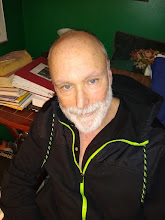
Richard Hoffman: Poet and Memoirist writes from a traumatic past.
Richard Hoffman is the Writer-in Residence at Emerson College. For a man who has experienced years of trauma during his hardscrabble past he seems remarkably together. He has a professorial manner, and seems to be comfortable in his own skin. Hoffman is the author of “Half the House: A Memoir,” that deals with his early years as a victim of child abuse. It tells of a 10 year old’s sexual abuse at the hands of a trusted baseball coach. The book was responsible for the man’s eventual arrest, and it reached a mother lode of boys and men who suffered past abuse in a tortured silence.
Hoffman’s poetry has appeared in many prestigious journals such as the: Painted Bride Quarterly, Cedar Hill Review, Janus Head, Barrow Street, etc… His most recent collection of poetry is “Gold Star Road.” I talked with him on my Somerville Community Access TV program “ Poet to Poet: Writer to Writer.”
Doug Holder: In your memoir “Half the House…” you inscribed in my personal copy a quote from Camus: “Freedom is the right not to lie.” Before you wrote your memoir were you lying to yourself about the past, and with the memoir’s writing are you now free?
Richard Hoffman: I don’t think anyone is ever free from trauma. I don’t think it is a question of catharsis. I think it is a question of integrating what can’t otherwise be integrated. The part of you connected to the trauma, that is. When you don’t have access to that you are not whole. To be whole you need to integrate. One way people have done this is through “story.” When you make it part of a narrative you own it. You see it in relation to all the other events in your life. You don’t make this up, or lie, why would you? It is part of your history.
DH: But you can deny certain memories, no?
RH: Yes, and society colludes with that; in that denial. This sort of “unwelcome knowledge” can be very threatening to the status quo. So I am free of this.
DH: Isn’t memory fickle? Does your poetic sensibility color your memoir?
RH: Well a lot of people have talked about the poetic qualities of the book. I think what they mean is the use of imagery, and that it is written for the ear. You are being told a story. And I am also a fiction writer. The writing is restrained. That’s part of its lyrical quality. Isaac Babel said: " There is nothing quite so heartbreaking as a period exactly in the right place.” So the writing comes out straight forward in terms of being immediately accessible. This is to make you one with the event—not focused on the writing. It is a hellu’va lot of work to do.
DH: You confronted your elderly father about his own abuse of you, and his negligence around your abuse by a baseball coach. Was this closure for you? Did you ever feel it was overkill to bring this up with your Dad at this point in the game?
RH: Yes, I felt it was necessary to bring it up. If I was going to have a relationship with him that was real I needed to. I remember when my mother died; I thought that she didn’t really know me. By the time I was eleven I was pressured to be someone I thought they needed me to be. I kept all my trauma to myself. I didn’t want to burden them with it.
I grew up in a family with two terminally ill kids. My parents were overwhelmed. So when my mother died I thought I would be burying my father one day without even knowing each other.
My father and I had a relationship but it was very cartoonish. It was “ Hey, how about those Red Sox?” So I wanted to make the first step to break through. Writing should be the axe to crack the frozen sea within us. There was certainly a frozen sea there.
DH: So did this confrontation work?
RH: The proof is in the pudding. My father is ill now. We are in touch constantly. We have been in touch for a while and we are able to talk about anything. Before all this we were able to talk about nothing. We were literally frozen in a father/son cartoon.
DH: Has there been a marked change in you?
RH: The change happened before the book. It’s not like you tell the story and it’s ok. I was involved with this project for 17 years.
DH: In your poetry collection “Gold Star Road” there is a poem titled “Humility” where it implies the writer’s vision is always impaired or encumbered to a certain degree.
RH: Yes. I think it is always encumbered. I think that is a good word for it. If you write I hope you believe the words matter. But you know—90% of the thinking that’s going on in your head isn’t even yours. It’s Pop Culture. It is really hard to get to what’s really yours. When you do, well, then you really have written something. It all comes together. You like the way it sounds—still, you are not quite if you believe it. That’s why you have to sit with it. Encumbered? Yes. I want to be sure about what I am saying.
DH: Do you revise a lot?
RH: Continually. For years sometimes. I say when I am writing, and finish the first draft: “ This is a real poem but it is not right just yet.”
DH: Are there poets you know who didn’t revise much?
RH: Ginsberg claims he didn’t revise much. Creeley didn’t. He wrote at a snail’s pace, and literally carved his poems out.
DH: Do you believe poetry should be able to cross over from the academy to outside the gate? Has their been too little exchange?
RH: There are academics that view poetry as fodder for theory. It should be more than that.
DH: You have had problems with alcohol. Many younger viewers look at substance abuse as a romantic part of the writing life. Your take?
RH: I hear a lot of that. It’s fine. I can’t do it.
DH: Do you think it helps creativity?
RH No. Not at all. Drinking in a sense helps you be a partial person. It quieted that part of me, the demons, so I could write. I would pour a little booze on them and they would go away. But I couldn’t write the whole story at the heart of my life.
WELCOME
They speak an appropriate language here.
Listen to them sometime.
There are never gnats in the evening. No matter.
No one here knows what that means.
The people pretend to believe the man pretending
he is blind is blind and give him money.
Handbills advertise classes in breathing,
cheaper than all their competitors.
Bacon has happy pigs on the wrapper,
smiling under the red star.
And a man with toenail-yellow teeth
greets new arrivals, hands them a brochure
that's been carefully written, carefully photographed,
lovingly put together just for them
-- Richard Hoffman