The Red Letters
In ancient Rome, feast days were indicated on the calendar by red letters.
To my mind, all poetry and art serves as a reminder that every day we wake together beneath the sun is a red-letter day.
––Steven Ratiner
Red Letter Poem #206
Walking with My Son at Fresh Pond
Taking a path along the reservoir
he’s my guide. Follow in my tracks.
We go to look at the reflection in the pond,
the trees in a patch of woods that burned,
the lifeless limbs charred charcoal, the scene
all watery, wind-rippled, turned upside down,
and set against sky and clouds.
On the bank he leans forward as if he
truly fears he might be taken into that world.
If I stare, I can imagine it, too.
Yikes! I’m falling off a cliff.
I hold onto him, feel the pull he feels,
the strength of it.
In a stand of evergreen he makes a stick hut,
like the Jews who make a Sukkah for harvest.
I help him collect fallen limbs, lean them
against the trunks of sturdy hemlock.
Then, a village springs up, inhabited
by gnomes and nymphs. They’re all around us!
I want to, love to, and need to
see things through his eyes.
We hunt and hide from monsters
who have powers that let them change
on a whim into huge creatures looming
over us, the landscape, energized.
Eventually reduced to tiny moles, They look
up to us, he says. My boy has the power
to dismiss them all, then allow the hillside
to suddenly become thick with wolves.
He carries a tree branch to ward them off.
Later it becomes a bridge to cross the water,
then a staff to help him climb the mountain,
the hill on the other side of the pond.
He holds his stick in the air whenever dogs appear,
to keep it from them, hoping they’ll know
it’s not a game of fetch he’s after, seeing them
run and jump. Today there were seven dogs:
Each one different, he noticed.
––Mary Bonina
I know: whenever one is tempted to make sweeping pronouncements, you’re venturing on shaky ground. And still, I feel confident with this declaration: most of us owe our survival––in body, mind, and spirit––in large part, to our mothers. Let me quickly say––as a member of the male persuasion, as a dad and a granddad who was and is deeply involved in the developing lives of our family––this is no knock against fathers. Parents, together, are the sun and moon in a child’s firmament, and the more loving and engaged the better. This is simply an acknowledgement that a mother’s love is of a very different nature and intensity, seeming perhaps to merge with biological necessity. Having once been its bodily home, the mother was the first to convey to this little being that the harsh external world would be survivable. At times, this love even appears to extend beyond the bounds of physical and metaphysical laws. Of course, I realize this is not true in every case, but I’d wager more often than not. And as children, I believe we intuitively recognized this, relied upon the gravitational constancy of that caring. Perhaps, over time, we bristled at how overwhelming was our motherly dependence, and so we declared the maternal wars in order to stake a claim to our own territory, earn a measure of autonomy. But, as Heather Treseler reminds us in her poem “Purpura”: “The first empire is mother.”
So, as Mother’s Day swings around again, I wanted to share the second of two new ‘mother/son’ poems I have from Mary Bonina. The first, “Fever” (published back in December, RLP#185) was a hymn to a mother’s reservoir of anxiety and caring, as she tried to help a child vanquish the monsters escaped from his feverish delirium. Comfort is certainly one of the greatest gifts I remember receiving from my own mother. Another, though, is perhaps one of the most impactful a mother can provide: her deep listening––and that’s at the core of today’s “Walking with my Son…”. “Follow in my tracks” the boy commands and, dutifully (delightedly) Mary’s protagonist obeys, switching the parental dynamics of who usually blazes the trail and who tails behind. It is quickly clear that the gift-giving is mutual, as the mother gets to reclaim something of her own childhood self, seeing the world through this imaginative boy’s eyes. In that perspective, menace is always lurking––but also the unbridled delight in being an embodied creature, exploring the world. I love how the real and imagined share a common space and have equally-powerful effects on our fertile minds. After all, those charred trees really did burn; destruction and loss are not just dark figures in fairy tales. But we also get to indulge in those fanciful terrors which we have the power to control: “Yikes! I’m falling off a cliff.” But they do not topple––they play, and danger is a thrilling reminder that we are alive. When those marauding wolves appear (in the guise of dogs, romping on the trail), the boy’s wand––and a mother’s watchfulness––has the power to keep us safe. More than just safe: we are allowed to be fully present to this lived moment; and we can relish the loving companionship we’re sometimes privileged to enjoy.
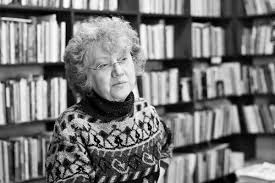
Mary is a poet and prose writer; she’s published two collections––both from Červená Barva Press––and a memoir, My Father’s Eyes. Today’s poem will appear in a forthcoming book, The Charm. Her poem “Drift”, a winner of UrbanArts "Boston Contemporary Authors" prize, was engraved on a granite monolith outside Boston’s Green Street MBTA Station. She’s been honored with a number of fellowships including seven from the Virginia Center for the Creative Arts where she has been a fellow since 2002. Mary’s taken part in collaborative art experiments with composers and sculptors, working to expand poetry’s vocabulary and reach. And today, she has given us all a good reason to quickly pick up the phone and call Mom. Or, if that is an impossibility, perhaps we can spend a few minutes following in memory’s tracks, journeying back to a time when it was an unexpected joy, simply to see through each other’s eyes.
Red Letters 3.0
* If you would like to receive these poems every Friday in your own in-box – or would like to write in with comments or submissions – send correspondence to:
steven.arlingtonlaureate@gmail.com
* To learn more about the origins of the Red Letter Project, check out an essay I wrote for Arrowsmith Magazine:
https://www.arrowsmithpress.com/community-of-voices
and the Boston Area Small Press and Poetry Scene
http://dougholder.blogspot.com
* For updates and announcements about Red Letter projects and poetry readings, please follow me on Twitter
@StevenRatiner