Friday, May 05, 2017

Robert Creeley at the Wilderness House in Littleton, Mass.


 ** Shortly before his death I had the pleasure to spend an afternoon with Robert Creeley. The Wilderness House Literary Retreat founded by Steve Glines hosted him, and I happened to be on the board for the retreat. The retreat closed after a few years--but we had quite a few interesting guests like Lois Ames, Afaa Michael Weaver, and a number of others...


Robert Creeley at the Wilderness House in Littleton, Mass.

By Doug Holder


It is always exciting to help start a new literary venture. Steve Glines, the founder of the “Wilderness House Literary Retreat” in Littleton, Mass. asked me to be a founding board member last Summer, and finally on Dec. 11 2004 we had our first event. We managed to get the renowned poet Robert Creeley as our first guest. Lo Galluccio, a poet and a friend of mine, joined me and we caught a train out of Porter Square, Cambridge to the hinterlands of Littleton, Mass. Steve Glines met us there and ferried us up to the “New England Forestry Foundation” lodge where the first event was to be held. The actual hunting lodge, where the retreat will be housed hopefully by the late Summer of 2005, is currently being renovated. Later, we inspected the premises, and found it full of promise, not to mention a spectacular view of the nature preserve below.

Lo and I sat down in a spacious room in the NEFF lodge, and enjoyed the crackling fireplace. Creeley was the first to arrive and looked amazingly hale and hearty, and much younger than his 78 years.


The event was advertised as a “chat” with Creeley, and that’s exactly what it was, a “chat,” not a formal lecture. Creeley was free to ramble on about his fascinating career as a literary legend. He talked about the many poets he knew; his years at the experimental “Black Mountain College,” to his experience with Jazz greats such as Miles Davis, to name one illustrious figure.

Creeley who grew up in Acton, Mass. has strong connections to Littleton, the home of the retreat. As a kid he swam at Long Lake which is just down the road from the retreat. Creeley was surprised that the natural beauty of the area has been preserved. Creeley felt that he could now thumb his nose at neighboring Concord that always had a better literary pedigree than Acton and Littleton. Creeley, tongue firmly in his cheek stated; “ I am glad to thumb my nose at Concord.”

Creeley, who taught at the “ Black Mountain College“, which in the 1940’s and 50’s was an innovative avant-garde institution located in North Carolina. Folks like Merce Cunnigham, John Wieners, Robert Motherwell, Buckminster Fuller, Charles Olsen, and others taught there or were students.

Creeley, who attended Harvard, was less than enthusiastic about the years he spent there. He stated: “ Harvard makes everyone feel like an outsider.” He said there was not a welcoming feeling there, and he felt inhibited to approach the formidable and often aloof professors. He said his literature professor at the time excluded the works of Hart Crane, Ezra Pound, and Wallace Stevens, much to his dismay.

Creeley told the audience that at first he wanted to be a prose writer. He laughed: “ I had a naïve sense of supporting a family writing a novel.” However, a publisher told him his novel was all about transitions; nothing ever happened. So Creeley decided to concentrate on Poetry.

Creeley had a plethora of anecdotes about poets he knew like: Allen Ginsberg and Anne Sexton. He recalled Sexton demanding a six-pack of beer before a reading she was to do in Buffalo, NY, that he organized. Ginsberg, commenting on the brevity of Creeley’s poems told him:” What a big book you wrote with such little poems.”

Creeley talked a bit bout his own poetry and process. Surprisingly he said he doesn’t make drafts of poems. If the poem doesn’t work he simply throws it away. He reminded the audience that writing poetry should be fun--not some solemn, painful process. He remembers William Carlos Williams saying “ Maybe we should tell them it’s fun.”

Creeley feels that poetry should be more about the act of “making,” than the final product. He rails against proponents of strict dogma regarding poetic form. He feels there can not be “set” rules for an art form we can not define.

The afternoon went quickly, as Creeley was as an engaging presence. The author Lois Ames was in the audience, and she and Creeley had a fascinating back and forth about Plath and Sexton, both of whom Ames has written extensively about.

Lo and I shook hands with the great man, and of course gave him a few “Ibbetson” books on our way out. We both thanked our lucky charms for this unique experience.


Thursday, May 04, 2017

Poetry and the 'Blues' at Endicott College

photo courtesy of Stephen Basden

Hopson Commissary

The electric night sky
Shades of royal blue
Yanking and pulling 
with all of its strength
To bring darkness over the world

The blue sky pulling 
with all the same force
The millions of hands
And hand and hands
That so long ago
Sowed harvested
And bled
Over the untainted
Purest fields of white
Cotton

The very same fields
Where the songs of sorrows
Would lull in the stagnant
Sweltering air
Melting off skin
Pooling at feet
Under the brightest sun 
That would only be stifled again
In a few short hours

From fields of pure white 
Erupted the darkest blues..

---Nicole Cadro


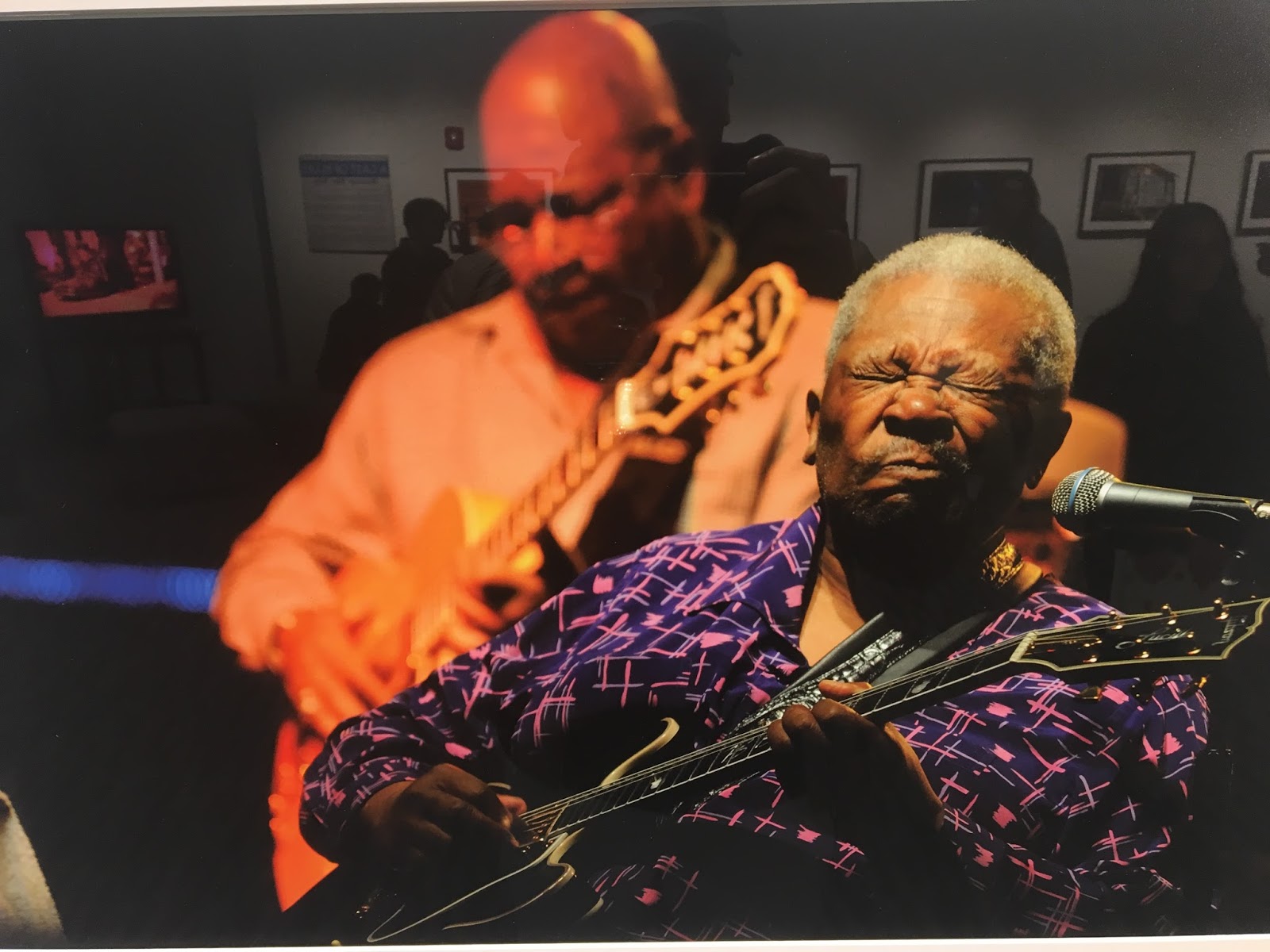
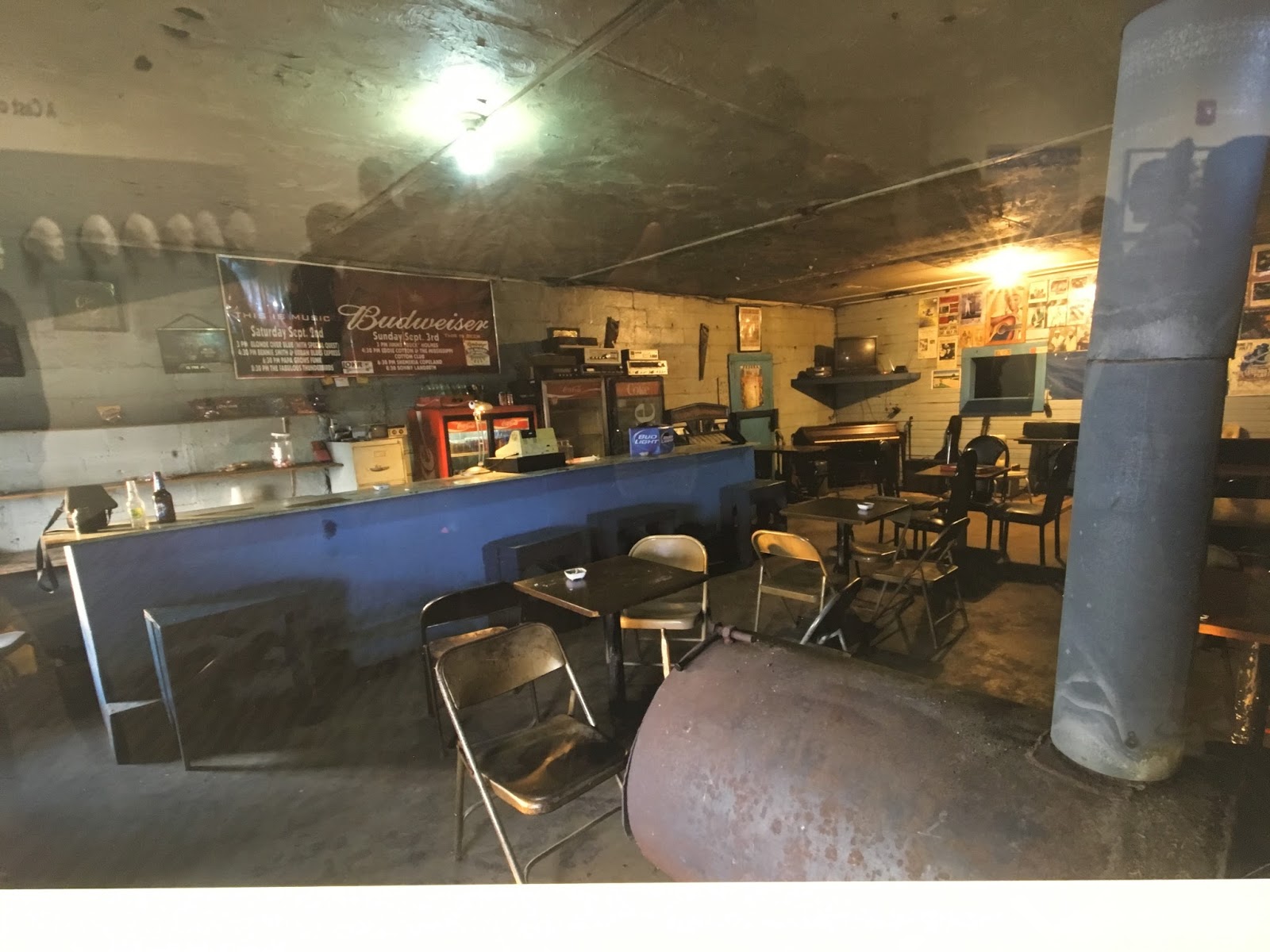
Recently I took my students to the exhibit " A Cast of Blues" at the Walter J. Mannien Center for the Arts at Endicott College. They are creative writing students, and they will present their gallery poems on exam day at the college. From what I have heard they were very inspired by the photographs, masks, as well as the video and audio presentation.  The exhibit is at the Heftler Visiting Artist Gallery at the Center. And who knows if I dig the poems--I may send a few to the gallery.  Here is the description of the exhibit:


A celebration of Mississippi’s rich musical heritage, the exhibition features 15 resin-cast masks of blues legends created by artist Sharon McConnell-Dickerson and photographs of performers and juke joints by acclaimed photographer Ken Murphy. Murphy’s photographs are selected from the groundbreaking book Mississippi: State of Blues.The exhibition is fully accessible to all visitors, featuring braille labels and educational materials, a music playlist for gallery use, and a closed-captioned film about the Cast of Blues project.  Experience new technology that transforms two-dimensional photography into three dimensional touchable art.

For more info go to  http://endicott.edu 


**** Many thanks to Kathleen Moore for her lecture and tour of the exhibit and for some of the photos.


photo courtesy of Stephen Basden.


photo courtesy of Stephen Basden


Before We Were Birds by Susan Richmond


Before We Were Birds

Susan Richmond (Adastra Press, 2017)


By Lawrence Kessenich


A sentence from the blurb by Fred Marchant on the back of Before We Were Birds is a good jumping off point for this review: “Richmond’s poems…continually ask us to imagine the natural world as rife with spirits, ones that for a moment in the ongoing metamorphoses have taken on the form of dolphin or snowy owl…or a fox that stops and stares right back.” Nature, spirits, and metamorphoses are the common threads that run through this collection—and there’s a quality of nature staring right back at us that lends it power as well.


If you’re the sort of person who takes nature for granted, or only sees it in scientific terms, Richmond is not a poet for you. For her, as for the ancients, nature is teaming with stories and spiritual energy that we can tap into for our entertainment and edification. For her, human beings are not detached from nature, but inextricably bound up with it. Take, for example, these lines from “Fox Run:”


…But once

he acknowledges me with deep

fox eyes, quivering black

mustache of mouth. I was out


on the porch and froze, not

breathing. For a moment, I was

fox, too, worthy

to run with him…


Or these lines, from “River Crossings:”


When I tried to push you

from the boat, a fish leapt

from the river, lodged in my arms…

…

let me draw the night heron

down from its alder perch, to settle

beside me on the bank.


Some of the story poems in this book are of people whose identification with nature goes much deeper than this, who become involved with mythological creatures of the natural world. The first section of the collection, “Boto,” is about a storied Brazilian creature who rises out of the water in the shape of a dolphin:


The smooth lines of his body

were words first and she swallowed them
whole; his, a story of many years waiting

to surface, she, a part of it, never knowing.


In “Arrival,” the boto…


            …comes from underwater

            …

            a man, dressed in white. The moon hovers

            and tilts, a bowl half empty, half full.

            He is searching for other music and finds

            her, open, eager for his
            secrets…

…

…he takes her

            down by the river, changes
            the chemistry of her body,
            leaves her
            a kiss.


It is fascinating the way the boto and his lover move back and forth between the world of human life and the world of river creatures. As Richmond presents it, the border between the two worlds is easily crossed.


There is also plenty of straightforward observation of the wonders of nature—plants, animals, trees, mountains—in Before We Were Birds. This poet who can imagine becoming one with the natural world has, as one would expect, a keen eye for the natural beauty and bounty she observes every day. In “Wild Fruit” it’s berries:


I can’t tell if I’m too early

or too late, gathering a scant

sweet handful, eyeing the ratio

of hard green globes to blue.


In the high ground, rising

above Pratt’s Brook, the town

burned this circle in the fall

to force a bigger crop,


ripening when
flies are most intense,
and heat condenses
on the upper lip like dew.


In “Three for the Western Island” it’s mountains:


How can we see so far from such a modest height?

It’s all position, the way the peak peers

over the promontory, giddy distance,

water at our feet, the way
the high, soft clouds receive the light.


In Richmond’s hands, it’s hard to tell which is more marvelous, stories of humans dramatically entwined with nature or simple, astute observations of the natural world we  encounter every day. In any case, both spoke deeply to me, both left me in wonder about the depth of connection—too often overlooked in our predominantly urban culture—between human life and the rest of life on the planet we inhabit. Before We Were Birds will open your eyes to that connection.

Tuesday, May 02, 2017

Michael C. Keith to retire from Boston College

Michael C. Keith


 My friend Michael C. Keith is retiring after many years teaching at Boston College. Mike has written extensively about radio and the media in general, and has regaled me with many stories from the trenches. He is one of the most noted scholars on the social impact and the role of the radio in American culture. Keith has written prolifically in this genre as well as in fiction, poetry, and memoir. I have used his memoir The Next Better Place in many of my creative writing classes at Endicott College. The students always respond well to his sad and comic recount of his youth spent on the road with his gone-to-seed dad. Keith has lectured in my classes and has been very supportive of my work. I met him through Robin Stratton--founder of the Newton Writing and Publishing Center. Keith--who is a board member at the center--was one of the folks who awarded me their Allen Ginsberg Award.  Keith--to use a cliche is a "regular guy" despite his distinguished career. He is always quick with a handshake and a smile. I am sure he is going to continue to do great things in the years to come...


 Bio:


Michael C. Keith (born in Albany, New York) is an American media historian and author. He has served as a faculty member of the Boston College Communication Department [1] since 1993 and is the author of some two dozen books on media. He is one of the country's foremost authorities on the social impact and role of radio in American culture. He has lectured in Russia, Spain, Tanzania, and at several institutions in the U.S. and Canada.

Keith served as a visiting professor at George Washington University and Marquette University and Director of Telecommunications at Dean College. He frequently appears in both American and foreign media as an authority on electronic media. Prior to becoming a full-time academic in the late 1970s, he worked as a broadcast professional for more than a decade.

Keith's substantial published output melds his own experience, an excellent network of contacts in and beyond the radio business, and careful research, to produce solid analysis of what a growing number in and out of the industry see as the growing crisis of broadcast radio. A number of his books have been co-authored with Robert Hilliard, now retired from Emerson College. The team usually works this way—with Keith conceiving the topic and doing much of the initial legwork research and Hilliard taking on the initial book manuscript draft. They both work on the final version. Their co-authored works, and those of Keith alone, often tackle controversial topics such as the demise of local radio programming (2005); the legal intricacies of indecent or even obscene programming (2003); the use of radio by extreme hate groups (1999), a title on President's Clinton's summer reading list one year; and the use of radio by Native Americans (1995), the first monograph to appear on that topic. Keith has been a Stanton Fellow of the International Radio & Television Society and received the Distinguished Scholar Award given by the Broadcast Education Association and the Achievement Award in the Humanities by the University of Rhode Island.

In addition to his many media books and academic articles, Keith has written a well-reviewed memoir of his unconventional childhood years—The Next Better Place (Algonquin Books, 2003) [2] [3] [4] [5] —as well as a coming of age novel, Life is Falling Sideways (Parlance, 2009). Recently, he has written an ever-expanding list of short stories, which have appeared in numerous online journals, such as The Literati Quarterly, "The Penmen Review," "Lowestoft Chronicle," and annual anthologies. Collections of his stories––"Hoag's Object" (Whiskey Creek Press), "And Through the Trembling Air" and "Of Night and Light" (Blue Mustang Press),"Sad Boy" (Big Table Publishing), "Everything is Epic" (Silver Birch Press), "The Collector of Tears" (Underground Voices), "If Things Were Made To Last Forever" (Big Table Publishing), "Caricatures" (Strange Days Books), "The Near Enough" (Cold River Press), "Bits, Specks, Crumbs, Flecks" (Vraeyda Literary), "Slow Transit" (Cervena Barva Press) and "Perspective Drifts Like a Log on a River" (PalmArtPress) are available in paperback editions and in ebook formats. His fiction has been nominated for the Pushcart Prize and Pen/O.Henry Award, among others.

Monday, May 01, 2017

Before There was Before: Poems by Wendy Drexler


Before There was Before: Poems by Wendy Drexler ( Iris Press) $16.

Review by Doug Holder

I am not surprised that poet Wendy Drexler is a cavity-nest monitor for the Massachusetts Audubon Society. I am not quite sure what that is, but I imagine she spends a lot of time in nature—watching and observing—all fodder for this wonderfully observed collection “ Before There was Before.”

Drexler has a number of poetry collections to her credit and has been published in top shelf journals such as, Barrow Street, Salamander, Ibbetson Street and others. She uses the props of nature, the nuances of relationships, the very origins of the universe, as the basis for her work. But this not some vague, conceptual work. Drexler personalizes the poetry, and as a result she makes the poem relevant to readers of all sensibilities.

In her poem, “The Elephants,” Drexler observes a group of these animals as they wrap themselves in their deceased mother's bones. This is a poem that Balanchine himself could of put to dance,

“ This is their poetry, their grief.

Slowly they sway
their gentle stamens of their trunks.

One wraps her trunk around
her mother's skull.

One combs his mother's pelvis
with the sole of his foot.

The cheeks of the elephants are matted
with red grass and stained with tears.

The elephants flap the ruffled flowers
of their ears.

They have found her bones.
There's nothing left but bones.”

And Drexler does not have to be situated in some pastoral scene to appreciate beauty. In fact in her poem “ Light 48 on the Storrow Drive Underpass” she praises a banal light fixture in a tunnel on Storrow Drive in Boston. She puts her microscope to it and the poem radiates its life to the reader, as evidenced in this passage:

"Praise the beam of light that slices
through the late afternoon traffic.

And the faint scatter of that light
on the roadbed graded to a gradual bend.

Praise the gradual bend.

And praise the worker who climbed up
the catwalk at 4 a.m. to tape
the stencil, R48 in rusty red ,..."

And the book is beautifully presented. The cover painting is by Tanya Hayes Lee . She presents a misty, primal landscape—our beginnings, our endings—the light—the dark—all encapsulated in this fine collection.

Sunday, April 30, 2017

Pui Ying Wong wins the PUSHCART PRIZE for her work in Constellations Magazine.

Pui Ying Wong --a Somerville Bagel Bard/Cervena Barva Press author/ has won a Pushcart Prize for her poem, "Language Lesson for One" in Constellations magazine, as published by Nina Rubinstein Alonso (another Bagel Bard). Hats off to Pui and Nina!!!

Saturday, April 29, 2017

The Sunday Poet: Julia Monaco


Poet Julia Monaco

 Julia Monaco is a freshman at Endicott College from Sandy Hook, CT. She is double majoring in International Business and Marketing, and has always enjoyed poetry and writing creatively. The poems she wrote each do not reflect one person, but pieces of the many stories she has heard of people throughout her life.


Rose

“A yellow paper rose twisted on a wire hanger in the closet.”
His sweet aroma glides off his sweater just a hanger over.
It lingers in the air,
I inhale deeply and close my eyes,
There he was.
Sitting peacefully in his chair, tea in hand.
A rose is hanging out of his shirt pocket.

I open my eyes and he’s gone.
We are gone.
Our petals have fallen one-by-one.
Our stem turned a corpsy brown and crumbled.
There is nothing but a memory left of us.

A memory of where we once stood proudly, unmoved by Earth,
Our bright yellow and white colors illuminating our surroundings
Like the radiant sun above us.

A memory of a warm summer breeze passing through the yard.
Now memories are beginning to fade
Like the color in our petals before they dropped.
As seasons come and go,
The memory of you slips away. 

--Julia Monaco

Thursday, April 27, 2017

Doug Holder interviews the Owner of the Famed Grolier Poetry Book Shop: ...


Come To This by Jeff Weddle


Poet Jeff Weddle


Come To This by Jeff Weddle. Nixes Mate Books, 2017, 49 pages.


By Ed Meek


Bill Moyers is currently touting what he calls civic poetry by which he seems to mean, political poetry or poetry that comments on our situation now that we’ve elected a plutocrat (as Paxton points out in a recent essay in Harper’s).  That’s right, we’ve elected someone whose priority is the accumulation of wealth and power for himself and his clan.  It’s true that right after the election I noticed people were quoting Yeats and Auden and looking for some way to explain what had happened. In addition to electing a narcissistic, sexist, racist xenophobe we had given the reigns of government to the Republican Party whose goal, it appears, is to dismantle the government of the people and to replace it with a government of, by, and for the rich. Such a state of affairs demands a response and one response for those of us who remain children of the enlightenment is to turn to art and poetry. But, it turns out that civic poetry is not so easy to write.  If the emphasis shifts in art from style and invention to content and meaning, the aesthetic suffers.  Moyers and organizations like Split This Rock may mean well but the poetry they promote is not always good.


Jeff Weddle enters this argument and walks a fine line between poetry that makes a statement artfully and poetry that sometimes lets us down with language that falls flat.  When it works though, such poetry feels necessary and valuable. Take “See America First.”

                        I am sick like you’re sick and I want to understand.

                        America, what have you done to us?

                        You are our pimp and pusher

                        and sainted church of Big Mac outrage

                        and sloganeered righteousness.


Doesn’t that remind you of Ginsberg? It’s refreshing to read someone addressing the country as a whole in this era when we seem to be two separate nations as the great Andrew Hacker put it.  Weddle goes on to say: “America, this isn’t working out. /I think we should see other people, America.”


There are a few strong poems about the country in this section.  One is called “Of Course.”

                        parents love their children

                        and hard work pays off

                        and the man who bags

                        your groceries never

                        tortured a lost hitchhiker

                        in his basement

                        and buried what was left in his wall

                        after making a stew of her parts…


Later in the same poem:


                        And no one you know

                        Goes to bed hungry…


                        And America is number one

                        And Jesus loves you

                        And voting matters…


Right, voting matters when it is done by the Electoral College or by a minority of Americans in a majority of states.


Weddle is also able to be upbeat and whimsical in “This Cool, Green Hour.”


                        Days when air holds you

                        like an absent caress

                        and trees stand like answers

                        to unasked questions…


                        Days when the coffee

                        in your favorite cup

                        tastes like joy

                        and smells like laughter…


Many of the poems are set up with a repeated refrain like “days when” or lines that begin with “you” or “this” and then the poet “free-associates” and expands on a theme. It’s Whitmanesque although Weddle lacks Whitman’s eloquence. Sometimes he’ll just be too tendentious and direct. A poem about a neighbor who walks his impaired daughter to the bus each morning ends with these lines: “A great man, unknown./ Time for coffee.”


Selling for the equivalent of two cups of Starbucks at $9.95, Come to This is, nonetheless, well worth the price.

Monday, April 24, 2017

Somerville's JT Thompson: A Chronicler of Union Square


JT THOMPSON


I usually use my backroom perch at the Bloc 11 Cafe to interview the many poets, writers, artists, and interesting   folks who live in the city of Somerville. On this April morning  my position on the backroom table was to be reversed. I was to be interviewed by Somerville writer  Thompson. Thompson, who early in our conversation spilled a cup of freshly brewed coffee all over my schoolboy notebook--regained his composure quickly--as any pro  would do. Thompson, back in the 90s, was one of the founders of the Washington Street Art Center --just outside Union Square. He was actively involved in the arts scene, and was on the Somerville Arts Council board, working with the former director of the Council-- Cecily Miller-- who he greatly enjoyed collaborating with. As it turns out Thompson is involved in a project that struck my fancy. It consists of interviews with some stalwarts of Union Square--immigrants, barkeeps, artists, poets, hairdressers, and assorted characters who make this piece of real estate unique and diverse. So-- of course-- I had to turn the table on him and first conduct an interview with Thompson himself.

Thompson is somewhere in middle age, of average height, sports an easy smile, and a nonthreatening and attentive presence. He does not have the standard background. His father's work (he set up law schools in Africa and elsewhere)  sent him to far flung places around the globe. As a result the younger Thompson wound up being born in Zambia, lived in Ethiopia , and along the long and winding path he hit the environs of Somerville. Thompson told me he earned a Master of Divinity  degree from Harvard University. For a number of years he worked as a travel writer, and in other forms of non-fiction. He also had stints as a marketing copywriter, and adjunct professor at Emerson College, and a private investigator.

Thompson was inspired by TV personality Jon Stewart, who was asked in an interview, "What makes America great?" So Thompson has interviewed people with that overall question in mind. In my case (and I assume others), Thompson asked me about my earliest memory, weaved through my elementary school years and my adult life--and asked some unexpected existential questions that I haven't thought about deeply in a long time. And I realized that even though I love my country it was hard to articulate exactly why.

Thompson told me that he uses Union Square as his stomping grounds, " Because of its vibrant, diverse community, and for its symbolic resonance as the home of our first flag." He revealed to me that so far he has interviewed Tony and Jerry, the father and son team at the PA Lounge-- the thoughtful and articulate owner of the Back Bar--Sam Treadway,  the owner of Groove Records, the poet/artist Julie Ann Otis and others.

Thompson told me wanted to reconnect with the vibrant art scene in the square--and this seemed to be a ticket in. Thompson worries (like a lot of us) that the jaws of gentrification may displace the very kind of people that are his subjects. But like many of us, he seems to be hopeful. So if you are walking in Union Square, and you see an amiable and inquisitive man stop and ask you questions...feel free to add to this ongoing narrative--it is well worth your while.


-A series of Thompson's interviews will appear in The Somerville Times.

Thursday, April 20, 2017

The Sunday Poet: Lillian Freedman


Poet Lillian Freedman


Lillian Freedman is a nonagenarian who has been interested in poetry all her life. Her favorite poem is 'The Chambered Nautilus' by Oliver Wendell Holmes. It was in 1978 that she wrote her first poem, while on flight to a wedding ceremony and now she is still still at it. She resides in Newton, Ma.


The Enabler

He knows there is always
Another arrow in the quiver
And another deer in the forest
He knows you are the deer
And the arrow will go
Straight to your heart
Do you want to be
The deer in his forest
Or is it your time to graze

He's luring his victim
With his engaging way
Feeding the deer with nibbles
And despite his previous betrayals
His lure is his charm
Setting up the inviting deer
For the coup d'etat
All the while indulging
His every whim
Knowing his enabler
Will be there for him.

-Lillian Freedman

Wednesday, April 19, 2017

Doug Holder interviews poet Fred Marchant


Holder interviewed Marchant about his new poetry collection, "Said Not Said," ( Gray Wolf Press)--his founding of the poetry center at Suffolk University, his work for the Poets Theatre in Cambridge, and other topics. Marchant taught at Suffolk University in Boston for many years, and is an iconic presence on the Boston poetry scene. Holder interviewed him on his Somerville Community Access TV show "Poet to Poet Writer to Writer." 

Tuesday, April 18, 2017

Somerville Poet Sharon Amuguni chats about the Massachusetts Poetry Festival/ May 5 to May 7, 2017.


  Somerville Poet Sharon Amuguni


Somerville Poet Sharon Amuguni chats about the Massachusetts Poetry Festival/ May 5 to May 7, 2017.


By SharonAmuguni


With increments of spring beginning to appear residents of Massachusetts are looking forward to the potential for activity that good weather brings. As a poet residing in Somerville, a creative, and member of Mass Poetry staff, I am especially looking forward to the start of spring because it signals the oncoming of the Massachusetts Poetry festival.


In its 9th year the Massachusetts Poetry Festival, a three-day festival in Salem dedicated to poetry, is doing a remarkable job of highlighting the complex diversity of the state. The workshops mirror the wide range of lives and how poetry and the arts intertwine with unexpected facets. This year we’re excited to host a variety of panels and workshops with themes ranging from character development for maternal poetry, post rock poetry, building bridges between physics and poetry, to seeds for multilingual multicultural narrative poems. We’ve got a panel for every type of writer. The multitude of events is something we’re proud of and is an indicator of how multifaceted our state is. Along with that we’re pleased to be able to bring in renowned poets into the local sphere. 


Of course, the headliners are always a big hit, drawing a wide crowd of devoted poetry cohorts from all over the state. This year I look forward to hearing from Kazim Ali, Louise Gluck and Ross Gay, as well as local poet Emily Pettit, who I heard speak at my first Student Day of Poetry workshop. Each writer brings a narrative distinctive to their experience.



But, truly my favorite aspect of the Massachusetts Poetry festival is what goes on amidst the headliners. Sitting in on the smaller workshops, I am always impressed by the wide reach that poetry has. Throughout the weekend, I witness poets who usually moonlight as teachers, dog walkers, and mathematicians get the opportunity to unfold in their natural environment. For many, these workshops are a chance to shed the weight of their daily responsibilities and bask in their identity as writers and creatives. The audience is a mix of all ages, students, families, poetry lovers and strangers who happen to wander into downtown Salem. For both workshop leaders and participants, the three-day festival is a moment of shared joy, catharsis, and expression.


At the end of the weekend what I hope festival goers take away is that there isn’t one monolithic approach to poetry. You don’t have to be a best-selling author, or headliner to write or be interested in poetry. Within our sixty plus workshops there are everyday people sharing how poetry moves them in their daily lives. That’s the real essence of the Massachusetts Poetry Festival, making poetry more accessible to the greater public. I believe it’s vital that we work towards removing the idea that poetry is a cumbersome solely academic subject critiqued in university classrooms and far away fellowships by older men with degrees and publications. Poetry has many faces each stemming from individuals with varied experiences.


Poetry is not this unfathomable thing separate from you. It is what your dentist devotes their free time to, how your mother finds peace when you leave for school, how children learn about their own emotions. It’s a tool for healing, a medium for community activism and a mouthpiece social justice.
I see this urge to synthesize art and community activism present throughout Somerville. From finding remnants of Mary Oliver’s poems meticulously placed in hidden corridors (which happened to a friend of mine earlier this week) to seeing organizations like Somerville Media Center, there is a focus on utilizing the power of the arts to revitalize communities. 
 
This want to bring poetry and the arts to the forefront of the public experience is shared at Mass Poetry. Through our Poetry on the T and raining Poetry projects we aim to bring poetry to the people and push forward this notion of poetry being a present and uniting element in everyone’s life. We hope to act as a resource to make it accessible to all community members.


In these next weeks prior to the festival, I implore all community members in Somerville and beyond to set aside some time. Explore how poetry may have played a role in your life and those around you. How access to resources or lack thereof affects individuals and communities’ ability to grow creatively. Then stop by the festival for a day. Bring a friend that loves poetry, two friends who may not be as well versed and a host of strangers with no idea of what to expect. Expose them to the power and freedom in poetry. Most importantly, after the weekend ends, act. Continue to use creative production in your daily lives. Use it to inspire others and explore your own understanding of the issues around you. Use it to showcase diversity and as a platform for activism, knowing that there is a place for everyone in the world of poetry.

Sunday, April 16, 2017

ASPECT MAGAZINE: THE SMALL PRESS and Somerville, Mass.

****  "Aspect magazine (1969-1980) was the creation of Edward J. Hogan, of Somerville, Massachusetts. Hogan was a history major at Northeastern University in March of 1969 when he launched a magazine featuring social and political commentary by a small group of university students. Hogan subsequently expanded that magazine to include poetry, fiction, graphic design, and literary news and reviews. Aspect published many writers, poets, and artists that represented the “Boston Scene” of the late 1960s and 1970s." ( Keene State College Archive)


Somerville is a city of many dimensions. It is an eclectic urban soup of professionals, newly arrived immigrants, artists, students, dreamers, drifters, all living in close and hopefully comfortable proximity. What may not be immediate apparent is that it is and has been a city of small presses and little magazines. Offhand I could think of the Boston Literary Review, Dark Horse, Small Moon, Yellow Moon Press, Davis 2 Porter, Ibbetson Street, Abyss and a host of others. Of all these presses, some would argue that ASPECT MAGAZINE and ZEPHYR PRESS founded by Somerville's late Ed Hogan are the most notable.

June Gross, who was Hogan's wife and former editor of Somerville's Dark Horse Magazine told me over tea in her home outside of Union Square, Somerville that there was not much of a literary "scene" in Boston in the 70's, when Aspect was around. There was some activity in Harvard Square, and a fair number of transient small magazines that appeared and vanished into the ether. Reflecting on the Cambridge and Somerville literary milieu, Gross recalled:" People from Cambridge always said, ' Oh, I always get lost in Somerville.' People from Cambridge never came to Somerville. It was a blank space. Somerville was a blank space."

If what Gross said was true then Hogan certainly filled the void with his prolific output of magazines and books over the years. Hogan, who died at the age of 47 in 1997 in a canoe accident, ran Aspect from 1969 to 1980, and in this time published many writers who are well- known today. Looking at a back issue from 1977 the roster of poets was quite impressive. Respected bards such as: Robin Becker, Bill Costley, Anna Warrock, Joyce Peseroff, Fred Marchant, all graced the pages of this single issue.

Ed Hogan grew up in Ball Square Somerville. He wrote in the ASPECT ANTHOLOGY ISSUE that he saw his first "little magazine" at age 12. Hogan was from a working class background and had an average public school education. Later he entered the History program at Northeastern University.While there he was inspired by a Bible scholar to pursue writing. Soon after ASPECT was founded in March of 1969. The early issues were simply typed and mimeographed sheets with articles on everything from Edmund Burke to Rock-n-Roll. Aspect was creature of its time , and the writers often dealt with issue like Vietnam, Watergate and the Cold War.

In 1971 Aspect took a turn to the literary. Aspect's first directory listing for writers was in Trace magazine. Later they were listed in Len Fulton's Int. Directory of Small Presses. As a result Hogan was flooded with poetry submissions. And true to Somerville's scrappy outsider image, Aspect did not pander to the mandarins and the academics. Hogan wrote: "We went about editing without undue notice to academic standards or established reputations . Our contributor's notes showed fewer writer's involved in writing programs or English Department Careers. I like to think we were more open than most to varied sensibilities. As we gained confidence and sophistication we maintained a central concern for accessibility, directness, lack of pretension, and a belief that these values are not antipathetic to literary excellence."

Over the years Aspect produced a Double Fiction Issue that was supplemented by extensive reviews, and a bibliography of small press published fiction. The Third Boston Poets issue included an interview with Phil Zuckerman of Apple-Wood Books, one of Boston's most successful literary small presses.

As any small press publisher knows, it is necessary to have a cadre of loyal, often volunteer staffers to put out a magazine. Aspect had it. Whether on Robinson St., School St., or Ibbetson St, in Somerville, a collective of artists, and writers put out this innovative magazine. One of the staffers Susan Lloyd McGarry wrote: " .editing a magazine collectively, as we do at Aspect, can be wearisome and trying to the temper. But the magazine gains immeasurably from the strength and energy of individuals who have an investment in all (of its) facets.without the others, that pleasure would not exist."

Around 1980 due to the amount of work that it required to run a small magazine and other personal problems, Hogan ended the enterprise. In its place Hogan, along with Miriam Sagan, Ronna Johnson and Leora Zeitlin, established a small press imprint ZEPHYR PRESS. Zephyr published primarily poetry chaps, literary fiction, and some non-fiction titles. Some of the releases were: AN EXPLORER'S GUIDE TO RUSSIA, and FROM THREE WORLDS: NEW UKRAINIAN WRITING. Hogan's crowning achievement was the COMPLETE POEMS OF ANNA AKHMTAOVA, (a famous Russian poetess of the 20th century), as translated by Judith Hemschmeyer. This collection was critically acclaimed by the New York Times Book Review, as one of the best books of 1990.

Len Fulton, publisher of the International Dict. of Small Presses wrote: " It is the Ed Hogans of the world that make it a better place, and it's the Ed Hogans of the small presses who have kept the movement honest and pointed in the right direction." And indeed Hogan was a dedicated man. Hogan embodied the feisty spirit of Somerville. He was an independent publisher from the wrong side of the tracks, who weathered many a storm and made his press work. His stepdaughter Viesia, recalled him hunched over a desk with an exacto knife for days on end, making sure things were just perfect. I think that's the way Hogan might have wanted to be remembered.


--Doug Holder  *** This article was used in a course on the small press at Keene State College New Hampshire.

Saturday, April 15, 2017

The Sunday Poet: Judy Katz-Levine


Judy Katz-Levine


Judy Katz-Levine is an internationally published poet who has authored two full-length collections - Ocarina (SARU) and When The Arms Of Our Dreams Embrace (SARU). Her most recent chapbook is When Performers Swim, The Dice Are Cast (Ahadada). Her poems have appeared recently in Blue Unicorn, Ibbetson St., and Salamander.


 Mississippi John Hurt

I would desire the hands of Mississippi John Hurt, the fingers
just slightly bent and with a touch of arthritis, though he
has spent a life-time caressing that gentle guitar, calling
to his folks you got to travel that lonesome road all by yourself
and the humbleness of his voice, just a touch of a rasp, eyes
that know far more than the eyes of a scholar, glancing up at the
camera
now and then only now and then, it isn't really trains one hears
in the blues guitar, it may be a walk with a grandchild down
by the river, or the grace bestowed after singing “Amazing Grace”
in the church near the homes of cousins getting ready to go out
and toss a baseball to the sky. I would desire, as I age, the fingers
of Mississippi John Hurt, which symbolize a life lived without
greed, without any malice whatsoever, any grab to power, and the
unearthly gentleness in his voice, yes, I would desire that.

- Judy Katz-Levine,

Friday, April 14, 2017

The Thin Wall. Martha Rhodes.

 
Martha Rhodes


The Thin Wall Martha Rhodes. University of Pittsburg Press 53 pages. ISBN 13: 978-0-8229-6453-7.

REVIEW BY ED MEEK

Nicholas Kristof, the liberal columnist for the New York Times, ran a poetry contest recently asking for poems about President Trump. He then printed the winners.
Here is one he chose: “If God has made men in his image/Please explain our new President’s visage.” The poem continues with the rest of the limerick. Apparently clever, rhymed limericks is what Mr. Kristof thinks of as good poetry and Mr. Kristof is a well-educated person.

In a recent article in The Atlantic, a well-meaning English teacher laments the fact that he doesn’t teach poetry in his classes; he would like to if only he had time. I taught high school for a number of years and I was surprised to learn that few of my colleagues taught poetry in their classes. They confessed they didn’t understand the poetry in The New Yorker and didn’t know what made poetry good anymore. Instead they read novels and memoirs and drama in their classes and on their own.

I bring this up to point out that poetry today is kind of a mess. There isn’t much agreement on what poetry is. Instead there are many different types of poetry or schools of poetry, created by universities and academics and beyond those schools, there is poetry outside the academy and beyond that, there is poetry that is popular with readers and fans. There is also rap, and spoken word. There are sites like “Hello Poetry” where people post poetry that is shared. “I love poetry/ an easy way to express/ my innermost thoughts.” Then there are rhymed religious poems read by funeral directors and poems written by best men at weddings. That is, there is an immense range, and quite a divide between what the public thinks of as good poetry and what the academy considers good poetry. The latest trend of blackout or erasure poetry is, on the one hand kind of interesting, on the other, a sign of creative bankruptcy.

In the last twenty years MFA Programs have surged and multiplied (hundreds of programs and thousands of yearly grads) and have become more academic. In fact, many writers who get MFAs now go on to get PhDs. In any case, academics, when they can, aim to control and define the arts. This happened with fiction back in the 1970s and 80s, but by the 90s, the public got fed up with all those post-modern pseudo-intellectual novels full of narrators talking about the novel and novels with multiple endings or with no endings at all and fiction returned to what it does best: telling stories that are well-written because those are the stories that sell and get made into movies.

Unfortunately, poetry doesn’t sell and doesn’t get made into movies. Poetry is more like painting and sculpture except it doesn’t look so good on your wall or in le jardin. But since there are so many MFA Programs, publishers figured out that they could sell books of poems to all those MFA grads. At the same time publishing and printing have evolved so that publishers can print on demand and no longer have to invest in a few thousand copies of a book before putting it on sale so that it is much easier now to get a book published by a small, independent press or even to publish it yourself. The result is that we have thousands of books flooding the market. Yet there are few critics of poetry who have been able to define the poetry of our age. In fact, for the most part, no one even criticizes poetry. Instead, people just write positive reviews of poetry that they like. This creates an odd situation where there are a number of poets who write prose that is merely broken into lines. And there are poets whose poetry really is aimed at an academic audience. The T.S. Eliot’s of our day.

Martha Rhodes is a prominent figure in the landscape of contemporary poetry. She teaches at Sarah Lawrence and in the MFA Program at Warren Wilson College; she is the Director of Four Way Books in New York. Her new book, The Thin Wall, has been published by Pittsburg Press. It is a slim volume of 53 pages divided into three sections, each with a number of poems, usually one to a page, with no titles. The sections are: (Burden of Inheritance), (Yard Fire), and (Looking Down). Those section titles are in parentheses. Why are they in parentheses? It seems a bit self-conscious, doesn’t it? Here is the first poem:

There are apples,
buckets of
and heads wet from the dunking.
A witch ‘round every corner.
Ladders.
Jury and judge.
A pond of bodies bobbing, condemned.
And nineteen nooses wait.
That seven-gabled house.
Girls run the streets accusing
the accused. In Salem Village,
Goody Proctor bears her child in jail.
Our party pays to tour the next grey house.

This is the most successful poem in the first section. This is our inheritance here in New England: the witchcraft and the hangings. Throw them in the pond to see if they float and if they do, they must be witches! The narrator sees this in her mind as she is on a tour. There’s wit in the last line—that we should pay to see this past of ours. And the self-conscious use of language shows up again. Why “buckets of” as a separate line rather than: There are buckets of apples. The off-rhyme with judge is there either way. Why isn’t it titled “That seven-gabled house” rather than insinuating that line in the middle of the poem awkwardly just to set up the last line?

Other poems in the first section are not so resonant. One poem begins: “The air was heavy with blood. /The boys washed off in the Merrimack.” That’s a little too heavy handed. So too another poem that begins: “Both of us under one boy or another./That’s how we spent our senior year.” That sounds like the beginning of a Chelsea Manning confession in Vogue. I don’t actually believe that anyone spent her senior year under one boy or another. Here’s how another poem begins: “Boys, girls, some of them siblings,/spawning in bathtubs all over town./ Drown them?” It sounds like The Beans of Egypt Maine where kids crawled under the porches and no one knew to whom they belonged. There’s a kind of condescension at work here, assuming personas that do not ring true.

The second section is called (Yard Fire). It is about relationships. The first poem is about loss:

A crow at my mouth.
The bread from me

it stole. I felt
like a flour sack,

pecked, consumed,
scattered. Enough dust

to dust. You, just gone.

That certainly captures the feeling of devastation when someone dies—the hour of lead, Emily Dickenson called it. Of course Emily’s poems were written before God died. Now there is no recourse. Nice sequence at the end of the poem with all that assonance.

The last section is called (Looking Down). In a couple of poems the narrator is in fact looking down at another or another’s body. There’s humor in this section. One poem begins: “Your dog’s dinner. /What you feed the chickens. /The mud at the bottom of the Charles. /I’m what washes up on the Merrimack’s shore.” The poet is personifying all that’s rejected and cast off. “I’m everyone’s former friend. /I’m his former wife.”

In the final poem of the book, the title comes up: “Nothing is the thin wall of glass (as thin as skin)/ just over there…nothing grabs us all, good or bad, boy/girl popular, un-, you…” So, when you read that, you might agree, Yes! It really does. Or you might not. Apparently, the publishers at Pittsburg Press think, Yes! “Nothing” separates and gets to us all. But can the word “nothing” when used as the subject of a sentence have agency? “Something there is that doesn’t love a wall…” Frost said and maybe Rhodes is playing off the Frost line.
There’s clearly an aesthetic and a worldview at work in these poems and if you identify with her sensibility, you will enjoy them. Martha Rhodes is widely published and, by just about any measure, quite successful as a poet. The fact that University of Pittsburg Press and a number of highly respected magazines publish her work is testimony to a particular type of poetry, “furious and viral,” Susan Wheeler calls it although I don’t know where these poems would ever go viral. There’s a psychic distance between the poet and her subjects that undermines her authenticity. Rick Barot says, “demanding as they are beautiful.” Beauty, and the appreciation of it, seems pretty rare in this collection.
In a recent interview in The Paris Review, Ben Lerner talks about a problem he sees as endemic to poetry.
The main demand associated with lyric poetry is that an individual poet can or must produce both a song that’s irreducibly individual—it’s the expression of their specific humanity, because it’s this intense, internal experience—and that is also shareable by everyone, because it can be intelligible to all social persons, so it can unite a community in its difference. And that demand… is impossible.

Of course it is not impossible. It is difficult, particularly today in our fragmented world. Whitman said, “to have great poets, there must be great audiences.”

We seem to be in a transition period for poetry. Here’s hoping that the recent popularity of writing, reading and performing poetry leads to a better sense of what good poetry is and what it is good for. Literary magazines call for poetry that pushes the boundaries; we would be better off with poetry that makes connections with tradition but reflects our age. Too much of what appears in our literary magazines today works too hard to break with traditional poetry and results in either not being poetry at all or in being self-conscious and awkward under the auspices of the experimental. Maybe a few great poets will create great audiences.