Friday, January 23, 2015

Misery Islands By January Gill O’Neil


Misery Islands

By January Gill O’Neil

CavanKerry Press

Fort Lee, NJ


ISBN: 978-1-933880-46-4

78 Pages

$16.00


Review by Dennis Daly


Some islands bask under an equatorial sun, massaged by gentle trade winds and tickled by turquoise water. Others offer stony, unforgiving shores, dangerous channels, and wreckage of grander days, with only the icy winds of desperate hope and final survival to mitigate the landscape.


It’s these “other” islands and their human iterations that January O’Neil dwells on in her dolorous but passionate new book of poetry, Misery Islands.


Opening the collection O’Neil audaciously fleshes her persona out in Whitmanesque fashion as everyman and, even more emphatically, everywoman. She identifies with those left behind and challenged by difficult circumstances, those storm tossed isles navigating daily life. Her persona drops words onto the page from a whirlwind of transitory motion. The poet says,


I am every mill town and boarded-up factory,

the assembly line disassembled, the layoffs,

layaways, and laid to rest.


I put the depressed into depression

I am America reconstructed; I am a force at work.


I dig a ditch, I fill a ditch.

My collar is white, my collar is blue.


I am missing 23 cents out of every dollar

a woman is supposed to earn

but doesn’t.


I am every God damn it and Lord have mercy.


O’Neil’s poem Rent To Own follows the routine of an older guy with bad knees as he cleans used furniture, removing the unsightly detritus from the bottom strata of human life. Her bigger theme that we are all just passing through in this life bolts up, volcano-like, through the messy details. Here’s a pretty telling section,


You’d be surprised how many people

pick their noses and leave the evidence

under the arm of an armchair, he tells me.

Roaches, bed bugs, pet hair, dander—

you name it, it’s there, in the fibers,

the polyester pillows and dense cushions.

Steam vapor removes almost anything,

even tar from a chaise owned by a guy

who works at an asphalt company,

working his ass off in 10-hour shifts

to afford his slice of America.


Tension between the roles of mother and child settles into an intimate and singular series of motions. The business-like care giver unfurls not only a washcloth but a sense of profound gratitude and love. O’Neil conveys the scene with affecting sentiment and dignity. Individuals, islanders, in other words, do make a difference. I really like the piece. The poet concludes this way,


She reaches around for the cloth

with slow and deliberate movements

as if not to admit pain, not to convey need—


the caregiver needing care, the care taker

not taking as she usually does. Not today.

I want to tell her I love her


but I don’t. I cover her with a towel

and some small talk, try not

to notice what’s missing.


No words, yet I listen

like a stethoscope

for her to say something. 


Putting into words the carnage of a marriage breakup confounds many of the best writers, most especially over sensitized poets. I can think of a recent Pulitzer Prize winner for instance. O’Neil handles this subject with just the right touch as her warmed up words chill and disappear into a midwinter’s frigid air. Her sentiments court despair with humor and astonish with tight artistic control. The poet aches out her feelings in an touching conclusion,


I can’t compete with the failing light

from your voracious heart

burning us both into nothing.


Something has left us.

Every droplet of joy evaporates

to sky. When will melt come?


How could anyone blame you

for wanting to escape

the coldest month of the year?


Like Homer’s Penelope, O’Neil weaves heartbreak and metaphor into one composition. Her title poem, Misery Islands, opens with a narrative description of two wondrous and tenuously connected islands off the coast of Salem Massachusetts—Great Misery, and Little Misery. Both are now uninhabited. Each island has its own personality and its own geologic traits. The poet also splices in other historical, tidal, and climate particulars of the islands which strangely magnify the emotional discomfort of the interwoven and parallel marital distress narrative. Consider the following juxtaposition. First the historical, set on Great Misery in the “roaring twenties,”


Imagine a pier, a club house,

a swimming  pool filled with salt water,

guest cottages to the horizon line,

a tennis court and tournaments,

a nine-hole golf course with caddies

dressed in pressed white linens.


So elegant, so glamorous a setting,

You can almost see a couple

Looking out over a balcony,

Hands entwined, the moon

Hanging over them

By the thin thread of midnight.


Now the equally compelling glory days before the marriage collapse,


I loved. You loved. We loved

with our whole selves—

lips first, then the tumble of skin

pulling each other down,

caught in the tangle and swirl,

closer to terror, closer to ourselves

the way we became something else

as soon as we were in it

the way our bodies displaced truth

through the depths of anger,

the way it changed us

and we were changed by it.

We were poor swimmers

Too far in the rip to be saved.


Late in the collection, another favorite of mine, the poem A Mother’s Tale appears. The poem whispers easily a harsh truth—life’s ephemeral nature. The poet’s persona speaks to her son and offers an interesting antidote to the human condition and its concomitant isolation. She says,


I tell my son

that the best poems

are written in the sand

and washed away with the tide.

I say the moon controls the waves,

uses the wind to rake the shore.

It is an open invitation to fill

The world with words…


O’Neil clearly follows her persona’s sage advice. She fills the world with her extraordinary poetic words, and we get to read them.

Thursday, January 22, 2015

With the people from the bridge (poena damni) Dimitris Lyacos

Dimitris Lyacos


With the people from the bridge
(poena damni)
Dimitris Lyacos
Shoestring Press 2014
Translation: Shorsha Sullivan
ISBN 978-1-910323-15-1
info@shoestringpress.com


“And always, night
and day in the tombs
and in the mountains he was crying
and cutting himself with stones...”

Lyacos's writings speak universally.  The Greeks are familiar with “mysterious.” Particularly, when a situation, conundrum, experience cannot be explained, a Greek-- minded person might exclaim, it is a mystery! Mystery has become synonymous with Orthodoxy and saints. Are there saintly writers of poetry? Yes. Dimitris Lyacos is not one of them; he is not a saint (at least I don't think he is.) He is mysterious or enigmatic. His poetry is real, really a long conversation with who we have become as a community. “With the people from the bridge,” his third book in his trilogy, even the word trilogy enlightens the space between words and reader. His third book brings us under a bridge where 'others' inhabit the unseen spaces most of us never look into or hear the rumble from characters:

“...That. Afterwards, though, comes the day
they come outside
you wait for them in the house.
Same day every time.
Sometimes in the morning when
you wake up it is as if you are stuck
and you prise yourself off them...”

The play/poem/cross genre, post modern Homeric tale begins arched under a bridge, just as classical theater surrounds the actors, Lyacos creates a beginning dialog with a chorus; “Sometimes more so. Like voices somehow, more or less. It is inside you.” All the characters, voices, try to be heard. Presently, I review very few books. Because most poetry books are the same dull energy. Unexpectedly, Shorsha Sullivan, the translator of this book of poems, asked me if I would write a review. I knew I would. I wrote this review because Lyacos is one of my favorite writers. Yes, being Greek adds to my gratitude for such a poet who does not come across the ocean that often any more. I exaggerate, as I am prone to do, yet, this trilogy is masterful and comes to us only once in a lifetime:

“Time passed.
I went out again and fetched some water.
A sip. Helps my stomach, it soothes me
and I can lay down for a little.
In sleep again, your voice coming strong.
I couldn't. I stood up
and was banging on the lid until it broke.
I took it out. I puffed her and turned her on her side.
I lifted her up. She fell again. Again.
Time passed.
In the end I got her out. I let her down and
went to see the blanket in case the wind
had blown it away. I went again and laid down
beside her. I was tired.
Enough light. A white worm, long.
A finger digging all by itself.
Leave something for me.
Something will be left in the end.
A tooth from her mouth.
Something for me
a tooth

broken...”

There is a sound sense when read aloud. The poem enters our mind as a good poem ought to, it becomes our mind for the duration of the reading. We live there. The ear does it. We have a  need for myth and more than myth.  In his poetry we hear  about places we might not be privy to otherwise. The reader will be delving into this book as they would a good novel. Daily reading:

“  he turned on his back. Opens his mouth.
He wanted to say something.
He fell again. Lifted his head a little.
He sees I am with him
and then falls, for a while holds me
by the throat
and then
empties
the flame
cleansed. We return together.
We will be there in a while.
Stay and rest a little.
On the way it was
dripping
a bit from his chest...”


Irene Koronas
Poetry Editor: Wilderness House Literary Review
Reviewer: Cervena Barva Press

Monday, January 19, 2015

Interview with X.J and Dorothy Kennedy with Doug Holder


X.J. KENNEDY


Interview with X.J and Dorothy Kennedy
With Doug Holder


***** Introduction from his website.

 X. J. Kennedy  was born in Dover, N. J., on August 21, 1929, shortly before the crash of the stock market. Irked by the hardship of having the name of Joseph Kennedy, he stuck the X on and has been stuck with it ever since.

Kennedy grew up in Dover, went to Seton Hall (B.Sc. ’50) and Columbia (M.A., ’51), then spent four years in the Navy as an enlisted journalist, serving aboard destroyers. He studied at the Sorbonne in 1955-56, then devoted the next six years to failing to complete a Ph.D. at the University of Michigan. But he did meet Dorothy, his wife, and a noted children's literature author there.

He has taught English at Michigan, at the Woman’s College of the U. of North Carolina (now UNC Greensboro), and from 1963 through 1978 at Tufts, with visiting sojourns at Wellesley, U. of California Irvine, and the U. of Leeds. In 1978, he became a free-lance writer.

Recognitions include the Lamont Award of the Academy of American Poets (for his first book, Nude Descending a Staircase in 1961), the Los Angeles Book Award for poetry (for Cross Ties: Selected Poems, 1985), the Aiken-Taylor Award for Modern American Poetry (given by the University of the South and The Sewanee Review), Guggenheim and National Arts Council fellowships.  In spring 2009 the Poetry Society of America gave him the Robert Frost Medal for lifetime service to poetry.

I had the pleasure to speak to X.J. and Dorothy Kennedy on my Somerville Community Access TV show  Poet to Poet: Writer to Writer.

Doug Holder: X.J.-- you asked if you could introduce your wife—please do. 

X.J. Kennedy:  Both Dorothy and I dropped out of PhD programs at Michigan, but she got further along than I did. She has been a writer in her own right and a collaborator with me for many years. She has written a number of children’s’ books including: “Thought I’d Take My Rat to School.” This was the first anthology of poems about school for children. She created a whole genre of imitators. (Laugh). We have both worked on a book of children’s poems titled: “Knock on a Star.” This has been in print for 32 years. We revised it around the turn of the new century. Dorothy has written text books—she is partly responsible for the “Bedford Reader,” that has been read by more than 2 million students.

DH: Dorothy, tell me about your work together on “Knock on a Star?”

DK: Both Joe and I had the idea that children might want to know how poems are put together. So we illustrated the book, and we mentioned ways that forms can be recognized and used in the conception of a poem.

DH: X.J.—you were born right after the Crash of 1929. Do you think this influenced your work in any way?

XJ: I would be pressed to figure out how.

DH: Why did you drop out of the PhD program at the University of Michigan?

XJ: I had a tough job getting a topic approved for a dissertation. I wanted to write about Emily Dickinson. By this time I had a book of poems out. I looked at all the poets who were making it through without a PhD—teaching college as a writer. I decided I would try this.

DH: How do you view the academic life?

XJ: I have nothing against it. It has fed me and the family. People talk about academic poetry. Well—I never have been sure there is such a thing. These days, with all these MFA programs, there is a danger of a certain sameness. There is still enough variety that I don’t see a problem. Nobody agrees what poetry is. Free Verse predominates of course.  I have always been an old grouch, with my rhyming, etc… I have tried to write free verse but I got scared, and I wanted my security blanket of rhyme scheme back.

DH: Would you advise a young poet to get his or her MFA?

XJ: It won’t get you a job. It might help you eventually teach Creative Writing—if you have written something that anyone notices. The workshops that these programs provide, gives a young writer an audience. The writers are put in with people who are reading his or her work with more patience and sympathy than is usually the case.

DH:  You are known for your light verse. But as you know comedy and tragedy are closely aligned. But your poems aren’t just for yucks. When you write a poem do you have in mind darker themes?

X.J.:  When I am writing a poem I don’t have a theme in mind. I am just trying to get some words down. Some poems shape up to nothing but a yuck. But others go deeper –I like that kind.

DH: You exhibit a ribald sense of humor in your work.   Has anyone influenced you—your family—other poets?

XJ: Well, I guess it was my father. He was sort of the family poet. Families had poet laureates back then. They were expected to produce poems for anniversaries, weddings, etc… He did not have much schooling, but he did memorize poem he read in school. He could recite pages of Whittier’s “Snow Bound”—and many others. I guess all of this made a dent on me.

DH:  We all have had a love affair with the Grolier Poetry Book Shop in Harvard Square. They are now publishing your book: “Fits of Concision: Collected Poems of Six or Fewer Lines.”

XJ: Ifeanyi Menkiti, the owner of the Grolier started the poetry press. I am one of the authors in their “Established Poets Series.” I have been writing for over 60 years—so I guess I am established. Tino Villanueva is another poet in the series; he authored “So Spoke Penelope.” I am happy to see the Grolier branching out to publishing. I am happy to find a publisher for such an odd book as this.

DH: Certainly a poet with your reputation wouldn’t have a hard time finding a publisher?

XJ: Many publishers would look at epigrams as vile bugs. But I have always liked the form. The book has Haiku, short lyrics, epitaphs. It is a challenge to write a poem tersely. I love the challenge.

DH: You have a novel coming out, right?

XJ: The book is titled: “A Hoarse -Half  human Cheer.” It was based on a Catholic college I went to that became under control of the Mafia. The college was being used as a front for a war surplus operation. I have only written novels for children—so this is a first.


DH: I noticed a poem you wrote dedicated to Allen Ginsberg.  Were you two friends? Did you know him well?

XJ: I can’t say I knew him well. We exchanged postcards, and I saw him at some social gatherings. I always felt a kinship to him though. We both grew up in industrial New Jersey, and we both had fathers who were poets. Ginsberg’s father, Louis, was a mediocre poet most of the time. He sent out a lot of poems—and he was very persistent. Out of every 100 poems or so he would have a good one. When I was an editor at the Paris Review we published a poem of his.
 But Allen Ginsberg and I both had Lionell Trilling as teacher, and we both loved William Blake’s “Songs of Innocence and Experience.”  We had some things in common.

DH: Well since you are a strong proponent of meter and rhyme—do you agree with Robert Frost’s statement that writing free verse is like playing tennis without a net?


XJ:  Well—that is a nasty remark—but there is some truth to it. But I do admire people who can write in free verse. There is a small reactionary movement that is now radical who still adheres to rhyme, and I am part of it.


 Reunion
Impassive, to a tuba chord,
Faces like blurry Photostats,
Enter the class of ’34
In wheelchairs, coned with paper hats.
Discreet, between the first Scotch punch
And the last tot of buttered rum,
President Till works over each,
Fomenting his new stadium.
Fire in his eyes, the class tycoon,
Four hog-hairs bristling from his chin,
Into his neighbor’s Sonotone
Confides his plan to corner tin.
His waitress with a piercing squeal
Wrestles a buttock from his grip.
Dropping the napkins a good deal,
She titters, puddling ox-tail soup.
Now all, cranked high, shrill voices raise
To quaver strains of purple hills
In Alma Mater’s book of days.
Some dim sub-dean picks up the bills,
One last car door slam breaks a whine
Solicitous of someone’s health,
And softly through the mezzanine
The night revives with punctual stealth.

Thursday, January 15, 2015

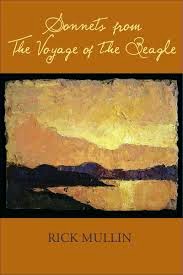
Sonnets from The Voyage of the Beagle By Rick Mullin


Sonnets from The Voyage of the Beagle
By Rick Mullin
Dos Madres Press
Loveland, Ohio
www.dosmadres.com
ISBN: 978-1-939929-22-8
155 Pages

Review by Dennis Daly

Charles Darwin embarked on the HMS Beagle into the natural world of fauna and flora from a context of faith and wonder. Like other rationalists and scientists who came before him, he armed himself with revelation and the romance of adventure. Whereas Johannes Kepler had his Pythagorean mysticism and astrology, and Isaac Newton his biblical prophecies and secrets of alchemy, Darwin entered the fray of reasoned observation with a Christian missionary’s certainty and an Englishman’s righteous superiority. Yet something extraordinary, miraculous if you will, seemed to take shape, something which changed the very way we look at the world around us and each other. Darwin’s five years of exploration and growth he chronicled in his journal and subsequently in his book The Voyage of the Beagle. Here begins poet Rick Mullin’s masterpiece of poetic reinterpretation.

Taking with him his painter’s skillset for critical observation and his magnificent formalist writing style, Mullin in his Sonnets from The Voyage of the Beagle conjures up a persona that both captures Darwin’s notebook cadence and blends in his own contemporary sensibilities.  Mullen’s Petrarchan sonnet variations carry the expedition’s narrative amazingly well, while at the same time lending themselves to detailed detections and measurements. The results bring to mind grand interpretive creations of poetic art, Alexander Pope’s translation of the Iliad being one.  Mullin’s perceptive powers are so attuned to specificities that he examines his own metaphor in his opening piece (after the invocation) entitled Launch of a 10-Gun Brig. The poet explains,

Our journey fronts on an incessant volley.
Heavy southwest headwinds sent us back
a second time to Devonport, unto that black
embankment of commercial blight. The trolley
at the warehouse hadn’t moved an inch. My heart
lay heavy as a gun, an iron gun
in line to fire—an apt comparison,
for on the third day we would make a start,
exploding on the sea through open light…

Non-readers of the “Voyage” often think of Darwin island-hopping from research site to research site. Nothing could be further from the truth. Most of Darwin’s time was spent on land—three years and three months to be exact. His coastal and inland studies included the native populations. On this subject his perceptions clearly matured over time.  Mullin’s persona relates the circumstances of an Indian attack in a matter-of-fact and somewhat self-satisfying way. He says,

My informant recollected with some horror
the sound of quivering chuzos in the hour
the estancia faced the naked entourage.
He saved the souls of many Christians there,
he claimed, by simply locking the corral
and courtyard. As the horrifying sound
intensified, a Frenchman on the wall
commenced with grapeshot, sputtering a prayer,
and putting 40 spearman on the ground.

Later on in the poem Indian Wars Darwin sees things a bit differently. Noting the genocidal deeds of Argentinian dictator and warlord Juan Manual de Rosas, Mullin’s Darwin tersely clarifies,

General Rosas and his cohorts justify
the government’s campaign in simple terms:
The Christian versus the Barbarian—
one more distinction lost on morning worms
and meaningless to certain birds that fly
in circles.  Carrion is carrion.

One of my favorite pieces, The Plain of Port Desire, prompts sadness and a passion for knowledge beyond the sensory and obvious. Darwin stands alone on the edge of a lifeless field of chalk and gravel. Forced to wait out the tides of life, he seeks words to flesh out descending loneliness and a wavering disquiet. Not much happens. Or does it? The poet puts it this way,

…I walk about
in a virgin forest, noting as I go
the tree line falling to a plain of gravel
mixed with soil resembling chalk, a level
lifeless  field except for one guanaco.
The one suggests a coterie. A herd.
But none is visible. The loner trots
and leaves me on the near edge with a journal
open to the hollow, doubtful thoughts
that fly into a landscape wanting words,
a permanence that speaks to the eternal.

The oddness of that camel-like guanaco and its complex evolutionary history stops one in mid-read and provokes awe, an awe which I’m sure Darwin felt as he captured the moment in his notes.

Although most of Mullin’s sonnets replicate the same rhyme scheme, he does, at least in a couple of instances, vary the initial octave from abba cddc to abab cdcd. One of those poems he entitles Jackass Penguin and it’s quite funny.  The poet details a showdown between man and beast, between Englishman and penguin, a veritable High Noon scenario in the Falkland Islands. In the actual journal entry Darwin noted his amusement triggered by the penguin’s demeanor and its strange jackass-like braying. I must say again that I am amazed how closely Mullin comes to capturing the voice and verbal mannerisms of Darwin. Here is the heart of the sonnet,

…Shall he best me?
We pose at loggerheads, two flightless birds.
But certainly my crude experiment
will show the world (or is it visa versa?)
common traits in nature evident
between Englishman and A. demersal.
Brave as Heracles, he holds every inch
he gains with vehemence, his head thrown back
and rolling side to side, a braying golem

Mullin’s persona considers the human species in the same conclusive matrix as he does finches or lizards. He is at his anthropological best in his journal entry set in Sydney entitled Silent Thoughts at Dinner. He imagines the penal colony mindset of his waiter at a dinner party and delves into this society’s hidden and rancorous undercurrents. The sonnet opens with Darwin speculating on the waiter’s crimes,

The servant’s shirt is snowy white and stiff
with starch. One wonders what he’s done.
One eyes his hand, imagining a gun,
the butcher’s knife. Yet here we dine as if
the man were serving of his own volition
in a London home, but on a wider street.
Remarkable, considering the heat
and given our antipodal position.

Yes, Rick Mullin astonishes with his formalist artistry and his narrative versatility. But more than that Mullin has fashioned a poetic voice that easily ascends, in this book and his previous collections, to the very top tier of all contemporary poetry—whatever the stylistic preferences. If you haven’t read him by now, you’re missing a lot.

Sunday, January 11, 2015

Sun Stigmata (Sculpture Poems) by Eileen R. Tabios


Sun Stigmata (Sculpture Poems)
by Eileen R. Tabios
Marsh Hawk Press
Copyright © Eileen R. Tabios, 2014
ISBN (hardcover): 978-0-9882356-6-3
Hardbound, 131 pages, NPG

Review by Zvi A. Sesling

Sometimes I have to read a poem by Eileen R. Tabios two or three times to truly receive the impact of her words and beauty of the poetry.  Sometimes the effort is not so great, but whatever time I put into a Tabios poem the reward is many times the effort.  Perhaps the following poem will help explain is it the story of her life, lover, husband, past and future fused together in an amalgam of memories or the story of an affair, a disappointing one, perhaps or a memory never to be shed.   These are my thoughts, you may have a different view that may also be correct or incorrect:

(Eclipse
           
       Holes in maps look through to nowhere
       –Laura Riding Jackson

                                    … fled

to an alien land
whose history has become
like you—impossible to be grasped

…to feel the white-haired woman           
I will become
(looking through a window and seeing glass)

I never entered a dark building
fraught upon the high heels you love
             feeling the embrace of leers

             a ripped hole in space
                           where you I felt you sculpting
                           a dispassionate embrace

How has she become
a shadow where there is no light


An interesting aspect of these poems is that each of them has a title which begins with a (  at the beginning, but not the end leaving the reader to (a) accept it as is, (b) wonder what is missing, (c) add their own words or (d) just wonder what should be there.

The poems themselves can be as enigmatic as the title or not. 

(BLIND DATE

The vagaries of memory—
you’d considered a prior sighting
inconsequential
           
                        :”an insouciant Sancerre”

Now you feel his touch leap
across a room, the weight
of his fingertips tracing the edges
of your publicly sanguine lips

Dust motes dance in the beams
thrown by a sconce clamped
onto a peacock’s florid tail
flowing across silk wallpaper

Why are you stubborn? He asked
just as you said, I am not stubborn
Both of you were supposed to sense
the presence of a B-movie camera
then smile after this overlap

We were promised a sunset, he said
when you would have walked away
He nodded towards a waiting
window framed in violet velvet

I didn’t lost that badly in poker
you replied but moved towards his
request. Unblinking stare. He should
have spanned your writs with one hand

He watched you as you watched
a sun die by painting its rubicund
departure across your tender face


Ripeness—against this memory
you take your first sip of a golden wine
nicknamed by commerce as “God’s nectar”
It coldness then warmth
down your throat brings you
forward to the future

where he would take the folds
of a hovering drape and swaddle
it around you as if you were
an infant. Even violet can

be gentle, he would whisper
Unexpectedly, you would feel
his fingers tremble
behind velvet camouflage

To spark your heart finally
into breathing. When you
finally would lay your lips
against his, offering a door
he would know can be keyed


it would be the appropriate decision
so that civilization aborts
its potential
as an endangered species


What I have found in Tabios’ poetry are overtones and undertones of sensual/sexual images requiring active thought to accept the image, which is another way saying think while you read her poetry or you will be lost.  Think at the end and you will feel wonderment at her talent.

In a biography of Tabios published in the Poetry Foundation it is noted that she came to the United States from the Philippines at the age of ten.  My guess is that she probably spoke Tagalog, the native language until she came here and to read her poetry is reminiscent of Joseph Conrad who learned English around the age of twenty-nine and then wrote some of the great stories of the English language.  I dare say there are few poets who can use the English language as well, as mysteriously, as excitingly as Tabios does in all her books and especially in this one.

In other reviews I have done of her poetry I have always had good things to say and this book is no exception. (Disclosure:  I am credited with a back cover blurb on this book from a review of a previous book.  Also note that I have published her in my online journal Muddy River Poetry Review at a featured poet.)  Nonetheless, I still find her on our most unique and enlightening poets, both for the subject matter and the style.

I only give two examples of her creativeness in this volume because I believe you should the entire volume and judge for yourself as to the talent she is. 

Here is an abbreviated version of what the Poetry Foundation has to say about her (note I have edited to make it fit my review):

Tabios was born in the Philippines and moved to the United States when she was 10. She earned a BA in political science from Barnard College and an MBA from New York University’s Stern School of Business. Founder and editor of the online poetry review journal GALATEA RESURRECTS (A POETRY ENGAGEMENT).

Tabios invented a poetic form called the “hay(na)ku,” a tercet in syllabics and is often considered an experimental writer.  She described her “abstract poetry” as follows: “In poetry, I try to create an emotion that transcends the dictionary sense of what words mean or what they typically evoke in the current cultural context. There are words that are beautiful outside their meaning, like azure or jasmine or cobalt.… For me, this is partly the place of abstract poetry, in addition to what’s happening in that space between, words, lines, sentences and paragraphs.”

Tabios has received many awards and commendations for her work, including the PEN Open Book Award, the Potrero Nuevo Fund Prize, the PEN Oakland–Josephine Miles National Literary Award, the Philippines’ Manila Critics Circle National Book Award for Poetry, and a Witter Bynner Poetry Grant. 


Finally, I should note book is separated into sections that include a Preface, My Greece and Returning the Borrowed Tongue. There is an Afterword as well as sections entitled About the Source Material, About the Cover, Humming a Crituque, Selected Notes To Poems, Acknowledgements and finally About The Author.   In other words, you get your money’s worth.

In Tagalog the word maganda means good.  Her poetry is certainly maganda.

______________________________________________________________________

Zvi A. Sesling is author of King of the Jungle (Ibbetson Street, 2010), Across Stones of Bad Dreams (Cervena Barva, 2011) and the soon to be published Fire Tongue (Cervena Barva). He is Editor of Muddy River Poetry Review and edited Bagel Bards Anthologies #7 and #8.

Saturday, January 10, 2015

Ball Square’s Gil Barbosa “ The Book Shop” Owner is a Survivor.


( Left Gil Barbosa/Doug Holder)


Ball Square’s Gil Barbosa “ The Book Shop” Owner is a Survivor.

By Doug Holder


Gil Barbosa is a survivor.  The owner of "The Book Shop" in Ball Square in Somerville has kept his store alive during a time when many similar used bookstores have had a rise and inevitable fall. Barbosa told me: “It is hard to believe that three and a half years have gone by and we are still here, and I am glad to have a very good landlord who understands and is sympathetic to small businesses."

Barbosa's shop is a small one, but it still carries a wide range of used and even new books covering the Classics, Science Fiction, Murder Mysteries, Children's Literature, and my favorite Poetry. In the Internet age one would think there would be less of an interest in the physical book, but Barbosa would disagree, “There is still a demand for the physical book. People want to support a bookstore especially in this area with academics, young professionals and students. Although younger folks gravitate to e-Books, they still want to have a paperback in their hands,” he said.

In order to increase traffic to his store, and the subsequent sales, Barbosa has started several book clubs.  They include a Science Fiction Book Club, a Mystery and Crime Club (Local mystery writer Bert Robbens helped with this one), and a new book club that will take the stage Jan. 27 at 7PM—the Books to Movies Club. Barbosa said of these clubs: “We usually get about 20 people for these groups. The age range is wide, anywhere from the 20s to the 60s. People who attend these groups are from all walks of life—students, authors, high tech folks, artists—you name it.” Barbosa continued: “These groups are not only good for the store but I get a great deal of personal enrichment from them.”

Over the years Barbosa has had well-known authors appear at hhis store, including: Mystery writers Hallie Ephron, Dennis Lehane, Dr. Michael Palmer and Linda Barnes.

The store also supports a number of local artists. Tom Prince, a local picture framer, has a popular selection of greeting cards in the store. Chie Yasuba, another local artist, has a line of cards that caught my fancy. One card had a snippet of text that I will quote:

“Live slow
  Live Slow
  Enjoy life.”

Words to live by—not exactly Hallmark, now is it? Also Aaron Kovalcik has a card line titled “Monkey Chow.’ Let’s just say they are a bit funny, and ghoulish.

As part of the Green Line subway expansion that just got approved for federal financing, a train will stop at a newly constructed station at Ball Square. Barbosa feels this may happen in 2018 or before. Barbosa opined: “It’s a double-edged sword. It will certainly bring more people to the square. That is good for business. But of course rents will skyrocket and people will be displaced.”

Since I last spoke to Barbosa, he said his taste in reading has changed. Originally he was a True Crime fan, but now he said: “I like the Russians—you know—Tolstoy, Dostoevsky, not to mention Charles Dickens, John Steinbeck, and I have even dabbled in Shakespeare.


Barbosa smiled: “Hey, life is too short to read bad books—know what I’m saying?” I certainly do—and that’s the way it is—here—in the Paris of New England.

Wednesday, January 07, 2015

Out of Time, Running by Edward Nudelman


Out of Time, Running
Edward Nudelman

 Review by Alice Weiss


            I  am often afraid of seeing what there is to see.  I think many of us are like this but not Edward Nudelman.  He is hungry to see and running out of time for it. As the punning title suggests he wants to look both at time and outside time. What he wants to see is a world populated, of course, by loved ones, and memories, and nature, but his nature is both apparent and microscopic, complex and surprisingly visual.  In this book he is both poet and scientist.
            Indeed, the poem which seemed to me the richest in this rich set, “Biochemist in a Cold Room,” takes place in a laboratory late at night.  Placing drops of liquid into glass tubes, the speaker observes, “Each shivering microliter bifurcates: equal parts myth and discovery.”  And that is his journey, myth and discovery, or his landscape.  Later in this poem he reflects,
It’s a good thing I’m here
in the middle of the night
when the error of judgment
is less pronounced, when artifact
more easily passes for breakthrough.
Here is the juncture of scientist and poet, and the contradiction.  For the scientist, an error of judgment may be disastrous, but for the poet it’s a ‘good thing’ for artifact to “pass for breakthrough,” and a good thing for it to be easy, or is it?  What does it say if late at night the “error of judgment is less pronounced.”  It has to do with seeing, I think and that is the complex maneuver of this book. For what is there to see. “Can one discern” he asks in another poem,  “a single dot/in a sea of pixels?”
            In “Melody of Complaint,” the opening poem, the visible landscape is his home where  “[f]aith would warm his hands if he had it. . .and doubt would hog the room . . but his mood
            shrinks this house into a cell
            . . .[of] wants and wills.  A desk riddled with sheets
            and letters and numbers.
            Above the bookcase leaded
            with broken glass, tulips
            in a glass jar begging for light.
            Everything as it were
            begging for light.
            There are all these details, these cells, these atoms, (one of the poems is titled “ Subatomic Rambling”) observable, visible, but also disappearing, begging, one thinks, for another kind of light, another way of focusing.  In “Monk Inside,” he both is and  is not  “scientist, mud-god, skunk of wisdom,” and addressing this god  of science, part of him, but not, he demands “. . .[S]peak to me no more in your native tongue of secrets
            unblanketed. . .
            Restless I am for the lapping moon
            and the first birds of morning. . .
And so who is the monk inside?  In “Id Ridden” there is some kind of answer. He imagines himself fading into the background “while countless unrecognizable me’s creep forward in stealth. . .sit down with me/ at night, share my silverware. . .
            perhaps it’s better that way
            not knowing the real you,
. so you can “let it slip out between the lines…”where he has, in any event, . . .never found anything but blank space.  “What’s ironic about grief is that it never fully goes away and that’s what makes it tolerable.” “The whole idea of bee is getting softer.” Taking down a roof, he props a ladder partly in a flower bed, “somewhere between heroism and outright idiocy.” So he is a changeling. 
            And in his poem “Lizard Status,” he, the elaborator of visions and implausible explanations, disgusted with the state of being human, posturing in words  like ‘skewered’ and ‘nictitating,’ and ‘ unbridled brine’ slows, finding something wonderful in lizardness announces,
            Here am I, coming to rest on linen.  A pear.


Monday, January 05, 2015

Making Sense Out of Life and Impossible Things by Jason Steinberg : A Review of Expanzaramadingdong


Making Sense Out of Life and Impossible Things: A Review of Expanzaramadingdong

Expanzaramadingdong: A phrase to say when things just don’t make sense—
(Jason Steinberg)

REVIEW BY EMILY PINEAU

    Sometimes life is just a list of things, a close-up look at simple things, and full of times we should forget about things. In his poem “Tree House,” Jason Steinberg writes, “Here’s my lovely tree house/ Inside is everything I need—/ My bike, my glove, my bowling ball/ And glasses to help me read.” Steinberg’s poetry book Expanzaramadingdong is filled with poems that read like little stories. These children’s poems provide life lessons, beautiful insights on relationships and nature, and spread a hearty laugh across many pages. Much like Shel Silverstein, Steinberg’s work has a quality that appeals to both children and adults, inviting them to bond over his play on words, silly situations, and the images that the illustrator Keith Klein created to accompany Steinberg’s poems. These images hold a comic-book quality, making the characters appear as though they move the way the rhyme scheme does—smoothly, like ribbons.

    In Steinberg’s poem “Kitchen” he plays with phrases and has the character/narrator interpret them as being literal. This quality is also found in Peggy Parish’s popular children’s book series Amelia Bedelia, which is about a girl who misunderstands her employer’s orders because she takes figures of speech literally. Steinberg writes, “No way am I beating eggs/ They never hurt anyone./ Pounding cake is out of the question/ What could they ever have done?” In this poem Steinberg’s narrator is imagining that ingredients and food have feelings, and that words like “beating” and “pounding” are only associated with hurting someone. The picture that goes along with this poem shows a girl hiding around a corner, and an angry looking refrigerator and stove in the kitchen. The checkered floor almost looks like it is moving because it is wavy, and appears to be angry as well. This illustration adds to the absurdity, silliness, and overall imaginative scenario that the poem creates. By showing readers how words can be used in different ways and how you can play around with them, this allows minds to be expanded and for people to think about stories and worlds of their own.

    Steinberg continues to encourage his readers to be creative, and to be imaginative in their own lives through other poems in his book. In his poem, “The Pen,” he talks about how the person reading the poem is in control of their own life story. Steinberg writes, “You write the book of your journey/ You choose what goes on each page.” Steinberg is emphasizing how it is possible to take control and to not let others dictate your own future. It is important to make your own decisions as you grow older, and to pay attention to how they may affect your future. Also, the drawing that accompanies this poem has a powerful message behind it. A boy is holding onto a pen twice his size, and he is writing with it in cursive. This seems to symbolize that even though the pen (life) seems too big for him to grasp, he is still capable of taking hold of it and writing with it beautifully. 

    Steinberg’s repetition in his poems “Just a Man” and “Queen” point out how even adults struggle to succeed, and that what truly matters is trying one’s best. In “Just a Man” the narrator repeats, “I try,” at the start of each line, and in “Queen” the narrator repeats, “I might never.” Life is all about trial and error, and recognizing our own limits. The repetition in each poem has the same type of effect that the line, “I think I can, I think I can” has in the infamous children’s book The Little Engine That Could. This chant loops its way into children’s minds, and also in adults, and it pushes them to be the best they can be.

    Expanzaramadingdong touches on different aspects of growing up, and different ways to interact and play with words, people, and life. Steinberg’s poems add color to Klein’s black and white illustrations, and together the stories feel like they exist off the pages. The rhymes in each poem have a similar beat, which makes each story feel linked to the next. These poems act like puzzle pieces, and the overall book feels like a map of life. As readers piece it all together, they can enjoy the images that they carry with them for the rest of their lives.


*****Emily Pineau is an English major at Endicott College.