Saturday, August 23, 2014

About the Seamus Heaney Memorial Reading: On Wednesday the 27th of August 2014 at 7:30 pm


About the Seamus Heaney Memorial Reading
On Wednesday the 27th of August 2014 at 7:30 pm
At First Church Congregationalist
11 Garden Street by the Sheraton Commander off of Harvard Square

by Michael Todd Steffen


The reading to honor Seamus Heaney this Wednesday came about in a very simple way. We had a reading this past May in the Hastings Room of the church. That reading went well and drew a lot of compliments for the space. Steve Brown, who helps organize events at the church, brought up the idea of doing another reading this summer, for late August. Wondering how to organize it, which readers to choose, and being an admiring reader of Heaney’s, I proposed that we make the reading to remember him around the one-year anniversary of his death, August 30 2013. Then I’d know I was looking for Irish-American poets, and I had Joan Houlihan and Daniel Tobin in mind right away. Joan brought up the excellent suggestion that we invite Fred Marchant who knew Seamus Heaney. I also for my own reasons wanted to have Doug Holder there as a reader. And Alex Green who runs Back Pages Book Store and Publishing in Waltham will be making a presentation of a fine press broadside he did of a poem given to him for that purpose by Heaney.

The poets will be reading, I believe, something of Heaney’s as well as from their own work. Each of the readers has something unique that relates to Seamus’s poetry. Notions or themes will sort of guide the event, like the mystery and inspiration of craft, of written language and poetry, the “living past,” what the voice of peace says in a time of war and violence, and the poet of his times relating tradition on his individual terms. Any one of the readers would have been sufficient as a feature reader. They are all really that good. But since it was a special occasion, I just reached out to the people I felt I knew well enough to invite. The Boston-Cambridge area must have many many poets worthy of such an occasion. Maybe the readings at the Hastings Room will be extended, and we’ll be able to do this again, and bring more dimension into Heaney’s legacy in the area, but nothing like that has been projected yet.

Our readers each have exciting new work to share, published this year or forthcoming. I think what Joan Houlihan has done in her narratives The Us and Ay speaks so relevantly and freshly to remind us who we are beneath our layers of historical expectations (and excuses), which Heaney expressed so well in his archeological poems. I’m also very excited about having Daniel Tobin who has written so extensively and insightfully in his book Passage to the Center: Imagination and the Sacred in the Poetry of Seamus Heaney. Daniel also has just this year put out a very powerful book of his own poetry called The Net. I think Fred Marchant has something special in the way of reminiscence and homage for Heaney. Fred has a book forthcoming from Graywolf Press, The Later Day, in 2016. The evening has a promise of wonder about it very suitable for Heaney who was a much endeared poet and individual to the Harvard community, to Ireland, and to the world. Doug Holder has had a new collection, Eating Grief at 3 A. M., released this year by Muddy River Press. Holder’s poetry in its own way, as it has been described “spare yet rich,” I think evokes the epigramist’s rigor that utterly haunts so much of the silence in Heaney’s riddling poems. Alex Green’s broadside and his story about getting this poem from Heaney will fascinate us all. Everybody who wants to celebrate Heaney’s memory and poetry is more than welcome. That’s what it’s all about. It’ll be a great time.

Friday, August 22, 2014

Fishing On the Pole Star Poems by Paul Pines


Fishing On the Pole Star
Poems by Paul Pines
Collages by Wayne Atherton
Dos Madres Press
Loveland, Ohio
www.dosmadres.com
ISBN 978-1-939929-11-2
94 Pages

Review by Dennis Daly

Have writer’s block or artistic ennui? Find yourself bereft of inspiration and adrift in life’s doldrums? My advice: go fishing! Even better, get Paul Pines’ new book of poems, Fishing on the Pole Star.

Pines turns this wonderfully chronicled fishing voyage with a family of friends through the Bahamian isles inward, across lines of deeper self-knowledge and surprising allegory. Dream-like collages and a contrast of gorgeous maps, both antique and modern, add a soulful surrealism that seems magically appropriate.

Many trolling poets would be more than satisfied with the transfixing images, ethical considerations, and iridescent lines that these pieces serve up, but Pines is after bigger fish. He seems intent on examining his sense of self and beyond into the deeper ocean of poetry and archetypes.  

Early on, in a poem entitled A Family At Sea, the poet confronts the ethics of killing fish. He recalls,

    stalking a yellow tail family
    around a coral head in Belize
    the moment when father
    falling behind his wife
    and kids turned
    to face me       
            gills puffed out
            his helpless fearlessness
            against my spear

The use of the provocative word “wife” gives me some pause. But this goes beyond anthropomorphic considerations. Here the poetry confronts the nature of existence and at this node of consciousness the poet-fisherman recognizes himself. Other examples later on in the same poem elaborate on this singular lesson. One of them strangely happens in dreamtime.

Judith dreamed she
was reeling in a dolphin then became the dolphin
being reeled

relives how it felt to be gaffed
hauled into the boat
flopped on her side
gasping in the air

            as fishermen
            comment
            on her beauty

And, yes, I see that there is obviously a lot more going on in these lines.

Uninhabited Concepcion Island offers sanctuary to birds on its tiny area of 2 miles by 2.7 miles. In his poem by the same name Pines meditates on the changing nature of conscious reality. His phrasing in the heart of the poem is quite lovely.

        all worlds are
        small worlds

clustered
or standing alone

each with
        its own evolutionary
        history

            atolls
            of longing

the hardened shale
of volcanic anger

In the third section of the poem Live Bait Buddha Pines details perfectly the frustrations of artistic creation. He’s working with live bait and fishing for that moment of inspiration that all poets seek or should seek.

        suddenly
        a hit

I put the reel in free spool
prepare for the impact
its furious weight

            as I do when trolling
            for a poem

before the line goes slack
and I pull up
        what the shark has left

        ragged remains

Mysticism of a sort rears its head in Pine’s poem entitled Crooked Island Passage. Translucent lines troll the oceanic darkness for divinity’s fire. Dolphins and their lovers respond, then are hooked and released. The piece opens with a religious connection,

Caleb swims
with Eagle Rays
in formation off Cape Verde

    long tails and wings
    like Tibetan temple flags
unfold to include him
in their play

    the leader
    eye to eye
    at his mask 

coveys
silent acceptance
of an alien species

Without any doubt the poem Marlin Strike tail walks the water as the climatic piece in Pines’ collection. In its movement the reader senses the powerful force and musical depth of poetry drawn up from a collective unconscious. The fishermen of the Pole Star wire and bring to heel a marlin of mythical significance. The contest ends serenely and in a life affirming manner. A hook is removed and wounds seem to heal—perhaps wounds afflicting both species. Here the poetry of another realm awakens into consciousness and connects with the artist as creator. Pines describes this numinous moment,

    he bites down twice
    gently on Caleb’s hand
    signals he’s ready

we gaze into
the perfect roundness of his eye
watch the boundary
  between us
  dissolve

  glimpse

    in that great wink of eternity

        the Divine Child

        watch him swim
             away

Creation demands the innocence and wonderment of a child. Even the momentary spark of conscious exchange will do. The poet at this moment becomes his art.

South of Concepcion (consider the allegorical implications in this now repeated name) Pines composes a most intriguing image—an alphabet of birds—in his title poem, Fishing On the Pole Star. The poet/explorer, here identified with Christopher Columbus, who died penniless, gets to have his moment of fame, albeit, in a preternatural way. Here’s how Pines describes it,

        where Columbus
        touched terra incognita
        before dying
        sin centavo

                an alphabet
                of birds spells out
                his name

                on an visible
                             world

Using his penultimate piece as a denouement, Pines once again weaves dreamtime into his poetic adventure. The poet returns to his unmoving natural state—home,

…Odysseus at sea
on his way

back to reclaim
his kingdom

a star among
stars blown off

course seldom
anchors

anywhere by
 choice

A worthy Odyssey of words from a true fisher king!

Monday, August 18, 2014

Looking for Art by Bert Robbens: A Somerville Gumshoe in a Gentrifying City


Looking for Art by Bert Robbens: A Somerville Gumshoe in a Gentrifying City

Review by Doug Holder

 The past informs the present. And in the mystery novel based in Somerville Looking for Art by Bert Robbens, the ghost of Somerville’s past haunts the present day landscape. Robbens mines the milieu of the 60s and 70s Somerville, the very one that spawned the likes of Howie Winter and the Winter Hill Gang, and other assorted thugs. His story involves the men and women from that crowd and its ilk who remain around today, and the younger folks who heard the stories, the myths, the hype, and the brass tacks.

Looking for Art is also a lament for the old city; a city that is being transformed by the rapid-fire pace of gentrification. The author captures the generational conflict, the old grudges, through excellent characterization and snappy dialogue that rings true. His characters are shades of gray—not black or white. They can be walking contradictions—like we all are.

The plot concerns the protagonist Joe, an ex-cop, who has lived in Davis Square all of his forty years. Joe is contacted by a former Somerville resident, Eileen, who now has a cushy job and a home in the tony suburb of Lexington, Mass. She hires Joe to find her missing father Art. Art, back in the day, was involved in the gang wars in Somerville, and now is in hiding as his unsavory past comes back for its pound of flesh. Joe, a street smart, self-styled gumshoe, could be in a Raymond Chandler novel. He talks tough, but inside he has an acute sense of his own failings as well as a sense of decency and honor.

Obviously, Robbens knows Somerville well, and can describe an old tavern, a slightly gone-to-seed Somerville home, and the trendy newcomers to our city, with right on accuracy.  On the first page of the novel Robbens gives a description of The Old Town Tavern—that gave me the look, the feel, the taste of any number of gin joints I frequented in our burg:

“ The Old Town Tavern had been a fixture in Somerville for more than fifty years. The building had been there for a hundred. Most of the interior hadn’t changed. The dark wood floor was original, as was the stamped tin ceiling. The bar was heavy wood, inlaid with some kind of textured black plastic. It had probably been installed when the tavern had taken over the space. It was all good material and workmanship, but it had seen a lot of service. The Yuppies would have taken over the place and called it ‘shabby chic’ if they been stiff-armed by the townies who considered it their turf.”
Since I am a long-time denizen of Union Square, and I have heard the hype of the wonderful new gleaming city that the new subway will bring, I was particularly affected by this passage where Joe ponders the plight of Brazilians immigrant and his own shaky future:

“ They were doing what generations of Somervillians had done before, what his own grandparents had done. The came here to work and make a better life for themselves and their families. As he saw it, that was what the city was for, part of its fundamental nature, and something to be proud of. The Brazilians didn’t organize massive criminal businesses to bleed the city dry…and they weren’t Yuppie colonists taking over in the name of Starbucks and sushi. But he feared for them, just as he feared for himself and the rest of his old time working class neighbors. Slowly, but inevitably, they were losing their grip on the city. Economic forces and changing tastes were forcing them out. The Brazilians would find a someplace to go, someplace with cheap housing and jobs, someplace where enough of them can gather to feel comfortable, a new home. For Joe, it wouldn’t be that easy. Somerville was his home. For him, there would be no other, not in his lifetime. If he went somewhere else—anywhere—he would be a stranger. The only thing he could do was hold on to his home as long as he could, until it changed so much it was no longer home.”

Robbens keep the plot moving in this book with quirky characters and Somerville archetypes. This is more than a mystery—it makes a political and sociological statement about so called ‘progress’ and what is left in its wake.

Sunday, August 17, 2014

Cracker crumbs in the bed, rhinestones by Amy Wright


Cracker crumbs in the bed, rhinestones
by Amy Wright
© 2014 by Amy Wright
Dancing Girl Press
Chicago, Illinois
Chapbook, softbound, $7

Review by Tom Daley

In Amy Wright’s chapbook, Cracker crumbs in the bed, rhinestones, the stereotype of the redneck as connoisseur of the tawdry is simultaneously elaborated and exploded. Wright, who seems to be rooting through direct observation as much as legend, manages to mold grand metaphors out of knock-offs, close-outs, seconds, and Dollar Store stock clearances as she relishes this particularly peculiar American phenomenon.

Mocking the feudal-derived hierarchies of our European heritage, the backwoods yeoman and yeowoman are elevated to “Barons of Cascade dish detergent and empires / of shoe shine.” With affectionate and winking attention to detail, Wright imagines these nobles as contriving their thrifty etiquette, their hopeful couture, and their shambling fashion statements out of the material possibilities afforded by the minimum wage. They

hoard their stings & sediment,
wind neon carnival necklaces over gear shifts,
propose by twining Christmas tree tinsel
around a lover’s finger.

Flirting with cultural clichés about a particular class of people makes for a risky project, especially in poetry, but Wright probes the pigeonhole, plucks its feathers, and scoops its guano with a brave and unabashed delight. The chutzpah sometimes takes one’s breath away, as in this litany of fun-poking at the beleaguered cracker’s predilections:

Crackers render the fat of the beloved
into Crisco, pour their hearts into
the great collaborative dumbwaiter,
console themselves with peppermint toddies
& Hershey’s syrup.

Yet there is honor in Grand Ole Opryland, as testified to by an elevation of “ordinary” into something almost sacral. These priests and priestesses of Cheez Whiz “dream in third person, / fast after services in backwoods churches / until nothing is ordinary or all things are.” “Ordinary” gives many meanings in its ecclesiastical context: An ordinary is a member of the clergy capable of judging matters of spiritual significance; it is the correct form that a religious service takes; and it is, in the Roman Catholic Church, “the parts of the daily Mass that do not change from day to day” (Encarta World English Dictionary). The word “ordinary” derives from “order,” and the famous handiness of the average cracker receives its due when you follow the etymological trail. “Order” derives from Latin ordinem, “originally ‘a row of threads in a loom,’ from Italic root *ord- ‘to arrange, arrangement’ (source of ordiri ‘to begin to weave;’ compare primordial), of unknown origin” (Online Etymological Dictionary).


Lampooned as ignorant and buffoonesque in the general culture, the cracker ultimately wins a recognition of his or her intelligence from Wright when we hear that they “plunge giddy into the elemental clamor knowing / the remains will be transparent & the guards ill-timed.”

Friday, August 15, 2014

Interview: Author Anthony Sammarco finds the ‘Lost Boston’


Anthony Sammarco


Author Anthony Sammarco finds the ‘Lost Boston’


By Doug Holder

  Writer Anthony Sammarco is a walking archive of the lost Boston. He has written a plethora of history/ photography books about the various neighborhoods in Boston, as well about that beloved, defunct, fried clam-- totting franchise Howard Johnson’s, that was founded in the Bay State.  His latest pictorial history book is titled Lost Boston… a book that traces the long vanished landmarks and institutions in the city of Boston. Sammarco brings all of these back to the collective consciousness.

 I had the privilege to interview Sammarco on my Somerville Public TV show: Poet to Poet: Writer to Writer. I asked Sammarco if this book was a lament for things past, he responded: “I lament the lost institutions, and buildings in Boston. I understand though that Boston is in a constant state of change, and some of the buildings must be destroyed by the advancement of the city, fires, natural causes, etc…But I hope people reading and viewing the book will realize the importance of preservation. The city always reinvents itself, every generation. Boston and the surrounding suburbs are now very different than the they were 25 to 50 years ago.”

Sammarco pointed out that Boston has a rich overlay of the 17th and 18th century and a strong connection to its historical past. In the past 25 years the city has been built up a great deal, with a strong emphasis on the downtown and the waterfront. Sammarco reflected: “I was on the waterfront recently looking for shops and bars that I remembered and patronized. For the most part they are gone. The hotels and restaurants that are there now attract people who would never go there in the past. And so this new development becomes an integral part of the city.” Sammarco continued: “There are neighborhoods that remain frozen in time, Beacon Hill, and the Back Bay. This has happened because of preservation interests, historical commissions, etc… But I always remember that the city is going to change, and that is probably for the best.”

As Sammarco talked my mind drifted back to Ken’s Deli in Copley Square in the 70s. I used to hang out there after a night of the theatre at the Colonial, a movie at the old Exeter Theater, or after hanging out in bars, or clubs. It was a wonderful place, with a great cast of characters: drag queens, eccentric old ladies who lived with a brood of cats, surly waitresses who would call you “honey ” through gritted teeth, people who got off their night shift jobs, theater people, entertainers, all nursing a sandwich and a cup of coffee or tea, and perhaps a pastry, after a night of working or partying. The Deli closed a long time ago but I asked Sammarco about it: He recalled, “I remember frequenting it in the 70s and 80s, to get my favorite turkey club. I used to ogle the people who were in the place. During Halloween for instance you would see a variety of Dorothy-- costumed people , as if they were from the cast of the Wizard of Oz, waiting online to get in. They served great food with copious servings. There was no drinking; you had that at the clubs before you came.  During the day there were businessmen, or ladies who lunched, but at night it really came alive.” Although Ken’s is part of the lost Boston, Sammarco is philosophical about it, he said: “As the city evolves you begin to realize that younger people have different interpretations of our city. A place like Ken’s—coffee and sandwiches—a place to chat, may seem like some quaint, archaic things to folks now.”

And being, well…a, sort of man of letters… I have been a longtime denizen of the Boston Public Library. I worked on my thesis there at the Bates Reading Room, with the dour bust of Henry James peering over me. He probably spotted typos. I wanted Sammarco to fill me in on the history of this great public institution. Sammarco was more than willing, he said: “Well…you know at the time of the Civil War the Boston Public Library was a very important institution. There was a sign over the door there that stated: ' Free to all.' " According to Sammarco Boston had private libraries like the Boston Athenaeum, but nothing really for the public at large. A bunch of people came together and donated their private libraries to benefit all the people of Boston. The Copley Square building was completed in 1895. The old Boston library was down the block on Boylston St. across from the Boston Common. The Colonial Theater now resides there. The Bates Reading Room, which I spent many a long hour in, was according to Sammarco, named after a benefactor of the library Joshua Bates, an international financier born in Weymouth, Mass. In 1852 he founded the old library near the Common by giving 50,000 dollars for that purpose. He also gave 30,000 volumes to the library.

I also remember the elevated tracks in the South End. I used to love the train that lifted me above the city in a sort of transcendent state, to see a panoramic view of the crowds, the buildings, the ebb and flow. Sammarco again filled in the details: “The elevated tracks were started in the late 19th Century. They were in reaction to the city streets that were jammed with pedestrians, carriages and wagons. The elevated tracks provided a quick way to get around Boston for the working class citizens and others from 5:30AM to 12AM.”

I told Sammarco my favorite bus line was the Dudley line. I took that bus from the Back Bay ( Where I lived at the time) to my teaching job at Dr. Solomon Carter Mental Health Center. The route traverses quite a cross section of the city: from Harvard University to the heart of Roxbury. Sammarco said: “The Dudley Bus is quite dramatic. I also enjoy the downtown bus that goes to City Point in Southie.”

At the end of our discussion, Lost Boston was found, at least for me. I was glad Sammarco so skillfully facilitated this… here, in the Paris of New England.

Sunday, August 10, 2014

A Hard Summation. Afaa Michael Weaver.


 A Hard Summation.  Afaa Michael Weaver. ( Central Square Press PO BOX 2621  Lynn, MA. 01903) $11.

Review by Doug Holder

It is always a pleasure to get a new book published by a new local press. A colleague of mine at Bunker Hill Community College in Boston, Enzo Silo Surin, the founder of the Central Square Press, has published a new book of poetry (A Hard Summation) by poet and Somerville resident Afaa Michael Weaver. Weaver is a professor at Simmons College in Boston, and recently won the prestigious Kingsley Tufts Award. He has penned a collection of 13 poems that cover the history of African- Americans from the Middle Passage to the present day. Weaver’s intention, according to Surin, is to give the reader, “an opportunity to listen, celebrate, commemorate, and appreciate the success and failures of the past in order to develop a current and contextual understanding of what it means to be an African-American."

In the poem “In Charleston, the Slave Market” Weaver gives us the visceral feel of a human being, being treated like a shank of beef by prospective slave brokers. Like the slaves, the poem is stripped down and naked, with powerful short bursts of metaphorical language:

“…the markets where they stand naked,
white women poking at them, looking over places
only mothers should touch, shopping for black pets
for white children, for girls who can grow and make
more black children, as it they are gardens…”

 The two part poem “Migration, the Big Cities” concerns the thoughts of a husband and wife about their exodus from the sweaty, unforgiving fields of the South, to the Northern industrial cities, with their relative freedom and broader horizons. Weaver, attuned to the telling detail gives us the before and after with crystal clear brushstrokes. Here the husband thinks of his new life with his wife and the past he left behind:

“ Steelworker now, ain’t no farmer no more.
met my wife in the  mills, not a juke joint floor.
I got a time clock to punch and work shoes too,
no mule to prance behind and feed hay to chew.

My dreams touch the sky and tickle heaven
as we forget the night riders and the evils of men,
while we save money for our little house
where we can feed our children a plate of souse.”

Weaver, a respected academic, was a factory worker in Baltimore for many years.  He knows his lineage and was part of the next generation of African-Americans to leave their blue-collar jobs to join the professional class. It is amazing what Weaver can do with thirteen poems. But a top shelf poet, with an economy of words, can create a whole world, a whole history for his reader. Weaver has achieved this.

Friday, August 08, 2014

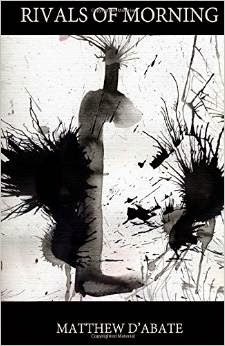
Rivals of Morning, poems by Matthew D'Abate


"All At Once, Light Slips in Like a Blade"
Rivals of Morning, poems by Matthew D'Abate

Matthew D'Abate lives in metaphor ("we wait like gypsies/screaming for dreams", "dabs of black ink in the/picture show of the centuries", "Neruda...in his puddles of blue/watching the sunlight drip/from his fingertips." ) His scattered images spray like a peeling black fireplug on the hottest day of summer. Rivals of Morning is street poetry, the dirty, littered, hopeful, heart-filled city street, off which he tends bars, tells tales, and writes poems, some of which are gathered in this, his vital and decisive, first collection.

Matt is an American writer, an American poet, self-invented, self-proclaimed, democratic in his inclinations, alert to the possibilities around him and willing to spill his blood in service of his art. This is no academy bred, MFA toting, painfully self-aware technician of the lyric line, but a guy who illuminates his poems, with sweat imagination, vulnerability and candor. His ambitions are smaller than Whitman's; he's not looking to invent an American poetry, or to reinvent it today, but in his self-construction, he follows the inventive, original line carrying from Whitman, through Kerouac to Bukowski. His subject matter, "rivals of morning"--those of us who live in the night world--and his sensitive embrace of their experience and dilemmas, place him deep in the tradition of artists who've memorably mined the diamond in coal vein of the American night, Hopper, Hammett, Kazan, Selby, Bukowski, and Waits, extending it across the millennial divide with verve, quirk and pathos.

I've seen you
a thousand nights
doing your thing
serving
us
drunks
and I've always wanted
to know what
you'd be like
when the door closes
and you're only paid
to serve
yourself

Rivals of Morning, is the poetry of a young artist as jazz innovator, one who spent years blowing behind the woodshed before going public with this brave and savage volume. Reading "Rivals" is like listening to Charlie Parker play Cherokee, or looking at an early Pollack, D'Abate has cracked something open, blowing licks never heard before, fresh, confident, divergent, potent with possibility. Rivals of Morning is one of those rare books of poems whose energy, spice, passion and bloody truth surge past its flaws, a flash flood in an arroyo. Our eyes see the unneeded word, the awkward construction, the metaphoric disconnects, but these burrs don't catch; Matthew's images and his drive to communicate are too strong. Rivals of Morning brings us through the aching point, far past the hiss of dawn, where light cannot be held back a moment longer, into the flash when the shade goes up and light comes flooding through.

the thing is that no one
owns the light or the direction of it

but grows toward the glow
despite the silence
and the gravity below

Read Rivals of Morning; better still, get your friends to read it too; go out with them to your version of the Cedar, the San Remo, or the Whitehorse, and discuss it with them loudly. Twenty-years from now, you'll wake up and say, "I remember that night. I remember I read it when."


Marc Zegans


Marc Zegans, is a poet and creative development advisor based in Santa Cruz California.  He’s recently completed, Lyon Street, a collection of poems about San Francisco during his coming of age in the late seventies and early eighties.

http://www.mycreativedevelopment.com

Thursday, August 07, 2014

Taking a Look Around Us: A Review of When The Light Turns Green by Kenneth Pobo, illustrations by Stacy Esch.


Taking a Look Around Us: A Review of When The Light Turns Green

Review by Emily Pineau

“Sooner or later/ everything is departure.  The hand lets go./ Wind finds it,” Kenneth Pobo writes in his poem, “Suitcase”.  This feeling of change, nature, and moving on is carried throughout Pobo’s poetry collection, When the Light Turns Green, illustrated by Stacy Esch.  Nature appears to be the binding force and metaphor that Pobo uses when talking about life, death, and the feeling of being stuck between the two.  Esch’s illustrations capture the feeling of childlike playfulness, imagination, and discovery that is found in Pobo’s examination of nature, the struggles of growing old, and letting go.  Esch gives a face to the sun and to the characters that are around trees and woven within a collage of bright colors.  This characteristic in her artwork instantly personifies nature, which matches the importance of nature found in Pobo’s poems.

As Pobo walks us through an intense scene in his poem, “Face the Autumn," he compares facing the seasons with the concept of facing bullies.  Pobo writes:

How to face
Autumn? Winter? Spring? Bullies,
birds surrounding the house
at the end of Hitchcock’s film,

waited.

When this feeling of being cornered is being compared to things that we have to face in life, such as the seasons, it makes this concept feel more manageable somehow.  Even when the harshness of winter seems to be unbearable, humans have the ability to make it through. So, when someone is faced with the harshness of bullying, helplessness, or loneliness, it would come to reason that people could make it through these situations and feelings as well.  Despite the fact that people may not know how to face these things, we somehow manage to keep going and cycle through, just like the seasons do.  Also, with this poem comes Esch’s picture called, “Where is the Horizon?”  A sun that has a face is being depicted as peeking over the land with what looks to be a pained expression.  Just like with Pobo’s poem, there seems to be a feeling of waiting for something to end, or waiting for a certain light or other side to come.  It is a very powerful metaphor thinking about the sun itself waiting and looking for something to happen.  Usually the sun is seen as something so constant and stationary that one would not think that it would desire change or long to be somewhere else.

    Pobo continues to change how one would think about certain aspects of nature with his poem, “Tree.”  I found this poem to be the one that best showcases Pobo’s unique and impactful images.  In this poem he shows how people can appear to be different in relation to nature and how nature can look different when compared with itself.  Pobo writes, “Put sky in a tree/ and it’s less than/ a caught kite.”  The sky is typically seen as something in the world that is overwhelming because it completely surrounds us and we do not see an end to it.  On the other hand, Pobo is suggesting that if you look at a tree and the spaces in between the branches you will find that the sky is tangled up in it.   Nature is all about perspective, just like how life is all about perspective.  Pobo also writes:

I sit under a leaf house
with no doors to lock,
no windows to close,
quiet slipping off
urgent green.

Houses are usually seen as something that would enclose someone and give them privacy.  In this image, however, a “leaf house” gives the narrator a feeling of openness and what sounds like a feeling of relief.  Peacefulness washes over the narrator at the end of the poem, and it feels like his life has been changed somehow.  The way that he looks at the world has been altered.  Also, accompanying this poem is Esch’s picture, “Last Call”.  In this green, yellow, and orange dominated picture, the sun has a curious look on its face as it is looking out at a fairy or some sort of character with its face hidden by a black mark.  There is a tilted tree off to the side and the setting appears to be a forest-type area.  This picture has a mystical feel to it and it feels like it came out of a fairy tale.  This aura of magic and mystery compliments Pobo’s poem very nicely because there are many elements of the unknown when it comes to looking at people and at nature.

    In general, people are constantly trying to figure out the uncertainties of each other and the world, while at the same time they are avoiding what they know for a fact—everyone’s time has a limit to it.  Naturally people want to continue to rush on to the next thing in life so that they do not waste any time being stuck in the same place.  Pobo’s poetry reminds us, however, that life shouldn’t be about rushing to the next stop.  We all need to slow down, water some plants, and look up at the sky.  After all, the light will turn green eventually.


************ Emily Pineau is an English major at Endicott College and the author of No Need to Speak (Ibbetson Street Press/Endicott College Young Poet Series)

Tuesday, August 05, 2014

Bound Each to Each By Ann Taylor


Bound Each to Each
By Ann Taylor
Finishing Line Press
www.finishinglinepress.com
ISBN: 978-1-62229-392-6
28 Pages
$14.00

Review by Dennis Daly

You don’t often see majesty in miscellany. Ann Taylor’s new collection of poems, Bound Each to Each, proves the exception. Her pieces may come from multiple directions but they bring with them a breadth, intelligence, and an underpinning of mythology that speak to their readers with accomplished and appropriately lofty tones.

Much of this majesty the poet delivers through meditations on place. In her opening poem entitled Horn Pond Taylor compares the gravitas of the pond she views every day from her kitchen window to immortalized bodies of water found in literature. She notices the reduced wonderment in each of her literary lakes as opposed to the strengthening magic in her nearby watery vision. Here begins the history and family lore of what she sees,

It’s the tale of Narragansett Winitihooloo
and Nansema, his Pawtucket Juliet,

or the old ice-cutting (my uncles’ misery),
slicing for the hot world
“crystal  blocks of Yankee coolness.”
It’s a newspaper vision of my grandfather
wheeling his famous figure 8’s.
Or cautious skids across this ice
leashed to my headlong Yellow Lab.
Then there are ma’s peanut butter picnics,
My trout reeled in by dad, let go by me,
A first kiss, and the battered pine
Dressed in red berries by my kids…

Taylor mixes exotica of place with laugh out loud humor in her poem Nairobi Track. The humans—she among them—drag race an ostrich on a track in Kenya. The ostrich has clearly been through this before. His delight seems to border on hubris. The poem makes an interesting point about humankind’s opponent and his feathery thrust, or non-thrust. It concludes thusly,

Long legs stretching, claws dinning in,
he seems almost a gangly lope until he
outpaces our mandated 30 MPH, glances
over and back at us as he departs.

All runway, no lift, the only way this fastest
earthly bird feels wind’s course through
billowing white wingfeathers is to run to win,
everything depending on it.

A mother’s primal instinct to protect her young drives Taylor’s title poem Bound Each to Each. For days the poet’s daughter dotes on a nest of robin eggs. When natural forces and predators threaten the new eggs, the mothering daughter resorts to high technology—namely a Nissan Altima to save the day. This brings to the poet’s mind her daughter’s first car and the night it died. Taylor explains,

on a rainy 3 AM highway—
“Mom! My car just stopped!”
On the way there, I hear
in the cellphone background,
the eighteen-wheeler roar,
dread the stranger’s “Can I help you?”

William Wordsworth’s poem Daffodils gets some neat and well-deserved commentary in Taylor’s piece entitled The Daffodils to Wordsworth. The poet describes our communal plight with concern and care as only a spiritual solitary could. Taylor, floating lonely as a cloud over these lines, meditates on tribal comforts. The poem dances to its conclusion here,

Our ancestral species reach
to hundreds of thousands,
so down to our ancient roots
we know only accumulated beauty,
the comfort of numbers,
the bliss that comes with
leaning as others lean.

Taylor turns the table on pretentious artists, their cockeyed fans, and their self-important, presumptuous reviewers (I ought to know) in her poem entitled Portrait of Lisa Gherardini. Mona Lisa’s enigmatic smile curls up with generational disdain the more she sees. The poem opens up like a shotgun blast,

“So foolish,” you seem to be thinking,
Madonna… Mona… Lady Lisa…
looking out at this carnevale of jesters
with raptor noses, pom-pom slippers,
Mickey Mouse ears, Osama beard,
or petting Paris Hilton’s pup.
Dali layers on his own pointy mustache,
Bug eyes, fingers dripping coins.

Among the millions in Eiffel t-shirts
angling for a cell- phone camera shot,
was the carpenter who claimed you for Italy,
the acid attacker, the hurler with the rock
that got your elbow…

At the heart of this chapbook the poem Homecoming offers Taylor’s classic take on Agamemnon’s somewhat unpleasant return to Mycenae after the sack of Troy. The poem, done in counterpoint, reads like a mini play. Cassandra, Agamemnon’s new slave girl, spits out her venomous prophecies in wonderfully crazed fashion. Clueless and arrogant Agamemnon rides his chariot into his wife’s death trap. The understatement builds to a powerful conclusion. I like this poem an awful lot. Here’s a center section of the counterpoint,

“Poor Cassandra’s crazy,”
my family thought, and turned away,
as you do now. You were
too easily deceived by my joy
in your company, blind to me
and my revenge.

    Why, my dear, do you point, shout?
    Do you laugh or weep?

It’s laughter, dear king,
as I see you trust her smile,
her comforting words
fraught with falsity.


    I want to share all this with you,
    but look, my wife
    spreads the carpet wide.

Historic place poems always interest me. Toward the end of this impressive collection Taylor offers us her poem Gallows Hill, Salem. It’s a nifty little piece, perfectly toned.  Nature knows the character of the poisoned land that the poet presents to us. Bloody red on white, sumac, redtail, and a robin’s breast on snow drifts, tells the tale. Innocents were damned here on what is forevermore evil ground. The poet says,

A redtail rises against darkening sun,
a hoarse crow tries to call, and an early robin
clings to a bare branch, does not…
should not…sing.

Snow squalls smooth granite folded over
like the scroll that named them witches,
named this as the place
to damn them.

Penned grandeur in such a little book— very nicely done!


Friday, August 01, 2014

Mass Transit Drawings by Joan Farber Poems by Michael O’Brien


Mass Transit
Drawings by Joan Farber
Poems by Michael O’Brien
Pressed Wafer
375 Parkside Avenue
Brooklyn, New York 111226
IBBN:978-1-940396-04-0
$12.50

by Wendell Smith

Mass Transit is a collection of some 25 graphite portraits by Joan Farber interspersed with 21 poems by Michael O’Brien. At 4 x 5 inches it may be the world's most petite coffee-table book, but it more than holds its own with larger examples of the genre. This is not a book to be read; that is, it is not a volume to be finished and stored on a shelf beside other books you've consumed. It needs to be left hanging around on an accessible surface, picked up and tasted, put down and picked up again—savored for its recurrent appeal to the appetite of your attention. Anyway, that is how my wife and I used it while it was on our kitchen table for a couple of weeks and how I came to appreciate its flavors

Although trim and dignified in its design, this little book has a casual structure. The design forgoes page numbers and places each drawing or poem on a right hand page with the facing page blank, so a reader encounters these statements, whether visual or verbal, individually without direct reference of one to another and is free to cross reference the drawings and poems at random so they form a mass of meaning not a linear narrative.  

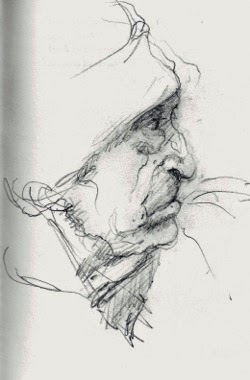
The drawings need to be seen to appreciate how completely Ms. Farber has mastered her pencil. The drawings vary from quick gestures that capture expressions in a few dozen lines to complete renderings: the difference between one subject’s startled thought and another’s meditative consideration. The faces in these drawings trigger questions, "what was she thinking?" and other associations. When I first saw this drawing,


, my mind reflexively said, "Rembrandt."

As the drawings vary from gestures to more complete portraits so the verses vary from notes:

kneeling bus
sighs, yields

to more complete descriptions:

A small, pot-bellied women in a bright green
dress speaks antiphonal, incomprehensible
sentences by the Seventh Avenue subway,
possessed, testifying, warning, rocking
in place with the voices, then repeating
decimal, ghosts that feed on speech. Nearby
a man, head raised, eyes closed, is drinking
the sunlight. He takes his time. His thirst
is great.

The poems are best read, as one would meditate upon a drawing, until the image blossoms in one's imagination as a character with a story:

opens her Times like
logical argument
shaking the pages as
if to be rid of the
worst of the news

The words honor trouble:

patience of the lost, going
through their ruins: ageless white-
haired high-browed black man in the
59th St. station, wild
eyes, nowhere, opening &
closing of filthy Bible
like a valve. like breath

and transience:

her smile detaches itself
from this girl's face
and from her benevolence
to hang in the
air for a moment
and then fade as
she boards the #11
bus one gray morning

I don’t think O’Brien’s poems should be subjected to the enhanced interrogation of a close reading. As I’ve said, I found them best when I absorbed them as I did Farber’s drawings, slowly letting my thoughts improvise along with them. When I did, the book became a celebration, an acknowledgment that we are, all of us, a mass in transit and the company we are keeping, as it is presented here, is a worthy one.

A note on Pressed Wafer


Pressed Wafer was founded in Boston by Daniel Bouchard, Joseph Torra and William Corbett and was originally 9 Columbus Square. It moved with Corbett to 375 Parkside, Brooklyn, New York in 2012. While you can order individual books from, Pressed Wafer subscriptions are available for $100 a year. In addition to the publications you receive for your subscription, you will also get all the backlist titles available. What a deal. I discovered Mass Transit because I became a subscriber this year. The backlist books I received for subscribing meant my investment came to less that $10 a book. So far those I’ve read have been as engaging as Mass Transit. As I said, what a deal!

The Hive Is a Book We Read For its Honey By Gerry Grubbs


The Hive
Is a Book We Read For its Honey
By Gerry Grubbs
Dos Madres Press
editor@dosmadres.com
Loveland, Ohio
ISBN: 978-1-939929-04-4

Review by Dennis Daly

Some of the best writers of poetry, by cultivating their art in public, seek to both gather in and pass on unanticipated inspiration. Their images and lines don’t prescribe direction or logic, rather they release the human heart to connect with the universe’s numinous energy. That’s what Gerry Grubbs does in his new collection of poetry entitled The Hive.

Each poem in Grubbs’ book transports one to the exotic realm of honeybee and hive with concomitant imagery and symbolism. The poet seems to leave much of what happens next to the imagination. But his suggestive techniques, along with his compositions, living real lives of their own, convey the reader to a heliopause of sorts on the edge of the unknown. Then things get really interesting.

In the poem Sometimes in the Evening Grubbs conjures up the sacred nature of life and how it works on the raw material of existence. A Promethean bee has stolen a bit of the fire, which transforms him and also his community. The poet explains,

…I think of the bees
Who would finish the work
Taking that fire
Back to the hive burning
Of that red honey
Dripping like the petals
It was stolen from
I think of that little thief
Who desires to disappear
Into the night
But cannot

Words do matter. They are the elements of communication and their connections create what otherwise does not exist. Observing the methods and results of these connective arts Grubbs says,

A few words
Can disturb the bees
A few thoughts
Can disturb the flowers
It is enough
To watch them
Serenely touching
Giving what effort is required
Mindful of each dip and buzz

My favorite piece in this collection the poet entitles Location. A man wanders through an orchard presumably seeking something. Yet he becomes the object as the divine muses seek him out. The orchard blooms with the heaviness of ripened fruit, or perhaps it doesn’t.  Perhaps all is potential. Timelessness revolves around the man as inspiration seeks to locate him, his potential poems in abeyance. The poem concludes this way,

…his feet
Lets him know what the earth
Looks like in all kinds of weather

Time unfolds from his pocket
Like a map on which the stars
Try to locate him the way bees

Locate the blossoms
From which they spin
Their rich honey

The need for poetic inspiration every artist feels. When ideas don’t come, a dreadful helplessness results. Happy is the writer who has been found by his muse and stocks up a surfeit of honey for the future. Grubbs describes this type of wealth in his poem We Want so Much. Here’s the heart of the piece,

We want so much

We cultivate them
In white boxes out back

Or in tops of tall trees
The way honey men do
Those whose wealth
Is measured in bees

In a sense this poet passes on part of the creative processes to his audience. Both poet and reader must wait for the poem to find them before any cultivation can take place.

Flowers not only provide nectar to the bees; they are an everlasting source of raw material that could, if there is an attendant will, be turned into poetic art. In Grubbs’ piece called The Rose the flower becomes the spoken word, a woman reading. Gertrude Stein would have appreciated the meditational value of the never ending construct A rose is a rose is a rose is a rose…. Grubbs’ eternity emphatically transforms itself into an Eden as the poem opens,

This is my version
Of paradise
And you are in it
And a woman
Reading
 So slowly
That each word
Lasts forever

Strangely, good poets often bring their poem to a conclusion by a process of forgetting. They forget their original plan, their grand set of ideas which propelled them onward. The poem captures them and turns them into metaphysical beings beyond their earthbound natures. Grubbs’ poem How to Lose Something explains this eerie construct. Here are the essential lines,

Finding yourself alone
In the woods
You will believe
You came this way
For some good reason

And so you begin
The gathering of things
You find along the way

All the time
Believing you had something
But can’t remember what

Grubbs hints at an unfathomable world of unseen mechanisms. Secrets are the norm in this geography of dreamtime. Like Plato observing life through its shadow- manifestations, the poet inhales the deep fragrance of other souls. He says,

The bees busy
Passing secrets
Back and forth
Between the apple
Blossoms
When I fell asleep
Within my dream
And when I awoke
From my second sleep
There was only
The fragrance
Of those blossoms
Gathered like worshippers
Of the moon

The poetic introduction to this collection offers a warning for those of us seeking sweetness in life or art and suggests attendant smoke. There are, after all, dangers in every hive. Drowsy bees are best. Shed whatever hubris you bring with you and wonder what comes next. You won’t be disappointed.

Thursday, July 31, 2014

Seamus Heaney Tribute Reading: Aug 27, 2014 7:30 PM-- Houlihan, Marchant, Tobin, Holder


Seamus Heaney Tribute Aug 27 Houlihan, Marchant, Tobin, Holder


Date: 8/27/2014 - 
Time: 7:30PM
Location: Cambridge, Mass First Church Congregationalist
Category: Arts/Entertainment
Summary: HOST: MICHAEL TODD STEFFEN


Seamus Heaney Tribute Wednesday August 27 at 7:30 pm

At First Church Congregationalist
11 Garden Street beside the Sheraton Commander off Harvard Square Cambridge
suggested donation $3

Details:   Michael Todd Steffen/ Host


Featured readers:  Joan Houlihan, Daniel Tobin, Fred Marchant, Doug Holder