Friday, February 22, 2013

Lake Effect Poems by Christina Cook


Lake Effect
Poems by Christina Cook
Finishing Line Press
ISBN: 978-1-62229-0628
29 Pages
$14.00

Review by Dennis Daly

Christina Cook in her book of poems, Lake Effect, commingles the universes of life and death onto a canvas alive with natural images painted in a thin and elegant texture reminiscent of ancient Japanese screens. The central construct in this phantasmal paradigm, a rural lake with summer cottage, pulsates with spiritual reconciliation and a stark, almost visionary, clarity. Poems throughout this book touch on the illness and death of the poet’s mother and these central poems expand into Cook’s comforting and rather stunning world view.
The poem A Night in Fenwick mixes the emotions of imminent death with a life force of surprising strength. The poet puts it this way,
…we sit on the jetty, in denial
of the diagnosis you received today.

Darkly, silence passes between us.
Crabs click over the rocks.

The tang of salt surprises our lips
as we listen to the day’s last waves

rattle oarlocks in the dories off shore.
In the morning we will accept it…

In the poem Dory, Cook elevates death into the life’s natural goal.  It becomes part of a grand bargain. Even without a paradisiacal afterlife of silver fish, it is sufficient. She begins,

Say something smooth
about a life long committed
to death.

Let the feathers fade.

Wooden dories dulled
by waves don’t want
netfuls of silver fish:
their rot-soft hulls
are enough. The callused feet
of old fishermen, enough.

Even in the extremes of sickness Cook finds images of mystery and beauty. Consider these lines from the poem Coma,

shadows pass
over my skin
like the care of a
quiet night nurse

I am immersed
in life, but not alive

my tiller-thin thirst
and tilting hull,
my sail’s silhouette
slicing a solstice moon…

When death finally comes the poet adds another twist. The wake becomes a true celebration rather than a melancholy rite. The poem entitled On the Night of Your Wake unfolds thusly,

Stars fall from a constellated open hand,
land like glitter in our hair.

We say the night is full of her gifts
and drink champagne, red

from rain falling through feverish skies,
we hang paper lanterns from the low

gnarled limbs of laurel…


 In a very short but wonderful poem called Summer Evening Cook amalgamates the natural and the mystical into a single metaphor—the lake. She does this by detailing the deposition of her mother’s ashes. The poet says,

…northern cardinals
crimson the shapeshift clouds,

we scatter your ash over the lake
and watch your cinder soften,
like last year’s peaches,
into water the color of koi.

The image of the peaches and the flickering multiple-colored koi emits vibrant color and light. There is little grief here, and much hope. Cook seems to use this hope as an impetus in her search for life’s meaning. She comes right to the point in her poem Departure. She marvels,

I see now how life’s only slightly
different from death, in the end.
We once watched whale oil burn

an aurora borealis of grime against
the burlap wall. Fur once softened my skin.
If regrets can survive death,
mine is this:

so much was done without knowing
what it meant…

Life forces include everyday duties. The poet upon opening up her summer cottage becomes locked in a conflict between her unresolved grief and family matters. Cook describes,

I suppose I should be dusting
pollen off the chairs instead
of pouring another glass,
or pruning the rhododendrons

before they bloom
through the hole in the screen,
before the shadow reaches
all the way over the cove,

once again graying the oaks
as if they’d always been
the parchment bones of birds.
I suppose I should

Stop mourning my mother
And put a fresh coat of paint
On the mildewed doors…

In the poem On the Sleeping Porch Cook portrays the profound weight that her family gives to her understanding of life, albeit of a transitory nature. The image of a sleeping porch, which extends into the darkness of night, seems perfect. Here are a couple sections of the poem,

A luna moth, large
As my husband’s hand
Bumps against the screen,
Batting its four-eyed wings
Like lashes…

It continues this way,

… Scorpio’s rising
over  the fringed ridge of firs
mirrored in the lake,
while somewhere,
the moth’s week-old shroud
slowly becomes one
with the soil.
                                In the trundle
bed beside me,
my son sighs in his sleep: he
is the weight I carry,
the ballast…

The title poem, Lake Effect, is the last poem in this collection and it’s well placed. It sums up the poet’s faith in a benevolent darkness which births beauty and consciousness for a time and then draws them back into a primordial night. Cook concludes,

So while the rest of us drink pinot
noir, discussing some temporal thing
like milkweed slowly strangling the lake,

my sons poke black lily buds
with their dessert forks, dissecting them
on the tablecloth.
                                                They, too,
                        believe in the night:

finding the petals fresh inside,
plucking them out, one by plush white one.

Cook’s poems succeed in the same way. Poke them enough and they bloom into a lovely plushness.

Monday, February 18, 2013

Celebrating Hugh Fox's Life and Work


        Location: Bloc 11 Cafe, 11 Bow Street, Somerville, MA
        AWP Offsite Event

        2nd Floor-- Grolier Poetry Room

        Cost: Free March 9, 2013 4PM


The 2013 edition of the Pushcart Anthology is dedicated to Hugh Fox (1932 -2011), who helped found the prize and start the COSMEP organization, and also published more than 60 of his own books of fiction, poetry, anthropology, and mythology, including a memoir, Way, Way Off the Road (Ibbetson Street Press, 2006). This event will feature poems and reminiscences by family, friends, and colleagues, including Bernadete Costa-Fox, Leonora Smith (Michigan State University, and John Roche (Rochester Institute of Technology). Doug Holder, Editor of Ibbetson Street Press, will read from Hugh's memoir. John Gosslee, Editor of Fjord's Review, will read from Hugh's last interview and show clips from Hugh's final reading. Marc Vincenz, Editor of Mad Hat Press, will read from Hugh Fox's posthumous poetry collection Primate Fox , and Lo Galluccio, poet/vocalist and confidante of Fox’s. Also included will be Steve Glines, editor of Way, Way Off the Road. Food will be available at the Bloc 11 Cafe. Contact: Doug Holder dougholder@post.harvard.edu

Friday, February 15, 2013

As Bees In Honey Drown A Play by Douglas Carter Beane


As Bees In Honey Drown
A Play by Douglas Carter Beane
Directed by Joey DeMita
January 25-27
F.U.D.G.E. Theatre Company
At the Factory on Tremont Street

Review by Zvi A. Sesling

This is my second encounter with The F.U.D.G.E. Theatre Company having first seen their production of Parade in October. The current production of As Bees In Honey Drown is a marvelous adaptation, directed by Joey DeMita who also directed Parade.

What DeMita brings to the performance is minimalist staging, the ability to work with few props and instilling a superb sense of timing by his actors. The play follows Alexa Vere De Vere deliciously portrayed by Linda Goetz. Alexa is a grifter
who seduces everyone with her English charm, runs up their credit cards and disappears from their lives as quickly as their credit card is maxed. She plies her unique talent on a number of fawning victims, the last of whom is Evan Wyler, a young somewhat naive writer. He has completed his first novel and is searching for new material when Alexa sinks her conning claws into his psyche. Even though Evan prefers men, he falls for Alexa – hook, line and credit card.

As the play unfolds, we learn of Alexa’s previous conquests: Kaden, the recording mogul, Mike, the artist and Illya. Each remains silent about being “sucked into” Alexa’s wiles because of their embarrassment. However, as wily as Alexa is, Evan, who has been educated about Alexa’s talents, exacts revenge by writing a tell-all book. As Alexa says in the play’s best line: “Maybe writers get the last word because they know so many of them.”
One scene is reminiscent of Donizetti’s spectacular sextet in the opera Lucia di Lammermoor. Various characters vent their anger until six soloists release their fury. In this play, the actors have a multi-line telephone conversation starting with one and adding until all are saying something different, all five speaking simultaneously. It takes talent to complete this without error, and these actors are more than capable of handling the difficulty.
As for the actors, Linda Goetz makes a perfect Alexa Vere De Vere, with English accent, body language and hand motions to match her delectable on stage persona. About eighty percent of the dialogue in the play is spoken by Goetz’ flawless and entertaining delivery. As the center of play she is terrific.


As I was exiting the theater I heard someone remark “Evan Wyler looks too young, so is not convincing.” But I would offer that is exactly the role Ryan MacPherson is supposed to play. Younger than Alexa, easily impressionable and captivated by a woman for the first time, he does a competent job as Wyler.
Frank Consolo is a true scene stealer. As the haberdasher, he plays the stereotyped gay with humor that even the most ardent opponent of stereotyping would enjoy. He flips from his gay role to ruffian portrayal in the manner of Bobcat Goldthwaite and finally plays Mike, a gay artist who lived with Alexa when she was Brenda, a New York nobody. Consolo brings a convincing earnestness to his roles.
Ross Brown comes alive as a big time recording executive talking realism to Wyler’s fantasy of Alexa. He tells of his own embarrassment and acts the way you would expect a thirty something seemingly big shot exec to act.
Julia Bailey has a certain grace, a dancer’s movement in the way she glides in and out of the scenes. Coupled with her winning smiles, she too fits her multiple roles enthusiastically and blends easily with the other actors.
Mimi Augustin provides facial expressions better than most well-known actors I have seen. Playing several roles does not mean she sloughs them off; on the contrary she is hilarious as the male physique-loving secretary to the record exec, and others.
Joey DeMita, whose direction I have seen twice, is a top notch director who pays attention to the message of the play, assuring the actors are well rehearsed with impeccable timing.
F.U.D.G.E. is one of the better acting groups in greater Boston, and perhaps they will bring back As Bees In Honey Drown so the play will be enjoyed by an even wider audience.
_____________________________________________________
Zvi A. Sesling
Reviewer, Boston Area Small Press and Poetry Scene
Author, King of the Jungle and Across Stones of Bad Dreams
Editor, Muddy River Poetry Review
Editor, Bagel Bards Anthology 7
Editor, Bagel Bards Anthology 8

Tuesday, February 12, 2013

CERVENA BARVA PRESS READING SERIES Feb 20 Doug Holder/Steve Glines


Doug Holder


Steve Glines


IN THE

CERVENA BARVA PRESS STUDIO

WEDNESDAY, FEBRUARY 20TH

BASEMENT, B8, 7:00PM

ADMISSION: $3.00

Arts for the Armory

191 Highland Avenue

Somerville, MA

CERVENA BARVA PRESS READING SERIES

Readers: DOUG HOLDER and STEVE GLINES

Doug Holder is the founder of the Ibbetson Street Press and the arts editor for The Somerville News. His poetry and prose have appeared in Rattle, The Boston Globe Magazine, the new renaissance, Endicott Review, Caesura, Long Island Quarterly and many others. Holder teaches writing at Bunker Hill Community College in Boston and Endicott College in Beverly, Mass. He holds an M.A. in English and American Literature and Language from Harvard University.


Steve Glines has spent most of his career as a journalist with a reputation as an edgy technical writer. For five years he authored a monthly technical advice column titled Panic in Altos World Magazine. The column was written in the voice of a fictionalized, over-caffeinated, sleep-deprived, computer engineer working for the mob. He also wrote a column titled Famous Last Words for Unix Review about products that never quite materialized or never lived up to their promise. He is the author or co-author of five "trade textbooks," a travelogue about teaching in Fiji, a flash fiction/ poetry chapbook and a novel in search of a publisher. For the past eight years he has been the editor/publisher of Wilderness House Literary Review.


--------------------------------------------------------------------------------


The Center for the Arts is located between Davis Square and Union Square. Parking is located behind the armory at the rear of the building. Arts at the Armory is approximately a 15 minute walk from Davis Square which is on the MTBA Red Line. You can also find us by using either the MBTA RT 88 and RT 90 bus that can be caught either at Lechmere (Green Line) or Davis Square (Red Line). Get off at the Highland Avenue and Lowell Street stop. You can also get to us from Sullivan Square (Orange Line) by using the MBTA RT 90 bus. Get off at the Highland Avenue and Benton Road stop.


Monday, February 11, 2013

“If One of Us Should Fall” by Nicole Terez Dutton


“If One of Us Should Fall”
by Nicole Terez Dutton
Pitt Poetry Series
University of Pittsburgh Press
copyright 2012
75 pages
Review by Lo Galluccio

Not since I first came across Lucy Brock-Broido's “The Hunger,” has a poetry collection excited and challenged me as much as “If One of Us Should Fall,” Dutton's debut. In “The Hunger” Brock-Broido takes on the persona of different characters: baby Jessica who fell down the well years ago, a child in the cult group MOVE in Philadelphia and creates an idiom for each of them. At other times she writes with a plethora of images that are at times baroque, but each poem holds its own based on the character and the situation. This is different from Dutton's equally brilliant work. When a writer invents a new syntax and manages to keep a unified voice amidst different poems, it is always a fascinating achievement.

Whatever preconceived notions I had based on the title –that she was posing a moral question and would she, in fact, answer it? – vanished as soon as I plunged into the first poem, which like a bookend, is mirrored at the end of the work: Girl#1 and Girl #2. We are met with
“clear, coal-hot squares of disco” and “a Dopple” and an ending “like horses,” It is a poem with one declaratory sentence: “Listen, I am girl,” thus signifying herself in a general category of people, but specifying that she is indeed girl, female. Horses serve as an emblematic force throughout this work – and they seem to represent something American, some kind of independent motion, a grace of mobility and speed. We are dealing in some measure with a language poet, one more interested in playing with juxtapositions of images and objects, than in their literal meaning in a typical narrative poem. However Dutton does write in the first person quite often and in an abstract way, tells a story of place or relationship or disposition including the weather and the objects that together stitched form the vibe and ambiance of each episode. She is almost always traveling somewhere, to Austin, to Ohio, in an airport. It is a book about coming and going and how to signify what happens in between those poles. Dutton does pen some prose-poems in this work but all her poetry has velocity, mystery and concrete sensuality, as in:

“And guitars burning us up, quick,
as malaria, strapped into the hind bucket
of second hand Buicks, speeding
away, always, and always dumbstruck
by the drums trundled in our bones
the whole interstate home.”
p. 4 “Every Answer is Yes.”

These poems give us a sense of motion, take us from one place to another through unlikely brash metaphors that often tantalize.

In “Playing the Room” Dutton writes about the aftermath of a show or event of some kind. We seem to be in a bar. But her sense of the context is wild associations that transmute from one thing
to something vastly different. Like a good jazz improviser she takes us beyond the original key.

“behind the words,
the carcasses of steel mills

and rivers on fire. They try
to reassemble the logic the way

people interrogate suicide notes
cold trails that could lead

to the coordinates
where certain hearts lay

unspeaking buried
in the earth like gold.”
p.7

Her endings are always satisfying,usually providing some kind of closure in the positive vein
compared to the journey of the poem itself. It seems she is always looking beyond the present moment,
through a crystal ball of language. Traveling to Austin or to some other place along the interstate and yet describing a state of mind or a strange association of verbs that burst with action:

In Minor Key, she writes:

“Time swallows itself. We will
begin slow and tell the truth, Tomorrow

a world, ten fingers less, will move
forward. There will be more

soldered wires, more chords and flesh
held close with butterfly clamps”
p 14

Or, in Chaser, she takes the gerund lying and gives it a series of unrelated descriptions, a whole new story. It is a great poem, which ends with “shut up, shut up”
“Lying is many scavenger birds, knees
beneath dinner tables
crossed and uncrossed, a virus
fortressed in blood and spit,
a name you do not speak,
feathers left in the mouth,”
p18


Like beautiful black and white photographs, concrete objects are set against landscapes
and declarations and questions. In one sense every poem is a missive describing where the author is and what it may mean to you. Sometimes there's an episodic plot as in “Holding Us This Away” which is interlaced with arresting metaphors/similies, like:

“their clay ramshackles lining
the interstate like molars.”
p 11

The expansive vocabulary alone of these pieces is impressive, their apposition and fine line of both concrete identity and abstraction from their usual source. One would deduce hat Dutton
has created a poetic travelogue of a trip across America, but she never tells us that explicitly.. We jump from Austin to Nashville to Ohio and no place is depicted in any sort of predictable or stereotypical way. We are treated with the inebriation of alcohol and music and road signs, yet the poems are soberly constructed with a fine, if non-logical force. In “When we get there we are Gone,” she writes:

“We can only sing razorblades over the brim of Nashville.” and
“We know that language won't survive past Ohio.”

There are so many finely crafted and imaginative poems in this book it is difficult to pick out
the plums. The whole pudding is quite delicious as a kind of celebration of language and an American cultural experience. Both the titles and endings of her poems frame each experience of reading them in a brilliant and suggestive way. In “Many Kingdoms Toward You.” she begins with the image:

“The map in yesterday's suitcase, a river
whose name dropped vowels and feathers”
p. 45

referring back to the alphabet of a common language combined somehow with the silky ephemera of the object, feathers... and she ends with the bold declaration: “I avalanche forward.” Such are the turns and twists Dutton takes in the landscape of each piece.

The end of the book is mostly a collection of prose-poems and experimental pieces that are almost like Gertrude Steins list of objects and their qualities in such striking poems (about gambling)
called “City of Candy-Colored Light” or “Within these Squares of American Heaven” (about a tribal bonding of friends moving through time zones,) or “Welcome Home” (which celebrates “blackness” “with pulled-pork televisions, ““hammer shanks and cornrow,” and “Musicians, Mojomen” “Mamis”)
This is a truly arresting book, inspiring and highly original. I recommend it whole-heartedly. Or catch Nicole Terez Dutton at a Boston or nearby venue. While I haven't heard her read from this work, I'm sure it is a lyrically-charged rendering of the many “razzle dazzle” poems she's created. This book won the 2011 Cave Canem Poetry Prize and Dutton studied poetry at Brown University and has won fellowships from Cave Canem, the Fine Artswork Center in Provincetown and the Virginia Center for the Creative Arts.

Lo Galluccio
Author of “Hot Rain,” “Sarasota VII” and
“Terrible Baubles.”

Wednesday, February 06, 2013

Two Colors Of The Soul: The Selected Poetry Of Dmytro Pavlychko


Two Colors Of The Soul:
The Selected Poetry Of
Dmytro Pavlychko
Copyright 2012© by Dmytro Pavlychko
Cervena Barva Press
Edited and with an introduction
by Michael M. Naydan
Somerville, Massachusetts
Softbound, 90 pages, $17
ISBN: 978-0-9883713-0-9

Review by Zvi A. Sesling

When reading a translation of poetry, usually one poet has translated. In this volume of Dmytro Pavlychko’s verse the Ukrainian-to-English is accomplished by eight translators.
One would think that eight different people bringing a Ukrainian poet to the English speaking word would result in an uneven, choppy book. However, the opposite is true in this presentation by Cervena Barva Press. The eight translators have made a unified collection, bring to English readers a Ukrainian poet who deserves wider recognition.

In the poem I Must, translated by Dzvinia Orlowsky he presents us with what Americans would refer to as a “bucket list” but is more like a self-awakening:

I Must

I must read books
so that I won’t become blind.
I must speak
so that I won’t grow mute from grief.
I must hear a song
so that I won’t fall deaf with silence.
I must fall in love
for joy to move toward me.
I must see my friend
for the day to become brighter.
I must write a poem
for my heart not to break.
I must work
to feel worthy of bread.
I must die at midnight
so the in the morning I may rise again!


In a poignant encounter with the Chernobyl dead zone, Pavlychko tells us how a possession once owned by someone might feel about no longer being owned.

The Plaything
(translated by Aliona Sydorenko)

In the Chornobyl dead zone
in a hut on a bench
there sits a man
sculpted of clay
the likeness of a god
unafraid of the radiation

He has been sitting for fourteen years
looking at the door with sadness
waiting for it to be opened
by his maker
the blond-haired boy
But the boy does not come
does not open the door
and the clay man
continues to sit and wait

A number of Pavlychko’s poems have built in irony, none more ironic than Too Late Too Soon in which we discover how unnecessary we are:

Too Late Too Soon
(translated by Aliona Sydorenko)
In whatever century
you’re born,
it will always be too late and too soon!
Too late, because everything most important
in this world
has already happened without you,
too soon, because everything most important
in this world
will happen without you too.


Pavlychko’s poetry is truly in the Eastern European mold which if you have not discovered you should. The photograph of him on the back cover is one of a stern, hard person who has lived through a lot, seen even more. Graying, balding with thick eyebrows and deep set blue eyes, Pavlychko looks more the stern politician than poet.

However, make no mistake his poetry is deep, accessible and worth a reading – and to be sure you enjoy its fullness, read it twice.


________________________________________________
Zvi A. Sesling
Reviewer, Boston Area Small Press and Poetry Scene
Author, King of the Jungle and Across Stones of Bad Dreams
Editor, Muddy River Poetry Review
Editor, Bagel Bards Anthology 7
Editor, Bagel Bards Anthology 8

Tuesday, February 05, 2013

John Keothe’s 9th, ROTC Kills: the Poetry of Articulated Consciousness


John Keothe’s 9th, ROTC Kills: the Poetry of Articulated Consciousness


by Michael T. Steffen


Poets dissolve or digest their inherited turns of mind and come into their own unique idiom, and from there can talk themselves into what they become. Few un-shield this talent as does John Koethe. In “Like Gods,” one of the inserted prose meditations of his new book of poems ROTC Kills (HarperPerennial), the poet unravels this line of thought:


despite the certainty I have, I’ve no idea what I really am, or where, and as for “searching nature,” I have no idea even where to start. These matters mean the world to me, and yet no matter how I come to grips with them, they slip away. I and here and now are ever present, yet they vanish in the act of apprehension, as a poem turns into language as you write it down (p. 37).


How agile a thought: something disappearing is like something appearing, so long present being, hello poem. The representation of a thing supplants the thing itself, which isn’t even a thing since Koethe’s scrutinized and elusive ideal, topos, inspiration is “the whole of creation, through the long song of myself” (“The Whole of Creation,” p. 21). For all the grandeur and homage to patriarchy in the spirit of this declaration, which underlies a continuity of optimism or acceptance throughout the book (“acknowledgment” may be the term, Koethe’s correlative for Whitman’s “embrace”), the composite of his discursive and fluent self portrait is well dampened, ordinary, anecdotal—and riddled with self-examining insights that transcend confession as they transcend personality into a broader sphere of cultural and philosophical supra-common place.

An honored poet disciplined in Philosophy, Koethe also surprises us with his utterly contemporary candor and unflinching fluency. In this sense, the poet makes himself plain, accessible, identifiable—especially at the opening of his poems which seem just to come out as from a breath momentarily held:


There are feelings you expect to have

And satisfactions you hope to find

In the course of an ordinary day…

(“The End of the Line,” p. 1)


There are four movies that I saw

Between the ages of ten and fourteen that became

Parts of my life, for what that’s worth…

(“Alfred Hitchcock,” p. 12)


Even Koethe’s more speculative topics are brought up in this direct, easy manner:


I love the past tense, but you can’t live there.

I love the stories you believe add up to you,

Though they never do…

(“Stele,” p. 17)


No one has to write any special way—

You make it up as you go along. I started

Writing this way—no thoughts at first,

Then a lot of words in the guise of thoughts,

Then real thoughts—a long time ago.

You can write or think about death directly,

Or you can write about it by indirection

And delay…

(“1135,” p. 52)


The self-possessed poet can also talk himself out of whatever it is from his cultural inheritance she or he can no longer embrace. Identifying illusions, specious persuasions and disappointments provides a major current in the poems of ROTC Kills. The mere passage of time makes an illusion of things and ideas which once were able to animate. This is a pivotal theme in the collection’s title poem “ROTC Kills.” In the articulate consciousness of the time being, memory, past events, for Koethe, crop up not to merge with and season the present but to stand in contrast to it, for comparison:


I’m retired, I’m sitting in a house I made

In my imagination years ago, that now is real.

On the walls are posters from the Harvard

Strike in 1969 I saved for their designs

And then forgot about, and now they’re here:

STOP HARVARD EXPANSION, STRIKE

FOR THE 8 DEMANDS, and then the best of all,

In small red letters with three red bayonets,

rotc kills (pronounced rot-cee kills). From here inside

Time seems unreal, I’m back in graduate school,

But then the mind ascends and time becomes objective,

I’m myself again, at home again, and sixty-four.


Time becomes objective, not because Koethe is repossessed by lost time that has come to suffuse an otherwise tenuous, somewhat hollow present. Unlike Proust’s madeleine, the posters from the 1969 Harvard student strike conjure nothing any longer memorably tangible or attainable for Koethe. In this instance of confronting particularly the cultural revolution of the sixties, time becomes objective because Koethe goes back and forth between the breech of then and now, separating himself from the perishable enthusiasm of that time (whose martyrs include John F Kennedy, Martin Luther King, Malcolm X, and no less Janice Joplin, Jim Morrison and Jimmy Hendrix, to name only a few).

Just what it was that made Koethe an apostate to the age of Aquarius, he himself is at a loss to pinpoint. Yet that choice, or inclination, has come along with him to this September day of his memory, metaphorically in the September of the poet’s life as the days grow short, and also suggestive of another September day when the U.S. was again sorely protested, even contested. Moving from a Four Quartets-like aerial view of the big picture, with a pinch of Stevens, back to his personal journal voice, Koethe confronts his break-up with the protest movement:


The particulars of a life, the pattern of a life:

These are the poles the mind, in the guise of a poem,

Floats back and forth between. The calm elation,

The deflating sigh: the trees are tossing in the wind, the leaves

Unfurl their silvery undersides, the soft clouds drift across the sky.

Time may be an abstraction, but it makes the days go by,

The days I never thought I’d see, when the music of the sixties

Lost its way, became too faint to hear, the voices fell away,

And then it all came down to me. What were those eight demands?

I can’t recall to save my life. I lived there, I breathed that air,

And sometimes some of it drifts back to me. “You should join PL,”

Paul said as we were sitting in the lounge. Picketing

The GE plant in Lynn didn’t much appeal to me, so I just

Said it seemed too hard to square with being married

And finishing my degree. “Yes! That’s what’s so great about it!”

He replied, as I rolled my eyes. Or Jonny Supak’s plan

To hold the chairman (Rogers Albritton) hostage in his office:

“The kids are stealing underwear from Filene’s Basement,

Asking for the Red Army! ‘Where’s the Red Army?’ they’re asking!”

It felt so all-important at the time, in a surreal way, the endless

Back-and-forths, the forums, teach-ins, meetings and analyses, strategic

Planning sessions (“But—but that would be capitulationism!”),

And look at what it came to. I didn’t even vote in 1968

(Chicago was too fresh), but on election night found myself

Nostalgic for the Hump, only by then it was too late.

(“ROTC Kills,” pp. 30-1)


This passage was especially resonant as John Koethe read it at the Lamont Library at Harvard on Wednesday November the 7th, the evening after this past autumn’s elections. He chatted before the reading about the election results without indifference, though he wasn’t demonstrably political either. An impressive introduction was made for the poet by the Woodbury Poetry Room’s curator Christina Davis. She had just returned to Cambridge from helping her family in New Jersey in the aftermath of Hurricane Sandy. Koethe read from the book at a table in front of a microphone, being recorded—though this wasn’t Beethoven’s 9th , it was Koeth’s 9th book of poems—for NPR.

Though nothing especially was made of it that evening, the reading at Harvard was significant as a return to the place of social events and the poster that gave the book its name. It may also be significant that very recently Harvard had occasioned another event which also marked a turn-around in attitudes between the community and its military presence. On September 21, 2011 Globe journalist Mary Carmichael wrote,


In a ceremony freighted with symbolism, Drew Faust, Harvard University president, lauded the Navy’s ROTC program and officially welcomed it onto campus yesterday, ending four decades of frosty relations between the university and the military and laying the groundwork for increased recruiting at the school.

(www.boston.com/news/local/massachusetts/articles/2011/09/21)


During the reading, Koethe clarified that he had taken the title for his book, not as a provocation against the ROTC, but in recollection of the posters as symbolic for the sixties protest movement, and went on to mention he had known many students who had benefited from participating in the ROTC by getting into good colleges.

These are considerations good to keep in mind approaching the title as it is with its undeniable self-contained meaning: ROTC Kills. And so Koethe gets to say two things at once. Poetry may differ from other kinds of writing in several hardly tangible or provable ways. Defiance of logic may have a special haven in poetry, where every coin can be turned for its two sides. Koethe’s poetry, beyond the ambiguities of his feeling for the sixties, doesn’t flinch at contradictions, which evolve rather as paradoxes and polarities.

Even one of Koethe’s main premises, the song of the self, is scathingly self-examined:


I’m a sucker for the private place,

Though it’s boring once you’ve found it:

You’re always right, which makes being right

Worthless, and yet you want to stay there

Even though you hate it…

(“Locus Solus,” p. 39)


Good books of poetry surpass the simple review’s capacity to betray them much. ROTC Kills is a work of personal mastery in its scope, generosity and forthrightness that holds the reader’s attention with a lot of familiarity in idiom for our ease and some truly breathtaking insights for our wonder. It is good for several reads.


ROTC Kills

Poems by John Koethe

$14.99/96pp

HarperPerennial

Monday, February 04, 2013

Somerville Writer Thomas R. Bransten Brings a Novel of Abduction, Intrigue and Romance set in France to the Paris of New England.


Somerville Writer Thomas R. Bransten Brings a Novel of Abduction, Intrigue and Romance set in France to the Paris of New England.


By Doug Holder

   A Somerville writer acquaintance of mine took me to task recently for using the phrase “The Paris of New England” to refer to Somerville. He said anyone who would compare Somerville to Paris has not been to Paris. And he is right, I haven’t been to Paris. So I was a glad to meet Somerville resident Thomas R. Bransten at meeting of the Somerville Bagel Bards.  Bransten was in Paris working as a reporter for the United Press International and the International Herald Tribune where he covered among other things the protracted French war with Algeria, and two kidnappings:  one of four year old Eric Peugeot, heir to the automobile fortune, and the kidnap-murder of seven year old Philippe Bertrand, which had most of the world in  a state of shock and outrage. The novel Bransten wrote “A Slight Case of Guilt” also involves a kidnapping of a young boy from a prominent family.

 Bransten has lived in Somerville for a number of years and moved from San Francisco to Massachusetts with his wife so she could pursue her PhD at Harvard. For a long while he was an agent of Prudential Prime Properties in Somerville, run by Somerville native sons John and Jim Duccelli. Bransten lauds the civic spirit of Somerville, and its easy accessibility to Boston and the outlying environs.

   Bransten, 81, went to France in 1959  “To look for a woman I thought I was in love with,” he said.  He studied psychology at the Sorbonne, but realized he needed to make a decent living when he started  a family. So he decided to try journalism, and after striking out numerous times he managed to secure an unpaid internship of sorts with the International Herald Tribune.  


Eventually he was offered a job on the night shift, where he worked from 11PM to 10AM—6 days a week. Later he graduated to the day desk—and went on to write many important stories.

  Bransten recalled his days covering the Algerian War for Independence from France. Not only did Algerian rebels commit terrorist  acts in Algeria, but they bombed cafes and buildings in Paris. Bransten told me he was minutes away from being killed by a bomb planted outside the offices of the newspaper Le Monde.  Because he got sidetracked, he missed walking by the building by minutes.

   His novel “A Slight Case of Guilt” is loosely based on a kidnapping that took place during his stint as a journalist in France.  For the purpose of the novel it is set in the Burgundy wine country where a young heir to the Ville De Courtray fortune is abducted.


  Bransten will be having a reading of his novel at the Book Shop at Ball Square Feb  24, 2013  1P.M, smack dab in the Paris of New England.

Sunday, February 03, 2013

The Black Buddhist by Meikle Paschal


The Black Buddhist   by Meikle Paschal   (Ibbetson Street Press)  http://ibbetsonpress.com  $15

Review by Afaa Michael Weaver


In sentences that are as sincere as they are nostalgic, Meikle Paschal gives us a valuable portrait of the journey of his life from the poor neighborhoods of Boston to the comfort of a consciousness furnished by the loving kindness of his Buddhist principles, principles that save him from the bitterness and resentment that can occupy the mind of someone who has fought adversity for his entire life. An African American man gifted with unusual intelligence and a keen intuition, he is lifted also by a penchant for forgiveness. As a reader, I am especially endeared to his portraits of a Boston I could never have known, the old Boston of the mid twentieth century. Paschal seems remarkably adept at recognizing and seizing the chance in life, even when he was not aware of the fuller meanings of his actions at the time. He implies repeatedly that something saved him, and it is that hope he offers the reader, namely that if we would just believe there is a way, the way will reveal itself to us. He is not blind to the tragedies of life, as he notes the people who did not have or see the chance, people who fell victim to things we would rather not imagine, but he offers his own encounters with those chances. He explores the vicissitudes of upward mobility in stories that are insightful and inspiring. In admitting the perfection possible in life, he admits the imperfections, the double binds, the impasses, and he continues on with life, even as the apparent paradise proves itself over and over to be only that and not something ultimately real. Paschal lets us see only the journey is real.


To order: 
http://tinyurl.com/cxgxdhh


Afaa Michael Weaver

Simmons College


**********************************************************************************


******Afaa Michael Weaver (born 1951 Baltimore, Maryland) formerly known as Michael S. Weaver, is an American poet, short story writer and editor. He is author of numerous poetry collections and his honors include a Fulbright Scholarship and fellowships from the National Endowment for the Arts and Pew Foundation. His poems have appeared in literary journals and magazines including Callaloo.

Born in Maryland, he studied two years at the University of Maryland. Then he entered the world of factory life alongside his father and uncles and remained a factory worker for fifteen years. He started 7th Son Press and Blind Alleys, a literary journal. He graduated from Brown University on a fellowship, with an M.A, and Excelsior College with a B.A. He taught at National Taiwan University and Taipei National University of the Arts as a Fulbright Scholar, and was a faculty member at the Cave Canem Foundation's annual retreat. In addition, he was the first to be named an elder of the Cave Canem Foundation. He also studied Chinese language at the Taipei Language Institute in Taiwan.

He teaches at Simmons College, and is director of the Zora Neale Hurston Literary Center He is Chairman of the Simmons International Chinese Poetry Conference.[4] Tess Onwueme, the Nigerian playwright, gave him the Ibo name "Afaa," meaning "oracle," while Dr. Perng Ching-hsi has given him the Chinese name "Wei Yafeng."


Saturday, February 02, 2013

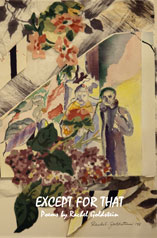
Except For That by Rachel Goldstein


Copyright 2013 © by Rachel Goldstein

Cervena Barva Press

Somerville, Massachusetts

Softbound, 33 pages, $8

ISBN: 978-0-9883713-1-6


Review by Zvi A. Sesling


From her bio on the back cover we learn that Rachel Goldstein is the daughter of Holocaust survivors. She was born in Germany in 1946 in a displaced person’s hospital. At the age of two she moved to La Paz, Bolivia with her parents. Five years later, her family emigrated to Montreal, Canada where she completed her education.


I once sat on the Board of Trustees of the Zamir Chorale of Boston with Ms. Goldstein and never knew this information. However, I was impressed enough with her poetry to publish one of her poems in my online journal, Muddy River Poetry Review.


In this volume of poetry, which lives up to my high regard for work, Goldstein presents her parents’ story. Many of the poems, are sparse, direct and harsh. They reveal truths that some still deny, but cannot be denied when you read realities from survivors and their children. In House of Mercy we encounter the realism of dead children.


Children burn. We go on

without them – ashes, ashes.

The neighbors hack and sing:


Kill and clean

til your work

is done. Soon

the roaches

will be gone


A blue sky cobbles sorrow.

A boy tucks into a nun’s

old habit, keeps his heart

from freezing in the House

of Mercy. There is no mercy.


Certainly during World War II Jews under nazi rule knew no mercy. They died in Auschwitz, Bergen-Belson, Treblinka and other camps. She also writes about places wiped out, people murdered.


First Cousins, Once Removed


Yankush, Leah, Salek! See them

dancing beside the river. Here

the flour mill was once enough

for them. The willow still stand

faithful in leafy gowns.

Do not throw off their green

voices, the circle of voices ringing

in Shreniava.* There is nothing

here. Everything they know is here.


*my grandparents’ summer gather

place for all the young cousins


In another poem she writes For an Extra Piece of Bread, a recurrent theme in Holocaust poetry because a slice of bread – or even a piece of a slice – was a very valuable commodity, sometimes even keeping someone alive for a day or two, or if lucky longer.


For an Extra Piece of Bread


The prisoners were asked to name

the twelve sons of Jacob. One man

tried and tried, was beaten to the ground.


The commandant’s wife came by.

All prisoners were ordered

to look away. My father did not.


He saw how she stood, legs apart,

ten little fox heads, open mouthed,

dead, smothering her breasts.


Some of these poems are before the war, some during and others post World War II yet each poem is poignant, piercing and a valuable contribution to the still growing oeuvre of Holocaust literature. I found this volume of poetry a superb addition to my collection of Jewish and Holocaust poetics. I think every reader will find this volume both accessible

and valuable to own.


____________________________________________________

Zvi A. Sesling

Reviewer, Boston Area Small Press and Poetry Scene

Author, King of the Jungle and Across Stones of Bad Dreams

Editor, Muddy River Poetry Review

Editor, Bagel Bards Anthology 7

Editor, Bagel Bards Anthology 8