Saturday, February 02, 2013
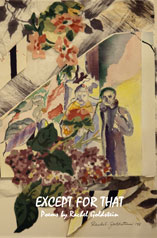
Except For That by Rachel Goldstein
Copyright 2013 © by Rachel Goldstein
Cervena Barva Press
Somerville, Massachusetts
Softbound, 33 pages, $8
ISBN: 978-0-9883713-1-6
Review by Zvi A. Sesling
From her bio on the back cover we learn that Rachel Goldstein is the daughter of Holocaust survivors. She was born in Germany in 1946 in a displaced person’s hospital. At the age of two she moved to La Paz, Bolivia with her parents. Five years later, her family emigrated to Montreal, Canada where she completed her education.
I once sat on the Board of Trustees of the Zamir Chorale of Boston with Ms. Goldstein and never knew this information. However, I was impressed enough with her poetry to publish one of her poems in my online journal, Muddy River Poetry Review.
In this volume of poetry, which lives up to my high regard for work, Goldstein presents her parents’ story. Many of the poems, are sparse, direct and harsh. They reveal truths that some still deny, but cannot be denied when you read realities from survivors and their children. In House of Mercy we encounter the realism of dead children.
Children burn. We go on
without them – ashes, ashes.
The neighbors hack and sing:
Kill and clean
til your work
is done. Soon
the roaches
will be gone
A blue sky cobbles sorrow.
A boy tucks into a nun’s
old habit, keeps his heart
from freezing in the House
of Mercy. There is no mercy.
Certainly during World War II Jews under nazi rule knew no mercy. They died in Auschwitz, Bergen-Belson, Treblinka and other camps. She also writes about places wiped out, people murdered.
First Cousins, Once Removed
Yankush, Leah, Salek! See them
dancing beside the river. Here
the flour mill was once enough
for them. The willow still stand
faithful in leafy gowns.
Do not throw off their green
voices, the circle of voices ringing
in Shreniava.* There is nothing
here. Everything they know is here.
*my grandparents’ summer gather
place for all the young cousins
In another poem she writes For an Extra Piece of Bread, a recurrent theme in Holocaust poetry because a slice of bread – or even a piece of a slice – was a very valuable commodity, sometimes even keeping someone alive for a day or two, or if lucky longer.
For an Extra Piece of Bread
The prisoners were asked to name
the twelve sons of Jacob. One man
tried and tried, was beaten to the ground.
The commandant’s wife came by.
All prisoners were ordered
to look away. My father did not.
He saw how she stood, legs apart,
ten little fox heads, open mouthed,
dead, smothering her breasts.
Some of these poems are before the war, some during and others post World War II yet each poem is poignant, piercing and a valuable contribution to the still growing oeuvre of Holocaust literature. I found this volume of poetry a superb addition to my collection of Jewish and Holocaust poetics. I think every reader will find this volume both accessible
and valuable to own.
____________________________________________________
Zvi A. Sesling
Reviewer, Boston Area Small Press and Poetry Scene
Author, King of the Jungle and Across Stones of Bad Dreams
Editor, Muddy River Poetry Review
Editor, Bagel Bards Anthology 7
Editor, Bagel Bards Anthology 8
Friday, February 01, 2013
The Cranberry Island Series by Donald Wellman
Donald Wellman’s The
Cranberry Island Series was published by Dos Madres Press in December 2012.
Like his Prolog Pages (Ahadada, 2009) , Wellman has written another book that
sometimes offers a challenge to read and understand. That’s probably because
Wellman is working with literal translations, or transliterations.
The Cranberry Island Series has essays that are not reads that you
can simply sit down, turn the pages, and figure out what this author is writing
about. To read The Cranberry Island
Series is to have the book in one hand and a dictionary/thesaurus in the
other. Or, more practically, you can utilize internet access.
In this
book, Wellman writes in a multitude of genres: essay, poetry, translation,
autobiography, family history, and more. A most intriguing piece is “A Poetics
of Transcription” in which Wellman discusses Charles Olson’s Maximus. Wellman writes, “I am seeking
to go beyond projective verse and approach a practice that is more nearly my
own…” In this essay, Wellman analyzes how Olson takes prose and puts it into
poetry without changing any of the words. It’s called:
…metaphrasis…,
Weather
comes
generally
under the
metaphrast.]
…a process that occurs in moving from prose to verse as
in the
many examples that are to be found in Maximus.
Wellman does nice work
translating The Seafarer from Old
English(ll 1-65a) into modern English. He writes in a lyrical, steadily
moving style that is easy for the reader to read and comprehend. Perhaps this
is because Wellman is being true to his writing style:
I want to speak the truth, to tell
about my travels and the hardships
which I have endured, the feelings
in my breast when I heard the keel
groan, terrible heaving of the sea
Nights I had to keep a close watch
clinging to the prow when the boat
plunged, seas breaking over ledges
Chains of ice, held me fast by the
legs, iron fetters of frost Sorrow
sighing hot in the heart like fire
I fought hunger and mind sea weary
from watchfulness. You who have it
all so easy on land don’t know how
poorly I fared on the cruel winter
sea, loneliness, longing for close
friends Rime,
icicles in my beard
Hail-scur flew I
heard naught but
hammering seas
Gannets sang to me
The ducks played games to amuse me….
Wellman’s poetry is clear, original and captures the reader’s
attention, as seen in “Memorial Day”
No one took my
photo when I wore the uniform
In those days we did not wear it in the streets.
Instead we dressed like the kids back home
and sang, “Lay lady, lay across my big brass bed.”
Everything was bigger then and the smell of wax
and shoe polish mixed with acrid tobacco
and made us unhappy to be men at all
but I had a child, a golden tender boy for whom
the sparkle of a ring on a chain meant incandescent joy
and his mother nursed him in the forests of Oregon
where we lived for a time under a translucent tent
and fished in the Three Sisters with a Cherokee
named Joe. The blue glacial waters turned flesh
to ghost white radiance and the war continued.
The journey through the pages of
The Cranberry Island Series is not a
lazy one. It keeps your mind active, and the book is quite a memorable read.
Wednesday, January 30, 2013
Diverting Angels by Deborah Diemont
by Deborah Diemont
Copyright 2012 by Dos
Madres Press inc.
Dos Madres Press
Loveland OH 45140
Softbound, 43 pages,
no price
ISBN 978-1-933675-75-6
Review by Zvi A. Sesling
For those of us who live in
New England Deborah Diemont seems a candidate to replace “Wrong Way
Corrigan.” She spends winters in Syracuse NY, with its lake effect
snow and summers in Mexico. So being bi-lingual, one would expect
the poems in Diverting Angels to be in English and Spanish. However,
it is all English, which is a benefit to many of us.
The books is one of
sonnets, broken into different construction: 14 lines, the standard
sonnet, 4-4-6, 4-4-4-2, 4-4-3-3 and of course 8-6.
These are fascinating
poems telling stories about people places, things that keep you into
each one through the fourteen lines. Take for example Housemate a
bittersweet, humorous verse in which we learn that furniture and
jealousy make a bad combination:
The walls loomed a metallic
oyster gray.
The lamps, Tiffany roses
upside-down
bloomed to themselves. Stray
artifacts broke ground
in dusty corners where
the baby played.
For less than half the rent –
the room in back –
I shared the lap dance of
another’s life,
cast iron rusted with soap, a
hobbled bike,
a garden overgrown with
Grickle-grass
Perhaps we’d be friends now
if I hadn’t paired
my shaky antique chairs with
missing screws
and her deco table, showing
too much wear
before I stained with my mug.
Nor stared,
discreetly, at her new
boyfriend’s tattoo,
a butterfly that straws
fermented air.
Ms. Diemont has
intriguing titles such as A Modest Blindness, Mountain and Spine,
Face Book, The Last Time I Read People, The Poet in Victoria’s
Secret™, Photos in Newsweek. All the poems live up to my
expectations. They provide insight into a poet whose views
ultimately coordinate with life, all types of people and of course,
the reader.
In Mountain and Spine
I like the mountain, I adore
your spine,
the way you stand as if
pulled by a string
toward the sky, palms turned
out by your hips.
And how you steeple, arch,
curve down to dive.
How emptiness exacts a
transformation –
dog-to-cat, child-to-warrior,
a tree
where right foot meets the
left thigh easily.
Your toes dig in like roots,
and your frustration
powers down, with knees and
chest and chin
against the floor. I like
best when you clasp
your hands in prayer, right
at the end, akin
to someone who believes. Roll
up your mat –
crave nicotine, pour coffee.
We’re aligned,
my tree, my mountain. I adore
your spine.
If find her poems compelling
in that they don’t go where I expect them to go, like Grandmother,
which begins one way and end another is typical of Diemont’s verse.
In To Dye Or Henna a whole
lifetime passes in fourteen lines, an explanation of a woman’s
thoughts and her history.
This is a book of
poetry I savored and which I believe you will as well.
____________________________________________________
Zvi A. Sesling
Reviewer, Boston
Area Small Press and Poetry Scene
Author, King
of the Jungle and Across
Stones of Bad Dreams
Editor, Muddy
River Poetry Review
Editor,
Bagel Bards Anthology 7
Editor,
Bagel Bards Anthology 8
Sunday, January 27, 2013
Earlier Lives: Poems By Sara Dailey
Dos Madres Press
www.dosmadres.com
ISBN: 978-1-933675-86-2
79 Pages
Review by Dennis Daly
Can writing poetry console? Can it deliver solace in the face of unbearable grief? Perhaps more to the point—can poetry do or accomplish anything that aids ordinary people in coping with the human condition? I think so. Apparently, so does Sara Dailey. Her book of poems, Earlier Lives, looks at anguish in an angular, near scientific way that includes sharp observations and a hygienic reductionism. Together Dailey’s collection of poems deals with the traumatic loss of her younger brother in a motorcycle accident, made more intense by her broken family history and the subsequent closeness of their sibling relationship. Throughout the book the poet studies the various facets of her overwhelming sorrow and that very act seems to engender a useful catharsis. Indeed, Dailey lords over her tempestuous territory with absolute control and the reader gets to see this commanding poet define a very difficult subject.
“Listen and I will fill your ears with truth,” says Dailey in her opening and introductory poem, Globe Artichoke. She lets her readers know that they are in for a rough, not a smooth experience. The tipped spikes and leathery scales need to be worked through and the density needs to be thinned out. The poet continues,
…What you desire of me, sparse
in proportion to what you will discard.
Ardishauk, ground thorn, artichoke:
Like a throat full of accordions
in a sommelier’s nightmare,
Come taste my heart.
Dailey’s persona, in the poem Dressing for Funerals, studies her every move, watches her dress appropriately for sorrow. She says,
But it is always sorrow
that moves you from speech.
In the mirror, your face, sepulcher,
practices humanity,
feels skin soft over bones,
the racketing click as jawbone clenches
and teeth tier into caged smile, mouth a cave
Aristotle would never see
his way out of.
Black linen slides over hips,
sways in rhythm with the body’s rocking,
how it shoulders sobs
like cliffs being crested by waves…
A Recognition of Being Left Behind is another poem which makes good use of a mirror. The poet sees her brother’s features in her own face and describes the phenomenon thusly,
When you became no more than my haunt,
ash bits boxed on the mantelpiece,
I sometimes felt the bathroom mirror
was my enemy, showing skin pale like
paper or oak brown eyes, a crooked smile
no longer shared
by anyone. You startle in my heart
like blood welling up, brother.
Who’s to know my secrets now?
The poem entitled Mary to All Her Painters insists the reader confront the reality of death (like the poet confronted her younger brother corpse). It’s never pretty when you’re caressing your dead son. In this case the material feel of the dead Redeemer is a carcass of meat or a formless octopus. Mary additionally admonishes her painters on the state of her being. She complains,
I’m never dirty in these paintings,
despite how far I might have walked,
and the flush you see is faith
not the red of too much weeping.
None of these paintings show
how the hard stones of ovaries
shrank to the dead pits of plums
or how I turned my face away.
In the title poem, An Earlier Life, Dailey’s persona relates her engagement with life before her brother’s death and after it. She once lived with risk and joy and lighthearted love. No more. The poet says,
…Not this life.
Here it isn’t like riding a bicycle.
You must relearn the falling,
the getting up after,
even the willingness to try.
And she does try. The Poet turns scientist and like Gregor Mendel she reads the microcosm of nature and sees her brother’s genes inside herself. She meditates on this in the poem, Gregor Mendel’s Peas on the Anniversary of my Brother’s Death. Following this train of thought to its logical conclusion, she comes up with an interesting question. Dailey asks,
When my blood at last spills,
or my body gives in to entropy
and finally rests, brother
will you still be there
in the strands of me, in DNA
like threads in the loom
of some cosmic weaver
leaving each breath
a silver shimmer?
Dailey composes a good number of Mendel poems for this collection. Her persona seems soothed by the sureness of scientific research that connects humans into families. Mendel becomes a surrogate for God. Not only does he breed animals, manage bees, and grow peas with desirable traits, but he offers a hope for coexistence between Daileyand her longed-for brother. The poet in her poem entitled Mendel, Age 27, Breeds Mice in His Room at the Abbey explains,
Because I wanted to believe in something with ease,
without doubt, your name was a prayer on my lips, words
sung into the air like a hymn. I was grown up far too young.
Unavailable mother. You know, the old story where child
sees parent as fallible, learns to trip lies off their tongue
because it is kinder than truth. I spent summers in the wild
overgrowth of weeds with skinned knees while she cried
behind a locked door we learned not to open. I created plaits
of clover and dandelions, found beauty by making it. When my brother died
years later I dreamt of your mice and plants, Mendel, wondered about traits
he would have passed on, the heritage of heredity…
In poem after poem the author portrays herself in as vestigial. Dailey expands on this concept in a poem entitled, That you are gone is but a fact. She says,
…like tailbones, a crude appendix
formed, structure without function, left behind.
Of loss, recall that even elephants grieve—
The need to touch the bones will make them pause,
Interpret, rage through huts like nettled wind.
As I read through this heartbreaking book of first rate artistry it occurred to me that the poems were working on yet another level. There is a tradition in Ireland and the Scottish highlands called keening. A group of professional mourners are contracted by the bereaved to formalize the grieving process. Each performer has a poetic purpose and together they lament and wail as a chorus. The effect of this sometimes disturbing performance can reduce the inconsolable to merely a singular sadness or even an acceptance.These poems do that. They are the keeners. They work magnificently for the reader. I hope they also deliver comfort tothis deserving poet.
Thursday, January 24, 2013
Ed Hamilton: One of the last Chelsea Hotel Bohemians, and author of Legends of the Chelsea Hotel: Living with Artists and Outlaws in New York’s Rebel Mecca
By Doug Holder
It was the kind of
winter day you may remember from your childhood, before things became so
heated. Bone chilling winds whipped my face making my cheeks look like they
were reddened from deep embarrassment. On this morning I was to meet author Ed Hamilton at the Grey Dog Café in the Chelsea section of Manhattan to talk about the glory days of the
famed Chelsea Hotel in New York City.
Hamilton, 53, a longtime resident of the hotel, and author of the book Legends of the Chelsea Hotel, had an
interesting tale to tell about this bohemian flophouse.
The Chelsea Hotel on
23rd St. in the Chelsea section of Manhattan has a unique history.
Built in 1883 it originally was a residential hotel that housed the stars of
the theatrical world. But over the years it was also the home for an eclectic group
of literary, visual and musical artists of all stripes. The Welsh poet Dylan
Thomas stayed at the hotel and was taken to St. Vincent’s Hospital in the
Village where he died from the result of drinking himself to death mostly at the famed White Horse Tavern ,near the environs of the Chelsea. William
Burroughs reportedly wrote Naked Lunch at
the Chelsea, and Kerouac is rumored to have had a fling with Gore Vidal in one
of the rooms, and some believed he completed On the Road there. Arthur Miller hung his hat there in his pre and
post Marilyn periods, as well as noted Punker and Poet Patti Smith and
the photographer Robert Mapplethorpe. (As recounted in Smith’s acclaimed memoir
Just Kids). And of course Sid Vicious
and Nancy met their infamous end in a gone-to-seed room in the Hotel.
For many years the
hotel was run benevolently (more or less) by Stanley Bard. Since 1957 Bard had
made the Chelsea a welcoming refuge of sorts for young artists to make a go of
it in the big city. He provided rooms at a reasonable rate for aspiring
artists, and was often forgiving if they came up short with the rent. He
sometimes took payment in the form of a painting or labor. But Bard was pushed
out. Now with gentrification, condo conversion, astronomical real estate
prices, the days of the Chelsea Hotel and others if its ilk are certainly
numbered. With Bard’s removal the Chelsea is undergoing renovation and all the artwork
that gave the building its unique flavor has vanished. Many of the permanent
residents have been evicted. Hamilton told me a total of 58 have been forced
out. Sixty residential apartments are left. Hamilton said: “I was in court for five years,
but I finally won the right to stay because I have a Rent Stabilized apartment.” Indeed, Hamilton , who has been at the
Chelsea since 1995, is the last of the breed who came to this hotel and lived the
life of a bohemian writer, in a room lined with books, and a bathroom down the
hall. He and his wife have lived outside “The broad lawns and narrow minds of
the suburbs,” as Hemmingway once wrote.
According to Hamilton the building was bought
for 80 million dollars by a Moroccan family headed by real estate mogul Joseph
Chetrit. Hamilton said: “ It is a huge
conglomerate that bought the Sears Tower in Chicago and other far flung
interests…the Chelsea is only a mere speck of dust in the whole perspective of
things.” It seems that many of the tenants who were not evicted were bought out
for well below the market rate. Hamilton does not want sell, and certainly not
for a price that will not allow him to stay in Manhattan. Hamilton said he
tried to enlist famed punker and poet Patti Smith, the author the
awarding-memoir set in the Chelsea Just Kids, but she ignored him. Finally she came out of the closet, but
according to Hamilton, decidedly on the management’s side. She agreed to do a concert for the tenants
that was supposed to introduce them to the wonderful
new world of the Chelsea Hotel under
Chetrit. Hamilton feels she was working for the management, in spite of the
common knowledge of the evictions and the destruction of the interior of the
hotel. When the tenants threatened a book burning, in addition to the media
deluge spurred on from Hamilton’s Chelsea Hotel blog, Smith reneged.
Hamilton and his girlfriend
Debbie Martin came to the Chelsea after
Hamilton’s stint at the University of Maryland, where Hamilton was teaching philosophy
and working on his doctorate. But Hamilton did not really like the academic
life. He was a product of the suburbs, and he was horrified to think he would
wind up in a conventional lifestyle near some strip mall. Hamilton and Martin
always knew about the Chelsea and its rich history, and they were determined to
come to New York City to live there. According to Stanley Bard to gain entrance
into the Chelsea was harder than getting into an Ivy League college, but the
duo got in through a sublet. Since then, with the help of Martin, Hamilton
started the Chelsea Hotel Blog, and penned the book Legends of the Chelsea Hotel….
Hamilton made a point in his book to
write not only about the famous folks who lived there but the unsung holy fools
as well. Hamilton said: “The everyday folks who lived in the Chelsea brought
this weird energy to the place. I think this contributed to the creativity of
the Chelsea. I am sure some of the great works conceived here as well as the
obscure were fired by the sparks in the atmosphere.” Hamilton told me that many
artists, even after it was long apparent that they didn’t have the talent or
luck to make it on a big scale, stayed on. Most folks after achieving some sort
of success moved out. For the ones that stay it can be a negative experience… a
reminder of what they are not.
I asked Hamilton
about some of the long term residents who are still pursuing their passion. One
lady Bettina G. has been in the hotel for many decades. She is a visual artist,
and a young artist who lived in the Chelsea, Sam Bennett, produced a documentary
about her. According to a newspaper account she had her paintings stacked to
the ceiling, and she was partially living in the hallway. Gerald Busby a
current resident and a protégé of Virgil Thompson had early success (He wrote
the film score for Robert Altman’s 3 Women), then went into obscurity and now
has been rediscovered.
Since I always have
had an interest in the poet Charles Bukowski, I asked him if the Buk ever spent
time at the Chelsea. Hamilton thought Bukowski spent one night or so there—and the poet
mentioned the hotel in a poem and short story he wrote. Hamilton then went on
to tell me that Harry Smith, the noted archivist, ethnomusicologist,
experimental filmmaker, also known for his Anthology
of American Folk Music, was a resident as well. He died at the Chelsea in
1993.
I remember in the
late 70’s when I came to Boston I lived in a number of rooming houses in Boston
and Cambridge. One, the Irving Inn in
Cambridge, advertised itself for Lean
Pocket Transients. The other was on Newbury Street in the Back Bay of
Boston. Many young people and not a few artists were able to get a reasonably
priced room in the city to pursue their art or passion. When I came to the city
there were a number of these places. Now they have seemed to have disappeared.
Hamilton said this is true of New York as well. Rent Stabilization is
vehemently opposed by the current city administration, and tenants can’t stand
up to the moneyed interests they are in conflict with.
Hamilton, continues
to write fiction, his first love, and has had his work in online and print
journals such as Penduline and Omphalos. Some of his fiction is loosely
autobiographical and at times deals with is life growing up Catholic, and all
the repressive baggage that comes with it. Although Hamilton’s Legends of the Chelsea continues to sell
and sell well; he is having trouble finding an agent for his fiction.
Hamilton has hopes
for his fiction as well as for the last outpost of bohemia, the Chelsea Hotel.
He thinks the chances that he and his partner will remain in the Chelsea are
slim. But hope springs eternal…and he still holds a candle in the encroaching
darkness. Hamilton is a creature of the city—he needs to breathe the asphalt,
blink back at the blinking neon, and pursue that ephemeral light that the
artist seeks. And the city, this Naked
City—New York City, that has a million stories, is the one that will keep
the pilot light of his creative life burning.
Friday, January 18, 2013
The Poetry Czars of The South Shore Visit Somerville
By Doug Holder
Jack Scully is the co-founder with the late Mike Amado of two ongoing poetry venues in Plymouth, Massachusetts, Poetry: The Art of Words a monthly poetry series and The Poetry Showcase a yearly poetry reading held in conjunction with the Plymouth Guild for the Arts yearly juried art show. In 2012 Scully organized Visual Inverse a joint effort between poets' and visual artists at the Plymouth Center for the Arts.
Mike Amado published three books of poetry during his short time on this earth. Scully and poet Nancy Brady Cunningham have edited his fourth book. Scully, who currently serves as the literary executor of Mike’s work has read Mike's poetry as a feature reader at Greater Brockton Poetry and Arts Society, Boston National Poetry Month Festival, Main Street Café, Poetry in the Village, Stone Soup Poetry, Poets Pathway, Poetry at O'Sheas' and Salem Literary Festival 2010. He also serves as the unofficial photographer of numerous poetry venues.
Rene Schwiesow is the co-host for the South Shore Poetry venue The Art of Words. A Somerville Bagel Bard, her publishing credits include Muddy River Poetry Review, the Waterhouse Review, and Ibbetson Street Press. Rene’s work has been aired on the Talking Information Network, a non-profit service for the visually impaired. April, 2012, she was a guest on WGDH, Vermont, along with New York/Vermont poet Michael Palma. In recent news, her work, “Shades,” has been chosen as Poem of the Week by the Massachusetts Poetry Festival and will appear beginning January 25, 2013. Rene is a reviewer for Boston Area Small Press, writes a column for the arts in The Old Colony Memorial newspaper, Plymouth, MA, and is currently working on a third poetry manuscript slated for a 2014 publication date by Cervena Barva Press.
I had the pleasure to talk to these two on my Somerville Community Access Community TV show Poet to Poet: Writer to Writer.
Doug Holder: The late poet Mike Amado was special to you both. What was it about him that inspired you?
Renee Schwiesow: He was accepting of everyone. So he made it very comfortable to open up to and discuss things. He was inspired by his Native American and Portuguese background. I have always had an interest in many different cultures. So that inspired me.
Jack Scully: Mike was basically a builder. Mike’s great idea was to build a bridge between the South Shore area and the Boston area. Originally I got Mike involved with the Somerville literary group the Bagel Bards. I read about the group in a column by Ellen Steinbaum in The Boston Globe, and I asked Mike if he would be interested in attending. So I took him to a meeting. At that time the meetings took place at Finagle-A-Bagel in Harvard Square. As a result Mike had two of his books of poetry published by the Ibbetson Street Press and the Cervena Barva Press of Somerville.
\
At that time, back in 2004, there was really not much going on in the Plymouth area poetically speaking. They had open mics but that was basically for music. Mike was looking for a place to start something for poetry.
In April 2008 we had our first poetry reading. David Surrette was our featured reader. We had a small audience. Now we average 30 to 50 people. We have a great open mic. So Mike and I founded two ongoing poetry venues in Plymouth, Massachusetts, Poetry: The Art of Words a monthly poetry series and The Poetry Showcase a yearly poetry reading held in conjunction with the Plymouth Guild for the Arts yearly juried art show. Our mission was and is to basically to give poets a place to meet other poets, and a place for poets to read their work. We hope to come out with an anthology in a couple of years.
We also started a new program connected with the Plymouth Center for the Arts where we match poets and artists, and have a public reading.
DH: Renee you are a well-respected book reviewer. How do you attack a review?
RS: I thoroughly enjoy reviewing because it has given me an interesting viewpoint on poetry and fiction. I generally read a book cover to cover. And then I do research on the author and the book. I make sure I include a few excerpts. But I try to highlight the good points, and then delicately discuss the not too good things. It is a ballet of sorts—a delicate dance.
DH: Jack you are editing the late Mike Amado’s 4th book of poems.
JS: In October of 2008 Mike knew he was going to die of kidney failure. So he gathered all his poems and put them into what he called books. And so Nancy and I went to his computer and basically put the Book of Arrows together. The book is in three parts and deals with his childhood in Plymouth, the plight of the Native American, and poems he wrote 3 or 4 weeks before he died. He has several poems about the National Day of Mourning, a Native American holiday that takes place at Thanksgiving. He attended this event shortly before his death.
DH: Jack do you have any ambitions for your own poetry?
JS: I attempt to write poetry. I have dabbled. I have scribbled on pieces of paper in my drawer at home.
DH: Renee any young talents you have discovered on the South Shore?
RS: We have a 12 year old Alicia Reed. She has a lot of promise. But it has been to attract poets under 30, but we are trying
Tuesday, January 15, 2013
Even the Dead Are Growing Old Poems by Don Winter
Working Stiff
Press
Niles, Michigan
25 Pages
Review by Dennis
Daly
I hated these
poems shortly before I liked them. They irritate. They grate. They steal your
comfort. They screw you up from toe to head with their revelations of dark
cruelty and bright cityscapes of emptiness. But pieced together like a jigsaw
puzzle you get to see the down and dirty desperateness and shellacked heroism
of an Urban Everyman’s life—maybe your own.
Cold Fact, the
first poem in this collection, confronts you with the callousness of unfettered
capitalism. The poet fearlessly states his case,
you can find in
evil good
if you are good
enough.
But where’s the
good in
“Ideally you’d
have every factory
you own on a
barge, tow it to where
labor costs were
the lowest.”? Still,
small towns
withhold
their terminal
truth, too afraid
or indolent or
drugged to ask
who is fucking
them,
I mean really…
The poem
continues with a litany of families broken apart and individuals gone bad due
to government supported decisions of greed glutted corporate bureaucrats. I know something about this subject and I have
seen those families in real time. I saw a work force of 16,000 decimated to less
than 3000 employees with little transitional training of any value. Their jobs moved to other countries on that
“barge” Winter mentions. The human beings themselves seemed to just vaporize.
In the poem
entitled Strip Bar: Hamtramck the poet details the initial excitement of moving
into the environs of a strip joint with the dancing, the dangling money, the
upturned faces, and the “goddamn of music” and bare skin. The denouement of
this piece offers the other lonely side of the tale. Winter says,
When she finally
got to me
I stuck a dollar
bill
where my eyes had
been.
Her face had the
alert sleepiness
of a cat’s. She
smiled
vacantly, moved
on to the next dollar.
I drifted into
the night air.
The lights on my
rig pushed
the dark aside,
moved me
towards the
house, towards
no one waiting.
Sometimes the
title of a poem summons a back story, which infuses the piece with extraordinary
significance and meaning. My Grandfather was a Matewan Miner is one of those
poems. Winter sets up the poem as a photograph: a bunch of coal miners posing
for the camera. As they stiffly hold their breaths for the shutter we can see
that they are dying from inside out. This was about the time of the so-called
Matewan massacre in West Virginia—the back story. When the United Mine Workers
tried to unionize these same workers, the miners were evicted from their
company housing. The local sheriff Sid Hatfield with the town’s mayor and well-armed
citizenry in tow faced off against the Baldwin–Felts Detective Agency (a
private army of company- hired gunmen). A shootout ensued and eleven people
died including seven detectives and the mayor. Detectives later murdered the
sheriff. Federal and state troops were called in to stop the violence and the
union’s organizing. Here’s part of the poem,
Coal’s turned
their faces
into dim candles.
Their teeth gone at 30.
With each cough
they still mine
the coal in the
dark
of their lungs.
They stare down
the future.
Dust will frame
their dreams.
Nice touch at the
end. Dust to dust—coal dust, that is.
The poem
Visitation in which the poet’s persona laments his inability to visit his child
hangs like a pall above this book. His sadness seems to etch itself into these
pages. He says,
All night I keep
arriving
in someone else’s
childhood.
And once a year
you send
a postcard of his
happiness.
The poem As Time
Goes By meditates on the innocence of the past and the reality that dreams once
proffered. Winter shows us an aging piece of Americana, the drive-in theater on
Route US 31. Then mulls over its memories and meanings. Winter describes a
moment of innocence,
… kids from days
of tight pants
& tight dreams, we stretched out
under the night
sky,
looked for a sign
from the stars
like a cosmic
lottery.
Of course the
title of the poem was the song of innocence banned in Rick’s bar in the movie
Casablanca. In fact the song highlighted the cynical son-of-a-bitch that the
Bogart character had seemingly become. The poet leads us in the same direction.
Describing the present realty of truckers the poet continues,
men slump alone
in rigs &
deeply smoke. Big assed, barrel-chested
cowboys who eat
double-fisted, steer
with their knees…
But like in
Casablanca memory has its moment of triumph. Winter says it this way,
…a few remain,
hang on
memory, like
those unknown connections
we used to credit
to the stars…
The title poem
Even the Dead are Growing Old tells a horrible tale of competition with a
woman’s dead boyfriend, a boyfriend she loved beyond all logic. The poet mulls
over his problem,
…I can see
by her eyes she
won’t let him go.
I don’t tell her
I knew the guy.
I worked misery
whips in Washington
with him on the
other end.
Woman he was
screwing then
used Maybelline
greens, foundation, grape lipstick—
nothing hid the
welts, things he’d done to her.
Once she wrote
FUCK YOU in empty beer cans
Across the lawn.
Then he flicked his knife
Like a match
before her eyes.
Okay, so these
things need to be told. It pisses me off but I get it. I’m not sure I like Don Winter’s
persona. Hell, I’m not sure I even like Don Winter. But damn this poet can write. He’s a natural
and I’m envious.
Subscribe to:
Posts (Atom)