Friday, September 14, 2012

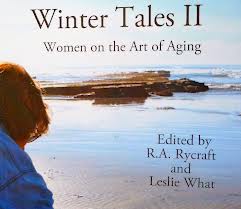
Winter Tales II: Women on the Art of Aging edited by R.A. Rycraft and Leslie What


Winter Tales II: Women on the Art of Aging
            edited by R.A. Rycraft and Leslie What

 Review by Alice Weiss

            If there  is an art to aging it is one we invent as we go along.  Art involves at the very least a particular way of seeing experience.  In this anthology there is a broad variety of such visions in  poems, essays, memoir and cartoons from women writers engaged in the project of inventing their old age.  The intended audience is also women and women “of a certain age.”  But I don’t think this is unjust.  Such an anthology has more than an underlying theme, it has a thrust, a purpose.  That is to counter the messages of the dominant culture. It hardly needs mention that for women age compounds the already difficult project of creating and sustaining an independent and autonomous self.  Speaking, writing words is a way of contending with that.  These are the words of that project.
            The scope of the material is broad and various, but the editors have not explicitly organized the material into themes, nonetheless certain themes do emerge, problems are defined, challenges explored.  Without intending to limit the richness of the individual pieces, I will explore some of these as they thread through the collection.  
            Here is the first theme, the clear challenge of age: the body.  It’s no longer the one you knew.  Every piece deals with this one way or another, some explicitly. Here are only one or two examples. In a poem that regards the body as an ironic “House of Mercy” Hester L. Fury recognizes, “I have to live here/ in these guts, these bones.”  In another poem, “The View from Here,” Betty Lynn Husted’s younger self cries out in horror at “A bent and hobbling woman /crossing the highway. . .”     but now through “joint pain.  Bone loss—lace designs on X-rays” she honors her.  Now she understands something in her “is already broken,” but she is still dancing across the kitchen floor.  Leigh Anne Joshaway in her essay “Facing Facts,” (note the pun) laughs her way through the shock of looking in the mirror and seeing, not her own, but Phyllis Diller’s lined and twisted mug.
            Another challenge: age has a bad reputation. This is nowhere clearer than in Jan Eliot’s comic strip, “Stone Soup,”  three panels of which are included. Grandma announces she is hosting her weekly poker game at their house, and the granddaughter says, “ I thought little old ladies played Bridge.” Grandma  in a last frame, “I could arm wrestle you into the DUST, Missy.”  Despite the bad rep or maybe because of it, age has hidden treasures and they are not here the traditional clichés. Elizabeth Murakowski, “I sin so much harder now.”  Ursula Le Guin; “the expertise of being lame. . . the silent furtive welcome of delay.”  Dorianne Laux, “Eventually the future shows up everywhere. . .[you] name the past and drag it behind/ bag like a lung filled with shadow and song,/dream of running, the keys to lost names.” 
            Michelle Bitting’s poem “Patti Smith after the premiere of ‘Dream of Life,’” takes that bad rep and shakes it like a dog shakes off water.  She builds from complex series of traditional and pop culture allusions.  The movie the title refers to is an account of the life of the seminal rock star as she returns to her career after a two decade break, a woman on stage with a “mannish mug,” “razor chin and dingy teeth,” “unshaven pits,” in short, a woman who defies conventions of female attractiveness yet who still brings an audience to “the hellfire heavens…[belting] the soaring refrain: G—l—o—r—i—a.”  Imagined  at first in the voice of two puzzled Jersey matrons wishing oddly to have been something like her, the speaker turns to her own sense of the singer in the final lines to address Patti Smith with this extraordinary invocation: 
 You are tracking Blake’s ghost
though the cemeteries, parks
and urinals of Paris,
every place his bony
misunderstood ass
is know to have squatted
and scribbled something beautiful
while taking an ordinary
everyday, entirely human piss.

            To evoke Blake’s  ghost is to remind us of another aspect of our lives, How things continue across time no matter what.  Just as we still read long dead poets, our lives contain facts that move through time as if there were no change and yet we see them anew as we change.  Diane McWhorter’s essay, “Stay Calm, Nothing Is Under Control” explores her life as an independent crafts person in a long lasting hippy community in California. She reaps the warmth and inventiveness of a life outside the ordinary institutions, but also recognizes the requirement to reinvent all the time grows wearying and dangerous she grows weaker.  In Lauren Davis’s essay, “Breaking Down”  the writer shows how age magnifies the always strange, strained relationship of mother and daughter.  The disintegration of the mother’s body becomes a metaphor for the difficulty of the relationship.  There is the failure of skin to maintain its protection of the body.  She sees an elbow bone all too clearly as if the  mother’s pain is demanding to be seen, as if that exposure were what love is.
            Pain is not the only continuous thing. Pleasures continue. In Alicia Ostriker’s wonderful long poem, “Approaching Seventy,” she explores the presence of past in the loving relationships with nature and with her husband.   Daring also continues. In ‘White Chin Hair and a Lonely Female Ccardinal,” Roisin McClean’s first person speaker relates an incident: she is masturbating in her bedroom with audible cries and sighs, sure that the house is empty, only to discover that her visiting daughter’s boyfriend had remained in the house and heard everything. This is defiance, the comedy of age.  Everything continues.
            And nothing continues. Finally we come up against the true thing, to age is to approach death.  It is to feel a fear with an intensity only glanced at earlier, perhaps after one has avoided a car crash on a rain slick highway, slipped at the edge of a balcony, or at the Grand Canyon.  In an essay notable for its calm acceptance, Supriya Bhatnagar’s “Memories and Misgivings: Death of a Friend” explores the imminence of  death in the loss of a friend.  She includes a careful and simple discussion of  Ashrama, the four stages of life in the Hindu religion, information added, almost it seems, for our comfort. In Elizabeth Murawsaki’s poem “Incense of the Blythe” she holds on, with humor and beauty, “It kills. . .[ her]. . . to die/ in the midst of orchards.”  And in another  Alicia Ostriker poem, a confession and  subtle metaphor in “Insomnia”
you brag to friends you won’t mind death only dying

what a liar you are—
all the other fears, of rejection, of physical pain,
of losing your mind, of losing your eyes,

they are all part of this!
Pawprints of this!  hair snarls in your comb—
Now notice the clock is the single light in the room—

            What the editors have done with this anthology is to define and redefine the “art” of aging.  It’s unquestionably worth a good read.

Wednesday, September 12, 2012

Terezin B.Z. Niditch


Terezin

B.Z. Niditch

Phrygian Press

58-09 205th Street

Bayside, New York

978-0-932155-20-7

31 Pages


Review by Dennis Daly


These deadening lines of sometimes discerning, sometimes defiling dissonance bestir us, hector us like some Old Testament prophet enumerating past horrors, here and there naming names and, above all, accusing the future, which harbors all of us, of ignorance or worse—complicity.


In the title poem Terezin the Eastern European world of 1942 passes by the cattle cars carrying the stunned Jewish families to the holding town or ghetto of Terezin, where many of them would be sent on to their appointed concentration camps and, of course, their deaths. The poet laments,


I carried my days

until we remain only a body

a historian’s vague nightmare

to a destination marked Terezin

with our aims throwing off

thin suitcases, blankets, towels

up to our waist in human dirt.


And this is just the beginning. The intensity and stridency of horror continues,


my father simply puffed out

by terror and night after nightmare

jumped off the train

from the bare-iced sheets

by howling hysteria

of mother pregnant with another life.


I know of no appropriate frame of mind or mood that can be easily summoned to handle this type of unrelenting assault well. But the insistent poem presses on. The prophet /poet wisely modulates the tone in two places by describing a child with a serious injured eye. Pathos is momentarily accommodated but barely acknowledged. Here is the earlier of these two affecting sections,


a warm boy holds out his hand

with tightly sweated fingers

his injured eye resembling

a yellow flamed torch lamp

no one wishes to acknowledge.


My Century, the very next poem in this disquieting collection, continues the righteous hectoring and the dissonance. It ends this way,


Those who forgive evil are the unforgiven.

Those who are good are known to the unknown.

Statistics cry in the night.

Statisticians of death have clean bureaucratic faces.

Historians move over the bodies.

Theologians move no one, not even

God.


Another poem that reflects on the tyranny of the Nazi years is 1944: Mid Europa. It works as a litany. Here is the Vichy France section,


death angels are desolate

hungary for children’s O negative

Quisling eats a four-course meal

Maurice Chevalier bows

Celine asks for human freight

Genet asks for primal sympathy…


And,


Sartre is recreative

Edith Piaf loses herself.


Niditch’s cumulative jeremiad reaches a crescendo with the poem, Berlin. Here the poet harangues,


Alleys close to joyless beggars.

A mighty fortress topples from metaphysics.

Wittgenstein has a solipsis of schoolboys.

Elan has its own gauntness for Heinrich Heine.

One’s cheekbones show our injustice.

Fashion coexists with fascism.


Believe it or not, the poet does back off for breath on occasion. The result is positively efficacious. The poem Exile of Boston contributes this persona-revealing piece of self-knowledge embedded in a striking image of an immigrant,


What playfulness

or riddled disasters

can I offer Boston

an exile in tentative sadness

when bitchery enthusiasms

self-indulgent necrologies

are put on this shoeless

pawned overcoat of a man

holding up a foreign body…


Also imagistic and a bit romantic is a piece called Boston Waterfront. The poet limns the scene this way,


A stranger’s tongue

squares off

I overheard

the freshness of water

and the fish bleed

in the delirium

of an exiled morning.


In the latitude

of transparent wind the blue-green ocean

outspoken in mortality

in the sanguine port calls

I am not ashamed

to weep along the sea wall

counting voices on the wharf.


In the poem Another Tryst Niditch reveals a well-wrought set of Kafka-like images. Nightmares and long corridors certainly seem to go together. The poet describes,


Now silence

is frozen in a well-lit

night spot

your spiky heels

will offer daily nightmares

and your understanding

creaking blows

of the cold long corridors.


The poet waxes subtlety and even bit of elegance in the poem entitled In Memory of C. Day Lewis. Notice that the subject has not changed, nor has the horror receded. The poet has simply put aside his prophetic gown for the moment. He says,


He was there in the sun

when nothing but a lilac

cold shouldered in the blitz

as the face of the dusk

fought the crime of night


The final poem in this chapbook returns to the poet’s prophetic tone and uses a staccato delivery. Niditch compels us to listen,


A chemical zyclon b2

To hell with D’Annunzio

Red flags us down

Eterna, play the chamber music

Leonardo is not only your cat

Michaelangeli plays Scarlatti

The red bearded snow dances

Where the streets are palmed

boys play boccie thinking of sex

Each generation offered

out from Moloch’s olfactory steel

for bread…


This is the second book of Niditch’s that I have reviewed. The first one—Lorca at Sevilla, filled with imagistic logic, I enjoyed more. In this one, enjoyment is beside the point. The poet here conveys his words with a prophet’s shrillness that overwhelms with its import and uneasy necessity. This chapbook needs to be read.

Monday, September 10, 2012

A Strange Frenzy: 17 Poems by Dom Gabrielli


A Strange Frenzy: 17 Poems
by Dom Gabrielli
Englewood, NJ: Unbound Content
ISBN-13: 978-1-936373-29-1
43 pages
$12.00
Release date: July 2012

Review by David P. Miller

Dom Gabrielli, a poet based in Salento, Italy, and writing in English, has produced this volume of responses to the works of Rumi, a 13th century Persian poet and Sufi mystic. Rumi’s ecstatic writing is probably best known in English through translations by Coleman Barks, with many other translations also available (see http://en.wikipedia.org/wiki/Rumi#English_translations). In his introduction, Gabrielli says that, although he had read Barks’ translations many times, his spirit took fire upon further rereading, and it was “almost as if my words were dictated to me.”

Each of Gabrieilli’s poems, titled simply with Roman numerals, is paired with a quotation from Rumi on the facing page. While it is not certain that the poems are direct responses to the quotations, it is intriguing to read them as if they were. I find that, considering the work from this perspective, Rumi and Gabrielli stand in counterpoint in different ways. In one instance, Rumi finds the beloved in every atom:

There’s a strange frenzy in my head,
of birds flying,
each particle circulating on its own.
Is the one I love everywhere?

Gabrielli’s paired poem (IV) may arise, in part, from his occupation producing extra virgin olive oil. Its physicality also points from materiality toward something ineffable:

every wane of dawn
with wicker basket and knife
with brown boots and burning fingers

i walk the same mounds of red earth
inhale perfumes of chamomile and fennel
watch the calendula open and close
its orange cup of promise

[.  .  .]

twisting black snake my basking companion

silence my mentor

my poems call Venus from the sky

Gabrielli’s poem XV seems to take Rumi’s simple expression of deep intimacy in a different and perhaps darker direction. Rumi:

How do we keep our love-secret?
We speak from brow to brow
and hear with our eyes.

Gabrielli’s poem concludes:

i do not need to look to find your mouth
nor call to hear your eyelashes caress my chest

you have grown vast also
like the deep underground rivers
without which you whole land of liars
would lie beneath us in cinders

This volume is dedicated to love, to the absolute unification of lover and beloved, beyond the ability to be expressed, and yet compelling expression. I am only somewhat familiar with Rumi’s poetry, but what always stands out is the parallelism between the discovery of matchless love between persons, and the absorption of the seeker into unity with God. As one consequence, the pronouns “I” and “you” become ambiguous, as they may refer to either level of reality, or both at once. I find this at points in Gabrielli’s poems as well. Poem XIV evinces both the ecstasy and the shifting sense of person:

[.  .  .]

throw me higher
than light falls on a leaf

kiss me there
in the vanishing dew of dawn

every word i write
has been to travel here

to where the dew evaporates

to where your fingers expose
the inaccurate beauty of love

to touch with my lips
the opening of the heavens

This is paired with a quotation from Rumi, in which the persons indicated by pronouns may be read in at least two dimensions simultaneously:

The inner secret of that which was never born,
you are that freshness, and I am with you now.

In the foreword to his earlier volume, The Parallel Body (Ziggurat Books, 2009), Gabrielli says that the writing “explores several ‘you’s’ as it travels toward a definition of love through poetry, towards a very intimate ‘you’, towards a harmony, both graceful and joyful, for which the poet can only be grateful.” A Strange Frenzy is evidently another step in that direction.

This is an elegant landscape-format chapbook, with cover art and line drawings by Emily Faccini. I wish that the Rumi translations had been credited, both simply to know whose work they are and also to allow for further exploration. Nevertheless, this encounter has me interested in reading more by Dom Gabrielli, and most likely to re-investigate the Persian mystic poets as well.


Saturday, September 08, 2012

And We’d Understand Crows Laughing – Poems (1997-2010), W. Nick Hill


And We’d Understand Crows Laughing – Poems (1997-2010), W. Nick Hill (Loveland, Ohio, Dos Madres Press, 2012), 83 pages, paper. ISBN: 978-1-933675-69-5. 

Review by Joanne DeSimone Reynolds

The title of Nick Hill’s new collection, “And We’d Understand Crows Laughing,” is a little cryptic and invites a question: What does one have to do to gain the ability to understand crows laughing? The title of the first section of the book, “Belongings,” made me wonder: Do we need to own or carry some thing or things in order to understand? The title of the first poem, “Skip The World,” seemed counterintuitive and begged yet another question: Skip the world and what, skip life?  But then I read the poem and began to catch on:

Tell yourself to value the notion of stone over water,
and whisper, Pick it up, and then just let it go.

Heft with the right, warm the arm.
Take bearings, estimate the curvature.

Feel the hand come around behind the ear, coiling,
releasing torque at the elbow,

snapping forward until it is
gone, its skipping course for a moment seen.

Throw into the waves
what you have endured.

Try to be the same each time,
hold fast against the zephyrs.

Throw hard into the angry waves
shoving forward with their burly shoulders.

The brute stone turns belly up and sinks,
its own dumb marker.

The dream, of course,
to skip it right out of this world.

Hill suggests we engage with the natural world wholeheartedly but with a touch of calculation in order to be fully of the world, to belong to it in an elemental way. Value possibility, the triumph of stone over wave and wind. Value perseverance; learn from what you have endured. Rely on steadfastness; believe in dreams. But the assumption of the last couplet leaves  a feeling of unease, a foreboding. A few pages later is the poem “Ars Peonensis,” with sensual, vivid images of a personified peony: “In March she was a honeyed knob, / an ant laden pincushion of promises, / a veined lollipop on a springy stick. / And then with cumulus in the blue / one afternoon she opened like a greeting, / a near chaos of tissues / bounded by a breath held and then released / soft as a chime . . . //  To keep her I cut her down, too late / to take back my error, once again.” Funny and a little heartbreaking. The narrator ends up with the wilted bloom in a compost heap, then fashions a simulacrum from paper and muses on “sapient cleverness // (monuments, tall ships, splitting atoms) . . . [how] compost // will need to teach me and guide me // . . . [to] watch the dark knife // of hubris become a shard // in the loam with the worms.” Fair warning to all stone-skippers! Late in this section is the very moving poem “Shakkei Memorial” about planting a cypress to “reverberate evergreen beside that massive sno-cone,” Mt. Baker, which lies in the distant background. Hill notes that “Shakkei is a Japanese term for a borrowed landscape in which a planting is located such that it participates in the distant view of a great feature of the landscape.” One need not know this to feel the deep reverence in the poem: “I don’t often address a tree so personally, / … I have noticed our kinship many times before, arms out / stretched, reaching, feet near clay, / eyes harder to discern, soul everywhere from bark to cone.” I found the first stanza to be too informational: “This time the deadline happens to be the first real winter storm / blowing south from Puget Sound sideways across the bay, / not some academic thing” and it detracted from the poem’s distilled beauty. But the first line of the second stanza, “And you bare in your root ball, cypress” really draws in the reader.

The second section, entitled “The Tides” is one long poem: the musings of one lover as the other comes and goes with regularity. Time, present time, when the lover is near, casts a kind of spell on the speaker, rendering him unable to capture the whole of the lover as he might like to. In the flesh, the lover can only be taken in in pieces: “It’s now that you seem most absent, ethereal, a fluttering / at the seed bin . . . a hand that must / be yours and I think I see you flaring there at close / range—though maybe I’m mistaken—the moments / passing through tinged eyebrows, then droopy / doubts . . but / where are you?” And further on “Sometimes the closer I get to you // The more you come apart, the sharp // Touch of a foot with toes, cold / And discrete.” It is a compelling theme, and Hill delves deeply to explicate it, but at ten pages it gets bogged down and hits too many off-notes: “If I held your skeleton any closer / you’d be me.” Or this: “Promised time fashioned itself into a mechanical bird.” The poem runs to the sentimental and risks cliche: “When you lie in bed together after twenty years / And you can still think to say, “That was super, sweetie.” Also, the poem is not served by the title “I Miss You Already,” which is then repeated as the first line to little effect. The section title, “The Tides,” is more apt and less telling, although the tidal imagery dries up. The reader feels buffeted about as the narrator swings between imaginings, past scenarios, and the present state of affairs with and without the lover.

The third section, entitled “Red Truck,” is an exploration of a landscape, a ruin of a truck, and someone referred to as “Somebody” who used and then abandoned the truck among the bramble. “Somebody” is Hill’s “Everyman,” whom the speaker in the poems sometimes refers to as simply “S” to imply a real but hidden person and to underscore that he/she is any one of us: you or me or a “ veteran of many wars, [a]street poet,” even the narrator himself. In the poem “Humanism Unveiled,” the speaker concludes the poem with the line, “But who is S. if not all of us between deeds and dreaming?” In the first poem “Red Truck,” the truck is referred to without an article to create a sense of persona, its first stanza – right justified – is quoted here in its entirety for its affinity to a certain wheel barrow:

                                                                                                    sun
                                                                                                    rise on
                                                                                                    red truck,
                                                                                                    rooster
                                                                                                    on a
                                                                                                    plastic
                                                                                                    bucket

Red truck is “…A one-ton ruin / That built the world as we know it / Remains of illusion // Not a pyramid or Xanadu / Not a poster for Communists or Capitalists / Not a glossy pin-up calendar // No landmark though it signifies / Rusting stolid, pistons seized … Satellite pictures a hunk of metal / Cousin to space debris / that falls in flaming chunks / bringing down / petite gods dreaming / from deep in heaven.” Red truck stands for America and for Americans, in fact for all of humanity, for dreams, for pursuit, for what we leave behind, for unintended consequences. In the poem “The Other,” the speaker pushes the concept of “Somebody” to a farcical conclusion, becoming “Nobody” as in “Nobody is somebody you could get into, like a part in a play. / Nobody lives here would be something like beachfront / property on a remote island. / Some of my best friends are nobodies. / We attend the yearly convention where everyone stands / around at the cocktail party looking at each other’s blank / name tags.” Somebody, everybody, nobody: who takes responsibility? In the poem “Blackberries In The Cold,” the epigraph “Come back to me is my request” brings to mind the primal fear of a parent sending a child off to war. In it, red truck seems a companion to the speaker: “Walking the trail beside red truck the blackberries taunt / from thorned labyrinths… In another season they will have covered your shape / completely in a barbed bower. / Their sweet tart taste but a harbinger of the grip of spines / about the heart, when we heard the names not coming / home.” Fitting, wrenching, and beautiful language.

Each section of Nick Hill’s collection is distinct in voice and tone. Intimate and awe-struck when engaging with the natural world in the first section, searching and self-reflective in the second, and social-political and authoritative in the third. Each replete with natural touchstones: soapberry, sedum and creeks; humus, tidelands, and volcanoes; salmon, salmonberry, and chickweed to name a few; and with off-beat places like Red Dog Farm, Cry Baby Hill, and Kah Tai lagoon. Hill uses Portuguese, Spanish, and a little French in some of these long-lined poems.  He is emeritus professor of Spanish and Latin American Literature at Fairfield University, and from the tender poem “Dona Alice’s Baked Apple,” about a mother and her recipe, one can surmise that he lived in Brazil as a child. I took my time reading this collection; it is dense and could have benefited from some pruning. But Nick Hill’s collection is intelligent, heart-felt, and varied in the best sense of the word. Poems such as “Thistles On Goleta Highlands,” “Water Tapestry,” and “Whale Creek, Near Queets” are engaging, lush lyrics. And as for crows laughing, it’s all in the poem “Seed,” which you will have to read, maybe while carrying one in your pocket “for guidance.”

Thursday, September 06, 2012

War All The Time John Bennett


War All The Time
John Bennett
Vagabond Press
605 E. 5th Avenue
Ellensburg, WA  98926

Review by Rene Schwiesow

In a 2011 interview, David Hoenigman, described John Bennett in this way:  “. . .John Bennett has always stood up for what's right and wrong in us, this country, the world. Big heart. Loud voice. Immense mission—to get it all down. For you to see what he sees. Like it or not. Think about it.”  In “Contact is How We Know We’re alive” Bennett punches it home.  And though “War All the Time” (part of a trilogy that includes “The Theory of Creation and “The Birth of Road Rage”) is copyrighted 2005, the words ring as true today:

Rugby, football and war.  Freeway carnage,
beaten wives, drunk drivers.  Elementary –
school shootouts, industry gone berserk in the
Congo – contact is how we know we’re alive.

Peace is for pansies.  Give us drill teams and frat
houses.  Sumo wrestlers, drive-bys and Mike
Tyson.  Bite the ears off of Jesus, cop a plea.  Talk
shows where we give vent to our grievance.

The face in the mirror turns its back.  We
shatter into a lifetime of bad luck.

Yeah.  “The truth,” Bennett says in “Drugs & Wars,” “claws at our backs like a woman in the throes of a climax” and then, “Historians dip their quills into blood” (“Flat-Line Reptilian Brains”).

You get the point, Bennett doesn’t wrap the ugly up in a bow.

Throughout the work he alludes to great writers, texts and individuals and each time the allusions jump from the page and grab you in the intellect, ask you to consider or re-consider the original thoughts.  For example, “Every child is Moses in a basket made of reeds that we bulldoze to make room for urban sprawl.”

He ends a work entitled “Pax Americana” with:

Are we having fun yet?  Good.  Now raise that
flag and snap to.  Mass graves full of children.
Tall buildings in rubble.  Genocide with a smiley
face.  You get the picture.


Myths to live by.

The hero’s journey.

It’s likely that Joseph Campbell did not have the above in mind when he told us to “follow your bliss.” 

Two last thoughts, read the book for the rest:

On a 10:00 am Sunday morning, church bells ring
whole families out into their cars, and just
outside the atmosphere, a huge bat circles the
earth, casting a shadow that covers whole
continents.  We call it stormy weather and
build solariums in the rain.  Giant buildings
come crashing down. . .

And we do not wish to pay attention, grasp the dire situation for ourselves, then for the children:

Our town.  Two kids sitting on a ledge, a boy
and a girl with white holes for eyes, untouched
by anything, kicking their feet in a world where
the clocks have stopped ticking, dreaming the
impossible dream, waiting for good things to
happen.

*****Rene Schwiesow is a poet/writer/reviewer/editor and co-host of the wildly popular South Shore venue, The Art of Words, in Plymouth, MA.