Wednesday, January 17, 2007


Greatest Uncommon Denominator
(a.k.a. GUD) – a new magazine of short/flash fiction
and poetry with surreal and beautiful graphics
by various artists in (mostly)_New England.
Issue 0- Spring 2007
USD $10
http://gudmagazine.com/
Contact: editor@gudmagazine.com.


GUD is a new journal of top-notch modern literature which embodies both eclecticism and unity. Its stories run the gamut from Gibsonian Sci-fi tales to moving emotional friezes about real people in naturalistic landscapes. Peppered with fine surreal and free-associative poetry that’s always got an eye to form, the reading public is treated to a rich cut of cake, including the often multi-media inspired drawings and paintings.

Here are some standouts from Issue O, released just this past month. Hats should be be tipped to all the editors and especially lay out editor Sue Miller and Instigator of the mag, Kaolin Fire (if that’s a real person, or if it’s not.):

There’s Beverly Jackson’s “Fade In and Fade Out” – a great three stanza poem – next to the mixed media work by Fefa called, “Changing Destiny.” The poem is about the shifting perspective one can have watching a movie, about getting lost in them and coming back around to the realia details that mark them also.

“My eyes are like the director’s. Eyes seeking out the monster. Looking for the love connection.” P 32

Fefa’s painting across the page looks like Frieda Kahlo or a Flamenco dancer rising above a dark medieval city with magical swirls of white issuing from her fingertips. It’s a real nice juxtaposition.

Poet Kenneth Ryan provides three short poems in this collection: “No Motor Home,” “Past Due: Final Notice,” and “Fortune.” Each provides an intimate portrait of compressed and visceral language. “No Motor Home” is about Cuddy Cabin in the woods and the fantasy of its being sea-born:

“when bog mists seeps over our bow/and your fingertips taste like salt/we’re finally out to sea.” P 124

“Fortune”, a love song, ends again in oceanic imagery:

“and the sea drew back from the beach with a sound like unstrung pearls cascading into your palm.” P 126

Short Fiction – which serves as the bulk of the journal – includes “Where Water Falls” by Rusty Barnes, a writer from Revere, MA. This story’s about a wife who’s pounding tenderloin a little too often and loudly for her bewildered husband’s comprehension. Set in a rural outpost, we become acquainted with rabbit hutches and the symbol of the hunted and captive, also the animal symbol of fecundity. As the mystery unravels with deft narration and concrete descriptions that never “lather it on” we find out that Maggie is, in fact, pregnant at forty-four. She’s also furious about it. Richard,

“watches the rabbit as it reaches the rock wall. He can follow the sound of Maggie’s tears as she runs crashing down into the back field toward a crick.” P 141

She proceeds to take him on a wild chase through the woods and winds up sitting by the crick on a rock without her pants on. In a strong dramatic turn, she waves a stick and threatens her husband to do it to her, as the abortionist will. It’s a pure cinematic moment, pristinely captured by his clear prose, and ends with Maggie proving her position and pain, then squeezing his hand with silent tears. Neither of them wants to keep the child, but that’s not the point, certainly not Maggie’s.

Another poet of note is Benjamin Buchholz, a US Army official recently returned from Iraq. In “Dialogue with the Hollows of Your Body,” he writes his first stanza in an unpredictable poem about desire and language and cultural congruities:

“When I am blind and very near to you
in the vesper stillness of a cell, small
and veiled from the street, through shiver,
heat, arch of back and hips, pressure placed
by the flat of your palms against the flat
of my palms: speak.

And ends, with:

“The body, like a map bears these significances.
Crease them, see where they cross: in the glens
And glades and most secret shrines,
At all of the roadsides and waysides,
I listen.” P 143

To prelude the short fiction of David Bulley, Sue Miller posts a ghostly rendering of what seem to be the heads of fish, eyes prominently stuck out in a Daliesque landscape filtered with gauze. The painting’s called “The Kiss.” And what follows is a fast-moving sort of tale of a man who transforms into the wolfman of his sexual fantasies….to take the school mother of a grade-schooler.

The narrator, speaking to himself, says:

And you are the wolf and you so so want to taste her fear, just a tiny bit, just a taste. “I want to fuck you.”

“Um, she says, looking around, checking the exits, nervous and shivery. “Um, are you threatening me?”

In the opposite chase scene to Barnes’ story, she takes off and the wolfman follows her till they proceed to bump and grind in a deliciously wanton sex scene under the moon. The tryst completely unmasks the hesitant and prim Teri, a suburban mom. Bulley writes as the wolfman:

“And when you see her next, smarmy and prim, at the bake sale, think about bright air and goose pimples.” A brilliant piece of flash fiction with a gorgeously poetic opening paragraph.

So like the entire collection. Get hooked!


Lo Galluccio

Tuesday, January 16, 2007


RUMORS OF ELECTRICITY by Richard Krech.Sunnyoutside, PO Box 441429 , Somerville, MA 02144. No price given. http://sunnyoutside.com -------------------------------------------------------------------------------------------------------------------Hugh Fox


First off, the whole quality of the printing/set of the book itself is astronomical. A beautiful cover of what look like embroidered plants, flowers,leaves, the kind of thing my mother had on all her needlepoint sofas and chairs. The typeface is Cochin, designed by Georges Peignot in 1913 trying torecapture the type-style of 18th century French engravers. The paper and cover cardboard all textured, whispering "Touch me!" And then Krech's poetry itself, just get a few maps of the MiddleEast/North Africa in order locate where the whole thing takes place.


Krech is aretired hippy turned defense lawyer, now retired as lawyer, totally soaked inNorth Africa and the Middle East: "By the Wadi Draa/at the end of the orad/just outside M'Hamid/the sign said "Timbuctu 2000 km."/ And beyond it the endless Sahara./In Arabic it means desert." ("Visions of Ted Joans on the Other Side ofthe Wadi Draa," p.14). Krech sees the Arab world the way I always saw it when I was surroundedby Arab students in the U.S., going to services in local mosques, meeting Arab friends and their families (and the Jews from Arab countries) in Paris...as exotic, historically fascinating, and fun:


"He came up towards me/to exchange greetings.//A young boy/perhaps 13, 14 years.//His back arched, pinched jacket,/turban, the flowing white tail/blowing in the Afghani wind.//His long delicate nose/& green eyes burning/with the wisdom & mystery of the East.//"Hello,hello," he said./I replied "Salaam." ("Chahar Square," p.18).


I've known Krech for almost forty years and I've never read a bad line in his work. Here in Rumors of Electricity he is the perfect guide into cultures and worlds that have been totally distorted by recent political events. TheArab world has been his obsession most of his life, and he rescues the culture, the world itself from the twistings and turnings that have turned it into dracula-ish horror in the last few years:


"At Prome on the Irawaddy/the greenwater has been slowing/past its lush banks/for thousands of years//the people have watched it flow/while they built their temples/and grew their crops, went to war/and to bed.//The brief spark/from any moment in time/infuses the present,/we are all here at once.//It all begins with you." ("Slow Boat from Mandalay," p.27).


Ibbetson Update/Hugh Fox/Jan 2007

Book Title: Winter Light
Poems by Alfred Nicol
Recipient of the 2004 Richard Wilbur Award
Publisher: UEP The University of Evansville Press
1800 Lincoln Avenue
Evansville, IN 47722
$15.


The title of Alfred Nicol’s poetry book "Winter Light" at first evoked in me the illusory gray of the long New England winters. This feeling was strengthened for me by the beautiful cover by Dozier Bell portraying a city, probably in Maine, covered by a grayish sky. This photo reminds me too of the winters in Russia in Chagal’s paintings. However, while reading throug his poems, Alfred Nicol’s writing gave me a different dimension of the light in winter. They are not always gray. The emerging crisp lights are already hinted at by the clear sun of the cover art which the author had chosen and is called Conflict Series no. 68. Yes, as in the cover, in Nicol’s poems are conflictive shades of lights and shadows.,


from the nostalgia of the loss objectified in the first five lines of the poem on page 4:

Rationale

You’d think statistics would console the heart
Where love is bound to fail (such is the norm),
It’s all in line with customary form
That what we built together falls apart;
We’ll look to science, now we’ve lost the art.
to the incommensurable desire for hope and other human feelings such as regret and doubt when Nicol’s non-traditional sonnet’s next lines say:
As there is no device to measure hope
For clarity we’ll simply rule it out;
Regret as well, and other such errata.
Results require a limiting of scope.
Remembered kindness, tears, the touch of doubt ---
What is all that but nonessential data?


to the intriguing questions raised by other people’s perception of the man when the poet uses a Shakespearean’s sonnet on p. 6:


What strange arithmetic is practiced here!
Of one body, one soul, I am the sum,
One man—and yet, as such must not appear;
Because if ten look on, then I become
Ten figures to shape an equation.
The variable is the sculptor’s eye,
Else I’d remain a single incarnation,
These several other selves not multiply.

Although rhymed and formal poetry does not usually entice me unless I read the greatest immortal poets such as Shakespeare and Jorge Luis Borges, I have to admit that the rhyme of Nicol’s poems is skillful and original. He is an excellent poet who knows the craft of formal poetry. In regard to the rhyme in the poem Rationale: errata and data are very interesting rhymes but I find those words somehow forced in relation to the rest of this poem.

One of the most interesting aspects in the poetry of Alfred Nicol’s is not only its content but its analysis of the depth of daily life in its simple structure. Further, while reading Nicol’s book, I felt that rhyme and meter appear effortlessly written because of the cadence of his verses; expressed with clarity and naturalness. However, the reality is that good rhyme and forms are neither easily found nor written. The choice of this book as the recipient of the 2004 Richard Wilbur Award is well deserved.

Original rhyme in the poem "Faint Prospect" (sonnet form, p.36) appears in:


what if and tiff // painted us so and years, we know // again and pain. I liked the use of the words: hesitation and separation // verse and suppressed // rest and best. In the poem Potatoes (p.38) I felt enchanted by the rhyme in the first stanza: pommes de terre and like the air and No reflection’s there; in the second stanza: reverie periphery could never be, and in the third stanza: root mute fruit // plot rot; in the fourth stanza: puttering fluttering guttering // one sun done // now plough.

I recommend reading the poem "Faint Prospect" to learn about rhyme, form and depth of meaning. Langston Hughes wrote: "What happens to a dream deferred?" Maybe the dream deferred of many poets is how to learn to write excellent formal poetry.


"Winter Light" is the book to read to learn through good examples. For instance, in the poem Maudlin Clay (7 quatrains, p.48) I love the following rhymes:

introduced loosed // true you // is not spot // tree me // time I’m // seed read // ache make. These are simply some of many other examples.

The Epigrams (couplets, p.54) are delightfully dark and very well written as in:

If I’d wanted a romance, I should have read one.
The only good emotion is a dead one.
Machismo in politics makes perfect sense.
A man well-endowed will not straddle the fence.
A few verses of mine are acclaimed a success.
The illiterate like recitation, I guess.


I would like to mention Nicol’s final quatrain of five in his last poem Sunday (p.66):

Something’s discovered in a day
Whose means are matched to gentle ends.
From a point of stillness far away,
A parable of light descends.

Because each poem in Nicol’s book made me feel that life’s moments and winter lights are parallel and are also a counterpoint to each other a parable of light descending as the poet says.
The events of our path for this earth are reflected in the poems in Winter Lights where even in a dark day, literally and metaphorically, the reflection might be clear and transparent while a clear day can be muddled by shadows of regrets and/or loss of love. The words of Nicol’s poems transmit all of this with wisdom and genuine grace. His formal techniques are well-honed. Whether you like formal poetry or not, I strongly recommend you read this book.

Beatriz Alba Del Rio/Ibbetson Update


.
.

Monday, January 15, 2007


The Somerville Museum Imagines Somerville

By Doug Holder

After savoring my usual oatmeal scone at my favorite haunt in Union Square Somerville, the “Sherman” cafe, I had the good fortune to talk with the curator of the Somerville Museum, who has yet another ambitious project in the works. Michael O’Connell has been the curator at the museum (which is well-appointed on the corner of Westwood Ave, and Central Ave. in the Prospect Hill section of our burg) for 20 years. His upcoming brainchild titled “Imagining Somerville, “ will according to O’Connell: “ Provide a unique opportunity to those on the leading edge of local creative culture to influence the way that Somerville is perceived and defined as a physical place as well as a social, cultural and historical construction.” O’Connell said that this comprehensive exhibition will include work provided by community groups, as well as individual artists who address contemporary issues of identity, context and sense of place in relation to Somerville. And even more intriguing to this dyed-in-the-wool poet, is the auxiliary programming and events that will include a poetry and narrative reading that O’Connell has asked me to organize.

“Imagining Somerville” will consists of one or more works of up to 12 artists working in any medium amenable to exhibition in the galleries of the Somerville Museum. This would include painting, photography, sculpture, video, site installation, etc… The works presented will reflect: “an ever changing Somerville as a literal subject of figurative experience,” according to a press release.

O’Connell’s collaborator in this artistic enterprise is Jessie Chamberlain, a Tufts college student at the Tish College of Citizenship and Public service. The Tisch School is providing partial funding for the event.

O’Connell, who has experience as a working artist living in the Fort Point Channel artist community in Boston, and as an art installer in the prestigious “List Gallery” at MIT; hopes to have the exhibition up and running by the first week of May. During that week there will be associated events as well as poetry reading with members of the “Bagel Bards, “a Somerville group of poets and writers. Local writers of all stripes will be asked to participate in an open mic section of the reading. The poetry, like the visual component, should reflect as O’Connell put it”…the wonderful diversity of the city of Somerville.”

Contact: Michael O’Connell mysticlakes@msn.com
Jessie Chamberlain Chamberlin@tufts.edu


Poets/Writers contact: dougholder@post.harvard.edu

ONE OF US ONE NIGHT
Poems by Mark Wisniewski
Platonic 3Way Press
Copyright 2006
41 pages


$5/

I’m handed a colorful chapbook scored with colored squares and rectangles like the modern painter Piet Mondrian. Sometimes the cover does sell the book…along with a neat postcard reproduction stuck in it.

But thankfully the poems are not like the geometrical art of said artist. They are magically real, naturalistic in shape and form, with &’s instead of ands, and also narrative, not very abstract. This is cool with me as I plunge in after the opening poem "Nebraska" about a hitcher and an ugly woman, "as ugly as that October in Nebraska." He’s "thumbing away from himself" and she’s rattling on about her paranoid, murderously angry life in a funny, would-be bad-assed rural way. And I kind of think Bukowski in the open land. But then Wisniewski twists me in these different directions: a basketball game at the Veterans Association, a cherry tree by the lake that gets aborted, a blue sky of buzzards, carpooling under the rubric of "Robert Redford" and all the surprises in topics and language do satisfy like oh, that chocolate martini and grilled calimari with spicy sauce, or even the 7-11 hot dog and red bull I drank at 4:00 a.m. More like the latter. It’s mixed up; but there’s a plan behind it. Kind of like, well, yeah, DeKooning. Is this guy Dutch though? Definitely not.

Or there’d be tulips wouldn’t there be?
Okay.

No, this guy, this poet, is definitely an American from the Midwest. He’s raw and cynical at times but he’s even, like the landscape at his best. It’s man (narrator) against his "California Girl" roommate, or man against raccoon as in "July":

"eat away
he thought
have the strawberries
too
the raspberries
the largest raccoon
noticed him
her paws at her snout
another shell cracked
& another
I can sit here all
night
the man thought
I am better
here
than anywhere."
p. 21

And furthermore divorce, litigation, radiation are not far from this everyman’s thoughts as he drives and is driven along some Nebraska highway with "the rich whitey on my ass in the Hummer." All the poems dangle like earrings down the page with those ampersands connecting fragments that build into something destitute or ornamental. And that supplies a beautiful and simple unity of form throughout One of Us One Night – the title seemingly referring to a game he plays again and again agsainst the would-be opponent. For there’s a story behind every scene and every chess move. In "San Antonio:"

"even the landlady
pretending high
heels aren’t that loud
squeaks of his mattress promising
that if any man
wealthy or not
simply breathes
long enough
he can work hell
into angels."
p. 28

He counts those miles driving, and he counts the amount of gas saved, money saved by motels off access roads "snaked behind a Denny’s and a Walmart or 2 truck stops & a Taco Bell." But the moral is usually that in-laws get stifled by windows shut from their ridiculing laughter and hearts are saved for belly-dancers, grudgingly for wives…

Wisniewski’s held two Regents’ Fellowships in Writing from UC Davis and won a Pushcart Prize and the 2006 Tobias Wolff Award.

Lo Galluccio
Ibbetson St. Press

Sunday, January 14, 2007


The Prince of Belvedere and other Poems
by Ephraim Figueroa
Tabor Press 2006
http://taborpress.com

There are many kinds of readers. My grandfather was a scholar who had a vast library of poetry from which he avidly read. He came from a generation who could quote from Chaucer to e e cummings with aplomb and when given the opportunity would argue the finer points of Alfred, Lord Tennyson’s body of work for hours, but he was the consummate literary snob. My mother, on the other hand, didn’t particularly like poetry but considered any act of creation to be a sacred event. For her, the urge to create was everything, the great mother goddess at work. She would take me to art shows (with their attendant poetry readings) and nod her head earnestly while some artists tried to explain their works. Her journalistic instincts dug and prodded until the poor subject of her inquest would cry “mea culpa,” and run away leaving my mother shaking her head and mumbling, “I just don’t understand it.” As if to prove a point she started entering her “bonnie ickies” in local art contests, usually winning a blue ribbon for her effort. She never did get “it” but became locally celebrated anyway.

Her opinion of the written word was far more liberal. Any act of literary creation was sacred and even if she didn’t like the work she would honor its creator. This was totally contrary to my grandfather’s view. He would read and argue with the critics, going so far as to write clever and argumentative letters to the book review editor of the New York Times on a regular basis. A poet’s work should be judged by his peers and by the critical public and eventually a literary force majeure pronounces a work and its author acceptable or not and to my grandfather that was that.

My mother was a part time working journalist. She recognized that on the on the scale of literary prominence she was at the bottom being just above the scribes working for Hallmark cards. She loved to point out that in his day Michelangelo was a working artist just like the hoards of artists that populate Madison Avenue and that the poets working for Hallmark cards made considerably more money and had a far larger following than most of the “hip” poets I liked. She started writing “little ditties” for the Readers Digest just to prove to my grandfather that literature was literature whether aimed at the highbrow snob or the workingman. She would publicly brag that she’d had a piece accepted by the Readers Digest just to make my grandfather cringe.

Everyone as a bias, of course, I like to read what I like to write. I like snapshot poems that paint a picture that can be seen with the eyes closed. That’s metaphorical, of course, I’m not saying that a short description of a still life equals poetry but I’m not tied to the form. Indeed the form has often gotten in the way of my own expression. My grandfather would object. For him the form was the very definition of poetry. A prose poem, a modern poem, a Gertrude Stein poem wasn’t really a poem at all but some shorter form of writing as yet unnamed. Perhaps he’s right. I’ve never claimed to be a poet and although I’ve tortured myself into writing a quatrain I didn’t enjoy it and generally don’t enjoy reading formula poems unless the formula drops away leaving the story, the snapshot in its wake. The “Cremation of Sam McGee” by Robert Service is great poetry as is e e cummings “little tree.” That’s my own bias. If someone were to write “little tree” today it would be judged sappy, no pun intended, and politically incorrect since it describes the murder of a little tree, the plunder of the forest so sweetly. Today “poems” by whatever form they take require meat, angst, anger and a little darkness. We get used to that and poetic forms with sweetness and light seem archaic and overly saccharine. I suspect my grandfather would approve.

All of this is a roundabout way of getting to “The Prince of Belvedere and other Poems” by Ephraim Figueroa. This beautiful little book contains more than 200 classically styled little poems. A quick reading reminded me of the “old poets” my grandfather would recite:

Among the Rocks
by Robert Browning

Oh, good gigantic smile o’ the brown old earth,
This autumn morning! How he sets his bones
To bask i’ the sun, and thrusts out knees and feet
For the ripple to run over in its mirth;
Listening the while, where on the heap of stones
The white breast of the sea-lark twitters sweet.

That is the doctrine, simple, ancient, true;
Such is life’s trial, as old earth smiles and knows.
If you loved only what were worth your love,
Love were clear gain, and wholly well for you:
Make the low nature better by your throes!
Give earth yourself, go up for gain above!

I don’t know why “The Prince of Belvedere” reminded me of Browning. It’s the sweetness and optimism and strict adherence to form, no free verse here, that made me think of Browning.

Tuesday
by Ephraim Figueroa

Tuesday comes to wake me up, he seems to say hello.
Underneath the sheets I stay, although its time to go.
“Eagerness” is not a word that properly describes
Starting out for work today, but still the mind decides:
Daily chores must first be done before it’s time to rest.
And so I leave, with cup in hand, to face my daily test
Yielding to the job at hand, I’ll try to do my best!

Yes, the initial letters spell TUESDAY and the poem is a rhyme and yes it sounds slightly Victorian in its tone. Cute. This whole book is cute and I’m not being cynical. This is not “modern,” “Language” poetry it’s in a more classic vein. No cutting edges here, just the soft, childlike purring of a neo-Victorian gentleman writing verse for the children and ladies of the household. If my grandfather wrote poetry (and I don’t know of any) he might well have written a book like this.

Anne
by Ephraim Figueroa

Beyond the horizon lies
A hidden treasure in your eyes;
And from it those who mearly gaze
Obtain much wealth for many days.

Maura
by Ephraim Figueroa

Your hair like golden sheaves of wheat,
Your eyes like stunning diamonds bright,
At once reflect the morning light,
No doubt, if ever they compete
In beauty’s realms, you would defeat
All queens on earth and them unseat

And so the author goes for 151 pages of easily accessible verse. Hallmark lookout. To be fair, the author is a self confessed lyricist of odes and hymns and his work shows it. If set to liturgical music many of these poems might well light up the otherwise drab interior of a puritanical New England church. I can hear a deacon musically chanting:

Till They see You Again
by Ephraim Figueroa

The bud shall not put forth its rose.
The streams of the south shall not repose,
Nor shall the clouds send forth their rain,
Until they see your face again.

My grandfather must be smiling after all his favorite all time poet was Alfred, Lord Tennyson whose work “farewell” seems appropriate.


A Farewell
By Alfred, Lord Tennyson

Flow down, cold rivulet, to the sea,
Thy tribute wave deliver:
No more by thee my steps shall be,
For ever and for ever.

Flow, softly flow, by lawn and lea,
A rivulet then a river;
No where by thee my steps shall be,
For ever and for ever.

But here will sigh thine alder tree,
And here thine aspen shiver;
And here by thee will hum the bee,
For ever and for ever.

A thousand suns will stream on thee,
A thousand moons will quiver;
But not by thee my steps shall be,
For ever and for ever.

Children of any age as well as mothers-n-laws safely tucked away in nursing homes will appreciate this book. It’s not for everyone.

Steve Glines/ Ibbetson Update/ Jan 2007

Saturday, January 13, 2007


Interview with Poet and Writer Nate Graziano: A Staple of Somerville’s “sunnyoutside” independent press.

Doug Holder

I first became acquainted with Nate Graziano through the now defunct literary magazine “Lucid Moon,” founded by the late Ralph Haselmann Jr., and the magazine Graziano put out the “Brown Bottle.” Over the years I have reviewed a few of his poetry books including “Honey, I’m Home,” from Somerville’s independent press
http://sunnyoutside.com/

Nate’s name is very familiar to anyone who has been involved in the small press the last decade. His work has been published in a number of magazines including the “Chiron Review,” ‘Poesy,” “Heeltap,” “Ibbetson Street,’, “Nerve Cowboy,” and others. He also has a number of fiction titles out.

Graziano resides in the hinterlands of New Hampshire, and teaches at the Pembroke Academy, in Pembroke, New Hampshire. He is also a part time graduate student in fiction writing at the University of New Hampshire. I talked with him on my Somerville Community Access TV Show: “Poet to Poet: Writer to Writer.”
Doug Holder: You are best known as a poet… at least by me. You are studying fiction writing—why not poetry? Which genre do you feel more comfortable with?

Nate Graziano: I think I always had a problem putting my writing in a specific genre. I like to think I just write. I consider myself primarily a fiction writer. Most of my poetry is very narrative. Poetry is more accessible in regards to publishing, as opposed to the short story market. Finding places to publish my short fiction has been very difficult. I have ideas and I fit them in whatever form that’s best in that space. Poetry tends to occupy smaller spaces, while short stories and novels larger.

DH: Some of your poems are scatological and make generous use of humor. Do you think humor cheapens a poem?

NG: I’ve been moving away from the scatological with my recent work. I think a lot of that had to do with my fascination with Charles Bukowski. You start to see how repetitive his work is, and the craft wasn’t always there. Bukowski was more iconic than anything else. As I get older I try to avoid the scatological but not the humor. The scatological is used for shock value. I think that wears thin after awhile. I think it does cheapen your work to some extent; not that it doesn’t have its place.

DH: Can you talk about the lit mag you started “Brown Bottle” some years ago?

NG: ‘Brown Bottle” was basically a solo act. I started it with a friend of mine Brad Edam. When I moved back to New Hampshire from Las Vegas I took it over. I ran it for 2 or 3 years then I burned out.

DH: Is editing a small press ‘zine a good way to cut your teeth as a writer?

NG: One of the good things about it is that you get to see how truly subjective the editorial process is. For young writers one of the most disheartening things can be the rejection letter. When you are sending out that letter you see how subjective that process is. For me it was realizing that editors are not gods.
DH: What do you think editors really want?

NG: They want a writer who really knows his market. Blindly submitting to a magazine because you want to see your name in print is not going to help your pursuit on any level. You need to know what that magazine is publishing; you need to know whether the work you are writing is going to fit in.

DH: Some writers go to New York, Paris, San Francisco, etc… You went to Las Vegas. Why?

NG: A job. I went there to teach high school. I was right out of college. My next poetry collection is about my experiences teaching high school. There was a romanticized idea of what I was going to do out there. I would experience vice first hand and tackle the tough life issues head on. But that’s like the cabin-in-the-woods myth.

Everything you do, if you are a keen observer, whether you are in Las Vegas or Union Square, Somerville is valuable material. There is a universal quality to the human experience.
DH: How does teaching fit with your writing?

NG: John Gardner pointed out in “Becoming a Novelist,” that the worst job you could choose if you want to be a novelist is high school teaching. This is because of the hours it demands and the emotional impact of working with adolescents. I always believed in the old Hemingway adage that “writer’s write.” If writing is something you are truly driven to do and your motives are pure—you are going to make time for it.

As of now I have to do the majority of my writing at night. I may forgo two or three hours of sleep, and I may be a bit lethargic in the morning. Anyone who is going to write is going to find the time. For me there is a guilt factor. It may be the fact of having eighteen years of Catholicism shoved down my throat. If I don’t write for a long time I start to feel guilty.

DH: In your poem” Reading Whitman to My daughter” your gay uncle asks (I hope tongue in cheek), if you are worried that your daughter will become gay if you read Walt Whitman’s work to her. But a serious query—do you believe in literature’s power of transformation?

NG: It has to be a symbiotic process. If you open yourself and allow yourself to be transformed by literature, than you can be transformed. Anyone who is a reader has had a writer who has a profound affect on him or her.
Depending where you are in your life literature has the ability to transform. When I was younger Jack Kerouac had that effect on me. But now going back and rereading him I’m not as mesmerized. There has to be a give and take process where the reader is opened to be transformed.

DH: You are an accessible poet I think. Do ‘difficult” poets like Wallace Stevens interest you?

NG: It’s funny because I do have a poem in my new collection “Wrestling With Wallace Stevens” There was a point where I read his “Emperor of Ice Cream’ for days on end. I tired to unravel that poem. There is a sense of satisfaction doing this, like trying to solve a riddle. Stevens would not be the first poet I would go to for recreation. I like poets a little more accessible than that. I try to make my work accessible. I think poetry has to find a way to reach wider audiences and wake them up.

DH: You have been published by “suunyoutide” of Somerville, Mass. How did you meet Dave McNamara the founder?

NG: David and I go back to “Brown Bottle” days. He sent me some poems and we struck up a correspondence. Dave and I have been in contact ever since.

DH: You are working on an MFA degree. What do you plan to do with it?

DM: Maybe manage a McDonald’s (laughs.) I am not sure. College teaching jobs are hard to get. The reason why I entered the program was to learn more about the novel. And I have.

Doug Holder

Friday, January 12, 2007


----------------------She’s my Best Friend by Jim Behrle, Pressed Water, 9 Columbus Square, Boston, MA 02116, 70 pp., $12.00.-----------------------------------------------------Hugh Fox-----------------------------------------------------

Review by Hugh Fox

For me reading Behrle is like reading the me I always wanted to escape from. I don’t know how many people can figure out poems like “Self-Convex Oath on a Tennis Court”: “vote for a black pope...kiss the barcode free Judas Iscariot/by Grand Central Station I shot a hooker.../alchemy alchemy alchemy teeth/5th Avenue is all rosaries & crucifixes/the images keep coming.” (PP. 42-3). Black popes, Judas, hookers, rosaries, crucifixes, Behrle, originally from Beverly Farms, an altar boy at St. Margaret’s church when he was young, the guy is soaked-soaked-soaked in Things Catholic, all the rituals, rules, obsessions, the anti-sex talk.
The whole Catholic thing as if it were in the Albigensian middle ages. And that’s the main thing that obsesses Behrle...along with his sexual frustrations, his immersion in city streets, city life. It’s a war between anti-flesh, ritualistic religion and the hopped-up profanities of modern street streets. Aided by the fact that Behrle fell strongly under the influence of Robert Lowell and was especially interested in Lowell’s writing about his own mental illness, a practice that to Behrle said: “Say it all, the way it comes to you.”
At the same time, though, Behrle is the soul of sophistication and plays poetry games like taking a line from every poet 3.in The New American Poetry (edited by Donald Allen) and turning the lines to his own uses in a kind of ridicule of and at the same time homage to the poetry world around him. You could write an essay on every poem Behrle has ever written, that’s how complicated a word-juggler/world-witness he is: “I want what everyone wants./The prongs of the vise,/a climbing italics of ardor. Newsprint black beneath the eyes...I want to know what the dream knows: what I love and why.” (“To My Valentine, for SM,” p. 59).

Hugh Fox/Ibbetson Update/ Jan 2007

Wednesday, January 10, 2007


San Miguel De Allende by Andrew H. Oerke, 2005 Swan Books Main Street, Pine Plains New York 12567 Editor: Stefan Janitschek 89 pages African Stilt Dancer by Andrew H. Oerke, 2006 Swan Books Main Street, Pine Plains New York 12567 Editorial Advisor: Stefan Janitschek 91 pages

Andrew H. Oerke, international aid worker, world-wide resident and traveler, company president, Golden Gloves champ, football player, professor, dean, poet-in-residence, Korean War vet, Fulbright scholar, etc., etc., recently added two book of poetry to his collection of published works. His writing is as crowded, varied, deeply eclectic as his curriculum vitae. In San Miguel de Allende (2005), roughly a quarter of the poems explore the geography and culture of this municipality on the Mexican altiplano. The poem "Christmas, San Miguel de Allende" displays both his signature strengths-rich language like "Lintels of Stonehenge hacked from shadows,"as well as the occasional tendency to overwrite. "The church is buttressed by a burro/slumped against it" is a simple and lovely line, but is immediately followed (and subsequently swallowed) by the mystifying "and children spill wax/hunting for a pad for a riding shotgun bride." Suddenly there's too much, I want to say Stop. Let me enjoy what is sublime here. For much of his writing is indeed sublime. From the poem "Wings on Good Friday": "How did the butterfly slip its halter/fly with weightless Michael to harrow hell/And abolish purgatory forever." There is much fine, transcendentwork in this volume. "Hawk on the Roadside," originally published in the New Yorker, is truly a diamond-it is glittery, hard, and clean-cutting.

African Stilt Dancer (2006), also beautifully presented with striking cover art, takes us through all of Africa, to the north, into Egypt, along the Nile,on Safari with the Masai, into the grasslands, beside the nomads in thedesert,along side oases, through the Serengeti, past the Nile Crocodile, up to the Elephants of Murchison Park. One doesn't read but rather travels Oerke's writing. The sights are invariably believable and true, even the train in "Night Train to Kisumu" tells us "Might as well accept it;\there are boats, there are cars\but they're merely the means to an end,\an excursionwithout a style." So then, ride on Oerke's train-"Stretch it out as long as you can."

Mary Buchinger Bodwell, Ph.D. Assistant Professor of English Massachusetts College of Pharmacy and Health Sciences Boston, MA Reviewer for Ibbetson Street Press

Monday, January 08, 2007


Interview with Poet Bert Stern : From the Banks of the Wabash to Somerville. Massachusetts.

By Doug Holder


Bert Stern is another Somerville, Mass. poet who lives right near my home on School Street in Union Square. In fact, his house is right behind the one I live in. So it was natural that I would want to interview him not only because of his location, but because of his long and varied career in the literary world.

Bert Stern was born in 1930 in Buffalo, N.Y. His first poems were made into a pamphlet by Gene Magner, the former curator at the University of Buffalo’s Poetry and Rare Books Collection. Stern wrote me that: “I received responses from Cid Corman and Robert Creeley and then felt confirmed.”

After graduate school Stern taught at Wabash College; retiring in 1997. Stern has also taught abroad at the University of Thessalonski in Greece from 1965 to 1967, and his second teaching experience was at Peking University (1984 to 1985).

After retiring from Wabash College Stern became an editor at Hilton Publishing, a company dedicated to bringing health information to the underserved, and especially to African-American and Latino readers.

More recently his wife the poet Tam Lin Neville, along with Stern and a few other friends have started a cooperative press “Off the Grid.” Stern wrote that: “We publish books of poems for accomplished poets over 60.”

Stern has also been teaching in the Dorchester, Mass. based program “Changing Lives Through Literature,” a program for people on probation.

Stern’s published writings include a book on the poet Wallace Stevens, a poetry chapbook, and poetry published in such magazines as: The American Poetry Review, Kenyon Review, The New Republic, Sewanee Review, The China Daily, and Ibbetson Street.

Doug Holder: You have been described as a “progressive” How was it teaching at a conservative, Corn Belt type of school, in the hinterlands of the Midwest?

Bert Stern: I played a role. And to some extent I was stereotyped as well. It’s not that I was alone. But I felt I had certain points of view to maintain and it felt valuable for that reason. My eyes were cocked at a slightly different angle than other people.

DH: How does Somerville differ from Indiana where you taught for many years?

BS: I was living in this inland land-locked place for a long-time. This certainly had repercussions with how I lived and related to people. The academic world became rather tiresome to me…I don’t mean the teaching…more the format. The school had certain formats of its own as a conservative college.

We chose to move to Somerville at this time in our lives, rather than slowly waste away in Indiana.

DH: You have been a teacher for a long time. Has teaching been a deterrent to writing poetry?

BS: I don’t think teaching has to be a detriment but it was. I let it be an excuse. I put very intense energy into my teaching. I think I taught creatively. So all the time I taught, poetry was on the back burner. I published some, but not much. In that sense it was detrimental.

DH: You wrote a critical book on Wallace Stevens. He is known as a “difficult” poet. From what I read of your work; you seem to have a different style and are accessible. What attracted you to him?

BS: What really attracted me…well, I consider myself a “reductionist” poet. Many of my poems, regardless of their surface patterns, really have to with diminishing movement. Stevens was as well. His poems, most notably “The Snowman” moves in that direction. I love the richness of his language, the same way I loved Keats. But I suppose I like the difficulty too. He made me feel like I wanted to right.

DH: You ever meet Stevens?

BS: Stevens isn’t the kind of man you would want to call up on the phone. I never met him. I met his daughter. I once even drank from his beer mug. When I was a kid I saw him at the New York Y. It was quite a spectacle. He came in his business suit, planted his book down, put his watch down on the lectern, and read with out even looking at the audience. And when his watch told him that his time was over, he just picked up and walked off.

DH: In your poem: “A Little Poem.” You have a humble man requesting a humble little poem.

“Did I ask to hear the earth thumping in it, like on a third day?/ Did I ask for peace, happiness, justice,/ the wicked withering away?/ No a little poem only, to watch water flowing through rocks/ fishes still in the current/ geese flying over/ noisy, like children.”

What are you asking for here?

BS: I am asking for the power of embodiment, which all poets ask for. To make words, and bring out the sound we want. That’s a big request.

DH: You told me to a certain degree you have come back to examine your Jewish roots. Why did you stray?

BD: It never took. Paradoxically even as a kid I was spiritually hungry. I think at that time Judaism meant ritual. There was a lot of complicated reasons. By the time I had my Bar-Mitzvah I lost interest.

I guess I came back to it for the sense of ancestry and family. I could track back. I am the product of a lot of people’s feelings and sufferings through the immigration process. The older I get the more I look like an old rabbi.

DH: Any Jewish writers you particularly like?

BS: I do like Saul Bellow, not necessarily the man but the writer.

DH: Did you like Henry Roth’s “Call it Sleep?”

BS: I think it was too lacerating for me.

DH: You founded the “Off the Grid” press with your wife and a couple of friends. It is a press for poets 60 and over. Why did you choose 60 as the demarcation point, and why is a press like this needed?

BS: The particular age was arbitrary. There comes a time when you reach an age that you don’t want to do the contests anymore. You maybe feel you are in a world where young people call all the shots. You might feel out of place with the taste of the time. I retired from my other publishing job so this filled in nicely. We have rejected seven manuscripts and published one. The one we published was by Henry Braun. We put that out as our calling card. Tam (my wife) and I really want to put out not just a good book, but a really good book.

DH: You are quite well traveled. Can you be just as good a provincial poet?

BS: Stevens never went away much. It is a temperamental thing with me. I have the sense if you only know one world you don’t know anything. This is true for me. Frost’s poetic scene was provincial, and Williams by definition is provincial.

DH: You are involved in a program “Changing Lives Through Literature.”

BS: In a way it is a religion for Tam and me. Our classes are for people on probation in Dorchester. It is the most exciting teaching I have done. So much is at stake. To break through the suspicion the street requires, to earn trust, to open hearts and minds, is a big thing.

Doug Holder

Thursday, January 04, 2007

Cyclamens And Swords
And Other Poems about the Land Of Israel

Art Work and Poetry by Helen Bar-Lev
Poetry by Johnmichael Simon

Printed by Ibbetson Press, Boston, MA
Contact the authors at: hbarlev@netvision.net.il
Or: j_simon@netvision.net.il

Approx. 75 pages of art and poetry

Reviewed by Katherine L. Gordon,
Author, Editor, Publisher, Judge and Reviewer,
Resident Columnist for Ancient Heart Magazine.


The title poem “Cyclamens and Swords”
leads the reader into the razor-fields of barefoot choreography
that is the daily dance of life in Israel to-day.
The artistic device of Johnmichael Simon’s
insights into each venture, accompanying Helen Bar-Lev’s words and
illustrations , is a gripping combination that enhances the whole book,
with two writers weaving and completing the theme like a classic chorus:
H. Bar-Lev: “sheep in a barbed wire fence”, J.Simon: “bunched between
the sprawl of Europe/ and the dark shroud/over Arabia. H: “reminding us
we are still in Israel,/that this is not yet paradise” “in a forest at peace
with itself/ a kalysha rocket’s lob away.”
The achingly beautiful cover of timeless trees, earth,
flowers and rock, is redolent of Israel’s destiny. This little land, so hallowed
in human history, seems the literary and spiritual core of existence to most
of humanity. If strife is ever present here, how can there ever be
the peace of ancient promise? This land seems to symbolize the eternal quest
for harmony where forces of turmoil march ceaselessly. Bar-Lev and Simon
explore this theme for us. Perhaps Helen Bar-lev’s observation “in my painting/
human-free” is much of the answer.
The paintings in this book are breathtaking. Helen Bar-Lev
manages to capture a brutal beauty, the sense of land that coaxed us to evolution
then left us unrequited on its rocks. The colours and contours seem internal
and universal. Johnmichael Simon gives the art of verbal painting to Helen’s work:
“Grafting words onto birds/we watch them fly the north wind.” “sailing like
rocket shells/ exploding in long weeks of coloured stars.”


Something poignantly lovely touches you in these pages:
the very human mundane concerns (hot water, the baby’s hunger, the cattle)
“Life is easier for a cow, for a sunflower.” Homely concern with a back-drop
of unceasing conflict is dramatic, a pulse that permeates the moment, disturbs
thought and enlightens the reader to reality in the dream symbol.
Israel’s botany is caught in words and painting to surprise the spirit,
birds enliven the skies, ancient hills brood. The poets have framed the land for us with freshness and wonder. We gain a new depth of appreciation for the visions born of this land, as Johnmichael Simon writes in Galilee Sunset: “like soaked disciples in the
sea of Galilee.”
The language is lush and powerful connecting the inescapable past
to the tenuous now: “the milk and honey fish ponds/of this holy land.” “we wondered
if the caravans then/were also awed by the pelicans.” A Thin Red Line “that divides
yesterday from today.”
Helen and Johnmichael visit, and write of, all the storied places that
resonate in so much of the world’s cultures. This is a special gift in a book that offers
a wealth of verse and art, answering our eager questions about this incomparable land
and the experience of living there. Yes, life and love continue and evolve in the long
link from cave to bungalow, each bitter-sweet moment cherished. A sense of the brevity
of life and longevity of landscape, both violent and creative, resonates here.
These are very talented writers who have developed together a total immersion
experience into the literature, geography and art of the lands that birthed these
phenomena.
Cyclamens and Swords gives the reader a “millipede of thoughts.”
There is the thread of peace and war so important and relevant to our times:
“we pulled the peace/over our eyes/so as not to see/how porous it was.” “the
iconic laughter/of middle eastern reality.” “it is the place peace goes/to meditate.”
Helen Bar-Lev’s painting of Jerusalem will stay in your heart’s-eye,
as will her poem to this city. The reader will be drawn into it with an ancient desire.
Johnmichael Simon sounds an accompanying chord , a symphony of hope and despair
in The Wadi, as does Helen with “like a cello string too taut/may snap at any moment/
in mid-note.” There is an overall note of tenderness in many images, so vivid and beautifully phrased, in love of place and persons: “you have fallen asleep/
on the blanket of your shadow” by the River Jordan.

Cyclamens and Swords will become a treasured classic, echoing
as it does so fluently, the longing, fearing and questing that marks these troubled times.
Helen Bar-Lev’s poem Beauty sums up the reader’s feelings as we reluctantly
finish this special book: “and I,/the ingrate,/ever insatiable,/implore you,/
please,/ show/ me/more.”

Katherine L. Gordon.

Wednesday, January 03, 2007

The Boston Poet Journal. Virgin Voyage. (Boston Poet Publishing 19 Oakridge Dr. Londonderry, NH 03053) $10. http://www.bostonpoet.com http://www.lulu.com


I remember rushing down to the long-defunct Book Cellar in Porter Square, Cambridge to get my copy of the "Boston Poet" some years ago. Many of us local poets often published on these pages, and more than a few got their first credits and moved on to publish and read widely. It was a scrappy newsletter, with right-on interviews, poetry, listings and reviews. Diana Saenz, the founder, writes in the forward that the journal is a "third generation" publication. After changing ownership for a few years, it later morphed into an online enterprise http://www.bostonpoet.com. Now it has reemerged as the "Boston Poet Journal" and Saenz is back at the helm. The inaugural issue has poetry from many of the stalwarts of the Boston poetry scene including: Afaa M. Weaver, Raffie Wolf, Walter Howard, C.D. Collins and others.
Walter Howard has a poem dedicated to the Boston poetry impresario Harris Gardner titled" Winter" Howard writes like a modern day Shakespeare recounting the call to of all places the Warwick Museum of Art in Rhode Island for another session of Gardner’s "Mad Poets’ Café" reading series.


" Into the windswept night
We flew
naked to the winter’s wrath
his terrible swift sword
Warwick our goal
To Warwick!
heart in both hands
storehouse of honey
harbor of wounds."


And poet Afaa Michael Weaver remembers his first car and uses it as a vehicle for a rite of passage for the young blue collar Baltimore black kid he once was:

…In motion,
a car’s wheels are the signals of the way
its soul hisses, sucks in its breath.
It breathes air like that spring air
of purple and yellow when I washed
the first car I ever drove, as Uncle Frank
let me turn it around in the alley.
I dreamed of chasing women with a machine
that could play music and smell like evergreens.
I dreamed of the hunt and being in the cut.
Uncle Frank through in men’s mother wit
to keep me out of Baltimore’s apocalypse--
A black man’s gotta wear suit and ties,
A black man gotta have a private world."

This is a fine rebirth of the Boston Poet. Highly Recommended.

Doug Holder/Ibbetson Update/ Jan 2007//Somerville, Mass.

Thursday, December 28, 2006


Molly Lynn Watt


Popular Cambridge, Mass. Poet and Fireside Reading Host at the Cambridge Co-Housing residence, Molly Lynn Watt, has a released a poetry collection with the scrappy Somerville independent press: "Ibbetson Street" Fred Marchant ( Author of "Full Moon" and Director of the Poetry Center at Suffolk University in Boston) writes of Molly's book: ""Shadow people begins far away and takes us on a journey home. We move from the Mendenhall Glacier in Alaska to the Redline in Boston....We begin as observers but by the end of the book we have joined with Molly Watt in the dance of her life, and our own." Copies can be purchased at http://www.lulu.com/content/596300 or through the Ibbetson Street Press 25 School St. Somerville, Mass. 02143 in the coming weeks

Sunday, December 24, 2006


These books are available at "The Lost Book Shelf" Cervena Barva Press http://cervenabarvapress.com or from the Ibbetson Street Press 25 School St. Somerville, Mass. 02143


Robert Olen Butler ( Pulitzer Prize Winner) on Doug Holder's Poetry:

"...you have a major league talent man."


Dreams at the Au Bon Pain by Doug HolderIbbetson Street Press, 2000


"a delightful chapbook of poetry." Diana Der-Hoveanessian, NEPC President


Doug Holders newest chapbook, "Wrestling With My Father," was Nov-Dec 2005 SPR *pick of the month $5.00 16 Pages In Stock: 3

Poems of Boston and Just Beyond: The Back Bay to The Back Ward by Doug Holder1998
*Pick of the Month, Small Press Review

Thursday, December 21, 2006


Body Language: Poems of the Medical Training Experience. Edited by Neeta Jain, Dagan Coppock, Stephanie Brown Clark. (BOA Anthology Series No. 2)
Rochester, NY 2006 $22 http://www.boaeditions.org/

In the introduction to: “Body Language,” Poems of the Medical Training Experience,” Jack Coulehan writes: “In ‘Body Language’, the editors have chosen poems that evoke the entire spectrum of medical education, beginning with medical school and residency training, and ending with full medical citizenship, as an attending physician…The book’s medical education framework provides the reader with an in-depth history of the conflict( and ultimately dynamic tension) between tenderness and steadiness in medical practice.”

This is poetry with a bedside manner. We are so often confronted with overworked doctors with huge caseloads that we find there is very little time for human contact, much less clinical. But if these doctors are any indication of the crop out there; then the medical profession still has a healthy population of sensitive and feeling beings.

There is a lot of excellent poetry to recommend this anthology. Kelly Jean White, a major presence on the small press poetry scene for years and an internet acquaintance of mine, has a number of fine pieces between the covers.
In her poem “Pandora” the poet deals with the Pandora’s Box of a hidden cancer in a 56 year old man she encountered while training at Massachusetts General Hospital in Boston. White, true to form, laces her work with striking imagery:

“I bring him a coloring book picture
that shows him this thing, this unfamiliar
organ that melted beneath our hands
at dissection:
Pancreas…

Leaving his room, crying,
avoiding classmates,
I take the back stairs.
I find myself locked,
coatless in the courtyard outside.”

My wife, the poet Dianne Robitaille, is also a Registered Nurse (who worked at MGH years ago) loved the poem “Foley,” by Mindy Shah. I had to concur; probably for different reasons. Shah follows of all things—a man’s penis—from its salad days to its undignified decline:

“As a kid you pissed
your name in the snow; at sixteen
you showed it to a girl
for the first time, face damp
and flushed. Now wires
thread your body.
I pull your old penis
from the fat seat of your thigh
and hold tight
as the catheter slides in to let
the blood and urine out,
tubing taped to your leg.
your glorious moment passed—
my first one.

Highly Recommended.

Doug Holder/ Ibbetson Update/Somerville, Mass/Dec 2006

Wednesday, December 20, 2006


" Did I mention that Mr. Slavitt is also a pornographer?" Alex Beam on David Slavitt.


In today's Alex Beam column in the Boston Globe Beam writes about Slavitt's many literary accomplishments. Now, you remember Slavitt( the gentleman) who read a poem about how much he dislikes the poet Robert Lowell at the Somerville News Writers Festival, and was trounced by Tim Toomey in an election for state rep. He also has a book out "Blue State Blues" about his campaign against Toomey. Now it seems that Slavitt has had a great career in another genre: Porn, according to Beam:

"Writing as "Henry Sutton" Slavitt grabbed the brass ring with his 1967 soft-porn bestseller "The Exhibitionist." which sold 4 million copies. "It's every English majors dream...I put my children through college and continue to write poems and translate Ausonius, whom nobody has ever heard of." Slavitt said. Beam writes " During his campaign against Toomey, Slavitt worried that his other works might come to light...his 1987 work "The-Book: A Child's First Book of Pornography." which he calls "my fist porn version of Dr. Seuss's "One Fish, Two Fish."

On Slavitt's hometown Cambridge, Mass: He asked his son Evan ( a lawyer) how he should handle any questions regarding his alternative literary history during his campaign against Toomey. His son, evidently a chip off the old block, replied:

"In Cambridge? There are no community standards."

Tuesday, December 19, 2006


Living In Dangerous Times. Linda Lerner. ( PO BOX 792 Rockford, MI 49341 http://www.presapress.com/ $6.


Linda Lerner is a Brooklyn-based poet who is passionate about poetry’s potency in our increasingly frightening and alienating age. Having interviewed her, published her, and reviewed several of her books I can say she shoots from the hip, is politically engaged, and at times very erotic. Like Lifshin, she is a popular poet, and although she teaches at Brooklyn College, her poetry remains outside the gates of the academy. In the poem “Who Dares Invoke The Bard?” Lerner is full of righteous indignation about the reporter who described Howard Dean’s primal scream as a “mad howl.” Surely not a “howl” worthy of Allen Ginsberg:

“ What “mad howl”
Allen would have fumed…

his ashes stir in its urn
at the very mention…

eminds us who rammed past
Columbia’s hollowed gates
more than fifty years ago
freed poetry a whole decade
marching in robot lockstep
nation: to breathe in
our own rhythm.

the sound that still reverberates
loud as all hell.” (9)

Linda Lerner is a fine addition to Presa Press’s “Contemporary Poetry Series.”

Doug Holder/ Ibbetson Update

Friday, December 15, 2006

"BIRDMAN: A MEMOIR" by Lo Galluccio


Lo Galluccio
2 Clinton Street, Apt. 8
Cambridge, MA 02139
(617) 876-4534

Lo747@hotmail.com


Lo Galluccio is a poet/vocalist and the poetry editor for "The Alewife" a monthly newspaper in Camridge, Mass. Her most recent poetry collection is titled "Hot Rain" ( Ibbetson Street Press)

BIRDMAN: A memoir

“You were an emperor with a sword who looked wounded
like a birdman after a storm. Your tongue like a garter snake enchants me…”
Lo song lyric

I wore an army jacket with brass buttons, double-breasted and green and walked around the night in sunglasses. Gloss on night: darkness over darkness to see the night, to be alone. Taking the A train, I went up to Harlem one day to find Jean Michel Basquiat’s paintings. I’d run into blonde-haired and waifish Billy Martin (of Martin, Medeski and Wood) at the MoMA and for some reason, he also loved Basquiat. I guess part of that was Basquiat’s association with John Lurie, Bandleader of the Lounge Lizards, which Martin was a drummer for. John ran with Basquiat in their dope days, dope days that killed poor Jean Michel, that Lurie and others recovered from.

In a small Harlem museum, there was a ring of Crown King paintings, black with silver and gold and colored chalk. Basquiat invented his cartoon icons of America as an outsider. And I was feeling this in myself. I remember the exercise of taking the subway up there and staring for hours at the paintings to memorize them. To switch my right brain on and open up my imagination synapses. My soul trembled with delight and said yes to the inverse narcissism, the codes, the blackness and the bones of the paintings.

He became my favorite post-modern painter. He began to open up my eyes. Why were they shut tight? And why did I feel blinded? This I will come to.

Maybe the reason I called Tronzo Birdman, was the look he had on the Queen of all Ears CD, the Lounge Lizards record. You see him --bald with squint bright eyes – wise bright eyes and his funny bird nose at the camera. And that was the creature of a man who had mesmerized me with his anger and his guitar’s heavenly blues oratorios. He was my former lover and boyfriend, Tronzo. Most people downtown then in New York knew the Lounge Lizards was the hip white Duke Ellington orchestra of our day. Or Count Basie to the Jazz Passengers’ Duke. Still Birdman and Lurie were rivals of a kind. Tronzo was happy for the gig but he always found Lurie to be egotistical and too much a showman. I loved them both, though Tronzo would later say I was more like John because I had stage-presence, was the singer.

The reason I needed to re-configure my mind’s eye was because I’d been pink-slipped and put in a psychiatric ward by a man named Dr. Dollar a month or so before that. Dr. Dollar (real name) was a Southern psychiatrist to whom I’d been referred by several friends who thought I needed medication for my “depression.” After the Birdman cast me out I was punished for a suicide attempt in a way that forever changed my life. And this is a story about that, and about how grief will run it’s course. Larry explained to me that “pathology” means, in Greek, “the logic of grief,” not mental illness. Larry Joseph was my mentor back then; a brilliant law school professor who wrote a book called, “Shouting at No One.” Here in America we still pathologize our imbalances and emotions. I learned a harsh lesson that by trying to take my own life, it became the property of others who could lock me up. Lock me up away from the source of my suffering, but not heal it with deeper understanding or joy. No, it was yoga and the piano and winter and mysticism and love that do that…or almost do.

My father, Tony Galluccio, died when I was 15. A child of grief and unclear about real world machineries, psychiatries, confineries – after refusing pain medication for my busted neck, I took those same pain pills to kill me. And I fell asleep like a dream of dying, not a massive overdose or bloodletting like the Godfather’s failed lieutenant. The kitchen window in my small studio was covered up. And after swallowing 6-7 Naprocyns, I turned on the oven and fell asleep. I woke up an hour or so later, feeling queasy. And I knew I wanted to live, that it had been a childish attempt to erase my life, under the shame of losing his love, which had been so great. The Birdman, that is.

Let me tell you something more about the Birdman. He could play his guitar like a laser beam of violet blues light. He’d internalized the blues of the early 1900’s like John Lee Hooker or Blind Lemon. He had the ego of Santana or Hendrix. But he’d boozed when he first came to New York City and blown up at bandleaders and got into mighty trouble despite his mighty talent. The first night we made love together…it was a slow fade into dawn with him sitting behind me like a birch tree, his arms coming around me as we walked ceremoniously to the bed. Like a rocking horse he took me. He hadn’t been with a woman for awhile. It hurt me a little and I also loved his taking possession of me physically with ecstasy. The next morning we sat in his little kitchen in the E. Village and he wept. He wept and I knelt down before him. He said to me it was because of all the guys he’d lost to booze in Times Square. He couldn’t believe he was still alive and they were all gone. I was amazed at this display of sorrow, the intensity of the grief.
Already, I’d played my song, “Queen of Mars” for him, in rough form, and I’d already gone to dinner on India Row with him on Thanksgiving, both of us apart from our families. I felt like he was my guide, in love and in art. There I was in a cream-colored trenchcoat, looking like a French movie actress, working as a secretary when we first met on the Upper East Side. We were both staying with friends until we found places downtown, within a few blocks of each other. So when he cried and I thought to myself, “Oh, no, Oh, yes,” What do I do about this man? I either run now and keep going…or I say, I’m here for you and we’re together. Later I would write a poem about the little fisherman who would come into his head and ride the ocean of the tears he cried. It was called, “The color of January.” That day, I walked away, down 6th Street, knowing love, and knowing too, that even more than our damage and desire was the music. The music was what I wanted.

“Your eye a scar, slants bird toward me winging in.
And the corner of your eye…became a bird.
And the corner of your eye…became a bird.” Birthday, a song, Galluccio/Tronzo

It was at a Lounge Lizards’s concert. It was John Lurie, the actor and sax-man who always reminded me of an outfielder, with his stance and Roman God’s profile. It was my dream of a bomb going off – the color orange. It was another dream. Later I would look back and say, “Why didn’t I follow the message of the dream?” The only orange in my apartment was Tronzo’s amplifier, and the bomb exploding was him. That was what my psyche was warning me about. So, why not avert catastrophe?

I saw Lurie on stage and Tronzo was playing in the band. We’d been together for a year and collaborated on many songs. Our band, “FishPistol” delighted audiences in downtown clubs. I was Lucy to his Ricky. I was also just myself. When the Birdman took me home that night, angry I’d shown up at the wrong show time, and on his way to Europe with his trio, he snared me. In that apartment on 6th Street that reminded me of Amsterdam, where we’d written “Creamsplit” and “Birthday” together and I’d woken up early and gotten to Arrow Shirts to earn my living, Tronzo threatened to strangle me to death. See-- when you say Tronzo, it could be a Japanese gangster also. But it was also the Birdman who exiled me at 3:00 a.m. into a dark New York night. His plane to Europe cut through the sky and my stomach turned the next day when I felt my heart leave the planet Earth.

About a month later, after that suicide attempt, I woke up and threw up and felt okay. I was not okay about losing the love of my life. I was okay about death not eclipsing me. I was okay that fate had kept me alive. What really happened was this:

Instead of showing up for an appointment with a shrink at St. Vincent’s I called and told Dr. Dollar the truth. The hospital scared me. He called the police and five of them showed up at my door to take me to the psychiatric emergency room. It was a two-week incarceration in a locked psychiatric unit with idiot doctors and a bunch of poor trapped inner-city adolescents. The guard, when I’d signed in under coercion, said to me, actually said to me, “It’s like walking onto the moon, huh?” Too hurt and terrorized to speak, I didn’t say, “No kind of moon, I’ve ever seen.” My roommate was a girl named Cecilia. She talked and talked about her adoration for Barbara Streisand. The first night inside, I stuck my fingers in my ears to block her out. I didn’t sleep for 48 hours because I was afraid of what it would do to my mind’s eye. A tall man with white hair arrived on the ward who smelled of books and patchouli. I trusted him. He said to me that his wife had been an ex-model who couldn’t take aging so took 60 seconals and turned purple on her side of the bed. He was so depressed, he was having shock treatments. Cecilia had had them since she was younger. She painted. I grew to like her. It was a wild wild ride, a grim story. However, what finally turned things around was a fifteen-year old Latin girl named Danae. She had been walking around silently with her hands pinned to her thighs. She has been there for months. One night I watched Danae pick up a framed print off the main corridor –and there really was only a long one and a shortish one in an L-shaped ward—and smashed it on the ground. And she started screaming. “I’m too young to be in here. Let me outta here. I’m an artist and this just messes me up.” That’s what she yelled over and over to the nurse’s very uncomfortable astonishment. This statue of a girl, had completely flipped over into rage and a voice. It was revolutionary music to my ears. The next day she was released to her parents. Soon after, so was I. Not before I watched Cecilia straightjacketed; not before I was threatened with brain scans because they thought I wasn’t thinking “clearly” when I questioned their methods.

Then I wrote “Bright Star/Shot Horse”

"You take me down a corridor where dreams turn into television.
The color of your potions won’t replace the color of my visions.
You ask me do I hear voices. I hear voices like the sea.
You want me to take my trilophon, I drink my asylum tea.
The color’s red in my museum, it won’t fade in your cure for me…”

I didn’t want the Birdman to know I was in there. He found out anyway.
When I got out, the first night out on the town, I caught a cab with John Lurie. Think I had on the blue-striped shirt Tronzo had given me and some purple bell-bottoms with sneakers. When I told Lurie what happened, he said, “Sweetheart, you’re much braver than I am, trying to kill yourself.” “I could never do that.” I told him all the kids in the unit said, “mad this” and “mad that.” This was the same Lurie who plays it cool in the movie, Stranger than Paradise. He’s an immigrant who knew how to gamble and travel and bide his time til something better happened, free in America. That was the John Lurie with the penetrating eyes and the off-hand remarks and the temper flares just shy of real violence. Once I looked for work in stores in Soho with giraffes in them because he also reminded me of a giraffe.

So Lurie might have “killed” the Birdman for me. He carried me upstairs to his loft and I had on a 1950’s dress from a tour of Greece. He said he did that with all the girls. I laughed. And then that night, another dream, interrupted the action. Before we made love, I dreamt of Tronzo, my Birdman. It was a simple dream but we were together in bed holding hands. I was startled and guilt-ridden and knew he still had a spell over my soul. And I lost Lurie too for awhile. I lost Lurie forever until something very strange happened when I made my own first record. It had a queen in it too. And she was my double. The CD was called, Being Visited and on the front cover I was Queen of Mars, a song that almost healed me for good. Because the song was written in code about my father also. And Queen of Mars was the tarot card on the wall, maybe Queen of all Ears, and she was me. Long pink hair, and sharp teeth. She used men and was tricked by them, “my twin, my nemesis, Queen of Mars.” And there it was, the music given by those slide-guitar hands, come back to me. Like Ikkyu’s bird. A bird of paradise. Stranger, New York, than paradise. Birdman, John Lurie. -- you go to my head like champagne. Danae -- your bravery kept my heart from shattering. I was changed, but my soul remained.

Lo Galluccio

Wednesday, December 13, 2006


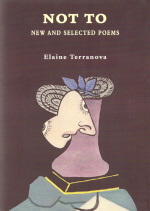
Not To: New and Selected Poems. Elaine Terranova. (The Sheep Meadow Press. Riverdale-On-Hudson, NY 10471) $14.95


This is the second book of poetry from the “Sheep Meadow Press” that I have read and reviewed. The other collection was Richard Wollman’s “Evidence of Things Seen.” Both books were excellent reads and were handsomely presented. Elaine Terranova’s collection “Not To: New and Selected Poems” is poetry at its best: lean, cuts to the chase, striking imagery, and masterful metaphor. In the poem “A Story,” Terranova uses a woman’s “beautiful, impervious face,” as a jumping off point to examine our search for transcendence-- for the answer to the unanswerable:

“I spot on the street a woman’s
beautiful, impervious face
like a China plate. She is
talking to air. “That’s

the end,” she says.
“That’s all there is, that’s
my story.” I’m sorry
to have missed the good part,
hovering over us like vapor.

What drops at her feet?—
a bird, a leaf, a candywrapper,
something from the world.
I know that even without that
encouragement, she would go on...


Think of those people who call
middle of the night from
the impossibly far reaches of an old
friendship, new acquaintance…


It isn’t you they want,
voice thinning out to ether,
only access to the entrails
of the divine animal.” (68-9)


In the poem “In the Home,” Terranova uses the props of a small chair, a heavy rain, and a fleeting memory of braided hair with heartbreaking effect to describe her mother in her terminal dotage:

“My mother sits in the small chair
that is now enough for her.

Her fingers find the edge
and tap, tap
as if there is something
she is trying to remember:

the way she liked to braid
her long thick hair

in the terrible rain
that shut us off
from all the other houses.” (171)

Highly Recommended.

Doug Holder/Ibbetson Update/Dec. 2006/ Somerville, Mass.
A Few Words I Live By. Diamond Riley. (DiamondRiley08@aol.com) $10.

Awhile ago a 16 year old Harvard Summer School student Diamond Riley sent me some poems, and told me she was going to publish a collection of her writings. I published one of her poems in my “Lyrical Somerville” column in The Somerville News, and several months later I got her book in the mail. Riley, whose poetry is conversational, writes in the first section of her book: “Ok, so you’re probably wondering what the purpose of this book is. Well, in a nutshell I basically want to help young people….teenagers like myself…see things before they happen.” Riley’s poetry concerns the pleasures and perils of the dating scene, the trial and tribulations of being a young African-American, and of forging an identity in a conformist youth culture. In this perceptive piece “Still Growing” the poet writes about the difficulties of growing from girl to woman:

“Damn, how hard is it to act like a woman/Everybody be killing me, complaining about not receiving the proper respect they deserve/…Did you ever think about why, you were treated this way?/No we want the cake and to eat it too/ We want to act like hoes and still be treated like ladies…/ Hell, I am not ready for the STD/ or to be, a mother of three/I am not ready to drop out of the school/ and later struggle for my GED/ I am not ready so…I choose to GROW UP.”

Riley is a spirited and proud of whom she is; as displayed in her poem “Who is Diamond Riley”

“ A Diva/with a name/to live up to/A realist/ who’s not afraid to tell it like it is/ A friend/ who doesn’t like to betray or be betrayed/ A girl with dreams/ who will conquer them all..”

This book will certainly be an inspiration to adolescents, as it talks the talk and walks the walk. It is also an inspiration because Riley did the hard work of compiling a collection and publishing it at the tender age of 16.
Doug Holder/ Ibbetson Update