Saturday, July 28, 2018

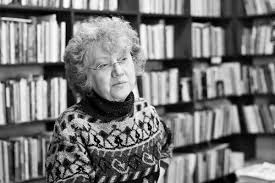
The Sunday Poet: Miriam Sagan


Miriam Sagan was born in NYC, raised in New Jersey, educated in Boston, liberated in San Francisco, and has lived more than half her life in Santa Fe, New Mexico. She is the author of 30 published books, including the novel Black Rainbow (Sherman Asher, 2015) and Geographic: A Memoir of Time and Space (Casa de Snapdragon). which won the 2016 Arizona/New Mexico Book Award in Poetry. She founded and headed the creative writing program at Santa Fe Community College until her retirement in 2016.  Her awards include the Santa Fe Mayor’s award for Excellence in the Arts, the Poetry Gratitude Award from New Mexico Literary Arts, and a Lannan Foundation residency in Marfa, Texas.


Fogg Museum


I liked it better
than the rest
of Harvard. Sad
undergraduate, I’d wander,
depressed and damp,
my boots leaking
my vision compressed
among the world’s artifacts
that calmed me. Archaic
Chinese bronzes,
vessels that held smoke
or who knows what
sacrifice, a Greco-Roman torso
an Ingres of an odalisque
(now that
was something to look at!
Better than boys,
soft and voluptuous flesh,
mine? or another’s?)

Each frame was a window
each painting
promised someplace else
Gaugin’s “Poemes Barbares”
a kind of Waikiki Beach cliche
but still located far from here,
far from the rainy square
where I’d skip dinner, buy a magazine
and apple, read the unassigned
Jane Eyre.

Each reader sniffs the air.
There is a boat, a bus, a train,
the blue line to Logan, and a plane.
Or let me turn
inside myself
to anywhere but here,
self like the earth must spin,
the snowy road, the vanishing point
the figure’s back
will led me out of this
to somewhere else.

Friday, July 27, 2018

Animalalia Liz Hutchinson

Poet Liz Hutchinson


Animalalia
Liz Hutchinson
Salem, Mass.: Yes/No Press, 2017
ISBN 9780692837757, $14.95

Reviewed by David P. Miller

Poems about animals: a keyword search in Poetry.org on the simple word “animals” brings 326 results on July 19, 2018, including titles such as “Four Questions Regarding the Dreams of Animals” (Susan Stewart), “To Pipe the Animals Aboard Noah’s Ark” (Constance Urdang) and “O My Sweet Animals” (Salvatore Quasimodo). I immediately think of Ogden Nash’s poems for The Carnival of The Animals, read by Noel Coward on an LP I had in childhood. The book in hand, Liz Hutchinson’s Animalalia, doesn’t have animal, beast, creature, etc. words in any of the poems’ titles: the titles themselves are mute. That is, the titles are drawings: the contents page matches thumbnails with page numbers. There are thirteen sections, each dedicated to the creature in the drawing. In the drawings (by Scout Hutchinson), those creatures who have faces (not all do) have their backs to us or regard us obliquely. None of them face us. They aren’t performing or posing, and they certainly don’t explain themselves to us. They’re not available to become videos on social media.

Animalalia consists mostly of prose poems, with one numbered statement or section per page. The book design is generous, with plenty of white space to invite reflection or daydreaming before moving on. Most are in four to ten sections; the longest (fox) has twelve. The briefest consists of one unnumbered page: this is for the animal represented by a drawing of a constellation. It would be a spoiler to say more about that one. Three of the sections (rabbit, fox, and cat) are presented in pages of verse paragraphs.

It is difficult to generalize about Liz Hutchinson’s animal-writing, and that’s a sign of the work’s strength. Each creature requires its own approach to the challenge of minding the gap between our (often facile) sense of identification with other humans, and our typical difficulties with “understanding animals,” once we drop the habit of anthropomorphizing. We’re all sentient beings, but the spaces among our sentiences are permanent mysteries. And we just have to keep trying to find our way in: we don’t really know how Dr. Doolittle managed it, say. We can be sure, though, that “Hello, I’m a giraffe, have you ever seen anything like me?” or the like is pretty much played out.

Human/other animal communication is immediately enabled and prevented by the premise of Bear. The reader has been waiting, apparently – “After what feels like a long time” – and the spark almost jumps the gap – “the bear rips the page out of her notebook, folds it twice. When you open it, you see that her folding has marred the ink.” It’s the instant failure of anthropomorphizing hope: the bear has a notebook with a message just for you, available and impossible. “It might have been […] it might have been” a great many things: esoteric bear dance steps, a story about her break-in to the house of Three Goldilockses, a refutation of your intrusive action: “Do I come to your den in the middle of the day? I don’t think so, I do not.” It might have been a berry stain. The bear is gone, and nothing remains but an undefined gesture between species.

Unlike Bear, Skunk lives where we do. Skunks have a knowledge of our extended spaces, but theirs is alien to ours: skunks map. “Skunks map your driveway.” “They have maps for things you’ve never heard of.” “They map out whole neighborhoods in chicken bones, draw slippery trails through lo mein.” We more or less know that our garbage can make their landmarks; we didn’t know that “night, the smell of snow, despair” are mapped too, as well as “more constellations […] more stars, all the things they point to.” Skunk’s knowledge is hermetic to us, but unintentionally: they just make different transparencies overlaid on the same phenomena. We might have access to something like this if, when “stoop[ing] down to pick up one skeletonized leaf” from the driveway, you might then “trace the map of your life: the taste of something sweet gone sour.”

Cat is, of course, famously one anchor of the cat/dog polarity. Is Cat actually there for you, cat lover? Is she, as some insist, faking it for food and housing? Does she maybe have only an orthogonal relationship with what we call affection? “Cat is a cat / accidentally // She didn’t mean / to do it / but there it is”. Maybe both she and you form relationships out of continual misunderstanding:

When Cat is inside
she is a cat

She wears her
self for you

You don’t know
who Cat is
when she’s outside

She looks at you
with big eyes
brings the sparrow inside

You watch its head
turn back and forth
in her mouth

It could be a matter of misread signals — “you see her / out in the neighborhood // looking at you / like she’s never seen you // like she’s never seen anything / on such slow stupid legs” — which have somehow stayed in a wobbly balance for millennia.

Perhaps it is because rabbits are inherently furtive (rarely living with us as pets, mostly seen running away) that the rabbit poems are elusive. Full of suggestion but bounding off into the underbrush. Plums, a jacket, rain, rabbits (but mainly the idea of rabbits): these elements combine and reconfigure in a multiply-folded puzzle. Who is speaking here?

mother told me
not to run
with plums in my

mouth mother
isn’t always
right

(Note in passing the stark brief line, “mouth mother” and the affirmation of “right” free of the denial “isn’t always.”) Or, what is a rabbit’s paw – a good luck charm or a means of escape? “there is no way // or knowing / which one it means / at any given time”. Perhaps they’re not animals at all, but tokens for “your hands // which you fold / like two rabbits / in your pockets” over-filled by plums. In most of the sections of Animalia, the creatures are named in upper-case (Bear, Crow, Fox), like proper names assigned to individuals. Not here, as there’s barely any actual rabbit anywhere.

Two more instances will further suggest the range of animal being in Animalalia. Coyote is an antihero: his is the outside case here of solo animal readable as solo human. This coyote is one we all thought we knew. His name is silenced, and I won’t tell you, but we know him as an animated figure fixated on a roadrunner. (Oh, that coyote.) What might it be like if his cartoons were documentary, a kind of cinema verité? His obsession blossoms into self-loathing and regret, his ACME bills are out of hand, he becomes the object of his desire, the archetypal Roadrunner, in his dreams. He finds roadrunner roadkill: “consumed by lust and terror … He devours it, bursts into tears and shakes for days afterward.” When he “falls from a great height,” as we’ve so often seen him do in these pursuits, what does this actually mean? “He does not collapse into a limbed accordion. He sprains his wrist, twists his ankle and hits his head. It’s all he can do to crawl home.” Existentially miserable, a prisoner of his compulsion, Coyote goes to the mountain, “dances Roadrunnercoyote, Coyoteroadrunner, round and round.” A new transformative legend arises from the hilarity of the premise: Liz Hutchinson beautifully works a piece of popular culture away from any expected meme.

The final example is the first: Owl, whose section begins the book. Owl is not found to be wise-old, and does not utter “whoo.” He begins in relationship with a dying tree, a state which seems apparent (“The owl rides the tree bareback. The owl and the tree are old friends.”) But the owl’s connections also seem opaque though plainly stated. He abandons the tree as soon as it dies and “takes the long way around the forest” to avoid it afterwards. The longings between owl and tree are asymmetric: the tree wants an owl hat but the owl only wears hats of other owls. The owl might stalk newborn kittens in a dumpster behind Burger King, but we only learn of the owl listening to their “collective, unsorted mewl.” Does the owl deliberately conceal its meanings from us, or are they disconnected by the owl’s very nature? (The opposite of the coyote’s tale.) Was it always impossible to go beneath bare observation? “Nobody knows if owls bury their dead because owls have a different definition of both the word bury and the word dead.” There’s a suggestion of linkage, that we might find owls in ourselves, but it stays empirical: “If I am an owl and you are an owl then we are probably all owls who drink from the same ceramic bowl.” The owl grazes us, scratching If you are an owl into the glass of a bedroom window, but there’s no then to go with if. A suggestion abandoned as soon as made.

I am pleased that Microsoft Word does not recognize the word Animalalia. Liz Hutchinson’s lucidly written but subtle parables could have been brought together under the title “Animalia,” of which the software approves. That could have signaled a more expected approach to the theme, instead of the faceted surprises found here. Congratulations and thanks to Yes/No Press for bringing this forward.

Wednesday, July 25, 2018

Poems from Miriam Sagan

Poet Miriam Sagan


Miriam Sagan was born in NYC, raised in New Jersey, educated in Boston, liberated in San Francisco, and has lived more than half her life in Santa Fe, New Mexico. She is the author of 30 published books, including the novel Black Rainbow (Sherman Asher, 2015) and Geographic: A Memoir of Time and Space (Casa de Snapdragon). which won the 2016 Arizona/New Mexico Book Award in Poetry. She founded and headed the creative writing program at Santa Fe Community College until her retirement in 2016.  Her awards include the Santa Fe Mayor’s award for Excellence in the Arts, the Poetry Gratitude Award from New Mexico Literary Arts, and a Lannan Foundation residency in Marfa, Texas.


How To Find Henry David Thoreau


1. Wake up at 5 am. Take a small plane to a larger plane.
2. Arrive in Boston, a city you have too many feelings about.
3. See your body asleep in a motel bed, as if from a great distance.
4. Get on google maps.
5. Watch Lexington Street turn to Moody turn to Common.
6. Get lost at Hanscom Airforce Base and feel humiliated when the soldier you ask for directions glares at you.
7. Overshoot.
8. Ask the turbaned owner of the convenience store for directions and go back.
9. Bear left on to Old Bedford Road.
10. Turn right on to Virginia Road.
11. Sit at a green desk on a mustard colored floor.
12. Eat a peanut butter sandwich, because what would Thoreau eat?
13. Write haiku, by hand.
14. Get slightly bored because it is raining.
15. Realize you could have stayed home and read WALDEN.
16. Admire bright green lichen on tree trunks and the piles of oak leaves this raw November afternoon.
17. Realize every day is a fine day for Henry David Thoreau.

***

On Elizabeth Bishop


I bought, second-hand, not wanting to waste
The Complete Poems
of Elizabeth Bishop
in paperback
that someone named Emily
had already marked up
in green ink
for English 310—Section 1.

Her handwriting, firm and round
makes puerile comments
“Mirror to the soul?” and asks
“But who is he really?”
something we’ll never know,
are not supposed to know,
about hermit, gentleman, or boy
who populate these poems—
an animus, poet’s
masculine self
suffering
yet not lying wan
like a century of pale
Pre-Raphaelite girls
floated tubercular
in bathtubs
full of flowers
for the painter’s brush
to smirch.

I don’t think Emily
has chosen these poems herself,
they seem assigned, and she
although obviously a careful student,
is baffled.
Her comments further obscure:
“The negotiation between what is real
and what is real”
Then underlined.

I know she has gone on to other things.
The copyright is more than thirty years old.
Emily, if she is even still alive
has children, grand-children maybe, and I’m guessing
is on a second husband
and has forgotten all about
the inexpensive book
she sold back
or gave to Goodwill
or the library sale.
I doubt she misses it
while I, sitting in bed
am reading it bit by bit
hope not to drop
one stitch.

Monday, July 23, 2018

Grolier Poetry Bookshop Documentary Selected for the Massachusetts Independent Film Festival!


So glad for the Grolier Poetry Book Shop and filmmaker Olivia Huang-- producer of the Grolier Poetry Book Shop Documentary-- "The Last Sacred Place for Poetry" ( which I was thrilled to be in!). It will be shown at the Brattle Theatre in Harvard Square--Where the festival is going to be held?  When?-- to be announced! 

 Here is a trailer:  for the  Grolier Poetry Book Shop: The Last Sacred Place of Poetry.    https://www.youtube.com/watch?v=M0Q3CnIzrH8

Below is an interview I conducted with filmmaker Olivia Huang: 

 http://www.thesomervilletimes.com/archives/79725 

Doug Holder Interviews Brandeis Scholar Rosie Rosenzweig about Mindfulness and C...


Sunday, July 22, 2018

A Memoir of Murder and Redemption: Notice of Release by Stephanie Cassalty


  Left--Doug Holder,  Center--Stephanie Cassatly, Right Dr. Mark Herlihy


Interview with Doug Holder


I am always looking to use different memoirs for my creative writing seminars at Endicott College in Beverly, MA. In the past I have use Alan Kaufman's Jew Boy, Nick Flynn's Another Bullshit Night in Suck City, Patti Smith's Just Kids, Richard Hoffman's Half the House, Michael C. Keith's  The Next Better Place, and others. So when I had memoirist Stephanie Cassatly as a guest at the Ibbetson Street Press/Endicott College Visiting Author Series, I was very open to her new work:  Notice of Release: A Daughter's Journey to Forgive her Mother's Killer.

It seems that Cassatly ( who will be teaching at Endicott this fall), has written a memoir that deals with her mother's brutal death. When Cassatly was eighteen her mother was killed in a convenience store robbery in New Orleans. After twenty years she forgave the murderer-- just before he passed in the notorious Angola State Penitentiary

Cassatly eventually comes out of this tragedy as a whole person.  The reader witnesses her trauma-ridden journey and her redemption in this evocative book.

Recently I had the pleasure to interview the author....


Doug Holder: You wrote that it took over 20 years for you to forgive your mother's killer.  How long did the memoir percolate in your mind?


Stephanie  Cassatly:  It took seventeen years, with many fits and starts and long hiatus periods. Writing the book was emotionally intense, so I had to take breaks. I needed time to process events of the story, almost as if they were happening to me for the first time. The story kept unfolding even as I wrote it; it was a process that could not be rushed. I did not originally set out to write a book. I simply wanted to record the experience of forgiving my mother’s killer for my daughters, as I had not shared very much with them. I wanted them to have a record of the story, incase anything ever happened to me (mothers can die young, right?) I was not a writer at the time. Once I started, I realized how much I enjoyed the process and began taking writing classes at community college to become better at it. Then, I started writing for the newspaper and eventually found my way to an MFA program. For a long time, I wrote about everything else, until a very wise instructor challenged me to write the story I was meant to write. I began writing shorter essays that circled around my mother’s life and death, which were published in different anthologies and journals. Essays were easier, because the idea of writing a book was daunting. Eventually, I wove them into my memoir as chapters or parts of chapters. Each essay that was published felt like validation for the larger work.


DH: You move back and forth in your memoir--from your childhood-- to the time you were investigating your mother's death, her killer, and the final resolution of forgiveness. Why did you choose this route instead of a straight chronology?


SC I realized in my MFA program the many possible structures for a story, chronological being the most obvious. I wanted to try something different and not be bound by time. Writing this story was a deep exploration for me…in every respect. I allowed it to flow like my mind, which often moves from one thing to the next in no particular order. That being said, I think it’s essential to maintain enough of a thread between time periods in order to give readers a linear picture. I definitely worked to accomplish this and hope I did.


DH: You use dreams often in this memoir. Why do you find them an effective vehicle to tell your story?


SC:  I wrote much of this book in the early morning hours before my children woke for school (4-6 AM). Because the house was still dark and quiet, and my mind was a clean slate from sleeping, it felt like I was writing in a dream state. Additionally, I abide by the rule of consulting my pillow. Whenever I have something to figure out in my writing (or life), I pose a question or problem before sleep. More often than not, I wake with a solution (having worked it out in my dreams). The best example I can think of was the chapter in my book called “Turbulence,” about my husband and I buying a new home after the owner died in a plane crash. I knew I had to connect the dots between his story and mine. I was unclear on the relevancy, so before I went to sleep one night, I asked myself why I was so obsessed with him. The next morning I realized that he represented a combination of both of my parents (my father’s life and my mother’s death) and that his surviving daughter reminded me of younger self. I worked all this out in my sleep and the next morning the writing flowed like honey. I believe dreams are powerful, telling and helpful. Used as a device, they deepen stories and offer insight into inner landscapes of characters and authors.


 DH: Primary sources play a big role in the memoir as well: court transcripts, letters, etc... What does this add to the work?


SC:  In my MFA program, I read several books written in epistolary style and realized how much can be revealed through letters, photographs and documents. I think these add an interesting dimension and texture to an otherwise more traditional style of storytelling.


DH: The old writing adage is "show don't tell". In your memoir you certainly "show"--but you also tell how things connect-- for the reader. When do you decide it's time to go into the didactic mode?


SC:  I struggled with this. I once had an editor tell me to “trust the reader more.” I think it’s a balance that requires finessing, because sometimes readers need a little help connecting the dots, but they shouldn’t feel like they’re being hit over the head. Dialogue, for instance, is a great device to “show,” because it puts readers in the moment or scene. It only works, however, to the degree that it serves the plot or theme. Like anything else, it can be overdone. I think this is where revision comes in. After I wrote large chunks of my manuscript, I went back to see what needed to be handled more “in the moment” of showing, versus telling. I did a lot of shifting between these two modes in the latter stages.


DH: Was it hard to decide what to leave in and what to leave out?


SC:  Yes. At different points I felt like I was throwing in everything, plus the kitchen sink. That’s where a good editor comes in. I read a book called Tell it Slant, by Brenda Miller and Suzanne Paola, which essentially teaches writers that everything needs to slant toward theme. The question we need to ask ourselves is how does this serve the story? If it doesn’t, that’s usually an indication that it needs to be cut, as painful as that can be. It’s called “killing our darlings.” I try to recycle them my darlings into other works, instead of burying them.


DH: Memoir is part of the genre of creative non-fiction. Tell me how your writing differs from standard non-fiction?


SC:  I once had a historian writer friend turn his nose up at me when I told him I was writing creative non-fiction. I think standard non-fiction is a more historical and factual account of someone or something, where as creative non-fiction and memoir is also fact, but the boundaries are slightly blurred. My writing differs from standard non-fiction in that it is fact mixed with creative extrapolation, and a narrower focus and theme. Unfortunately, in the wake of James Frey’s A Million Little Pieces, memoirists (and publishers) are much more cautious about blurring the line.


DH: Tell us about your revision process?


 It’s endless. I’m a bit of a perfectionist, so it’s hard to stop editing and revising until it’s printed. Even now, I still think of things I’d revise. I don’t have a set process, but I think it’s important to have a large enough body of work before revising too much. In the case of my memoir, there were many incarnations of it, with different structures, endings, etc. I made large and small changes all along the way. Mostly, I went chapter by chapter (multiple times), thinking both globally (how things fit within the whole story) and line by line (making sure every sentence was as good as it could be). My biggest challenge was to stay open to change, even if it meant giving up favorite passages. A sense of willingness and a trusted editor helped tremendously. A good editor is almost always right. There are never any guarantees when revising, but if we don’t try things, we will never know. That’s why it’s good to save drafts.


DH: Hurricane Katrina was a major prop in your story. The storm seemed to be a metaphor for a good deal of your life. Can you expand on this a bit?


SC: Sure. I’ll group Katrina and the Mississippi River (both powerful forces of nature) together in answering this question. Much of my story takes place in an around the Mississippi River, where I set scenes of my grandfather’s serene farm, a cleansing baptism, a chilling maximum security Prison and Katrina, the mother of all storms. The contrast of peace and violence and how storms destroy and people rebuild felt relevant. I wanted to juxtapose opposites in order to show how things such as joy and sorrow, peace and violence, hope and hopelessness, life and death coexist. Katrina took my family down, but it also provided a rich opportunity to care for my aunt in a way that I could not care for my mother. Katrina and the Mississippi symbolized death and destruction, yet resilience and rebirth.


DH: Do you think writing this book was necessary for full closure for your mother's death?


SC:  Yes, absolutely. It turned the tide for me. I think writing this book forced me to face her death (and life) head-on. Digging so deeply and for so long provided some kind of desensitization, maybe like they use for PTSD? That being said, it was also an excellent and fulfilling creative endeavor in and of itself. As I went along, I started to see myself more as a character outside of myself. I think writing this memoir wrote me as much as I wrote it. I am a different person because of it and so grateful for having endeavored it.


Give us the five top elements of memoir writing.


  1. First and foremost…Let go of fear. Telling our stories can feel like standing naked in front of a room of people, but we can’t underestimate the power and benefit of sharing them. If we censor too much or worry about who will be hurt, we’ll never write it. Write first, edit or apologize later.

  2. Narrow the focus. Memoir is not autobiography. It’s a slice of life, so stick to a theme or particular aspect of your life.

  3. Elevate life to art. Writing memoir is a cocktail of memory and imagination. Be creative without lying. There is plenty of leeway.

  4. Use elements of fiction: plot, characters, theme, setting, narrative arc, etc. While it is a history of sorts, it’s not just that. It has to captivate readers like a novel.

  5. It’s an internal narrative, so use inner mind workings: flashbacks, dreamscapes, memories, ruminations, letters, songs, poems, thoughts, etc.


The Sunday Poet: jojo Lazar


jojo Lazar


jojo Lazar, “the burlesque poetess” is a Somer-vaudevillian multimedia visual and performance artist. She plays ukulele and flute in ‘The Army of Toys’ band, and teaches uke, creative writing, and zine-making. You can find blackout poetry & more collages - @poetessS on social media


Thursday, July 19, 2018

At Breath and Matter-- A Day Ending with the Boston Sculptor's Gallery

  Left---Doug Holder   Right-- Dewitt Henry ( A founding editor of Ploughshares Magazine)

I am a man of simple pleasures. One of those pleasures is to walk. And Boston is still a walking city--although the landscape is greatly altered. So I left my comfortable abode in Somerville--and headed  across the Charles.  I always like to walk down Charles Street at the foot of Beacon Hill. I was almost swept away by the rush of tourists. There were a lot of new shops--but I was pleased to see Gary Drug was still standing--an old school drugstore--crammed with things to relieve what ails ya'--and all those little knickknacks. It brings me back to the stores of my childhood--the ones my dad took me to in the Bronx. As I traversed the Commons  I saw that Shakespeare's Richard lll was in rehearsal--my favorite by the Bard. I heard screams of horror waft across the Commons--as Richard put in full bloom his nefarious plans. I am going to grab lawn chair and see it one of these humid evenings-- I hope. Next a walk to my old haunt Jacob Wirth's--it was closed! I so wanted the classic house dark on this warm day. The sign said it is closed because a fire--but they will return-- I hope so--this place has marked so many phases of my life.  So I walked down to the Copley Plaza--and had a beer at the grand Oak Bar. The waitress saw I was hot--and said in heavily accented English, " Have a glass of water--it's good for you my dear." That and the amber ale left me restored. Next I walked down Dartmouth Street--past Villa Victoria--a famed housing project amidst the very gentrified South End. Then I wound up on Harrison Ave--part of the SOWA section of Boston-- a very artsy area with galleries, studios--oddly puncutated by the Pine Street Inn--a shelter for the homeless on the end of the block. I remember teaching Nick Flynn's memoir at Endicott College ("Another Bullshit Night in Suck City')  in my creative writing seminar. Much of the memoir takes place in the Inn.

I arrived at at my destination -- at the Breath and Matter exhibit--at the Boston Sculptor's Gallery. It was jammed packed--with folks viewing sculptures paired with poetry. Many of the poets and artists were present like, Wendy Drexler, Julia Shepley, Mary Bonina, Tomas O' Leary, Chris Smart, David Daniels, and many others were present. There was a reading after the reception. I had written an article in The Somerville Times about a number of the artist and poets at the event--and it seemed it was very well-received. It was great to hook up with DeWitt Henry--founder of Ploughares magazine. I have had the pleasure to interview him, and he has a new memoir out-- and he tells me he will have a launch at the Plough &Stars pub in Cambridge--where the magazine was founded.


Before I left Andy Morelin a sculptor and an organizer of the event told me that I was an " iconic character in the Boston poetry scene."  That was very nice to hear--indeed!

 http://www.bostonsculptors.com/breath-matter-home


Wednesday, July 18, 2018

Doug Holder Interviews Alan Bingham author of " Dying Well Prepared"

Do you have to be 'crazy' to write poetry?

 
Robert Lowell with his family


For as long as I can remember there has always been the romantic notion of the "mad," poet or "divinely inspired" poet floating around in the ether.   While working at  a noted psychiatric facility,  outside of Boston for 36 years, I heave heard and read about the legendary poets who paced the  wards. Poets like Robert Lowell, Sylvia Plath and Anne Sexton suffered from severe mental illness, and were hospitalized at different points in their mercurial careers. Plath and Sexton met their end through suicide, and Lowell died in the back seat of a cab he was taking to visit his ex-wife in New York City. Since I have often worked with manic and clinically depressed patients over the years, and therefore have an intimate knowledge of the affliction; I can only write that the toll and the turmoil of depression is not worth the creative insight you might mine. In a review of "The Letters of Robert Lowell', edited by Saskia Hamilton, in "The Boston Globe," I came across  part of a letter Lowell wrote to the poet Robert Fitzgerald about his experience with mental illness: " ...terrific lifts, insights, pourings in of new energy, but no work on my part, only more and more self-indulgence, lack of objectivity; and so, into literal madness i.e. I had to be locked up." As with any experience in our lives, we can bring it   back into our own writing. But my question is, is it worth it? In the midst of mental illness, or a severe depression; the ability to concentrate, to think straight, not to mention to take care of one's most basic needs is severely impaired. Peter D. Kramer, the author of "Against Depression," and a clinical professor of psychiatry at Brown University-- writes that depression takes an actual, tangible toll on the brain. Indeed, MRI studies at McLean Hospital have shown that the actual structure of the brain can be altered due to past abuse and mental illness. It has been speculated that depression can cause the hippocampus to shrink, and may have a big role in the course of heart, and other related diseases; as well as cancer.


 Part of my job over the years at the hospital was to run poetry groups on some of the locked wards. For the most part the poetry that was shared was from psychotic and clinically depressed patients (in the midst of their illness) was impoverished. Often when they were on the mend  they were writing much better and even inspired poetry. They wrote equally well about their experience with their illness, as well as nature, and other less oppressive aspects of their lives. The experience of mental illness can be very good fodder for poetry, but I think if you asked these patient/writers if they would like to go the the depths of depression to mine material for their creative work, the answer would be a resounding "no.'


 Thomas J. Cottle, a Boston-area psychologist, writes " first, there is no evidence to suggest that depression is the cause of the enriched imagination, the basis, in other words, of the creative fount. People paint and write poetry in spite of their illness."

  For me, that is the most inspiring aspect of mental illness and writing. I have seen folks savaged by the disease, barely able to put a spoon or folk to their mouth--pick up a pen, and write.

Tuesday, July 17, 2018

of juliet/ winter 2018/spring/summer2018


of juliet/ winter 2018/spring/summer2018

By Doug Holder

Decades ago—I remember working on my master's thesis at Harvard. The thesis was titled “Food in the Fiction of Henry Roth.” My adviser was a prominent Yiddish literature scholar. At the end of the project she told me, “ I thought food as your focus would be trivial, but you proved me wrong.” Food of course is now a national obsession, a hotbed for media attention, a subject for scholarship, etc...

This brings me to Juliet, a restaurant, bistro, cafe, etc... that now resides in Union Square, Somerville—the very place the Sherman Cafe, an old haunt of mine, once lived and breathed.

A few years back I had the pleasure to interview the young and ambitious owners of the said establishment, Katrina Juliet Jazayeri and Joshua Lewin. They are an admirable duo who firmly believe in giving their employees a “ livable wage.” This venue provides a unique dining experience—with well-honed dollops of French cuisine, among its many offerings.

But Juliet has literary aspirations. Josh Lewin is a published poet and just finished a stint at the William Joiner's Writing Workshop at U/Mass Boston. He and Jazayeri founded a literary/food magazine, “ of juliet.” On these pages you will not only find well-written articles on food and other subjects, but you will find poetry. Have if you will this haiku from Megan Guidarelli--”Pouilly--Fuisse, Clos Varambon,”

a creamy lemon
with a stone in the middle
waving a silky scarf.

Obviously Juliet shares my sentiment of food and drink—that it is fine fodder for verse.

There is also a “ I Was Listening” column by Lewin, who writes: “ It turns snippets of conversation from our dining room into stories everyone can hear.” Pedestrian asides about a resplendent smile on a dog, or the intricacies of eating a grapefruit, are turned into funky dialogue.

Included in these issues are—recipes, interviews, a fascinating piece about the Juliet staff cooking at the James Beard House in NYC, evocative photographs of Juliet by Grace Wexler, and much more.


This publication is surely part of the recipe for success at Juliet.


*** of juliet is available at Juliet
 http://www.JulietSomerville.com

Saturday, July 14, 2018

The Grolier Poetry Festival: The Certain Magic that Happens When


The Grolier Poetry Festival: The Certain Magic that Happens When

Collective Poetry and Arts Performances Gather Together in a Public Space


by Francine C. LaChance

francinelachance@comcast.net


The Grolier Poetry Festival went on, as scheduled, on Saturday June 2, 2018, from 12noon–8pm. Poets, musicians, dancers, and actors performed for a rapt audience, under the sun and an occasional light rain. During the light rain, Stage Manager James Fraser was found onstage, holding an umbrella or two over the performers, and in one case, a harp. Some remarked that the light rain only added to the magic of the day–the magic that occurs when so much talent and creativity comes together in one glorious space, with an open and receptive audience.


The Poetry Festival opened with the dynamic scene selections from "Romeo and Juliet," performed by the The Young Company at Greater Boston Stage Company, followed by a poetry reading for children, by poet X.J. Kennedy, reflecting the Grolier’s commitment to providing engaging  programming for children. David Ferry was the first in an impressive lineup of poets, followed by Lloyd Schwartz, Gail Mazur, Kathleen Spivack and many other notable poets. Dramatic performances were presented by Jim Vrabel and Michael Mack. Sounds in Bloom performed, with Dennis Shafer playing the saxophone while Diana Norma Szokolyai read her poetry. Audrey Harrer, a harpist, also performed. Readings from poets published by the Grolier Poetry Press were held, including excerpts from Tino Villanueva’s book “So Spoke Penelope,” followed by Grolier Poetry Press poets X.J.Kennedy and Partridge Boswell. Joe Burgio presented Ensemble Inedit: Poetry, Song and Dance. Dancers Katerine Gagnon and Ofri Rieger, and musicians John Voigt and Walter Wright performed to poems by Hector de Saint-Denys Garneau and Todros Abulafia.


The Grolier also paid homage to their dear long-time friend, Donald Hall, who just weeks later passed away. Lloyd Schwartz and Joyce Peseroff read excerpts from Donald Hall's essays and poems, and poems by Donald Hall’s late wife Jane Kenyon. The conclusion was magnificent: A video presentation of George Emlen's musical composition of Ifeanyi Menkiti's poem "Before a Common Soil," performed by the Revels chorus and musicians. The dramatic music filled the streets, while the sun was beginning to set.


While the Grolier Poetry Festival was a special celebration for their 90th year, with so much positive feedback and hope expressed that the Grolier would plan another poetry festival, both Ifeanyi Menkiti, Director and Proprietor, and Francine LaChance, Festival Producer and Director  will be exploring the possibility of other poetry festivals in the coming years.


On the importance of sharing poetry and performances at the Poetry Festival, outside of the Grolier, on Plympton Street, in Harvard Square, Ifeanyi Menkiti remarked:


“When a brilliant moon is shining, and kinsmen gather together in the public square, to watch the moon under an Iroko tree, a tree with very hard wood that is tall and strong, and tell stories to one another and recount history there is a certain power to it. Everybody can see that moon from his or her own private back yard, but when kinsmen and women, in this case, the poetry and arts communities, gather together in a public space, celebrating, watching the moon together, there is a certain power to this collective experience, another dimension is introduced, that is magical.”


Along with celebrating our 90th year, the Grolier has recommitted to our mission of keeping poetry alive, expanding programming, and providing many more opportunities for poets and performers to gather together. The Festival is one such example, and more collaborations with other art forms and cultural organizations will follow. We are developing an educational book discussion on “Richard III,” the play the Commonwealth Shakespeare Company will perform on the Boston Common, from July 17–August 5. We are planning an event with Robert Perkins, who creates art work in response to poetry by many of our poet friends. We are in discussion with Ivy Moylan, Executive Director of the Brattle Theatre, who is interested in creating a Friday Night Stroll with us, which would include several additional arts and cultural organizations in Harvard Square to participate. The following events are being planned with poets:  2018 Poetry Pulitzer Prize winner Frank Bidart, Robert Pinsky, David Ferry, Peter Balakian, Robert Perkins, Lloyd Schwartz, and many more. We will also premiere Olivia (Weiying) Huang’s documentary of the Grolier.


We will be releasing a comprehensive list of additional future events shortly, in addition to the ongoing readings in the Book Shop.

The Sunday Poet: Abigail Wotton


 Abigail Wotton teaches English at Red Cloud Indian School, Pine Ridge, SD. Her creative work has appeared or is forthcoming in 805 Lit+Art, Kaaterskill Basin Literary Journal and Free Inquiry.


When the Heart Forgets

On Delancey Street,
hands like knotted tree bark,
flip and slap hot roti.
Hold the grocery bags on the train.
Hold the door,
look for the keys,
pick up the phone.
Slip peppermint candy into a child’s coat pocket. 
At home, a mother’s hands
linger by the microwave.
Clean the bottles,
pick up the baby,
put her down.
Leave pizza on the counter.
Make sure the door is locked.
And then check it again.

At the bar, a girl’s hands hold up the hands
of the girl next to her.
Whose are smaller?
Hands look at lines,
check for veins,
feel callouses.                                                                
The hand waves over another drink
for both of them.

When I drive
I stretch my hands out the window.
Hands know resilience
when the heart forgets.                                     
They can point out Cassiopeia
in an October sky.
If you can find the Big Dipper,
they say, you can see her.