Saturday, June 09, 2018

The Sunday Poet: Tree Riesener


Tree Riesener


Tree Riesener is the author of  Sleepers Awake, a collection of fiction, winner of the Eludia Award (Sowilo Press), The Hubble Cantos (Aldrich Press), and EK (Cervena Barva Press). Angel Fever, a chapbook, has been published by Ravenna Press as part of their Triple series, Triple No. 5. Three previous chapbooks are Liminalog, Angel Poison and Inscapes. Her website is http://www.treeriesener.com.

peeping tom


I like to think about you
in heaven

I’m in the cold black night
under a window
behind me surf booms and crashes
my footsteps slowly fill with water

when I look
through the window
you’re in a warm bright room
nobody sees me looking in

I watch them welcome you
embrace you
the christmas tree
glowing in every color
eggnog in a chinese bowl
some sort of classical music
probably haydn or mozart
softly from a string quartet

everybody hangs on your words
as you tell your story
laughing
every once in a while
patting your hand
when you wipe away tears

I turn away
walk through drifting fog
down the dark road
to that little all-night bar

shaking with cold
I gulp down a strong coffee
with plenty of sugar
have a couple of drinks
to make sure
the coffee won’t keep me awake

then
in that warm room
after the hot drink and the whiskey
I cross my arms on the table
like school kids
when it’s time to rest

lay my head down
and fall asleep

thinking about you in heaven

Friday, June 08, 2018

New book out from the Endicott College/Ibbetson Street Press Young Poet Series.

Talented  Endicott College undergraduate Dan Calnan has a new book out from the Young Poet Series at Endicott College.


 “In this collection, Calnan writes with a wisdom and authority beyond his years. Ranging in tone from witty to profound, these poems all demonstrate his intelligence and affinity with words. He is a writer to watch.” — Elizabeth Winthrop, author of Fireworks, December, and The Mercy Seat.


to order a copy go to http://lulu.com/ibbetsonpress


Thursday, June 07, 2018

Poets/ Artists Ponder 'Breath and Matter' Article by Doug Holder


( Left to Right) Jodi Colella, Chris Frost, Audrey Henderson, David Daniel, Jodi Colella, Julia Shepley


Poets/ Artists Ponder 'Breath and Matter'

Article by Doug Holder

I was pondering a question over my dark ale (with a hint of citrus) at the Remnant Brewery in the new Bow Market in Union Square. It was posed by the poet Robert Pinsky in the foreword of an anthology of poems about sculpture. He asked, “ What has art made of breath to do with art made of matter?” Well—six people joined me at my table to answer that question: Chris Frost—a Somerville-- based sculptor, David Daniel—former editor of Ploughshares magazine, as well as the head of Creative Writing at Fairleigh Dickinson University, Jodi Colella—a sculptor and a mixed-- media artist based in Somerville, Wendy Drexler, a noted poet, Julia Shepely –an artist and one of the founders of the Brickbottom Gallery in Somerville, MA., as well as poet Audrey Henderson -- the author of the collection “Air Stream.”

They were all here to discuss a project they are involved in that will appear at the Boston Sculptor's Gallery in Boston, starting July 18, 2018. The project is titled “ Breath and Matter.” On the website of the gallery it states that they, “... invited poets to partner with artists to create collaborative work combining both of their voices... twenty four pairs of sculptors and writers have taken up the challenges of this timeless question.” These artistic partners respond to each other. The sculptor interprets the words of the poet through concrete material such as silk, steel, bronze, rawhide, granite, wood, glass, etc...

Many distinguished poets will be included like for U.S. Poet Laureate Robert Pinsky, Boston Poet Laureate Danielle Legros Georges, Mary Bonina, and others.

Chris Frost and David Daniel talked about a notebook they are creating--a work still in progress. Frost has provided the illustrations and Daniel-- the poems. Daniel told me, " I hope we capture the process of collaboration. We have found poems easily lead to images."

Now...getting back to that daunting question. When I posed it to them, there were a lot of laughs. David Daniel piped in, “ Maybe I should text Robert.” But the most succinct comment I heard among the gaggle --in regards to why this project matters was, “To make what is intangible—tangible." So sculpture --in a sense-- will give poetry a tangible form.

Jodi Colella, (who I have had the privilege to interview years back) has paired her sculpture with Wendy Drexler's poetry. They both met by a twist of fate, and both came to realize their process is similar. They start their artistic exploration with intense observation as a way to get in the marrow of, or deep meaning of their subjects. So-of all things they turned to MOSS--which they feel shares many of the same traits as humans like: resilience, collaboration, as well as being opportunistic. So Colella created the sculpture  (seen below) and Drexler came up  the words to go with it.  Colella adorned the moss with piercing human eyes. The pair even developed a lesson plan for schools based on their collaboration.


Julia Shepley and poet Audrey Henderson have their work speak to each other. According to the Boston Sculpture Gallery website they  "...have identified common themes and concerns in their respective work: the significance of early memory as it relates to architecture and architecture as repository of meaning and emotion; the residual energy of inhabited space; and the significance of handcrafted objects as expressions of love and affection.  In the dynamic process of passing from one medium to the other, certain shared elements have intensified and accumulated layers of complexity and association."

Muse by Julia Shepley

This should be a unique exhibit at the Boston Sculpture Gallery  486 Harrison Ave, Boston.   For more information about the gallery and artists go to:  http://www.bostonsculptors.com/breath-matter-index

Wednesday, June 06, 2018

Daniel Shapiro / Child with a Swan's Wings

Poet Daniel Shapiro

 Daniel Shapiro
 Child with a Swan's Wings
Publisher: Dos Madres Press, Inc.
Illustration and Book Design: Elizabeth H. Murphy
Executive Editor: Robert J. Murphy
Cover Image: Shulamith Shapiro

Reviewer: Ari Alkalay Appel


Daniel Shapiro's poetry collection, Child with a Swan's Wings, is full of delectable little poems like "White Standard Poodle," “Almost Haiku,” "Arte Poética," and "Street of Chameleons," and darker, yet equally beautiful poems like "Providencia" and "Solitude" which come together to form a remarkable collection. As a whole, the volume masterfully portrays the author's relationship with language, with poetry, and with his content, which does not fall short of encapsulating the universe itself.

In connecting nature and animals with poetry, the author manages to create a sense wonder and amazement which extends to the way he organizes words on the page. Words sometimes curve away from one side of the page, then back toward the other in a cup shape, form a box around other words, or jump around like popcorn. The presence of words in places we do not expect to find them and their absence where we do expect them creates interesting interpretive possibilities. This is not completely original, but Shapiro's use of blank space is especially apt because has a mesmerizing effect.

The poems in this volume explore the infinite and the finite. Lines like, "My words are spokes / spinning to oblivion” invoke infinity, while others like “It's the body giggling, / telling you thank you / for the Chicken Vindaloo” use details to ground the poetry. Then there are lines I find exceptionally beautiful and evocative, like, "I too would emerge from an almond tree / to greet my lover, clasp my arms around his chest, / press his flat belly stippled with moss" and “Each word tactile—hairy or sweet— / will stand / like an obelisk....” Both the interplay between the natural world and the human in the first lines and the commentary on poetry itself in the second are easy to find more of in the volume.


Some of the poems are short while others span pages. The shortest poem, “Almost Haiku,” is only eight words, while the longest, the eponymous and multidimensional “Child With a Swan's Wings” is written across twelve pages, including bold headlines and words “spattered” across the page, to use the author's language. The brilliance of this poem is that it is about its own becoming. A few lines at the beginning state that a poem is born and the rest of the poem tracks its development, including its giving birth to another poem. The poem that we are reading unfolds insofar as the poem we are reading about is described. The poem reaches into infinity, “The poem rejects all designations. / Who says it's even a poem?” and comes back to its mooring, “Chameleon-horse / flick their tails and leap / volcanoes.” This poem is a reflection of the collection as a whole: self-reflexive, imaginative, and driven forward by a sense of amazement, almost as if from a child's perspective.


As an overall collection, Daniel Shapiro has written a work that clearly comes from an experienced poet. It is worth the read not just for its commentary on poetry and language but also for the pleasure that its poems yield. If you are looking for a fresh and exciting collection, buy a copy of Child with a Swan's Wings.

Monday, June 04, 2018

Somerville Artist Marilyn Ranker: An Artist Who Pushes Against Boundaries


Somerville Artist Marilyn Ranker: An Artist Who Pushes Against Boundaries

By Doug Holder

Marilyn Ranker traversed the shoals of the Bloc 11 Cafe to the inner sanctum-- my usual perch in the back of the said eatery in Union Square. I was munching on a bagel—a plain one—though longing for my multigrain -- the very one the store assured me would have a second coming—as soon as it “rises.” Ranker is a thin woman, with refined features and an engaging smile. She had come to my table to talk about her life and work as an accomplished artist.

Ranker has a studio at 57 Central St., across from the Somerville Museum. And with the rapidly gentrifying city, and the hunger of developers of “luxury” condos, she is glad to have an affordable space. Many artists that I have interviewed have been worried about displacement, or have been displaced. Ranker told me, “You have to move out as far as Roxbury to find something that is affordable.

Ranker—who is originally from Pittsburgh, now lives in Cambridge. She was once part of the academy-- on tenure track at Dartmouth. When that hit the skids, she had to look elsewhere for steady work. For years she has held a steady job as a suit salesman at a high-end department store to make the daily nut and feed her art.

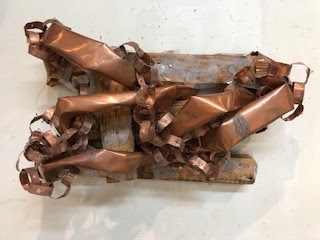
Ranker has been trained in sculpture, ceramics and drawing. She said she often uses her drawings on her sculpture. She works with a variety of materials, like: wood, cloth, wire, copper, etc... She often paints with gouache—a water-based pigment.

Ranker describes her work as pushing boundaries. She reflected, “ I often use skeletal systems that uphold a compressed form. There is always a tension in the elements of my work.”

One copper and wood piece titled, “ Emotional Entanglement and Mental Restraints” has copper elements that are folded—emerging from a wood structure. The copper chains weave around the wood foundation. One can clearly see the metaphor the piece evokes.


Ranker told me that she exhibits her work at the studio 314 at 450 Harrison Ave. in Boston. You should visit Ranker there— because the first Friday of each month—  her gallery and many of the commercial galleries open their doors to the public.

To view Ranker's artwork go to:  http://marilynranker.org

Sunday, June 03, 2018

The Sunday Poet: Heather Nelson

 
Poet Heather Nelson

 Heather Nelson is a poet, teacher, mother and recovering attorney based in Cambridge, Massachusetts. She studied writing under the poet C.D. Wright as an undergraduate at Brown University. Most recently she studied poetry with Tom Daley and Barbara Helfgott Hyett. Heather is also a member of Poemworks, the workshop for publishing poets. Her work has been published in Main Street Rag, The Somerville Times, Constellations, Ekphrastic and The Compassion Anthology.


Resilience
On the slim wooden shaft of the women’s room key is a query, in black Sharpie.  Do you identify as female? Literal me, I take all questions seriously, I examine the evidence.  The swelling prow of my chest as I thread my way between the coffee shop tables certainly broadcasts a woman’s body. As I resume my scone, I look out across the tables at all the other solitudes. Is what they see female?  I’m not looking at myself most of the time. I’m not shopping, I’m not dieting, I’m not waxing. I’m not waiting to be asked. I’m feeding my hunger. I live in this soft and solid house, we’re incorporated, this body and I.  I’m 49 and full of questions and desire. As we age, does sex fade or intensify? If my gender’s fluid, could it overflow and lap at the feet of the beautiful barista boys? That would be hot, but it wouldn’t be pretty. Everyone likes to look, but no one really wants to be touched.   Midlife is a second childhood, equally turbulent, but less endearing. If we’re flirting, it’s with ourselves, stretching in front of our mirror.
Resilience means:
opening a mental door,
keeping it ajar.

Thursday, May 31, 2018

What I Got For A Dollar Poems by Bert Stern


What I Got For A Dollar
Poems by Bert Stern
Off the Grid Press
Boston, MA
ISBN: 978-1-946830-01-2
93 Pages
$16.00

Review by Dennis Daly

If ever there were a tour de force of poetic cravings this is it. What I Got for a Dollar is Bert Stern’s third poetry collection and it’s magnificent. Stern craves deeply, but not shrilly, the cause behind the cause of creation. He makes the basic argument for divinity’s possibility as deftly as Thomas Aquinas ever did. Perhaps better. In fact the somewhat absentminded Deity that Stern conjures up behind his naturalistic images seems eminently likable, albeit dependent on humanity for help in keeping up appearances.

Everything depends on the focus in Stern’s poems. In one poem he considers the micro world, Blake’s grain of sand. In other contexts the poet ponders over what he curiously calls “the ordinary.” Occasionally he jumps off the earth’s edge to commune with more fearsome, macro and fiery powers. Even the political and the comic are not beyond Stern’s observational attention. Also, throughout the collection, the poet works in an exquisite commentary on aging. He embeds it in both his persona’s longings and perceptions.

Before the first section of poems Stern positions an elegant poetic inscription, which acts as a prologue of sorts and speaks to the poet’s overriding motivation. Here is a portion of it,

Behind the ripples
in water,
behind old age,
torrents of spring
plunge down mountains.

Under my face
I crave another face,
as if behind it all
a God still sleeps…

On the Ausable, the poem that opens the collection, portrays the poet-protagonist following a riverside path in the aftermath of a rain storm, seeking the most basic things and the most tangible concepts. He appears fragile yet full of life and describes his trek thusly,

I wobble down the rough path
of the bank, propped by love
and a broken stick, eyes
agog with dappled water.

On the cobbled beach
totter over stones,
breathe beginnings in…

The title poem, What I Got for a Dollar, sounds like an intended political piece, dark and forbidding, that pushed back against its author and had its way. Comedy and newfound optimism result. Here’s the heart of the piece,

the man in the Red Sox cap
who loves Jesus (it says on the button pinned to the cap),
offers to help me lug groceries, and though, upstairs,
I give him a dollar
he doesn’t do it for that because, when I look for another one,
he waves it off.
This works,” he says, so I know he really loves Jesus.

Contra my argument, love looks out, waiting for us to notice.
It’s springtime, and all the swelling renewal is like love.

I try to imagine a time after money, after celebrities
have stopped shouting
and the words a child says as I walk hand in hand with her
sound like salvation: timbre and innocence and openness
to what’s to come.

My favorite poem in the collection, entitled The Ordinary, considers the scene beyond our present tame realty. Every day we pour over our books, or screens, or peer through our pleasant windows. Habit and routine control all. Only imagination delivers divergent details on sedate creation and suggests the numinous, the feral and, possibly, the continuous. The poet concludes his piece with an arresting contrast,

The palette’s simple as the scene: skies gray
or blue or dappled, rain, snow or nothing falling,
a tree, one tree I’ve pruned and love
because it’s red and green and Japanese and
longest to hold its leaves.

Up ahead a gale’s coming in, but the ordinary prow
keeps its nose to the wind.
Up ahead rumbling thunder, visions of shipwreck,
but something sails on, and I’m haunted by
this ghost, this thin aroma
brilliant and concealed.
As if, behind the same old, a different face looks out
Through glowing-ember eyes.

Stern’s ekphrastic poem, Samuel Palmer’s Trees, works wonderfully well verbalizing the original painting, Palmer’s The Gleaning Field (1833). But Stern goes much further. He uses the painting as a way in, a way to explore metaphysical implications of the work. Consider this description of laboring peasants,

the gleaners keep their eyes
on the ground, to pluck what’s left
from wheat stubble.

Soon darkness falls over them,
but for now it’s hard to name what
lurks in the waning light.

I might say “God,” but which?
The one who sees all but feels
nothing?

The people are hungrier than
the cattle, who freely gaze
amid the wheat still to be harvested.

God can’t remember why
he sent creation forth, and
his creatures never knew.

Craving a deeper reality or a more fulfilling reality doesn’t just happen. Usually it begins with a wound, a tear in the fabric of ordinary life. In Riding Bareback in the Tropics Stern’s persona discovers an antidote to lost love by going South. Citrus delights await. Most of us at one time or another have this urge. Some even buy the epistemological ticket. But few go. Perhaps it’s the coral snakes that dissuade us. Stern’s protagonist packs up and leaves. Here he describes the adventure and the aha-moment that follows,

So it came about, all old ties broken,
high in the canopies, spider monkeys noisier
than neighbors, air orchids the horses loved
to eat. One night, drunk, I galloped bareback
round the rim of a great, natural bowl, with only
my thighs to gird me against the unnamed hurt
I somehow managed to keep dodging,
even among coral snakes.

By reducing his spiritual cravings to poetry Bert Stern has, in a very real sense, already created what he seeks. Words become beginnings; they fill up nothingness with creative constructions that allow us to comprehend the nature of things and, by extension, nature. Lucky for Stern to have written this book. Double lucky for his readers.

Sunday, May 27, 2018

Betsy Lenora: Owner of the Blue Cloud Gallery in Ball Square.


Betsy Lenora: Owner of the Blue Cloud Gallery in Ball Square.

Article by Doug Holder

Betsy Lenora arrived at my unofficial office in the Bloc 11 Cafe to tell me about her relatively new undertaking—namely ownership of the Blue Cloud Gallery in Ball Square. Lenora, 62, is the same age as this writer, so we were able to talk turkey—without the necessary footnotes that are sometimes needed. This longtime artist—who has traversed the shoals of both the Cambridge and Somerville art scene for many years—is still very much in the game with her stewardship of this venue.

Lenora has no formal schooling in the arts, although she has taken many courses on the fly. She describes herself as self-taught. I asked her if there were any advantages to this status. Lenora reflected, “ There are certain advantages. I never incurred any debt, and I never became pigeonholed in any niche.”

Like many artists I have interviewed she has worked a variety of jobs to make the daily nut—retail, restaurant, etc... But the most significant job she held, that was pivotal to her career was at the award-winning Cambridge Artists' Collaborative in Harvard Square. She told me, “ I worked their for seven years. I was involved in choosing the art for the store, and I managed the gallery. We selected and displayed the work of over 200 artists in a wide variety of media.”

All this of course gave her the smarts and acumen to own her own gallery the “ Blue Cloud.” The gallery was originally owned by Patricia Wellenkamp. Lenora worked there one day a week, but eventually was given the reigns of the store when Wellenkamp left for the hinterlands of Brookline.

Lenora said, “ We have a barrage of colorful work by over 100 local artists. We have blown glass, jewelry, ceramics, and more. The work is sold on consignment.

Lenora made it clear that she is strict about what work she takes: “ We don't cliched work—like beaded jewelry –for instance. This is seriously overdone. It has to be original and well-crafted.”

Lenora has a number of loyal customers in Ball Square. She is a favorite of Tufts students, and their visiting parents. She plans to have events at the gallery, including artists workshops, music and craft parties.

Lenora is an accomplished artist in her own right, with the requisite awards, gallery exhibitions, that comes with the territory . She also has a great love of photography. She does a lot of nature studies, and is influenced by the nature photographer Eliot Porter. She reflected, “ My forte is focusing on reflections of the surfaces of water. They create wonderful images.”

Thursday, May 24, 2018

The Sunday Poet: Ari Alkalay Appel

Poet Ari Appel

Ari Alkalay Appel is a poet and essayist who lives and works in Roxbury. He enjoys cycling and woodworking during his free time. He grew up in Newton, Massachusetts, where he graduated from Newton North High School. He studied at Whitman College in Eastern Washington, where he obtained a degree in Rhetoric Studies. He also studied at the University of Buenos Aires in Argentina.

Manic Mechanic

My brain is flooding with information;
Information circulates through my neuro-circuitry
Like an electrical current.
I am dizzy, my vision is distorted, and
My head pounds at three second intervals.
The world is spinning.
My hands are engaged with tools.
I am twisting a wrench at every moment,
But I do not know what I am fixing.
The bikes pass through my workstand somehow
But my I am focused on the abyss,
The winding gaps in the scrap butyl tubes in a pile
Under my stand, coated with an indescribable white chemical powder
Leftover from their manufacture.
I can't stare at the pile enough;
It seems to provide the only symmetry to my mind's condition
That's where I've gone,
That's what I'll tell my friends and family:
I'm stuck staring endlessly into a pile of scrap butyl.
You may see me look elsewhere, but
You know where I really am.

Somehow, I still get the job done.