|
| Click on pic to enlarge |
Thursday, September 25, 2014


Plots We Can’t Keep Up With Poems by Randy Phillis
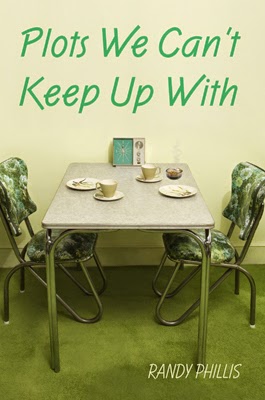
Plots We Can’t Keep Up With
Poems by Randy
Phillis
Copyright 2014 by
Randy Phillis
Encircle
Publications, LLC
Softbound, 30
pages, no price given
ISBN 13: 978-1-893035-22-5
Review by Zvi A. Sesling
Every so often a
book of poetry comes across the desk by an author I have not heard of while the
blurbs on the back cover do not really reveal much though the blurb writers
seem to agree on memory, time and the bridge between past and present.
For these reasons
I opened Randy Phillis’s Plots We Can’t Keep
Up With somewhat hesitantly not wishing to be bored or stretched to my
imaginative limits. But I opened to page
1 and off I was on an interesting journey.
The opening poem is a bittersweet remembrance of a boy and his not so
cool father, yet the memory affects his life with women in barrooms.
What’s a Boy to
Do
As a kid I had a
choice:
stay in the car
or follow him in
to Ben’s, red
lights
and thick smoke,
sit at the bar
that came to my
chin or
a booth if I had
crayons and paper.
Behind the bar,
the big mirror
floated the backs
of bottle
over my forehead
as Dad
leaned forward,
elbow propped so
his cigarette
hung above his
head, studying
the barmaid’s
face not two inches
from his. Then
he’d sit far back
and laugh,
stretching carefully to ash,
and ask what went
best
with pickled
eggs. All that was good
with beer he
already knew.
Sometimes I’d
stay in the car,
play the radio
and dance
my fingers across
the dash, clench
the hard cool
wheel and jerk
until I
understood he wouldn’t be right back.
Then I wandered
the muddy lot,
floated bottle
caps across puddles
and built solid
homes for frogs.
Bored, I’d
flatten my face
against the glass
door for effect,
and finally drag
myself in,
knuckles almost
scraping across the stained
carpet and pull myself up beside him.
Other days, sent on an errand by Mom,
I’d stop in by myself, blinded
by the sudden dark and drink
short cold Cokes on Dad’s tab.
But mostly, like now, I didn’t like
going in alone, reading all the signs
to keep my eyes busy, never knowing
what to say to the woman next to me.
A number of his poems are filled with booze
and/or death. In “Gone, Fishing” the opening
lines are “if it weren’t you who died/ it would
have been me:”
While in “Directive,” the opening stanza is “When
death unzips
me/let there be no struggle to pick a stone.”
Then again we learn in “A Husk Under the Gum” we
learn from “…on
Fridays, Dad at the bar,/Mom folded out on the
couch…” that Phillis’s
parents were neither the most loving nor caring
parents, or that perhaps
they are worn out from their week of work and
whatever else they
did and their child was not No. 1 on their hit
parade.
Then there is the title poem which opens: “Our
neighbor’s wife has left him,”
There is not a lot of happiness in these poems, no
matter who it is and perhaps
there are other poems and happier times for Randy
Phillis. Nonetheless these poems
are well written, entertaining, maybe even
captivating in their own (somewhat) depressing way.
More importantly they present honest personal
experiences and present poets with
a good lesson on how to write about their own
lives.
__________________________________________
Zvi A. Sesling
Author, King
of the Jungle (Ibbetson Street, 2010)
and Across
Stones of Bad Dreams (Cervena Barva, 2011)
Editor, Muddy
River Poetry Review
Editor,
Bagel Bards Anthologies No. 7 & No. 8
Publisher, Muddy
River Books
Saturday, September 20, 2014
Seamus Heaney Tribute Appreciation and Reflections
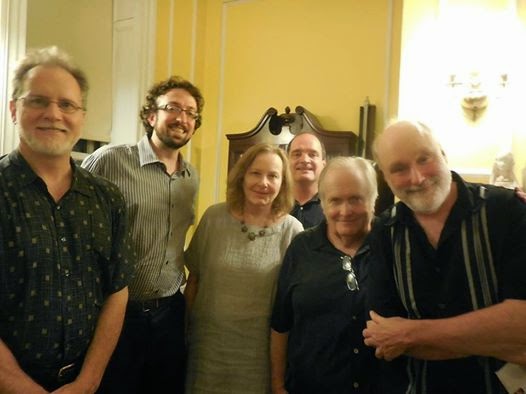 |
| ( Left to right) Dan Tobin, Alex Green, Jean Houlihan, Michael Todd Steffen (back) Fred Marchant, Doug Holder |
Seamus Heaney Tribute: Appreciation and Reflections
By Alice Weiss
On
Wednesday the 27th of August, along, I attended a tribute to the
Irish poet, Seamus Heaney, deceased one year.
It was organized and presented by Michael Todd Steffen at the Hastings
room, First Church Cambridge. We were in a small yellow painted room. The
furniture, pushed aside for folding chairs was plush and there were paintings
on the walls in ornate frames, or at least that’s how I remember it. The
podium was set in front of a mantel. The weather played a part. It rained and
thundered. I had not given much
attention to Heaney’s poetry. After this
evening that changed. The essay that
follows reflects my memories of the evening and readings I did and thought
about in response to it.
Presenters
included two Irish-American poets, Joan Houlihan and Dan Tobin; the
Jewish-American poet and cultural entrepreneur, Doug Holder; Back Pages in
Waltham bookseller and publisher, Alex Green, and Fred Marchand, poet, war
resister, and Suffolk University emeritus professor of poetry. They all read and commented on a Heaney poem
and, except for Alex Green, read work of their own. Michael Todd Steffen made the introductions.
Steffen
began with a discussion of the Heaney’s poetry, took firmly into the high
territory of great poetry, but there was one poem, title actually, that struck
me especially, “Whatever You Say, Say Nothing.” It’s slangy, calls up living in an occupied
Ireland and, it catches some truth about the concentrated code we call poetry. The poem, itself, is a bracing referential
meditation (if so languorous a word can be applied to the tartness of its tone)
on “the Irish thing’”and how people talk about it. Take the opening quatrains
of section III, its disgust with a public language rendered powerless by its
refusal to take sides and its burst into an impatience that nonetheless
maintains a ‘tight gag.”
‘Religion’s never mentioned here,’
of course.
‘You know them by their eyes,’ and
‘hold your tongue.’
‘One side’s as bad as the other,’
never worse,
Christ, it’s near time that some
small leak was sprung
In the great dykes the Dutchman made
To dam the dangerous tide that
following Seamus.
How do you talk through a mouth gag that makes you ignore
history? some small leak? The poem apes
the language of the op-ed in such a way that it never leaves a question
about where its heart is. An unending
dilemma hovers, though, in the poem, and finally breaks out in the last
stanza: like Paul Celan, and Adrienne Rich, if he was going
to sing he had to do it in the language of his oppressors.
Ulster was British, but with no
rights on
the English lyric: all around us,
though
We hadn’t named it, the ministry of
fear.
Michael, introducing Doug
Holder, admitted that he had intended to feature only Irish- American poets,
but then, Doug. Not a word else was
needed. If there was anymore said I
didn’t hear it because I was laughing.
The room, I must add, was quite hot and someone handed out little
personal fans. They looked like the
paddles art auction houses provide for bidders.
Doug, of course had his opportunity and thanked all the fans in the
room. People hissed, I called out “Sit
down” Joan Houlihan laughed.
Doug read
Heaney’s, “The Frontier of Writing,” and bumped us out of laughter back into
that landscape of hostile occupation that was (is?) Northern Ireland. Except here, the “tightness and the nilness,”
that one attempting to cross a border (frontier) feels when stopped and inspected
at gun point, has more to do with the hesitations and fears approaching the act
of writing, subjugating that resistant part of your inner self to glide
obediently past them,
out
between
the posted soldiers flowing and
receding
like tree shadows into the polished
windscreen.
Whether internal or external trouble always looks like
British soldiers.
Doug’s
poems too explored an inner/outer landscape.
His was Bickford’s, in “Eating grief at 3 A.M,” dedicated to Alan
Ginsberg and evoking Walt Whitman at the supermarket old Marxists, flirting old
ladies, a landscape, this time of loss leaving the poet with no place to sit. In another of his poems “You know it
is tough being a writer,” Holder managed to chime both Seamus Heaney and Henny
Youngman: “The waiter /Charging me extra/ For the fly in /My soup.. . . And
take my creative partner/Please.” This
swing between the world of Take-my-wife, and Northern Ireland seemed apt. It
provided urban levity for all the rural seriousness you knew was coming.
Joan Houlihan read Seamus Heaney’s
“Miracle,” a poem drawn she told us from the New Testament where a man, unable
to walk, was brought on a stretcher to Jesus to be healed. The crowd was
such that his friends could not get through with their stretcher and so climbed
on the roof, pried off parts of it and lowered the man down. Heaney’s
poem, she explained, had its origin in the days when he had suffered a stroke
and he was able to recover, but only help from the orderlies, the EMTS, the
night nurses, in short, the hospital community. Her own son had had a brain
injury, she added, and she knew what it was to depend on a caring community responding
strangers.
Not the one who takes up his bed and walks
But the ones who have known him all along
And carry him in –
But the ones who have known him all along
And carry him in –
Their
shoulders numb, the ache and stoop deeplocked
In their backs, the stretcher handles
Slippery with sweat. And no let up
In their backs, the stretcher handles
Slippery with sweat. And no let up
Until he’s strapped on tight, made tiltable
and
raised to the tiled roof, then lowered for healing.
Be mindful of them as they stand and wait
Be mindful of them as they stand and wait
For
the burn of the paid out ropes to cool,
Their slight lightheadedness and incredulity
To pass, those who had known him all along.
Their slight lightheadedness and incredulity
To pass, those who had known him all along.
In the
poems Joan read from her own work, a character suffering locked-in syndrome
survives with the
help of “the ones who had known him all along.” Using the strange feelingful language in “The Us,” and “The Ay,” her recent poetry of
wild almost celtic invention: an imaginary tribe, speaking an unexpected
language her poems too invoke the bare, quiet human interaction of caring.
and brae would spoon the broth,
and make talk between us
where mine own had gone,
as sounding saved by water,
rivered in its mouth
when saving ay had none
and all mine days were silt
and through the hand.
“Sounding
saved by water/ rivered in its mouth.” I understand this with my physical
center: sounding (the capacity of make sounds)(but also water itself as
in Long island sound, or measuring depths) saved by water, and then back
to language as river, incredible. I find
the same mystery in, for example, Heaney’s “Markings.”
iii
All these things entered you
As if they were both the door and what came through it.
They marked the spot, marked time and held it open.
A mower parted the bronze sea of corn.
A windlass hauled the center out of water.
Two men with a cross-cut kept it swimming
Into a felled beech backwards and forwards
So that they seemed to row the steady earth.
It seemed to me that Daniel Tobin’s
presentation also looked at ways Heaney explored the entering of things, “As if
they were both the door and what came through it.” Tobin read from his own study, Passage to the Center, Imagination and the Sacred in the Poetry of
Seamus Heaney.
Heaney’s quest demands that he explore the process of
self definition by tracing through his art the formative experiences that
helped mold his identity. . . .[It}
entails a paradox in which the very outward movement of the quest calls for a
radical inward scrutiny, an interrogation into the origins of the self.
As if you could not separate that
quest from the character of the man, Tobin spoke about his special capacity for
encouragement. Here is where Heaney’s
exceptional capacity to locate the self in movement towards others illuminates
the sources of poetry in ritual, More
than just a bunch of chants, ritual is a way for the self to merge with others. In Station
Island which I turned to in response to Tobin’s discussion, I found poems which explore that “merging” in its most
extreme form, as a mystical union with a landscape of “hard lodgings.” So these last lines from “Sweeney’s Lament
on Ailsa Craig”
But to have ended up
lamenting here
on Ailsa Craig
A hard station!
Ailsa Craig,
the seagulls home,
God know it is
hard lodgings.
Ailsa Craig,
bell-shaped rock,
reaching sky high,
snout in the sea—
it hard-beaked,
me seasoned and scraggy:
We mated like a couple
of hard- shanked cranes.
Picking up the exploration of ritual
and community, Tobin read his own work,
The Narrows, a ghazal, “A Mosque in Brooklyn,” It takes place in the basement of the
apartment house he grew up in. The poem
does a stunning turn with the word history,
There is no prayer that can abolish history,
though in this basement mosque the muezzin’s history
gathers in his throat like a tenor’s aria
and he calls to God to put an end to history. . .
Allah, Allah—above
the crowded rowhouse roofs.
Their rusted antennas, stalled arrows of history. . .
. . .these prayers are lifted on the thermals of history,
and sound strangely like. . .
the remnant who
survived a blighted history,
. . .lost themselves, flourishing into the One
without division, without names, without history.
The ghazal form
gives him an opportunity to endow the word history, also a concern of Heaney’s,
with a repetitive force which ends up turning on the notion of history itself.
The ritual takes the one step further, and by gathering in the throat of the
muezzin puts an end to it, history.
As the last reader, Fred Marchand, went right to the point: the impact of
reading Heaney on his own writing. He spoke of a time he felt that he could no
longer hear the music in his own poems and had stumbled upon a poem by Heaney
called “The Loose Box” and, it was implied, shook his deafness off. I found it a long poem to listen to, but
later read it from the New York Times
Archives. It’s a poet’s poem. A “loose box” is a high horse stall that
has four walls that horses are placed in so they can be held without
harnesses. The poem is in three
parts. The first lines of each section
place the source of a particular diction the poet has used throughout his career, then bursts
into that very language to describe an imaginative encounter using it. It’s an ars poetica: Heaney openly exploring the
sources of his own poetic language. The
sections of the poem seem disjointed , but the question is implicit in each of
them:
talk about the properties of land,
the actual soil
almost doesn’t matter; the main thing is
an inner restitution, a purchase come by.
By Pacing it in words that make you feel
you’ve found your feet.. . .
or
the threshing scene in Tess of the D’Urbervilles—
That magnified my soul.
and also
Michael Collins, ambushed. . .
Has nothing to hold onto and falls again
Willingly, lastly, foreknowledgeably deep
Into the hay floor that gave once in his childhood
. . .
True or not, the fall within his fall,
. . .lets him find his feet
In an underworld of understanding
Better than any newsreel lying-in-state. . .
could ever manage to.
Or so
it can stated
in the must and drift of talk aabout the loose box.
I thought
Fred Marchant must have found his own feet in that poem. He read a three part
poem from his own Looking Glass House, “The Custody of Eyes.” In it he, too, seemed
to be finding his rhythm in meditating on three diverse sources: surrealist
art, a surreal sculpture, a piece of extraordinary hagiography on St. Agnes and
a visit to a sister in an asylum. My favorite section, “The Origins of the
Practice,” described the excruciating
tormenting of St. Agnes, \ by the crowd of onlookers, soldiers. The issue is
eyes that “are naturally unruly, straying without conscience,” A judge
orders Agnes stripped before a crowd.
There is a miracle, except for the suitor, no one looks at her
nakedness.
What is so interesting about this
poem is its evocation of concentration and the temptation to stray from it.
Straying from the concentration is straying from precise individuation of the
moment, the self, that is poetry. And
yet, that tension between attention and distraction is just the drama that gets
played out over and over again, bringing us back to the “tightness and
nilness,”the dangers and pleasure of “The Frontier of Writing.” Seamus Heaney.
Thursday, September 18, 2014
Church of the Adagio By Philip Dacey

Church
of the Adagio
By
Philip Dacey
Rain
Mountain Press
New
York City
ISBN:
13 978-0-9897051-4-1
95
Pages
$15.00
Review
by Dennis Daly
I
don’t know about you, but lately life’s gales seem to gust past me toward the
thin-lipped, unforgiving horizon. I’m always looking for that bloody slow
button. Philip Dacey offers relief by setting up his Church of the Adagio in
the artificial spaces that creativity engenders. His poetic moments linger
until they don’t. Time stops and starts as anticipation surges through the
connecting nerves as you climb over the profane and the sacred stanzas, easing
into and then merging with the lines. It’s damn reassuring. He makes it so.
In
Llama Days, a serendipitous poem plotted out in formal verse, Dacey considers
the many facets of wonder encompassed in a brief meeting of unintroduced
species, a parsed parley, which changes the very nature of time twice: first,
the convocation itself suspends the protagonist’s disbelief, and second, the
poem, itself emerges out of artistic (read daydream) time. Here’s the moment of
decision in the heart of the poem,
But
llama? I’d never noticed one before,
though
no doubt my surprise at seeing him
was
matched by his at seeing me—or more
then
matched, he being lost, freedom become
a
burden twice as bad as any bars,
so
much so panic struck and he turned back,
high-stepping
it onto the road, two-laned, tarred,
and
I saw the headline, “Llama killed by truck.”
Dropping
the rake, I raced to rescue him,
Who
now stood frozen, straddling the centerline…
Attempts
at political poems crash and burn all the time. The more self-righteous the
poet the better the chance of failure. True believers rarely produce first rate
art. There are exceptions however. Dacey’s poem News of the Day, for instance,
takes three historical examples of man’s inhumanity to man, cedes some freedom
to formalist techniques, slowing down a river of natural anger, and creates
three hardened jewel-like pieces. He sets his inspired words into two rondels
and a sonnet. The Hiroshima rondel is beyond exceptional. The last stanza burns
into you,
The
room reshaped itself around me, night
disguised
itself as day, and words, undone,
turned
ash. Gone blind by ecstasy of sight,
my
eyes read fire. When spines began to run,
I
turned the page and fell into the sun.
Another
curiosity in this book is the way Dacey moves almost seamlessly from formal
poetry of the strictest type ( rondels, villanelles, sestinas) into languid free verse and then back into
formality. The relaxed prosy narrative of Dacey’s free verse poem White Trash
lures you into an ongoing joke with very serious undertones. The poet opens his
piece matter-of-factly,
When
middle-class blacks
moved
into my family’s neighborhood
in
St. Louis in the Fifties
and
we and all our neighbors
moved
out, the property values
soared.
Lawns greened, junkers
disappeared.
I realize now
I
was white trash.
Maybe
I’m still white trash.
My
parents never told me.
Did
they know? Do they know now?
I
like having a clear identity,
if
not the one I’d have chosen for myself.
I’d
long ago accepted the notion I was
gutter
Irish…
My
Allen Ginsberg Story, Dacey’s humorous poem of admiration, rocks one with
fastidious details of stage props and prescribed paraphernalia. One doesn’t
usually associate the word fastidious with Allen Ginsberg. And here lies the
rub. Ginsberg apparently acted as a diva before readings with assorted ecentric
demands. The myth of artistic spontaneity slows down and breaks into component
parts in this piece. Ginsberg leaves nothing to chance when it comes to adding
honey to his tea. The piece’s form, free verse lines, as Ginsberg might have
written them, almost adds another layer of irony to the poem. Here are some
lines from the heart of the composition,
Ginsberg
saw me looking at the traffic jam
of
paraphernalia and smiled. No doubt he knew
the
effect of his phone call—beyond bizarre, honey
as
an emergency. But now it seemed the act
of
a consummate pro, perfectionist even, showman
not
about to let an accident break a spell.
I
thought of Whitman, whose “spontaneous me”
didn’t
stop him from revising some poems for decades.
He’d
agree that to place a honey jar and spoon
amidst
that crush would ask for a disaster.
Still
smiling, Ginsberg said, “You see what I mean.”
Leaping
between the arts of dance and writing Dacey’s poem Nijinsky: A Sestina describes both the medicinal and the madness
inherent in the famous dancer’s life. It turns out that Nijinsky was also a
talented diarist whose words soar as they detail ruin and degradation. Dacey’s sestina in homage to Nijinsky is a short-lined
poem with odd end words that Najinsky sputtered out nonsensically at one point
in his life. But there is no nonsense in Dacey’s poem. The piece is a
triumphant pas de deux between the poet and his subject.
One
of this collections unusual pieces, The Cockroach Ball, skitters in with
beautiful phrasing and organic unhesitant rhymes. Dacey uses the villanelle
form here and it is lovely. Along with the obvious humor, the poet expresses
his rather wondrous sensitivities. The poem works! Cockroach love in the midst
of poverty—who would have thought it possible?
My
advice: worship at Dacey’s Church of the Adagio for the very best in
contemporary poetry. And do it as soon as possible.
****** originally appeared in the Fox Chase Review.
****** originally appeared in the Fox Chase Review.
Subscribe to:
Posts (Atom)