Friday, March 15, 2013

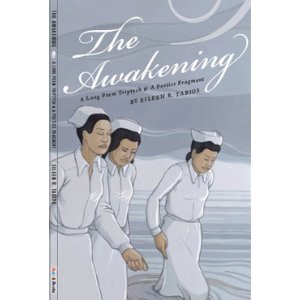
The Awakening A Long Poem Triptych & A Poetics Fragment


The Awakening


A Long Poem Triptych & A Poetics Fragment

by Eileen R. Tabios

Copyright 2013 by Eileen R.

theenk Books

Palmyra NY

ISBN-13: 978-0-9647362-8-9

Softbound, 59 pages, $16


Review by Zvi A. Sesling


9 1 1 / My Forty-First Birthday –

Notes for the Poem That I Will Not Write


This is a poem of heartbreak and tragedy. It does, of course, refer to the 9/11 attack on New York and Ms. Tabios’ very personal recollection of that day, she having worked on the 95th floor of One World Trade Center. The poem follows an exchange of emails with various people she knew/knows documenting the emotions, the landscape of fright into terror, anger into anti-American policy with a last line that leaves you...


The final poem, The Awakening Of A is another masterful tour for Tabios as she takes through lines about her child, about herself. Do not take her poetry as confessional, it is revealing, yes, yet it speaks certain truths about other matters such as


our founding fathers

were refugees.

Now


Native Americans are

refugees…


or these lines about Afghanistan


BK means below

the knee.

AK


means above the

(It is easier to make a BK prosthesis)

knee


The final piece is a prose work From Babaylan Poetics which Ms. Tabios presented a panel, Bay Area APIA Poets and Avant Garde. This piece is part of that presentation, perhaps best explained that she is “…a Filipino, including Filipino-American poet…”

She explains “…the space, from which I attempt to create poem. In the indigenous myth, the human, by being rooted onto the planet but also touching the sky, is connected to everything in the universe and across all time, including that the human is rooted to the past and future – indeed, there is no unfolding of time.”


Another line which captured my sensibility is “I don’t believe it’s the poet’s role to say whether a poem succeeded—and I believe this because I believe a poet only begins the poem and it’s the audience or reader that completes it.”


And finally “If I am an avant garde poet, it’s not because “I” am avant garde. It would be because we, all of us, are. This We, that is holding my hand writing the poem.


Want to get your socks knock off, like to read an intellectual or an avant garde poet, pick up an Eileen Tabios selection of poetry. To quote Betty Davis, “Fasten your seatbelt you’re in for a bumpy ride.” Albeit one that is most illuminating and pleasing.


_______________________________________

Zvi A. Sesling is author of King of the Jungle (Ibbetson Street, 2010), Across Stones of Bad Dreams (Cervena Barva, 2011) and the soon to be published Fire Tongue (Cervena Barva). He is Editor of Muddy River Poetry Review, Bagel Bards Anthologies #7 and #8.


Wednesday, March 13, 2013

The Government of Nature By Afaa Michael Weaver


Somerville poet Afaa Michael Weaver has a new collection of poetry out The Government of Nature. I asked poet Dennis Daly author of The Custom House ( Ibbetson Street Press) to review this book....


The Government of Nature

By Afaa Michael Weaver

University of Pittsburgh Press

www.upress.pitt.edu


ISBN: 13: 978-0-8229-6231-1

68 Pages

$15.95


Review by Dennis Daly

These poems of Afaa Michael Weaver take you by the hand, like a trusted grown-up takes a child, down a landscaped and stylized pathway of disturbing memories, family ghosts, and familiar, even endearing, internal landmarks. The cadences are well wrought, formal (in the sense of elevated language), and beautifully rhythmic. In some poems the rhythm delivers a near chant. In others it becomes a strangled but pulsed whisper.

Weaver covers some dangerous territory here. The power of this poetic collection derives from his meditations on his own experiences as a survivor of childhood sexual abuse by an uncle. So much could have gone wrong in the writing. But it doesn’t. Without hatred or self-pity Weaver strikes just the right tone with intelligent contemplation and a pretty remarkable understanding of evil’s context.


The poems themselves seem to bridge a psychic divide between the horror of past predation and the solace of a future life. In the poem The Path Weaver describes his trek into an alternative peace this way,

With my umbrella I stumble, too lonesome

for the way water soaks into the skin in the thunder,

listening for the sound of the eagles circling

above the lost children of wild pigs or what can be

caught and carried in the talon. My hands are

not free, too busy with trying to keep cover

on my head. The stones have another meditation,

a kind of counting to music. Touch me, they say,

and a thousand stone paths will make their way to me.

Once in the night when it is dry, when the pretty

rain of mountain springtime was suspended,

I walked this path to the dream of where we live.

Again using rain and water as unifying factors Weaver in his piece entitled The Ten Thousand constructs a gauzy memory palace in which reality must be faced and imagination deciphered. The poet says,

If I write without color it is to obey the gray way rain brings

the past to us. The ten thousand are one giant palace with a room

for remembering, where you must stand alone, touch and believe

while it seems you are touching nothing and have gone mad

in this life, this gift. We are sitting on a rock in the thick falling

of water, purple lilies are growing in the sun’s ocean shadow,

sheep with golden wool are flying in the trees, a patient monkey

is bandaging a wounded blade of grass, the garden is a mesa,

seeds are mountain caves, the moon has gone infinite, made

two of its own selves for each of our palms. Now we have faces.

This poem flows wonderfully. Between surreal images Eastern thought connects with Christian mythology. Doubting Thomas is even here touching the wounds of his Redeemer.

Some of these poems are quite explicit and troubling. The poet, however, has a point to make about the damage that can be done to a child and the burden that that child carries throughout his life. This image from Weaver’s poem Looking Up from the Naked Bed I found particularly affecting,

One Spring I find myself with a woman,

craving love’s raw way, getting high on sex,

thrill of skin and breasts, losing myself,

my medication for my heart failing to slow

my addiction until this door opens, above

what I call love. I see myself, a child,

feel the hands of the man carving

the cross I carry, its totem marks.

A little over halfway through the book the fiercely protective poem Remember crouches like a lion. Weaver dedicates this poem to his granddaughter. It begins as a charming childhood litany. Listen,

If I forget to plug the sun,

let me know

If I forget to tame the sharks’ teeth,

let me know

If I forget to stop the tsunamis

let me know

If I forget to tie up the bears,

Let me know…

The poem continues with the same rhythm but ends quite differently and quite grimly. Here’s the last three sections,

If I forget to outlaw nightmares,

let me know

If I forget to put perverts away,

let me know

If I forget that the divine thing

moved inside me to write this,

the thing that can do all things,

let me know

let me down easy

into the earth.

In his title poem, The Government of Nature, the poet addresses his body directly. He again goes to a place of memories in order to find himself and negate those same memories and confront the monster, who propagated them. He says,

I come with you to places I cannot go alone, as alone

I would be only the decision to be, not the things

I cannot explain to anyone, except in the privacy

Of a piety I have had to own, a profound saintliness

That came to me in places too foul to remain buried…

My favorite poem in this book and one that gives this collection a gentle and positive gravity Weaver entitles Scrapple. It portrays good people trying to do the right thing and make the best of life’s mix of good and bad. Here, for instance, is Weaver’s loving description of his father,

…in the good times, between

the strikes and layoffs at the mills when work

was too slack, and Pop sat around pretending

not to worry, not to let the stream of sweat

he wiped from his head be anything except

the natural way of things, keeping his habits,

the paper in his chair by the window, the radio

with the Orioles, with Earl Weaver the screamer

and Frank Robinson the gentle black man,

keeping his habits…

Weaver’s book transforms the unnatural nightmares of a damaged childhood into something transcendent, warm and wondrous. This is beyond poetry. This is alchemy.

Tuesday, March 12, 2013

DOLLHOUSE, Poems by Elaine Terranova


Review of DOLLHOUSE, Poems by Elaine Terranova, winner of the 2012 award from the Off The Grid Press manuscript contest, Off the Grid Press, 24 Quincy Street, Somerville, MA 02143, www.offthegridpress.net, copyright 2013, $15.


Note: Cover photo “Kitchen of tenant purchase client, Hidalgo County Texas” by Russell Lee (1903-1986), Library of Congress.


Review by Barbara Bialick


 Dollhouse is a collection of poems that are built around a conceit of a dollhouse from sometime between the 1930s and 1950s as the excellent glossy black and white cover photo indicates. Off the Grid Press only publishes works by authors of age 60 and older, but someone of any age could appreciate the theme of the doll house family reflecting on the life of the poet from childhood to adulthood.


In “The Importance of the Dollhouse,” Terranova writes: “It is the only safe place for them/…I may see myself passing through/the little house, the clay house of myself/walking quickly past the windows.”


In contrast, she writes in “Excluded”, “Because she sat on the doorstep/and her mother wasn’t there./No One was there. The key/on a string around her neck, tied to her, key to a whole world gone. An uninhabited/interior…”


While, on the other hand, in “Girl: Bicameral” she points out “Everything/in the dollhouse, (is) in perfect balance…”


The dollhouse is a symbol of every facet of the author’s life, even the spiritual—a missionary in a park gave her a card with a picture of The Virgin Mary: “The Virgin Mary sits, prayers in hand/…the Holy Spirit can come in…”


Finally, in the book’s Section III, the last section, she writes of herself as an adult,

still transfixed by dolls, dollmaking and collectibles. In the poem, “Collector”, she writes “A doll is an object, a trinket, a token./Yet the dolls are not collected/in a glass case, which would remove them/from their main function, life./Instead, they inhabit a dollhouse/based on our memory/of the real. In them we recover our history…”


ElaineTerranova is the author of five books of poems and two chapbooks. Her translation of Euripides’ “Iphigenia” is part of the Penn Greek Drama Series. Her awards besides the one for this book include, the Walt Whitman Award, an NEA, a Pew Fellowship and a Pushcart Prize.


Monday, March 11, 2013

New Poetry Book From Tino Villanueva

 
                                                     (Click to on pic to enlarge)


Glad that my pal Tino Villanueva has this new book out from the Grolier Poetry Press-- go to  http://grolierpoetrybookshop.org/  to get information about the Grolier and ordering the book....

Sunday, March 10, 2013

THE BOSTON NATIONAL POETRY MONTH FESTIVAL April 5-7 2013


THE BOSTON NATIONAL POETRY MONTH FESTIVAL

Now In Its Successful THIRTEENTH!!! Year

CO-SPONSORS: Tapestry of Voices & Kaji Aso Studio in partnership with the Boston Public Library, SAVE the DATES: Friday, April 5, Noon-4:00P.M. Saturday, April 6th 10:00 A.M.- 4:40 P.M. OPEN MIKE: 1:30 to 3:00P.M.; & Sunday, April 7th, 1:10 to 4:30P.M. Open Mike 1:30-3:00P.M.- Work Shop 3:15-4:30 P.M. The Festival will be held at the library’s main branch in Copley Square. FREE ADMISSION

Friday, April 5- Commonwealth Avenue Salon Room at the BPL:

12:00-1:00 P.M. Dan Tobin, Afaa M. Weaver, Christine Casson

1:00-2:00P.M. David Ferry and George Kalogeris

2:00-3:00 P.M. Rhina P. Espaillat , X.J. Kennedy

3:00-4:00P.M. Kathleen Spivack, Richard Hoffman, Judith Steinbergh

56 Major and Emerging poets will each do a ten minute reading; ALSO

Featuring 5 extraordinarily talented prize winning high school students: from Boston Latin High School,; Boston Arts Academy, and Harvard University, Daniel Schwartz. These student stars will open the Popular Poetry Marathon portion of the Festival April 6th at 10:00 A.M. SAM CORNISH, Boston’s current and first Poet Laureate will open the formal part of the Festival at 11:00 A.M. 55 additional major and emerging poets will follow with a POETRY MARATHON


Some of the many luminaries include SAM CORNISH, Rhina P. Espaillat, Afaa M. Weaver, Christine Casson, Dan Tobin, X.J. Kennedy, Alfred Nicol, Kathleen Spivack, Ifeanyi Menkiti , Richard Wollman, Doug Holder, Elizabeth Doran, Richard Hoffman, Lucy Holstedt, Kirk Etherton, Charles Coe, Ryk McIntyre, January O’Neil , Regie O’Gibson, Kate Finnegan (Kaji Aso Studio), Victor Howes, Lainie Senechal, Harris Gardner Susan Donnelly, Jack Scully, Rene Schwiesow, Tomas O’Leary, Marc Goldfinger, Gloria Mindock, Tim Gager,Barbara Helfgott Hyett, Stuart Peterfreund, Elizabeth McKim, Valerie Lawson, Michael Brown, Mignon Ariel King, Tom Daley, Molly Lynn Watt, Chad Parenteau, Joanna Nealon, Walter Howard, Kim Triedman, Zvi Sesling, Irene Koronas, Fred Marchant, Sheila Twyman, Robert K. Johnson, Chris Warner and a Plethora of other prize winning poets.


This Festival has it all: Professional published poets, celebrities, numerous prize winners, student participation, OPEN MIKES, WORKSHOP, BOOK TABLES.

Even more, it is about community, neighborhoods, diversity, Boston, and Massachusetts. FREE ADMISSION !!!

FOR INFORMATION: Tapestry of Voices: 617-306-9484- Library: 617-536-5400

Wheelchair accessible. Assistive listening devices available. To request a sign language interpreter, or for other special needs, call 617-536-7855(TTY) at least two weeks before the program date.

Friday, March 08, 2013

GRAND MAL Poetry by Dennis Mahagin


GRAND MAL
Poetry by Dennis Mahagin
Paper,  $12.95
122 pages
ISBN 978 1 60864 051 5

REBEL SATORI PRESS
www.rebelsatori.com

Review by Susan Tepper


GRAND MAL Book Review


What makes Dennis Mahagin run?  Run, as in jet engine propelling tons of steel down a runway and up into the sky.  From his opening poem GRAND MAL W / GROWN UP, it’s clear things are out on the table:

“Back then there was Grandma, / stuffing your thoughtless pie hole / with a freshly-bought / Ivory soap cake, / after you just popped off / to your impressionable siblings / at breakfast, a wisecrack / about the sweet / peach ridge panty cleft / on February’s / Sports Illustrated / swimsuit cover model— /… ”

GRAND MAL can be frantic, it’s often funny, often strung out, yet the craft here never wavers.  The poems hang together the way a talented musician knows to assemble dissonant chords, making them something powerful and profound that will move people; provided it’s done without strain or artifice.  For many years Mahagin was a bass player and song writer— no surprise!  Music punches up each of his fractured poetic lines, so when they coalesce into lyrical scenes they move and shout and lament from that deep well in the land of the down and out: the almost dead; or dead for all practical purposes. 

So why Grand Mal?  Medically speaking, Grand Mal is a seizure characterized by 4 phases (there’s an epigram explaining each Phase as it delineates the book’s 4 sections).  Mahagin writes in BANISHING THE SNAKES: 

“It’s a go-fast world, and green / is the color of my disease— / … / I’ve done that / Riverdance sidestep, / caught the flak of dripping fang / that makes you so dreadful sick; / and I can tell you: no driftwood / wishbone stabbing stick at arms length / will work on this bitch it’s strictly up / close and personal, under your thumb / in a fire nozzle grip, until she opens wide, / blasting poison like syphilis piss / on a slush bank…”  (from Phase 1). 

Sub-dividing the book in this way allows the poems a forward momentum that tightens narrative tension, while at the same time maintaining the Grand Mal as its driving metaphor.   He writes in FARE:  “The Laotian impresario / at the outcall agency / recommended her / as a star in his stable: / “She go slow— she so / con-sooo-mate… pro.” / Now, as she slips on / the glistening condom / with her mouth / in a frisson of python, he bats back / the eyelid splash of rushing purple dusk /…”  (from Phase 2). 
So what makes Mahagin run?  Perhaps the demons of his past, present, and the always uncertain future, which is part and parcel of what makes poetry such a compelling art form.  Some can channel these demons better than others.  Mahagin puts it transparently out there, saying to anyone who happens to amble by, for a read:  “Stuff they give / to empty you / out, / makes sleep / tough, / getting up / to go, crapper / to sack , and back / …”  from ENDOSCOPY (Phase 4).  

GRAND MAL  is the second book by this prolific poet.   I eagerly anticipate more. 
—Susan Tepper

Wednesday, March 06, 2013

Novelist Perry Glasser: Sending Archie Andrews to a Brothel


Perry Glasser has lived in Haverhill, Mass for the past 30 years, but he still has the brash, streetwise  persona, of a What Makes Sammy Run--like  Brooklyn Jewish kid that he once was. Glasser who has taught writing at Salem State University for many years, is an accomplished man with five books to his credit, the most recent:  Riverton Noir, which won the Gival Press Novel Award  for 2011. The novel deals with a bunch of teenage characters in a fictional Riverton, Mass. and it hysterically sends up the relatively pristine 1950s notion of the teenager exemplified by Archie Comics.  I had the good fortune to interview Glasser on my Somerville Community Access TV show  Poet to Poet :Writer to Writer.


Doug Holder: You have lived in Haverhill, Mass. the home of the late Andre Dubus. Many writers that I interviewed on this show have been in his workshop he used to hold out there. What is your association with him?
 
Perry Glasser: I met Andre at a writers conference years ago where he was running a workshop. I guess there were about 15 people in the class...we became good friends. I assisted him. I read a lot the manuscripts so he didn't have to. (Laugh) He had just got married to his wife Peggy. I remember his daughter Candice as an infant. A couple of years later I got a call from Bradford College where Dubus taught. He said he was moving on from his position there, and wanted to know if I wanted to take a shot at it. So I took the job. I applied for it and I was accepted.
 
DH: They made a film based on Dubus' fiction, didn't they?
 
PG: Yeah. We Don't Live Here Anymore. The film wasn't too good. His son's novel The House of Sand and Fog was made into a film and it was much better. When Andre lll learned that his novel was to be published...it was one day after his father died. So he never knew that his son was going to be a big deal. Then Oprah picked the book up. I always say if you have a choice between the Pulitzer and Oprah, pick Oprah--you sell more books. (Laugh).
 
DH: In your novel  Riverton Noir you have a sort of jaded, hip, sexually-advanced group of teenagers, involved in drugs, murder and mayhem. Are you throwing pie in the face of the 1950s version of the typical teenager?
 
PG: The answer is yes. Haverhill, Mass. is the birthplace of Archie Comics. When I first moved there over 30 years ago there were people who claimed they knew the characters, which was of course impossible. The comic was designed by a World War ll vet. The Archie Comics annoyed me, perhaps because I taught school in New York City  for 10 years.  My sense of who were typical were not the kids in the Archie Comics. I mean the female characters were divided into three categories: blonde, redhead and brunette. Hair color was how they were classified. I created a dark plot. I wanted dark lives for my high school kids. I fell in love with the protagonist--Madge. She's puzzled by the fact that everyone who lives in Rivereton, appears not to grow old. She begins to think she is in a fictional plot. And then there is the pressure of the real world to contend with...drugs enter into Riverton.
 
DH: You seem to have a great knowledge of drug use or should I say abuse.
 
PG: I asked a student of mine about drug use--who had a boyfriend who knew much too much about it. I found out about different doses of drugs, what colors are the pills  etc... I found out if you are abusing painkillers--you want to chew the pills rather than have them go down slowly--this way you can get an immediate hit. I did research. I didn't come from a druggie past.
 
DH: I remember reading an essay of yours about these brilliant, eccentric but troubled youth you have taught over the years. They later wound up killing themselves. Are any of these characters based on this?
 
PG: That's very astute. The two formative experiences in my life--are the fact that I was a single parent, and an English teacher at a all girl's school in NYC. This was in 1969. I was a 60s boy and this was the inner city. I thought I was going to bring the revolution to people who needed it. But I of course was the guy who became educated. The kids did not want to change the system--they wanted to get into it. Much of my fiction expressed this, especially through my female characters. These characters are the archetypical young women I met while teaching. My characters experience some of the same things my students did. And to some extent my own daughter--although she was not a character in the novel. The characters are mash ups of several other people. Madge would be the most like me. She is not happy to accept things the way they are. And she uses the strategies young women need to in order to succeed, especially in the crime-ridden milieu of the novel.
 
DH:  There is a lot of graphic violence and sex. Have you got any flack?
 
PG: I wish I did--then there would be more people reading it. I haven't gotten any flack. But it is difficult to find pages that I can use at a public reading.
 
DH: You teach Creative Writing at Salem State University--how do you go about engaging the students?
 
PG: You give of yourself. You are honest. A student will eventually ask you in class: "What do you think?" You are obliged to tell them rather than evade them. I also think all good teachers are good actors. You also have to provide structure--so the student has the comfort of knowing what comes next and how each step is related to the other.
 
DH: One of your characters is a sort of Ma Barker-like Jewish aunt. She could cook Matzo Ball Soup, and at the same time be a den mother for a bunch of nefarious criminal types. She was also very literate.
 
PG: She is based on my first mother-in-law. She was a Holocaust survivor--she smoked cigarettes --and was very well read. She grew up in Vienna--she knew Freud. She was not a drug dealer like the fictional character Sasha. I am grateful to her because she brought  me above my provincial upbringing in Brooklyn.
 
DH: You have a great talent for dialogue. Your remind of the Boston area crime writer George Higgins of The Friends of Eddie Coyle  fame. I loved his line: "Life is tough and it's tougher if you are stupid."
 
PG: This is great. I adore Higgins. I don't make up dialogue. I record what my characters are saying. What they are saying in my head. I transcribe what I hear in my mind. It gets sharper when I revise it. It is easy to hear Sasha's voice because she was based on my mother-in-law. So I am either psychotic because I hear voices or else my characters just play out in my mind.
 
DH: You are a great admirer of Raymond Chandler too?
 
PG: Chandler is one of the strongest writers ever. I don't think he was a great mystery writer--he was a great writer--period. He gets the feel of the West Coast down cold. William Faulkner did at least two screen treatments of Chandler novels.
 
DH: Do movies influence your work?
 
PG:  The movie  Pulp Fiction certainly did. The dialogue is priceless.

Tuesday, March 05, 2013

Women Musicians Network 16th Annual Concert, with guest CD Collins, March 7 at the Berklee Performance Center.


Women Musicians Network 16th Annual Concert, with guest CD Collins, March 7 at the Berklee Performance Center.

By Kirk Etherton

Award-winning poet, spoken-word artist, and activist CD Collins is the Special Guest at this year’s WMN concert. “We’re thrilled to have CD in the show,” says Lucy Holstedt, co-director, and concert M.C. “She is a great, courageous artist. I’ve admired her work for years.”

CD will be performing the title track from her just-released album, “Clean Coal/Big Lie.” In a recent radio interview, Collins thanked Holstedt for putting together a talented backing band of Berkee women students “who helped me take this piece to a new level.”

The concert—which is produced by the WMN student club at Berklee College of Music—has 13 acts this year. In original jazz, you’ll hear a contemporary big band, vocal soloists, and a virtuosic Israeli recorder player. Co-director Christiane Karam is bringing her Balkan choir to the show for the second time.

Other acts: R&B, rock, Scandinavian folk, and very hip Italian a cappella doo-wop. All together, 100 performers are involved (including about 25 male students). Men are definitely welcome on stage and in the audience.

Says CD Collins, “this is always such a fun, fine, and diverse show. I’m honored to be part of it this year.”

Tickets/ more info. at berkleebpc.com, or at the B.P.C. box office.
$8 in advance / $12 day of the show. The concert is 8:15 pm – 10:00 pm. Doors open at 7:45

Sunday, March 03, 2013

Legally Dead by Dan Hunter


Legally Dead by Dan Hunter

In June 2011 when Dan Hunter's play Legally Dead had its first reading it was a serious drama.  Almost 2 years and 22 or perhaps 23 drafts later (the author himself was not even sure of the number) the play has developed into a comedy.  The playwright explains that this is what he discovered the play was apparently meant to be in the first place.  This discovery could have put the project on the right path if the author did not take things to such extremes in an attempt to make sure the play would be humorous. The play doesn't know if it should be a dark humor piece or a farce so it ends up being neither.  The humor is dark but not dark or interesting enough, and it doesn't have the lightness and sparkle to be farce.

The play would have been better served if the author had taken a lighter hand when he developed the humor.  There is not much subtlety here.  The quips and zingers come at you fast and furious without letup or real pacing.  This would not be as much of a problem perhaps if the jokes were not so one-note and in the same few veins.  They get very tired very quickly.

But then what can be expected when the characters are all crafted in a way that makes them very one-dimensional.  Each character seems to have his or her few specific odd traits, which Hunter pushes to the limit.  We have the alcoholic doddering mother Marsha (Kippy Goldfarb) with her various bottles stashed in all sorts of cracks and crevices in the home and even on her person, the germ-phobic Jesus-loving younger daughter Rebecca (Jen Alison Lewis), high-strung elder daughter Annie (Adrianne Krstansky) a lawyer with high gambling debts pursued by criminals and the recently released ex-con son Tommy (Christopher James Webb) who wants to take over the family business.  These are 4 of the 5 members of the Lincoln family. 

Missing is the patriarch of the family, who disappeared 5 years prior we discover into the play.  It is interesting to have the play center on a character who is MIA, not present but talked about.  But surprisingly not much is really made of the father's mysterious disappearance.  And no one seems particularly concerned or affected by his absence.  Only the younger daughter Rebecca seems to maintain any hope that he may still be alive, but then there is no speculation why he left and why he would stay away.  Filial love, as well as marital bliss between the parents come quickly into doubt.  It becomes clear very soon what the different possibilities are for what may have happened to the father. 

This is quite a disfunctional family, one of the most I have seen in a while, and in that the author does succeed.  I was not sure if this dysfunctionality was the cause or effect of the father being missing.  Nothing really is explained or occurs with any sort of logic.  This is exemplified perhaps by what happens at the very beginning when the younger daughter ends up killing her mother's incontinent dog when washing him and then vacuuming him, and then tries to hide the body from the mother and other members of the family.  More is made of the missing dog in fact than one imagines was ever made of the missing father.

Much of the story and its zany over the top characters come from Hunter's life.  He also is from the mid-west as are the family at the core of the story, the Lincolns, who have a prosperous car business that sells models by the namesake manufacturer Lincoln naturally.

The play is set on Christmas Eve, with Marsha looking forward to a reunion with all three of her children.  This will in fact be the first time they are all together since brother Tommy hired a hit man to kill them, why we can only guess, and only Annie harbors any fear or ill-will for his past actions.  But then Annie is dead-set to have her family sign a document she has drawn up to have the MIA father declared legally dead.  This is perhaps about time, and it would allow the family’s assets to be unfrozen and their car dealership to be sold.  Though a smart lawyer, Annie has some serious gambling and drinking problems, and now owes some very bad men a lot of money.  But then getting anyone in the family to agree to anything is a futile exercise, and everyone has their own agenda though some deal-making is attempted.  Money seems ultimately the common bond in the family and everyone is desperately trying to find the will to prove their claim to the family fortune.  But then what will turn up first, the body of Marsha's beloved pooch or the father's will?


The play's running time is 100 minutes and there is no intermission.  This is a piece that would have benefited from a short break.  Since there are several mysteries here to sort out and myriad of family secrets to be revealed, it would have been quite suitable to have a cliff-hanger of sorts leading into an intermission before things were revealed or discovered in the second act.

Much was probably expected from this new play by Hunter, who had received acclaim with his play RED ELM, also produced at the BPT.  Unfortunately the promise does not get delivered here, and perhaps yet another draft is called for.  Still the very capable team of actors and director Steven Bogart do their best with the material given them.  Probably the star of the production is the set designed by Christina Todesco; it is a wonderfully kitchy electric blue kitchen with all sorts of garish Christmas decorations including a life-sized Santa’s sleigh pulled appropriately enough by pink flamingos in flight above.

The Boston Playwrights Theatre production of Dan Hunter’s “Legally Dead.” Directed by Steven Bogart. At the Boston Playwrights Theatre, 949 Commonwealth Avenue, Boston. http://www.bu.edu/bpt/

Thursday, February 28, 2013

Tugboat Warrior by Ruth D. Handel


Tugboat Warrior

Poems by Ruth D. Handel

Dos Madres

www.dosmadres.com


ISBN: 978-1-933675-91-6

33 Pages

Review by Dennis Daly

Ruth D. Handel, in her book of poems Tugboat Warrior, reframes her mother’s historic life in a series of personal, sometimes achingly personal, poetic fragments, each one set at a slightly different angle. The collection expresses a line of narration that Ernest Hemingway would call, "one true sentence." Its multiple facets of heartfelt observation, positive and also negative, deliver this truthful sense of a heroic, flawed, and driven woman.

One of 12,000 female naval and marine enlistees during the First World War that freed up more men for shipboard duty, Handel’s mother, Florence Gluck, was both a feminist pioneer and an unabashed patriot. Although the Navy desperately needed stenographers, typists, translators and other office help to deal with the huge amount of war- generated paperwork, they had a problem. Every enlisted yeoman had to be assigned to a ship and women were not allowed on ships. In grand bureaucratic fashion the Navy solved their problem by assigning all 12,000 women to a sunken tugboat from the Civil War era. Thus the title of the book!

The first poem in the collection entitled Fragments serves as both a mini- introduction and microcosm of what comes after. The poet details a list that sums up an image of her mother,

opera glasses,

seamen’s manual of arms,

Browning’s Pippa Passes

inscribed "To My Hula Girl,"

blue bandana,

red checked blouse,

the Dodge sedan

she drove to the beach,

green spirals

on the cover of the phone

book by her bed,

the closed bedroom door.

You can’t help but feel the sadness and the intensity in the poem’s final line. The very next poem, Bricolage 1, expands on this sadness but shows the trade- off. The poet notes the sources of her creativity,

using whatever comes to mind

from anger, from images of a shadow mother

who lacked tenderness, but not pride,

who once rose alone for a patriotic anthem

and by example drew the assembly up,

her nine year-old daughter unwilling at her side.

In the poem Mother as Little Girl in White Hat, looking at a portrait of her mother, Handel speaks out her admiration,

What do you hope for?

Are you rehearsing the self-willed woman

you will become?

The portrait is almost one hundred years old.

Paint cracked. Frame loose.

Face full of light.

There is no doubt about Gluck’s pride in serving her country. The full length photo in front of an American flag on the cover tells all. Handel describes that photo in the poem Brooklyn Navy Yard this way,

She poses proud, white skirt to her ankles,

white jacket one stripe on the sleeve,

floppy bow tie, straw hat. In winter,

she’ll change to blues and a flowing cape.

Handel adds that her mother is issued a Bluejackets Manual that "every man on board ship must know." The poem ends with not a little irony,

Service done. Florence is rated

Proficiency in Rank: Good

Sobriety, Obedience: Excellent

and given medals to commemorate

the Great War to End All wars.

Handel admits to jealousy as a child of seven, a not uncommon jealousy to be sure. But her emotions were frozen in time by awful circumstances, and never blunted by accommodation or reconciliation. The poet in a poem called Wind-lashed Rain complains,

The glassed-in sunporch.

Wind rises to hurricane.

I watch

Mother, brother.

Those two.

Arm around his shoulder. Sheltering.

Wind at hurricane.

Those two…

Here is how Handel concludes the poem,

I am seven. My brother four.

Three years later, she would be lost to us both.

Emotional separation from a parent can maim a child deeply. Handel recalls such a wound in her poem Crabmeat with this intense image,

Home from second grade

I find my mother in the dining room

Eating seafood, white mound

On a green glass plate.

She looks up but doesn’t offer a taste.

Her fork flicks aside a tiny piece of shell.

Some facts of Gluck’s story are repeated by Handel in different poems, but they each come from a different direction with originality and even surprise. The poem Bricolage II begins this way,

Florence stood as the national anthem began.

No one else in the hall was as quick to rise.

I whined and struggled as she yanked me up

and for a moment we were the only ones standing,

me in the angers of 9 year-old embarrassment,

she at attention. My arm felt her sting for years.

When I marched for civil rights, walked

a picket line, worked for women’s causes,

protested war Florence was not in my line

of sight, yet in memory she was always standing

tall…

In spite of the friction between them, Florence Gluck became the poet’s role model for feminist rights and another, equally important, kind of patriotic serviceprotest. Another bit of irony perhaps!

These generational poems do justice to an imperfect but admirable woman and her equally remarkable and talented daughter. One true sentence, followed by another and another isn’t that what poetry should be?

Sunday, February 24, 2013

Interview with Robin Stratton: Novelist, Poet, Publisher, and Coach.


Interview with Robin Stratton: Novelist, Poet, Publisher, and Coach.

With Doug Holder


Robin Stratton has been a writing coach in the Boston area for almost 20 years. She is the author of The Revision Process, A Guide for Those Months or Years Between Your First Draft and Your Last, and two chapbooks, Dealing with Men and Interference from an Unwitting Species. A two-time Pushcart Prize nominee, she's been published in Word Riot, 63 Channels, Antithesis Common, Poor Richards Almanac(k), Blink-Ink, Pig in a Poke, Chick Flicks, Up the Staircase, Shoots and Vines and many others. Her novel, On Air, (Blue Mustang Press, 2011) was a National  Indie Excellence Book Award finalist. A second novel, Of Zen and Men, is now available from Big Table Publishing Company. She’d love to have you visit her at robinstratton.com  I had the pleasure to interview her on my Somerville Community Access TV Show:  Poet to Poet: Writer to Writer.


Doug Holder:  How did you establish yourself as a writing coach?

Robin Stratton: Well, that is a good question because it is hard to break into being a writing coach without a lot of writing credentials. It just sort of happened.. I had a number of people who approached me to edit their manuscripts when they learned I was a writer. They knew I had written novels--and they liked them--so it naturally followed. This was in the late 80s and there was not as many people doing coaching as there are today.

DH:  Did you have writing coaches?

RS:  For about three months. And this was before the Internet--so this is how it worked. You send the book, and it would take a week or so for the coach to get it. Then they would read it. And then they would write up their responses, and that would take another week--and then they mailed it back. But I did learn a lot about how to give feedback from this experience.

DH:  How would you define the role of a writing coach?

RS: I think a coach is someone who could tell you what the weakness is in your writing. He or she can advise you how to make it more commercial. They can advise you on the rules to adhere to sell books. I think tat is what people need from a coach.

DH:  I get the sense from you that you try to instill people with a sense of confidence?

RS: Yes. You have to try to build people up. Anyone who has finished a novel--well that's huge--so you want to cultivate that.  It takes a lot to write a book.

DH: Has there ever been a first draft that you can totally go with?

RS: Oh...No. Some poets can be pretty good the first time around--not so much for novelists.

DH: How many drafts do you have for a typical novel of yours/

RS:  15 drafts. I like to have a writing group--and that helps me. I always tell novelist that they should be in a group if they possibly can. Not only is it good to get feedback--but when you give feedback it illuminates weaknesses in your own writing.

DH: You write poetry as well as fiction.

RS: You know I never was a poetry person. I never really enjoyed reading poetry. I thought it was too short. I was never a short story kind of person either. But I needed  publishing credentials to get my book picked up by an agent. Then I thought I would start a magazine. So I started the Boston Literary Magazine, and it has been around since 2006. Now it is in print. So it was a great self-made credential to get my book picked up by an agent. In terms of the poetry I like, I lean to narrative poetry.

DH: A lot of your novels are about relationships between men and women. Your new novel Of Zen and Men is evidence of this.

RS: I think that is what's most important to me. A reader can see their own relationships through the relationships in the book, I hope. All my characters have to go through a grand transformation. They start out likable but flawed and then something happens, and they wind up more effective.  Everybody can relate to this.

DH: Tell us about the book you published from your own Big Table Press   The Revision Process ?

RS: I published that when I first started Big Table. It was a test book. It's not about the writing but the revision. That is where a lot of writers get stalled--the revision. This is a way to look at their manuscripts with a new set of eyes. To specifically look at things. A writer knows when something doesn't work--but sometimes they don't know why. I thought it was a useful guide. That came out in 2006. I then published chapbooks, and lately perfect bound editions.

DH: If you had a son and he wanted to be a writer would you encourage him?

RS: If I didn't have the contacts I have I might steer him to learn something that could supplement his income. I would say to a young writer :"Make sure you are in a writers group, have a lot of computer skills, make sure you use social networks to promote yourself, and make sure you have a website."


Young Poet Series--Endicott College


Since the Ibbetson Street Press and Endicott College formed an affiliation a few years ago, we have tried to reach out to the creative writing student body as well as the faculty. During this time we have published student interviews with such accomplished poets and writers as Marge Piercy, Maxine Kumin, Diana Der-Hovanessian, and others in our literary magazine Ibbetson Street. Students, as well as faculty have seen their own poems published in my column in The Somerville News. Students have written book reviews on our popular literary blog Boston Area Small Press and Poetry Scene, and in the bible of the small press itself: The Small Press Review.


Ibbetson Street has also started a small press collection with the help of the Halle Library staff at Endicott that houses alternative, small press poetry and fiction books from around the country in the tradition of the great rare book and poetry collections at University of Buffalo, Brown University, and the University of Wisconsin/Madison. We feel this growing collection will be an invaluable resource for future literature and creative writing students at the college and for the literary community in general.


We have arranged readings for students at such venues as Medicine Wheel Productions in South Boston and the Jewish Community Centers of Greater Boston, as well as helping them get literary internships in the Boston area.


The Endicott College/Ibbetson Street Visiting Author Series has brought such acclaimed authors as DeWitt Henry, Sam Cornish, Fred Marchant, Richard Hoffman, Luke Salisbury, Bert Stern, Miriam Levine, Tom Daly, Michael Mack, Vivian Shipley, and many others to campus; so the students can hear first class writing and get insight into their own work from talking with these authors.


Dan Sklar, a professor of Creative Writing at Endicott College and I discussed other ways that we could reach out to the Endicott community. We decided on a Young Poet Series that would publish the work of talented undergraduates once an academic year.


Our first poet is Emily Pineau. Pineau is a student of Dan Sklar's and has reviewed books, interviewed poets, and has had work published in Ibbetson Street, Endicott Review, and other magazines. In fact Pineau was nominated for a Pushcart Prize (By Zvi A. Sesling, editor of the poetry journal  Muddy River Review)--a prize given for excellent writing within the vibrant literary subculture of the small presses and literary magazines.


Emily has an accessible, honest and evocative style that shows great promise. We hope this little poetry book No Need to Speak will inspire her to keep writing and publishing, and inspire other young writers in the Endicott community.


Doug Holder/Director of the Ibbetson Street Press/Endicott College/ Beverly, Mass./Feb. 2013

Friday, February 22, 2013

Lake Effect Poems by Christina Cook


Lake Effect
Poems by Christina Cook
Finishing Line Press
ISBN: 978-1-62229-0628
29 Pages
$14.00

Review by Dennis Daly

Christina Cook in her book of poems, Lake Effect, commingles the universes of life and death onto a canvas alive with natural images painted in a thin and elegant texture reminiscent of ancient Japanese screens. The central construct in this phantasmal paradigm, a rural lake with summer cottage, pulsates with spiritual reconciliation and a stark, almost visionary, clarity. Poems throughout this book touch on the illness and death of the poet’s mother and these central poems expand into Cook’s comforting and rather stunning world view.
The poem A Night in Fenwick mixes the emotions of imminent death with a life force of surprising strength. The poet puts it this way,
…we sit on the jetty, in denial
of the diagnosis you received today.

Darkly, silence passes between us.
Crabs click over the rocks.

The tang of salt surprises our lips
as we listen to the day’s last waves

rattle oarlocks in the dories off shore.
In the morning we will accept it…

In the poem Dory, Cook elevates death into the life’s natural goal.  It becomes part of a grand bargain. Even without a paradisiacal afterlife of silver fish, it is sufficient. She begins,

Say something smooth
about a life long committed
to death.

Let the feathers fade.

Wooden dories dulled
by waves don’t want
netfuls of silver fish:
their rot-soft hulls
are enough. The callused feet
of old fishermen, enough.

Even in the extremes of sickness Cook finds images of mystery and beauty. Consider these lines from the poem Coma,

shadows pass
over my skin
like the care of a
quiet night nurse

I am immersed
in life, but not alive

my tiller-thin thirst
and tilting hull,
my sail’s silhouette
slicing a solstice moon…

When death finally comes the poet adds another twist. The wake becomes a true celebration rather than a melancholy rite. The poem entitled On the Night of Your Wake unfolds thusly,

Stars fall from a constellated open hand,
land like glitter in our hair.

We say the night is full of her gifts
and drink champagne, red

from rain falling through feverish skies,
we hang paper lanterns from the low

gnarled limbs of laurel…


 In a very short but wonderful poem called Summer Evening Cook amalgamates the natural and the mystical into a single metaphor—the lake. She does this by detailing the deposition of her mother’s ashes. The poet says,

…northern cardinals
crimson the shapeshift clouds,

we scatter your ash over the lake
and watch your cinder soften,
like last year’s peaches,
into water the color of koi.

The image of the peaches and the flickering multiple-colored koi emits vibrant color and light. There is little grief here, and much hope. Cook seems to use this hope as an impetus in her search for life’s meaning. She comes right to the point in her poem Departure. She marvels,

I see now how life’s only slightly
different from death, in the end.
We once watched whale oil burn

an aurora borealis of grime against
the burlap wall. Fur once softened my skin.
If regrets can survive death,
mine is this:

so much was done without knowing
what it meant…

Life forces include everyday duties. The poet upon opening up her summer cottage becomes locked in a conflict between her unresolved grief and family matters. Cook describes,

I suppose I should be dusting
pollen off the chairs instead
of pouring another glass,
or pruning the rhododendrons

before they bloom
through the hole in the screen,
before the shadow reaches
all the way over the cove,

once again graying the oaks
as if they’d always been
the parchment bones of birds.
I suppose I should

Stop mourning my mother
And put a fresh coat of paint
On the mildewed doors…

In the poem On the Sleeping Porch Cook portrays the profound weight that her family gives to her understanding of life, albeit of a transitory nature. The image of a sleeping porch, which extends into the darkness of night, seems perfect. Here are a couple sections of the poem,

A luna moth, large
As my husband’s hand
Bumps against the screen,
Batting its four-eyed wings
Like lashes…

It continues this way,

… Scorpio’s rising
over  the fringed ridge of firs
mirrored in the lake,
while somewhere,
the moth’s week-old shroud
slowly becomes one
with the soil.
                                In the trundle
bed beside me,
my son sighs in his sleep: he
is the weight I carry,
the ballast…

The title poem, Lake Effect, is the last poem in this collection and it’s well placed. It sums up the poet’s faith in a benevolent darkness which births beauty and consciousness for a time and then draws them back into a primordial night. Cook concludes,

So while the rest of us drink pinot
noir, discussing some temporal thing
like milkweed slowly strangling the lake,

my sons poke black lily buds
with their dessert forks, dissecting them
on the tablecloth.
                                                They, too,
                        believe in the night:

finding the petals fresh inside,
plucking them out, one by plush white one.

Cook’s poems succeed in the same way. Poke them enough and they bloom into a lovely plushness.