Thursday, October 04, 2012
Lummox Press: An Anthology of the Best of the Small Press Due out Nov. 2012!
Found Art
To spot a diamond bit
among crushed beer cans
and rusty cars
is to find truth
in this man-made world.
Roseanna Frechette
Lummox Press announces the inaugural issue of a new annual magazine/anthology entitled LUMMOX, due out in Nov. of this year. The first issue has the work of over 160 poets in it and features SPECIAL SPOTLIGHTS on poetry from all over the US and beyond! Guest Editors Georgia Santa Maria (ABQ, NM), Jane Lipman (Santa Fe, NM), Biola Olatunde (Nigeria), Don Kingfisher Campbell (San Gabriel Valley, CA), Doug Holder (Boston area), Ed Nudelman (Academia), Jaimes Palacio (OC poets), Jane Crown (International), Marie Lecrivain (LA Poets), Mike Adams (Colorado area) and Ryan Guth (Mid-South) represent their areas with gusto! In addition to all this, the poetry from all over the US, Canada and the world is represented by both known and unknown poets. There are essays on poetry; reviews of poetry; 2 interviews with a couple of SoCal movers and shakers: G. Murray Thomas & Rick Lupert! There is also a Tributes section to fallen poets. On top of all this there is also artwork by Robert Branaman, Mark Hartenbach, Claudio Parentela, Norman Olson, James McGrath and Raindog. All this for just $25 (shipping included) when you buy direct from the Lummox Press website!
Reserve a copy at: www.lummoxpress.com/journal.html scroll to the bottom of the page for the Pay Pal button or directions to pay by check.
Images of America: BOSTON’S DOWNTOWN MOVIE PALACES
Images of America
BOSTON’S DOWNTOWN
MOVIE PALACES
by Arthur Singer and Ron Goodman
Arcadia Publishing
Charleston SC
Copyright © 2011 by Arthur Singer
Softbound, 612 pgs, $21.99
ISBN 978-0-7385-7631-2
Review by Zvi A. Sesling
In his introduction to Boston’s Downtown Movie Palaces, Arthur Singer notes that the book is, “a ticket, a ticket through time to visit these places in their heyday.” And Singer
keeps the promise. Beginning in 1775 when Faneuil Hall was made into a theatre by the British forces led by Gen. John Burgoyne, the book provides prints, photographs and informative captions to carry readers a little known historical aspect of Boston. There are fires, the first theater with electric lights (under Thomas Edison’s supervision), the inventor of Vaudeville, and a thorough, fascinating history of Washington Street, then Boston’s Broadway, the Modern Theatre, the Orpheum, Loew’s State Theatre and Back Bay theatres, the Metropolitan, Keith Memorial and Paramount theatres. And while the history is an interesting step back in time, the photos are even more fun. So is the scurrying views of Brookline, Somerville, Dorchester, West Newton and other local theaters that were “rescued” and could now be listed as “survivors.” For those old enough to remember original theaters, knowing they are alive and doing well is a thrill.
And the sad demise of great old movie houses like the Saxon, Pilgrim, RKO Keith Memorial, and others. I can remember the Franklin, Morton and Oriental in Dorchester and Mattapan, all gone, though there was an attempt to revive the Oriental in Canton with it twinkling star and floating cloud ceiling. I am told it did not last either.
However, let me say that Arthur Singer and Ron Goodman have provided a great slice of nostalgia and a big chunk of history which is a captivating read. When it is coupled with photos of the past, result is successful and well worth having on one’s bookshelf.
Monday, October 01, 2012
Review of SEQUENCE 8 By Amy Tighe
Review
of
SEQUENCE
8
By
Amy Tighe
Performed
by Les 7 doigts de la main
Directed
by Shana Carroll and Sebastien Soldevila
Presented
by Arts Emerson, commissioning partner
Cutler
Majestic Theatre
219
Tremont Street, Boston Theatre District
September
27 thru October 7, 2012
Recommended
for all ages
Tickets
from $25-$79
available
through ArtsEmerson.org
or 617-824-8400
Your heart is a generosity. It beats alone in your own body and in tandem
with every other heart on this planet.
Experiencing SEQUENCE 8 is as intimate and as generous as feeling
your own hopeful heart when it finally connects to the beating of our global
heart. The combination of classic circus
performances, precisely choreographed and inspired dance and superior acrobatic
skills by 8 young artists, all sly masters in their disciplines, simply opens us
to a new future. The troupe, called Les
7 doigts de la main, relies on personal strength, focus and endless joy from
the individual artists and a seamless collaboration with one another. There is almost no high tech technology, the
circus props have all been used for hundreds of years in circuses and street theatres,
and an elegantly simple set design creates a night of transformation for all.
Years ago when a lesser circus came to town, at the Boston
Garden, you could go and watch the animals out back. You couldn’t get close to them, but it was
better than the zoo. I was a clown
wannabe at the time, and hung around as much as possible to feed my facepaint
fantasies. The tigers were housed
in the back. There were four baby tigers, less than a year old in a cage
together. You could get really close to them and I spent hours watching them.
I raised kittens, and
was familiar with the play all felines share.
But this was different. I was
witnessing “play” in its original form, an element as necessary as oxygen. The tribe of tigers were fascinated with
everything and attached to nothing. One watched
us humans as we watched her, while she indifferently chewing on a sibling’s
ear, and at the same time another
sibling was capturing her tail between his large clumsy paws.
Then in an instant, they would change, stalk and pounce on the imaginary
gazelle in their cage in unison before they collapsed into corners to wash
themselves ferociously.
Sequence 8 was sort of like that, only better.
Les 7 doigts de la main
is a Montreal based troupe. Their name is a play on words – instead of the
unison of five fingers on one hand, they describe their troupe as having “beautifully
awkward dexterity” whose “initial goal was to bring circus to a human scale.” Watch out.
They do it.
This is NOT Cirque du Soliel or Ringling Brothers. Yes, many of the feats are similar to what
you have seen before—a lithe gorgeous young woman performing scary circus
miracles in a ring above the crowd, elastic acrobats throwing themselves
through impossible openings, adorable powerful young men scootling up poles as
easily as most of us breathe.
But here is what is different: This troupe takes us into
their hearts while they play. The evening starts off with a moderator thanking
us for being there. After all, he says, they would not be performers without an
audience. And, he adds, “you wouldn’t be
much of an audience without the performers—you’d be sitting staring at an empty
stage, right? “
And that’s when it starts—the performers have declared “Tag, you’re it!” Surprised, you are caught
and so you just run. They draw you into
to their performance, whether it is doing a double somersault on a bouncing
balance beam, or soaring through the theatre while being catapulted by a
see-saw, you are there. Tag, you are it,
catch them if you can. And if you can’t,
it doesn’t matter because they have taken us all in to become baby tigers at play.
We are led back to engage with the archetype of original play and deep
innocence.
The sense of intimacy and familiarity is profoundly crafted
into each artist’s performance. You
don’t really watch these performers, you experience your connection to them as
they twist, catch, fly and question common sense. Hanging upside down on a trapeze by just the
top of your foot is something we have seen before, but when this troupe performer
does it, the entire audience is arching their foot with him and feeling the
breeze in their hair as he swings. We exhaled
as one when he landed.
My well dressed neighbors in the seats next to me tell me
that they just feel love when they watch Les 7 doigts de la main. They feel the love between the performers and
they feel how the performers love their work.
I am surprised at this, a middle aged couple talking so freely about
love after the show. But, it is the
first circus I have ever seen to receive a spontaneous standing ovation, so
perhaps more than just my section neighbors feel it.
We talk about youth, about being twice the age of who we
have just seen, I think we might go on a diatribe about regrets from our own
lives and the yoga classes we should really get back to….. After all, the audience is mostly older
tonight
.
But we don’t. Something has changed. We have witnessed
mastery: the strength of practicing a
feat over and over until your body can catch a colleague dropping from 8 feet and
throw her to another’s waiting arms without anyone missing a heartbeat. We witnessed a group of artists not only
create and inhabit a world of total interdependence, but play effortlessly and
generously within it. We have felt them
open to us as playmates.
As I leave the theatre, I ask the dyed cherry-red-haired
20-something patrons who sat at the top balcony, if they felt the immediacy of
the performers. I also ask two tiny
Russian women, who are “a leetle over 70, some” tottering as they leave, what
they thought. Each and everyone replies
“I felt them” as they unconsciously
touch their hearts. “But that leetle
girl,” continues my tiny Russian new friend strongly, “I worry for her.”
Sequence 8 is an intimate and intelligent invitation to
experience our collective heart. Go, and
play, and be ready to hear your heart open.
Friday, September 28, 2012
Review of EARTH LISTENING, Poems by Becky D. Sakellariou
Review of EARTH LISTENING, Poems by Becky D. Sakellariou, with a CD of the author reading selected poems, Hobblebush Books, 17-A Old Milford Road, Brookline,
New Hampshire 03033, 2010, The Hobblebush Granite State Poetry Series, Volume II, www.hobblebush.com, $15.
Review by Barbara Bialick, author TIME LEAVES
From Euboia, Greece to the state of New Hampshire, Becky Sakellariou meditates on life
“with its depth, its explorations of love and loss (to what) seems to be like one long prayer…” according to reader Patricia Fargnoli. Indeed, as the author says in her own words, “These poems explore what I call the beginning of dying, the way our pores open to the world even more intensely as we age…”
The poem “The Inside of a Prayer” begins with the epigraph: “We are all descendants of travelers”—William Least Heat Moon. The poem reads: “Hold still/the translucent moon…Hang it above the blood/scarlet sumac and let it tell us/of the women and men/who boarded wooden ships/who traveled through eons/of other moons/to become you.”
She continues this line of thought in “God Doesn’t Need a Boat”: Come, ferryman of our fears,/carry our boat across the gap/the one between fire and daylight/…Bear us back into the light.”
To the author, what is most “unexpected is death”. In the poem “Unexpected”, she concludes “A quick, violent wind/…roars across the fields/…into the tomorrow of worry, fear/another harvest gone,/another year lost.”
Becky D. Sakellariou was born and raised in New England but has lived most of her adult life in Greece. Since 2007, she has been going back and forth to New Hampshire for part of every year. She has a B.A. in Literature from Antioch College and a M.Ed. in Cross-Cultural Education from Lesley College. She has published in a variety of journals. In 2005, she won first prize in the Blue Light Press Chapbook contest for THE IMPORTANCE OF BONE.
Wednesday, September 26, 2012
Interview with Poet Steve Cramer Director of the MFA Program in Creative Writing at Lesley University
With Doug Holder
****I thought I had lost the following interview--but I just recently found it. It was conducted on my Somerville Community Access TV Show Poet to Poet: Writer to Writer in 2004. The audio tape is archived at the Poetry Room at the Lamont Library/Harvard University.
Steve
Cramer is the author of four poetry collections, the latest being
“Goodbye To The Orchard” (Sarabande 2004). His poems and criticism have
been in the “Partisan Review,” “The New Republic,” “The Paris Review,”
among others. He was the recipient of fellowships from the “Mass.
Artists Foundation“, and the “National Endowment for the Arts.” He has
taught literature and writing at B.U., MIT and Tufts. He currently
directs the low-residency MFA program in Creative Writing at Lesley
University in Cambridge, Mass.. I talked with him on my Somerville
Community Access TV Show “Poet to Poet/Writer To Writer.”
Doug Holder: Steve, the MFA program at Lesley University is barely a year old. Can you talk about it, and what makes the program unique?
Steve Cramer: It’s a low-residency MFA in Creative Writing. We have four genres: Poetry, fiction, non-fiction, and writing for young people. We will have our first graduating class in the Summer of 2005.
Doug Holder: Can you define “low-residency?”
Steve Cramer: The first low-residency program that I know of was at Goddard College in Vermont. The low-residency programs were conceived as programs for older people who had been through college. It was for folks who had perhaps given up on writing, and then had gone back to it later. In our program writing students and experienced writers can work together in the old way, through the mail, in a one to one relationship. In order to fuel-inject this experience this program holds residencies of about ten days twice-a-year; where everyone in the program, students and faculty get together. We hold workshops, there are seminars, readings, so people leave energized both to rework their writing and to experiment as well. It is a collective experience, followed by an intimate experience between a mentor and someone looking for a mentor. The result is a MFA.
Doug Holder: Can you talk about the faculty you hired?
Steve Cramer: In terms of faculty who live in the area we have Michael Lowenthal (fiction), and Rachel Kadish (fiction). We also have Janet Sylvester who teaches poetry at Harvard. A number of our writers are not American writers, but they do write in English. We have a Jamaican writer Wayne Brown, and Rachel Manley, the daughter of the former prime minister of Jamaica. So we have a diverse faculty.
Doug Holder: A former student of yours, who has just joined us, David Sirios, told me your collection “Goodbye to the Orchard” might refer to the orchard at Bennington College where you taught for awhile. Is that true?
Steve Cramer: It’s true and not true. I taught at Bennington for five years. For most of that time my family lived in this seedy apple orchard. There are a number of poems where the orchard figures in. The title poem: "Before the Orchard,”was actually started when we were leaving the orchard. It was a poem I could not finish at the time because I moved out. It was only after a year or two, that I finished the poem “Goodbye To The Orchard.”
Basically the “orchard’ is an emblem for me of a natural state that at first is cultivated, but left alone will revert back to a wild state.
Doug Holder: Can you tell us something about “Sarabande” the house that published your book?
Steve Cramer: It was founded by two poets. I don’t know what drove them to start an independent literary press. They market books well, and they have a great board of directors. They have a chapbook series. They have published chaps by: Frank Bidart, James Tate and others. It is a very canny way to attract people to their press.
Doug Holder: You start and end your book with a “loose” translation of a poem. Can you talk about the structure of this collection?
Steve Cramer: The book begins with a poem that is a loose translation of " Throw Yourself Like Seed" by Miguel de Unamuno. My recently deceased mentor, the poet Donald Justice, did this all the time. Whenever there was a period in which he wasn’t writing his own poems, he either worked on a translation of a poem, and tried to improve it, if he felt it was lacking. I knew both translations would form the foundation of the book. The first one sets the terms of the book, and the last one by the same poet “It is Night In My Study" “ was about writing a poem and imagining your own death as the conclusion of writing this poem.
In “Throw Yourself Like Seed” ( the lead translation) I don’t agree with the premise that your work, your art, is the single lasting thing. I was very conscious of starting with a poem I don’t agree with. In terms of what door I would like the reader to enter, I believe it.
Doug Holder: In the poem “Body on the Brain”, you really have another take on the body beautiful. I quote:"When we add our stink to a stranger’s stink from the next stall, two stinks/stink less than one-and isn’t this/ how mind and body mate when we’re in love.” Are you talking about true love as a sort of mating of warts and all?
Steve Cramer: This is a poem that has offended more people than any other that I have written. It was posted on an online magazine called: “Slate.” And it was available for immediate comment after it was posted. A cyber population got involved right away, and had some responses like:’ You ruined my day!’ “Thanks for sharing.” I took it as a badge of honor. Yeats wrote : “ ... and love is pitched in a tent, near the place of excrement.” We are essentially body in almost all of our life experience. We are bodies with sophisticated software, with a little free will mixed in.
Doug Holder: A prominent poet told me if a young student asked him if it was a good idea to attend a MFA program, he would say: “What ... Are you crazy? Go to law school, there are jobs there. Join the Merchant Marines, at least it’s more interesting.” How would you respond to this?
Steve Cramer: MFA programs have been fodder for comments like that since there have been MFA programs. If someone came up to me and said: “Should I go to a MFA program?,” I would not answer it with an answer but with a series of questions. An MFA program is the institutionalization between the master artist and the apprentice. I would tell them if they think they are going to get a teaching job somewhere other than Murray, Kentucky, they are fostering an illusion. To work with people on an art, who are masters of the art, is not a new idea. I don’t think it is a culturally ruinous thing to have a lot of people interested in writing. Very often if they don’t become writers, they become passionate readers.
Doug Holder: David can you tell us about Steven Cramer, the teacher?
David Sirios: I was an older student. I was very serious about poetry. I found Steven to be illuminated and illuminating on the subject of poetry. The way he taught Elizabeth Bishop, Louise Gluck, John Ashbury, was really great. You taught me things I would never of learned on my own.
Doug Holder: Thank you gentleman, for joining me on Poet To Poet/ Writer To Writer.
Doug Holder is the host of Poet to Poet/ Writer To Writer -- airs at 5PM on Tuesdays on SCAT Channel 3 on an irregular basis. http://www.poettopoetwritertowriterblogspotcom
****I thought I had lost the following interview--but I just recently found it. It was conducted on my Somerville Community Access TV Show Poet to Poet: Writer to Writer in 2004. The audio tape is archived at the Poetry Room at the Lamont Library/Harvard University.
Doug Holder: Steve, the MFA program at Lesley University is barely a year old. Can you talk about it, and what makes the program unique?
Steve Cramer: It’s a low-residency MFA in Creative Writing. We have four genres: Poetry, fiction, non-fiction, and writing for young people. We will have our first graduating class in the Summer of 2005.
Doug Holder: Can you define “low-residency?”
Steve Cramer: The first low-residency program that I know of was at Goddard College in Vermont. The low-residency programs were conceived as programs for older people who had been through college. It was for folks who had perhaps given up on writing, and then had gone back to it later. In our program writing students and experienced writers can work together in the old way, through the mail, in a one to one relationship. In order to fuel-inject this experience this program holds residencies of about ten days twice-a-year; where everyone in the program, students and faculty get together. We hold workshops, there are seminars, readings, so people leave energized both to rework their writing and to experiment as well. It is a collective experience, followed by an intimate experience between a mentor and someone looking for a mentor. The result is a MFA.
Doug Holder: Can you talk about the faculty you hired?
Steve Cramer: In terms of faculty who live in the area we have Michael Lowenthal (fiction), and Rachel Kadish (fiction). We also have Janet Sylvester who teaches poetry at Harvard. A number of our writers are not American writers, but they do write in English. We have a Jamaican writer Wayne Brown, and Rachel Manley, the daughter of the former prime minister of Jamaica. So we have a diverse faculty.
Doug Holder: A former student of yours, who has just joined us, David Sirios, told me your collection “Goodbye to the Orchard” might refer to the orchard at Bennington College where you taught for awhile. Is that true?
Steve Cramer: It’s true and not true. I taught at Bennington for five years. For most of that time my family lived in this seedy apple orchard. There are a number of poems where the orchard figures in. The title poem: "Before the Orchard,”was actually started when we were leaving the orchard. It was a poem I could not finish at the time because I moved out. It was only after a year or two, that I finished the poem “Goodbye To The Orchard.”
Basically the “orchard’ is an emblem for me of a natural state that at first is cultivated, but left alone will revert back to a wild state.
Doug Holder: Can you tell us something about “Sarabande” the house that published your book?
Steve Cramer: It was founded by two poets. I don’t know what drove them to start an independent literary press. They market books well, and they have a great board of directors. They have a chapbook series. They have published chaps by: Frank Bidart, James Tate and others. It is a very canny way to attract people to their press.
Doug Holder: You start and end your book with a “loose” translation of a poem. Can you talk about the structure of this collection?
Steve Cramer: The book begins with a poem that is a loose translation of " Throw Yourself Like Seed" by Miguel de Unamuno. My recently deceased mentor, the poet Donald Justice, did this all the time. Whenever there was a period in which he wasn’t writing his own poems, he either worked on a translation of a poem, and tried to improve it, if he felt it was lacking. I knew both translations would form the foundation of the book. The first one sets the terms of the book, and the last one by the same poet “It is Night In My Study" “ was about writing a poem and imagining your own death as the conclusion of writing this poem.
In “Throw Yourself Like Seed” ( the lead translation) I don’t agree with the premise that your work, your art, is the single lasting thing. I was very conscious of starting with a poem I don’t agree with. In terms of what door I would like the reader to enter, I believe it.
Doug Holder: In the poem “Body on the Brain”, you really have another take on the body beautiful. I quote:"When we add our stink to a stranger’s stink from the next stall, two stinks/stink less than one-and isn’t this/ how mind and body mate when we’re in love.” Are you talking about true love as a sort of mating of warts and all?
Steve Cramer: This is a poem that has offended more people than any other that I have written. It was posted on an online magazine called: “Slate.” And it was available for immediate comment after it was posted. A cyber population got involved right away, and had some responses like:’ You ruined my day!’ “Thanks for sharing.” I took it as a badge of honor. Yeats wrote : “ ... and love is pitched in a tent, near the place of excrement.” We are essentially body in almost all of our life experience. We are bodies with sophisticated software, with a little free will mixed in.
Doug Holder: A prominent poet told me if a young student asked him if it was a good idea to attend a MFA program, he would say: “What ... Are you crazy? Go to law school, there are jobs there. Join the Merchant Marines, at least it’s more interesting.” How would you respond to this?
Steve Cramer: MFA programs have been fodder for comments like that since there have been MFA programs. If someone came up to me and said: “Should I go to a MFA program?,” I would not answer it with an answer but with a series of questions. An MFA program is the institutionalization between the master artist and the apprentice. I would tell them if they think they are going to get a teaching job somewhere other than Murray, Kentucky, they are fostering an illusion. To work with people on an art, who are masters of the art, is not a new idea. I don’t think it is a culturally ruinous thing to have a lot of people interested in writing. Very often if they don’t become writers, they become passionate readers.
Doug Holder: David can you tell us about Steven Cramer, the teacher?
David Sirios: I was an older student. I was very serious about poetry. I found Steven to be illuminated and illuminating on the subject of poetry. The way he taught Elizabeth Bishop, Louise Gluck, John Ashbury, was really great. You taught me things I would never of learned on my own.
Doug Holder: Thank you gentleman, for joining me on Poet To Poet/ Writer To Writer.
Doug Holder is the host of Poet to Poet/ Writer To Writer -- airs at 5PM on Tuesdays on SCAT Channel 3 on an irregular basis. http://www.poettopoetwritertowriterblogspotcom
Monday, September 24, 2012
Oppressive Light Selected poems by Robert Walser
Oppressive Light
Selected poems by Robert Walser
Translated & Edited by Daniele Pantano
Black Lawrence Press
ISBN: 978-1-936873-17-3
180 Pages
Review by Dennis Daly
“I’m not here to write, I’m here to be mad,” Robert Walser (1878-1956)
explained to a friend and admirer who had come to see him at the Herisau asylum
in Switzerland. Walser meant it. For the next twenty plus years until his death
this famous novelist, short story writer, and self-described poet refrained
from writing anything at all. Most who knew Walser best before he entered the
asylum thought him mad. Those who visited him after he was committed believed
him quite sane. It seems to me that there is a lesson here—somewhere.
As a young man Walser got himself a job as a bank clerk, a job he was
very good at and clearly identified with. He later failed at an acting
audition, worked at multiple clerical jobs, and trained as a butler, at which
he worked and seemed suited to. His little view of the good life, where details
are ordered, and emotions are calm, probably stems from these experiences.
For a time Walser even supported himself with his writings. Franz
Kafka, for one, delighted in his prose and echoed Walser in his own writings.
Hermann Hesse also admired Walser’s art.
But after the First World War Walser’s writings became less popular and
he turned into a vagabond of sorts, moving from place to place. He had a
position in the National Archives in Bern for a while, but then was fired. He
drank too often and too much and finally tried suicide, an attempt which he
also numbered among his perceived failures.
During these years Walser wrote some excellent expressionistic poems.
Many of these unique, well-crafted miniature pieces were published in
prestigious literary magazines. Walser’s madness, if madness it was, did not
originate in artistic anonymity or lack of acknowledgement. It came from some
place deeper.
Danielo Pantano, himself a Swiss poet, does admirable work in conveying
the intensity and starkness of Walser’s darkly euphoric vision. The original
German is printed on the opposite pages for those interested in Walser’s rhyme
schemes and other mechanics translated into this nicely toned English version.
The first poem in the book, entitled In The Office, entrances with the
portrayal of everyman- the- clerk. It’s not a caricature; it’s something else.
Reading it is like observing the pinning of a butterfly: intimate and
troubling. Here is the better part of the poem,
The moon peers in on us.
He sees me as a miserable clerk
languishing under the strict gaze
of my boss.
Embarrassed, I scratch my neck.
I’ve never known
life’s lasting sunshine.
My flaw is my skill…
Notice also that it’s the moon that observes the clerk in the above
poem. We get to watch many of Walser’s poetic creations from above, from outer
space. In the poem Rushing we look down on the dynamic of Walser’s world. The
poet says,
In the world there’s still this rush,
the rush that never ceases;
I love—and it will never stop,
a love that rushes through the world.
Sometimes the poet zooms in for a closer look. In the truly miniature
piece, As Always, a simple lamp and table seem to have the same weight as the
poet’s longings and fears. These juxtapositions all take place in a single
room, yet strangely there doesn’t seem to be a whit of claustrophobia. Walser
describes the scene and ponders,
The lamp is still here,
the table is also still her,
and I’m still in the room,
and my longings, ah,
still sighs, as always.
Cowardice, are you still here?
and Lie, you, too?
I hear a dim, Yes:
Misfortune is still here,
and I’m still in the room,
as always.
Walser often uses the idea of outside meadow and or inside room as
geographical points, places of safety where he can demand a kind of sanctuary
from nature. One of his most existential poems and one that uses both these
geographical havens the poet calls Tryst.
Here are two sections,
…the meadows are fresh and pure,
and a spot in shade and sunshine
like well-behaved children.
Here the strong desire
that is my life dissolves,
And,
… there’s complaining in the room
of such a soft kind, so white, so dreamy,
and again I’m left knowing nothing.
I only know that it’s quiet here,
stripped of all needs and doings,
here it feels good, here I can rest,
for no time measures my time.
The macrocosmic world seems to be hiding something from human kind. In
Evening Song the poet hints at it this way,
Something like the weariness of nature
wants to lie down on the houses and fields.
Its subtle smile moves from tree to tree
but you can barely recognize it.
How miserable is the small breeze
that still travels the evening world.
Certain poets by their withdrawal from social and emotional life negate
themselves and almost disappear. As they vanish their vision becomes their
existence and its intensity becomes overwhelming and even oppressive. It
empties them. They become cold, husks of themselves, the remnants left after
poetic possession has finished with them. The young Walser somehow knew this.
One of his early poems describes the scene,
You do not see me crossing the meadow
stiff and dead from the mist?
I long for that home,
that home that I never had,
and without any hope
that I’ll ever be able to reach it.
For such a home, never touched,
I carry that longing that will
never die, like that meadow dies
stiff and dead from the mist.
You do see me crossing it, full of dread?
On Christmas Day in 1956 a group of children found Walser’s body,
frozen stiff, lying dead in the snow. He had walked away from the asylum,
across a large meadow, leaving footprints. Those footprints are here in this
book.
Saturday, September 22, 2012
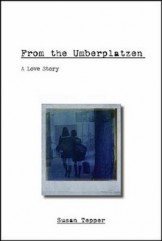
I Thought I Felt Myself Crack: Review by DeWitt Henry of From the Umberplatzen: A Love Story by Susan Tepper
I Thought I Felt Myself Crack
Review by DeWitt Henry
Tepper’s 47 short shorts and/or prose poems (From the Umberplatzen: A Love Story) each one page or less, offer a linear narrative about an ambivalent, two-year relationship. In each section there is a dialogue between the woman narrator, Kitty Kat, who is from America and married, and “M,” her German lover in an unnamed German city with a park and a species of deciduous tree she calls “umberplatzen (“Of course that is not the true name of the tree. I can’t ever remember the true name”).
She has moved to Germany to escape her ex in America, though they are still married. Her means of support are mysterious. As she reveals, almost as an aside in the 47th section, M. used to teach physics at the University and travel a lot. When they first met, presumably in the park, she’d joked about biological warfare chemicals affecting his brain, and he’d picked up on the joke. “They say it’s all chemical,” writes Kitty Kat, remembering. “His chemicals invading mine. Some sort of cross pollination.” The park too “had a kind of force field that drew us together.” They have separate apartments. Neither have children. He is divorced from a woman in France. We learn that he once studied medicine. Also that he’d once been a champion parachutist, but hates flying. He is virile and sexy, but above all he is witty, as is she. Both appear to be Catholic.
Nearly every section is structured on some topic of their disagreement: the trees, favorite movies, favorite paintings, hair styles, bird song, kites, shoes. They start off happily, then either she or he suggests an idea or a preference, the other disagrees, apparent misunderstanding or offense sets in, and they part. Then M. makes amends by sending some token or message across town, which arrives next day, and disarms or further perplexes Kitty Kat. Distance and intimacy are their necessary dialectic.
Kitty Kat can’t give up her past (her husband, her country), but revels in M. as her German holiday. For M. Germany is home and he wants Kitty Kat to share it with him permanently. Every now and then, despite their verbal parrying (much like the couples’ parrying in Hemingway’s “Cat in the Rain” or “Hills Like White Elephants”), there are lines of crisis. “We stood there facing off. A kind of crossroads”; “You can’t boss me”; “You want a baby by yourself”; “I’m not ready for a ring.” In terms of story, as seasons turn, and as attempts to amuse each other wear thin, there is no big argument or break up scene, no final, bittersweet “wisdom.” But we know from the opening section that Kitty Kat has returned to her ex, who also sent messages and tokens across the time and distance (“My ex had sent me . . . three jars of peanut butter . . . He no longer hated me”), and that the 46 sections that follow, while wonderfully immediate, are fulfilling her promise to M. that “I will remember everything.”
Tepper’s ear is pitch perfect. None of the dialogue is attributed and put between quote marks in the usual way, but the reader is rarely confused about who is speaking. Her packed segments in dramatizing two witty, bright, and sexy individuals even seem to suggest a screenplay (Neil Simon meets Truffaut or perhaps Bertolucci). All the dialogue is there, as in this passage:
It’s my time. I don’t mind he said. I do. Women. And he shook a finger at me. Your body is my body. OK then I’ll buy your body. When my flat gets sold. M had laughed. To the coldest bidder he said. OK We’ll get beer. We’ll get beer and sausage. We’ll dance out the day into the night. He hugged me so hard then. I thought I felt myself crack.This is a classic, unsentimental love story about ambivalence; it’s often comic; both characters are imaginative. There are moments of whimsy, astonishment, anger, and beauty.
Tepper asks the reader to work, and the work pays off.
****** This review was originally published in the Lit Pub
DeWitt Henry
DeWitt Henry is the founding editor of Ploughshares, a novelist and memoirist, and Professor at Emerson College. His most recent book is Sweet Dreams: A Family History.
Friday, September 21, 2012
My Dear Girl: The Art of Florence Hosmer By Helen Marie Casey
My Dear
Girl: The Art of Florence Hosmer
By
Helen Marie Casey
Review by
Kim Triedman
9/17/2012
“I want us to explore what it means to be an artist, to work
as an artist, and to lack acclaim.” Thus
begins author Helen Marie Casey in the preface to her new book, My Dear
Girl: The Art of Florence Hosmer, released by Black Lawrence Press earlier
this year. The artist in question, who
lived in Sudbury, MA for most of her long and productive life, is a figure of
profound interest to Casey, who also lives in the area and is clearly well
versed in the art history of the time.
As much meditation as biography, My Dear Girl takes as its task
not just the reconstructing of one particular life but also, in a way, its
conjuring: In fashioning her biography,
Casey seems to walk through Hosmer’s life as a kind of kindred spirit,
hand-in-hand.
Florence Armes Hosmer (1880-1978), lived through huge
changes in her world – women’s suffrage, two world wars, the great Depression,
and struggles for Civil rights and equal rights – and on a more personal level
endured nearly constant financial obstacles and crises of confidence. Born into a large and supportive family and
educated at the Normal Art School in Boston, she went through her adult life
unmarried, with “no protective partner or spouse, no mentor in the shadows who
took her part for her; no agent,” under constant strain to make ends meet. Acclaimed at one time as one of the more
prominent of Boston portraitists, she “fell off almost all the charts of
American women artists of the early 20th century.” She was not “a path-breaking painter,” writes
Casey, “but she was a good one,” and never gave up on “her commitment to the
creation of beauty.” She was simply a
woman on her own with the desire and training to paint in a world and a time
which made such goals particularly challenging.
In tracing the outlines of Hosmer’s life, Casey opts for a
free-form approach, sorting through the “jumble of detritus waiting to be
deciphered” (Hosmer’s letters, notebooks, possessions, artwork, etc) and
shifting always backward and forward in time.
It is a tack which works well for her.
Casey is an astute observer, and there is a method to her
meanderings. Through repeated and often
seemingly incidental appearances of those most intimately involved in Hosmer’s
life and work, Casey draws us gradually into her inner circle, developing
Hosmer’s persona Rashomon-style, from
a multiplicity of angles.
As Casey frames it, the heart of the Florence Hosmer story
is really the heart of every artist’s struggle, regardless the medium. “The subjects here that interest me are
twinned,” she writes, “—obscurity and accomplishment.” What she seeks to explore is the question of
whether some alliance between artist and audience is necessary, “some sign of
confirmation that a thing is so.” In Florence
Hosmer’s case – as with most artists, it could be argued – the signs were
intermittent and often contradictory, though they never stopped her from doing
what she loved despite the hardships that that implied. Her art was her way of assimilating her world
and, as such, essential to her.
In many ways, Casey
argues, Hosmer’s life serves as a kind of allegory: no matter the costs,
Florence Hosmer – as so many before and after her – “could not choose not to
paint,” and ultimately that became its own victory:
The creation of even one beautiful, unforgettable work is enough. One painting. One poem. One short story. One novel.
One quilt. One equation. One theory.
One musical composition. One work
of the imagination that won’t let go of us, that gets under our skin, that
haunts us because it has everything right.
Florence Armes Hosmer left us hundreds of paintings. Not all of them are memorable. But the memorable work is breathtaking.
**** Kim Triedman is a managing editor for Ibbetson Street and a widely published poet.
Thursday, September 20, 2012
Merrimack Media Writers: Beer & Books Networking Event

My friend Jenny Hudson has started a new venture located in Kendall Square in Cambridge, and this is an upcoming event that you should attend!
Beer & Books Networking Event
Calling all writers to join us at Atwood’s Tavern (877 Cambridge Street in Cambridge, MA) on Tuesday October 9th from 6-8 p.m.
If you’ve already published a book, are thinking about publishing a book, or are in the middle of writing a book, you’re perfect for this event! You’ll be able to network with other authors and learn about Merrimack Writers, our newly launched membership-based initiative that offers exclusive promotions, discounts and member events. Bring your books, business cards or just ideas. There will be door prizes, as well as a full kitchen menu available if you’re hungry.
In addition to this event, we’ve got a few others in the works. You can see our full calendar of events here. (http://merrimackmedia.com/event-schedule/} And, please save the date - Saturday October 27th - we’ll be at the Boston Book Festival with our Merrimack Media writers who will be signing books.
To RSVP, join our meetup, The Write, Publish, and Promote Network for free events for the writing community. Click here (http://www.meetup.com/The-Write-Publish-and-Promote-Network/) RSVP
Merrimack Media, sponsor of Merrimack Writers and the Write, Publish, and Promote Network, is a full-service self-publishing, distribution, and promotion company. http://merrimackmedia.com
For more information, please contact: Jenny Hudson at jenny@merrimackmedia.com
Tuesday, September 18, 2012
Flag Day in Detroit by Dawn McDuffie
Flag Day in Detroit
Poems by Dawn McDuffie
Adastra Press
ISBN# 978-0-9838238-3-4
Review by Prema Bangera
Wrapped in a stone-blue textural cover, you will discover poems radiating the after-math of love—the binding of uncertainties, the teachings of “normalcy,” and the willingness and courage to let go of this love. Dawn McDuffie’s latest chapbook, Flag Day in Detroit, captures us by the throat, and gingerly cradles us with the reality of understanding the inexpressible fear of longing, of picking up the shattered pieces for closure, of allowing something to be larger than oneself and unlearning the fabrications around us.
The book opens with “Marriage, It Turned Out, Was a Disappointment,” a poem about the reflection of a dissolving union, where one finds companionship with inanimate objects and invokes life to daily mundane happenings:
How did broken glass get into the sheets?
The biggest question—why did I marry
this man, not a bad man, but dull,
so dull I had to rely on Cherries Flambé
for lively dinner company.
I would pretend the moon had joined us,
an extra light over the candles…
I imagined she radiated appreciation.
Thank you for the beer and the
sweet and sour pork. Thank you
for thinking of moonlight, even when
I’m invisible, or hidden in the clouds. (9)
Here, we see the narrator breathing in the silence of perhaps living day to day without words, with imagining gratitude and acknowledgement of being alive. The narrator, like the moon, wants to be thought about and no longer carry on invisibly.
In order to feel visible and discover a new life within yourself, sometimes you need to rid old possessions. In “I Wanted To Sell Anything That Reminded Me of Bob,” the narrator wants to pawn, sell, and give away anything which carries the essence of her past:
Brave ship, wind that never died
and four continents of fruits and fishes—
he didn’t deserve these gifts.
I sold four deceitful shelves of books
that suggested we had a past and now
we would have a future…
I gave your birthday present to my sister,
but the wedding ring, green gold vine,
pink gold grapes, I returned to the store.
I used the money for a weekend trip
with my new boyfriend, a limited person
who got drunk every night, but didn’t
pretend that our nightly ritual of red wine,
Hungarian carryout, and sex
meant God ordained a marriage. (10)
These objects no longer felt like belongings, only became artifacts of a life filled with pretenses. The narrator compares the mundane daily activities of her current relationship to her marriage, remembering how naïve she once was to believe that these happenings create a happy bond forever. She was not only selling all reminiscent material, but letting go of all fabrications of an ideal life.
Often people imagine an ideal life as a journey simply requiring love of some sort. In “I Married My African-American Lover and Signed Up for a Class in Stained Glass,” McDuffie creates a clear metaphor between the difficulties of being in an interracial couple and working with broken glass:
I paid special attention to interracial couples that year,
like my teachers, a husband and wife team who loved
the transformations possible with glass…
The teachers advocated first aid supplies.
Have band-aids close by, soap and alcohol.
Be ready to bleed if you take on this work. (12)
How closely the narrator examines skin color with colored glass, light transcending through to create a new world. How this new world takes time to construct, takes on wounds and bruises. A marriage of colors appearing on window panes, and sometimes its beauty is demeaned.
Such lack of comfort causes you to lose innocence and faith in the goodness of others. This touching struggle appears in “The Second Mary,” where the needs occur in paradox:
After the adoption,
after the judge, the social worker,
the child protection agent, our own
adoption representative, after we waved
good-bye to all of them, eager
for the happy ending, the child
fought back, a big eleven –year-old
deep into tantrum, kicking her heels
into the mattress to kill the thoughts
that slept there and came out
to whisper insults and threats.
Our child hatched schemes to ditch us
and find a good mother, a good father.
I hate you I hate you I hate you,
she chanted one night. Don’t leave me
don’t leave me don’t leave me. (17)
How small one feels at the image that an abandoned child’s hatred is in actuality her prayer, her plead for someone to stay and love her. This poem grasps you with its raw emotions of this child, pushing away the love she needs, the love she wants.
McDuffie evokes a sense of delicacy in each of her poems, drawing us into the hearts of each of its narrators, and creates shadows of our own souls in her work. She ends this collection of poetry with the book title, “Flag Day in Detroit.” In the poem, Jon, the husband who is born on Flag Day, wonders “what is a flag waving after all, but a demand to love what I love” (24). He is inspired by Bradford’s tribute to La Création du Monde by Milhaud. Together the wife and husband stand and “pledge allegiance to every pure, weightless note.” McDuffie’s book displays the unification of the world, understanding the clefts created, and appreciating its complexities.
Monday, September 17, 2012
Sunday, September 16, 2012
Bagel Bard Anthology Reading Sept 24 8PM
****** The Bagel Bards was founded in 2004 in the basement of a Finagle A Bagel in Harvard Square by Harris Gardner and Doug Holder.
From a Poets and Writers article by Ifeanyi Menkiti:
Bagel Bards, a seven-year-old group cofounded by Douglas Holder of Ibbetson Street Press and Harris Gardner, is not a writing workshop—though those who come can, if they wish, bring work to share and receive feedback from other members—but rather a dedicated group of area poets and writers who meet every Saturday morning for company and support in Somerville’s Davis Square at the Au Bon Pain (18-48 Holland Street). (They even have a permanent symbolic home at the coffee shop, as management has allowed members to have a plaque in the corner where they meet behind the muffin case.) Important parts of the meetings are recorded for future reference by a designated member with the title of “Word Catcher.” There is no fee to belong or join the Bagel Bards. All that is needed is a willingness to bring oneself to Davis Square on Saturday mornings, maybe purchase a bagel or two, or a steaming cup of coffee, so as to keep the management happy. Last year poet Clayton Eshleman paid a surprise visit to the Bards while he was in town and had warm things to say about the group and its spirit. Other prize-winning authors such as Kathleen Spivack, Afaa Michael Weaver, and Gloria Mindock can be found holding court there. A Bagel Bards anthology is also published annually.
Hosted and organized by Rene Schwiesow
1. Prema Bangera
2. Philip Burnham
3. Heather Campbell
4. Julia Carlson
5. Louisa Clerici
6. Dennis Daly
7. Timothy Gager
8. Bridget Galway
9. Harris Gardner
10. Steve Glines
11. Elizabeth Hanson
12. Doug Holder
13. Abbott Ikeler
14. Irene Koronas
15. Linda Larson
16. Deborah Leipziger
17. Tony Majahad
18. Gloria Mindock
19. Thomas O’Leary
20. Ralph Pennel
21. Janice Rebibo
22. Rosie Rosenzweig
23. Rene Schwiesow
24. Jack Scully
25. Wendell Smith
26. Manson Solomon
27. Paul Steven Stone
28. Chris Warner
29. Alice Weiss
30. Debra Weiss
The 20th Century In Poetry Edited by Michael Hulse and Simon Rae
Edited by Michael Hulse and Simon Rae
Pegasus Books, New York
Collection Copyright © 2011 by Michael Hulse and Simon Rae
ISBN13: 978-1-60598- 364-6
Review Copy, Softbound, 860 pages
Hardcover edition $35.00
Review by Zvi A. Sesling
Where history, politics and war intersect the poet can be found. Words recording daily life, power struggles, bombs dropping. The poet protests, writes words of praise putting down feelings, emotions, observations like a row boat, sometimes, following a river, sometimes peacefully, other times like a white water raft.
The poet drifts across history, engages war, reminds us of the explosions. There must be a keen eye, a good ear, a quick pen, a long memory and the truth. The poet says what needs to be said, says what is to say, says it so it is understood, remembered.
If a poem says it well enough, it is printed in a magazine or book. The really good ones make it to an anthology of which there are many – some good, some great, some exceptional. With The 20th Century In Poetry Michael Hulse and Simon Rae have achieved excellence.
The books is divided into logical time periods with names which tell the reader what to expect: 1900-1914, Never such innocence again; 1915-1922, War to Waste Land; 1923-1939, Danger and Hope; 1940-1945, War; 1946-1968, Peace and Cold War; 1969-1988, From the Moon to Berlin 1989-2000.
Each section features names, some easily recognizable, others less well known and a few who have been left behind with the passage of time; overlooked in previous anthologies. This is what makes the volume particularly exciting. But it is not only the poets, it is the selection of poems which the editors chosen to use; many not readily found in other poetry books. Another remarkable aspect is the pairing of poets, sometimes the tripling of them, providing side-by-side comparisons giving new and fascinating views of poems and poets.
For example, in 1910 you will find W. B. Yeats’s No Second Troy with an annotation of his obsession “with the questions of Irish identity and nationality, and through his own poetry and plays contributed strongly to the forging of a modern Irish literature.” There is, of course, more to the annotation.
On the next page is Linda Bierds White Bears: Tolstoy at Astapovo with an annotation which cites William Nickell’s The Death of Tolstoy (2010), Roy Fuller, who also wrote of Tolstoy’s death at Astapovo and Jay Parini’s The Last Station (1990) starring Christopher Plummer and Helen Mirren in the movie version.
This type of information allows the reader to not only unite time and space, but offers the opportunity to more easily access information on writer and subject or to pursue a particular, previously unfamiliar path.
In the pages under 1917, for example, you find Wilfred Owen, T.S. Eliot, Alan Brownjohn, the known, the famous, the unknown. 1960 finds Randall Jarrell, Galway Kinnell, Ted Hughes, Dom Moraes, Ingrid De Kok which gives you an idea of the depth, breath and quality of poets and poetry.
There are many sections in this anthology. Some 400 or more poets represent different eras. I have deliberately not included selections of poetry for two reasons (a) there are too many great works in this volume and (b) I would prefer readers go out and buy this book which will be a valuable resource for those interested in poetry and history. Indeed Pegasus Books and editors Hulse and Rae have issued a collection which in the 21st and 22nd centuries and beyond will be a valuable reflection of the history and poetics of the English written word.
Subscribe to:
Posts (Atom)