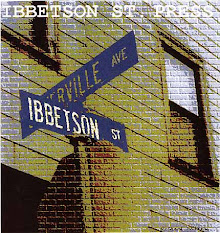
Thursday, April 30, 2009

ERIC GREINKE: A Poet and publisher who promotes mental expansion.


ERIC GREINKE: A Poet and publisher who promotes mental expansion.

Interview with Doug Holder

Eric Greinke, a native of Michigan, makes no apologies about his ambitions for his work. Greinke, 61, has always been about mental expansion, a way to advance not only the awareness of individuals but society as a whole. I was introduced to Greinke by Hugh Fox, the noted small press poet, writer, and critic. In 2005 Fox told me that Greinke was starting up a small press (Presa Press), and was soliciting select small press poets for an avant-garde anthology “Inside the Outside…” Fox had recommended me for the anthology and I was thrilled to be in a collection with the likes of A. D.Winans, Lyn Lifshin, Hugh Fox, Harry Smith, Stanley Nelson, Richard Kostelantz and so many other noted poets.

Greinke founded his first literary magazine “Metamorphosis” with Ronnie Lane in 1968. His first poetry chapbook “Earth Songs” was published in 1970, followed by “Canary Wine, Milk run & and Other Poems,” and “Sand & Other Poems,” (A full length, hardcover book.) In the early 70’s Greinke started Pilot Press Books with Ronnie Lane and established a national literary magazine while at Grand Valley State University in Michigan. He published a wide selection of poets early in their careers like: Diane Wakoski, Etheridge Knight, Donald Hall, Kirby Congdon and many others. Greinke was also a book reviewer for the Grand Rapids Press for many years, and brought writers like Robert Creeley, Charles Bukowski, Clayton Eshleman to the attention of a mass audience. After a long hiatus from the publishing game Greinke, along with his wife Roseanne, birthed the Presa Press, and in a short time Presa has been making a name for itself on the national literary scene. Greinke generously consented to an interview, but wanted to concentrate on his life as a writer, rather than on his publishing that has been well-covered in previous interviews.


Doug Holder: A lot of poets talk about how journalism helped them learn the discipline needed to write. Did the Coast Guard contribute to your maturation as a writer, as well as your journalistic background?

Eric Greinke: I went into the Coast Guard in 1966, at the height of the Vietnam War, mainly to avoid the draft. Saving lives seemed preferable to taking them or losing my own. Also, we were poor & I had no money for college, so I wanted the G.I. Bill, which had generous educational benefits back then. I did apply for a job as a journalist in the Coast Guard, but there were only two slots for journalism because the Coast Guard was smaller than the New York Police Department, about 28,000 at that time. Being the literary editor of a high school newspaper didn't qualify me. So, I went on a Search & Rescue team on the Great Lakes, which was home, so I was quite pleased with that instead of death abroad. I did write my first attempt at a novel during my night watches, however, & of course, later wrote Sea Dog as a quasi-autobiographical-90%-true experiment in creative non-fiction. But, Sea Dog probably owes more to Mark Twain than it does to the Coast Guard. I was inspired by Huckleberry Finn to write it in the first person naive voice that allows for many funny double entendres. But, I guess I did learn the value of writing every day, because those night watches were four hours of nothing much to do but listen to the emergency ship to shore channel & hourly security checks around the station. The dog that was the inspiration for Yogi (the dog character in Sea Dog) kept me company on those watches.


DH: I noticed the first magazine you put out was "Metamorphosis." Were you a Kafka freak, or just into the over-all idea of transformation?


EG: My work has always been about mental expansion. Metamorphosis Magazine started as a newsletter subtitled "a Transcendental Newsletter" & it evolved into a local literary magazine supported by book & record store ads, primarily. But, yes, the idea that poetry should be seen as part of the human potential movement, a way to advance the awareness not only of individuals, but also of society as a whole, was central to my philosophy from the beginning.


DH: Were you part of what Hugh Fox coined as the "Invisible Generation" of writers?

EG: Not exactly. I think Hugh meant that immediate generation of post-Beat poets & writers that were less primitive than the Beats but who found it difficult to follow such a popular act. I knew all those guys, but they were all older than I was. Hugh Fox & Harry Smith were already icons in the early seventies. Hugh was the most avant-garde poet/publisher in Michigan then, with his Ghost Dance. Harry was the most active small press publisher in New York City. I was recognized early by the established avant-garde. In my early twenties, I had already published in magazines alongside Robert Bly, Donald Hall, William Stafford, Robert Creeley, Allen Ginsberg, Phil Whalen, Diane Wakoski, Ted Berrigan & other well-recognized poets. Because our last names both started with ‘G,' I found myself published a page or two away from Allen Ginsberg regularly.
I was also published alongside Lyn Lifshin quite a bit in the early days. Joel Oppenheimer, Jackson MacLow, Paul Blackburn - I was acquainted with all those guys. But, most poets born in the forties tend toward deconstruction. We have been influenced by not only the Beats, but the New York School, the Black Mountain poets & the neo-imagists like Robert Bly. As a generation, the boomers are more diverse & literate than the more primitive Beats, therefore not as accessible or popular as a result. We were certainly more visible back then with only four or five hundred poetry books being produced a year instead of the four or five thousand produced today. It was easier to get attention back then. Also, poetry became quite popular in the seventies on college campuses.


DH: You were a book reviewer for the Grand Rapid Press in Michigan. What for you constitutes a good book review?


EG: That experience was amazing in hindsight. The Grand Rapids Press has a high circulation - a half a million readers. I didn't realize how unusual it was for a large city newspaper to print big reviews, some up to a half page, of poetry books. I reviewed Charles Bukowski early in his career, Robert Creeley, Tom Clark, Dan Gerber, Diane Wakoski, Clayton Eshleman, Jerome Rothenberg, Joe Brainard, Nikki Giovanni, & numerous other poets during the seventies. John Martin of Black Sparrow Press regularly sent me everything he published, among others such as Jim Harrison's Sumac Press, Caterpillar Press, etc. The overall effect was that poetry actually sold in the Grand Rapids area. The reviews were part of the whole scene.
When a review is well-written, it reveals the essence of the book being reviewed. It answers the question of whether the writer accomplished what he set out to do. It identifies the primary message of the book & how well the message is delivered.
I also like it when the reviewer confesses to any biases regarding the material. I guess the most important thing is to write honestly about your response to the book, qualifying your opinions when fair & necessary. Sometimes this means going against popular opinion. I panned The Autobiography of Andy Warhol for its facetiousness. He'd sent all the reviewers signed copies. But, the book was campy & lacked the substance it could potentially have had. Decades later, the critics mostly agree with me on Warhol's work. But, at the time, I was out on the proverbial limb.


DH: Transcendentalism has a big influence in your writing. Your work seems to be steeped in nature, nature imagery, like Thoreau. Can you talk a bit about this? I am more into character study, does this appeal to you at all?


EG: Thoreau & his transcendentalism had enormous influence on my world-view. Let me go on record saying that Thoreau was the greatest American writer/philosopher of all. He was a kind of American Zen master. He was right about everything, & he had the personal courage to live his convictions. The true test of genius is that their works continue to be relevant over time. Thoreau surpasses even that test. His philosophy is actually more relevant today than in his own time.
I believe deeply in human potential & in poetry as a tool of social consciousness & personal awareness. Poetry is like humor, in that it attempts to break through to a higher level of awareness, a new recognition or a relationship that you didn't see before. Thoreau believed in immersing oneself into whatever natural environment one was born into. Every man is a microcosm of the larger macrocosm. Pure spirituality outside of religious dogma is a human potential. Nature is my cathedral. It renews me & energizes me. The best way for me to overcome writer's block is to go outside. For me, that usually means hiking or kayaking, maybe fishing. I love to spend time with friends on these activities, & do so regularly.
I live by a large lake in an area of numerous lakes & rivers. (Michigan has almost 12,000 lakes.) I have two ski resorts, a large park with hiking trails & a big nature preserve that includes a good-sized lake, all within about a five mile radius of my cottage. I purposely chose the place for its outdoor recreational value.
As a poet, you write about your environment & experiences. I do include the human world though. It's an essential ingredient in my so-called nature poems, because I want to evoke the contrast between the human world & the natural world. We need to recognize that nature is alive too, & become respectful of that, for our soul's sake, & for the survival of our species.
Character study does interest me, but not in poetry. My novel-in-progress, Elephant's Graveyard, is a character driven book. I see poetry, at least for me, my impulse, as dealing with big mysteries, paradox & perceptual awareness.


DH: Allen Ginsberg wrote, and I paraphrase: "I saw the best minds of my generation lost to madness." How about you? Is this poet as a madman a lot of hype, a misguided romantic notion?


EG: I think the stereotype of the mad poet is mostly hyperbole, with a few notable exceptions. Writing poetry is high functioning. Perhaps it was only when they were writing that the so called mad poets were sane, or super-sane. Like a joke, a poem needs a punch-line that delivers that "Aha!" that lift to a new recognition. That's why laughter is transcendental. It's that moment of mental integration, when recognition rushes in. Good poems do the same thing. They take the top of your head off, to paraphrase Emily Dickinson.


DH: You said in an interview that you are concerned with perception vs. reality. Isn't perception reality... for the person that is? Is there a collective reality...really?

EG: The human condition contains a wide range of experiences & states of mind, but taken as a whole, there are parameters. Poetry, like humor, plugs into that common shared experience. Morality is an expression of shared values. Again, there is diversity, but there are also universal or near universal taboos on the negative side & positive values such as altruism too.
There is a big reality, but we are limited by our sensory perception & our mental capacity in perceiving it. In the context of the rather large expanding universe, human reality is limited indeed. Dogs hear & smell far more than we do. Eagles have telescopic vision. Whales have a bigger brain to body ration than humans.

DH: You say you want to "break through the surface of things" Have you? And what have you found?


EG: Philosophically: personal growth requires divergent thinking. If one is convergent in thought, forming dogmatic attitudes, progress is halted. Degrees of abstraction are like rungs on a ladder. Climbing requires flexibility. An internal locus of control increases responsibility & leads to better choices. Being in love is the highest level of human experience. It takes you out of yourself. Nature abhors a vacuum. When you're hurting, give until it feels good. Worry about the past or future causes anxiety. Time is precious & limited. Death is inevitable & unpredictable. Make each day Thanksgiving & Valentine's Day.
In poetic terms, I've learned that ambiguity & mystery are desirable, & that the poet's intention is not necessarily the real message of a poem. Poems symbolize deeper thoughts & feelings, the way dreams do. I've learned to trust my intuition as my greatest strength as a poet.


DH: Why did you work as a social worker as opposed to English teacher, editor, etc...?


EG: I felt a strong need to get physically involved in the effort to treat child abuse & neglect. Although I had some sudden fame as a poet, I felt that it would be vain to prioritize it over working directly toward social change. I needed to see myself as a man of action. I had the energy & I wanted to tussle with evil. Later, when my conscience was clear, I began publishing my writing again.


DH: Hugh Fox wrote in a critical essay about you that it seems that you advocate dropping out of the work-a-day world, tune out the rat race, and tune into the natural world. Should I, for an example, quit the day job, and retire to the wilds, living off the land. In other words how can a man or woman combine the demands of everyday, with the need to connect to our natural selves?


EG: Obviously we can't all retire to the wilds. But we can, as Emerson advised "simplify, simplify." (Why the hell did he have to say it twice?) We can pare down our material possessions; make time decisions based on the potential quality of an experience instead of material gain or superficial social compulsion. I think people should choose an occupation based on meaning. My youngest son told me he wants to major in philosophy. "That will have no occupational value." I said. "That's what I like about it." he replied. He's right.


DH: Can you talk about the genesis of the Presa Press?


EG: The word presa is a musical term that refers to the entry-point into a canon. We felt that the non-academic post-Beat poets were poorly represented in relation to each other. The need was there to document the underground canon. The whole thing developed through conversations with Kirby Congdon, Harry Smith & Hugh Fox. Librarians & others interested in documenting the independent press poets expressed the need to me originally. I had the experience of running the successful seventies press Pilot Press Books. Some of those Pilot Press Books are selling for over $600 a copy on the international market. We've tried to publish the edgiest, most consistently good poets, like any other press.
The strength of a small press is its backlist. We are committed to keeping everything we publish in print. Sales of well-received poetry books are cumulative over time. Of course, a lot depends on the poet. The poet is the best salesman of his own books.


DH: I consider you one of the exalted gray beards of the small press along with Hugh Fox, Len Fulton, Lyn Lifshin, Alan Catlin, Ed Galing, A.D. Winans and the list goes on. What would the world be like without the small or alternative presses?


EG: Lyn Lifshin has no beard at all, but she is, & should be exalted! The world would be less hopeful without the small press, for one thing. For another, literature would stagnate. Historically, the greatest writers have never been academics. They were either Bohemians, or they worked in another non-academic profession. Frost was a farmer. Eliot & Stevens were businessmen. Williams was a physician. The academy didn't like the Beats until City Lights sold a million copies of Howl. Even though Olson & Creeley were academics, they were relegated to the small press because they were avant-garde. Today, college teachers like Gerald Locklin or Hugh Fox, if they work in the Whitmanic, colloquial manner, choose the small press. I've learned that every poet who writes represents a group of people who feel the same way. Some of us, like Billy Collins, have wider audiences, & some of us are closer to the minority on the cutting edge. You'll find that edge in the independent presses. Folkways are ultimately much more powerful than the current fashion of a socio-economically privileged few. All will be reconciled through the test of time.

GARMENT

Light emanates from my coat
My coat that contains
A shining stream
My coat of fool’s gold
Wiser than the stars
Singing in its pockets
Imprisoned by the fragrance
Of the rosy clouds
Like the dark heart
Hidden in a bright cave
Hidden in infinity
So far out in the open
That little fish
Swim through its fabric.

--Eric Greinke

-----Doug Holder

Tuesday, April 28, 2009

The Ride by Brian MacQuarrie


The Ride

By Brian MacQuarrie

DaCapo Books

261 pages

Review by Timothy Gager


On October 1, 1997 ten year old Jeffrey Curley of Cambridge, Massachusetts took a ride with two adults, Salvatore Sicari and Charles Jaynes under the false pretense of receiving a new bicycle. He was brutally murdered after not accepting their sexual advances, then post-mortally raped, and stuffed into a plastic storage box. Then the container with his body in it was thrown off a bridge into the Great Works River in South Berwick, Maine.


The Ride is the story of that case, one which is familiar to many in the Massachusetts area. The book works its way from the grisly crime to the years afterward. It focuses on the family of Jeffrey, heavily weighted on the life of Cambridge Firefighter Bob Curley, Jeffrey’s father. Briefly the book explains Bob Curley’s need for vengeance was what kept him going in the dark months following his son’s murder. He became a champion in the attempted legalization of the death penalty in Massachusetts. He spoke out at the State House, in the media, often confronting those opposing his beliefs. Years later, Bob meets the father of an Oklahoma City bombing victim and the brother of Ted Kaczynski, gentleman who opposed the death penalty. Through their shared experience, Bob Curley undergoes a remarkable transformation; he becomes an opponent of the very proposed law that he passionately fought for.


Brian MacQuarrie, a Pulitzer Prize Award nominee and Boston Globe writer does a fine detailed and astute job in reporting the facts regarding this case and the lingering affects it had on the Curley family. It is a no-holds barred account of the emotional ups and downs that occur over the years for the family, placing the reader into the edge of their painful abyss. One can not possibly fathom what it must be like to suffer such a tragedy and then turn the pain into such important work on causes the way Bob Curley did. Bob Curley’s work on child safety and protection laws is currently on the books in Massachusetts.


Bob Curley’s life as portrayed in The Ride is a study of breaking and redemption of human spirit. The rest of the Curley family was and remains shattered by Jeffrey’s murder. There are no words that can be written that could convey this by author MacQuarrie. As a writer he handled this impossible task with skill and sensitivity. I recommend this book as an excellent, interesting read and a ride into heavy emotional traffic.

Monday, April 27, 2009

Heavyweight to Overweight Champion Bout: The Somerville News Poetry Editor Vs Spare Change News Poetry Editor in 9 round reading May 11!


Marc Goldfinger and Doug Holder in previous bout...


MARC GOLDFINGER


DOUG HOLDER


May 11 at the Out of the Blue Gallery 106 Prospect Street Cambridge, Mass. as part of the Stone Soup Poetry Series hosted by Chad Parenteau: Marc Goldinger poetry editor of Spare Change News and Doug Holder poetry editor of The Somerville News, will go 9 rounds, in a action-packed poetry reading May 11 7:30PM

Goldinger, 61, 5'9" weighing 158 has been training at the Spare Change News' office, where he publishes sharp jabs of poems, that sucker punch you in the end. A veteran fighter and poet, he brings experience and world weary knowledge to his poetry and boxing game.

Doug Holder 53, 5'10" 164, the younger of the two, has staying power, and has the lightening speed and wit of the great poet and fighter Ali... He has been pummeling
metaphors into his work since he was wet behind the ears. Holder has no fears!


Open mic too!

Friday, April 24, 2009

The Bluffer’s Guide to the Cosmos. Daniel Hudon.


The Bluffer’s Guide to the Cosmos. Daniel Hudon. (http://www.ovalbooks.com) $10

Daniel Hudon is a regular at the meetings of the Somerville, Mass. literary group the Bagel Bards. One Saturday morning (his eyes shining brightly as say…stars), he handed me a book he wrote for the popular best- selling series; “The Bluffer’s Guide…” His book’s title is: “The Bluffer’s Guide to the Cosmos.” Hudon is a science lecturer at Boston University and has had an interest in the cosmos ever since he was a little dwarf star of a boy himself.

The book is perfect for guys like me. You know the sort of stumblebum at the cocktail party who corners you then bamboozles, beguiles, outsmarts, or more likely bluffs his way to your attention.

The book ain’t fluff, Hudon has some solid facts and theories to present and he does it in a light and humorous way. I mean this book is not meant for Carl Sagan or Steven Hawking to read, it is meant for me, and my ilk.

In this passage Hudon gives some advice about how to explain the “Big Bang” at, say, some haughty dinner part with a bunch of nattering nabobs:

“ Because the expansion of the cosmos is a source of great confusion for people, choosing your words carefully at the beginning will save you much grief later on. To get started, it’s best to repeat the following phrase to yourself before trying it out in public: The Big Bang was an explosion of space at the beginning of time. Then keep repeating it until everyone who hears it appreciates that it is truly profound as it sounds.”


Now there are a lot of talking points in this little book like: “The color of the universe is not black or blue, or even colorless—it’s beige. Think cosmic latte.” Or: “ A white dwarf is so compact that a teaspoon of its material would weigh the same as an automobile.” And how about? “ In jumping into a black hole, you would first be stretched thin like spaghetti and then crushed into oblivion.” I don’t think I will live in the pasta folks!

Carry this trusty little book in your back pocket and refer to it when you encounter a pack of rabid MIT nerds at some gathering and are at a loss for words. Houdin can make you bluff your way in or out in any situation.

Doug Holder/ Ibbetson Update

Thursday, April 23, 2009

Poet Dan Tobin: Writes of the West of Ireland and the New World of Brooklyn.


Poet Dan Tobin: Writes of the West of Ireland and the New World of Brooklyn.

By Doug Holder

In a blurb on the back of Dan Tobin’s brilliant poetry collection “The Narrows” (Four Way Books-2005) it reads: ”…Dan Tobin recounts the many-sided history of his family. Conceived around the oldest theme in Irish literature, the dinnseanchas or ‘lore of place’ poem, the poems in this collection range back and forth between the West of Ireland and New World Brooklyn.”

What I found most compelling about this book was the poems about his father. My late father was a World War ll vet, a hardscrabble kid from the Bronx, and later became a Madison Ave. advertising executive. Tobin’s poem about drinking with his old man brought a tear to this poet’s eyes. My late father always asked me to join him for a few drinks at a pub he frequented in Manhattan, and talk to his pals…you know meet the kid from Somerville who writes poetry. Somehow I never found the time. Too self-absorbed I guess. Tobin, who is the director of the MFA program in Boston, Mass., and a recent recipient of a Guggenheim Award, read in my poetry series at the Newton Free Library this spring, and I took the opportunity to purchase his book. He graciously let me use his poem: “Drinking with my Father at Muse’s Bar.”


DRINKING WITH MY FATHER AT MUSES'S BAR


Butcher, green grocer, luncheonette, altar rail,
once a week bingo at the Young at Heart,
coffee at Pegasus, The Green Tea Room;
then it's off to the garage to warm up the car
he can't drive anymore. But everyday
my widowed father's rounds end at Muse's
where he settles in, one of the regulars,
giving the sign for his afternoon drink.

This could be any dim watering hole
glimpsed into walking past, but this is here.
No need to order since everyone knows
what everyone wants, and everyone is named
but me--Turk the Tender, John the Bookie,
Big Fat Roger who bounces on weekends,
Jameson Jimmy, Jose the Gambler,
Killer Bill, Budweiser Bill, Bill the Suit.

And bellied up beside them: my father,
Dewar's Jerry, life-long exile to haunts
like this, where he would come into his own
outside his family's overweening eyes.
Connolly's, Spiro's, Hannigan's--now all gone.
Hours-long chin-fests, palaver thick as smoke
that drifted from my mother's cigarette
where she brooded alone in our kitchen.

Time moves in closed circuits of memory,
pools in the half-light of the TV's glow
where the horses rehearse each coming race
in races run before, an endless replay
like my father's story the day he found
my mother dead in bed beside him, or those
he told for months after, his life with her
unreeled into after-lives at one remove.

I nurse my beer and listen to the talk
of Aqueduct, Belmont, the betting pools--
such ease, as if a life without regrets
blessed each of these cronies, my father, me.
And soon, surprised, I find myself at rest
among this motley crew, sharing their jibes
till Turk says, "Hey Jerry, your son's alright."
"Yeh, I know--he's a first class ballbuster."

Outside the bar he takes my arm, unsteady,
as we walk to the same apartment house
he's lived in fifty years. "I'm glad you're home,"
and "I miss your mother." Then, up the stairs:
"I need to rest--go on ahead of me."
I make my way myself up the last flight
while he sits beside the landing window,
his blunt face shining in the low evening light.


--- Daniel Tobin

Monday, April 20, 2009

Poetic Healing: As the hospital and its clients have changed, counselor Douglas Holder adds another dimension.


* This article came out 9 years ago in The Boston Globe. It was the lead article in the Living/Arts. I found it in my archives and typed it up because it is no longer online. It can be purchased from The Boston Globe archives.


THE BOSTON GLOBE: (Living Arts: Feb. 8, 2000.)

Poetic Healing: As the hospital and its clients have changed, counselor Douglas Holder adds another dimension.

By Michael Kenney (Globe Staff)

SOMERVILLE—In the fourth collection of poetry of poetry Douglas Holder has published at his Ibbetson Street Press here, he includes a poem of his own, titled: “ A Simple Nod.”

I saw him in Harvard Square,
happily walking with a friend.
As we passed each other
we exchanged a simple, understated
nod.
Our silence was a friendly conspiracy
a reminder of where he once was
and where he was
now.

The where is never stated—although two words, “the ward,” a few lines further on provide a hint. Holder, 44, is a mental health counselor, and for the past six years he has been conducting poetry workshops at McLean Hospital for its patients.

“ I’d been working there 17 years, and I’d had my poetry published in small journals,” he says. I wanted to add another dimension to my job and help a few folks out.”

While Holder would not think of ranking himself with Anne Sexton, who won the Pulitzer Prize for poetry in 1967, he does invoke the legendary poetry workshops she conducted at McLean in the late 1960s. Sexton, a patient at the Belmont hospital in 1973, committed suicide in October 1974.

Nor does Holder claim that the hospital today resemble the institution of those years. “It’s not like the old McLean,” he says, “with patrician types sitting around drinking tea from bone china.” That was the McLean of Harvard fullbacks, Porcellian Club members, and “ Mayflower screwballs.” That was the McLean that Robert Lowell, a frequent patient there in the 1960’s, memorialized in his poem “Waking in the Blue,” and that writer Susanna Kaysen, a patient in 1967, recalls in her best-selling memoir “Girl Interrupted,” now a major motion picture.

Today, Holder says, the members of his poetry groups are more likely to be the homeless “ coming in with a bit of doggerel.”

He runs two workshops, one on Thursday afternoons for patients in the hospital’s open-ward program, which meets in a converted Victorian mansion, and other Friday evenings for patients on two locked wards where Holder works. Neither is open to an outside visitor.


But whether in the mansion or in the more institutional setting of the locked ward, Holder says, “ I try to sort of have a coffeehouse atmosphere. We’ll have a round of applause when some reads a poem.”

Of course it doesn’t always work out as planned.

Holder remembers reading Allen Ginsberg’s “Howl” at his very first workshop.

“I was pretty enthusiastic then, and a bit naïve,” he says. I thought they’d like it. I saw the poem—with its lament about the “best minds of his generation lost to madness”—as a haunting cry that would be a catalyst for discussion.”

And he says with some self-deprecation, “ I thought they’d think of me as, “ Hey, this guy knows where I am coming from.”

Instead , “they were angry and one of them walked out,” he says. “And one of them told me: “Why do I have to hear this? I live with it.”

Another time, Holder says, a young woman became hysterical and ran out when he read a poem of his own about a kosher butcher in Brookline.

“It turned out the young woman had a painful experience in her life, which she associated with chickens, and she couldn’t take it,” Holder says. “ I had a lot of explaining to do with the clinical staff.”

“You never know,” he adds, “when you might hit a vein.”

The problem is compounded, Holder says, by the fact that today’s hospital stays tend to be shorter—a week or two instead of several months. “You don’t always know what to expect,” he says.

It also means that the workshops aren’t quite they were in Sexton’s day.

“I get in their face about it,” Holder says. “ I’ll go around to the rooms in my wards and ask: “Are you coming to the poetry group tonight?’

“And sometimes, I’ll have a doctor or another staff person tell me that so-and-so is a well-known writer, so I’ll make a special effort to get them to come.”

A number of poems written by patients in these workshops have been published—usually anonymously in the now defunct Boston Poet and other small poetry magazines. But not in his own magazine, which shares the name of his small press, Holder says, because that would violate hospital policy.

Because he believes that poetry can play a healing role, Holder started Ibbetson Street Press, out of house in Somerville—naming it after the street where he lives with his wife, Dianne Robitaille, a poet and geriatric nurse.

Holder, who got a master’s degree in literature from Harvard’s extension school while working at McLean, has been publishing his poetry in small magazines and especially Spare Change, the monthly journal for the homeless. “I write a lot about homelessness and mental health problems.”

Starting a small press to publish local poets, Holder says, was “ a way to get connected.”

The most recent issue—38 pages on 81/2 by 11 paper with a paper cover, bound with black slip plastic binder—sells for $4 and contains 40 poems; an interview with Ed Galing, an elderly small press poet; and several reviews.

Among the poets are a number of first-time writers and others described as “mainstays” of Holder’s press. There are also two professors of literature—John Hildebidle, who teaches at MIT, and Robert K. Johnson, who teaches at Suffolk University—as well as Don DiVecchio, the poetry editor of Spare Change.

Ibbetson Street Press has also published a number of chapbooks, and old English term for a small collection of poems or ballads, most recently: Poems From 42nd Street” by Rufus Goodwin, a poet and journalist who lives in Boston; and a collection called “ Poems for the Poet, the Working Man and the Downtrodden,” by A.D. Winans, who published a small poetry magazine in San Francisco.

“What distinguishes our journal,” says Holder, “is that it contains poems that anyone can read.” They deal “with everyday life. There’s not a lot of arcane words or funny verse patterns.” Anyone, he adds,” can get something out of them.”


The following is a poem written by an anonymous participant in one of Douglas Holder’s poetry workshops at McLean Hospital:


When The Hunter Arrived.

When the hunter arrived
at the place
where it was unfamiliar
he became the prey
stalked by everything
ever unleashed
by the conspiracy of creation.
to the edge he cantered
idols toppling by his sides
until at last
those that were against him
trusted his insight into their
essential nature
Finally pushing a hole through
God’s left eye
past what had separately
designed the limitless war
streaming beyond infinity.

Saturday, April 18, 2009

STEVE GLINES: Poet, Publisher and bon vivant.


STEVE GLINES: Poet, Publisher and bon vivant.

Interview by Doug Holder

Steve Glines is a jovial looking man with a perpetual twinkle in his blue eyes, and a zealous appreciation for anything that has to do with the writing, publishing, and the printing of books. Glines has published six books of his own, has been published in literary journals and newspapers, has designed books for a number of presses over the years, has worked as a researcher at MIT, and founded the online literary journal: “The Wilderness House Literary Review.” to name just a few accomplishments. I spoke with him on my Somerville Community Access TV Show: “Poet to Poet: Writer to Writer.”

Doug Holder: You often say you are from a family of failed literati. Can you explain, and do you define yourself as “failed” as well?

Steve Glines: I don’t know. I am not dead yet. When I was about twelve years old I announced to my mother that I was going to be a writer. She said: “That should come naturally, you are from a long line of failed literati.” I have been writing ever since.

DH: Who were the failed writers in your family?

SG: There were six generations of Scotch Presbyterian ministers that ran a magazine that was a hellfire and brimstone broadside published once a month. It was published from 1650 to 1830. My great grandfather was a geologist, and my grandfather was a lawyer. My grandfather was ultra right wing and wrote about 20 or 25 books. My favorite was “States Rights and National Prohibition.”

DH: What are your criteria for a failed writer?

SG: If you swing for the fences and miss, you failed. If you never get out of the infield you are petty. So I am a petty failure (laugh)

DH: You were involved in an ambitious project the “Wilderness House Literary Retreat” in Littleton, Mass. that I helped you with. We managed to attract the late Robert Creeley, C. Michael Curtis (Atlantic Fiction Editor), Afaa Michael Weaver, Louisa Solano, John Hanson Mitchell, Lois Ames, and other notables. Can you talk about this venture?

SG: It came about by accident. I’ve been a p/t journalist. When we moved out to Littleton, Mass I discovered that the editor of the Littleton Independent was a cub reporter for the Belmont Citizen, the very paper I wrote a political column for when we lived in Belmont. I called her and asked her if she needed anything and she said” I need an obituary today!” It seems that town moderator had died. The widow took me up to this huge estate atop a hill. She showed me a 6,000 square foot cabin. It was quite rundown. She said it would make a good retreat. Later the New England Forestry Foundation bought the property. I met the director and she said, “There is this old house atop the hill and the town is charging me residential taxes. What should I do with it?” I said: “ Turn it into a retreat.” So she challenged me to do it. Basically the Rotary Club, (which I am a member of) rehabbed the building. It is gorgeous. It has six bedrooms; you can see Mt. Monadonk and the nature reserve blow.

After rebuilding it we never got an occupancy permit so we were sort of illegal. We couldn’t raise enough money to finish it so they kicked us out. I don’t know what the status of the building is now. We did have a very big audience for Creeley, but the students and teachers we invited to the events didn’t come. They said Saturdays were a problem for them.

DH: You design Print-On-Demand books. It has been met with resistance by the gatekeepers of the literary community. Can you comment on this?

SG: I am not sure why. Instead of a printing press we use a laser printer. It still goes into the conventional binding equipment. The difference is you do one book at a time. The thing about poetry books is that it is well-known 400 books sold are a bestseller. Before POD it was very expensive for typesetting and you couldn’t print les than 500 or 600 copies. With POD you can publish 1 book or however many you want. A lot of stuff that couldn’t be published can now be published by small press publications. The production quality between POD and conventional publishing is virtually identical. The books never go out of print. The publisher will always have the electronic file.

DH: You did some work for Alice James Books when they were located in Cambridge in the 70’s.

SG: It started out as a collective in Cambridge. I had a little shop in Harvard Square. We did typesetting and Photostats. We would do anything you needed. I worked with the poet Ron Schreiber, a member of the collective. We did typesetting for a number of small magazines he was putting out.

DH: What was the atmosphere in Harvard Square in the 70’s?

SG: The 70’s was an interesting period. There was a magazine on every corner, book publishers all over. We did work for a lot of them. There was a remarkable amount of ad agencies in the Boston area as well. It was an extraordinary time.

DH: You have come back to designing books over the past couple of years.

SG: I’ve done about 30 books over the past two years. For presses like Ibbetson Street, Cervena Barva, and my own ISCS PRESS. I have been involved in every aspect of the publishing process. Back in the 70’s I was an art/director of Sail magazine. I have edited books, and I have work for any number of publishers.

DH: You found the online literary journal the “Wilderness House Literary Review.” How has it been received?

SG: We get a 1,000 readers every issue. I publish stuff that I would like to read. We have put it out for four years now. We have had remarkable fiction and poetry. We are not academic, nor are we in the spirit of the academy. We also publish a print “Best of…” every year.

DH: You also publish a yearly anthology for the Bagel Bards, a literary group that meets in Somerville, Mass.

SG: That is a labor of love. We have 50 or 60 writers in it. We will release our 4th annual anthology soon.

DH: So how do you define yourself: Publisher, Printer, Poet, Journalist, or Designer?

SG: I have been most successful with nonfiction and tech books. I wrote about the operating system UNIX. I got five books out of that. I made pretty good money. Eventually I got burnt out writing about it.

For the last 20 years I made half my living as a tech writer and half as a computer geek.

My first love is publishing. The idea of books. They represent knowledge. They represent civilization. You read a book 2,000 years old and it is as fresh today as it was then. It will have the same meaning and same value, a thousand years from now. I look at myself as a writer, and publishing is what I do in order to get my work out there. Writing for me is fun but hard work. Graphic design is fun—not work at all.

* For more information about Steve Glines go to HTTP://WWW.ISCSPRESS.COM steveglines@gmail.com

God Bless the Small Press by Charles P. Ries


*Charles Ries has given me permission to run this article about the small press that appeared in the last issue of Free Verse Magazine.


The Often Too Short, Unpredictable, Yet Glorious
Life of An Independent Small Press Magazine

or

God Bless The Small Press

By: Charles P. Ries


When I heard that Linda Aschbrenner, The God Mother of All Wisconsin Poets was stepping down from her beloved Free Verse, I felt like a jilted lover.” Free Verse was one of my first small press dates. My earliest published poems appeared in Free Verse. And when I decided to try my hand at essays, reviews, and interviews, it was the place I sent my work to first. I recently heard that HazMat Review and Blind Man’s Rainbow were closing shop. Bath Tub Gin and Latino Stuff Review are on “hiatus”. The list goes on. Over the ten years I have been active in the independent small press I have seen many publications come and go. With the effort that goes into creating a magazine being so great and the return being so small, why do little magazines keep pooping up? To help me answer this question I invited four small press editor/publishers to guide me work through my separation anxiety. They are: Linda Aschbrenner of Free Verse, Michael Hathaway of Chiron Review, Leah Angstman of Propaganda Press, and Rob Cook of Skidrow Penthouse.


RIES: What is your circulation?

ASCHBRENNER: 465 individual copies of Free Verse 97/98 were mailed in October 2008. In addition, bulk mailings are sent to a few Wisconsin book stores. Not everyone on the Free Verse mailing list is a paying subscriber, unfortunately. I usually had a pressrun of 600 to 750. I distributed free copies at poetry workshops and conferences throughout the year.

The first issue of Free Verse appeared in March 1998. Free Verse turns 11 in March 2009. However, poetry years are like dog years, so Free Verse is actually much older. Fortunately, it works in reverse for poetry editors. I became 15 years younger in the process. Another perk.

HATHAWAY: It is currently at about 100 paid subscribers, less than it was before I quit in 2005, by about 50%. Obviously, that doesn't bode well for the future of Chiron Review, but it may take awhile to get back to where it was, and I have no plans for throwing in the towel again, unless the money just runs out completely. Usually about another 100 go out to contributors and reviewers, and another 500 or so I distribute locally for free, or mail in bundles to people elsewhere who distribute them.

COOK: We’re about to publish our tenth issue. Stephanie Dickinson and I started SP back in 1998. I would rather not reveal the circulation. Just that it’s pitiful. Again, that practicality thing.

ANGSTMAN: My current circulation is about 500 domestic, 100 international. I am just starting the second issue of Poiesis as she exists today, due out January 2009. She existed in several forms and other titles before this recent incarnation, but this is her current and future shell. My press, Propaganda Press, started back in 1994, with the very first poetry litzine -- ridiculously and appropriately titled Crackrock -- being published in 1996. The first issue of Poiesis as she stands now came out in July 2008, and is published twice a year in January and July.


RIES: What was your motivation for initially creating your magazine?

ASCHBRENNER: I never intended to start a poetry journal. Eleven years ago I collected and typed up poems from my writing group because I wanted to preserve our poetry. The first issue of Free Verse was three pages, six poems. I handed Free Verse to three poets. Other poets discovered this publication, submitted poetry, and Free Verse grew to 12, 18, 24, 32, 40, 72 pages. My last issue, #99/100, will be about 80 pages.

HATHAWAY: What prompted me to start Chiron Review (then titled The Kindred Spirit, 1982) was to see my cousin Connie Edwards' poems in print. I had sent them to many publishers for a year or so and they were always rejected. Of course, I had no experience in submitting manuscripts at that time, at the age 17-19, so I probably did it all wrong. Anyway, after I began working as a typesetter at a daily newspaper out of high school, I realized I could just publish Connie's poems myself, and that's what I did. I guess I created it for myself and other poets. I never thought about money or subscribers until subscriptions started coming in and I thought that was pretty cool.

COOK: I started Skidrow Penthouse because of what I perceived as a very black-and-white literary landscape. It seemed to me that journals featured work that was either overwrought and precious—most mainstream places like Poetry, The Paris Review, New England Review, etc or work that was too easy, too sloppy and not very interesting, meaning most small press magazines I was reading at the time. I wanted to create a dissonant space for many different voices and styles, all marked by a surrealistic or idiosyncratic aesthetic. This may sound strange, and even arrogant, but I am not at all interested in reaching “the common man” with Skidrow Penthouse. There are a lot of small pressers who naively think they can reach the average person, the type of person who “needs art.” I think this is bullshit. Maybe you can get someone to say, yeah, that’s good, provided you dumb it down enough. But that person will most likely never return to the poem in question. I realize there are exceptions to this, and there are some people who don’t write who might be interested, but these are few and infinitely far between. Most readers of poetry are poets themselves, and most read what is closest to their own sensibilities. But getting back to the question, I really created Skidrow Penthouse for the contributors. I know how disappointing it is to receive a long-awaited contributor’s copy only to have it be a complete embarrassment—either lacking in production values or containing not-so-great work or both. I wanted a mag that looked good and that was a work of art in itself, something with a mood, an atmosphere, and not just a pile of random poems and stories.

ANGSTMAN: Initially, I created Poiesis as an outlet for the enormous amount of poetry I was receiving that was giving my political/societal-/issues-oriented zine, Revolution Calling, too much of a personal, girly slant. Poetry often exists as a separate entity from other kinds of writings, so I tried to create a place where I could keep it apart from the more technical or article-based writing. I guess, in this aspect, that I created the litzine for myself.

There is a second motivation, however, that exists for the poets, and that is that Poiesis has very few guidelines or judgment policies. After receiving rejection letter after rejection letter for my own writing from some places that have stringent rules and opinions, we decided that we just wanted to create a space where you don't get turned away. This puts veteran poets right alongside the newbs, learning from each other, and letting the readers be the true judges. We all had to start somewhere and learn to perfect our craft, so it might as well be in Poiesis. It is our only outlet where we don't scrutinize, and, coincidentally, it is also our current best-selling publication. Draw your own conclusions.


RIES: What was your greatest disappointment or challenge with your publication. What was your greatest surprise or joy?

ASCHBRENNER: My greatest challenge was finding enough time, space, and money to keep Free Verse going. One is happy to have enough funds to pay for printing and postage.
Another challenge—submissions, giving each poem and poet enough time and thought, respect. The time challenge, the space on the page challenge, the challenge of readers to keep up with poetry journals. In the ideal world, there would be funds to pay poets for poetry, there would be a poetry audience.

My greatest joy was becoming acquainted with poets throughout Wisconsin and the country. My biggest surprise was that the subscription base kept growing. I appreciated the poets who sent poetry, who wrote reviews and articles, and who became patrons. I also could not have survived without brilliant friends Kris Rued-Clark and Sherrie Weber who did proofreading, and son Nick who maintained the website. It helped greatly that my husband and extended family were also supportive.

Another joy was doing what I wanted with Free Verse—adding contests, book reviews, photos, cartoons, essays, articles, interviews, information about poetry events in Wisconsin. The independent editor/publisher is truly independent, for better or worse. No boards, committees, or restrictions.

HATHAWAY: My greatest disappointment and challenge was when I broke ties with the newspaper where I worked and where Chiron was printed. In 1995 they refused to print Chiron Review anymore because of an Antler poem in the summer, 1995 issue. I had a very naive concept of "freedom of the press," and to have my own violated by a newspaper publisher was very disillusioning and disturbing. The greatest challenge was finding a way to keep the magazine alive without a job, without a press and without a place to typeset. But I met the challenge head-on, with the help of loyal readers, and everything worked out for the absolute very best.

The greatest joy revolves around the friendships that have come about because of the magazine, meeting writers such as Ruth Moon Kempher, Lorri Jackson, Virginia Love Long, Gerald Locklin, Fred and Joan Voss, Wilma McDaniel, Ellaraine Lockie, Rochelle Lynn Holt, Gina Bergamino, Carl Miller Daniels, Belinda Subraman, Padi Harman, the list is endless. Also the travels that have come about because of the magazine have been wonderful, too. Publishing Chiron Review really opened up the world for me.

COOK: My greatest disappointment with Skidrow has been lack of recognition and lack of respect. I was young and stupid when I came up with the name and I probably should have listened to the poet Walter Griffin when he insisted that the name was sophomoric and that I would have trouble attracting the right kind of attention. And he was right. I’ve had a great deal of difficulty soliciting submissions from even emerging writers, let alone writers who are already established.

The greatest joy has been the discovery of new voices. Weird, angular gems that most likely wouldn’t be published by anyone else. Also, the pleasure of picking up any issue of the magazine and really, truly loving the work inside. There is no greater joy than publishing work I wish I had written.

ANGSTMAN: The greatest challenge for Poiesis is probably the same with all poetry litzines and that is that poetry is just plain hard to market. People are wary of it, unless they have a history with the purchase of a repeat magazine or author. Various-author collections are not as hard to market as single-author collections, probably because there is a greater possibility that you can take a chance and find at least one poem you like; but they are certainly hard to get into bookstores and distribution outlets -- even if you are a "Vendor of record" -- they just don't want to invest in low-key deals or consignment, nor do they want to purchase upfront. So therein lies an ever-present problem: getting the small press to be marketed and valued as highly as major presses.

The joy, however, comes in seeing the poetic newcomers gain confidence and talent. They ask for feedback and criticism, and really listen; their second submission is always better than their first, and it's exciting to watch their growth. It also comes with a secret surprise: not-so-established authors are way more likely to help peddle their wares and bring in tons of book orders in their efforts to become established. Veteran authors are more likely to sit back and let you do all the work. It's refreshing to have the newbie enthusiasm!


RIES: Why are you ending your publication, or beginning it, or beginning it again?

ASCHBRENNER: After 11 years of publishing Free Verse, after 100 issues and over three thousand poems, I decided I needed more time to read, write, live, and work. My last issue, #99/100, is scheduled for February 2009. Our house is packed with 11 years of poetry papers—I ran out of space. Fortunately, Free Verse will continue as Wendy Vardaman and Sarah Busse of Madison will take over. Their first issue, #101, is scheduled for January 2010. They also hope to become nonprofit which should be a big help, and they will have two houses to spread out their papers.
I’ve also published 16 chapbooks after founding Marsh River Editions in 2001. I’ll continue to publish one or two chaps a year, to keep in the biz.

HATHAWAY: I ended Chiron Review because of the exhaustive work, because I needed time to tend to other aspects of my life, because circulation never rose, it always hovered around the same number, even after 24 years.

I returned because I missed the work, the contact with poets and writers, the feeling of being "connected" to something bigger and better beyond the ignorance and pettiness of the small town people where I live.

ANGSTMAN: Poiesis is just beginning again, in different form and title. With so much technology happening so quickly, and the Internet being so faceless, I think now, more than ever, people need to remember what it is like to hold a book in their hands, to get back to the purity of poetry and away from the cold glare of computer screens, meaningless blogs, websites, the like. Now is the time to reconnect to our zinester roots.


RIES: What is difference between a poet/writer and editor/publisher? How would you describe your fellow publishers? Are they different then poets or writers who only write?

ASCHBRENNER: An editor/publisher has a certain bag of tricks. In the small press world, grit, tenacity, and lack of logic are important. One keeps going without profit or reason. There is little demand for poetry journals—or poetry books, for that matter.
Editor/publishers perhaps envy poet/writers. We wish we had more time to write and submit our own work. However, not all editors are poets and not all poets could become editors.

I find something to admire in every poetry publication I pick up. I might like the layout, design, fonts, table of contents, photos, art, or the way the editor handles book reviews. However, of all the poetry journals on this planet, the poetry in Free Verse is my favorite. Nothing comes close. No doubt other editors feel the same way about the poetry in their publications. One of the perks of publishing—as editor/publishers we foot the bill, we do the work, so we get to establish content.

HATHAWAY: For the most part, there is very little difference. There is an editor/publisher in every poet/writer and a poet/writer in every editor/publisher, even if they are never "released."

Some differences revolve around an editor/publisher's practicality and innate concept of limitations and boundaries (from intellectual, economic, or even the physical limitations of a page or book) vs. that utter wonderful chaos of a poet/writer's creativity.

I can't think of any of my fellow publishers who are not also writers and I'm not really sure how I would describe or define them, they are so diverse. But one word would definitely describe them all: independent.

COOK: I think the main difference between a poet/writer and editor/publisher is that there isn’t much of a difference at all. And what I mean is that most editors and publishers are writers themselves. I think the most significant difference is that writers who are also publishers might or at least should be more aware of what’s going on in the literary world, what kinds of things people are writing, and along with this, an awareness of what works and what doesn’t work and what still needs to be written about and what’s being written to death. I think it’s very hard to be both a successful writer and a successful publisher. It takes an enormous amount of time to do even one of these, so usually, one or the other suffers. I think the main reason SP isn’t really known is that I am also a writer, and my writing comes first. But the magazine is also very important. I certainly take time to read everything that comes in, and take the necessary pains and then some to make sure the work is featured properly and makes the authors look good. My main problem has been marketing/sales. I have never been good at the practical side of anything. I am thinking about hiring a publicity person to do these mundane but necessary tasks.

I think most editors and publishers of small press magazines cover a wide range of personalities and ambitions. Larry Ziman, who publishes The Great American Poetry Show – and does a very good job I might add - still thinks people will read poetry, provided it’s presented in a hard-bound coffee-table anthology. I don’t know to what extent he’s accomplished this, a readership, that is, but it is certainly a noble effort. Other editors, such as Michael Hathaway and Paul Roth have been doing this for decades with great joy and success and they are my heroes. Others, too many others, just don’t know what they’re getting into when they start up their little enterprises, and some have the tenacity to grow and stick it out, but most don’t. Of course, we all know the story concerning the mag that bursts onto the scene and then flames out in two or three issues, if they even get that far. But for the most part, I think the hearts of small press publishers are in the right place.

ANGSTMAN: It is very hard for me to tell you the difference between a poet/writer and an editor/publisher, because i am both. I think that most publishers of poetry in the small press are both. Or at least, wish they were. To me, it seems that you kind of have to be; in order to love poetry so much that you are willing to take loss after loss on the selling and creating of small press books, you either had to have read something along the way that really just blew your mind, or you have to be writing it yourself. I think 8 out of 10 times it's the latter. Most publishers usually just start out creating an outlet to push their own work. Little by little, they meet and connect with other writers whose work is admirable, and the publishers feel the urge to promote that work, as well. Wa-la! A press is born.

Is there a difference between an editor/publisher and a poet who just writes? Sure. A publisher works harder. Every word a poet writes, an editor reads twenty times, publishes 500, and discusses infinitely.


RIES: Is there anything you want to say about the ebb, flow, value, longevity of the small press magazines?

ASCHBRENNER: All of us bow to small press editors/publishers who came before us—those who paved the way, who showed us what was possible. They had energy and stamina. The small press has its place—right now that place is in my basement, attic, closets, stacked along walls, on dressers, in drawers, and everywhere I look.

Some of the small press journals I currently get, listed with the editor(s): Donald Michael Aucutt - Wisconsin River Valley Journal; John and Nancy Berbrich - Barbaric Yawp; Roderick Clark - Rosebud; Tom Conroy - The League of Laboring Poets; M. Scott Douglass - Main Street Rag; Joseph Farley (various publications); Alan Fox - Rattle; Len Fulton - Small Press Review; Michael Hathaway - Chiron Review; Larry Hill - Presa; Brian Morrisey - Poesy; Christopher Robin - Zen Baby; Joseph Shields and Jerry Hagins - Nerve Cowboy; Phil Wagner - Iconoclast; Oren Wagner, Steve Henn, and Don Winter - Fight These Bastards; Phyllis Walsh - Hummingbird.

HATHAWAY: Small press magazines are valuable because they provide a diversity and an honesty that is not available in more mainstream publications. I think they have their fingers on the real pulse of real society. Small press magazines are rare, bona fide cultural treasures.

COOK: A lot of writers go on and on about the deplorable state of contemporary poetry as if they’re the first ones to have made this observation. The majority of anything from any time period is mediocre. By definition, it has to be. Do these people really think that everyone is capable of writing great poetry, as if this is something that is easy to do? What IS different today is that the mediocrity is made way more available by desktop publishing programs and literary web-sites/blogs that are relatively inexpensive to produce. Plus there is no real standard about what is good poetry and what is bad. Everyone has an opinion, and everyone is a critic. I’m reading a book by Susan Jacoby called The Age of American Unreason, which addresses this, and a lot of other things about the dumbing down of Americans.

ANGSTMAN: The value of the small press cannot be measured in any amount of dollars or words, which is usually why we editors do not mind shelling a bit out of our own pockets for good material. In the age of print-on-demand, blogs, and the post office doing everything possible to jack up those shipping prices, it is harder than ever to tell those with staying power from the first-time hacks. But, as always, they will separate themselves in time. And the ones with true merit are the root and cap of everything we know and understand about language and literature today, as they will always be into the future, regardless of how technical and faceless our computerized species becomes.

*******
When I reflect on Linda, Michael, Leah, and Rob’s replies to my questions I can only conclude: they do it for love. We all have our literary loves, and the small press is mine. These are the writers, editors, and publishers I care about. Where can you find greater diversity, talent, community, and wonderful insanity then in the independent small press. God bless the small press!
____________________________________________________

Charles P. Ries lives in Milwaukee, Wisconsin. His narrative poems, short stories, interviews and poetry reviews have appeared in over two hundred print and electronic publications. He has received four Pushcart Prize nominations for his writing. He is the author of THE FATHERS WE FIND, a novel based on memory and five books of poetry. Most recently he was awarded the Wisconsin Regional Writers Association “Jade Ring” Award for humorous poetry. He is the poetry editor for Word Riot (www.wordriot.org). He is on the board of the Woodland Pattern Bookstore (www.woodlandpattern.org) and a member of the Wisconsin Poet Laureate Commission. But most of all he is a founding member of the Lake Shore Surf Club, the oldest fresh water surfing club on the Great Lakes (http://www.visitsheboygan.com/dairyland/). You may find additional samples of his work by going to: http://www.literati.net/Ries/

Thursday, April 16, 2009

Prolog Pages by Donald Wellman


Prolog Pages ( $14.95) (Ahadada Books, 3158 Bentworth Drive, Burlington, Ontario Canada L7M-1M2), published 2009.
By Donald Wellman

Review by Pam Rosenblatt

Donald Wellman’s Prolog Pages contains topics ranging from art and artists to literature and writers to travel and countries and states and cities to culture and identity. Published in 2009 by Ahadada Press, Prolog Pages is a compilation of journal and poetry entries based on observations and personal thoughts that Wellman writes about from his travels and knowledge of Mexico, Spain, and the United States.
Right from the start, as soon as the reader sees the beautiful, artistic cover of Prolog Pages, the reader realizes he is about to take a wonderful, creative journey into and outside of the mind of poet/writer Donald Wellman. The book is filled with references to other sources. Sometimes poems contain different languages like Spanish and French or have been translated from foreign languages into English.
A professor at Daniel Webster College, New Hampshire, Wellman has not written an easy read. He has created a current day, experimental book that the reader needs to read with a dictionary, thesaurus, and/or computer’s internet close by, unless that reader is a scholar on Mexico and its history and cultures, both present day and past. Sometimes his poetry and journal entries are easy to understand; other times, the reader finds Wellman’s written lines somewhat confusing and nonsensical. This lost and confusing feeling that the reader gets is just what Wellman is trying to achieve, as he often writes in a Dadaistic, sometimes nihilistic style. Sometimes this sensibility never leaves the reader; other times, Wellman eases the reader out of it through his use of clear, decisive imagery and metaphor and syntax. Please let me show you what I mean. On page two of Prolog Pages, Wellman writes a short, two line quote:

Horizons give perspective.
Here they have been abolished.

If Dadaism is “a way to express the confusion that was felt by many people as their world [after World War I] was turned upside down. These is not an attempt to find meaning in disorder, but rather to accept disorder as the Dada, using it as a means to express their distaste for the aesthetics of the previous order and carnage it reaped” , then Wellman
seems to be suggesting here that like World War I when the “world was turned upside
down”, the words on the pages that follow have lost their “perspective”. Or, in other words, “here they have been abolished.” Wellman has given the reader a clue on how
to understand the pages of this book he is about to read – that is, you probably won’t clearly understand what he is writing all the time, as in Dadaism. It’s not surprising that Wellman has used Ahadada Press for publishing this 118 page book.
Through his rejection of the “Horizons”, Wellman sets the reader up for a confusing, chaotic journey. The reader probably wonders what is going to be rejected! As he writes mostly about his travels through Mexico and the United States, Wellman writes about traditional culture and aesthetics. Sometimes they are rejected. But, unlike in Dadaism, most often they are cherished. Through these journal entries and poems, Wellman writes with such detail and imagery, that the confusion of Dadaism tapers away and the reader just remembers the beauty of the written lines and the visual images Wellman has conjured up in the reader’s mind. In Prolog Pages, Wellman seems to be searching for personal meaning of nature and its truth in the surrounding world , whether it is in Mexico (such as Mexico City, Granada, Tepotzotlán) or the United States (such as Chicago or New Hampshire).
In the first entry, a poem called “Previously”, Wellman directs the reader in the direction that he would like the reader to head in hopes he will understand Prolog Pages. The first two stanzas of section 1 read:

1
If something or someone with properties similar to those of a machine had been wanted
then the impossibility of truly sharing might have been circumvented;
but, at the time, who dared ask?

So I fled to the opposite end of all earthly lands.

Here Wellman gives the feeling to the reader that nothing is worthwhile, that life is has no point, so the speaker runs away from this society in which “something or someone with properties similar to those of a machine had been wanted” but unfortunately was never attained. The speaker says that the “properties similar to those of a machine” didn’t work. In a Dadaistic way, Wellman confuses the syntax and the reader by writing “then the impossibility of truly sharing might have been circumvented”.
What the reader expects the speaker to say is something like this: “then the possibility of truly sharing might have been circumvented”, meaning that sharing may gotten around this restriction. But Wellman doesn’t say this. In a sense, Wellman writes Dadaistically and in doing so offends sensibilities of the sentence structure as well as of the readers’ train of thought. Wellman understands what he has done, that he has probably confused the reader, and in a humorous way, concludes the first stanza by composing this line “but, at the time, who dared to ask?”
He concludes the first section of “Previously” with the final line, “So I fled to the opposite end of all earthly lands.” The speaker sees the chaos and tries to escape it.
Now, Wellman has set the tone, a feeling of loss and confusion, for the book. The
speaker has traveled to “the opposite end of all earthly lands.” In Prolog Pages,
this land appears to be Mexico.

Wellman has created a speaker who has traveled extensively through Mexico and Spain, something that Wellman himself probably has done. The detailed accounts like in the poetic journalistic piece called “Granada” (p. 22) show the professorial side of Wellman as he is always educating the reader about the places the speaker has visited. Like in many of his poems, the speaker tells about external experiences and then brings the reader into his personal mind’s thoughts:

Granada
In what sense did I earn the privilege
Of sitting in the courtyard of the Fountain of the Four Lions?
To quench my thirst with waters from Lanjarón?
Or to write in this notebook, its cover incorporating Caneletto,
His disconcerting 18th century gentlemen
Admiring the campanile.
Advice, I have heard repeatedly, warns the traveler not to bathe in the lagoons of Venice.
At night, looking over the valley of the Daro toward the Alhambra
The view approximates my conception of heaven.
Looking up into the vaults of Palacios Nazaríes, that vertigo returns.
Possibly in my childhood, a different castle on a different hill had a similar effect? Briar Rose?
As if I were constrained to ask what is next, but I have not found anyone to whom
I am willing to pose
The necessary questions.
In murderous dreams I am my mother
My body becomes hers again.

In “Granada”, Wellman succeeds in accepting social customs, which is the opposite of what Dadaists artists do. He has taken a broad subject of traveling in Granada, avoiding “the lagoons of Venice”, “looking over the valley of the Daro toward the Alhambra”, “Looking up into the vaults of Palacios Nazaríes” and internalized it something personal and somewhat violent for he writes “In murderous dreams I am my mother/My body becomes hers again.”
Then in “Earthenware: Oaxaco” (p, 87), Wellman switches the structure of content around. The speaker tells of concrete images that go slightly universal. He writes about seeing:

Earthenware: Oaxaco
Tin-glazed
Four petal compass, stellate
The shoot curls within the pod
Monocotyledon

Horned whelks, honeycomb snails adhere
To the cosmic rim.

Charcoal layers
Her skirt sweeps the floor
Ribbed shell
Bared-breasts, wasp woman
Of summer skies

Amulets of molded
kernels, exhumed
from crevasse, royal tomb
sacred ears,
fed on blood to gives human strength
to human gods.

In “Earthenware: Oaxaca”, the reader probably needs to reach for a dictionary or a thesaurus. Words like “stellate”, “Monocotyledon”, “whelks”, and “Amulets” are probably not in the typical reader’s vocabulary, thus making the poem a bit confusing and foreign to him. It’s typical of Wellman in Prolog Pages to select words common to the place where he writes about. And once the word or words are deciphered, sense to the poem’s or the journal entry’s meaning is achieved. In “Earthenware: Oaxaca”’s first stanza, Wellman moves from the simple image of a “Tin-glazed/Four petal compass…
to the cosmic rim” Unlike in Granada”, Wellman has gone from concrete to abstract, universal thought. Also, he writes about the Oaxaca’s culture where a “skirt sweeps the floor/Ribbed shell/Bared-breasts, wasp woman of summer skies”. This woman seems to be an offering to “human gods”.
Perception plays an important part in Wellman’s writings. The poem is still a little confusing but the images are perceptively wonderful. As written on the bottom of the
previous page (p. 86), Wellman explains:

Expressive artifacts abrupt on felt realities, universes of feeling.
My model is Charles Olsen’s Mayan Letters. I am an outsider, participant
and observe, traveling through the land, learning how others perceive
themselves, discovering new perceptions of my motives and practices.

Also vital to understanding Wellman’s Prolog Pages is that aesthetics play a major role. Art is everything. In Dadaism, there’s no action to find reason. Disorder is accepted as a norm. Artists express dislike for aesthetics. But, in Prolog Pages, Wellman writes about art and aesthetics, especially that of Mexico, in positive historical and cultural perspectives.
Granted Dadaism’s confusion is always an element in many of his writings,
Yet Wellman obviously appreciates Mexico and its social, cultural, and physical beauty.
He references or writes about artists like Diego Rivera, Frida Kahlo, writers like Brecht and Elena Garro, and photographers like Mariana Yamplosky and Ed Rusha in articulate, vivid poetry and journal entries.
As Wellman writes in “Tepotzotlán”(p. 95):

…What can be said about the role of art in creating a national
consciousness when its burden is historical fact? To transform without
transport denies blood lore and ritual, enshrines compulsion.

Wellman has created a form of Dadaism that is trying to see the “Horizons” and regain what “ha(s) been abolished.”
Prolog Pages is a personal journey of identity and discovering meaning in aesthetics, culture, history, and religion. It’s a valuable book to read for those educated in Mexican and Spanish history and culture as well as those who are interested in expanding their knowledge of Mexico, Spain, and Dadaism. You might even learn a bit about yourself during this read!

The Bagel Bards Bring Their Poetry and Prose to the Somerville Central Library


The Bagel Bards Bring Their Poetry and Prose to the Somerville Central Library

By Doug Holder


On Monday April 27 at 6:30 PM at the Somerville Central Library (79 Highland Ave.) the Somerville literary group the “Bagel Bards” will read from their work, both poetry and prose. The group was founded four years ago by yours truly and Harris Gardner in the basement of the old Finagle-A-Bagel in Harvard Square. When the joint went south we moved it to the promised land of Somerville. Every Saturday morning from 9AM to 12PM we meet at the Au Bon Pain in Davis Square. We have an online journal the “Wilderness House Literary Review” founded by Steve Glines, and we print yearly anthologies of our work. Our members have also reviewed hundreds of books from the small press on the literary blog: “Boston Area Small Press and Poetry Scene,” and many have published collections of their own poetry and prose. We have university professors, Pushcart Prize winners, and the unpublished in our group. If you are interested in writing then you are welcomed. I included an introduction to the Bards written by Somerville poet Afaa Michael Weaver, and listed some of our many members and their books below.


“It all came to fruition the day we made our first bagel, after a few energetic drafts of the thing. It got up from the table, shook its rolling shoulders, yawned from the hollow core mouth of itself, and began to dance. At that precise moment, the miracle came as sure as the Matrix Oracle would have predicted from over her pan of cookies. Sunlight hit the bagel, and it became lines on the floor, long lines that would have been perfect for any chorus line, but instead filled themselves with words, words that made promises to all of us. These words spoke the premise. The poet is a baker although he may never have the dough. We looked at each other and knew this was our creation myth, this dance of language on some piece of paper, or in our hearts, or in the burrowed brow of the manager trying to wrap his head around the idea that poets gather in the corner of his place on Saturdays and spend a few hours living, living, living. O bard, a bagel has become a poem.”

-- Afaa Michael Weaver


Some Books by Bagel Bards


"The Wren's Cry" ( Poems) Dorian Brooks

Self-Portrait of a Severed Head ( Poems) CD Collins

Shadow People ( Poems) Molly Lynn Watt

Time Leaves ( Poems) Barbara Bialick

Seven Days in Fiji ( Non-Fiction) Steve Glines

Outpost (Poems) Abbott Ikeler

"Self-Portrait with Severed Head" (Poems) CD Collins

"Rebuilding the Pyramids" ( Poems) Mike Amado

"Hot Rain" (Poems) Lo Galluccio

"The Man in the Booth in the Midtown Tunnel" ( Poems) Doug Holder

"Louisa Solano: The Grolier Poetry Bookshop" ( Non-Fiction) Steve Glines/Doug Holder

"Hollywood and Sunset" ( Fiction) Luke Salisbury

"Or So It Seems" ( Fiction) Paul Stone

"Plum Flower Dance" (Poems) Afaa Michael Weaver

"Lest They Become" ( Poems) Harris Garner

"Way, Way Off The Road" ( Memoir) Hugh Fox

"An Apron Full of Beans" (Poems) Sam Cornish

"Awakenings" (Poems) Richard Wilhelm

"Manufacturing America" (Poems) Lisa Beatman

"Blood Soaked Dresses" (Poems) Gloria Mindock

"Self Portrait Drawn From Many" ( Poems) Irene Koronas

"From Mist to Shadow" ( Poems) Robert K. Johnson

"Dark Opens" ( Poems) Miriam Levine

" On Becoming A Fulltime Poet" ( POEMS) Llyn Clague

"On How to Read The Manual" ( Poems ) Pam Rosenblatt

MAINLINE TO THE HEART AND OTHER POEMS by Clive Matson


MAINLINE TO THE HEART AND OTHER POEMS
By Clive Matson
Published by Regent Press
ISBN 978-1587901393
92 pages/ paperback
Price $22.

REVIEW BY RICHARD WILHELM
 
MAINLINE TO THE HEART AND OTHER POEMS is a new edition of early poems published by Diane di Prima’s “Poets Press” in 1966 plus some uncollected poems from the same era. Matson arrived on the Lower East Side in 1960 and soon was attending poetry readings where he met Allen Ginsburg, Diane di Prima, Gregory Corso, and Herbert Huncke.

While the themes of most of the poems embody a young man’s concerns, e.g., his relationship with his lady, his drug experiences, his alienation from the larger society, the language is intense and beautifully crafted, the work of a seasoned writer. And yet Matson maintains a rawness, a nakedness, to the imagery as his speaker wanders the New York streets in search of transcendence come how it may, from daydreaming through a dirt-caked window, an orgasm or the rush of junk. Along with transcendence comes a lot of hassle and frustration. The first poem begins:

Fuck you, Huncke.
Leave me
hung up for junk, waiting
alone in a dark room candles
you lit burn down in.
(Teardrop in My Eye)

Matson is always honest. His poems express what he saw and how he felt without hedging or apologizing. In “Snow White” he says:

I love drugs:
cocaine and heroin today for speed and warmth,
grass for spice.
Now I dig myself.
& forget myself.
Go out for air and
the desert street is white with
radiance
from the sun.

Matson has long ago left the drug life behind and has gone on to earn an MFA in Poetry at Columbia University. He currently resides in Oakland, CA and has lead poetry workshops and taught in the classroom . Prior to reading these poems, this reviewer was unfamiliar with Matson’s work but MAINLINE TO THE HEART makes one want to know what he’s writing these days and how he has matured as a poet. His seventh book, SQUISH BOOTS (2002), was placed in John Wieners’ coffin. (Wiener’s had written the introduction to the original edition.) Clive Matson is a poet who knows the value of his vision and one surmises he has not let it dissipate. In SICKBED II, he writes:

The Ides of March comes
looking like the first of spring.
The first day
I go out into a beautiful world.. Of color&
light
where each tree & building & person
is beautiful!
It is a vision that will not last.
But I’ll damn well
bring it back someday.
The stars allow it.


--Richard Wilhelm
Ibbetson Update

Wednesday, April 15, 2009

The Bones of Saints Under Glass Jeff Fleming


The Bones of Saints Under Glass
Jeff Fleming
2009 Propaganda Press
www.alt-current.com

“when I focus on the raven
(a dark smudge on a blue canvas)
and the music in my ears
(a cashmere wall of perfect sound)

I am alone”

there are great poets that I have read, (like basho) who, “shakes loose the dirt of age.” Fleming brings us to an immediacy, a stop, a place to rest, almost like passing a dead creature; we stand and contemplate what we are reading, not in a way that takes us out of ourselves but in a way that holds our attention. it is a fallen log on the path ahead of us.. “this morning, I yelled at my kids so laud my throat hurt..” there is a dead seriousness about ourselves that breathes in relief at reading those words. we identify with the yell, the dead log, the fallen branch. the reality is shocking, simple and clear. “I could tell you why, write it all down, but so what? it wouldn’t matter, not to you and certainly not to them.” ‘to them’ is an important twist. yes them, are his children, them is also the outer space yelled into, or the inner space yelled from. who are we yelling at? in this small collection of poetry about family and the
implications of being within the family, the giving and taking, the growing and maturations, and finally the letting go:

“the form was abandoned
when the crops failed.

even the house
is not enough

to draw anyone
way out here.

the apple trees have gone
wild, giving fruit

to the earth
and migrating birds.

one tree, blown over
in a passing storm,

has fallen against
the empty farmhouse,

but still grows strong,
dropping apples

through an open window.
every fall, the fruit

rots upon the hard-
wood floor,

leaving seeds that struggle
to grow among

abandoned furniture”

Fleming’s poems are compassionate. and bosho seemed to be entirely focused on his outer life. well they may not be true. but I still think fleming has an insight that that guy did not have. a must read.

irene koronas
poetry editor
ibbetson street press
poetry editor
wilderness house literary review

13 Most Beautiful: Songs for Andy Warhol's Screen Tests: Review by Lo Galluccio


13 Most Beautiful: Songs for Andy Warhol's Screen Tests

On Saturday, March 21, my boyfriend, Kent Thompson and I went to the ICA in Boston on the wharf to experience Dean and Britta's (pop musical duo spin-off the rock band “Luna) commissioned musical accompaniment to 13 of Andy Warhol's screen tests from 1964-1967.

I was totally enchanted by what this virtuosic husband and wife pair came up with to score 3 minute screen tests of the glamorous misfits of the Warhol factory scene: Richard Rheem, Ann Buchanan, Paul America, Edie Sedgwick, Billy Name, Susan Bottomly, Dennis Hopper, Mary Woronov, Nico, Freddy Harko, Ingrid Superstar, Lou Reed, and Jane Holzer. Culled from approximately 500 screen tests the subjects were asked "to pose, lit with a strong backlight, and filmed by Warhol with his stationary 16 mm Bolex camera on silent black and white film."

Introduced by ancecdotes about these characters lives, Dean invented some actual songs with lyrics for several of the film portraits -- canny, wry and always at some sort of magical angle to the persona viewed. For Lou Reed, he chose to sing an old Velvet Underground tune "Not a Young Man Anymore." His original band, Luna, supposedly took a lot of musical cues from the Velvet Underground and Wareham continues to evolve as a brilliant guitarist and songwriter, always laid-back and somehow elegant simultaneously. Britta’s a lovely and poised performer; ultra-talented on both electric bass and synthetic keys. Their dreamy pop progressions and the tribal-like drums and retro feel made these somewhat bizarre portraits come to life.

Out of this night, I wrote two poems one of which I'd like to share: a snapshot of three of the "uniques" being filmed: Ann Buchanan (who wept after about a minute and a half,) Lou Reed, and the last of the series, Jane Holzer, who to my giggling astonishment actually managed to brush her teeth without a mirror for 3 minutes smiling maniacally at the camera

SCREEN TEST FOR ANDY WARHOL
Three x three minutes*
(1964-1966)

Ann

I never blinked but after a few minutes
behind my mane of chestnut hair
I started to weep. Like Mona Lisa
breaking down and cracking the slightest
highway smile. It was only water tearing
from my eyes. One tear ran down my cheek.
Then the screen went white and I was undone,
complete.

Would I be the same?
What would be my new name?
Am I christened now to be a velvetspeed freak?

Lou

I’m Lou Reed with lunar skin
and large black shades.
You can’t see my eyes; they’re
closed inside my pockets with nickels and dimes.
Laughing inside, I swig from a bottle
of coke in three directions…almost
A commercial, more like a joke.
I already sing and shoot dope.

How did I come off?
Will the coke still pop?
What will be my sound?
What pretty tramp will stick around?
Jane

I teased my blonde hair into waves
like ocean knives and my eyes
are flashing like flash cubes, like stars.
I’ve got my teeth behind bars and
my prank is to brush them brush them
Oh yes, I can froth and brush, and
swish and clean them spotless
like the silver gleam of the factory scene.
No, I won’t bleed for you Mr. Warhol,
But catch the white white white
of my smile.

I only spat out once.

Lo Galluccio

* I encourage anyone fascinated by Warhol’s scene and the fate of those who sought his approval and glamour to check out the DVD of Dean and Britta’s work. 13 MOST BEAUTIFUL will be released on Amazon.com shortly. They are already taking advanced orders.

Short Shots by Alan Catlin


Short Shots
Alan Catlin
Pocket Protector Book Eight
2009 Propaganda Press
www.alt-current.com

bar none, this small book of poems takes place in and around establishments related to alcohol. the after hour reeling, all the ramifications of the dead end lure. Catlin serves up each poem with the experience of one schooled in tender memory and quick shots:

“first light through
picture window
inside the bar

blood shot eyes stare
out at the straights
dressed for church

one last double shot
for the road is never
enough”

the plough and star words fill the bottomless pool Catlin draws from, his clear unapologetic rendering of situations that don‘t allow warrant a poem, but in this case, the poems fill the reader with biographical sketches. the first poem leading to all the rest:

“when I was working lounges
a lot tackier and a lot more
expensive than this bar that I was
doing time in, I used to get
girls like her tossed on general
principles rather than take the ten per
cent she and her friends gave out
for not noticing what was coming
down. maybe she still thought
all the men peed their pants just
thinking about fucking her, though
once you decided that wouldn’t
happen
in this lifetime or another, she was
just another aging bimbo with big tits…”

for a tiny book, it is packed, full of powerful poems. and I must say I always look forward to reading what Propaganda Press will put out next. somehow the size of these chapbooks seems to offer the poets reason to be at their best.

Irene Koronas
Poetry Editor Ibbetson Street Press
Poetry Editor Wilderness House Literary Review