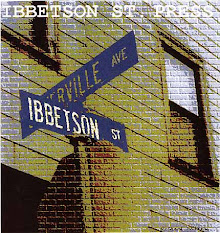
Thursday, March 27, 2008

DAVIS SQUARE POET ED MEEK: SOMERVILLE MAKES YOU WANT TO WRITE.


(Ed Meek center)


DAVIS SQUARE POET ED MEEK: SOMERVILLE MAKES YOU WANT TO WRITE.

Poet Ed Meek is a new transplant to Davis Square, Somerville, and damn glad of it. Meek, an accomplished writer in both the fiction and non-fiction genre, moved from the staid and tony suburbs of Belmont, Mass. to the hotbed of cultural activity: Somerville, Mass. Belmont, once labeled the “most boring” town in the state by The Boston Globe, was a bit rarefied for the writer in the man. Meek, the author of a new poetry collection “What We Love” (First World Publishing) said of Davis Square and Somerville: “Somerville is a great community. It makes you feel like writing.”

Like many writers Meek has held a host of jobs, mostly in teaching. In the 70’s Meek had a job as a wine steward at Locke Ober in Boston, a bastion of the cold roast Brahmin crowd. Meek told me he has a working knowledge of fine wines, but he said: “I have tastes that I can longer afford.”

Meek, who was born in Quincy, Mass. holds two Master Degrees, one in Creative Writing from the University of Montana, and the other in English Composition from U/Mass Boston. His work has appeared in such journals as the Paris Review, Bellevue Literary Review, Yankee, and Ibbetson Street, to name a few.

Meek has taught at Curry College in Milton, Mass, as well as overseas in Tehran, Iran. Meek now hangs his hat at Austin Prep in Reading, Mass. He likes the steadiness of teaching on the secondary level. The colleges he has taught at offered temporary one-year contracts, adjunct position, and the uncertainty wore on Meek. He also feels teaching high school has its advantages: “In high schools you can build relationships with students at an age when they have completely new ways of looking at things.”

Meek’s poems in “What We Love” are on the surface deceptively simple, but underneath are layers of meaning. Case-in-point: in Meek’s poem: “Divorce” he uses the conceit of divorcing the tired image of oneself, at say fifty years old.

“Move to a new city. Leave behind/ that fat lazy fool who returns your hopeful gaze/ in cruel mirrors every morning/ as you brush your caffeine-stained teeth/…This is the year to take a train into tomorrow/ one-way ticket in hand/ where no one knows your name/ and you can be someone else…”

Meek said as he grows older his writing” Just keeps getting better.” As a Baby Boomer, he is more aware of his limitations now as a writer and a man.. He feels at this point in his life he has a better grasp of what he wants.

About his own writing process Meek said that he does a great deal of revising. After he writes a poem he has to sit with it for two weeks or so to see if it works.

Meek said his major poetic mentor was Richard Hugo at the University of Montana. Meek said Hugo was a master of writing about place, with attention to concrete details, and he had a great ear. Meek smiled: “ He combines sound and metaphor, something I appreciate.” Meek also admires Robert Frost and John Ashbury who he heard read recently in Concord, Mass.

Meek said that we all have an aesthetic impulse that needs expression. “It is part of who we are,” he opined. Meek is a man who writes for the sake of writing not publishing. Although he is widely published he assured me that he would still be writing if nothing was published. He smiled: “Hey, not everything I write today is published, but I am still going at it!”

--Doug Holder

Wednesday, March 26, 2008

REVIEWS FROM CHARLES RIES


REVIEWS FROM CHARLES RIES


Charles Ries is one of the most prolific and insightful reviewers in the small press today. I had the pleasure to meet him in New York City this winter. He sent me a batch of his latest...


Greetings –


I wanted to share the following reviews with you now that they’ve appeared here and there. Forgive me for sending these along in this master-blaster-manner, but they don’t call it the “small” press for nothing. And we must get good work into the hands and heart as best we can.


The follow writers, publishers are covered in the review sequence that follows: Curt Johnson, Cervena Barva Press (Gloria Mindock, Editor), Ellaraine Lockie, Ralph Murre and Peter Schwartz. These reviews run between 250 and 1,000 words. They have appeared in print in the US, but I wanted to get them out to a wider audience. Enjoy them and send them around if you wish. If you want to run any of them just credit the first appearance as noted.


Thanks,


Charles P. Ries

Milwaukee, WI


Find Web Home of Charles P. Ries at: http://www.literati.net/Ries


_______________________________________________________________


SALUD

Selected Writings

By Curt Johnson

216 Pages

Price: $15.00


Cross & Roads Press

P.O. Box 33

Ellison Bay, WI 54210

www.bleidoorcountytimes.com


ISBN: 0-889460-16-8


Review/Interview By: Charles P. Ries


This Review First Appeared In: Free Verse


SALUD is a homage to Curt Johnson by his dear friend and small press institution, Norb Blei. This is the 27th publication from Blei’s, Cross + Roads Press. Blei says, “When a writer reaches the point of Selected Works in his life, a definite benchmark has been achieved. You stand by your words. What you’ve penned you are. This could not be more true then in the life and work of Curt Johnson, short story artist, novelist, essayist, critic, and one of the best yet, least celebrated writers and publisher (december magazine and december press) coming out of the heartland.”


Through SALUD, Blei gives us a sampling of Johnson’s work: novel excerpts, essays, articles, and memoirs. The challenge here is condensing the works of a writer who wrote so broadly and in so many forms. I often felt like I was getting only the first course – a taste. But this is want Blei intended to do; tempt us with Johnson’s work and encourage us to seek it out.


This book is both a literary experience and a history of the small independent press. Johnson who is now in his 80’s, was editor of the highly regarded december magazine in the early 60s. He was one of the first to publish the works of Raymond Carver, Joyce Carol Oates, Bukowski, and Ted Kooser, to name only a few who have gone onto popular acclaim. But Johnson also published the work of many writers who never hit it big, or at all. Johnson and Blei are two of the patron saints of the small press. They have been in it and doing it for over 50 years. They do it as much to give new writers a place to shine, a chance to be heard, as much as for any glory they may receive.


I found the interview between Johnson and Blei that concludes SALUD a delight - a history lesson and look inside the head of two small press pioneers. Blei says in the interview, “Curt have you, one of the Granddaddies of independent publishers in America, ever been invited to read your work and/or discuss the role of the independent presses in academia? Northwestern University? The University of Illinois (Johnson has lived his life in Chicago). And Johnson replies, “I don’t think the academy and its creative writing courses are of much use to the real writer. And I don’t think the safe haven the academy provides established writers does their own writing much good either.”


For those of us active in the independent small press this book is a must read. How can we know that we are innovating if we don’t know what has come before us? But even more, SALUD is a morality tale that has been told again and again by yet another talented, prolific writer sitting at linoleum kitchen table at 11:00 a.m., having a coffee and a shot of whiskey with a fellow writer and friend reflecting on the old days, lamenting the fact he never quite hit it big, but not willing to change one thing about his journey, the books he wrote, the people he met, or the writers he helped along the way.


________________________________________________________________


ČERVENA BARVA PRESS

Gloria Mindock, Editor

P.O. Box 440357

W. Somerville, MA 02144-3222

www.cervenabarvapress.com


By: Charles P. Ries


This Review First Appeared In: PRESA


What do you suppose is in the water in Somerville? Small press publishers are popping up all over the place: Ibbetson Street Press, sunny outside press and now, Červená Barva Press. Maybe we should all drink some of that Somerville prose juice as it appears to be poetry fortified.


Gloria Mindock founded Červená Barva Press in April 2005, since that time she has published and designed ten chapbooks, three e-books, and twenty-one poetry postcards. Forthcoming in 2007 are four more chapbooks, four full-length poetry books, as well as two plays and fourteen poetry postcards by fourteen poets using paintings by Nancy Mitchell. Oh, and she also publishes a monthly electronic newsletter which lists readings from all over the world as well as interviews with authors. I asked Gloria how it all began, “I started this press because of my passion for poetry. I edited the Boston Literary Review (BluR) for 10 years, and I read high-quality submissions during that period. Since the magazine ceased circulation, I have spent many years freelance writing, but see a need for a new publishing forum. This led me to take it a step further and expand into publishing. I wanted to provide another outlet for writers who take risks, have a strong voice, and are unique. Eventually I will publish more writing from different countries, particularly authors from Eastern Europe. There are so many wonderful writers in this world and I want to give them more exposure.” Mindock’s fascination with Eastern Europe, and especially Prague, prompted her to name her press Červená Barva which means the “red color” in Czech.


As the following short poetry reviews will note, Mindock has a wide range of tastes and inclinations when it comes to the writers she chooses to publish:


The Whole Enchilada

By: Ed Miller

Wonderful! If this is Miller’s first chap book – I want to put in an advance order on the next ten. I loved “Dear Poet” and “Extraterrestrials Use Holographic Imagery Of Naked Females”. How glorious to read a wry sense of humor who is capable of creating such endless possibilities.


God Of The Jellyfish

By: Lucille Lang Day

We need more poets with M.A.’s in zoology and Ph.D.’s in science and math education, or we will never discover the metaphoric limits of the ocean, stars and universe. Oh, and Lucille Lang Day also has a M.A. in English and M.F.A. in creative writing. She will never run out of material given the galaxies she has chosen to examine. She does a wonderful job making this collision of science, the cosmic, and the day-to-day work.


Of All The Meals I Had Before:

Poems About Food and Eating

By: Doug Holder

This collection of poetry may well elevate food above sex as one of life’s two great pleasures. Holder writes in the spare precise style he is known for. No extras – all meat and potatoes. These are highly descriptive, ambient poems of place and person. I was surprised at how well Holder pulled this collection off.


Gothic Calligraphy

By: Flavia Cosma

Mindock says her favorite writers come from Eastern Europe. As I read this delicious and somber Romanian born Canadian poet, it is easy to see why. Cosma uses nature as a backdrop and foundation for her poetry. She is a Richard Wilber Poetry in Translation winner for her book of poetry 47 POEMS. One has to wonder if being born speaking Slavic gives a poet the upper hand when painting silk on water.


Bilingual Poems

By: Richard Kostelanetz

I had to work hard to get through Kostelanetz’s work – esoteric word art more than poetry. Begging the question, where does poetry end and visual art begin? Scrabble meets Einstein. Bilingual Poems is on one level a series of two dimensional Mandalas, and on another, a series of Gideon knots. Kostelanetz says that his goal is “to be the most inventive poet ever in American Literature.” He just might do it, but will people read it?


W Is For War

By: George Held

It is hard to create metaphor or image equal to combat. War is horror – how can words ever come close to mirroring moments of such suffering and fear? I give George Held credit for trying and doing such a good job at it. His poem, “From Nam to Armageddon” is a great piece of work. One of the most complete war poems I have ever read.


Fishing In Green Waters

By: Judy Ray

These are effortless poems that spin between here and now using both conversational and lyrical language. Judy Ray lavishes description around the subjects of her observations that are often common in their nature, but elevates their substance with her gentle compassion. Her poems, “Anonymous Valentines” and “Sometimes” are wonderful works. About this Fishing In Green Waters, Judy Ray says, “This new collection is more elusive in theme, and maybe more mysterious for that reason. Several of the poems refer to those sparks of excitement which come from recognition of some moment of transient beauty, or a small gesture which speaks for a historic moment.” This is work by a very fine, skilled, steady hand


I asked Mindock about her background and influences and she said, “My mother always painted, and poetry was always around me. I always had that artistic background. My dad taught 7th and 8th grade English. There are a lot of artists in my family. My sister is a musicologist. My parents are my biggest influence.”


Doug Holder of Ibbetson Street says this about Mindock, “Gloria has long experience in the poetry biz. We call each other holy fools because we are passionate about our work, and don't make a red cent, like most of the holy fools in the small press. She puts out a quality product and is a joy to deal with!” Doug is right, and we poets are lucky to have holy fools who work for nothing, but the joy it brings them.


____________________________________________________________________


BLUE RIBBONS

At the County Fair

By: Ellaraine Lockie

63 Pages / 34 Poems

Price: $10.00


PWJ Publishing

P.O. Box 238

Tehama, CA 96090

www.wellinghamjones.com


ISBN: 0-939221-45-4


Review/Interview By: Charles P. Ries


This Review First Appeared In: Chiron Review


Ellaraine Lockie once again walks the tight rope between poetry that is accessible and ethereal - poetry that is at once plain spoken and musical. The title for her most recent collection of poetry is deceptively colloquial, Blue Ribbons at the County Fair, but her poems travel a varied world taking us far beyond the confines of the county fair. She uses a variety of technique and style to take us with her. As in her past work, she tiptoes along the high-wire that can separate the work of the academically trained and the self-taught writers.


In her poem, “Lost Legacy,” we find her wonderful ability to use alliteration with good effect. Moving us gently forward as she reflects on her beloved Montana, “Houses a hundred years old / with Alzheimer’s / Abandoned in isolation wards / on western prairies // Where homesteads were settled / on small town sanity brinks / Mine long ago lost / to profit margins / on minimal Montana farm // Hospice where I come to heal / from city assaults / My heart heavier / than the hard timber / turned driftwood soft.”


Lockie has received first place prizes for each poem in this collection, and as Lockie explains in her essay at the conclusion of the book, “And yes, some received blue ribbons at county fairs.” She goes on to say, “When I began writing poetry, naturally I thrilled to the idea of poetry contests. Not only are they fun and suspenseful, but placing in them gives credibility to cover-letters, pays money prizes or other honorariums and sometimes provides public reading opportunities.” So in a sense Blue Ribbons at the County Fair is sort of an Ellaraine Lockie Greatest Hits Collection. I especially enjoyed her poems focusing on the topic of modern romance – of one sort or another, such as in “The Other Woman”: “She shows signs of jealousy / That slight smart of suspicion / Of course she would know / How a woman / can move in on a man / Hang her underwear / over his philandering lines / Being a practiced poacher herself / An artist in sculpting seduction”. And again in, “Silk Dreams”: “I told you ahead of time / this affair / if it happened / wouldn’t be casual / But here it is a few hours old / Already wearing sneakers / and a wrinkled tee shirt / You say you will pass my way / when time permits / I say the way has potholes / that require attention / Mapped maintenance.” “Defying Gravity” also covers this eternal landscape with exceptional skill.


Lockie told me about her jump into poetry, “I previously had written in other genres (and still do)--nonfiction, magazine articles and children’s picture books. Nine years ago I had not read a poem since high school, except for the occasional one I came across in children’s literature. I thought I hated poetry; I thought it had to rhyme. Then one day an old friend sent me some of his poems and wanted my opinion. I liked them, but they didn’t rhyme. So I called my children’s writing mentors for advice. When they told me about free verse, I became obsessed with writing it and with getting it published. This happened at a tough time in my life, and poetry became my salvation. I just jumped in and started writing like crazy, unaware of what other poets were writing. I entered the poems in contests before submitting to editors, knowing that I needed something in cover letters to entice editors into reading my work carefully.” If she needed verification that she was on the right track, she certainly got it.

What I enjoyed most about this collection is Lockie’s ability to use language beautifully and yet have it remain accessible. I understood her metaphors; I could relate to her stories and pictures. And while her writing was accessible, it remained well developed and carefully composed. There are only a few writers in the independent small press who manage to walk this line and not fall in to the pit of abstraction (Michael Kriesel and Gloria Mindock are certainly two who come to my mind). One wonders if as poets grow and extend themselves that they must inevitably drift further away from the common and push the art form, play with structure and elevate their style of their writing? But it was a joy for me to settle into Lockie’s recent collection and find no extraneous obstacles to my entering her world or her meaning. As Lockie has grown as a poet she has become more elegant about communicating common meaning.


_______________________________________________________


MY NOVENA

By: Peter Schwartz

T.K. LLC

P.O. Box 767

Augusta, ME 04332

Price: $4.50 / 19 pages / 1 Poem

Review By: Charles P. Ries


Peter Schwartz walks the line between ethereal image and the everyday about as well as any poet writing in the small press. His new book, “My Novena” is a single poem that covers nine days in nineteen pages. The word novena is from the Latin word novem meaning nine. It is a process of hopeful mourning, of yearning and prayer which if conducted over nine consecutive days promises special graces. Schwartz embarks on his reflection and on day one notes that, “I swim without / meaning as my memory / tunes itself to the tides / becoming the net / it always was”. And on day five: he comes into his own with the realization “to domesticate the distance / to acquaint flyspecks / with the celestial / because intimacy’s / its own habitat / a pleasant anarchy / seldom discussed”. Schwartz’s considerable talent at colliding the eloquent and common greatly elevated my experience with his reflections. “My Novena” no longer became just his prayer, but mine as well when on day four he notes, “I waver / from being somebody to nobody /so many time within the space / of a single hour that I really am / that person in between / the intermediate / the delegate / the agent and broker / to a condition / that can perhaps / be best summed up / as heartbroken”. This is a very talented writer.


________________________________________________________________


CRUDE RED BOAT

By: Ralph Murre

Cross+Roads Press

P.O. Box 33

Ellison Bay, WI 54210

Price: $10.00 / 72 pages / 50 Poems

ISBN 1-889460-18-4

Review By: Charles P. Ries


First Appeared in: Free Verse


It always surprises me when I read a new book of poetry by a writer I've read and enjoyed in various journals and discover it is their first book. “How could this be?” I wonder when the writer has such talent. “Crude Red Boat” by Ralph Murre is published by the venerated Norb Blei’s Cross + Roads Press. It is a wonderful coming out party for a writer who began to write poetry just a few years ago. Murre uses plain spoken language in this collection of fifty-three poems, and the subjects of his musings are also common as noted by a few of the titles from this collection, “Rock”, “My Room”, “Gust”, and “Neighbor”. These poems are so immediate they made me feel like I was sitting across the table from Ralph having coffee. Indeed, he is the coffee counter philosopher in “A Good Reed”: “we are those of us who survive / slender reed / bending with each passing wave / changing with the tide yet unchanged / as the ocean is unchanged / by each reed on it shore”. And again, in “Running Things”: “Another year / Another chance to get it right / To do the things I shoulda done / Tear down that fence I built / Quite the party / Let running things run”. These poems are fresh and honest - a wonderful first book of poetry.

_________________________________________________________


Charles P. Ries lives in Milwaukee, Wisconsin. His narrative poems, short stories, interviews and poetry reviews have appeared in over two hundred print and electronic publications. He has received four Pushcart Prize nominations for his writing. He is the author of THE FATHERS WE FIND, a novel based on memory and five books of poetry. He is the poetry editor for Word Riot (www.wordriot.org), Pass Port Journal (www.passportjournal.org) and ESC! (www.escmagazine.com). He is on the board of the Woodland Pattern Bookstore (www.woodlandpattern.org). He is a founding member of the Lake Shore Surf Club, the oldest fresh water surfing club on the Great Lakes (http://www.visitsheboygan.com/dairyland/). You may find additional samples of his work by going to: http://www.literati.net/Ries/

Tuesday, March 25, 2008

Readers and schedule of Boston National Poetry Festival April 12-Boston Public Library-Copley Square

BOSTON NATIONAL POETRY MONTH FESTIVAL
POETS’ Reading Schedule ROOM 5-6
Rabb Lecture Hall
APRIL 12, 2008

OPEN MIKE – Room 4
10:00 Boston Latin High School- 1:30 to 4:00 P.M.
Rhea Kroutil McKendry
10:10 Boston Latin High School
Tu Phan
10:20 Boston Arts Academy
Jocelyn Morris
10:30 Boston Arts Academy
Yamira Serret
10:40 Boston Arts Academy
Taoe Clarke
10:50 Walnut Hill School for the Arts
Gabriella Fee

11:00 Sam Cornish
11:10 Suzanne E. Berger 11:10 Lisa Beatman
11:20 Regie O. Gibson 11:20 Cynthia Brackett -Vincent
11:30 Joanna Nealon 11:30 Sandra Storey
11:40 Danielle Legros-Georges 11:40 Marc Goldfinger
11:50 Len Krisak 11:50 Andy Levesque
12:00 Susan Donnelly 12:00 Ron Goba
12:10 Charles Coe 12:10 Carol Weston
12:20 Dan Tobin 12:20 Walter Howard
12:30 Cathy Salmons 12:30 Elizabeth McKim
12:40 Kaji Aso Studio 12:40 Elizabeth Leonard
Kate Finnegan / Michael Bialis 12:50 Marc Widershien
12:50 CD Collins 1:00 Ifeanyi Menkiti
1:00 Dan Sklar 1:10 Elizabeth Doran
1:10 Jeffrey Harrison 1:20 Robert K. Johnson
1:20 Tino Villenueva 1:30 Tim Gager
1:30 Jan Schreiber 1:40 Frannie Lindsay
1:40Diana DerHovanessian 1:50 Joseph DeRoche
1:50 Lloyd Schwartz 2:00 Victor Howes
2:00 Lainie Senechal 2:10 Richard Hoffman
2:10 Harris Gardner 2:20 Robert J. Clawson
2:20 Doug Holder 2:30 Anne Elizabeth Tom
2:30 Barbara Helfgott-Hyett 2:40 Irene Koronas
2:40 Rhina P. Espaillat 2:50 Frank Blessington
2:50 Richard Wollman 3:00 Lo Galluccio
3:00 Stuart Peterfreund
3:10 Ellen Steinbaum
3:20 Diana Saenz
3:30 Richard Moore
3:40 Fred Marchant
3:50 Valerie Lawson
4:00 Ryk McIntyre


Harris Gardner

PRESA ( Spring 2008) Reviewed by Irene Koronas

Presa :S: Press

"I do not put down the academy but have

assumed its function in my own person..."

-Philip Whalen


PRESA
Number 7, Spring 2008
Featured Poet: Doug Holder
Lest We Forget: Etheridge Knight
Toward a new eclecticism: Eric Greinke
$8.50

This issue of Presa is chalk full of good poets and
poems. I especially enjoyed the essay by Eric Greinke
and reading about the poet Etheridge Knight. I will be
reading this issue over the next few weeks, but my
focus is, presently, on Doug Holder.

I am biased. Doug Holder gets my immediate, full
attention, because of his active presence in the local
communities around the Boston area, he is well
established as a poetry activist and without his
support and validation as a writer/poet I would not be
able to write this review. It is Doug Holder who
opened a door for me many years ago. Many poets owe
him a thank you. I love Doug Holder and he can do no
wrong, (that’s a bit of an exaggeration. but you get
my drift.)

The five poems printed in this edition of Presa #7,
I’ve heard Doug read except for, “with my shirt off.”
In that particular poem he presents the reader with a
scant peek at being in a vulnerable position, love.
His love, his honesty, packed into a short verse, "and
my love, will you love the rest?” In the words, “the
rest” leads me on a journey and will set the tone for
the rest of his poetry. If we take the words at face
value it is still powerful writing, but if we allow
ourselves to muse on that simple phrase, “the rest” I
have to ask what is ’the rest.’ I will not answer here
because it doesn’t seem appropriate to the review,
except to say, ’the rest’ is apropos to my situation.
In his poem “looking at a lone woman at a bar,” Doug
places me in front of a photograph, in front of a
person sitting alone, a person from a painting by
Toulouse Lautrec, or an Edward Hopper. Holder captures
the same isolation, “they are always impenetrable.”
From our modern or contemporary societies or systems,
Doug offers us the opportunity to feel what it is like
to wait in line, have a casual glance with out a
meeting, a consummation or any action. We could say it
is because of the glass protecting the photograph. The
poem’s expanse, “no-my gaze will not be met.” a simple
word phrasing, ’met’ becomes for me, an implication,
each reader will find for themselves. the phrasing is
poignant, a realization, the reality of being the
viewer, a passive participant, similar to Lautrec and
Hopper, who show us in their work, the barren human
landscape, and Dianne Arbus, the queen of outsider
depictions. Holder is a master of the simple word
play.

The poems in this edition of Presa, speak in laud soft
voices. Holder’s voice is often times, subtle,
humorous, astute, and always familiar. So familiar, we
may over look the profound nature of the simple
phrasing, a figure sitting in front of us, the people
who visit joke shops, or the people who collect our
money from a small enclosed booth, or the extinct
booth in the middle of an under pass. Doug Holder
sees. He offers us a chance to invite that same
difference into our own perspective. His poems present
the imperfections perfectly present:

The Perfect Lawn

far from boston
I will neuter it.
I will mow
that plot
before the
plot thickens.

cut all the intrusive
outside of the box
gay blades.

in my narrow mind
I picture a broad lawn
a perfect rectangle
where I draw
the line.

no random weed
will drop
mix
will be felt
on my
flawless
green pelt.

Doug Holder can never be overlooked. We all know, or
at least we will all know his work is as great as any
of those great paintings hanging in the ‘Met.’ I dare
not compare his work to significant, ‘other’ poets
such as…. you know, some of those u.s. of a. poet
laureates. In my book he is the Mother Teresa of the
small press. Oh God, Doug will not enjoy that
reference, I’ll change it.
He’s the wailing wall for unknown poets. nah. He won’t
like that either. okay. Doug Holder can reach tall
buildings in a single bound.

He can flip a coin phrase faster than a speeding
bullet. He is always the first one to show-up for a
meeting. He always welcomes new poets and writes. He
always passes out flyers and the local newspapers,
with poetry event schedules. He always has a poem in
his small brown notebook in his back pocket

Irene Koronas
Poetry Editor
Wilderness House Literary Review
www.whlreview.com

Monday, March 24, 2008

92 Rapple Drive by Lyn Lifshin


92 Rapple Drive
Lyn Lifshin
Coatlism Press 2008
15.95 ISBN 13: 978-0-9802073-1-6
ISBN 10: 0-9802073-1-2
http://www.coatlism.blogspot.com

the font used for titling the poems is distraction;
too emphatic for this reader, especially, in the
morning before my coffee kools. I proceed anyway to
the poems which run into each other or so it seems,
“imagined I couldn’t go on without her.” “here, with
the cat on my feet…” “was it the black starless
nights,.” Lyn Lifshin’s 92 Rapple poems are rooted,
they grow from rich soil fed and turned regularly.
what surprises me is the poems are not about trees or
those flowery blouses dotted with pink and lilac.
instead Lifshin plants memory and the moment opens; we
meet the unabashed poems’ presence, in the presence of
their unfolded. “but I was fire, i was adrenalin,
flame. I wanted the white wind…” and as the reader
thumbs thru, turns pages, we harvest her white, we
breath in and exhale slowly in front of, before her
verse, before we are allowed entrance, “the key
gulped by crows,” the reader needs to retrieve, settle
into, an often “cranky.” Lifshin lets us walk thru
concrete passage ways, the subtle play between
couplets. those who have read her work before, you’ll
find the same genuine voice, that pause encounter,
"remember stories of panthers,” pawed rows and rows,
spooning words as ordinary, the extrodinary lift, the
fresh break or corner of shade.

I don’t want to talk
of the other I passed
in the hall, you know
that story tho it was
not quite that, was
tea in bed and then I
wrote in the kitchen.
what was new
would be stained.
what wasn’t, lost
its sheen. days a
scrim I saw only
what I made up thru,
the moon pink and
if there was a pond,
a deep rose thru the
sand that let go of
everything too

Irene Koronas
Ibbetson Street Press (reviewer)
Poetry Editor
Wilderness House Litery Review
www.whlreview.com

Saturday, March 22, 2008

This is where you go when you are gone. Tim Gager


This is where you go when you are gone. Tim Gager ( Cervena Barva Press POBOX 440357 West Somerville, Mass. 02144) $7. http://www.cervenabarvapress.com

Tim Gager’s poems are poems of the regular guy, and in his own way Gager’s work is as American as apple pie. He is a man who is confused by and craves women, retains a childlike enthusiasm for Baseball into his middle age , downs the burger and brews, and pines for something that always seems just out of his reach. There is nothing rarefied about the poet’s work; his poetry speaks as plainly as a stick or bone.

In the poem “2A.M.” Gager writes evocatively about the concessions of carnality:

“ On me
you push down
the weight on each bent leg,
cures my evils…
no more bile
to hold down
no more skeletons
to settle for
when it’s dark…”

And Gager really hits his stride with “ stuck, with my old school ways.” I must admit in this age of the wireless I remain a Luddite , and view the pay phone, and the phone booth with a certain romantic reverence. Gager infuses this one pedestrian booth simmering in the Arizona heat with a plume of sad/sweet nostalgia and longing:

“ got green in my pocket
not plastic—nor have I
ever brought a cell
to make his call like this
with poles and wires
endless from where I stand
to you

i’ve driven miles in dust
to find this pay phone
to whisper in your ear
i love you baby
and how are the kids

on the side of the road,
my loneliness
is this booth where
i hear you smile
and I picture
the way your hips thrust
forward, every time you laugh…
this surge of you
bursts, hits me
like the heat in Arizona
at ten
AM.”

This is another fine collection from Cervena Barva. And hats off to the front cover artist Andrea Libertini.

Friday, March 21, 2008

Presa Number 7 Spring 2008


PRESA Number 7 Spring 2008 (Presa S Press POBOX 792 Rockford, MI 49341) $8.50 presapress@aol.com http://www.presapress.com


Well, I have, and my minions of crack reviewers have reviewed many books that have come through the portals of Eric Greinke’s PRESA PRESS. I foreworn you I was the featured poet in this issue so I am deliriously biased. But I do have to say PRESA magazine is in the best tradition of small press journals. Eric Greinke has a thoughtful essay titled “ Toward A New Eclecticism” where he examines the gaping divide between the academy poets, and the small and independent presses. Greinke, although a dyed-in-the-wool small press doyen, pleads his case for more tolerance between the groups for other poetic forms. He tries to bring down “purists” of both camps. Greinke writes:

“The main problem we face in American poetry is narrow-minded intolerance of various forms taken by poetry itself. The obvious division along social class lines is a symptom of elitism and mutual intolerance, rather than being based in legitimate, fundamental, aesthetic differences.”

There is an extensive review section of chapbooks. Greinke recognizes that chaps are the currency of the small press: “ Literature owes a great deal to the chapbook. Historically, the first bound books were single signature chapbooks. They are nearly indestructible. They are non-commercial. Every poet first sees his work collected in a chapbook. They are the perfect medium for poetry, the quintessential “slim volume.” But it can be difficult to get them reviewed.” Well Presa addresses this problem with reviews of chaps by Harris Gardner, Mary Bonina, Ellaraine Lockie, Gerald Locklin, Michael Graves and others…

Also in this edition is an essay on Etheridge Knight by Ronnie M. Lane, as well as poetry by small press notables as Lyn Lifshin, Robert K. Johnson, Alan Catlin, Michael Estabrook,, Hugh Fox, Donald Lev, John Amen and others.

Highly Recommended.

Thursday, March 20, 2008

KEEN
Philip Ramp
Shoestring Press 2008
$15.00 ISBN 978 1 904886 66 3


Philip Ramp's poems slip in and out of my thoughts
like water lapping on shore, not the coastal wave's
hard crash, but the gentle lapping of a calm sea
against a boat or a floating tree trunk. each time I
read one of Ramp's poems I am able to see right to
the bottom of his ocean, the fish darting, riding the
ebb and flow, "a shadow ran like a path." Ramp's ideas
are solitary in nature, but never random. he chooses
his words, phrases, metaphors, he ponders each line,
"so it was nature, not me, erased the intrusive
hills." the actuality of his reality becomes our
vision of his visit with his natural surroundings, he
places us before the sunset, "its not us death wants
but our memories, what we think we're sneaking out."
the poems become a landscape of thought. Ramp brings
us a sense of wonder, as if for the first time after a
long time, "I saw the stars as if caught unaware,
exposed, as big and luscious as fresh fruit. how could
it be I'd never seen that sky before." his vast space
contained within a depiction of trees, birds, breeze,
and, "the plastic flowers drooping."

Fall

of all the seasons
this is the one
gets nearest to complete,
the day scrubbed down
to its fundamental browns
put in a box
smooth to the eyes
rough to the touch
spilling over with leaves.
the wind rattles the last
useful music from the trees
shakes the mist
from the grass
gives the sky
a lick and a promise
and tells the birds; scat.
cleaned of their abstract shadows
things are so outward
they're as impervious as a hum.
all the distance
this one space can hold.
then brown's removed.
the going is gone.
the box is empty
and there's nothing
on the ground.


Irene Koronas
Reveiwer Ibbetson Street Press
Poetry Editor
Wilderness House Literary Review

Tuesday, March 18, 2008

Anne Elizabeth Tom: A Bagel Bard is the New Head of the Cape Cod Writers Center


Anne Elizabeth Tom: Bagel Bard New Head of the Cape Cod Writers Center


Anne Elizabeth Tom, among other things, is a member of the “Bagel Bards,” a writers group that meets every Saturday at the Au Bon Pain in Davis Square, Somerville. Late in 2007 Tom was appointed the new executive director of the Cape Cod Writers Center. Anne who lives on the Cape with her husband Steve grew up in Boston but remembers her summers on the Cape with great affection. Tom got an MFA from Tufts University, worked as a writer/editor for the MITRE Corp., started a family, lived around the country, but wound up back on the Cape.

For several seasons she produced the Grange Hall Poetry Series, the Cape Cod Winter Poetry Series, and produced original plays of Cape Cod playwrights. She is no stranger to the small press, and has published in such literary journals as the Aurorean, Ibbetson Street, Poesy, Out of the Blue Writers Unite (anthology), and Bagel with the Bards ll. Tom also established Cape Cod Cultural Tours which specialized in custom excursions focused on local history, and architecture. I spoke with Tom on my Somerville Community Access TV show “ Poet to Poet: Writer to Writer.”


Doug Holder: Anne you have lived a number of places and traveled the world. Why have you chosen the Cape to hang your hat?

Anne Elizabeth Tom: The Cape got under my skin at a very young age. To me it is a nostalgic place. Once you go over the Sagamore Bridge it is all Cape Cod and you don’t have to leave it to get from town to town. Especially in the off-season.

D H: That divide--- does it cut you off from the Boston poetry community?

AT: Unfortunately I don’t get up to Boston as much I would like to. But I try to get together with Boston poets also.

DH: There have always been a lot of writers residing on the Cape from Norman Mailer, on…

AT: I know. It is just amazing. The poet May Oliver lived there. Marge Piercy, and the list goes on. We have a lot of great theatre too. We have a new theatre the: Wellfleet Harbor Actors Theatre. There is a tremendous amount of talent. So there is plenty to do. I could be out a few nights a week.

DH: Can you tell us a bit about the history of the Cape Cod Writers’ Center, and your mission statement, etc…

AT: The Cape Cod Writers Center is almost fifty years old. It was started by a small group of writers to support one another. And that’s really still the mission to support one another. We have an annual conference that really is the core work of the center. One of the ways we expanded our mission statement is to include more readers, and that includes poets. We also have a breakfast with the authors series at the Hyannis Golf Club. We have hosted such writers as Jan Shapiro, Shelia Connolly, Scott Withiam, and others. So many people come around from the Cape. It helps to have things happening on a regular basis.

We have an annual conference in August. It’s held in a wonderful retreat, overlooking, the Nantucket Sound. It’s right next to a charming, little Victorian town.

DH: You have published in such small press magazines and anthologies as: Poesy , Ibbetson Street, Out of the Blue Writers Unite, and Bagel Bards ll to name a few. What’s your view of the small press?

AT: I feel it is very important. It is important to publish. After I left my position as a museum director and moved to the Cape, I said I didn’t care if I ever published anything. I just wanted to write. But it didn’t take long before I wanted to share, and be taken seriously. It was the Aurorean and Ibbetson Street that published me for the first time. It was in the fall of 2002-I think. It was such an affirmation of my work. The small press brings poets together. I don’t think it is a good idea for poets just to write about by themselves, and never show their work. The small press is a wonderful way to meet other poets and get your work out there. Fred Marchant, one of our poets-in-residence at the Center, encouraged us to send our work to the small press.

DH: Who were your other poets-in-residence

AT: Afaa Michael Weaver, Wes McNair, to name a couple.

DH: What is the young writers workshop you offer about?

AT: We have a lot of summer people from other cities and other states that send their kids here. This year it’s going to be taught by David Surette. It is for talented writers between the ages of 12 to 16. It is held from Aug. 18 to Aug. 22 during our summer conference.

DH: You have done different types of writing. Why is poetry your favored genre?

AT: I’ve done business writing, and public relations writing. My favorite non-poetry writing is research and writing about history. I feel things very deeply, and I find poetry as the best way to express this.

for more information go to http://capecodwriterscenter.com

--Doug Holder

Monday, March 17, 2008

Barnes and Noble and The Small Press.


Barnes and Noble and The Small Press.

Ok. I can understand why Barnes and Noble can’t stock the many titles that are produced in the Small Press. But for crying out loud, when you have a well-known local poet, whose book has received good coverage in the local media, will be making appearances at local colleges, and reading around town, don’t you think you could be a bit more community minded? Barnes and Noble at Harvard University refused to grant any shelf space for Lisa Beatman’s book of poetry “Manufacturing America” a book of poetry about immigrant workers at the Ames Safety Envelope Factory in Somerville, Mass. They also refused to give her a reading at the store. Lisa is a graduate of the Kennedy School of Government at Harvard, and the publisher has a graduate degree from the University as well. And what’s funny this is the University’s bookstore! Most colleges I have dealt with have no problem doing this for their former students. It would be great if a poet who writes about the unsung workers in a local factory could read at a venue like this, along with the other authors who get recognition from the store. Thank god for indies like Porter Square Books, McIntyre and Moore, the Grolier---where would we be without them!

Doug Holder/Ibbetson Street Press


Here are the exchanges between Beatman and the store.


Nancy,

Thanks for your email. I do understand about market forces. However, your
decision to exclude considering small press publications, particularly in
the case of a Harvard alumna, is an unfortunate one. It perpetuates the
public perception that when a large national chain takes over a venerable
local institution, it loses its character and responsiveness to the
community.

Sincerely,

Lisa


Thank you for letting us know about your book. When it comes to stocking
books on the shelves of our store and choosing authors for our events, we
have to make choices. More than 150,000 new titles annually are submitted to
our store by traditional publishers. With more than 1.5 million books in
print via traditional publishers & distributors, our store does not have
room to stock the tens of thousands of small press titles that are produced
annually.
Sincerely,
Nancie Scheirer
The Harvard Coop
Trade Book Manager

Sunday, March 16, 2008

Somerville artist Heather Bonin helps bring “sub-zero” on stage.


Somerville artist Heather Bonin helps bring “sub-zero” on stage.

Powder House Square resident Heather Bonin is a 25-year-old Regis College graduate, who works as an asst. stage manager for the critically acclaimed play “sub-zero” written by Anastasia Townsend, playing at the Factory Theatre in the South End of Boston. Bonin who graduated with B.A. in Theatre, has worked with the Speak Easy Theatre, and had had roles in the production of plays by Tom Stoppard and others, in regional theatres in the area. Bonin cheerfully describes herself as a “starving artist” and has a hard time keeping up with the payments on her cell phone. She said as a stage manager she is a “Jane of all trades.” She helps with the props, feeds lines to the actors, monitors the audition process, gets the company takeout grub, you name it. Although an MFA is not in her immediate future she seems destined to have a career working in the theatre.

After graduating from Regis in 2005, she moved to Somerville when an apartment in Dorchester fell through. This turned out to be a blessing in disguise. She finds Somerville the ideal place to live. It is accessible to Boston, and Somerville’s artist-friendly environment is a perfect fit for her Boheme sensibility.

The Factory Theatre is in the basement of a large artists residence the “Piano Factory” on Tremont Street in the South End. Jim Resnick, my companion for the evening and I found the theatre to be decidedly intimate (50 seats), with exposed brick, (well, you know the drill,) the whole Off-Off Broadway digs, kind of affair. The play opens in a city in the shadow of Somerville, Cambridge, Mass. It is at the end of a long winter of discontent for a manic depressive artist/professor Fenton, played by Chuck Schwager, his wife Lois played by Jean Sheikh, their son Sean played by Joe Orrigo, and the young object of desire of the two men, Claire, played by Lisa Caron Driscoll.

It seems that Lois, wants her son to keep tabs on Fenton, as he is quickly hitting the skids in a manic freefall. But, ah what a tangled web we weave! Both father and son become involved with Claire, an artist model/ coffee server, who is as unfocused as they are. The mother, Lois, seems to be the most stable of the characters. But until the end she is rendered affected and ineffectual in a suited armor of academic jargon and posturing.

The dialogue is sharp, bantering, witty, and at times a bit over the top. And make sure you bring your pocket Janus as there are many references to the “arts”, “artists,” not to mention the many intellectual barbs that are thrown about like poisonous darts. Both father and son are prone to purple flourishes, and the audience is made to wonder where the artistic temperament ends, and where the mental illness begins.

Having worked at McLean Hospital for the past twenty-five years, I can attest to the fact that Townsend does capture the wild highs and lows, the verbal barrage, that a full-blown manic episode can bring. The father, a middle-aged, cherub-faced hysteric rages against his fate like Harpo Marx as King Lear. The playwright sticks a pin in the balloon that romanticizes the mad artist. Townsend has written a thought provoking piece that dramatically examines identity, the familial ties that bind and break, and the toll of mental illness.

For more information go to: http://ww.ridgeproductions.org 978-460-3294

--Doug Holder

Friday, March 14, 2008

Philip E. Burnham's Poetry Collection "Housekeeping" ( Ibbetson Press 2005) to be featured on NPR


Philip E. Burnham, Jr's Housekeeping: Poems out of the ordinary (Ibbetson, 2005) will be featured on Garrison Keillor's The Writer's Almanac on NPR.

March 14, 2008


Ibbetson Street Press

25 School Street

Somerville MA 02143 (617) 628-2313

http://www.ibbetsonpress.com


Garrison Keillor, host of A Prairie Home Companionâ and of The Writer's Almanacâ, would like to include a poem by Philip Burnham, Jr.in his program. We understand you hold rights to the poem, and I am writing to arrange permission to include it on The Writer’s Almanac. The poem and broadcast date are:


“Assignment # 1: Write a poem about Baseball and God” from Housekeeping: Poems out of the ordinary April 4, 2008


The Writer’s Almanac is a daily radio program produced by American Public Media (APM). In each program Mr. Keillor presents a list of cultural events and anniversaries, many associated with literature and literary figures, then ends with the poetry reading. APM currently distributes the program for broadcast to about 320 non-commercial public radio stations around the country. The program audio is also streamed and podcast from and archived on the APM website at http://writersalmanac.publicradio.org and may be streamed, archived on carrying station websites as well. In addition, we would appreciate permission to put the text of the poem on those websites and promotional materials, only in connection with The Writer’s Almanac.


Sincerely,


Kathy Roach


“Assignment # 1: Write a poem about Baseball and God” ( From the collection "Housekeeping")


Assignment #1: Write a poem about Baseball and God

And on the ninth day, God
In His infinite playfulness
Grass green grass, sky blue sky,
Separated the infield from the outfield,
Formed a skin of clay,
Assigned bases of safety
On cardinal points of the compass
Circling the mountain of deliverance,
Fashioned a wandering moon
From a horse, a string and a gum tree,
Tempered weapons of ash,
Made gloves from the golden skin of sacrificial bulls,
Set stars alight in the Milky Way,
Divided the descendants of Cain and Abel into contenders,
Declared time out, time in, stepped back,
And thundered over all creation:


"Play Ball!"

Wednesday, March 12, 2008

THE BOSTON NATIONAL POETRY MONTH FESTIVAL April 12 , 2008


PRESS RELEASE
THE BOSTON NATIONAL POETRY MONTH FESTIVAL
Now in its SUCCESSFUL Eighth !!! Year

CO-SPONSORS:Tapestry of Voices & Kaji Aso Studio in partnership with
The Boston Public Library. Starts Saturday, April 12th, 2008 10:00 A.M.
To 5:00 P.M. OPEN MIKE: Saturday, 1:30 to 4:00P.M. The festival will be held at the library ’s main branch in Copley Square.


56 Major and emerging poets will each do a ten minute reading; also


Featuring six extraordinarily talented prize winning high school students: Rhea Kroutil-McKendry and Tu Phan, Boston Latin High School; Jocelyn Morris, Yamira Serret, Taoe Clark, Boston Arts Academy; and Gabriella Fee, a Sophomore attending the Walnut Hill School for the Arts. These Student stars will open the festival at 10:00 A.M. SAM CORNISH, Boston's new and first Poet Laureate will open the formal part of the festival at 11:00 A/M. 55 additional major and emerging poets will follow with a
POETRY MARATHON.
Some of the many luminaries include SAM CORNISH, Diana DerHovanessian , Rhina P. Espaillat, Richard Wollman, Lloyd Schwartz,, Fred Marchant, Barbara Helfgott-Hyett, DanTobin, Charles Coe, Danielle Legros-Georges, Regie Gibson, Marc Widershien, Sandee Story, Tino Villanueva,C.D. Collins, Stuart Peterfreund, Frannie Lindsay, Ifanyi Menkiti, Lainie Senechal, Harris Gardner, Susan Donnelly and Doug Holder.


This festival has it all. A plethora of professional poets, celebrities, a Pulitzer Prize Winner, numerous award winners, student participation.
Even more, it is about community, neighborhoods, diversity, BOSTON and MASSACHUSETTS. This fast growing tradition is one of the largest events in Boston’s Contribution to National Poetry Month. FREE ADMISSION !!


For information: Tapestry of Voices, (617-306-9484) or
617-723-3716 Library: (617)- 536-5400


Wheelchair accessible. Assistive listening devices available. To request a sign language interpreter or for other special needs, call (617) 536-7855 (TTY) at least two weeks before the program date.


Harris Gardner

The Art of Writing Poetry with Doug Holder

NEWTON COMMUNITY EDUCATION


( click on to enlarge)


Course ID:
W1024

Course Name:
The Art of Writing Poetry (Writing & Speaking)

Description:
Poets want two things: to be able to write compelling poetry, and to
see it in print. In this participatory workshop we will develop
poetry through creative brainstorming. Feedback will focus on the
effective use of language, imagery, and metaphor in the construction
of a poem. The instructor will provide leads for publishing and
contacts at small presses. Many students have published their poems
for the first time in the course of this workshop. Please bring
three original poems to each class. You will have the chance to read
your work aloud and to get feedback from other class members.

Instructor:
Douglas Holder

Time:
7pm to 9pm on Tuesday

Location:
Newton SOUTH HS in Room 2105

Tuition:
$110

No Class Dates:
(No class Apr 22)
Classes are from 4/8/2008 to 5/20/2008. There will be 6 sessions.

Doug Holder is a small press activist. He founded the Ibbetson
Street Press in the winter of 1998 in Somerville, Mass. He has
published over 40 books of poetry of local and national poets and
over 20 issues of the literary journal "Ibbetson Street." Holder is
a co-founder of "The Somerville News Writers Festival," and is the
curator of the "Newton Free Library Poetry Series" in Newton, Mass.
His interviews with contemporary poets are archived at the Harvard
and Buffalo University libraries, as well as Poet's House in NYC.
Holder's own articles and poetry have appeared in several
anthologies including: Inside the Outside: An Anthology of Avant-
Garde American Poets (Presa Press) "Greatest Hits: twelve years of
Compost Magazine (Zephyr Press) America's Favorite Poems edited by
Robert Pinsky. His work has appeared in such magazines as: Rattle,
Caesura, Home Planet News,Istanbul Literary Review, Sahara, The
Boston Globe Magazine, Poesy, Small Press Review, Artword Quarterly,
Manifold (U.K.), The Café Review, the new renaissance and many
others. He holds an M.A. in Literature from Harvard University.
Recently Holder was a guest of the "Voices Israel" literary
organization, and conducted workshops and read from his work in
Jerusalem, Tel Aviv (Zoa House), and Haifa. His two most recent
collections of poetry are: "Of All the Meals I Had Before," (
Cervena Barva),"No One Dies at the Au Bon Pain" (sunnyoutside)

"Bird Scarer"( poems) by Glenn Sheldon


"Bird Scarer"( poems) by Glenn Sheldon

$14.00 U.S. paperback

Cervena Barva Press

http://www.cervenabarvapress.com

ISBN: 9780615171678

Pub.: 2008


Review by Mike Amado


"Bird Scarer" is the first full-length poetry collection

by Glen Sheldon, though, at the same time, it stands in sapient

observation like a guru in a rock garden, silently reflecting

every speck.


The collection is split into three sections. All of which

own their own psyche, and draws for the reader a continuum

of images, both concrete and not, that shift perception

just like the poems switch geographic locations; from Chicago

to "North of Boston", French Guiana to Buenos Aires.


There is a certain division of voice in the first section of "Bird

Scarer", the "alert" poet taking in the atmosphere of a city where

the view from skyscrapers are,

". . .a tool invented to seduce angels into throwing / stones down

upon damned rooftops." and the man looking for employment.

Shining his shoes just to go to the library or the art museum.

With an almost split personality, the speaker is both an adult

with a job and is an unquiet youth running loose in the city:

"There is the sugar rush of / leaving work and undoing / one’s

tie on an unraveling / street."


In the poem, "Class Wars", the speaker is an infiltrator in the

"High-art" world, stealing into exhibit openings in "SuHu

(SoHo transplanted to corn country)".

The art openings are seen as being less about the art and more

about the artist, "Discreetly visible", in "Expensively pensive

clothing.",( black, of course ) and about making a sale. "The

cheese was often / cut into cubes as if cubism, at last,

/ was profitable." Sheldon concludes:


"The wine spurred us

to fall in love with the neon of streetlights,

the shine on mouths with lipstick or

offers of the wrong kisses. And the art?

In a city rich from hanging meat, it

hung there. It was for the wealthy

to steal away from constipated drunks."


While the first section tackles relocation and the inertia of trying t

o assimilate to new surroundings, the second section introduces

an existentialism. In "Evasive Summer", the last line asks,

"Is Earth the only/ planet where dreams can harm?" The

speaker watches his stoned neighbors cavorting in an above-g

round pool. Though vicariously, at the same time watching

with exhilaration. Calling it, "The Fall of Troy as puppet-theater"

as they,". . .touch each / others scars."

The poems here are presented with a roving eye that virtually

wishes to be somewhere else or apart of what is being observed,

however continuing a keen sense for every detail.


"North of Boston" is the speaker’s account of a "family

tradition",driving with his family to view other families’

Christmas lights. The competing neighbors, no doubt vying for t

he attention with their, "bright attempts to turn /

the manger into a mystery, Off-Broadway." Sheldon continues:


"Angels gather into barber shop quartets.

We look for the lights to make us say, Ah.


I look for the Atlantic lights farther out, heading

south. Cuba? Argentina? Ah."


In section three, "Geography of Desire" the speaker finally casts

off his necktie that only became undone in the first section.

There are many poems worthy of citation that the reader will

have to experience themselves. Holding true to the title, the

poems here involve an eroticism, both for flesh and for

landscapes. All the while the voice of the writer is there.

"Borrowed Horoscope: San Juan" presents that

voice of the writer with strength:

. . . "My journal says Romans were

our first tourists, that souvenirs were


the only proof that they didn’t spend

their last years in prisons. I write just


to look at the splendor of my penmanship,

the Caribbean waves crashing inside comfort


rented by the week." . . .


Throughout "Bird Scarer, Sheldon effortlessly glides from

couplets to triplets, then to quatrains without loosing the story.

Most poetic forms can be the death of a good story, in my opinion.

Though Sheldon has developed both story and form

alongside each other in "Bird Scarer".

These are the words of an uprooted soul, finding transplantation

and a temp job in Chicago, finally regaining a new

consciousness in abstract horizons where,

"My notebooks fill up with zodiacs /

in temporarily strange skies." ("In Nicaragua, Again")

THE SPLINTERED FACE: TSUNAMI POEMS by Indran Amirthanayagam


THE SPLINTERED FACE: TSUNAMI POEMS
By Indran Amirthanayagam
Hanging Loose Press, 2008
Price $16.00 ISBN 978-1931236-82-9

Review by Richard Wilhelm
http://www.richardwilhelm.blogspot.com

More than 225,000 human lives were lost on Dec. 26th 2004 when one of the worst tsunamis in history brought destruction to the coastlines of Indonesia, Thailand, the northwestern coast of Malaysia, Bangladesh, India, Sri Lanka, and the Maldives. Even Somalia, Kenya, and Tanzania in eastern Africa felt the effects. The death toll was the equivalent of approximately 52 September 11ths occurring on one day. Sri Lanka lost approximately 35,000. Indran Amirthanayagam’s collection of poems memorializes those lost and gives voice to the survivors of this incomprehensible tragedy in powerful evocative images. In the preface, he writes:
“It was the day after Christmas, Boxing Day, and they were sleepy-eyed, and unaware of the ominous signs, a sea receding revealing hundreds of fish gasping for air, brackish, angry water, and animals scurrying for higher ground, birds flying inland. On the Andaman Islands some people still close to birds and beasts picked up the signals and headed for safety. They were a drop literally in the sea’s bucket.”
He speaks of “the ones who picked up huge fish and dashed for shore delighted at their luck,” not guessing that moments later would come a catastrophe of Biblical proportions. Amirthanayagam, along with bearing witness, cannot help but ask questions as well. In the first poem of the collection, “Face”, he asks:

“How shall we greet
the orphan boy,
the husband whose hand
slipped, children
and wife swept away?

and:

“but what if the ocean
were innocent,
the tectonic plates
innocent, what if God
were innocent?

In “Century” he describes the tsunami as a

five-hundred-mile-
an-hour knife
hurtling towards
our island
to gash and gut
the coast, unearth
childhood treasures
and landmines

popped out
for public display
in the silt and mud
the tsunami’s
gift and curse,
psychotherapy
instant and forced
for you the survivor
who lives on---

Amirthanayagam documents the sufferings of various individuals and gives them a voice, persons such as Chinnathambi, the body builder who tried to swim with his wife and mother-in-law clinging to his neck until he hit a wall and was knocked unconscious. He woke to find his family lost.

And does he think:
Who will say Dada now?
Who will care for me
when I grow old and cannot
lift a woman with my leg,
or 330 pounds of cement?
My sons and wife
must have thought
my strength would save them;
“King Kong”

In the poem “Bill,” the speaker observes:

“Something strange

is happening to the sea,” a man
shouted. “We are going to die.”
I rushed to the window,
the whole bay had emptied
and shoals of huge fish
were flapping and gasping
on the bed. -----

In “Eyewitness,” Amirthanayagam calls the sea “an angry bugger, sleeping monster, murderer,” but adds:

blind, brutal, blood-
thirsty, but she is
our mother;
we are islanders;
she has fed,
circled,
brooded us,
let our boats

come and go,----

Indran Amirthanayagam is a poet and essayist whose first collection of poems “Elephants of Reckoning” won the 1994 Paterson Poetry Prize. He was born in Sri Lanka and is a member of the United States Foreign Service. “The Splintered Face,” his second book published in the US, paints haunting images in well-crafted rhythms. It is a deeply moving book, highly recommended especially for those of us who, unlike the Andaman Islanders, are no longer close to birds and beasts, no longer picking up the signals. A portion of the proceeds from the sale of the book are donated to tsunami relief.


-- Richard Wilhelm

Tuesday, March 11, 2008

Interview with poet Mark Doty: A poet who goes from “Fire to Fire.”


Interview with poet Mark Doty: A poet who goes from “Fire to Fire.”

When a publicist from Harper Collins in New York City emailed to see if I wanted to review Mark Doty’s new poetry collection: “Fire to Fire,” I was on it like the proverbial hornet. Doty is high on the top shelf of American poets, a winner of the National Book Critics Circle Award, the Los Angeles Times Book Prize, a Whiting Writers Award and the U.K’s T.S. Eliot Prize. His poetry has appeared in the American Poetry Review, Ploughshare, Prairie Schooner, and many other well-regarded literary journals. He has received fellowships from the Guggenheim Foundation, the National Endowment of the Arts, the Ingram-Merrill Foundation, as well as the Center for Scholars and Writers at the New York Public Library. In his new collection Doty peppers his work with beautiful studied images, and haunting apparitions he spies in the most unlikely of places. Doty has an astute ear for music, he can smell death’s most subtle odor, and he can explain to you what you have been just dying to articulate. To be honest, few of the poetry books I get to review are dyed-in-the-wool page turners. But Doty’s is hands down. I interviewed Doty recently for The Somerville News.


Doug Holder: You were an army brat moving from one place to the other. Did that transience early on make you want to get that image on the permanent page?


Mark Doty: I really had transience drummed into me -- by my grandparents' apocalyptic Protestantism, and the hymns we used to sing on the porch, and what seems to have been a built-in obsession with mortality. And because we moved all the time, it's true that people and places were always being left behind.

DH: Ghosts are a presence in your poems. Do you feel that you are haunted? Is that a good thing for a poet?

MD: I do want my poems to hold conversation with the dead -- both my own and the great dead whose poems I love.
It's an inescapable thing for a poet, because how can you not speak back to the poets who've mattered most to you, who've taught you to see and to speak?

DH: Saul Bellow considered himself a writer who happened to be Jewish. Do you consider yourself a poet who happens to be Gay?

MD: I like to steal a line from Lucille Clifton, who says, "I do not happen to be black, I AM black." Same-sex desire lives right near the core of me. But what that has to do with being a poet is complex. It doesn't mean that my poems must always focus on
sexual life, or on the cultural conditions in which gay men live. But it does mean that my sexuality is part of my subjectivity, and inescapably shapes how I see.

DH: Your partner Wally Roberts died of AIDS. Many of your poems address this. Do you view “Illness as a metaphor?

MD: Other people made it so -- AIDS as a token of sexual shame, or punishment for transgression. HIV's a virus, and we surround it, as we do a select group of diseases, with meanings. I have yet to find any of the ways we try to make HIV disease "mean" to be helpful. But I've wanted to at least give form to my experience with Wally, and with our friends and neighbors, during the terrible crisis years of the late 80s and early 90s. That's part of what you described above as being haunted. What can you do for the dead but keep their stories, or name them?

DH: I noticed your second volume of poems was “Bethlehem in Broad Daylight” was published by David R. Godine, Inc., a fine small press here in Boston. I awarded Godine an Ibbetson Street Press Life Time Achievement Award a few years back for his contributions to poetry and the small press. How was it working with Godine? Do you think the small press plays an important role in the development of poetic talent?

MD: Godine published my first two books, and I'm forever grateful for that. The press took a chance on an unknown poet and produced beautiful volumes. I don't think poets need think about smaller presses as just places to start out. A trade house isn't necessarily the best place to wind up; books can get lost in the shuffle, and frequently do not remain in print. The loyalty and resources of a more specialized literary press often serve our art better than the big houses do -- though I have been very fortunate in this regard.


DH: Your poetry is accessible. I don’t think you need an academic bent to get something out of your work. Obviously this has not hurt you in the poetry biz. Do you think a lot of poetry being written today is deliberately obtuse?

MD: It’s a very large and capacious house, American poetry. I have no desire for everyone to work in the same way. What interests me most is the individuality and vivacity of a voice, a way of seeing and speaking the world. So there are poets I love who are very plain-spoken (like Marie Howe) and poets I love whose work makes a different set of demands on the reader (Brenda Hillman or Jean Valentine). I don't think either transparency or opacity are virtues in themselves. They're just ways of speaking. What matters is what you do with them.

DH: In the poem “Almost Blue” in your new collection “Fire to Fire” (Harper Collins) you write of the beautiful and doomed jazz musician Chet Baker. In the poem you imagine Baker’s swan song which is composed of nodding out and falling out a hotel window in Amsterdam:

“ and you leaning into that warm
haze from the window, Amsterdam,
late afternoon glimmer
a blur of buds.

Breathing in the lindens
And you let go and why not.”

Is this acceptance of things as they are, what is, is; something you try to get across in your work?

MD: Baker was a heroin addict for something like 28 years, so you could see that as a very long slow letting go. He fell from a hotel window in Amsterdam, maybe nodded out, maybe jumped. I wanted, in this poem; to try to lean into the feeling of addiction, into that state of mind that just says Oh, let me go, let it all go. What I want to admire, you know, is the Chet Baker who made all that incredible art, who kept producing that stunning music. But there's something about the toxic pull of addiction, of the poison -- you know, the deep allure of that. Acceptance? I don't know. Sometimes yes. Then sometimes I think you should resist with all your might.


At the Gym


This salt-stain spot

marks the place where men

lay down their heads,

back to the bench,


and hoist nothing

that need be lifted

but some burden they've chosen

this time: more reps,


more weight, the upward shove

of it leaving, collectively,

this sign of where we've been:

shroud-stain, negative


flashed onto the vinyl

where we push something

unyielding skyward,

gaining some power


at least over flesh,

which goads with desire,

and terrifies with frailty.

Who could say who's


added his heat to the nimbus

of our intent, here where

we make ourselves:

something difficult


lifted, pressed or curled,

Power over beauty,

power over power!

Though there's something more


tender, beneath our vanity,

our will to become objects

of desire: we sweat the mark

of our presence onto the cloth.


Here is some halo

the living made together.


--Mark Doty

Mark Doty will be reading from his collection "Fire to Fire" March 19 7PM 79 Harvard Street Brookline Booksmith


DOUG HOLDER

Sunday, March 09, 2008

Fire to Fire: New and Selected Poems. Mark Doty.


Fire to Fire: New and Selected Poems. Mark Doty. (Harper Collins-2008) $23.


Mark Doty is not only a poet’s poet. Thank God. Doty is an accomplished writer, the winner of the National Book Critics Award, Los Angeles Times Book Prize, and is the only American winner of Britain’s T.S. Eliot Prize. But in spite of these accolades, we barbarians outside of the gates of the Academy can be thoroughly engaged and enamored with his latest collection: “Fire to Fire: New and Selected Poems.”

Some years ago a friend of mine the poet Richard Wilhelm took a workshop with Doty at the Cambridge Center for Adult Education, in Cambridge, Mass. He said Doty emphasized the need to avoid neat, pat, endings. He wanted his students to “stretch” their work. In this time of frenzied movement he wanted his students to “sit” with their poems.

And indeed this seems what Doty has done as evidenced by his brilliant new collection. His work is peppered with beautiful, studied images; with haunting apparitions spotted in the most unlikely of places. Doty has an astute ear for music, which makes for a wonderful musicality in his work. He can smell death’s most subtle odor, and he can explain to you what your inarticulate rage is all about. How many poetry books can we really call page-turners? But this book is in the truest sense.

In a stunning poem about the late “Cool” jazz horn player Chet Baker, Doty’s musical language captures the brutal and beautiful texture of Baker’s life and art. Baker, a naturally gifted musician, with a hauntingly, angelic voice, was also a dyed-in-the wool heroin addict and psychopath. He met his end by nodding out of a hotel window in Amsterdam. In Doty’s poem “Almost Blue,” we have Baker’s swan song, and the poet encapsulates the man, his elegiac music, his lyrics, and his drugged-out Zen-like acceptance of what life brings:

“ in the warm suspension and glaze
of this song everything stays up

almost forever in the long
glide sung into the vein,

one note held almost impossibly
almost blue and the lyric takes so long

to open, a little blood
blooming: there’s no love song finer

but how strange the change
from major to minor

every time
we say goodbye

and you leaning into that warm
haze from the window, Amsterdam,

late afternoon glimmer
a blur of buds

breathing in the lindens
and you let go and why not.”

And speaking of inarticulate rage, and lives of quiet desperation, have you ever thought why you become inordinately angry with some of the daily outrages you encounter on the street? In the poem “Citizens,” Doty is almost swiped by a truck on a Manhattan street. The truck driver smiles as Doty yells his indignant invective in his direction. Doty ponders why he carries the burden of anger so long after the fact:

“ and I am carrying the devil
in his carbon chariot all the way to 23rd, down into the subway,
roiling against the impersonal malice of the truck that armors
him

so he doesn’t have to know anyone.
Under the Port Authority I understand I’m raging
because that’s easier than weeping, not because I’m so afraid

of scraping my skull
on the pavement but because he’s made me erasable,
a slip of self, subject to. How’d I get emptied

till I can be hostaged
by a dope in a flaming climate-wrecker? I try to think
who made him so powerless he craves dominion over strangers,

but you know what?
I don’t care. If he’s one of those people miserable for lack
of what is found in poetry, fine.”

Yes—that it’s Mr. Doty. You have got it down. It’s what I meant to say. It is what I meant to write.

This is one of the most brilliant collections I have reviewed in years, and I am sent a lot of them. I don’t care if you are gay or straight, have a Rockefeller Grant, or food stamps, Doty speaks to us all, baby.

Doug Holder/ Ibbetson Update/ Somerville, Mass /2008


* Om Monday March 19 7PM Doty will be reading at the Brookline Booksmith 279 Harvard Street.

Thursday, March 06, 2008

Ed Galing Tribute in May Issue of Quercus Review


Sam Pierstorff, the editor of the Quercus Review, will be reprinting my Ed Galing article in Rattle Magazine "Ed Galing: A Poet of the Greatest Generation" in the May issue. The issue will be a tribute to this 90 year old small press legend.

www.quercusreview.com

Check out Ed's Blog http://www.edgaling.blogspot.com

Times Leaves by Barbara Bialick Reviewed by Luke Salisbury


Times Leaves by Barbara Bialick
reviewed by Luke Salisbury
( Ibbetson Press, 2007)

Poets, it seems, will not give a book of poetry a bad review. The poetry world seems to be one happy family, as opposed to the fiction jungle where firing out a bad review can be a badge of honor and taste, or as Bob Dylan once put it, "Your loss is my gain."

I'm not a poet, so my praise for Barbara Bialick's Time Leaves, comes from the jungle, not the communal smiley face. This is a fine little book. Ms. Bialick writes from the heart of the Baby Boom generation. Her concerns are aging, peace, remembering the worlds of parents and grandparents, Israel, divorce, Detroit. The insights, and fine,clean, language, are clear-sighted, never warped by nostalgia, bitterness or self-pity.

In "'Good Shabbes' Sestina," after being warned by her grandmother not to waste time watching My Friend Flicka (That's the heart of a 1950s childhood and a lousy show as I recall), the poet and her brother "head from our grandparents' den to the room of Yiddish, smell the Maxwell House coffee, "sit at an olden, carved wood table from another time," and sense "the sepia ghosts of my great grandparents."

"I swear I hear an old Siberian train whistle.

With an anxious hiss, I whistle
at the weirdness of aging and time."

"Detroit For Sale, 1960s" describes the poet's reaction to her neighborhood moving from the city to the suburbs. This happened en masse after the riots in '67 and '68.

"Outside the window;
'for sale signs' like cemetery stones,
from one house to the next."

"I'm scared of the new German shepard, in chains
in the garage next-door.

I'm not supposed to go outside alone.
I feel like a prisoner...
Just then, the dog in chains, begins to howl...."

There's allot in these seemingly simple lines. The fear, white-flight, new guard dog, the poet's feelings, the death of a certain urban way of life in the wake of violence and neighborhoods turning Black--it's not a simple or pleasant story, but it's here in this seemingly simple poem. Like many of Ms. Bialick's poems, there's depth and craft behind the apparent simplicity.

Time Leaves is a whistle at the weirdness of aging and time. And a fine whistle, indeed. Its tunes are tunes we all whistle. And tunes we shall all hear.

This book should be read and read again. A life has been distilled here.

Enjoy.

* Luke Salisbury is a professor of English at Bunker Hill Community College in Boston.