Cyclamens And Swords
And Other Poems about the Land Of Israel
Art Work and Poetry by Helen Bar-Lev
Poetry by Johnmichael Simon
Printed by Ibbetson Press, Boston, MA
Contact the authors at: hbarlev@netvision.net.il
Or: j_simon@netvision.net.il
Approx. 75 pages of art and poetry
Reviewed by Katherine L. Gordon,
Author, Editor, Publisher, Judge and Reviewer,
Resident Columnist for Ancient Heart Magazine.
The title poem “Cyclamens and Swords”
leads the reader into the razor-fields of barefoot choreography
that is the daily dance of life in Israel to-day.
The artistic device of Johnmichael Simon’s
insights into each venture, accompanying Helen Bar-Lev’s words and
illustrations , is a gripping combination that enhances the whole book,
with two writers weaving and completing the theme like a classic chorus:
H. Bar-Lev: “sheep in a barbed wire fence”, J.Simon: “bunched between
the sprawl of Europe/ and the dark shroud/over Arabia. H: “reminding us
we are still in Israel,/that this is not yet paradise” “in a forest at peace
with itself/ a kalysha rocket’s lob away.”
The achingly beautiful cover of timeless trees, earth,
flowers and rock, is redolent of Israel’s destiny. This little land, so hallowed
in human history, seems the literary and spiritual core of existence to most
of humanity. If strife is ever present here, how can there ever be
the peace of ancient promise? This land seems to symbolize the eternal quest
for harmony where forces of turmoil march ceaselessly. Bar-Lev and Simon
explore this theme for us. Perhaps Helen Bar-lev’s observation “in my painting/
human-free” is much of the answer.
The paintings in this book are breathtaking. Helen Bar-Lev
manages to capture a brutal beauty, the sense of land that coaxed us to evolution
then left us unrequited on its rocks. The colours and contours seem internal
and universal. Johnmichael Simon gives the art of verbal painting to Helen’s work:
“Grafting words onto birds/we watch them fly the north wind.” “sailing like
rocket shells/ exploding in long weeks of coloured stars.”
Something poignantly lovely touches you in these pages:
the very human mundane concerns (hot water, the baby’s hunger, the cattle)
“Life is easier for a cow, for a sunflower.” Homely concern with a back-drop
of unceasing conflict is dramatic, a pulse that permeates the moment, disturbs
thought and enlightens the reader to reality in the dream symbol.
Israel’s botany is caught in words and painting to surprise the spirit,
birds enliven the skies, ancient hills brood. The poets have framed the land for us with freshness and wonder. We gain a new depth of appreciation for the visions born of this land, as Johnmichael Simon writes in Galilee Sunset: “like soaked disciples in the
sea of Galilee.”
The language is lush and powerful connecting the inescapable past
to the tenuous now: “the milk and honey fish ponds/of this holy land.” “we wondered
if the caravans then/were also awed by the pelicans.” A Thin Red Line “that divides
yesterday from today.”
Helen and Johnmichael visit, and write of, all the storied places that
resonate in so much of the world’s cultures. This is a special gift in a book that offers
a wealth of verse and art, answering our eager questions about this incomparable land
and the experience of living there. Yes, life and love continue and evolve in the long
link from cave to bungalow, each bitter-sweet moment cherished. A sense of the brevity
of life and longevity of landscape, both violent and creative, resonates here.
These are very talented writers who have developed together a total immersion
experience into the literature, geography and art of the lands that birthed these
phenomena.
Cyclamens and Swords gives the reader a “millipede of thoughts.”
There is the thread of peace and war so important and relevant to our times:
“we pulled the peace/over our eyes/so as not to see/how porous it was.” “the
iconic laughter/of middle eastern reality.” “it is the place peace goes/to meditate.”
Helen Bar-Lev’s painting of Jerusalem will stay in your heart’s-eye,
as will her poem to this city. The reader will be drawn into it with an ancient desire.
Johnmichael Simon sounds an accompanying chord , a symphony of hope and despair
in The Wadi, as does Helen with “like a cello string too taut/may snap at any moment/
in mid-note.” There is an overall note of tenderness in many images, so vivid and beautifully phrased, in love of place and persons: “you have fallen asleep/
on the blanket of your shadow” by the River Jordan.
Cyclamens and Swords will become a treasured classic, echoing
as it does so fluently, the longing, fearing and questing that marks these troubled times.
Helen Bar-Lev’s poem Beauty sums up the reader’s feelings as we reluctantly
finish this special book: “and I,/the ingrate,/ever insatiable,/implore you,/
please,/ show/ me/more.”
Katherine L. Gordon.
Thursday, January 04, 2007


Wednesday, January 03, 2007
The Boston Poet Journal. Virgin Voyage. (Boston Poet Publishing 19 Oakridge Dr. Londonderry, NH 03053) $10. http://www.bostonpoet.com http://www.lulu.com
I remember rushing down to the long-defunct Book Cellar in Porter Square, Cambridge to get my copy of the "Boston Poet" some years ago. Many of us local poets often published on these pages, and more than a few got their first credits and moved on to publish and read widely. It was a scrappy newsletter, with right-on interviews, poetry, listings and reviews. Diana Saenz, the founder, writes in the forward that the journal is a "third generation" publication. After changing ownership for a few years, it later morphed into an online enterprise http://www.bostonpoet.com. Now it has reemerged as the "Boston Poet Journal" and Saenz is back at the helm. The inaugural issue has poetry from many of the stalwarts of the Boston poetry scene including: Afaa M. Weaver, Raffie Wolf, Walter Howard, C.D. Collins and others.
Walter Howard has a poem dedicated to the Boston poetry impresario Harris Gardner titled" Winter" Howard writes like a modern day Shakespeare recounting the call to of all places the Warwick Museum of Art in Rhode Island for another session of Gardner’s "Mad Poets’ Café" reading series.
" Into the windswept night
We flew
naked to the winter’s wrath
his terrible swift sword
Warwick our goal
To Warwick!
heart in both hands
storehouse of honey
harbor of wounds."
And poet Afaa Michael Weaver remembers his first car and uses it as a vehicle for a rite of passage for the young blue collar Baltimore black kid he once was:
…In motion,
a car’s wheels are the signals of the way
its soul hisses, sucks in its breath.
It breathes air like that spring air
of purple and yellow when I washed
the first car I ever drove, as Uncle Frank
let me turn it around in the alley.
I dreamed of chasing women with a machine
that could play music and smell like evergreens.
I dreamed of the hunt and being in the cut.
Uncle Frank through in men’s mother wit
to keep me out of Baltimore’s apocalypse--
A black man’s gotta wear suit and ties,
A black man gotta have a private world."
This is a fine rebirth of the Boston Poet. Highly Recommended.
Doug Holder/Ibbetson Update/ Jan 2007//Somerville, Mass.
I remember rushing down to the long-defunct Book Cellar in Porter Square, Cambridge to get my copy of the "Boston Poet" some years ago. Many of us local poets often published on these pages, and more than a few got their first credits and moved on to publish and read widely. It was a scrappy newsletter, with right-on interviews, poetry, listings and reviews. Diana Saenz, the founder, writes in the forward that the journal is a "third generation" publication. After changing ownership for a few years, it later morphed into an online enterprise http://www.bostonpoet.com. Now it has reemerged as the "Boston Poet Journal" and Saenz is back at the helm. The inaugural issue has poetry from many of the stalwarts of the Boston poetry scene including: Afaa M. Weaver, Raffie Wolf, Walter Howard, C.D. Collins and others.
Walter Howard has a poem dedicated to the Boston poetry impresario Harris Gardner titled" Winter" Howard writes like a modern day Shakespeare recounting the call to of all places the Warwick Museum of Art in Rhode Island for another session of Gardner’s "Mad Poets’ Café" reading series.
" Into the windswept night
We flew
naked to the winter’s wrath
his terrible swift sword
Warwick our goal
To Warwick!
heart in both hands
storehouse of honey
harbor of wounds."
And poet Afaa Michael Weaver remembers his first car and uses it as a vehicle for a rite of passage for the young blue collar Baltimore black kid he once was:
…In motion,
a car’s wheels are the signals of the way
its soul hisses, sucks in its breath.
It breathes air like that spring air
of purple and yellow when I washed
the first car I ever drove, as Uncle Frank
let me turn it around in the alley.
I dreamed of chasing women with a machine
that could play music and smell like evergreens.
I dreamed of the hunt and being in the cut.
Uncle Frank through in men’s mother wit
to keep me out of Baltimore’s apocalypse--
A black man’s gotta wear suit and ties,
A black man gotta have a private world."
This is a fine rebirth of the Boston Poet. Highly Recommended.
Doug Holder/Ibbetson Update/ Jan 2007//Somerville, Mass.
Thursday, December 28, 2006

Molly Lynn Watt
Popular Cambridge, Mass. Poet and Fireside Reading Host at the Cambridge Co-Housing residence, Molly Lynn Watt, has a released a poetry collection with the scrappy Somerville independent press: "Ibbetson Street" Fred Marchant ( Author of "Full Moon" and Director of the Poetry Center at Suffolk University in Boston) writes of Molly's book: ""Shadow people begins far away and takes us on a journey home. We move from the Mendenhall Glacier in Alaska to the Redline in Boston....We begin as observers but by the end of the book we have joined with Molly Watt in the dance of her life, and our own." Copies can be purchased at http://www.lulu.com/content/596300 or through the Ibbetson Street Press 25 School St. Somerville, Mass. 02143 in the coming weeks
Sunday, December 24, 2006

 These books are available at "The Lost Book Shelf" Cervena Barva Press http://cervenabarvapress.com or from the Ibbetson Street Press 25 School St. Somerville, Mass. 02143
Robert Olen Butler ( Pulitzer Prize Winner) on Doug Holder's Poetry:
"...you have a major league talent man."
Dreams at the Au Bon Pain by Doug HolderIbbetson Street Press, 2000
"a delightful chapbook of poetry." Diana Der-Hoveanessian, NEPC President
Doug Holders newest chapbook, "Wrestling With My Father," was Nov-Dec 2005 SPR *pick of the month $5.00 16 Pages In Stock: 3
Poems of Boston and Just Beyond: The Back Bay to The Back Ward by Doug Holder1998
*Pick of the Month, Small Press Review
Thursday, December 21, 2006

Body Language: Poems of the Medical Training Experience. Edited by Neeta Jain, Dagan Coppock, Stephanie Brown Clark. (BOA Anthology Series No. 2)
Rochester, NY 2006 $22 http://www.boaeditions.org/
In the introduction to: “Body Language,” Poems of the Medical Training Experience,” Jack Coulehan writes: “In ‘Body Language’, the editors have chosen poems that evoke the entire spectrum of medical education, beginning with medical school and residency training, and ending with full medical citizenship, as an attending physician…The book’s medical education framework provides the reader with an in-depth history of the conflict( and ultimately dynamic tension) between tenderness and steadiness in medical practice.”
This is poetry with a bedside manner. We are so often confronted with overworked doctors with huge caseloads that we find there is very little time for human contact, much less clinical. But if these doctors are any indication of the crop out there; then the medical profession still has a healthy population of sensitive and feeling beings.
There is a lot of excellent poetry to recommend this anthology. Kelly Jean White, a major presence on the small press poetry scene for years and an internet acquaintance of mine, has a number of fine pieces between the covers.
In her poem “Pandora” the poet deals with the Pandora’s Box of a hidden cancer in a 56 year old man she encountered while training at Massachusetts General Hospital in Boston. White, true to form, laces her work with striking imagery:
“I bring him a coloring book picture
that shows him this thing, this unfamiliar
organ that melted beneath our hands
at dissection:
Pancreas…
Leaving his room, crying,
avoiding classmates,
I take the back stairs.
I find myself locked,
coatless in the courtyard outside.”
My wife, the poet Dianne Robitaille, is also a Registered Nurse (who worked at MGH years ago) loved the poem “Foley,” by Mindy Shah. I had to concur; probably for different reasons. Shah follows of all things—a man’s penis—from its salad days to its undignified decline:
“As a kid you pissed
your name in the snow; at sixteen
you showed it to a girl
for the first time, face damp
and flushed. Now wires
thread your body.
I pull your old penis
from the fat seat of your thigh
and hold tight
as the catheter slides in to let
the blood and urine out,
tubing taped to your leg.
your glorious moment passed—
my first one.
Highly Recommended.
Doug Holder/ Ibbetson Update/Somerville, Mass/Dec 2006
Rochester, NY 2006 $22 http://www.boaeditions.org/
In the introduction to: “Body Language,” Poems of the Medical Training Experience,” Jack Coulehan writes: “In ‘Body Language’, the editors have chosen poems that evoke the entire spectrum of medical education, beginning with medical school and residency training, and ending with full medical citizenship, as an attending physician…The book’s medical education framework provides the reader with an in-depth history of the conflict( and ultimately dynamic tension) between tenderness and steadiness in medical practice.”
This is poetry with a bedside manner. We are so often confronted with overworked doctors with huge caseloads that we find there is very little time for human contact, much less clinical. But if these doctors are any indication of the crop out there; then the medical profession still has a healthy population of sensitive and feeling beings.
There is a lot of excellent poetry to recommend this anthology. Kelly Jean White, a major presence on the small press poetry scene for years and an internet acquaintance of mine, has a number of fine pieces between the covers.
In her poem “Pandora” the poet deals with the Pandora’s Box of a hidden cancer in a 56 year old man she encountered while training at Massachusetts General Hospital in Boston. White, true to form, laces her work with striking imagery:
“I bring him a coloring book picture
that shows him this thing, this unfamiliar
organ that melted beneath our hands
at dissection:
Pancreas…
Leaving his room, crying,
avoiding classmates,
I take the back stairs.
I find myself locked,
coatless in the courtyard outside.”
My wife, the poet Dianne Robitaille, is also a Registered Nurse (who worked at MGH years ago) loved the poem “Foley,” by Mindy Shah. I had to concur; probably for different reasons. Shah follows of all things—a man’s penis—from its salad days to its undignified decline:
“As a kid you pissed
your name in the snow; at sixteen
you showed it to a girl
for the first time, face damp
and flushed. Now wires
thread your body.
I pull your old penis
from the fat seat of your thigh
and hold tight
as the catheter slides in to let
the blood and urine out,
tubing taped to your leg.
your glorious moment passed—
my first one.
Highly Recommended.
Doug Holder/ Ibbetson Update/Somerville, Mass/Dec 2006
Wednesday, December 20, 2006
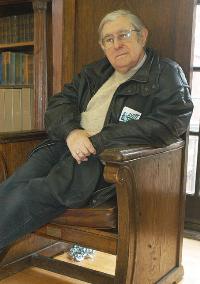
" Did I mention that Mr. Slavitt is also a pornographer?" Alex Beam on David Slavitt.
In today's Alex Beam column in the Boston Globe Beam writes about Slavitt's many literary accomplishments. Now, you remember Slavitt( the gentleman) who read a poem about how much he dislikes the poet Robert Lowell at the Somerville News Writers Festival, and was trounced by Tim Toomey in an election for state rep. He also has a book out "Blue State Blues" about his campaign against Toomey. Now it seems that Slavitt has had a great career in another genre: Porn, according to Beam:
"Writing as "Henry Sutton" Slavitt grabbed the brass ring with his 1967 soft-porn bestseller "The Exhibitionist." which sold 4 million copies. "It's every English majors dream...I put my children through college and continue to write poems and translate Ausonius, whom nobody has ever heard of." Slavitt said. Beam writes " During his campaign against Toomey, Slavitt worried that his other works might come to light...his 1987 work "The-Book: A Child's First Book of Pornography." which he calls "my fist porn version of Dr. Seuss's "One Fish, Two Fish."
On Slavitt's hometown Cambridge, Mass: He asked his son Evan ( a lawyer) how he should handle any questions regarding his alternative literary history during his campaign against Toomey. His son, evidently a chip off the old block, replied:
"In Cambridge? There are no community standards."
Tuesday, December 19, 2006

Living In Dangerous Times. Linda Lerner. ( PO BOX 792 Rockford, MI 49341 http://www.presapress.com/ $6.
Linda Lerner is a Brooklyn-based poet who is passionate about poetry’s potency in our increasingly frightening and alienating age. Having interviewed her, published her, and reviewed several of her books I can say she shoots from the hip, is politically engaged, and at times very erotic. Like Lifshin, she is a popular poet, and although she teaches at Brooklyn College, her poetry remains outside the gates of the academy. In the poem “Who Dares Invoke The Bard?” Lerner is full of righteous indignation about the reporter who described Howard Dean’s primal scream as a “mad howl.” Surely not a “howl” worthy of Allen Ginsberg:
“ What “mad howl”
Allen would have fumed…
his ashes stir in its urn
at the very mention…
eminds us who rammed past
Columbia’s hollowed gates
more than fifty years ago
freed poetry a whole decade
marching in robot lockstep
nation: to breathe in
our own rhythm.
the sound that still reverberates
loud as all hell.” (9)
Linda Lerner is a fine addition to Presa Press’s “Contemporary Poetry Series.”
Doug Holder/ Ibbetson Update
Friday, December 15, 2006
"BIRDMAN: A MEMOIR" by Lo Galluccio
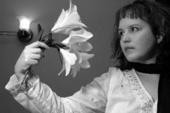
Lo Galluccio
2 Clinton Street, Apt. 8
Cambridge, MA 02139
(617) 876-4534
Lo747@hotmail.com
Lo Galluccio is a poet/vocalist and the poetry editor for "The Alewife" a monthly newspaper in Camridge, Mass. Her most recent poetry collection is titled "Hot Rain" ( Ibbetson Street Press)
BIRDMAN: A memoir
“You were an emperor with a sword who looked wounded
like a birdman after a storm. Your tongue like a garter snake enchants me…”
Lo song lyric
I wore an army jacket with brass buttons, double-breasted and green and walked around the night in sunglasses. Gloss on night: darkness over darkness to see the night, to be alone. Taking the A train, I went up to Harlem one day to find Jean Michel Basquiat’s paintings. I’d run into blonde-haired and waifish Billy Martin (of Martin, Medeski and Wood) at the MoMA and for some reason, he also loved Basquiat. I guess part of that was Basquiat’s association with John Lurie, Bandleader of the Lounge Lizards, which Martin was a drummer for. John ran with Basquiat in their dope days, dope days that killed poor Jean Michel, that Lurie and others recovered from.
In a small Harlem museum, there was a ring of Crown King paintings, black with silver and gold and colored chalk. Basquiat invented his cartoon icons of America as an outsider. And I was feeling this in myself. I remember the exercise of taking the subway up there and staring for hours at the paintings to memorize them. To switch my right brain on and open up my imagination synapses. My soul trembled with delight and said yes to the inverse narcissism, the codes, the blackness and the bones of the paintings.
He became my favorite post-modern painter. He began to open up my eyes. Why were they shut tight? And why did I feel blinded? This I will come to.
Maybe the reason I called Tronzo Birdman, was the look he had on the Queen of all Ears CD, the Lounge Lizards record. You see him --bald with squint bright eyes – wise bright eyes and his funny bird nose at the camera. And that was the creature of a man who had mesmerized me with his anger and his guitar’s heavenly blues oratorios. He was my former lover and boyfriend, Tronzo. Most people downtown then in New York knew the Lounge Lizards was the hip white Duke Ellington orchestra of our day. Or Count Basie to the Jazz Passengers’ Duke. Still Birdman and Lurie were rivals of a kind. Tronzo was happy for the gig but he always found Lurie to be egotistical and too much a showman. I loved them both, though Tronzo would later say I was more like John because I had stage-presence, was the singer.
The reason I needed to re-configure my mind’s eye was because I’d been pink-slipped and put in a psychiatric ward by a man named Dr. Dollar a month or so before that. Dr. Dollar (real name) was a Southern psychiatrist to whom I’d been referred by several friends who thought I needed medication for my “depression.” After the Birdman cast me out I was punished for a suicide attempt in a way that forever changed my life. And this is a story about that, and about how grief will run it’s course. Larry explained to me that “pathology” means, in Greek, “the logic of grief,” not mental illness. Larry Joseph was my mentor back then; a brilliant law school professor who wrote a book called, “Shouting at No One.” Here in America we still pathologize our imbalances and emotions. I learned a harsh lesson that by trying to take my own life, it became the property of others who could lock me up. Lock me up away from the source of my suffering, but not heal it with deeper understanding or joy. No, it was yoga and the piano and winter and mysticism and love that do that…or almost do.
My father, Tony Galluccio, died when I was 15. A child of grief and unclear about real world machineries, psychiatries, confineries – after refusing pain medication for my busted neck, I took those same pain pills to kill me. And I fell asleep like a dream of dying, not a massive overdose or bloodletting like the Godfather’s failed lieutenant. The kitchen window in my small studio was covered up. And after swallowing 6-7 Naprocyns, I turned on the oven and fell asleep. I woke up an hour or so later, feeling queasy. And I knew I wanted to live, that it had been a childish attempt to erase my life, under the shame of losing his love, which had been so great. The Birdman, that is.
Let me tell you something more about the Birdman. He could play his guitar like a laser beam of violet blues light. He’d internalized the blues of the early 1900’s like John Lee Hooker or Blind Lemon. He had the ego of Santana or Hendrix. But he’d boozed when he first came to New York City and blown up at bandleaders and got into mighty trouble despite his mighty talent. The first night we made love together…it was a slow fade into dawn with him sitting behind me like a birch tree, his arms coming around me as we walked ceremoniously to the bed. Like a rocking horse he took me. He hadn’t been with a woman for awhile. It hurt me a little and I also loved his taking possession of me physically with ecstasy. The next morning we sat in his little kitchen in the E. Village and he wept. He wept and I knelt down before him. He said to me it was because of all the guys he’d lost to booze in Times Square. He couldn’t believe he was still alive and they were all gone. I was amazed at this display of sorrow, the intensity of the grief.
Already, I’d played my song, “Queen of Mars” for him, in rough form, and I’d already gone to dinner on India Row with him on Thanksgiving, both of us apart from our families. I felt like he was my guide, in love and in art. There I was in a cream-colored trenchcoat, looking like a French movie actress, working as a secretary when we first met on the Upper East Side. We were both staying with friends until we found places downtown, within a few blocks of each other. So when he cried and I thought to myself, “Oh, no, Oh, yes,” What do I do about this man? I either run now and keep going…or I say, I’m here for you and we’re together. Later I would write a poem about the little fisherman who would come into his head and ride the ocean of the tears he cried. It was called, “The color of January.” That day, I walked away, down 6th Street, knowing love, and knowing too, that even more than our damage and desire was the music. The music was what I wanted.
“Your eye a scar, slants bird toward me winging in.
And the corner of your eye…became a bird.
And the corner of your eye…became a bird.” Birthday, a song, Galluccio/Tronzo
It was at a Lounge Lizards’s concert. It was John Lurie, the actor and sax-man who always reminded me of an outfielder, with his stance and Roman God’s profile. It was my dream of a bomb going off – the color orange. It was another dream. Later I would look back and say, “Why didn’t I follow the message of the dream?” The only orange in my apartment was Tronzo’s amplifier, and the bomb exploding was him. That was what my psyche was warning me about. So, why not avert catastrophe?
I saw Lurie on stage and Tronzo was playing in the band. We’d been together for a year and collaborated on many songs. Our band, “FishPistol” delighted audiences in downtown clubs. I was Lucy to his Ricky. I was also just myself. When the Birdman took me home that night, angry I’d shown up at the wrong show time, and on his way to Europe with his trio, he snared me. In that apartment on 6th Street that reminded me of Amsterdam, where we’d written “Creamsplit” and “Birthday” together and I’d woken up early and gotten to Arrow Shirts to earn my living, Tronzo threatened to strangle me to death. See-- when you say Tronzo, it could be a Japanese gangster also. But it was also the Birdman who exiled me at 3:00 a.m. into a dark New York night. His plane to Europe cut through the sky and my stomach turned the next day when I felt my heart leave the planet Earth.
About a month later, after that suicide attempt, I woke up and threw up and felt okay. I was not okay about losing the love of my life. I was okay about death not eclipsing me. I was okay that fate had kept me alive. What really happened was this:
Instead of showing up for an appointment with a shrink at St. Vincent’s I called and told Dr. Dollar the truth. The hospital scared me. He called the police and five of them showed up at my door to take me to the psychiatric emergency room. It was a two-week incarceration in a locked psychiatric unit with idiot doctors and a bunch of poor trapped inner-city adolescents. The guard, when I’d signed in under coercion, said to me, actually said to me, “It’s like walking onto the moon, huh?” Too hurt and terrorized to speak, I didn’t say, “No kind of moon, I’ve ever seen.” My roommate was a girl named Cecilia. She talked and talked about her adoration for Barbara Streisand. The first night inside, I stuck my fingers in my ears to block her out. I didn’t sleep for 48 hours because I was afraid of what it would do to my mind’s eye. A tall man with white hair arrived on the ward who smelled of books and patchouli. I trusted him. He said to me that his wife had been an ex-model who couldn’t take aging so took 60 seconals and turned purple on her side of the bed. He was so depressed, he was having shock treatments. Cecilia had had them since she was younger. She painted. I grew to like her. It was a wild wild ride, a grim story. However, what finally turned things around was a fifteen-year old Latin girl named Danae. She had been walking around silently with her hands pinned to her thighs. She has been there for months. One night I watched Danae pick up a framed print off the main corridor –and there really was only a long one and a shortish one in an L-shaped ward—and smashed it on the ground. And she started screaming. “I’m too young to be in here. Let me outta here. I’m an artist and this just messes me up.” That’s what she yelled over and over to the nurse’s very uncomfortable astonishment. This statue of a girl, had completely flipped over into rage and a voice. It was revolutionary music to my ears. The next day she was released to her parents. Soon after, so was I. Not before I watched Cecilia straightjacketed; not before I was threatened with brain scans because they thought I wasn’t thinking “clearly” when I questioned their methods.
Then I wrote “Bright Star/Shot Horse”
"You take me down a corridor where dreams turn into television.
The color of your potions won’t replace the color of my visions.
You ask me do I hear voices. I hear voices like the sea.
You want me to take my trilophon, I drink my asylum tea.
The color’s red in my museum, it won’t fade in your cure for me…”
I didn’t want the Birdman to know I was in there. He found out anyway.
When I got out, the first night out on the town, I caught a cab with John Lurie. Think I had on the blue-striped shirt Tronzo had given me and some purple bell-bottoms with sneakers. When I told Lurie what happened, he said, “Sweetheart, you’re much braver than I am, trying to kill yourself.” “I could never do that.” I told him all the kids in the unit said, “mad this” and “mad that.” This was the same Lurie who plays it cool in the movie, Stranger than Paradise. He’s an immigrant who knew how to gamble and travel and bide his time til something better happened, free in America. That was the John Lurie with the penetrating eyes and the off-hand remarks and the temper flares just shy of real violence. Once I looked for work in stores in Soho with giraffes in them because he also reminded me of a giraffe.
So Lurie might have “killed” the Birdman for me. He carried me upstairs to his loft and I had on a 1950’s dress from a tour of Greece. He said he did that with all the girls. I laughed. And then that night, another dream, interrupted the action. Before we made love, I dreamt of Tronzo, my Birdman. It was a simple dream but we were together in bed holding hands. I was startled and guilt-ridden and knew he still had a spell over my soul. And I lost Lurie too for awhile. I lost Lurie forever until something very strange happened when I made my own first record. It had a queen in it too. And she was my double. The CD was called, Being Visited and on the front cover I was Queen of Mars, a song that almost healed me for good. Because the song was written in code about my father also. And Queen of Mars was the tarot card on the wall, maybe Queen of all Ears, and she was me. Long pink hair, and sharp teeth. She used men and was tricked by them, “my twin, my nemesis, Queen of Mars.” And there it was, the music given by those slide-guitar hands, come back to me. Like Ikkyu’s bird. A bird of paradise. Stranger, New York, than paradise. Birdman, John Lurie. -- you go to my head like champagne. Danae -- your bravery kept my heart from shattering. I was changed, but my soul remained.
Lo Galluccio
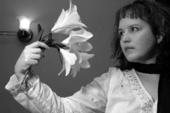
Lo Galluccio
2 Clinton Street, Apt. 8
Cambridge, MA 02139
(617) 876-4534
Lo747@hotmail.com
Lo Galluccio is a poet/vocalist and the poetry editor for "The Alewife" a monthly newspaper in Camridge, Mass. Her most recent poetry collection is titled "Hot Rain" ( Ibbetson Street Press)
BIRDMAN: A memoir
“You were an emperor with a sword who looked wounded
like a birdman after a storm. Your tongue like a garter snake enchants me…”
Lo song lyric
I wore an army jacket with brass buttons, double-breasted and green and walked around the night in sunglasses. Gloss on night: darkness over darkness to see the night, to be alone. Taking the A train, I went up to Harlem one day to find Jean Michel Basquiat’s paintings. I’d run into blonde-haired and waifish Billy Martin (of Martin, Medeski and Wood) at the MoMA and for some reason, he also loved Basquiat. I guess part of that was Basquiat’s association with John Lurie, Bandleader of the Lounge Lizards, which Martin was a drummer for. John ran with Basquiat in their dope days, dope days that killed poor Jean Michel, that Lurie and others recovered from.
In a small Harlem museum, there was a ring of Crown King paintings, black with silver and gold and colored chalk. Basquiat invented his cartoon icons of America as an outsider. And I was feeling this in myself. I remember the exercise of taking the subway up there and staring for hours at the paintings to memorize them. To switch my right brain on and open up my imagination synapses. My soul trembled with delight and said yes to the inverse narcissism, the codes, the blackness and the bones of the paintings.
He became my favorite post-modern painter. He began to open up my eyes. Why were they shut tight? And why did I feel blinded? This I will come to.
Maybe the reason I called Tronzo Birdman, was the look he had on the Queen of all Ears CD, the Lounge Lizards record. You see him --bald with squint bright eyes – wise bright eyes and his funny bird nose at the camera. And that was the creature of a man who had mesmerized me with his anger and his guitar’s heavenly blues oratorios. He was my former lover and boyfriend, Tronzo. Most people downtown then in New York knew the Lounge Lizards was the hip white Duke Ellington orchestra of our day. Or Count Basie to the Jazz Passengers’ Duke. Still Birdman and Lurie were rivals of a kind. Tronzo was happy for the gig but he always found Lurie to be egotistical and too much a showman. I loved them both, though Tronzo would later say I was more like John because I had stage-presence, was the singer.
The reason I needed to re-configure my mind’s eye was because I’d been pink-slipped and put in a psychiatric ward by a man named Dr. Dollar a month or so before that. Dr. Dollar (real name) was a Southern psychiatrist to whom I’d been referred by several friends who thought I needed medication for my “depression.” After the Birdman cast me out I was punished for a suicide attempt in a way that forever changed my life. And this is a story about that, and about how grief will run it’s course. Larry explained to me that “pathology” means, in Greek, “the logic of grief,” not mental illness. Larry Joseph was my mentor back then; a brilliant law school professor who wrote a book called, “Shouting at No One.” Here in America we still pathologize our imbalances and emotions. I learned a harsh lesson that by trying to take my own life, it became the property of others who could lock me up. Lock me up away from the source of my suffering, but not heal it with deeper understanding or joy. No, it was yoga and the piano and winter and mysticism and love that do that…or almost do.
My father, Tony Galluccio, died when I was 15. A child of grief and unclear about real world machineries, psychiatries, confineries – after refusing pain medication for my busted neck, I took those same pain pills to kill me. And I fell asleep like a dream of dying, not a massive overdose or bloodletting like the Godfather’s failed lieutenant. The kitchen window in my small studio was covered up. And after swallowing 6-7 Naprocyns, I turned on the oven and fell asleep. I woke up an hour or so later, feeling queasy. And I knew I wanted to live, that it had been a childish attempt to erase my life, under the shame of losing his love, which had been so great. The Birdman, that is.
Let me tell you something more about the Birdman. He could play his guitar like a laser beam of violet blues light. He’d internalized the blues of the early 1900’s like John Lee Hooker or Blind Lemon. He had the ego of Santana or Hendrix. But he’d boozed when he first came to New York City and blown up at bandleaders and got into mighty trouble despite his mighty talent. The first night we made love together…it was a slow fade into dawn with him sitting behind me like a birch tree, his arms coming around me as we walked ceremoniously to the bed. Like a rocking horse he took me. He hadn’t been with a woman for awhile. It hurt me a little and I also loved his taking possession of me physically with ecstasy. The next morning we sat in his little kitchen in the E. Village and he wept. He wept and I knelt down before him. He said to me it was because of all the guys he’d lost to booze in Times Square. He couldn’t believe he was still alive and they were all gone. I was amazed at this display of sorrow, the intensity of the grief.
Already, I’d played my song, “Queen of Mars” for him, in rough form, and I’d already gone to dinner on India Row with him on Thanksgiving, both of us apart from our families. I felt like he was my guide, in love and in art. There I was in a cream-colored trenchcoat, looking like a French movie actress, working as a secretary when we first met on the Upper East Side. We were both staying with friends until we found places downtown, within a few blocks of each other. So when he cried and I thought to myself, “Oh, no, Oh, yes,” What do I do about this man? I either run now and keep going…or I say, I’m here for you and we’re together. Later I would write a poem about the little fisherman who would come into his head and ride the ocean of the tears he cried. It was called, “The color of January.” That day, I walked away, down 6th Street, knowing love, and knowing too, that even more than our damage and desire was the music. The music was what I wanted.
“Your eye a scar, slants bird toward me winging in.
And the corner of your eye…became a bird.
And the corner of your eye…became a bird.” Birthday, a song, Galluccio/Tronzo
It was at a Lounge Lizards’s concert. It was John Lurie, the actor and sax-man who always reminded me of an outfielder, with his stance and Roman God’s profile. It was my dream of a bomb going off – the color orange. It was another dream. Later I would look back and say, “Why didn’t I follow the message of the dream?” The only orange in my apartment was Tronzo’s amplifier, and the bomb exploding was him. That was what my psyche was warning me about. So, why not avert catastrophe?
I saw Lurie on stage and Tronzo was playing in the band. We’d been together for a year and collaborated on many songs. Our band, “FishPistol” delighted audiences in downtown clubs. I was Lucy to his Ricky. I was also just myself. When the Birdman took me home that night, angry I’d shown up at the wrong show time, and on his way to Europe with his trio, he snared me. In that apartment on 6th Street that reminded me of Amsterdam, where we’d written “Creamsplit” and “Birthday” together and I’d woken up early and gotten to Arrow Shirts to earn my living, Tronzo threatened to strangle me to death. See-- when you say Tronzo, it could be a Japanese gangster also. But it was also the Birdman who exiled me at 3:00 a.m. into a dark New York night. His plane to Europe cut through the sky and my stomach turned the next day when I felt my heart leave the planet Earth.
About a month later, after that suicide attempt, I woke up and threw up and felt okay. I was not okay about losing the love of my life. I was okay about death not eclipsing me. I was okay that fate had kept me alive. What really happened was this:
Instead of showing up for an appointment with a shrink at St. Vincent’s I called and told Dr. Dollar the truth. The hospital scared me. He called the police and five of them showed up at my door to take me to the psychiatric emergency room. It was a two-week incarceration in a locked psychiatric unit with idiot doctors and a bunch of poor trapped inner-city adolescents. The guard, when I’d signed in under coercion, said to me, actually said to me, “It’s like walking onto the moon, huh?” Too hurt and terrorized to speak, I didn’t say, “No kind of moon, I’ve ever seen.” My roommate was a girl named Cecilia. She talked and talked about her adoration for Barbara Streisand. The first night inside, I stuck my fingers in my ears to block her out. I didn’t sleep for 48 hours because I was afraid of what it would do to my mind’s eye. A tall man with white hair arrived on the ward who smelled of books and patchouli. I trusted him. He said to me that his wife had been an ex-model who couldn’t take aging so took 60 seconals and turned purple on her side of the bed. He was so depressed, he was having shock treatments. Cecilia had had them since she was younger. She painted. I grew to like her. It was a wild wild ride, a grim story. However, what finally turned things around was a fifteen-year old Latin girl named Danae. She had been walking around silently with her hands pinned to her thighs. She has been there for months. One night I watched Danae pick up a framed print off the main corridor –and there really was only a long one and a shortish one in an L-shaped ward—and smashed it on the ground. And she started screaming. “I’m too young to be in here. Let me outta here. I’m an artist and this just messes me up.” That’s what she yelled over and over to the nurse’s very uncomfortable astonishment. This statue of a girl, had completely flipped over into rage and a voice. It was revolutionary music to my ears. The next day she was released to her parents. Soon after, so was I. Not before I watched Cecilia straightjacketed; not before I was threatened with brain scans because they thought I wasn’t thinking “clearly” when I questioned their methods.
Then I wrote “Bright Star/Shot Horse”
"You take me down a corridor where dreams turn into television.
The color of your potions won’t replace the color of my visions.
You ask me do I hear voices. I hear voices like the sea.
You want me to take my trilophon, I drink my asylum tea.
The color’s red in my museum, it won’t fade in your cure for me…”
I didn’t want the Birdman to know I was in there. He found out anyway.
When I got out, the first night out on the town, I caught a cab with John Lurie. Think I had on the blue-striped shirt Tronzo had given me and some purple bell-bottoms with sneakers. When I told Lurie what happened, he said, “Sweetheart, you’re much braver than I am, trying to kill yourself.” “I could never do that.” I told him all the kids in the unit said, “mad this” and “mad that.” This was the same Lurie who plays it cool in the movie, Stranger than Paradise. He’s an immigrant who knew how to gamble and travel and bide his time til something better happened, free in America. That was the John Lurie with the penetrating eyes and the off-hand remarks and the temper flares just shy of real violence. Once I looked for work in stores in Soho with giraffes in them because he also reminded me of a giraffe.
So Lurie might have “killed” the Birdman for me. He carried me upstairs to his loft and I had on a 1950’s dress from a tour of Greece. He said he did that with all the girls. I laughed. And then that night, another dream, interrupted the action. Before we made love, I dreamt of Tronzo, my Birdman. It was a simple dream but we were together in bed holding hands. I was startled and guilt-ridden and knew he still had a spell over my soul. And I lost Lurie too for awhile. I lost Lurie forever until something very strange happened when I made my own first record. It had a queen in it too. And she was my double. The CD was called, Being Visited and on the front cover I was Queen of Mars, a song that almost healed me for good. Because the song was written in code about my father also. And Queen of Mars was the tarot card on the wall, maybe Queen of all Ears, and she was me. Long pink hair, and sharp teeth. She used men and was tricked by them, “my twin, my nemesis, Queen of Mars.” And there it was, the music given by those slide-guitar hands, come back to me. Like Ikkyu’s bird. A bird of paradise. Stranger, New York, than paradise. Birdman, John Lurie. -- you go to my head like champagne. Danae -- your bravery kept my heart from shattering. I was changed, but my soul remained.
Lo Galluccio
Wednesday, December 13, 2006
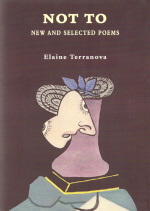
Not To: New and Selected Poems. Elaine Terranova. (The Sheep Meadow Press. Riverdale-On-Hudson, NY 10471) $14.95
This is the second book of poetry from the “Sheep Meadow Press” that I have read and reviewed. The other collection was Richard Wollman’s “Evidence of Things Seen.” Both books were excellent reads and were handsomely presented. Elaine Terranova’s collection “Not To: New and Selected Poems” is poetry at its best: lean, cuts to the chase, striking imagery, and masterful metaphor. In the poem “A Story,” Terranova uses a woman’s “beautiful, impervious face,” as a jumping off point to examine our search for transcendence-- for the answer to the unanswerable:
“I spot on the street a woman’s
beautiful, impervious face
like a China plate. She is
talking to air. “That’s
the end,” she says.
“That’s all there is, that’s
my story.” I’m sorry
to have missed the good part,
hovering over us like vapor.
What drops at her feet?—
a bird, a leaf, a candywrapper,
something from the world.
I know that even without that
encouragement, she would go on...
Think of those people who call
middle of the night from
the impossibly far reaches of an old
friendship, new acquaintance…
It isn’t you they want,
voice thinning out to ether,
only access to the entrails
of the divine animal.” (68-9)
In the poem “In the Home,” Terranova uses the props of a small chair, a heavy rain, and a fleeting memory of braided hair with heartbreaking effect to describe her mother in her terminal dotage:
“My mother sits in the small chair
that is now enough for her.
Her fingers find the edge
and tap, tap
as if there is something
she is trying to remember:
the way she liked to braid
her long thick hair
in the terrible rain
that shut us off
from all the other houses.” (171)
Highly Recommended.
Doug Holder/Ibbetson Update/Dec. 2006/ Somerville, Mass.
A Few Words I Live By. Diamond Riley. (DiamondRiley08@aol.com) $10.
Awhile ago a 16 year old Harvard Summer School student Diamond Riley sent me some poems, and told me she was going to publish a collection of her writings. I published one of her poems in my “Lyrical Somerville” column in The Somerville News, and several months later I got her book in the mail. Riley, whose poetry is conversational, writes in the first section of her book: “Ok, so you’re probably wondering what the purpose of this book is. Well, in a nutshell I basically want to help young people….teenagers like myself…see things before they happen.” Riley’s poetry concerns the pleasures and perils of the dating scene, the trial and tribulations of being a young African-American, and of forging an identity in a conformist youth culture. In this perceptive piece “Still Growing” the poet writes about the difficulties of growing from girl to woman:
“Damn, how hard is it to act like a woman/Everybody be killing me, complaining about not receiving the proper respect they deserve/…Did you ever think about why, you were treated this way?/No we want the cake and to eat it too/ We want to act like hoes and still be treated like ladies…/ Hell, I am not ready for the STD/ or to be, a mother of three/I am not ready to drop out of the school/ and later struggle for my GED/ I am not ready so…I choose to GROW UP.”
Riley is a spirited and proud of whom she is; as displayed in her poem “Who is Diamond Riley”
“ A Diva/with a name/to live up to/A realist/ who’s not afraid to tell it like it is/ A friend/ who doesn’t like to betray or be betrayed/ A girl with dreams/ who will conquer them all..”
This book will certainly be an inspiration to adolescents, as it talks the talk and walks the walk. It is also an inspiration because Riley did the hard work of compiling a collection and publishing it at the tender age of 16.
Doug Holder/ Ibbetson Update
Awhile ago a 16 year old Harvard Summer School student Diamond Riley sent me some poems, and told me she was going to publish a collection of her writings. I published one of her poems in my “Lyrical Somerville” column in The Somerville News, and several months later I got her book in the mail. Riley, whose poetry is conversational, writes in the first section of her book: “Ok, so you’re probably wondering what the purpose of this book is. Well, in a nutshell I basically want to help young people….teenagers like myself…see things before they happen.” Riley’s poetry concerns the pleasures and perils of the dating scene, the trial and tribulations of being a young African-American, and of forging an identity in a conformist youth culture. In this perceptive piece “Still Growing” the poet writes about the difficulties of growing from girl to woman:
“Damn, how hard is it to act like a woman/Everybody be killing me, complaining about not receiving the proper respect they deserve/…Did you ever think about why, you were treated this way?/No we want the cake and to eat it too/ We want to act like hoes and still be treated like ladies…/ Hell, I am not ready for the STD/ or to be, a mother of three/I am not ready to drop out of the school/ and later struggle for my GED/ I am not ready so…I choose to GROW UP.”
Riley is a spirited and proud of whom she is; as displayed in her poem “Who is Diamond Riley”
“ A Diva/with a name/to live up to/A realist/ who’s not afraid to tell it like it is/ A friend/ who doesn’t like to betray or be betrayed/ A girl with dreams/ who will conquer them all..”
This book will certainly be an inspiration to adolescents, as it talks the talk and walks the walk. It is also an inspiration because Riley did the hard work of compiling a collection and publishing it at the tender age of 16.
Doug Holder/ Ibbetson Update
Monday, December 11, 2006
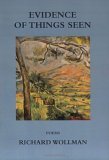
Poet Richard Wollman Searches for “Evidence of Things Seen.”
Poet Richard Wollman is the author of a new collection of Poetry “Evidence of Things Seen.’ (The Sheep Meadow Press). Poet Samuel Menashe writes of his work: “What Wollman speaks of, ‘the plain grandeur of the ordinary evening,’ is true of many of his poems.”
Wollman is a native New Yorker living in Newburyport, Mass. He was educated at Brandeis University and got his doctorate from Columbia University. He is an associate professor of English at Simmons College in Boston and co-director of the “Zora Neale Hurston Literary Center” at the college. I talked with Wollman on my Somerville Community Access TV show: “Poet to Poet/Writer to Writer.”
Doug Holder: Stanley Moss wrote that you are not afraid to “dirty your face and hands with the truth.” What do you feel he was getting at, and do you feel your poetry is “dirty” so to speak?
Richard Wollman: When Stanley Moss wrote that about me I didn’t know what to think at first. I think he means to look at things--“evidence of things seen,” might mean looking at things that on the surface might not look beautiful… it might be “the dirty feet of common people.” I think it defines the question I have: “What would God have us see?”
Doug Holder: In the poem “Interior Monologue of a Person,” you write of the thoughts of a corpse—a victim of the Nazi death camps: “The day they uncovered me, /I rested against a banker from Lodz. /A young girl’s cheekbone/ received my hand for eternity. / You can still see where the officer-physician/ took a scalpel to the light/ camouflage of the skin / to find what was impure in me.”
Where did this poem arise from? You seem to drape a scrim of beauty over this grim scene.
Richard Wollman: If there are any of my poems that haunts me it is this one. This was the hardest one to decide whether to include it in the book. This is a tough one to accept because of its grimness. I want the poem to be acceptable to me, the reader, and also the community I have in mind. They are a very particular group—survivors of the Holocaust. There has always been this sensibility since the Holucast, that poetry after the fact would be barbaric. Poets have stayed off the subject for many years. But now we are coming to a certain point of time where the survivors are dying off. There aren’t many left. I wonder who will sing for them. I happened to be a speaker at a rather large gathering for a Holocaust remembrance day. I thought if I could read some of my poems on stage I might have answer in regards to its acceptability. I got a partial answer. There were no objections, and a Rabbi who was with me said” You said good things.”
You do have to dirty your hands with the truth. Poets have to define and redefine what is meaningful. This is just the nature of change in the world. The poem we discussed is a way to get back to “singing.”
Doug Holder: How much does your Jewish background play a role in your poetry?
Richard Wollman: A large portion of the poems in this book are on Jewish themes. It is a home base. I begin there and move outward. I am from a Reformed Jewish background. I have always been intrigued with the fact that on my mother’s side (before they came to America) my relatives were all poets and Rabbis.
I started to write poetry late in life at age 40. It was spurred on by an anti-Semitic incident at my home on the North Shore of Massachusetts.
So my first poem was from a very real incident. Some of our neighbors took their discarded Christmas trees and barricaded our front door with them. This rattled me so, and caused me so much pain, that I responded by writing a poem. The poem was the only way to alleviate the pain.
Doug Holder: Your poem “Self-Portrait” is a fascinating piece, where you view yourself as a work-in-progress, unfinished: “in my unpainted chair.” Do you view the artist, as well as the art, a work of art as well?
Richard Wollman: If not a work of art, certainly a work-in-progress. There is an art to living the poetic life.
Doug Holder: What is the poetic life?
.
Richard Wollman: For me it means you don’t write your poems for entertainment or merely for esthetic purposes. It is a way of living. Poetry is not even the poetry on the page. I think the poem on the page is the last or best attempt to record some record of the poetic life.
Doug Holder; Where do you write?
Richard Wollman: I write in a third floor room in my home. It is a pretty dreadful place. It has a tiny, little window…it’s bare. Nobody wants to go up there. You have to restrict yourself in order to capture a piece of the world in your poem. I need poverty and solitude. I write better if I can feel the presence of my wife and son two floors down.
Doug Holder: You are the co-director of the Zora Neale Hurston Center at Simmons College in Boston. Can you tell me about that?
Richard Wollman: It is a brainchild of my colleague Afaa Michael Weaver. Afaa created a wonderful reading series of minority voices at Simmons College. We extend out to the community to reach the young students. Afaa also hosted the first “International Chinese Poetry Conference” at Simmons. We are gearing up to have a second in Oct. 2007.
Doug Holder: You are a member of the Pow Wow River poets, no?
Richard Wollman: Yes. We meet in Newburyport, Mass. Rhina Espalliat is the founder. It is a group of two dozen poets. We have a workshop once-a-month. We also have a reading series. Anyone can come to the workshop. It is amazing that in Newburyport you have so many accomplished poets. We push each other.
Doug Holder
Sunday, December 10, 2006
 Helen Vendler: I seldom review poets under 50."
I don't know this sounds patronizing. I am a poet, 51, so my 40's are right behind me..I don't remember writing about TV shows and comics... This was in today's New York Times Book Review. It is an interview with Helen Vendler,noted critic and Harvard professor:
"Vendler seldom reviews poets under 50. 'They're writing about the television cartoons they saw when they were growing up. And that's fine. It's as good a resource of imagery as orchards... I didn't watch these cartoons. So I don't feel I'm the best reader for most of the young ones.'
As a major reviewer I think she should be better informed about poets under50. This seems very dismissive to me. I mean she writes about poets in the1700's,etc.. She must of studied the milieu back then. Then why not pay some attention to the younger poets. Ah! The academy.
Saturday, December 09, 2006
Newton Free Library Poetry Reading Series 330 Homer St. Newton Centre, Mass. Resumes Feb 13 7PM Open mic and features.
Director: Doug Holder
READERS:
Beatriz Alba del Rio is a bilingual poet and lawyer. She has lived inCambridge since 1982, a city she adores. She was born in Buenos Aires, Argentina. Beatriz won the 1st Prize of the 2002 Octavio Paz Internationalpoetry Contest (Poem: "Ser" = "To be"), the 3rd Prize of the 2003 Pablo Neruda International poetry Contest ( Poem "Tristeza de Abril"= "Aprilblues" and the 2004 Cambridge Poetry award with the poem MASKS OVER MASKS in the category "female erotic poem" and her poem "Black Crows" was nominated in the category "female love poem." Her poetry has appeared in severalanthologies and literary magazines, inclluding "the new renaissance." As alawyer, Beatriz represents abused and neglected children and parents, mediates conflicts between families, and does some international work. Beatriz' languages: Spanish, English, French. She understands Portuguese andItalian. Beatriz' mission as a lawyer is to help people to create better lives. Her poetry speaks of longings. Some of her poems are songs to lovea nd to the unity of us all.
Nicole DiCello has received honorable mentions for her poetry, and wonfirst place in the Ithaca College poetry contest in 1996. She has been asked to read at festivals in Ithaca, NY, and for the Feminist Women'sWriting Workshop in New York state. She currently attends Barbara Helfgott Hyett's Writing Workshop for Publishing Poets in Brookline, MA. She lives in Leominster, MA and is working on her first book of poems, Red Shift,based upon astronomical phenomenon.
Gouri Datta Born in India, she started writing poetry around age 10.,both in English and mother tongue , Bengali. She has published severalworks: Book of Bengali poems , "Sukh, Dukho, Ittadi " ( "Pleasures, Sorrows, ETc. ") published in 1973. Book of Eng. poems published in '78, "Amaranths andElse " In addition, 2 books of Bengali short stories: "Maitry"( Friendship), and"Vaidehi "( Daughter of Videha ). She is currently, in a Bengali writers' group, "Lekhoni" (The Pen ) based in Newton, and Wingate Writers' Group ,based in Haverhill. She wrote while in College , Medical school and while working as a psychiatrist in various hospitals near Boston, including McLean Hospital inBelmont( which has inspired many writers. ) At McLean , Datta writes: "I met Doug Holder , whose vast love of the art form has spawned magazines , journals, publications, groups, rallies and a place for writers and poets to meet and move the world. Our talks turned to common interests, poetry in patient care and enhancement of the underprivileged, a cause espoused by Doug and and inspiration for me.'
Director: Doug Holder
READERS:
Beatriz Alba del Rio is a bilingual poet and lawyer. She has lived inCambridge since 1982, a city she adores. She was born in Buenos Aires, Argentina. Beatriz won the 1st Prize of the 2002 Octavio Paz Internationalpoetry Contest (Poem: "Ser" = "To be"), the 3rd Prize of the 2003 Pablo Neruda International poetry Contest ( Poem "Tristeza de Abril"= "Aprilblues" and the 2004 Cambridge Poetry award with the poem MASKS OVER MASKS in the category "female erotic poem" and her poem "Black Crows" was nominated in the category "female love poem." Her poetry has appeared in severalanthologies and literary magazines, inclluding "the new renaissance." As alawyer, Beatriz represents abused and neglected children and parents, mediates conflicts between families, and does some international work. Beatriz' languages: Spanish, English, French. She understands Portuguese andItalian. Beatriz' mission as a lawyer is to help people to create better lives. Her poetry speaks of longings. Some of her poems are songs to lovea nd to the unity of us all.
Nicole DiCello has received honorable mentions for her poetry, and wonfirst place in the Ithaca College poetry contest in 1996. She has been asked to read at festivals in Ithaca, NY, and for the Feminist Women'sWriting Workshop in New York state. She currently attends Barbara Helfgott Hyett's Writing Workshop for Publishing Poets in Brookline, MA. She lives in Leominster, MA and is working on her first book of poems, Red Shift,based upon astronomical phenomenon.
Gouri Datta Born in India, she started writing poetry around age 10.,both in English and mother tongue , Bengali. She has published severalworks: Book of Bengali poems , "Sukh, Dukho, Ittadi " ( "Pleasures, Sorrows, ETc. ") published in 1973. Book of Eng. poems published in '78, "Amaranths andElse " In addition, 2 books of Bengali short stories: "Maitry"( Friendship), and"Vaidehi "( Daughter of Videha ). She is currently, in a Bengali writers' group, "Lekhoni" (The Pen ) based in Newton, and Wingate Writers' Group ,based in Haverhill. She wrote while in College , Medical school and while working as a psychiatrist in various hospitals near Boston, including McLean Hospital inBelmont( which has inspired many writers. ) At McLean , Datta writes: "I met Doug Holder , whose vast love of the art form has spawned magazines , journals, publications, groups, rallies and a place for writers and poets to meet and move the world. Our talks turned to common interests, poetry in patient care and enhancement of the underprivileged, a cause espoused by Doug and and inspiration for me.'
Thursday, December 07, 2006
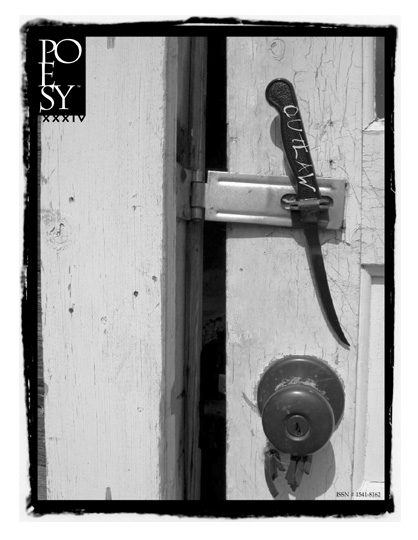
Poesy 34 will be the "Outlaw" poet issue. I am proud to say I will have an interview with Marc Goldfinger in that issue. Marc is a respected poet, Spare Change News Poetry Editor, recovering drug addict, political activist, etc... He's been in prison, and organized poetry readings on Death Row...he is a real "Outlaw" poet indeed!
POESY 34 OUTLAW POETS SPECIAL EDITION will be released December 15, 2006.We expect to have the printed issue distributed by Chrstmas.
http://poesy.org
Wednesday, December 06, 2006

A new poetry collection from Poesy Magazine founder Brian Morrisey.
Love Poems for the Wicked: poems by Brian Morrisey
Published by Zeitgeist Press available now through Poesy for$5.95 + $1.00 postage. Make checks payable to: Brian MorriseyP.O. Box 7823Santa Cruz, CA 95061
brian@poesy.org
Monday, December 04, 2006
(Gordon Cairnie and Louisa Solano)
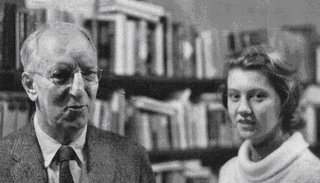
Louisa Solano: The Grolier Poetry Bookshop
by Doug Holder/Steve Glines
to purchase go to: http://www.lulu.com/content/353454
or send a check for $12 to Ibbetson Street Press 25 School St. Somerville, Ma. 02143
The Grolier Poetry Book Shop is the "oldest continuous bookshop" devoted solely to the sale of poetry and poetry criticism. It was founded by Adrian Gambet and Gordon Cairnie (in picture) in 1927, and Louisa Solano took over operations in 1974 after Cairnie's death. Solano turned the store into a self-sustaining business, has sponsored an annual national poetry contest and a reading series of national reputation at Adams House at Harvard.
Many of the great poets of the 20th century have passed through the portals of the store. In the book is an exclusive interview with Solano as she recounts her experiences with Jack Kerouac, Donald Hall, Robert Lowell, Elsa Dorfman, Octavio Paz, and many more...
In this new editon just released from Ibbetson Street Press there is new poetry by poet/patrons of the store. The book is bursting with ripe anecdotes by Boston-area writers about their experiences in the shop. A true collector's item...not to be missed!
Sunday, December 03, 2006

Bagel Bards: (Left to Right) Philip Burnham, Irene Koronas and Mike Adamo.
The Bagel Bards meet every Saturday 9AM at the Au Bon Pain in Davis Square, Somerville and the Au Bon Pain Central Square, Cambridge. Davis Square 2nd and 4th Saturday Central Square 1st and 4th.
All poets and writers invited...come and go as you please!
Tuesday, November 21, 2006
Sunday, November 19, 2006

Here is a fine letter by poet Afaa Michael Weaver regarding the Somerville News Writers Festival held Nov. 12 2006... a festival not without controversy...
Hi Doug, Tam, and everyone else here,
I did stay for the second half, and it was fine. David Godine
was visibly pleased.
Overall, I would say the festival was a success, having
organized a few such things in the past. It is impossible to please
everyone. There are things that could be improved, but one of the
major factors for success as I see it was the venue. Jimmy Tingle's
is the perfect place.
If you think it was a wild time, we should reflect on some
wilder times the poetry scene historically has had, and I must
admit that lately I have been a little concerned about a growing
sense of what I call "Wall Street Careerism in Poetry". It is nice
to see a little of what some think is unevenness...or perhaps
the "great growl of a roughened poetry." Call it whatever...
Baltimore's poetry renaissance of the early eighties made the
Somerville festival look tame. & don't forget Ginsberg's unveiling
of his metaphor in San Francisco where Phyllis Diller (sp) was one
of the poets in black.
I am glad there is so much energy, and although I live
on one of the hills here in the town, it is not because I think there
is a place for looking down or looking up.....just looking out over
the landscape of things. I like to curb the Poet Ego whenever
I can....need it as we do...let us not let it bite us in the caesura.
So I say look forward to next year. Give much thanks
to Jimmy Tingle...give much thanks to Doug.
& thanks to Tam and everyone else who wants to add to
all of the "great growling."
best,
--Afaa the Cave Canem Elder Who Lives in a Cave

Subscribe to:
Posts (Atom)