Friday, June 23, 2006


Interview with Patricia Brodie: author of “American Wives Club.”

Patricia Brodie is the author of a new poetry collection from the Ibbetson Street Press, “The American Wives Club.” Brodie was born in New York City, and lived in Boston and California before moving to Sao Paulo, Brazil. She taught English in Concord, Mass, and later became a clinical social worker. Her poetry has appeared in “Whidbey Island,” “Edge City,” “Ibbetson Street,” “Potpourri” and many other publications. I talked with Brodie on my Somerville Community Access TV show “Poet to Poet: Writer to Writer.” http://poettopoetwritertowriter.blogspot.com/


Doug Holder: Your poetry collection touches on the ying and yang of marriage. Is marriage worthwhile?

Patricia Brodie: Oh yes. Of course. I feel that you’re lucky if you can deal with the ying and yang and stay married. If it works for you both that is.

DH: How is it to have released your first collection? What took you so long?

PB: I didn’t start writing poetry till 2000. But I was busy with teaching, social work, raising a family, getting used to Brazil, and a lot of things. When I started to pull back from being a social worker; I took a course at Concord Adult Ed, and started to write poetry. I have 85 to 90 poems published. That’s when I thought I would like a chapbook published.

DH: Some say the routine of marriage is deadening to creativity? Writers, especially young writers, laud the footloose and fancy free
lifestyle. What do you say?

PB: I don’t see it that way. I think it is a font of material.

DH: You wrote a poem about the suicide of your grandfather. Did this provide you with a sense of closure?

PB: Nobody ever told me about his suicide. It happened long before I was born. Nobody told me how he died. When I was visiting a cousin in Scotland, I looked him up in the town records. And there was all this detail about his life in Scotland. And this came as a shock to me. My father wasn’t around anymore, and my cousin wasn’t forthcoming. There was no one to ask about this. So this is where the poem came from. You learn more about yourself, and why your parents acted in certain ways.

DH: You wrote a poem about a colleague at a community mental health center who lost a daughter due to suicide. Do you use your experiences as a social worker as material for poems?

PB: The poem you mentioned was one of the few poems about my work. It just doesn’t happen. I worked in a community mental health center for several years. The psychiatrist, a nice guy, had a daughter who was living in New Jersey. One day she went on the railroad tracks, sat down with her baby, as a train was coming. The baby squirmed out of her arms into a snow bank and was ok. The daughter was killed. The psychiatrist, her father, did not prevent this, and he blamed himself for not realizing how depressed she was. He felt he could work as a psychiatrist anymore. He felt if he couldn’t tell that his own daughter was suicidal, how could he work as a psychiatrist?

DH: Quite a few of your poems deal with your time in Brazil?

PB: Quite a few. The poet Elizabeth Bishop lived there for at least 12 years and she liked it. She wrote a lot of poems there. I married a man who was Italian but was raised in Brazil. He had a job waiting for him there. His family was there. So we moved to Brazil. I never got to like it. The country was beautiful, the people were warm…it’s a wonderful population. But there were aspects for me that just didn’t work. It was a very different culture. I couldn’t grow there. Women were like the 1950 June Cleaver there. When I came back to the states in 1975, it took me a full year to adjust. I went through culture shock in my own culture.

DH: Describe how you got the title for your book “The American Wives Club.”

PB: It’s the main poem in the collection. On one side it deals with Brazil, and the other side is my difficulty getting along there. I was in a sort of club with other women who were married to Brazilians. We supported each other in this dual culture environment.

DH: Was your family surprised by anything in the book?

PB: My family is basically my husband and four children. They are very pleased.

DH: What are your ambitions for your poetry?

PB: I find my poetry is evolving. I don’t know where it is going, but it is changing. I’m still on the road, and I am going to see where it goes.

__Doug Holder

* ‘The American Wives Club” is available through the Ibbetson Street Press c/o Doug Holder 25 School St. Somerville, Mass. 02143 http://www.ibbetsonpress.com/

Monday, June 19, 2006


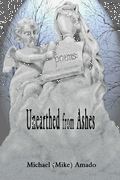
Poems: Unearthed From Ashes. Mike Amado. ( Dorrance Publishing. 701 Smithfield St. 3rd floor. Pittsburg, PA. 15222) http://www.dorrancebookstore.com/ $9.


I met poet Mike Amado at the weekly meeting of the “Bagel Bards,” now held every Saturday at 9AM at the Au Bon Pain Café in Davis Square, Somerville. Mike hails from Plymouth, Mass., is a self-employed musician, and a long-practicing poet who penned this collection, “Unearthed From Ashes,” over five years during treatment for kidney disease. Amado describes himself as a ‘multi-ethnic,’ poet. The poems here deal with his Native American background, as well as his exploration of nature, mortality and the trials and travails of the act of writing. In the lead poem “Mighty Orange Lightning,” Amado paints a powerful elemental scene of man and nature, and the yearning for connection:

“ Mighty, orange lightning
In the northern sky
Let your voice sing
On the breeze
Mighty drumbeat rippling
An unmeasured rhythm
Breathe…let me breathe
…And shake, and ravel
In the wind where I stand
Through the clouds, you unfold
Your purple wings.
Breathe-seek your connection
Where static of sky
Meets fingers of earth.”

And a real gem of a poem “The Punk Poet and the Editor,” deals with a minimalist editor’s desire to cut a poem, and an expansive Punk poet’s desire to embrace the infinite with a colorful flourish of words. Here the poet has a few words about minimalism:

“But he takes every sentence
And leaves it dismembered, performing semantic
Dissection on parts of my speech, then transecting
The skin of preposition from the noun-flesh
In such a way to confirm the fact that “poetry...
Is the art of condensing.”
Exposing to view through a part-by-part analysis of
The physiology of signs and symbols; concepts and
Feelings to reveal not just the actual structure
But the anatomy of “minimalism.”


Recommended.

Doug Holder/Ibbetson Update/ June 2006/Somerville, mass.

Friday, June 16, 2006


Lyrical Somerville

Afaa Michael Weaver is a prominent Afro-American poet, a professor at Simmons College, the founder of the “Chinese Poetry Conference,” as well as the “Zora Neale Hurston Center,” at Simmons College, and the author of numerous books and poetry collections. He is a Somerville resident, and a member of the “Bagel Bards,” a group of poets and writers that meets at the Au Bon Pain Café every Saturday morning at 9 AM. I asked Afaa to contribute a poem about Somerville for the “Lyrical.” Gloucester had Charles Olsen, Brooklyn had Whitman, Chicago had Sandburg, and perhaps Somerville has Weaver. To have your work considered for the “Lyrical” send it Doug Holder 25 School St. Somerville, Mass. 02143 dougholder@post.harvard.edu


Freedom and Public Discourse,
Walter Howard in Davis Square


for the Bagel Bards

Publicare…our prayers, some to the east,
some to rainbows, some to dictionaries,
to white mums, wreaths, laurels,
Comcast, power bars, chocolate chip
ice cream sandwiches, bocconottis, canolis--
our prayers tease the nostrils of the dead who
have no sense. It was when the animals died
in slaughterhouses built after glaciers gave
way to Prospect Hill, hides and meat,
grease and glue taken over by Chicago,
grease and glue, all black and blue, grease
the glue that binds us. Down the hill
to where Harvard grinds its grey matter,
the evening walk back to here, where worker
ghosts are the deepest root of foundations
in these Old Houses, the erudite elbows sliding
in tables on the Grill Deli, working chaos
theory against deconstruction, the death
of poets and writers, Ovid’s elbows reclining
in Jimmy Tingle’s Off Broadway, sliding
on the arms of seats as poets and writers
are born again in the Somerville of Haitian
rice and beans, Guyanan dalpouri pulouri,
night songs swooning stubborn insomniacs,
music of Irish glory like Thomas O’Leary
speaking his brogue, and he is the only poet
in this poem because he alone walks these
lines to speak for Somerville as you read,
and now you understand why we poets are
legislators. We are meter maids and butlers
come to ticket superficial lives for being stuck
on the cushion of all money can buy.
Shallow must not happen in Market Basket
where the official language is the joy of
opportunity, the chance, and seeing this is all
we have, this town, this summit of the planet,
directly opposite China’s Gulf of Chili (go
study your globe) and below the melting ice
above us (top of the globe) as Jodie Foster says
in Inside Man, …buy grass seeds when water
is in the streets…paring the filmic phrase,
we write the law in poems that name only
one poet in this place that has grown above
the blood of things we eat, burgers and steaks,
stake in the way of all faith, in all we foolish
mortals have, a planet turning to its lush
life, the mass of who we are now a mikvah
for a globe warming, becoming its own feast.


Afaa Michael Weaver

Wednesday, June 14, 2006


linear hymns. ( 7 Selmeston Court Surrey Road Seaford East Sussex BN25 2NG- Great Britain.) Giles Paley- Phillips. http://www.gilespaleyphillips.co.uk/) eliistender@yahoo.co.uk

When poetry is put into service for a good cause I am always supportive. Giles Paley- Phillips has written a collection of poetry “linear hymns,” dedicated to his late mother, who died from Cancer. Proceeds from the book will go the “Leukemia Research Fund.” Having lost a father a few years ago, I, like Phillips,
compiled a collection of poetry in memory of him. I found the writing of my book clarified things about our relationship, provided a better understanding of the man, and gave me a sense of closure. Hopefully Phillips achieved some of this. The poems trace the before and after of his mother’s demise, and his reflections and ruminations regarding her untimely death. In the poem “God Bless Sympathy,” Philips takes an amused look at all those well-meaning clichés we send forth in a nervous flurry:

“God bless sympathy
greatest of all the symphonies
even when it’s not in key,
you still taste the notes.

With a receding tongue
that is trying to escape
another coming wave,
heading for two kind ears…

You’d think you had died already
by the tone of this embrace.
A tad less sensitivity
may help you stay awake…”


And as in any relationship, there is a dance of deception we all play. “Terminal Orchid,” examines denial and resignation for the mother and son:

“On the way home
by the corner of our road
I turn to look at my mother,
as a tear stains her laughter.

I tell her she’ll look a million dollars,
in that gray hairpiece we found.
An orchid that has finally bloomed,
with colours so strong and proud.”


This is a sensitive and thought-provoking book from a young poet residing in England. Recommended.

Doug Holder/ Ibbetson Update/ Somerville, Mass. 02143

Monday, June 12, 2006

*This poem was published in "Tales from the City" in The Boston Globe Magazine Section.

FOOD FOR THOUGHT

This is a poem about a sign I saw outside Savenor's gourmet food shop in Cambridge. It also deals with a favored Chinese joint of mine.

WILD BOARS AT SAVENOR'S

Imagine . . .what a place for Wild Boars.
Pressed into a tamed tenderloin
for the most cultivated and savage Cambridge tongue.
And forgive me - If I slip away to the Hong Kong
and gorge on an unapologetically
greasy eggfoo yong.

DOUG HOLDER /// Somerville

© Copyright 2006 Globe Newspaper Company.

Friday, June 09, 2006


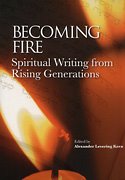
Becoming Fire: Spiritual Writing From Rising Generations. Edited by Alexander Levering Kern. (Andover Newton Publications, Newton Centre, Mass.) http://www.ants.edu/ $13.


Alex Levering Kern writes in his introduction to “Becoming Fire: Spiritual Writing From Rising Generations:”

“The book project began with an awareness of absence on several levels. In my years of living and working with young adults I have been astonished by the creative and distinctive ways, in which rising generations inherit their faith, form vibrant communities of their own, practice spirituality and activism, construct theology, and make meaning of their lives…. in the literary market place younger spiritual voices are woefully underrepresented…. this collection offers a vision of creative and engaged faith and a testimony to the diverse gifts and callings of rising generations. In this spirit, Becoming Free, extends radical hospitality to voices that are frequently relegated to the margins of mainstream spiritual writing and theological discourse on the basis of age, race, sexual orientation, or religious identity.”

This anthology showcases the spiritual voices of General X and Y, and the Hip Hop generation, along with selected works of older writers. What the book proves, and proves resoundingly is that the under 40 crowd is not a bunch of Paris Hilton ciphers, obsessed with navel gazing. The poets and writers in this collection have a deep interest in the nature of being, and seem to have actively engaged in an ongoing search for their own spirituality, be it through organized religion, or through their own personal quests.


The lead poem, and appropriately so, is by the accomplished poet Sophie Wadsworth, titled “Lost.” Wadsworth using the state of being lost in the woods, as a touchstone for finding oneself in spite of the incessant chatter of a frenetic inner and outer world:

“If you’ve taken stock—
food, knife, matches,
fuel—if you backtracked
and map checked and every tree
looks alike, the mind may start
its manic talk of broken ankles
and electrical storms.

Try to still that voice.
Listen for the ripple of birdsong,
Synchronizing your breath
With the canopy’s rise and fall. “

I loved Ian Thal’s Whitmanesque romp through Brooklyn (“A Child’s Trip Through The Underworld”) on the A-Train—bringing the high holy to the everyday:

“Hail to the A-Train
circa nineteen-seventy eight
cars clanking proudly illuminated
in fuchsia, sky, black, and gold spray paint
graffitied with esoteric writing few can read…
(at any speed) ….


holy are the drivers who drive
holy are the couplings that link
holy are the riders who ride
holy are the turnstiles leapt
holy are the lights that blind…”

So often people associate religion, spiritualism, as either dry dogma or facile New Age claptrap. These poets bring a lush and engaging lyricism in a quest we are all involved in, whether we now it or not.

Doug Holder/ Ibbetson Update/ Somerville, Mass./ June 2006

Monday, June 05, 2006


Lyrical Somerville

Somerville Poet Lisa King died this year at the age of 46. She was one of the most dynamic performance poets in the Boston-area. She was a member of the 1993 Slam Champion Team, an individual Boston Slam Champion, and a member of the 1996 Boston Slam team. King devoted much of her time working with Gay and Lesbian youth groups, as well as working in schools as a "poet in residence." She inspired people to thrive through poetry. I selected a couple of poems from her chapbook "Eyes Blinking Backward," that was reprinted for a recent memorial reading for her in Cambridge. To have your work considered for the Lyrical send it to: Doug Holder 25 School St. Somerville, Mass. 02143. dougholder@post.harvard.edu


The Death of Stars

In between the soft sand and shoulder
and the white lined road
a heavy curtain of velvet night
drapes down.

Slowly stars bore holes
through the dark.
Shimmering certain death.

I feel kinship with them,
as they press against my mind
with twinkling fatality.

Poets are like stars.
They pierce the darkness of time,
to deliver image and emotion
from the void.

And unfortunately like stars,
they may already be dead
by the time their light
reaches you.


Nature's Revolution

Through a vortex of flying pigeons,
my eyes catch a deeper shade of city.
Away from thickly strangled streets.
Far from the bustle of horns blaring,
lies the beauty of peaceful resistance.

Like where the sidewalk breaks from tree roots
pushing back the attack.
Or where blades of grass work through
concrete cracks on the side of a pulsing highway.

This is nature's revolution.
The rooted ones silent conspiracy
to remake the world.

--Lisa King

Friday, June 02, 2006


The Boston Area Poetry Scene: A Plethora of Poets and Poetry


There is rarely a day that goes by that I don’t bump into a fellow poet or writer of my acquaintance. In Somerville, where I live, a poet-couple lives in a house behind me, another lives on the adjacent street, and my landlord, a poet and writer of some local fame lives downstairs. The cafes of Somerville Cambridge and Boston overflow with Bards tapping away on laptops and scribbling in dog-eared notebooks. There are poets of the “academy,” poet/scholars of the street, slam poets, black-clad avant-gardes…you name it. And there is room and a venue for them all.

In Cambridge, at 106 Prospect St, just outside Central Square, is the Out of the Blue Art Gallery. This gallery owned by Cambridge’s own Deborah Priestly and Tom Tipton, hosts two well-known poetry venues. The most noted is “Stone Soup Poets,” that meets every Monday night, and was founded and is hosted by veteran Boston poet Jack Powers, who is assisted by the very capable Chad Parenteau.

“Stone Soup” has been around since 1971, at various venues in Boston and Cambridge. Many of the movers and shakers in the poetry world like Allen Ginsberg, Lawrence Ferlinghetti, Gregory Corso, Robert Creeley, and others have read and have even been published by “Stone Soup Inc.,” the publishing imprint of the organization.

Deborah Priestly, a well-regarded and frequently published poet in her own right, hosts a poetry venue every Saturday night at the gallery. It is named after her ubiquitous dog, titled “Open Bark.”

But the republic of Cambridge is not limited to the Out of the Blue Gallery for poetry. The Cantab Lounge on Mass. Ave in Central Square, Cambridge hosts a competitive slam poetry night every Wednesday night, and the Lizard Lounge, near the Harvard Law School, has a “Poetry Jam” hosted by Jeff Robinson every Sunday night. Here poets of all stripes read their works accompanied by the music of Robinson’s jazz ensemble.

But poetry thrives not only in the galleries and bars, but in the hushed environs of a church. Jessa Pia and Lee Kidd run a poetry venue at the Harvard Epworth Church, just outside Harvard Square every Thursday night. The poetic couple describe their brainchild as a place,”…where everyone gathers weekly to practice their new scribblings.” Pia and Kidd also encourage musicians to partake in the open mic, and more often than not there is a sing-along with audience and performers.


There are perhaps more staid but no less valuable places for a poet to ply his trade. Harris Gardner, known as the impresario of the poetry scene, is the founder of “Tapestry of Voices,” which consists of reading venues at the Forest Hills Chapel in Jamaica Plain, Borders Books in downtown Boston, and perhaps his crowning achievement the annual Boston National Poetry Festival Marathon held at the main branch of the Boston Public Library during poetry month (April) each year. Over 50 poets, both established and emerging, read over the length of a weekend, as well as the general public at the open mic.

Affa Michael Weaver, a highly acclaimed Afro-American poet and professor at Boston’s Simmons College, runs the Zora Neale Hurston Center that has hosted such poets as: Askia Toure, Alicia Ostriker, and Marcia Douglas, to name a few. Weaver said the center is,” A resource to enhance diversity for Simmons and the surrounding community.”

One of the oldest reading series in the country was founded by Amy Lowell and Robert Frost in 1915. Diana Der- Hovanessian, the current president has hosted poetry readings at the Longfellow House in Cambridge for many years now. Personally I have heard such poets as Donald Hall, and Robert Creeley read from their work, while I sat on the well-manicured grounds of this historical site.

One of the newer but vibrant poetry happenings in the area takes place every Saturday at the Au Bon Pain Café, in Somerville’s Davis Square. A group of poets called the “Bagel Bards,” meet every Saturday, chat, kibbitz, edit an online journal “The Wilderness House Literary Review,” and publish an anthology, thanks to the techno-savvy poet Steve Glines. On any given Saturday poets gather in a sort of “Last Supper,” scene, seated and talking animatedly on either side of a long row of tables.

But we really haven’t covered the waterfront. In the metropolitan area poetry groups, venues, magazines crop, thrive and disappear with a breathless frequency. Any poet, of any persuasion, can find a niche, a place to plant a poem, in this rich lyrical soil.

Thursday, June 01, 2006


Ibbetson Poet Jennifer Matthews ("Fairytales and Misdemeanors" 2003) http://jeniffermatthews.com/ has released a new acoustic cd, through thundamoon records. I have listened to this cd, and can attest to the fact that her voice and lyrics are beautiful and haunting. This is an accomplished production by an accomplished and passionate artist. Doug Holder/Ibbetson Update to order go to http://www.bostongirlguide.com/ or contact rose@bostongirlguide.com

Tuesday, May 30, 2006


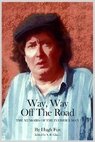
Way, Way Off the Road. The Memoirs of the Invisible Man. Hugh Fox. Edited by S.R. Glines. $15. ( Ibbetson Street Press 25 School St. Somerville, Mass. 02143) http://lulu.com/ http://ibbetsonpress.com/

Hugh Fox, in his memoir of the small press movement, “Way, Way off the Road,” quotes the poet Charles Plymell:

“…the generation that came after the Beats, was overpowered by the Beats themselves. All that media hype. My god, the media fell in love with them. They were practically rock stars. And the post-Beats, the Hippie-Yippies, whatever you want to call them, were lost in the Beat’s shadow. They were and still are invisible!”

Plymell defined the group of poets Fox feels he was part of. Fox was solidly in his 30’s, a nerdy academic, equipped with a PhD and a foundation grant, when he picked up a copy of “Crucifix in a Death Hand,” by the “dirty old man,” of poetry Charles Bukowski. Fox was thrilled by the Buk’s use of language and felt a new door was opened for him outside the stagnant air of the academy. Fox wound up doing a critical study of the man. Here is an account of his first meeting with Bukowski:

“So I’d gone over and found him in this motel-hotel place in Hollywood. You know, the usual tattered, potted palms out in front, everything kind of run down.”

Fox told Bukowski that he wanted to do a critical study of his work. Fox was sick of Eliot and Pound, and wanted a taste of the wild side. Here is Bukowski’s response according to Fox:

“ …nothing wrong with Eliot and Pound, they’re some of my best friends, he answered, got up and started emptying the wall of bookcases that contained all of his printed work, all the books, all the magazines. Went into a closet and started taking out suitcases and throwing the books and mags inside.”

Bukowski said: “Ok I can trust you. I’m gonna give you the whole schmear. And if you find any duplicates, keep them.”

Fox wound up writing the first critical study of the man, as well as studies of Winans, and Lifshin, and began his life as a wandering-Jewish scribe, recording the comings, goings, happenings and personalities in the small press for the last 40 years.

Fox recounts his years at COSMEP, a seminal press organization, that he was a founding board member of, and his years of publishing the avant-garde lit mag “Ghost Dance.” Fox, who admits he has a very manic side, has written literally thousands of reviews of poetry books, chaps, and small press publications, as well has edited the groundbreaking anthology “The Living Underground.”

This book is not a straight narrative. It reads the way Fox talks. It is written in a rapid fire stream of consciousness style—so that often the reader has to catch his or her breath. His description of fellow writers is often inspired. Here is a portrait of a down-at-the-heels Richard Nason, a movie critic for TIME magazine,

“And when he’d come into the office out of the Captain Midnight dark, you always smelled the booze on him. Pickled full time. Fedora. Sports jacket. Topcoat. Remnants of former glory. Only when he pulled his topcoat off there would be five pens in the front pockets of his sports coat, all of them uncapped, leaking into the coat itself, another uncapped pen in his shirt pocket also leaking, so it looked like he had been harpooned and was bleeding blue blood.’”

Fox has an inquisitive, fascinating, and hungry mind, and he covers a wide range of subjects from drug-induced writing, ancient Indian cultures, men’s sexual prowess and perversions, you name it. In the books there are countless anecdotes about personages from the world of the small press like: Lyn Lifshin, A.D. Winans, Harry Smith, Len Fulton, Richard Kostelantz, Allen Ginsberg, “The Boston Underground,” Bill Costley, Sam Cornish , Bill Blatty, Donald Hall, and Fox has an original take on them all.

In ways Fox’s literary history reminds me of Howard Zinn’s writing. He gives you a view of the outsider, and how the outsider views things. This is a history you won’t find in the classrooms, although it should be there. Fox makes darkness visible, with this iconoclastic, zany and compelling memoir.

Doug Holder/Ibbetson Update

Monday, May 22, 2006


tnr # 37
Review
Walter L. Maroney
http://www.tnrlitmag.net

The Fall 2005 issue (#37) of the the new renaissance (tnr), an Arlington-based periodical with a long history of presenting excellent work by a wide range of international artists, makes for a fascinating, if ultimately saddening, read. Over the years, tnr has carved a niche for itself, by bringing together a diverse mix of visual art, poetry, prose fiction, lead articles, and memoirs. Given such an eclectic range of media and content, the challenge for a journal as ambitious as tnr is to impose some sort of order on the material, or, more precisely, to order the chosen material so that it speaks to the reader as more than just a well-selected miscellany. tnr tends to achieve that goal by arranging its pieces thematically, so that, if read cover to cover, the reader may come away with an approximation of the experience of having read a novel: the whole is intended to deliver a message that amplifies the substance of its parts.

This issue for example, is dominated by thoughts, meditations and evidence of loss. It opens with a lead article co-written by H. Gyde Lund and Ashbindu Singh, that is part personal observation and part a statistical compilation about the rapidly increasing deforestation of the planet’s rain forests. A salient quote:

The number of species of birds alone in one square mile of the Amazon rain forest is more than the combined species in all of North America (Gore 1992). Destroying the rainforests is comparable to destroying an unknown planet – we have no idea what we’d be losing. Yet if deforestation continues at its current rate, the world’s tropical rainforests will be wiped out within 40 years.

Well, that’s interesting, arguably true, and certainly disturbing; but in the context of an arts journal, it seems a little inexplicably reportorial. Until, that is, one begins to read the ensuing stories and poetry. The rainforest meditation, for example, is followed by two poems by Daniel Tobin, the first a vision of a wasted western mesa that ends with the native leader Black Elk in a vision quest, imagining lost animals. The second, modeled after Munch’s The Scream, transfers that wasteland into the mind of a man, head shaped like a light bulb, while boats move in the distance toward a vanishing point.

From there, tnr takes us on a wide ranging journey across continents and into souls. The theme is constant: that we have no idea what we are losing; and yet we go on, doing all the things that cause our loss until our losses are staring us in the (sometimes screaming) face. One story, Louise Berchine, by M.E. McMullen, deals with an adolescent crush, minutely remembered by the now mature narrator with a compulsive personality disorder, that ends with the seemingly ordinary observation that the girl, the object of all his internalized affection, simply “grew up, moved away, met a nice guy, married him, had three kids that she drove to school in a new silver SUV.” But that ordinariness takes a sudden turn into pain in the following sentence:. “She never once gave a thought to her brother’s buddy for the rest of her life, but he thought about her every day …. Tough duty.” This piece finds an odd resonance with the story, Obsession by Bruce Douglas Reeves. In Reeve’s story, an apparently aging man ruminates, over a distance of decades, about his seeming friendship with an English family in post-war London. He is smitten by the wife and, for reasons he never discerns, she allows them to have a one-night affair shortly before he posts himself back to America. This quiet story is a gem of things left unsaid, and the reader comes away understanding that the narrator has never understood anything about the woman, and her war-bruised family, and pitifully little about himself - - losses perceived and unperceived.

There is a story, Greetings From Portugal, by Kenneth Rapoza about a young Portuguese student, on fellowship at an American university, whose guilt at having a barely consequential affair with a fellow student is so great that it reaches across the Atlantic to touch his fiancée; a devastating memoir Graves in London, by Barbara Honigmann, translated from the German by Lauren Hahn, of a woman’s lifelong struggle to understand her Jewish refugee mother’s adamant refusal to address her own past. This journey ends at the unmarked site of her grandparents’ graves. Four poems of Liu Yung, translated by Julie Landau: one starts with an image of boredom at a window that morphs into a cry of regret over giving up a woman years past; another, written while in exile, that is all of a moment, observing how “last nights third watch rain/Did add one more cool day to this uncertain life.”[1] An essay by Norman Ball on Keats’ “When I Have Fears That I May Cease To Be” that closes with a crushing invitation to “join me, dear friends in never joining anyone again. Together we can honor Keats’s memory, relegating togetherness to the dustbin of history.”

All in all, tnr #37 is a powerful collection of works, of which I’ve cited only a selection that do in fact deepen and enrich each other by spinning a hundred different skeins on a similar subject: the world, our lives, their fragility, all refracted through a plethora of souls. Makes for a pretty remarkable read – and a tough duty.

Ibbetson Update/ Walter R. Maroney


FYI:

Walter Maroney is a lawyer, poet, short story writer occasional storyteller and (so far) unpublished novelist. He lives in Manchester, New Hampshire with his wife and two sons.


____________________________________________________________
Naiad by Marina Tsvetayeva of the name Father Neptune for the god called ??????-????, instead of some phrase closer to the Russian’s sound of “Okeana” for Ocean.


1 One further note: tnr adopts the practice, which is often not done for reasons of space, paper and money, of printing translated works in their original language. This is a profound gift, which allows readers with facility in one or another language to consult the artist’s original phrasing when working one’s way through a translated piece. A small pleasure, maybe, but a genuine bonus, as well. This reader, for example, spent an enjoyable few minutes debating in his head with Karen Braucher and Laura Weeks, their choice, in translating the poem

Sunday, May 21, 2006


Mad Hatter’s Review is among the most content rich literary web sites on the internet. Its depth and scope are almost scary. Equally captivating are the graphics and ease of maneuvering from one location to another. I have come to realize that literary magazines, whether print or electronic, are the children of their founders. It is not surprising that Mad Hatter’s Review is the brain child of Carol Novack. As Novack’s bio tells us, she “is a re-emerging, angst-ridden writer of sociopolitical neurotic rants and raves, comic emails, and image drenched, lyrical whatnots.” Carol's frequently enigmatic and totally misunderstood writings have appeared in numerous anthologies. One of her prose poem narratives, "Destination," was selected as a best of Web Del Sol fiction. She's attempting a blog: http://carolnovack.blogspot.com. I asked Carol to provide a few samples of her work so readers could better know her mind, but first I wanted to know how Carol Novack could manage and sustain a site of this scale.
Q: I don't think I have ever seen an electronic zine with as many editors, covering as many topic areas as Mad Hatters' Review. Amazing. You must be a very persuasive, charismatic person to get all these good folks to help you out?
A: Hell if I know! Maybe I've always wanted to live on a Kibbutz. Maybe because I have no siblings. Maybe it's my cyberitic pheromones.
Q: How do you handle the triaging of submissions out and back from your editors?
A: I don't. Editors are not "readers," as in most other magazines. Decision-making is a group process. We congregate virtually in a secret place (or sometimes, secretly in a virtual place) during every reading period over a few flagons of Aussie shiraz-grenache and discuss submissions as they arrive. If we all go "wow" over a sub, it's accepted. If one or two of us wonder what the author was thinking when s/he submitted the whatever/s to MHR, and it's obvious that the sub's not for us, it's rejected. If some of us are hot and others cold or tepid, the sub is usually (ultimately) rejected with an invitation to please submit again. Occasionally, I or I and my associate editor, Alla Michelle Watson, overrule the majority or make the ultimate decision when a consensus can't be reached and one or both of us feel strongly one way or the other. Individual editors often work with authors, suggesting revisions. Some highly original writers make grammatical mistakes that make us stand on our ears. While such mistakes are irksome, they're curable. The authors are usually happy to work with us.
Q: When was MHR born and what was your core goal in creating it?
A: At first, I envisioned becoming a multimillionaire and star. When people laughed at me, I altered my vision.
As I've said in my "Editor's Rave," "[w]ay back in summer, 2004, I decided that the Internets [sic] didn't have enough exciting multimedia "literary" magazines, not to mention edgy ones. I envisioned something real flashy and eccentric, experimental, collaborative, multicultural, playful and even meaningful, in the social change/progressive sense." I wanted to create a unique online publication and I knew that I'd enjoy the process. The magazine emerged in an early version of its current form in March, 2005.
Q: I mean, there are SO MANY e-zines popping up; why bother? Can one e-zine really rise to the top?
A: Good question. I must be mad. Well, of course I am!
Seriously, it's not a matter of one e-zine rising to the top like la crème de la crème (a tired phrase I find absurd). There's no big Olympics for artsy e-zines, thank the cybergods. There are quite a few excellent online magazines, and hundreds or maybe thousands of mediocre ones, and worse, and far worse. Hatters and friends find most magazines publishing the same types of write-by-the-MFA-rules stories and poems, the kind that make us yawn, if not scream – you know, those gritty realistic stories about bad marriages, divorces, dying relatives, kids discovering morality and sex, and the same puerile "comic" tales of college students on sexual rampages, "shocking" tales about brilliant writer dope addicts nearly killing themselves, heartbreaking tales about unloved children, etc. Might as well watch made for tv movies. Very few quality magazines publish writings by relatively unknown authors who are writing original, out-of-stream pieces, literature that sounds like literature, demonstrating lyricism, playfulness, love of language. Very few magazines are visually and aurally exciting, as well as truly entertaining. "Entertaining" is a consistent adjective that readers use when they talk about MHR. Yet, MHR is "literary" in its focus on language, originality, imagination and substance over schlock and shock. Quality literature can be entertaining!
Moreover, we offer a variety of media: mini-movies, cartoons and parodies, art galleries, columns (soon expanding to include those by "guests"), contests, reviews and interviews, plus art and music custom-made to enhance the writings we publish. Special thanks to our incredible Art Editor Tantra Bensko.
A review of MHR Issue 3 in Eclectica cited the artwork as "bordering on the astounding." Authors whose works we accept are given the option to either recite their works or request musical accompaniment; we have some excellent composers on staff. Next issue, we'll present a "mental" multimedia theater and visual poems created by our new Director of Digital Multimedia Fusions. It's all so much fun and I know I sound like an overly proud mother.
Q: Okay, I have to know. "Paper or Electronic" -- which form do you think has most credibility? What form thrusts a writer's work into the great "out there" and gets it read by the right people, like agents and publishers?
A: I think that both forms have equal "credibility," though the "establishment" is still pushing the concept that print magazines are innately superior to webzines. This makes no sense for various reasons, one being that there are incredible writers published on the Web and e-zines can offer so much more than print magazines, in terms of innovative multimedia presentations, exciting collaborations, virtually unlimited space and expandability. (Ok, so you can't get into bed and cuddle up with a warm webzine.) Imagine MHR as a print mag – the cost of reproducing the glorious artworks would be prohibitive. And we'd have to include a CD of the music, but how would one manage easily to play simultaneously the recitation or music made for the text one were reading? And what of our animated art and movies? One can't reproduce them in print! The integrated visual and audio experiences presented online would be impossible to duplicate in a print mag.
Agents do read Internet magazines; I'd wager that some actually scout webzines for talent. I was contacted by an agent who'd read one of my quirky comic pieces in an online magazine. In fact, the agent encouraged me to write a novel based on the characters in that piece, but he also urged me to seek publication of my stories in well-known print magazines in order to impress putative publishers of the putative novel. So okay, the big publishers and agents want print credits from their authors. There's this snobbish perspective that print publications are superior to online publications, and there's this crazy "top tier" approach most writers buy into – e.g., better to publish in The New Yorker or Harper's than literary magazines such Mississippi Review; better Ploughshares than Conjunctions, Tin House than New England Review; better Wanky Dink (stapled print magazine published by the Ohoochitaha County Poetry Society) than Mad Hatters' Review. One sees the same "successful" authors over and over again in the "top" publications, rarely the innovative/risk-taking writers, but the tried and true, the ones who are selling. "We welcome innovative/experimental writers" is most frequently a sad joke.
Writers are tripping over themselves in order to get into top tier print magazines -- if not the top tier than the next to top or the next to the next to the top and so on ad nauseum and absurdum – that's the reigning mentality in this brutally competitive field, and most of us succumb to this mode of conventional thinking. Most people want to write like well-published X and Y, with their perfectly crafted characters, arcs, plots, and resolutions, or maybe like B and C, those awfully witty, stylish boys and gals so popular at readings. Few print mags pay well, and pay is supposedly an incentive. But how many writers of fiction and poetry make decent incomes from publishing in magazines that pay? Hell, I'd love to pay my contributors more than the token the usual "paying" print (or occasional online) magazine offers to include itself as a member of the "paying" market. Instead, we give our contributors custom-made art and music, a nice fat bio with pics, and global exposure. Our artists and musicians also benefit, exposure-wise, from the collaborative package. One volunteer artist won an award for a painting she'd created for an author's poems.
Just think how much exposure a writer gets when s/he publishes online. People from all over the world can access her work. Compare the potential readership to that of even the most prestigious literary (print) magazine and the reasonably popular or well-known webzine obviously wins hands down.
Judging by the Best Seller lists and ads in Barnes and Nobles windows, the vast majority of publishers and agents are going for memoirs -- memoirs are the latest craze. (Big yawn from some of us.) Those "right" people are following their green noses, looking for comic pop novels and heartbreak tales that will appeal to the literate masses. Hardly surprising for business people. They're certainly not going for innovative, surprising, and intellectually challenging fiction like Raymond Federman's (we're featuring him, and also presenting translations of avant-garde French poets). Federman is not a New Yorker writer! And lyrical/rhythm and image-driven prose? What's that? Thank goodness for Dalkey Archive, the FC2 Collective, and the other quality independent presses out there (e.g. Ravenna Press and Ugly Duckling Presse), that print books by unconventional writers as a labor of love. Actually, I'm hard pressed to figure out what print or online zines persistently demonstrate a love of narrative prose that focuses on lyricism and imagery rather than STORY. How many of those sought after print zines would publish an unknown Robbe-Grillet or Borges?
So what's the future? I believe that as long as the telephone monopolies in the USA aren't permitted to charge people for every click, USA-based Internet art and literary zine will thrive and become more and more accepted as credible publications that offer top quality creations. If monopolies win out over here, webzines in other countries will thrive without much of an American audience.
Q: Your site is very active, I love how you post bios and photos, you have so much going on, WOW you must be exhausted. Who is your web slave? You have to pay her more money!
A: Yes, it's exhausting but so rewarding to create MHR with my staff, and the possibilities are seemingly endless --- what can be done with the Internet as a communicative, expressive tool. Our web slave is Shirley Harshenin, maestress of nutheadproductions, a wonderful, creative web designer in BC, Canada. I don't believe in saints, but she is the most patient person I've ever known, putting up with all sorts of confusion and alterations and always willing to expend the considerable time and energy it takes us to create each issue. She definitely deserves a salary in the six figures. Fortunately, Shirley feels like one of the gaggle, which she certainly is (a true Mad Hatter) so she doesn't expect to be paid her worth, at this time. I feel really lucky to have found her. Shirley comes up with great ideas; the mag is a labor of love and passion for all of us.
Q: Alla Michelle -- How did you find Carol Novack and her Mad Hatters?
A: I didn't! Carol found me. She read my bio, my flash fiction on Zoetrope (excellent resource for writers, btw), my pieces published in various e-zines and then…she still offered me a role of Assistant Editor! Carol is amazing. She has gathered the most talented editors, artists and musicians, and anchored us solidly in cyberspace as one of the most innovative, far-reaching e-zines out there. What I admire most about her is that she didn't wait until all the pieces fell perfectly into their spot from the get-go; the mag evolved over the past year, and continues to push the boundaries of creative imagination, now offering a truly prodigious variety of media. I guess Turgenev was right when he said: If we wait for the moment when everything, absolutely everything is ready, we shall never begin!
Q: Give us some of your favorite Carol Novack first lines and paragraphs. Maybe this will give potential submitters a clue as to where your Top Hatter head is at (or isn't).
A: First lines:
1. “In Siberia, the trains are exhausted from the smells of potatoes, onions and sots; and they are never fast enough." (from A Tourist in Siberia, published in Milk Magazine)2. “In Utah she will meet a man of god in a brown suit white socks and tassel loafers, a little bit old not at all like the usual cleft-chinned ones in deep blue or sometimes oil green Joe's Garage t-shirts and running shoes, disappointed Norman Mailer men with dangerous low flying pheromones and large plastic dice and Barbie dolls dangling from their dashboards; no she will not meet the man everyone says she will meet again and again particularly in Utah she imagines so many versions but he is always burned with youth bursting with seeds like a fat cactus, always obsessed." (from A Tourist in Utah)3. “Foolhardy with the three of them you said but hardly a fool seeing full well how well I played with Jimmy Timmy and Bop in all our backyards when the mothers were out they had me I had them down on the perfect lawns they would plant their seeds and they were all three big like columns, Corinthian, Ionic and Dorian, my favorite one Bop the laconic Ionic one ramming like a spring lamb." (from Power Trilogy)
A: A few favorite paragraphs:
"Now it's your time to listen, so listen. I have this to say. Picture a donkey with a cargo of bananas and hens. She is stumbling on stones through the night, smells a bewildering frenzy of unidentified flowers, somewhere under the shared sky of dim, far flung stars. She hears the voices of creatures she can neither smell nor see and trembles, feeling vulnerable to their genetic destinies. Inevitably, the donkey, exhausted, sits down by the roadside if she is allowed. Her nose longs for only one scent, her eyes for only one vision, and her ears for only one sound." (from Interview with Self)
"Comes a dry, quiet Sunday right for reading Leibniz and counting Monads at the edge of the field when I see the bride rising out of the flat planet, nearing fast with veil and train, and she puts her finger to her lips, maybe thinks I'm going to tell my dead daddy he should rise from the mud to get a shotgun. She's running so like desperation that her left off-white shoe takes off from her right foot, landing on a goat's ear. I hear the constipated yearning strains of Wagner and surmise that the cops are almost on her heels 'cause she's a bit dark complicated and in these parts the cops are always chasing whoever doesn't look like the underside of a hamburger roll. So I roll on my back, making like a tailless dog with my paws in the air to show her I'm not in attack mode and she smiles suddenly and totally which tells me everything I've ever wanted to know about my unexpected glorious future. And she sees right then and there how smart I am despite my issues with set tables; she grasps my hands to lift me up, floats a dewy caterpillar kiss on my little boy lips, attaching me like magic to something surprisingly elegant beyond myself. Says Spinoza: "All happiness or unhappiness solely depends upon the quality of the object to which we are attached by love." (from My Life with the Runaway Bride, Part I)
"In the beginnings endings of galaxies exploding imploding, birthing stars together falling apart together twinkling and belching the indigestible jet sum phoenixes and flotsam; before and after, is all the zero times zero, meaning one in its parts fractions of no things parting departing breathing always in and out breaking up into fractious star bits ego bits id bits alpha bit soup, genetic stew, caves, pyramids, igloos, coffins, mud huts, holes and monkfish revolving madly breaking into molecules into galaxies exploding imploding, birthing stars falling twinkling and belching the indigestible jet sum corsets and flotsam, casino chips, pterodactyls, blue hats, canaries, pompoms and pantaloons, the hollow cries of wolves." (from In the beginning is).
I found the quality of writing on Mad Hatter Review to be consistently high. I remain amazed at its scale and complexity. But what I loved most about it is how it reflects the curious mind of Carol Novack. It is both her electronic magazine, and her work of art.
_________________________________________________________
Charles P. Ries lives in Milwaukee, Wisconsin. His narrative poems, short stories, interviews and poetry reviews have appeared in over one hundred and twenty print and electronic publications. He has received three Pushcart Prize nominations for his writing and most recently read his poetry on National Public Radio’s Theme and Variations, a program that is broadcast over seventy NPR affiliates. He is the author of THE FATHERS WE FIND, a novel based on memory. Ries is also the author of five books of poetry — the most recent entitled, The Last Time which was released by The Moon Press in Tucson, Arizona. He is the poetry editor for Word Riot (www.wordriot.org) and on the board of the Woodland Pattern Bookstore in Milwaukee, Wisconsin. Most recently he has been appointed to the Wisconsin Poet Laureate Commission. You may find additional samples of his work by going to: http://www.literarti.net/Ries/ .
I finally got a caricature "The American Dissident" http://theamericandissident.org put me in their series of Lit Toons. I have been mocked with the best, Including Harold Bloom, Martin Espada and a host of others....

Saturday, May 20, 2006

Mark Pawlak is a longtime editor of the respected small press “Hanging Loose,” http://www.hangingloosepress.com , and the author of the poetry collection “Official Versions.”
His poetry and prose have appeared in The Best American Poetry 2006 (Billy Collins, ed.), New American Writing, Off the Coast, Pemmican, and The Saint Ann’s Review, among other places. In addition, he is editor of four anthologies, most recently, Present/Tense: Poets in the World, a collection of contemporary American political poetry, featuring work from some of the country’s best-known writers. Pawlak is Director of Academic Support Programs at the University of Massachusetts Boston, where he also teaches mathematics. He has been the recipient of two Massachusetts Artist Fellowship awards. He lives in Cambridge with his wife and his teenage son. Mark was a guest on my Somerville Community Access TV show: “Poet to Poet/Writer to Writer.”


Doug Holder: Marc, you have been at Hanging Loose Press for some twenty-six years. Tell me a bit about the press and your involvement.

Mark Pawlak: Forty years ago Hanging Loose was literally loose sheets of paper inside of an envelope with a cover on it. It literally hung loose. We used to advertise that if you wanted to edit the magazine, you could throw the pages you don’t like in the garbage, and the ones you like you can tack on the wall. Over the years it has evolved to perfect bound.

Doug Holder: What is your press run?

Mark Pawlak: 1500.

Doug Holder: How did you get involved with Hanging Loose?

Mark Pawlak: I got involved through the poet Denise Levertov. She was a contributing editor. She taught a poetry class at MIT, when I was a student. She published a supplement to issue No. 12 in 1970 that included her students’ work. That’s how I was introduced to “Hanging Loose,” through her. Subsequently, I met Ron Schreiber, another of the founding editors, at U/Mass. Later the editors invited me to join them, when on member stepped down.

Doug Holder: This is the 40th Anniversary of Hanging Loose. What keeps the press together?

Mark Pawlak: This year is our 40th. Many small presses are one person operations, and it is a labor of love. We have four different people editing Hanging Loose so when one of us is ill or doesn’t have the energy, we just pick up the slack. That has helped us through the difficult years. Presses with only one or two people might have folded.

Doug Holder: You say this is a labor of love. You don’t make much or any money from your efforts. What keeps you keeping on?

Mark Pawlak: I am a “holy fool.” It has become a community of writers for me. There are people I have never actually met who I consider dear friends. It does distract me from my own work. It took me three years to complete “Official Versions.” The press distracted me.

Doug Holder: You teach math at U/Mass/Boston. How does this fit with the art of writing poetry?

Mark Pawlak: It does and it doesn’t. It does in the sense of the esthetic of math—getting to the solution, much like knowing you finished a poem. There is a formal precision in poetry and math.

I was a math geek as a kid. I did read some poetry on my own. I discovered Whitman one summer and fell in love with him. I am from Buffalo, NY—a really provincial, working class place. I wasn’t until I encountered Denise Levertov at MIT; during my final year at college did I try my hand at poetry.

Doug Holder: I know I use the newspapers as fodder for my poetry. How about you?

Mark Pawlak: I read The Boston Globe and The New York Times. I pick up the METRO on the train, and if I am really bored I read The Boston Herald. I am always foraging. The language, human interest stories interest me, as well as the political pronouncements of the government, all sources of my poetry. I also have used Billboard’s Best Song titles. I did a poem that involved Hallmark greeting card clichés. I am interested in language out in the world and how it is used and abused.

Doug Holder: It has been said that your poetry cuts through “political doubletalk.” Do you consider yourself a political poet?

Mark Pawlak: I do. In the sense I want to empower people to think critically how language is used. I would like them to understand the disinformation of the headlines. I want to speak plainly.

Doug Holder: Some people say that political poetry is no more than polemic disguised as poetry..

Mark Pawlak: It certainly can be. Political poetry has been accused of being too much of the moment. But what’s more permanent than war, oppression and injustice?

Doug Holder: I characterized you as a “lyrical junkman,” in that you sort of forage through newspapers, ephemera, etc… for words and phrases to flesh out a poem. Is this fair?

Mark Pawlak: Poetry can be conservative. I want to take what’s around me—basic language, and put it together in informative ways.

Doug Holder: Is being an editor drudgery?

Mark Pawlak: It can be drudgery. As you get more practice, you are able to read a few lines—by the energy and language—you can decide where a poem is going or not going. So you can minimize drudgery. There is always the excitement of finding unexpected things. It happens a lot. The thing I am most proud about is that we have a special section in our magazine for high school writers. They are not jaded. High school students are very open to experience and language.

Doug Holder: Is it necessary to have a higher education to be a poet?

Mark Pawlak: You have to be able to read and read deeply. I don’t think a PhD is necessary. Denise Levertov said that poets who became grad. students needed a number of years to shed their skins to get back to their “work.”

Doug Holder

Thursday, May 18, 2006


Eric Greinke

Up North. Harry Smith. Eric Greinke. ( Presa S Press http://www.presapress.com/ ) $6


Presa Press has released a chapbook of poetry by Harry Smith and Eric Greinke. Harry Smith is well-known in small press circles as publisher of "The Smith," and a founding member of COSMEP, ( a seminal small press organization). Eric Greinke was the publisher of "Pilot Press Books" in the 70's, and recently founded the Presa Press. Both Smith and Greinke choose the territory of northern/rural/wilderness environs to set their poems. In Smith's case it is Maine, and in Greinke's Northern Michigan. Being a dyed-in-the wool city boy, with a need for the smell of asphalt to keep me honest, I approached the work with trepidation. But these two poets welcome the inspiration, respite and solace the hinterlands seem to offer. In Smith's poem "Paths." the reader gleans something about the journey of life from a wilderness trail:

" When I was young, I made my paths...
I saw my paths as metaphors
for all my art and thought, and now
the forest and the bog reclaim my toil
I keep no trails; I blunder on
through thickets green beyond conclusion."

Greinke's poem "Green Wood," is sort of a "This Old House Poem." The house at first is made from unformed green wood, and later becomes something more solid. In this poem we learn about the life of a house, but more importantly the man:

"The wood was swollen,
Heavy and green
Sap bubbled
Around the spikes
As I drove them in.

I burned through
Two sabre-saws
cured through
The wet, green wood.
A year later
When it cleared,
It was so hard & dark
That no nail could penetrate."

Hey... if you ain't out of the woods yet, you will be well-served by these two trail blazing poets.

Doug Holder/ Ibbetson Update

Monday, May 15, 2006

For Immediate ReleaseLiterature:

New Issues ReleaseMay, 2006Mary Curtin, Events Coordinator, 617-241-9664, 617-470-5867 (cell), marycurtin@comcast.netPeter Coyle, Store Manager, 617-629-4840, info@mcintyreandmoore.comDoug Holder, Ibbetson St. Press, 617-628-2313, dougholder@post.harvard.eduMcIntyre & Moore Booksellershosts theIbbetson Street PressIssue No.19Reading and CelebrationSaturday, June 10, 3:00 pm(Somerville, MA) McIntyre & Moore Booksellers hosts the Ibbetson Street Press: Issue No.19 Reading and Celebration. Saturday, June 10, 3:00 pm at McIntyre & Moore Booksellers, 255 Elm St. in Davis Square, Somerville, near the Red Line. Free and open to all, with an open read and reception following; wheelchair accessible. 15% book discount* for all those attending [*discount available for day of event only]. For information call McIntyre & Moore Booksellers (617) 629-4840 or log onto www.mcintyreandmoore.com.Somerville's Independent Poetry Press, the IBBETSON STREET PRESS, will have a poetry reading in celebration of its recent release Issue No.19. Featured readers include Doug Holder, Marc Goldfinger, Lainie Senechal, Steve Glines, Robert K. Johnson, Dorian Brooks, and others. The Ibbetson Street Press has published award-winning books of local and national writers for about eight years. Recent issues of IBBETSON STREET were picks of the month by the Small Press Review.Founded by Doug Holder (http://www.authorsden.com/douglasholder), along with Dianne Robitaille and Richard Wilhelm, the press is dedicated to publishing poets from all walks of life. Poets such as Lyn Lifshin, Lawrence Ferlinghetti, X .J. Kennedy, Jack Powers, Diana Der-Hovanessian, Hugh Fox, and historian Howard Zinn have praised Ibbetson's books. Each issue of IBBETSON STREET has a large sampling of local poets. For further information on the press, see www.ibbetsonpress.com.PAST AND PRESENT CONTRIBUTORS INVITED TO READ!McIntyre & Moore Booksellerswww.mcintyreandmoore.comOn the Red Line, in the heart of Davis SquareGreater Boston's best source for scholarly used booksOpen for browsing 7 days a week until 11 pm###--submitted by marycurtinproductionsc/o Mary CurtinPO Box 290703, Charlestown, MA 02129617-241-9664, 617-470-5867

(cell), marycurtin@comcast.net"dedicated to staging insightful entertainment, particularly in non-traditional venues"http://www.marycurtinproductions.com

Sunday, May 14, 2006


"Way, Way, Off The Road." by Hugh Fox edited by Steve Glines
(Ibbetson Street Press-2006)

To order go to: http://www.lulu.com


Introduction

Several years ago the “Ibbetson Street Press,” publisheda Hugh Fox poetry collection: “Angel of Death.” I had neveractually met Fox in the flesh, but I was aware of his substantialcontributions to the small press over the past 40 years. Foxwas a founding member of the “Pushcart Prize,” a foundingboard member of COSMEP, (a seminal small press organization),edited the groundbreaking anthology “The Living Underground,”to name just a few achievements.One day, in my apartment on Ibbetson Street, inSomerville, Mass., I was just about asleep when I heard mydoorbell ring. I went to answer it and this man of a “certainage,” with long gray hair sprouting from the sides of his capand a heavy Bronx-like accent said: “ Hi Doug, what do ya’have in there, a Blonde?” I said: “Well my wife is here, she’ssort of blondish.” I asked him in but I guess he sensed I was inno condition for company. He declined and promptly took acab back to his hotel.Since then I have had the opportunity to meet him on acouple of occasions. Fox is full of anecdotes about many of thestumblebums, poets, poseurs, players, publishers, editors, withall their infinite variety, on the small press scene. I am glad thismanuscript has seen the light of day. And when you read ithopefully you will see the ‘”light” too.

Doug Holder/ Ibbetson Street Press

Dick Lourie Brings The Blues to the “News”


Somerville poet, publisher and Blues musician Dick Lourie, is a man who is never without a project. Currently he is working on a collection of poetry: “Overdue At The Crossroad,” that deals with the vibrant Blues community in Clarksdale, Mississippi, that Lourie visits frequently. Lourie talked to the “News” staff at our regular contributors meeting. Although Lourie has been a Somerville resident since 1981, he feels equally at home in Clarksdale. Clarksdale, although much smaller than Somerville, is similar, in that it has a large and vibrant population of musicians. Deep in the south, Clarksdale has an unusual degree of sophistication because according to Lourie, “Many international visitors pass through for the Blues Festival and the plethora of blues clubs.” Lourie said he has an “obsession,” with the town, and has become friends with many of the accomplished musicians and singers who reside in this burg. He hopes to have the poetry book out next year, and is currently soliciting a number of University presses.

Meanwhile Lourie remains active in a Doo-Wop group, and performs regularly with “Weeping Willy”, a Blues musician in the Boston area. Currently, Lourie and his wife Abbey Friedman (a documentary filmmaker) are working on a film documenting a Boston-based Afro-American singing group the “G-Clefs.” This group has been performing together for well-over 40 years, in such venues as the “Apollo Theatre,” in Harlem, to name one.

Lourie, who considers himself a poet first, and a musician a close second, told the “News” reporters that he continues to be intimately involved with the “Hanging Loose Press” that is based in Brooklyn, NY, with former Somerville resident Mark Pawlak and others. Lourie has several poetry books to his credit, most recently: “Ghost Radio Blues” that brags an accompanying CD.

Lourie, who played his 60 year old sax at the end of the meeting, said that his poems are often related to the 12 bar Blues form. Lourie said that poetry and music have always been related. Their separation has only been a relatively recent development in modern cultural history. Lourie, ever the iconoclast, ended the meeting with an unexpected remark: “I realized I was never going to make a living in music, so I went into poetry.” Spoken like a true artist!

Doug Holder

Thursday, May 11, 2006


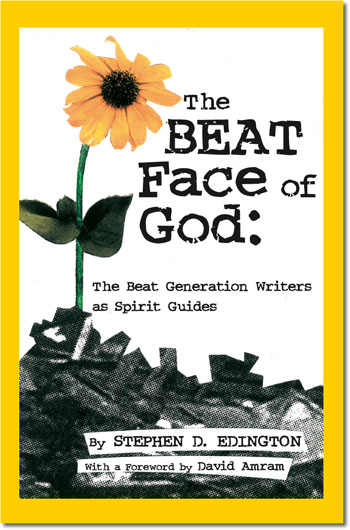
Author Steve Edington Sees “The Beat Face of God.”


Steve Edington is the author of “The Beat Face of God,” a book that explores the spiritual aspects of the “Beat” generation of writers who emerged on the American literary landscape in the 1940’s and 1950’s. Among the poets and writers in this rebel group of writers were Jack Kerouac, Lawrence Ferlinghetti, Gary Snyder and Allen Ginsberg, to name a few. Edington, a Unitarian Universalist minister and “Beat” Generation Scholar, argues that these writers were religious, but not in the conventional sense. I spoke with Edington on my Somerville Community Access TV show “Poet to Poet: Writer to Writer.”

Doug Holder: You are a minister. How does being a religious leader fit with your love of “Beat” literature that often glorifies drugs, promiscuity, and things not usually associated with the religious life?

Steve Edington: Writing the book was a way to bring together two of the worlds I move around in. Unitarian Universalist is a very liberal form of Protestantism. My other interest was with the “Beats” that I had since I was in theological school in the 1960’s. The way I saw them coming together is a theme in the book. A colleague of mine offered this thought and definition of the nature of religion: “It’s our human response to the reality of being alive and knowing we will die.” It is a way we find meaning and purpose in death and life in the face of our mortality. I really took a look at the writing of the “Beats,” and decided this is what they were really trying to do. This was beyond some of the more self-destructive behaviors that they were engaged in. Jack Kerouac said that the “Beat” generation was a religious generation. When Kerouac was on the “Steve Allen Show” and was asked why he wrote: “On The Road,” he said: “Well, I wrote the book because we all are going to die.” This caught a lot of people off-guard. What he really meant by that harks back to the definition we discussed. There are two sides to “On the Road.” One is the America of the 1940’s, and the other is the soul of Kerouac, in the person of Sal Paradise ( a character in “On the Road”). He was trying to answer the question: “Who am I?” “Where do I belong?” Kerouac said on a radio show: “I want God to show his face,” hence the title of the book.

DH: So you choose to concentrate on the positive spiritual quest of the “Beats.” You don’t advocate all the other stuff attributed to the “Beats,” like using drugs, etc…?

SE: I have a twenty-two year old son. I have tried to give him an appreciation of these people. I would not want him to live the life that some of these people lived. Interesting. He has one more year of college to go. He and his friend want to drive across country this summer. How can I say, no? He has been hearing about “On the Road,” all his life, and now he wants to do his own road trip. I would never be an advocate for these people’s self-destructive behavior. I would ask that people try to look at what they were searching for. Try to find some meaning in life. The “Beats” tried to find meaning against the backdrop of cultural conformity.

DH: Were “Beat” generation writers like Jack Kerouac, and Allen Ginsberg, religious people?

SE: I would say so. Kerouac was a life-long Catholic. He was born a Catholic and he had a Catholic burial. He tried to embrace his Catholicism, later her embraced Buddhism. Kerouac was very captivated by the concept of the tortured Jesus. There was something about that suffering that really attracted him and caused him a lot of trouble.

DH: Did Ginsberg wrestle with his Judaism?

SE: Ginsberg went easier with his Judaism than Kerouac did with his Catholicism. I don’t think Ginsberg ever renounced his Judaism, he just sort of added Buddhism on to it. His poem “Kaddish” ( Kaddish being a Jewish prayer for the dead), is an incredibly moving poem. His poem “Howl,” is a walk through the demonic in search for the holy. The “Beats” they felt were walking through the demonic aspects of the society they were in. They were in the end looking for a divine dimension to life.

DH: In 1948, Jack Kerouac, the author of “On the Road,” wrote: “In America today there is a claw hanging over our brains, which must be pushed aside or else it will clutch and strangle our real selves. Is that still true today?

SE: My last chapter of my book is built around this quote. That grabbed me. I thought: "What was the claw he saw in 1948, and what is the claw right now? Some of the claws today are consumerism and anti-terrorism.

The Backdrop the “Beats,” were writing against was a country that wanted to get back to normal after the Depression and Second World War. The “Beats” were what I call “holy misfits.” They were the people that could not fit to where the culture was going at the time.

DH: Who are the “Beats” today?

SE: I find the “Beats” on a local level. I don’t know of any big names. Young poets find their own venues. Places like “Squawk” or “Stone Soup Poets.” I see the new “Beats” at mostly smaller venues like these. I can them at the poetry slams we have at the Kerouac Festival in Lowell, Mass.

DH: Can you tell me about the “Scroll” that will be exhibited at the Kerouac Festival in the summer of 2007?

SE: What is referred to as the scroll is a 120 foot roll of paper that Kerouac wrote the original manuscript of “On the Road.” on. I believe that was in April of 1950. Kerouac was a “stream of consciousness” writer, and didn’t want to break his chain of thought. He could type so fast and he didn’t want to stop to change paper.

The scroll will be on display in Lowell at the “Blue Cotton Mill Museum,” in Lowell. For more information go to: http://cultureiscool.com/

DH: Who has the best archive of “Beat” literature?

SE: Stanford University has the Ginsberg archive. The New York Public Library has the Kerouac archive. Stanford paid Ginsberg a million dollars for his papers before he died.

DH: Which “Beat writer speaks to you the loudest?

SE: On the East Coast-- Kerouac. On the West Coast-- Lawrence Ferlinghetti. Ferlinghetti is a businessman/poet, as he needs to be to run the “City Lights” bookstore in San Francisco. He has become the grand old man of the “Beats,” and is now in his 80’s. He is an amazing guy. He was in World War ll, and his transformation came (according to him), when he was stationed in Nagasaki shortly after the Atomic Bomb was dropped. He realized the potential destructiveness of humans. My main “Beat,” now is Ferlinghetti. His poetry is wonderful. It has a whimsical quality—but it will zap you too.

DH: Is the “Beat” body of literature best read when you are young?

SE: In a way it is. I first read ‘On the Road” when I was in my early twenties. You read it in different stages in your life and you see different things. You read it later and you see a counterpoint to the joy and excitement—an undertone of sadness and tragedy.
Kerouac picked up on this in his twenties. He was able to write on all levels.
--------------- Doug Holder

Monday, May 08, 2006


One Art. Juliana Bures. Cheryl Reed Devitt. A.S. Henderson. George Locke. Cam Terwilliger. Edited by Julia G. Henderson. http://jgalhenderson.etsy.com $12.


Julia G. Henderson, the editor of the poetry anthology “One Art,” writes in her introduction:

“This anthology was conceived based on my hope to highlight the work of five talented twenty-somethings. The voice of each writer is unique, and reflects a wide range of emotions and beliefs, and the images are modern and striking. With the anthology, I also hope to pay homage to the art of the small press publishing and self-publishing, as a forum in which the thinkers, philosophers, artists and writers of our time can let their voices be heard.”

Being a long-time small press publisher and editor myself, I was like a dog on a meat truck when I read this introduction. Henderson, a graduate of the Emerson College (Boston), writing and publishing program, has created a winning- looking book complimented by the abstract artwork of George Locke.

In any anthology there is a mixed bag of work. In “One Art,” there are more than a few choices morsels to whet a poetry-lover’s appetite.

Somerville poet Juliana Bures in her poem “”Determine The Source,” writes of our world of chaos, and the façade of control:

“The sky is an endless layer upon the world,
a blanket to the wild.
Clouds come to cover,
but the sun burns above, always,

The procession is constant,
forward is the way the water flows.
Slants stretch out the afternoon,
without any purpose other than to begin again.

The world is an endless layer
cradling what cannot be controlled.”


Cheryl Reed Devitt has a simple but evocative poem about the sweet and not so sweet mystery of love, titled “i used to.”

“love a boy with blue eyes,
but he moved away. and
he didn’t know what to do
with me, nor i him,
i suppose.

i used to be sure
it was all figured out
it was all a done deal
‘til these past couple days
came and ripped the threads out…”


To have a book published is thrilling; which I am sure is the case with these young poets. And to have a book published with such high production values is even more thrilling. “One Art” is a welcomed addition to the world of the small press, and showcases the work of these talented poets admirably.

Doug Holder/Ibbetson Update