Friday, May 05, 2006


Dead Stars Have No Graves: A Poem. Joseph Kerschbaum. (http://www.pathwisepress.com/) $6.

“Dead Stars Have No Graves… ” is a long-poem that dives deep in the black hole of a dying or dead relationship. There is a touching mix of fragile, dashed hope and resignation, to this work. Here is a heated riff that explores the road from infatuation to the morning-after reality in a long relationship with the perquisite could-of, would-of, speculation:


“She could have been
anything. She could have been
a philanthropist who works with disabled children.
The way she talked, her slow drawl, sharp wit, could have
sustained conversations for hours. I could have
talked with her for days in those months when I was talking
with no one. Her smile could have been
the most alluring I’ve ever seen. Her walk could have
led me to cliffs ready to leap from upon command. Her perfume
could have fogged my mind till her eyes became color-less.
She could have been all this. Her mouth dispelled
all the myths I constructed.
I woke to find her smile simply composed
of teeth, not diamonds. Roses were not planted
in her mattress, just sweat.”

Kerschbaum, an award-winning poet from Bloomington, Indiana, rages against the dying of the light in a relationship, and does it with style and deeply layered use of language.

Doug Holder/ Ibbetson Update

Wednesday, May 03, 2006


Lee Briccetti: The Woman Behind “Poets House.”

I met Lee Briccetti executive director of “Poets House” during the “Poets House Showcase” this April (2006). “Poets House” is located in the SOHO section of New York City, and offers classes, lectures, readings, a library with thousands of poetry books, chaps, broadsides, etc… for the benefit of poets, writers, publishers, editors, and the general public to study and enjoy. Briccetti graciously agreed to be interviewed via the internet .


Doug Holder: “Poets House” was started in 1985 by Stanley Kunitz and Elizabeth Kray. Their vision was to create a “Place of Poetry.” They felt this was lacking in American cultural life. Do you think things have changed in the last twenty years?

Lee Briccetti: My work as executive director of “Poets House” convinces me that the whole culture of reading is in evolution. Desktop publishing has democratized the means of production, giving many more Americans, and a wider range of voices, access to print.

There is much poetry in this nation, and in many ways that poetry is being experienced—as text in books and magazines; on the internet and the radio; and in reading series in libraries, bars and bookstores, which continue to provide a social context for the exchange.

Finally, I would like to say that I do believe Poets House has made a contribution by creating a more visible presence for poetry in our culture. Initiatives like our poetry installation at the Central Park Zoo, a permanent addition to the Zoo’s signage near the dazzling animals, surprise audiences with a discovery of the pleasure of poetry in unexpected places. Also our “Poetry in the Branches,” program has become a national model for librarians who learn how to make their sites centers of poetry. My real point here is that for love of the art to thrive, first there must be exposure. And many more organizations and presses are working together to create these points of public contact.

DH: Poets House has over 45,000 items including books of poetry, chaps, biography, criticism and anthologies. You say you are the most comprehensive archive. How do you define “most comprehensive”? Are you more comprehensive than say the poetry collections at Buffalo and Brown Universities?

LB: Our Poets House Showcase gather’s the entire year’s harvest of poetry books—nearly 2,100 this year. Through this program we have become one of the most comprehensive collections in open stacks, open to the public. We need and love many university collections—but Poets House exists to reach out to the unmatriculated and unaffiliated—to poets and readers at every level of learning.


DH: You have a “Password Series.” It invites poets to read and discuss the work of other poets. How do you pick your guests? Why do you have them discuss other poets, instead, say, their own work?

LB: The “Password Series” celebrates poetry through the enthusiasms of contemporary poets who focus their presentation on the oeuvre of some other writer. One of the great interests for me is the match: watching two literary imaginations engage with and inform each other, in the dialogue of reading.

Most frequently we determine the match through long conversations with poets to learn of their literary loves.

The beauty of this kind of programming is that it communicates, here in our magnificent library, that readers and listeners are in a continuing conversation with all the poets who have ever lived. Indeed, I think that opening this conversation that crosses barriers of place and time for everyone, makes for a lively experience of the art.

DH: You have created an “Online Directory of American Poetry Books.” Can you tell me a bit about this?

LB: The Directory is a compilation of records documenting each book that has appeared in the Showcase since its inception nearly fifteen years ago. The Showcase is open annually to all publishers with new books of poetry who submit their books to us. There are forms on our website: http://www.poetshouse.org/

DH: You are a poet with a new collection out: “Day Mark.” Are you part of any “school,” of poetry? How do you define yourself as a poet?

LB: Temperamentally, I am well suited to the democratic embrace of the Poets House. I love getting the overview of what is out there each year; and there are many poets whose books I look for and whose “projects’ I want to keep up with. I think of myself as interested in experimental writing but I am foremost a devotee of Shakespeare, Keats and Dickinson. These are the poets I memorize devoutly so that I can carry their words with me.

DH: How do you find time to write? Any major influences?

LB: Discipline is my only hope in terms of getting writing time. I dream of whole days alone to read ten books at a time and think and enter a writing trance. But for now it is the local Café and a few mornings a week before work.

The whole idea of influence is tricky, no? Since as artists we are always making and articulating new connections between everything in our experience; but okay, oh well… the writers I hope I am most influenced by this year are Borges, Calvino, and Mandelstam.

DH: Poets House will move from the SOHO to Battery Park City. You will have a rent free space for many years. What other advantages will there be?

LB: As we move to the new permanent home, we aim to find ways to keep the intimacy of our current space while professionalizing the library and its services. The new home will give us room to grow our programs and services:

--comfortable reading and writing places where one will be able to lounge with books of poems or listen in the Multimedia room;

--exhibition space

--an expanded Children’s Room where school classes can visit in the morning and families can visit in the afternoon.

--expanded classrooms spaces for writing workshops or reading seminars

--Doug Holder

For more info. On Poets House go to http://www.poetshouse.org/

Tuesday, May 02, 2006


INTERVIEW WITH DOUG HOLDER appearing in http://www.cervenabarvapress.com
Write a bio about yourself.

I was born July 5 1955 in Manhattan. I graduated the State College at Buffalo in 1977 with a B.A. in History. Later, in 1997, I got an M.A. in American Literature and Language from Harvard University. I have worked at McLean Hospital since 1982, and for many of those years I have lead poetry workshops for inpatient psychiatric patients. I have been an editorial assistant for the Boston Review, assistant to the poetry editor at Spare Change News, and former president of Stone Soup Poets. I am currently the arts/editor for The Somerville News, director of the Newton Free Library Poetry Series, and host of the Somerville Community Access TV Show: "Poet to Poet/Writer to Writer." I founded the small independent poetry press "Ibbetson Street," in 1998. My poetry and articles have been widely published in the small press, and my books and taped interview with contemporary poets are archived at Buffalo, Brown, and Harvard University libraries.

Describe the room you write in.

I do a lot of my writing at the Sherman Cafe in Union Square, Somerville. I've written poems in many settings: from the comfort of my toilet seat to the back of a cab. Whenever the spirit moves me, as the saying goes.

What are you working on now?

I am working on promoting "Wrestling With My Father," a collection of my poetry, and "Inside the Outside," an anthology of American Avant-Garde poets released by the Presa Press that I am included in.

Your chapbook, Wrestling With My Father, was just published by Yellow Pepper Press. It is a beautifully written chapbook and tribute to your Father. Please talk about this chapbook.

"Wrestling With My Father,"was compiled after my father's death in April 2003 at age 86. Before his death I had written a number of poems about our relationship. I also wrote a few after his death. I completed this collection first for myself. I wanted a sense of closure. I wanted to be honest ...I wanted to deal with the ying and yang of our relationship. I hope other fathers and sons can relate to this collection. I feel its themes of conflict and love are universal. Of course I wanted to pass this book on to my family in memory of my Dad.

I read that one of your biggest influences was Henry Roth. Explain why?

I wrote my graduate thesis at Harvard on Roth. It was titled: "Food in the Fiction of Henry Roth..."You can find it at Harvard's Gutman Library. Roth wrote a classic novel: "Call It Sleep," that dealt with a Jewish boy, David Schearl's, assimilation into the New World of the Lower East Side of NYC in the early part of the 20th century. First off I have always loved writing about food. Food is very evocative, and I include it in a lot of my poetry. Second, Roth wrote about a milieu that my older relatives were part of, and would always talk about when I was a boy, often in Yiddish. I was always fascinated about what went on back then: the smells, the taste, the textures...

What writers do you read over and over?

I have so much new reading to do: poetry, books for reviews, etc...that I have very little time to read the same book over and over.

You founded Ibbetson Street Press in what year? Talk about your vision for the press. Have the other editors Diane Robitaille and Richard Wilhelm been involved from the beginning?

I founded the press in 1998, with Richard Wilhelm and my wife Dianne Robitaille. Richard and Dianne have been involved in one degree or the other since its inception. Richard and I are fond of saying we found the Press over "bagels." We had been discussing starting the press at our usual breakfast meeting at Breuger's Bagels in Porter Square, Cambridge.
What type of work do you look for as editor?

Any thing that hits me on an emotional or gut level.

You have done so much for the community of Somerville and the surrounding areas. I would like to start out this section of the interview asking you to talk about the Somerville Writer's Festival you founded.

I founded the festival with Tim Gager, a local writer and literary activist. We have put on three festivals so far. When The Somerville News was taken over by the Norton and Tauro families they wanted to improve the image of the paper.Tim and I thought holding a writers' festival would do just that. So for the past few years we have put on a festival held at Jimmy Tingle's Off- Broadway Theatre or The Somerville Theatre. We have had such readers as Franz Wright, Afaa Michael Weaver, and novelist Robert Olen Butler, to name a few.

For "The Somerville News", you are the Arts Editor. How long have you been writing for them? Every week you interview a writer, this must be so rewarding and interesting. Talk about your experience so far. Adding to this also mention your Poet To Poet/Writer To Writer Program on the Somerville Community Access Program.

I have been writing for The Somerville news for about 5 years now. I love interviewing people. It gives me the opportunity to talk to people I normally wouldn't have the opportunity to. I have always loved interview shows. I grew up listening to Barry Farber, Long John Nebble, and other radio personalities on WOR radio in NYC. On TV I watched David Susskind, Dick Cavett, and Alan Berk. Now I have a chance to do what they did, granted, on a much smaller scale. I love to explore the creative process, and I love to be surrounded by interesting people who have something to say.

Every Saturday in Davis Square, Somerville, at the "Au Bon Pain" cafe, a group of writers from all over meet at 9:00AM, hence the name "Bagel Bards. Since I have been attending this, I have met so many wonderful people. I look forward to going every week. Please talk about how you and Harris Gardner came up with this idea. Attendance Saturday morning has been growing and more people are becoming involved. This must be so exciting for you and Harris to see. What is this like for you?

My idea for "Bagels with the Bards" came from comedians. I was reading that for many years a group of comedians met informally at the "Stage Deli," in NYC for years. People would come and go, just shoot the breeze, talk shop, whatever. I thought this would be great for poets. A poet, Doug Worth, had written me about how cliquish he found the poetry scene in Boston and Cambridge. So I approached my friend Harris Gardner, and we came up with the name, and launched it in the basement of "Finagle-A-Bagel" in Harvard square, where we met for breakfast for awhile. I love it...its like having a secret club or something.

There are other magazines you are involved with. Discuss your role. You are also on the Board for The Wilderness Retreat in Littleton, MA. Discuss this.

I am the Boston editor for Poesy Magazine http://poesy.org/, a regular contributor to the Small Press Review, on the advisory board of 'the new renaissance " literary magazine, http://tnrlitmag.net/ , a fairly regular contributor to "Spare Change News," and the book review editor for the online journal: The Wilderness House Literary Review http://whlreview.com

The Wilderness House Literary Retreat was started by Steve Glines on a nature reserve in Littleton, Mass....a short drive from Boston. Steve asked me to helpout with publicity and literary guests. We have had the late poet Robert Creeley, Atlantic fiction editor C. Michael Curtis, Hallie Ephron, Afaa Michael Weaver, Suzanne Berger, Lois Ames...to name a few.

I am amazed at all your energy. You have heard me say that a zillion times now. You have given so much to the writers and community. Would you like to mention anything else here.

I am blessed with an abundance of energy. I also don't have kids, so I have a lot more time to devote to this. I find by giving to the community you reap rewards too.

Thank you so much for the interview Doug.

Monday, May 01, 2006

Buying A Suit on Essex Street. Ed Galing. ( Iniquity Press./Vendetta Books POBOX 54 Manasquam, N.J. 08736) No Price. iniquitypress@hotmail.com
http://www.iniquitypress.com/


Ed Galing writes of lost worlds. Approaching 90, he recalls The Lower East Side of NYC, the great Jazz players sensuously dancing with their axes, the joys and bountiful flavors of Moishe's Café, the memories of the great and obscure men and women he knew, the prize of a shiny new suit from an Essex St. shop, a boy looking at the riotous streets from a tenement fire escape, and all these images are rendered simply and evocatively. In "Jazz Man," Galing recalls a musician in a cold underground subway station in NY, who transforms the rather unforgiving environs:

eyes closed
his sax intruded
on the din and noise
of a cold subway
station where the
only music one
heard was the
screeching of a
train.

and suddenly the
bland, cruel world
of unseeing non-
caring people became
a paradise where the
only thing that counted
was the beautiful music
he was making,
a solo on sax
both sweet and caressing
in such contrast
to the shrill cacophony
around him.

And here we have Galing as a young kid in The Lower East Side viewing the world from the confines of his tenement building . From: "Fire Escape":

Mine was on the
fifth floor

A small iron
cage....

Down below I
could see pushcarts:

Crowded streets
people pushing and
shoving,

Screams and mutterings:
shouts of despair.

Up here, when I sat
outside the window
in my fire escape
refuge

I was six years old:
and already I knew
what if felt like

To be caged in
like
some wild animal.

Ed Galing and I have been friends for awhile; keeping in touch on the phone and in letters. Ed does not do email! Long ago I told Ed I would publish a poem of his in Ibbetson Street for as long as he is around. To this day Ed Galing goes to "Jack's Deli," in Philadelphia, plays his harmonica, and regales folks with stories of the "old days." The letters he writes me are full of the fears of old age and mortality. And I can tell you this: I love Ed Galing ,and so do many others in our small press community.

Doug Holder/ Ibbetson Update

Saturday, April 29, 2006


The Powow River Anthology
Edited By: Alfred Nichols
Ocean Publishers, 2006
Soft cover ISBN 0-9717641-0-7 $11.95
reviewed by Amy Brais amy.brais@gmail.com

The product of over a decade’s worth of meeting, collaboration, and creativity centered in Newburyport, The Powow River Anthology accomplishes one of the great feats of any anthology of poetry – while each poem remains a strong entity of singular import, the pieces all fit together to form a cohesive whole, joined not only by thematic similarities but by their painstaking attention to language and structure, with no one poem eclipsing another. And the best part about that whole is that it’s a book you can live with, think about, and share. Perhaps the most notable experience I had with the book while carrying it around was when I passed Rhina Espaillat’s "Weighing In" to a co-worker, who had been complaining about recent weight gain, in what was admittedly an overly dramatized effort to comfort her. Espaillat writes:
"What the scale tells you is how much the earth/has missed you,
body, how it wants you back/ again after you leave it and go forth/
into the light."
In a final stanza that is both warm and dark, the speaker concludes:
"But look at you now, body, soft old shoe/ that love wears
when it’s stirring, look down, look/ how earth wants what you weigh,
needs what you know."
It’s no surprise that the poems in this anthology deal with the themes of love, death, and spirituality, but the ways in which the poems explore these familiar subjects are inventive. Brian T. O’Brien’s Pantry Mouse takes a seemingly mundane encounter between a man and a mouse in his kitchen and applies the dynamic of the encounter to the loss of love:
"You slid with whatever dignity/you could muster down a vertical/
partition, and I threatened and swore/ like a man—though without
conviction. / It was very much like when love departs. / There will be
no traps or poisoned bait. / I put a brick in front of your hole, / as I did
another time with my heart."
A. M. Juster’s Cancer Prayer is a modern sonnet that beautifully captures small wishes to make a terminal situation more bearable. The speaker prays:
"Please smite that intern in oncology who craves approval from
department heads. / Please ease her urge to vomit; let there be/ kind but
flirtatious men in nearby beds. /…Surround her with forgiving family/ and nurses not too numb to cry."
Len Krisak’s What of the Night? recalls a scene of love often overlooked – a father’s nighttime ritual of locking the house to keep his family safe, and wonders of the father, "When he’s townsman of the stillest town,/ Who will I be to set his burden down?" Noah’s Wife by Nancy Bailey Miller tells the Genesis story from the wife’s perspective and shows how, in the midst of all the other animals boarding the ark two by two, she boards alone. And James Najarian evokes loss and the passage of time through reminiscences of life on a goat farm, in his at times whimsical Goat Song.
Countless poems in the anthology are replete with striking, sensual imagery and language. Of particular note are Bill Coyle’s Anima, Alfred Nichol’s Sunday, Robert Crawford’s The Whole of It, Michele Leavitt’s Ladies Night, Karen Nelson’s Flamenco Dancer, and Deborah Warren’s Elizabeth’s Dress, which cleverly describes through claims of not describing.
With a blend of appropriate gravity and wit, the poems of The Powow River Anthology have tremendous resonance with the reader, long after the anthology has been put down.


Reviewed By: Amy Brais /Ibbetson Update/ April 2006/Somerville, Mass.

Thursday, April 27, 2006


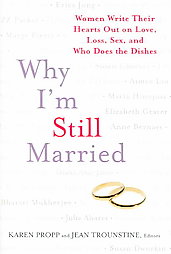
Why I’m Still Married. Women Write Their Hearts Out on Love, Loss, Sex and Who Does the Dishes. Edited by Karen Propp and Jean Trounstine.

Although the title of this collection of essays: “Why I’m Still Married,” is not posed as a question, it would be a good one to ask. And the writers in this evocative anthology answer it with a warts-and-all account of their “successful” relationships. When we are young, and even not so young, we let ourselves imagine that marriage will be angst- free, a union of undying love with our much desired mate. Ah! But then reality rears its ugly head! The ladies in this anthology, expertly edited by Jean Trounstine and Karen Propp, have a wide range of stories to tell, and they ain’t always pretty. Often many of our partner’s flaws reveal themselves after the wedding ceremony, and tolerance, compromise, compassion, and accommodation have to come into play. According to statistics many couples today are quick on the trigger for divorce as soon as they see a few red flags. The testimony of the women in this book is that in spite of the problems a relationship can present; it is worth it to try to make a go of it.

The celebrated poet Marge Piercy has had multiple relationships, open relationships, affairs, the whole spectrum of liaisons. Finally, in her later years, she married a man 13 years her junior, the writer Ira Wood. Piercy writes about what she feels is the secret of a good marriage, and how it often fits us better as we age:

“I need to know that my partner has my back, is on my side, can be trusted out of my sight; Ira needs that also. He had to learn to live with cats in order to live with me. I had to learn to follow and understand football in order to live with him….

“You learn where your real boundaries lie as you make your way through a marriage, where you can give away, and where you cannot. When you are young, it’s no particular advantage to be married unless you are having a baby and want help and support. When you’re older, it is much more valuable to be in a marriage. Who has time or patience to date over forty unless you absolutely have to. We need each other more as we age, not less. Growing old together is, in part not forgetting to grow.”

Kathleen Aguero, a poet and educator, writes about her relationship with a man who had a very hard time controlling his explosive anger. But she stuck by him, and has not lived to regret it. Aguero writes:

“Describing the tender disciplines and pleasures of marriage is difficult for me. The pleasures of our relationship are mundane—shopping together for kitchen linoleum at the Home Depot, reading together in bed… He buys me flowers for no particular occasion. I buy him espresso beans covered with dark chocolate….All that anger and shouting, all those tears had bound us in good ways as well as bad. We’d seen the worst of each other and still on balance wanted what we saw. We love each other. But that’s not it, not enough. In the end I can’t explain why I didn’t divorce any more than I can explain why I married. I wanted to/I didn’t want to. At the core of my deepest commitments is something mute, a koan.”

This book is written by women, but this man got a lot out of it. I saw myself in many of the men portrayed here. When I read some passages to my wife of 12 years, she laughed in recognition. The women in this book are not pointing fingers. They admit to flaws and multiple mistakes themselves. What this book provides is a “true” account of what a relationship is: its ups and downs, its ying and yang,

For these women the right move was to stay in their marriages. But the point is clearly rendered that there are no definite answers in matters of the heart. In the end it is your decision to stay…or go away.

Doug Holder/ Ibbetson Update/ April 2006.

The book is $25 from Hudson Street Press. ( Penguin Group)

Sunday, April 23, 2006


David McNamara: For this Somerville, Mass. publisher it is always: “sunnyoutside.”

David McNamara founded and operates “sunnyoutside,” (http://www.sunnyoutside.com/ ), an independent literary press located in Somerville, Mass. McNamara studied literature at Long Island University, Ohio State, the “Poet’s House,” in Ireland, and Farleigh Dickinson University, where he earned his B.A. David has been widely published in the small press, as well as being the director of the magazine “ism,” that was based in Seattle in the late 90’s. He still is writing and has a collection of poetry coming out “Or,” from Hemispherical Press.

Doug Holder: “sunnyoutside” was founded as an online literary journal in 2000. In 2004 you went to print. Why did you decide to make the change?

David McNamara: “suunyoutside” online folded because I was unable to keep up with submissions. I basically just submitted and wrote for awhile. Later the creative urge to start publishing came out. “sunnyoutside” had a logo, a website and somewhat of a following. It just seemed logical to stay with the name.

DH: Can you tell me about the Emerson College (Boston, Mass.) publishing program you graduated from?

DM: The program is basically 12 months. They break it up into four modules. It is a crash course for publishing in the ‘real world.’ Most of the people in it are looking to get editorial and publishing positions with trade publishers. The modules were editorial, marketing, business and production. I’ve been working in publishing for 10 or 12 years. I really didn’t have a good grasp of the business side of things. So the program prepped me to run a business and to market it.

DH: Small press publishers of poetry rarely if ever make a profit.

DM: There is a couple out there. One is the University of Pittsburgh Press. Of course they have university funds to depend on. “Black Sparrow,” made money on Bukowski and other authors.

I hope to expand from poetry to fiction. I also have an interest in non-fiction.

DH: Is there a mission statement for “sunnyoutside?”

DM: That’s a tough one. I think I changed it a few times. I want to publish works that are crafted and skilled on the contemporary literary landscape. From a production standpoint we really emphasize the quality of the product. We want to create a visual format that represents the text well. The presentation should not detract from the text. It should accenuate it.

DH: You describe your press as a “Fine Book,” press. What is that?

DM: We are an ‘aspiring’ fine book press. Fine presses usually work with a letterpress. They are not going to use digital reproduction. The technology that I use goes back to Gutenberg.

DH: Do you think the physical book is threatened by the internet?

DM. Threatened? I can’t dispute that. Readership for books has and will go down. I don’t think extinction will happen. There is too much value with holding what you are reading. We are still seeing more and more books on the market.

DH: Are production values as important as the actual content of the book for you?

DM: Yes and no. Only once did I publish something based on what I thought I could do with it. The text really has to stand out by itself. It still has to be good.

DH: Reviewers don’t often comment on production value. Is this frustrating for you?

DM: It’s at times loveless work. It is kind of frustrating. I put in a lot time into something like paper and soliciting an artist to do the work. Then the review comes out and says what a great job the artist did. And the artist did do a good job, but the reviewer doesn’t see behind the scene. There is a part of me that wishes I got more attention.

Dh: You just published a book by the San Francisco poet William Taylor, Jr. titled: “So Much is Burning.” What attracted you to his work?

DM: Everything I accept has to be accessible and more than one dimension. With Bill’s work, anyone who reads it, can appreciate it. He writes about the downtrodden of society in a way in which anyone can enjoy it. He explores the dichotomy of beauty and ugliness in a skillful way.

DH: Where are your books carried?

DM: “Powell’s” in Portland, Oregon, hopefully the “Trident,” in Boston, hopefully “Porter Square Books,” in Cambridge, Mass. and “City Lights,” in San Francisco. The cover of William Taylor’s book is modeled on the “City Light,” books style. We also have books at “Logos Books,” in Santa Cruz, California.

DH: You publish in other formats, right?

DM: The first publication we did was a broadside (one sheet of paper- published on both sides) I am going to start a postcard series, and we also have produced mini-chaps.

DH: Talk about the writers you published?

DM: We have done a few things by William Taylor Jr. We have published a couple of things by the poet Nate Graziano. I have four essays by A.D. Winans that might be our first work of non-fiction. Winnans founded the “Second Coming Press,” in the 70’s in San Francisco. The press was well-known for publishing Bukowski, among other things.

DH: What do you think of Bukowski’s work?

DM: I respect it. Bukowski is Bukowski. There are a lot of spin-offs in the small press by people who are trying to write like him. This is a paradox because, again Bukowski is Bukowski. He was one-of-a-kind.

DH: Do you need a formal education to be a poet? Do you need an MFA?

DM: Not necessarily. My education has definitely helped me as an editor. There are a lot of writers out there whose work I like, who don’t have their MFA. On the other hand there are a lot of people who have them whose work I like. I think if you are going to write novels what you learn in an MFA program is invaluable. This is being said by a person who does not have one.

DH: What are your ambitions for the press?

DM: I’d love to do trade publishing. It’s hard when you are dealing with relatively obscure writers. I would like to transcend the small press yet still be in it. I want to do trade publishing as well as fine press publishing.

Doug Holder for more info. About sunnyoutside go to: http://sunnyoutside.com/

Thursday, April 20, 2006

Endicott Review. Spring 2006. (Endicott College Beverly, Mass.) No. Price.

Having been a visiting poet in Nov. 2005 at Endicott College I can attest to the fact that the college has an active poetry community, as evidenced by their literary mag: “The Endicott Review.” Don Sklar, poet and head of the Creative Writing Department acts as a faculty advisor, along with Ruth Henderson. There is a lot of good stuff by students and people some way connected to the college on these pages. “At Sixty-Five,” (a poem by John M. Freiermuth), is a lyrical guide to the “stages of man.”

“At forty-five, I admonished my parents, “Don’t ever get old!”
But like the kids they had become,
they didn’t listen to the parent in me. Now I can hear
the faint whirring of Grimm’s scythe…”

In “Leaving Lansing, 1945,” Jack Murray brings us back to our seminal foray into the world-at-large. In this poem he uses detailed, evocative writing to capture an eighteen year old would-be artists’ first trip to Chicago:

“Chicago
a big dirty city
windy cold place,
hot like a steam-bath
in July…gangsters and thugs too
neighbors warn me.

yet I pack
my favorite things,


“new suitcase
with straps and brass buckles
rests on the rack above me
…a graduation gift.
light in the cars
is semi-darkness
occasional shuffling and snores.
I hear the porter call
Valparaiso, South Bend and Gary.
in blackness the train speeds
towards dawn and Chicago.”

There is also fine work by Sean Teaford, Betsy Retallack, and others. Included are photos and artwork. I would have included a bio section…but you can’t have everything. This digest-sized journal joins the ranks of student magazines like “Watermark” (U/Mass Boston), “Dudley Review,” (Harvard University), and “Clarion,” (Boston University), and does itself proud. Dan Sklar tells me Endicott is starting an MFA program so stay tuned for other developments!

Doug Holder/Ibbetson Update

Tuesday, April 18, 2006


Day Mark: Poems by Lee Briccetti: ( Four Way Books POB 535, Village Station N.Y. 10014) http://fourwaybooks.com/ $15.

During poetry month in April 2006, I went down to New York City to attend the “Poets House Showcase,” and reception for poetry publications for the year 2005. Housed in the SOHO section of the city, “Poets House,” a venerable resource for poetry and poets for decades, is going to move to the Battery Park section on the lower tip of Manhattan. At the reception I had the pleasure to meet Lee Briccetti, the executive director of “ Poet’s House.” Later I received a copy of her first poetry collection: “Day Mark.” Being somewhat of a poetry activist myself, it is always heartening to see a fellow activist come out with a book of his or her own work. So often we promote other “stuff” and let our own work hang in the wind. Briccetti’s “Day Mark,” definitely will leave its mark. The poetry is vivid, ethereal, and has a deep emotional investment.

Personally I love poems about collections of any sort. Poems that are lists, artfully done can illuminate the textures of our lives. In “Apartment Archive,” Briccetti, who oversees a large archive of books at “Poet’s House, uses an archive of concrete images with evocative affect:

“ Moving to the 36th floor, facing south, I had the illusion of living in open
sky, in two rooms of things around me. And because I had packed
my dead father’s house,

I imagined my posthumous life refracted in the implicit intimacies of my
collected thing…

--blue airmail letters, buried bones I alternately dig up or bark at;

--and the rabbit fur hat my best friend gave me in third grade, glamorous
awaitedness of womanhood;…

--Modest and lucky, it’s the view of the river I still love, blue-gray abundance

spread out like the ancient silvery times I live by


And in the title poem: “Day Mark” we have an enigmatic and moody piece concerning the post 9/11 aftershock:

“… There is a blister on my mind.
I agree to that.

Moment as the plane, four blocks away,
Turned, angling in—and I knew

They would be dead but I would live.

And so it is.

Time, a membrane
We both slipped through, into the next
Moment when I could scream.


Personality swallowed itself to a nerve:

Live.

I live
Above the pit, river
A gorgeous frame

For abundant new morning light.


This is an accomplished first collection by Lee Briccetti.

Doug Holder/ Ibbetson Update/ April 2006/Somerville,Mass.

Sunday, April 16, 2006


Interview with Poet Sarah Getty: A Poet who mixes the concrete, with metaphors and emotions….

Sarah Getty is a poet who believes that concrete imagery, as well as being in touch with one’s emotions, are necessary to write poetry. And indeed, Getty’s poetry is full of both, and her work has a descriptive and evocative abundance. Getty is an award-winning poet and fiction writer living near Boston. Her most recent collection of poems is: “Bring Me Her Heart,” (Higganum Hill Books, 2006) Getty is the recipient of a “Cambridge Poetry Prize,” and won the “Barbara Bradley Prize,” from the New England Poetry Club. Her wok has been in such journals as: “The Paris Review,” “The Massachusetts Review,’ ‘The Larcom Review,” and many others. I talked with Getty on my Somerville Community Access TV Show: “Poet to Poet/Writer to Writer.”

Doug Holder: In a review of your new poetry collection “Bring Me Her Heart,” the reviewer writes that your work indicates to the reader and other writers that they ought to learn more. Why do you think your work is so informed?

Sarah Getty: I have a PhD in English so I have a rather broad range of knowledge.

Doug Holder: Is it arcane knowledge?

Sarah Getty: No. I wouldn’t say it’s arcane. I use some of the best known Greek myths in my work. I have always been a big reader and I have a good memory.

Doug Holder: But don’t you think most poets have a broad range of knowledge?

Sarah Getty: Well… It’s partly because of my age of course…. I mean I have a lot more time as a writer. When I was in school there was probably more attention paid to traditional literature. I think this is now lacking in public education. Education today seems more concerned with boosting the student’s self-esteem.

Doug Holder: You have a new book out: “Bring Her My Heart,” by Higganum Hill Press. Richard Debold, the publisher told me his editorial board shies away from work that is “self-referential.” How would you define your work?

Sarah Getty: Some of it is self-reerential. I think he means “just,” writing about yourself. My poetry deals with issues like death, by putting it in the context of Greek myth, etc…My editor wants work that refers to more than the poet himself.

Doug Holder: But isn’t the poet’s experience part of the common bond of humanity.

Sarah Getty: Indeed this is true. You can write things that are universal without referring to Greek myth. The more specific you can be, the more universal you will be.

Doug Holder: In your poem: “Leonardo’s The Coition of a Hemisected Man and Woman,” you brilliantly dissect a DaVinci sketch of the anatomies of a man and woman. You write that DaVinci started the search for the “essence,’ of man…” but we hapless humans still…hop about hapless and hopeful/ as the half Chick, creating fictitious forms, to fulfill speculative functions. Explain.

Sarah Getty: (Laughs) That was quoted from a scholar’s writing about DaVinci. Although we credit DaVinci with being one of the first people to dissect cadavers, he made a lot of mistakes. He created fictitious forms of speculative function. I meant we blunder around in our lives just as people did 500 years ago. In matters of the heart we are still speculative,

Doug Holder: In the poem “Late Day,” in your new collection, you recreate a scene that uses a rural pond as a backdrop for a reflection on death, or perhaps our ultimate divorce from nature. You write:

“When three Mallards glide by, green heads
gleaming. When sound sleeps. When,

for an hour, there is nothing to wish for.
When the air cools and the water

darkens. When gray geese raise a ruckus,
saying you cannot stay.”

Do you think we are drawn to images like the sea, the sunset, because they are in effect dramas about the cycle of life and death?

Sarah Getty: They are natural symbols. Yes. You sit in lake, during a golden afternoon…everything is beautiful…everything is perfect. But these geese are making a noise that implies: “you cannot stay.” On the first level it means: “I have to go home and make dinner.” But on the other it signals mortality. There is a lot of thought about our mortality in the book.

Doug Holder: You run workshops for poets. How do you approach the novice?

Sarah Getty: I basically have a two-sided approach. One is to concentrate on concrete images in the poem. Concrete images are important. I also encourage them to expand their vocabulary. I have them use the dictionary, and use words that they don’t know.

Doug Holder: Why is it important to expand their vocabulary?

Sarah Getty: It’s like you have a small wardrobe and you want to expand. The other approach I use in my workshops is for the poets to get in touch with their emotions. I make them imagine something they encounter, the ghost of their mother, etc… Something evocative.

Doug Holder: You are a singer. How does that fit with your life as a poet?

Sarah Getty: I am a member of the “Master Singers,” that perform in Lexington, Mass. for the past 30 years. I do think there is a connection between poetry and song. Poetry is about sound and rhythm.

Doug Holder: How hard is it to get a poetry book published?

Sarah Getty: It is very hard. It helps to be in the area for a long time. I have and I built up a large personal network. Both of my books were published by people I know. You have to get a practical approach or you are going to put your poems in a drawer like Emily Dickinson.

--Doug Holder. For more info. On Sarah Getty go to http://www.sarahgetty.net/

Tuesday, April 11, 2006


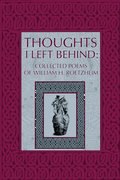
Roetzheim, William H., _Thoughts I Left Behind_. Jamul, CA : Level 4 Press.
179 Pages. Softcover, Perfect Bound. $14.95 US plus shipping. For
ordering information visit www.level4press.com.

Review of _Thoughts I Left Behind

Fertility Doll

Returning home I brought my wife some gifts,
among them was a carved figure—an ugly
woman with huge breasts and bigger belly.
Hawaiians said her name was Hi’iaka.
She stood beside our bed and watched, her eyes
reflecting red in candlelight, her shadow
dancing with obscene and naked joy
to hear Bolero by Ravel, to hear
the primitive music of need and want.
And in one month my wife told me that she
was pregnant after trying for so long.
We loaned her out to Loni, who was pregnant
that same month. And then the breathless call
when Hi’iaka had the same results
for Betty Lou, after four years of trying,
crying, clinics too. but now my laughing
wasn’t easy, now I found that I
was queasy when I thought of Hi’iaka’s
naked dancing, watching with those eyes
that seemed to glow.
I know, I know she’s just
a doll and not a god, not like my god,
the western god that toppled her and all
her kind two hundred years ago, although
she dances on our wall, her shadow leaps
and falls, and quietly she plants her seeds
of pagan thought, of faith in ancient gods.

Those of you who have followed my reviews by now have most likely learned
that I’m a relatively hard critic. Were I to put a book of my own out into
this shark pit, I’d probably be the last person I would want to write on it.

Another thing that may or may not have been evident in reviews that I have
formerly written is that I seem to have developed somewhat of an abhorrence
toward metered or formal poetry. It often doesn’t have so much to do with
the pieces themselves as it does with having so many momentarily inspired
pieces cross my desk by students who have just been reading Wordsworth’s “I
Wandered Lonely as a Cloud.” In three separate classes I have assisted, I
have heard no less that five would-be poets exclaim “I think in rhyme! It
just comes naturally to me.”

So when I open Roetzheim’s _Thoughts I Left Behind_, my initial response is
one of horror. All those old memories of workshop failures come to life,
and a teeny, meter-loving tapeworm starts doubling me over. If I’m to bide
my time reading formal, metric poetry, it had better be damn good.

This book is. Very good in fact.

Roetzheim’s critics have praised the poetry of _Thoughts I Left Behind_ for
its honesty (Gene Auprey), its personal nature (Stephen Scaer), and its
humor (Jackleen Holton), amongst other things. What takes me by surprise
mostly is that in Roetzheim the reader finds perhaps one of the few poets
who has ever picked up a pen and been able to write in form without sounding
trite or forcing rhymes. Where other poets have modified the sonnet form
and called it the “New Sonnet,” and pretty much classified any 14 line poem
as such, Roetzheim is able not only to maintain original Petrarchian form,
but also to do so without making the reader hear somewhere in her head “duh
DAH duh DAH duh DAH duh DAH duh DAH.” It’s subtle, it’s iambic, and in the
few moments where the toughest of critics could go so far as to call it
forced, the emotion and timing is so poignantly accurate, so aptly placed,
that it takes more nitpicking than this reviewer is capable of to point it
out, or let it detract from the poem.

Another thing that greatly impresses me with this book is that Roetzheim
remembers that poetry does not always have to be sullen and serious. There
are two sections of the book titled “Responses to the Dead” that portray the
poet’s reactions to several of those archaic, beastly poems that got us all
writing terrible poetry in high school. Such poems as Rossetti’s “When I am
Dead, My Dearest,” Byron’s “She Walks in Beauty,” and Donne’s “Death be not
Proud” are critiqued and parodied in such accurate and cynical wit that I
found myself quoting them to friends the next day at work. In a response to
Hardy’s “A Broken Appointment,” which is a melancholy piece about the
speaker’s lament that his date never showed up, Roetzheim borrows the meter
and writes:

I mean, I like this piece, its poignant mood,
And poetry to get revenge is cool,
But nowadays we say, “Get past it, dude!”
And real friends tell you when you are a fool, [lines 3 – 6]
I am there with the speaker of this poem. I have my tongue in my cheek
along with him. Moreover, I was thinking the same thing when I read Hardy’s
poem in the first place.

The first notes I took as I began to read this book and prepare for review
read as follows: “Unless you are a lover or meter, specifically iambic, and
are not opposed or put off by rhyming poetry, this book is not the book for
you.” Now having completed reading the book a second time, beginning
through it a third, emailing fragments of the material herein to friends,
jotting down stanzas on the back of notebooks, I can say this: If you buy
one book of poetry this year, make it this one. Tired of being beaten over
the head with Hallmark rhyme? Here’s a book that proves that there is at
least one poet left who can still write in meter without making you feel
like someone’s banging a cast iron pot near your head. But regardless of
your stance on metered poetry, herein lay fine poems of content, emotion,
and universality. The shear grace with which Roetzheim writes proves that
he is a master at this craft. _Thoughts I Left Behind_ is a journey that
you won’t want to miss.

Dave Anderson
Ibbetson Press Update /Somerville, Mass.

Monday, April 10, 2006

Wilderness House Literary Review # 1/1
WHLReview
145 Foster Street
Littleton MA 01460

The Wilderness House Literary Review is a publication devoted to excellence in literature and the arts.

The WHLReview is published online quarterly with a best of annual print edition.

Deadlines are as follows
March 1 - Spring
June 1 - Summer
September 1 - Autumn
December 1 - Winter

The annual edition will be published in May.

Editor & Publisher
Steve Glines

Poetry Editor
Irene Koronas

Fiction Editor
Julia Carlson

Nonfiction Editor
Steve Glines

Book Reviews Editor
Doug Holder

Arts Editor
Steve Glines

Poet in Residence
Tomas O'Leary

The Wilderness House Literary Review
is the result of the cooperation of the
Bagel Bards,
and the
Wilderness House Literary Retreat.

Submissions

Poetry may be submitted in any form.

Short fiction may be submitted in three formats:

1. very short stories less than 500 words in length
2. short stories less than 1000 words in length
3. Short stories that don't fit the above should be less than 5000 words.

Non-Fiction is just that so lets see some interesting footnotes.

Book Reviews should be positive unless the author is a well-known blowhard. Our mission is to encourage literature not discourage it.

Non-fiction should be short, (a lot) less than 5000 words.

Any form of art may be submitted with the constraint that it must be something that can be published in 2 dimensions. It's hard to publish sculpture but illustrations together with some intelligent prose count.

Published works are welcome with proper attribution.

Please submit all works electronically.
Welcome to the first edition of the Wilderness House Literary Review. WHLR is a result of the collaboration between a group of poets and writers who call themselves the Bagel Bards and the Wilderness House Literary Retreat, itself a cooperative effort between the Rotary Club of Littleton Massachusetts and the New England Forestry Foundation. All of the stories, articles, poems and examples of art have been presented as PDF files, Portable Document Format. This is a format that allows for a much cleaner presentation than would otherwise be available on the web. If you don't have an Adobe Reader (used to read a PDF file) on your computer you can download one from the Adobe website. The files are large and we hope you will be patient when downloading but we think the beauty of the words deserver a beautiful presentation. Enough housekeeping.
It's always a pleasure to present a new collection of art and literature. When we started to assemble this issue none of us expected the volume of submissions. It was a pleasure making this selection. Since this is our spring issue and we are hungry for sunshine after the drab confines of winter we begin with a poem by Tomas O'Leary, our poet in residence, titled 'Sermon on Sun Worship.' We hope that warmed you up.
Essays
When you get to a certain age many of us discover that we are living in an age of regrets, not for what we have done but for what we left undone. How many of us wish we could go back and tell our first love what they still mean to us. Charles Campbell tells us in two essays about the first two meaningful relationships of his adult life. He's asked us to post his biography lest some think he is stuck in the past.
Charles Campbell is a man who reached 60 years of life managing to accomplish nothing of note but a happy marriage of 34 years, so considers himself an extremely successful man. He has not written anything except a check for most of those decades. He currently resides in Georgia.. "If Lou Gehrig is the luckiest man on the face of the earth, he must feel my hot breath on the back of his neck."
We start with 'Red Sky at Night' followed by 'Red Sky in the Morning.' We secretly hope he finds a very wide audience.
On the literati of Philadelphia
Meeting at the Pass by Afaa Michael Weaver
Mathematical musings by Irene Koronas
Ellipse and Parabola
Zero begins end
Friends, family and reform school by John Hildebidle
Strict Objectivity
A New Relationship
Mathew
The Class Struggle
Winter musings
Urban Orchard by Steve Glines
Fiction
October Run in Danehy Park
By Sarah Merrow
28th Century Milky Way Conference on Hieroglyph Philology. Paper 27-09:
By Edward Abrahamson
Over life (about my dead aunt)
By Irene Koronas
THE QUIET ROOM
By Doug Holder
Poetry
Modern life is fast. None of us have the time to .... fill in the blank here. Where once the literary inclined might have written a serialized Victorian novel now we find the poet and chapbook. This is not your grandmother's poetry, the standard measures of poetry, meter and verse, still exist and are thrilling to hear when well executed but most modern poetry is what the classic academics might condescendingly call experimental. Filled with blank verse and prose, poetry is illustrative, gestalt filled, post-post modern expressions of short fiction, short essay, short .... It is Picasso to Rembrandt, e. e. cummings to Shakespeare. How often have you read a short work and exclaimed metaphorically, "Wow that's poetry." Today it is poetry. America is experiencing a vibrant literary renaissance. We offer a sampling of it here.
A D Winans
Afaa M Weaver
Alan Catlin
Barbara Bialick
Bill Costley
Carolyn Gregory
Chad Parenteau
Clara Diebold
Deborah Priestly
Diana Der-Hovanessian
Doug Worth
Ellaraine Lockie
Eric Greinke
Francis Lemoine
Harris Gardner
Howard Lee Kilby
Hugh Fox
Jennifer Matthews
Joanne Vyce
John Hildebidle
John Mercui Dooley
Julia Carlson
Kelley J White
Kevin McLellan
Lainie Senechal
Lo Galluccio
Marc D Goldfiner
Matthew Silver Rosenthal
Molly Lynn Watt
Pat Brodie
Patrick Carrington
Philip E Burnham
Richard Wilhelm
Robert K Johnson
Sarah Merrow
Stephen Morse
Taylor Graham
Tomas OLeary
Visual Art
We take pleasure putting our logo on top of interesting works of art. For our arts section we have chosen to place out logo on top of an exceptional work of art by Jenny Lawson Grassl. A version of the original art may be found here.

The masthead (at the top of this page) is our logo placed on a work by Irene Koronas who is also a writer and out poetry editor. If out masthead was a teaser here is a further sampling of Irene's work.
For some reason many poets are also visual artists and Deborah Priestly is one of them. Her poem 'tree of cats' may be found above in the poetry section. We thought it fitting to show off a sampling of her art with a painting of a cat.
We know we said no 3D art but photograph of this sculpture by architect William Turvelle somehow fit.
That is it for out Spring 2006 edition. The deadline for out Summer edition is June 1. No doubt there are errors and omissions. Please bring these to our attention.
As we said when we started this is a joint production of Wilderness House Literary Retreat and the 'bagel bards'. The 'Bagel Bards' have just published their first (and we hope of many) anthology. You may purchase it here:


A new and exciting travelog:


var sc_project=1219946;
var sc_invisible=0;
var sc_partition=10;
var sc_security="0431345a";

Thursday, April 06, 2006

Main Channel Voices. Spring 2006. ( POBOX 492) Winona, MN. 55987-0492 Winona, MN. $7.50 mcvsubmissions@mainchannelvoices.com

This is a solid small press poetry magazine with unpretentious production values, put out by Nancy K. Peterson and Carol Borzyskowski. There is a lot of very good poetry on these pages, with poets like: Richard Fein, Karla Houston, Paul Hostovsky, Charles Ries, and Patricia Wellingham-Jones gracing the magazine.

Here is a small gem of a poem by Carol Carpenter “Pushed by Passion,” that equates of all things: dirt with sex:

“Aunt Violet loved the smell of dirt,
the way it felt, the way
it crumbled in her hand.
She said it reminded her of sex…

Aunt Violet knew how those leaves had burst from bulbs,
How they licked nutrients from dirt. Those leaves
Wiggled upward, pushed by passion to reach the light.

Aunt Violet rose from the ground, her knees brown
With dirt, her flesh hot and sweaty. She had waited
Months for the vernal equinox, for that musky smell of love.”

In Charles P. Ries poem: “Below the Floor,” the poet tells how it is live in an “underground,” state of mind, with flights of vivid imagination:


“My ex-wife lives one floor above.
10,000 miles away.
My daughters with wings
Sail between heaven and earth.
Getting honey from the clouds
And iron from the brown soil.

This journal is well-represented by skillful, accessible, and sometimes visionary small press poets. Highly Recommended.

Doug Holder/Ibbetson Update/Somerville, Mass. /April2006.


My possessions are ideas.
My lovers names all rhyme.
My conquests are fictionalized.

The shadow side of home sweet home,
Where a giant prowls naked
Beneath the floor and ideas
Grow during intercourse.

Monday, April 03, 2006


Edward J. Carvalho is a twice nominated Pushcart Prize writer, who has been writing poetry for over 20 years. He is the author of several chapbooks, and is shopping around a manuscript “solitary, poor, nasty, brutish and short.” His poetry has been admired by Martin Espada and Nobel-prize winner Elie Wiesel. Carvalho’s poetry has been published in journals around the country. He holds an M.F. A. in Creative writing from Goddard College and will be pursuing his PhD. I spoke with Carvalho on my SCAT TV program: “Poet to Poet/ Writer to Writer.”


Doug Holder: Tell me why you chose the Thomas Hobbes quote for your manuscript “… the life of man is solitary, poor, nasty, brutish and short?” Is it?

Ed Carvalho: I always run the risk when I use a quote like this as coming across as a guy who probably lives a life like this. I chose this quote because there was an ethics class in the early 90’s when I was in college. I was an undergrad and Thomas Hobbes philosophy of mechanistic materialism had a cynical edge to it. I thought he had a very honest appraisal of life. I really do believe in many cases that the life of man is solitary, brutish and short. The philosophy of Hobbes stayed with me. It kind of came out in the poetry manuscript. It has become a theme for me.

Doug Holder: We all “affect,” a style, whatever walk of life we come from. You wear a leather jacket, a formidable goatee, a tight fitting black wool cap…you look like a biker.
What’s the deal?

Ed Carvalho: People always ask me: “Do you have a motorcycle,” and I say: “No, I have a Honda Civic.” I grew up in New England my whole life. I had ski hats since I was a little kid…winters can be brutal. It became how people recognized me. I’d go out to bars…I used to sing in a local band…certain things become part of the consciousness of people.

Doug Holder: Where did you get the title for your literary blog “The Outlaw Goatee??”

Ed Carvalho: I was reading old, old laws that are still on the books in the Commonwealth. One of the laws states that is illegal to have a goatee in the Commonwealth unless it is registered. I thought in a poetic way it was funny. So I refuse to register my goatee!


Doug Holder: In your poem: “sometime boy”, you write:

“what happens to the life of a man,
when it sags, like that toothpick,
from the corner of your lips
is chewn by dentures
to its very end?”

Are you afraid that question will not be answered. That you, yourself, will be trivially defined at the end of your life?

Ed Carvalho: It’s a great question. I do fear not leaving some kind of mark, not living up to my potential. In the poem the observed character, was dreaming about things that he may not have realized. Maybe he was a “sometime boy,” that missed his calling, or opportunity. This was one of the things I was thinking of when I was writing the poem. I am always thinking about if I am on the right track.

Doug Holder: Your work has been described as brutal. Has your life been brutal?

Ed Carvalho: Well... a white kid growing up in suburban Connecticut…it’s hard for me to say that. I think we all have our own “human closet,” or “skeletons.” My mother was very sick when I was a boy and she died when I was in my twenties. These types of personal experiences have left me with a lot of anger. In that respect, yeah, I do bring a lot of my personal things in. I try to reflect on things that are personable as much as possible.

Doug Holder: You have taught poetry workshops at the “Out of the Blue Art Gallery,” in Cambridge, Mass. How do you approach the novice poet?

Ed Carvalho: I will find something that everyone can grab on to. Something from their everyday lives. I use as an example the poet Martin Espada. I think what gives him that mass appeal is that he is very democratic and grabs on to things that the layperson and poet can appreciate.

Doug Holder: What was your experience at Goddard College like? Are MFA programs factories?

Ed Carvalho: I can see how some programs can be factory-like. Goddard celebrated the individual. My work was very different from other poets at the program, but everyone was allowed to create their own little gem. It was a time of heightened inspiration.

Doug Holder: Disparate writers like Martin Espada and Eli Wiesel have admired your work. Why?

Ed Carvalho: I worked with Espada last summer. And I think we hit it off. I did an interview with him for the “Heat City Review.” We have a Whitman connection. He pulled me aside once and said: “You got it.” I got a letter from Wiesel in response to a poem I sent him and he wrote me back and told me he admired the work.

For more info about Ed go to: http://www.edcdwardcarvalho.com/

Doug Holder/ Boston Area Small press and Poetry Scene.

Thursday, March 30, 2006


Newton Free LibraryPoetry Festival Features Tino Villanueva, Steve Almond and Frannie Lindsay ( 330 Homer St. Newton Centre, Mass.)


In honor of National Poetry Month and National Library Week April 2 - 8, the Library will present its 33rd Annual Evening of Poetry, sponsored by the Friends of the Library.

Tino Villanueva, Steve Almond and Frannie Lindsay will read their latest poetry on Tuesday, April 11, 7:00PM, followed by an Open Mike with a one-poem/ person limit. Refreshments will be served. This festival and the year-long series are coordinated by Doug Holder, publisher of Ibbetson Street Press..

A writer, editor and translator, Villanueva is the founder of Imagine Publishers and editor of Imagine: International Chicano Poetry Journal. He has published six books of poetry, among them: Shaking Off the Dark; Chronicle of My Worst Years; and Scene from the Movie GIANT, winner of a 1994 American Book Award, now in bilingual format. His paintings and drawings have appeared on the covers of international and national journals such as Nexos (Mexico City), Green Mountains Review, TriQuarterly and Parnassus. He teaches at Boston University.


Lindsay’s volume of poetry, Where She Always Was, received the 2004 May Swenson Award sponsored by Utah State University Press. A former NEA Fellow and twice a Pushcart nominee, she has had work published in The Atlantic Monthly, Quarterly West, Harvard Review, Hunger Mountain, Field, Poet Lore, Salamander, The Yale Review and many others. Her work has been read by Garrison Keillor on NPR’s “Writer’s Almanac” and been featured on the websites “Poetry Daily” and “Verse Daily.”

Almond’s fresh and often provocative stories and poems have beenpublished in many anthologies and literary journals and broadcast on NPR’s “Morning Edition.” Among his honors are a Pushcart Prize, Mass. Book Circle’s Book of the Year, AP Feature Writing Award for Sports Writing (1989-91), fellowship to Bread-loaf Writer’s Conference and twice being published in The Best American Short Stories. He is the author of such popular and acclaimed fiction and non-fiction works as: My Life in Heavy Metal, Candyfreak and The Evil B.B. Chow. He teaches creative writing at Boston College and serves on the faculty of Grub Street Writers.

Saturday, March 25, 2006

Charles Ries Reviews books by "Young" Poets

WORDS
By: Nancy Gauquier
12 Poems / 29 Pages / $5
Weird City Publishers
P.O. Box 8245
Santa Cruz, CA 95061

Words by Nancy Gauquier is mind blowingly clever, fast, nimble, insightful and fun. As I read Words, I thought how such new talent could write with this great range and agility? But then I found out this emerging talent was sixty years old and learned she, “flirted with theatre, tried stand-up comedy for a year or two on the gay circuit in San Francisco. They had the best comedy! And they actually let me on the stage!”

She has not been published much in the small press. “I have been published in several mostly local, now defunct, very small circulation literary magazines that very few people have ever heard of. And three publications that are still alive and functioning.” I than asked her how long she’s been writing, “I've written poetry off and on since adolescence, but only in the last few years have I decided to take it "seriously" (only I don't know if that's the right word). To commit to it. To trust myself to just keep writing. To not lose heart.” I asked her how she developed poems in this collection, “Words, Men, and Worried were all developed when I was doing comedy; Get Used To It and Angry Old Women were developed as spoken word at the New College Experimental Performance Institute. Aging Dysgracefully was the first poem I ever read at a slam (The Berkeley Slam, which is totally gung-ho and can be incredibly intense) and it was the first slam I had ever attended (out of curiosity) and I went way overtime, but it was still voted the best poem of the night. So I got reeled right in, and How Are You, The Fence Sitters Ball, My Muse, and Blues for Paul were all performed at slams (along with the other funny stuff, which the slammers love). The thing I love about the slams is -- it is so great to see so many young people caring so passionately about poetry. Any kind of poetry. Or spoken word or humor. It feels so vital and important. I think it has injected some energy into my work.”

Here is one example of her work from Words, it is titled, “Men”: “I just could never understand men! / But then I moved to the Castro, / and I discovered gay men! / Gay men are way easier to understand. / Most gay men actually want their partners / to have equal rights. / Most straight men say, “Oh, I’m all for women’s rights, I just don’t like feminists.” / That’s like saying it’s okay / if you want equal rights, / as long as you don’t think of any way / you might possibly get them.” And further along in the same poem, “I did crazier things than that / when I was young. / I used to wear this black fake-fur mini-dress / with these tight brocade bell-bottoms / and purple high-tops. / And hair down to my ass. / It was so thick, when I wore my glasses, / I looked like It! / I took acid every week! I danced naked in a graveyard in Bolinas. / I lived with a musician. / I fucked a perfect stranger / under the psychedelic puppet stage / at the Avalon Ballroom. / That’s what youth is for! / I should have said, “Yeah, I’m gonna die my pubic hair purple. Why not? No one’s gonna see it. ‘Cept me, and I could use a change.”

Not bad for a young, emerging talent with only a few publication credits

________________________________________________

THE SEEDY UNDERBELLY OF THE HIGH-FALUTIN’ OVERSOUL
By: Steve Henn
15 Poems / 15 Pages (30 Page Book) / $4
THE LAST REDCOAT
By: Oren Wagner
21 Poems / 15 Pages (30 Page Book) / $4
Platonic 3 Way Press
P.O. Box 844
Warsaw, IN 46581

Oren Wagner and Steve Henn are close friends. They are also co-editors along with well known Small Press poet, Don Winter of the new Platonic 3 Way Press. They are 28 and 30 years old respectively. They have been submitting work for about three years and have an average of eight publication credits between them. This is their first book of poetry. They divide the space between the covers; half the book entitled, The Last Redcoat is devoted to Oren Wager’s work and the other half entitled, The Seedy Underbelly of the High-falutin’ Oversoul is devoted to Steve Henn’s work.

I asked Henn about his background, “I don't know that I've started writing in earnest yet. I've been writing a lot more these past three years than ever before, but really I started in high school. There were several years of awful stuff, tho, and then after that several more years of mediocrity. For quite a bit of the last three years I've been thinking of myself as a prose writer who is too busy teaching and schooling to get at the novel I've got about 4/5ths of a complete rough draft of, but lately I've been thinking of myself more as a poet, intentionally trying to expand my abilities and come up with creative subject matter in verse. I don't buy that "find truth and beauty in the mundane" crap. I've always written to entertain, and primarily to entertain myself. Novel subject matter, taking risks with what I write about are what I find stimulating.”

Henn’s poems are direct, narrative, and clear. They are warm hearted and good natured. Here is an example of one of his poems entitled, “Church League Softball”: “Oren and I love softball but we don’t / believe in God, so we decided to collect / a team of atheists to join the church league. / We filed for entry, marking “other” / in the spot for affiliation. Our fake name / was The Church of One, as in one life, / one chance, no soul, nothing to pray / to or for but today and tomorrow until we’re dead. / The rumor spread that we were eastern mystics, / that our experience of Him bordered on the sexual. / Janice, our token woman, got a lot of attention / from opposing men. She’d wave her tight ass / back and forth in the batter’s box, and they / served ‘em up with a slight arc, aiming / for her sweet spot.”

Oren Wagner’s work in The Last Redcoat is equally well written, but has more edge and bite to it then does Henn’s. Wagner writes impressionistically. This may be a bi-product of his years as a musician where song lyrics by their nature are often not linear in structure. I asked Wagner when did he begin writing poetry in earnest? “I've been writing for about twelve years, I was 15 or 16 when I started, you know, sad teenage poetry kind of shit. I was about 21 when I started writing stuff that doesn't make me recoil in shame (retrospectively speaking.)” I asked about his education, “An honor roll student in the school of hard knocks. After high school I was in a couple of touring punk bands. I've lived in Detroit MI, Warsaw IN, Seattle WA, South Bend IN, North Manchester IN, Colorado Springs CO, Zionsville IN and now Indianapolis IN, six of those cities have been in the past eight years, so moving around has been very formative or educational...I spent a year in college in Colorado, and have spent the last three years at a university in Indianapolis. Since I can't go to school full time, I am on the eight year program.”

Here is an example of one of Wagner’s poems entitled, “icons of the virgin”: “icons of the virgin are painted in the etceteras on the wall / surface, texture, erosion. / you don’t know that I can hear assembly line / efforts in your voice. / midnight sky of Braille and Arabic numerals / counting, falling. dot dot dot dash, / immaculate Morse code for V,/not for victory or for varsity / or for virtue. /latitude lines on an uncreated earth / still have their degrees and intervene with longitude / baby born into a cartilage cage / a metaphor for the unspoken / benedictions for the perishing apostle / zodiac, monkey pox , increased rations / assembly line icons of the virgin / etcetera etcetera written on her face.”

This is a very fine set of poetry. Well crafted, clever, mature, visual, surprising – from the minds of two friends, editors and emerging poets.
__________________________________________________

JUST ANOHTER ADOLESCENT BRAGGART
By: Mark Gaudet
28 Poems / 41 Pages / $6.43
Order by going to: www.lulu.com

Just Another Adolescent Braggart is Mark Gaudet’s first print poetry collection. He is 36 and started actively submitting work to small press publications about a year ago. He has a degree in fine art, but no formal training in writing. In his bio he notes his major influences to be Charles Bukowski and William Carlos Williams. His poems are word light and earth bound. I was curious about his use of light-up words such as fuck, sex, cigarettes, booze, blow job, vomit. He told me, “I try not to use a lot of symbolism; usually what you see is what you get. I like it simple, to the point. I want my poetry to stand up, grab a hold of someone and slap them across the face. I like it hard and with an edge, but I also like to mix in some humor.” He went on to tell me, “But my first love is Bukowski. He told it like it was. For some reason his words hold my attention. I'm not reading something and saying to myself what does that mean? Or trying to understand the hidden meaning behind him screwing some woman while watching cockroaches scattering across the floor.”

I asked Gaudet if he could determine a writer’s age by their writing style or themes. I wondered if there was such a thing as young poetry and old poetry. Here is what he told me, “Its hard sometimes; I don't try to make judgments on someone's age. Hell there are kids in High School who write wonderful poetry, and people who've been writing poetry for 40 years, and their stuff is just plain shit. At least that's my opinion. Poetry's a funny thing you could write something half assed in the bathroom stall, and someone can think it's the next Jack Kerouac.” Maybe so, but good or bad writing does not seem to be a function of age.

Here is an example of Gaudet’s writing a poem entitled, “Replacement”: “We met / I found another / cute, naïve, innocent // happy? // Let me peel / her face back / probing through / bone / tissue / bloody pulp // Are you hiding in her?” And here is another example, “Killing Degas”: “Paint / on my pallet // Pretty / yellows / cyan /burnt / sienna // Mash together / biting the brush / not knowing / waiting // Horses over steeple chase / pretty ballerinas glide / across / his paintings // Bourbon and pills / hues / of vomit / green / and yellow / spew / across my / canvas // Voluptuous / women / bathing / in a tub // Slit / wrists / grasp / the shower tiles // French / Impressionist / American / Depressionist “

Gaudet writes in a non-narrative, impressionistic style that is more difficult to master. Some of the poems work and some nearly do. His best work are those poems that don’t push so hard and where he backs off the adverbs and elevator words, allowing his curious world to unfold before us – just as it is. All in all, a solid first book of poetry.

_______________________________________________________________

Charles P. Ries lives in Milwaukee, Wisconsin. His narrative poems, short stories, interviews and poetry reviews have appeared in over one hundred and twenty print and electronic publications. He has received three Pushcart Prize nominations for his writing and most recently read his poetry on National Public Radio’s Theme and Variations, a program that is broadcast over seventy NPR affiliates. He is the author of THE FATHERS WE FIND, a novel based on memory. Ries is also the author of five books of poetry — the most recent entitled, The Last Time which was released by The Moon Press in Tucson, Arizona. He is the poetry editor for Word Riot (www.wordriot.org) and on the board of the Woodland Pattern Bookstore in Milwaukee, Wisconsin. Most recently he has been appointed to the Wisconsin Poet Laureate Commission. You may find additional samples of his work by going to: http://www.literarti.net/Ries/ .

Monday, March 20, 2006


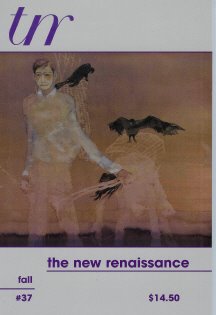
Simmons College hosts a gathering forthe new renaissance (tnr) celebrating the local literary magazine'snew issuetnr #37

Simmons College hosts a gathering for the new renaissance (tnr) : celebrating the local literary magazine's new issue, tnr #37: a reading with reception following. Wednesday, April 5, 7-9 pm, in the Trustman Art Gallery, 300 The Fenway, 4th floor, Boston. Free and open to all. For more information, contact Rachel Ruggles, Rachel.Ruggles@simmons.edu, 617-521-2220. Featured Readers: Marc Widershien, Doug Holder, Dan Tobin, Doc. Mal Hammond, and Afaa Michael Weaver.

Against all odds, the new renaissance (tnr) insists on upholding its over 37-year tradition of excellence by publishing tnr #37. Full of literary and visually artistic gems that provoke, titillate, satisfy, and/or haunt the senses, tnr #37 vibrates with contributions from the present and the past, pulled from the international, national, and local scene. Where else can Russian poet, Marina Tsvetayeva (1892-1941), Paris-born painter, Zevi Blum, Boston-based poet, Daniel Tobin, East German short story writer, Barbara Honigmann, traditional Chinese poets, Liu Yung and Su Shih (11th century), and an article on “Reigning in on Rainforest Destruction” by the UN’s Indian environmentalist, Ashindu Singh and Virginia-based international forester, Gyde Lund, co-exist?

tnr, established in 1968, has always been grounded in the real world. Each issue contains a lead article that deals with a hot socio-political topic. This is a rare approach in the literary magazine world in the 1960s and still is. tnr also differs from most litmags in its high emphasis on the visual arts. In tnr #37, artist Zevi Blum has eight fantasy-laden etchings and the talented but unpredictable Kai Althoff has nine “paintings” (his preferred term: drawings on canvas). The translations of non-English literary work are also visually engaging: the Chinese calligraphy and Tsvetayeva’s Cyrillic are displayed right alongside their English translations. In 1969, tnr was the first non-scholarly magazine to feature bilingual poetry (which, in 1980, became a tnr standard) and, in 1989, the magazine introduced bilingual fiction.

Some of tnr #37’s other highlights:--“Reigning in on Rainforest Destruction” cautions that “…if deforestation continues at its current rate, the world’s tropical rainforests will be wiped out within 40 years.” The authors conclude their article by suggesting the steps that governments, corporations, and individuals must take to prevent further destruction.--Russian poet Marina Tsvetayeva, who along with her more famous contemporary, Anna Akhmatova, is now considered to be the “other” great Russian woman poet of the last century. Like many Russian writers and artists of the early 20th century, Tsvetayeva led a life of suffering and sorrow – in 1941, she committed suicide.

--Many fine poems from American writers, including Daniel Tobin, a professor at Emerson College in Boston, and winner of many awards including the “Discovery/The Nation Award”; the Robert Penn Warren Award; the Greensboro Review Poetry Prize; and a Creative Writing Fellowship from the National Endowment for the Arts.--A satirical essay “The Swoon of the Unknown Soulmate” by Norman Ball, a widely published Glaswegian native, who lives in Virginia.--A review, “Blissful Dreams of Long Ago” by Ruth Moose of Helen Masson Copeland’s memoir “Pill Hill: Growing Up With The Mayo Clinic”. Moose teaches at UNC-Chapel Hill and is the recipient of many awards, including five PEN Awards for Syndicated Fiction, a Robert Ruark Award for Short Story, and a MacDowell Fellowship.--Other contributors: fiction by M.E. McMullen, newcomer, Kenneth Rapoza, Germany’s Barbara Honigmann, and Bruce Reeves; poetry by Karen Braucher, Miriam Vermilya, Lynn Veach Sadler, Thomas Robert Barnes, Myrna Stone, Karl Patten, Thomas Kretz, Alice Jay, Jay Baron Nicorvo, Judy Rowley, Ann Struther, and Marvin Solomon; and color photographs by H. Gyde Lund and Ashbindu Singh. Without a doubt, this tradition of mixing various artistic disciplines makes tnr unique in the litmag world. No matter the medium or the message, tnr “has only one criterion: excellence.” (Library Journal) Other acclaim for tnr’s unusual approach: Magazines for Libraries states that tnr’s writers “…write with a skill and objectivity rarely associated with the traditional little mag genre” and the Christian Science Monitor has proclaimed that tnr “…offers the originality one demands from a small press, without the annoying quirks ….

”An independent, unsponsored literary magazine (itself amazing in an audio/visual age), tnr is the brainchild of Louise T. Reynolds and her teacher at Columbia University, the award-winning short-story writer, Sylvia Shirley. While they were still collecting material for the first issue, Shirley collapsed at The New School and died. More than a year later, Reynolds returned to her home in Arlington, MA, to launch tnr#1 in October 1968. The dream had become real -- and its loyal subscribers have come to expect the unexpected.From the beginning, tnr took a somewhat different turn from traditional litmags. Reynolds and Shirley wanted tnr to be part of the real world, a literary canary as it were, in a universe that is sometimes as dark as coal. Their seeking in-depth lead articles on political/social issues alienated them at once from the world of belles letters, the traditional litmag approach, and it didn’t endear them to the world of the alternative press either. Their insistence on publishing pieces which they might not agree with or support, and on eschewing fashions, fads, and coteries by accepting work only on merit, made them an outsider even among the world of litmag outsiders.But with more than 175 of their writers/artists having received international, national and local awards after being published in tnr and with at least 70 having received such honors and awards before ever submitting to tnr, Reynolds and her talented staff believe they’re doing something right.

The Boston National Poetry Festival: Going on Six Years and Reaching Poetic Heights!

For the last 5 years, in April, (Poetry Month) I have participated in probably the most ambitious poetry event in the area: “The Boston National Poetry Festival.” This brainchild of Boston impresario, and “Tapestry of Voices,” founder Harris Gardner, will take place this year, as it has the last five years, at the Boston Public Library, Copley Square Branch, April8 and 9, 2006. Over fifty established and emerging poets will be reading as well as 15 1st and 2nd Grade students from the “Blessed Mother Theresa School,” of Dorchester, as well as students from the “Boston Latin High School.”

Each year Gardner, a man with a graying Einstein fro, and a generous amount of creative and nervous energy, manages to raise the funds and organize this Herculean effort, much to the admiration of the poetry community.

Gardner told me in a recent conversation we had that he will have several new poets in the lineup such as: James R. Whitley, Simmons College Literature Professor Afaa Michael Weaver, Endicott English Professor Dan Sklar, Stone Soup Poetry Coordinator Chad Parenteau, and Pulitzer Prize-winning poet Jorie Graham. Somerville will be represented with C. D. Collins, Lesley University lecturer Suzanne E. Berger and yours truly.

Gardner told me that he got a late start this year, but was able to raise the funds to keep the festival alive. He plans to include an open mic, and he is excited about student readings he has planned. As always there will be a book table. Gardner told me that it does a brisk business and people often get the featured poets to sign their books.

Although Gardner is better known as a poetry activist; he is an accomplished poet as well. He was a featured reader at the “Somerville News Writers Festival,” and has a number of collections and magazine publication to his credit such as: The Harvard Review, Ibbetson Street, Vallum, Aurorean, to name just a few… As Gardner told me: “I consider myself a poet first and foremost.”
The Boston National Poetry Festival starts on Saturday at 10A.M. (BPL-Copley sq. Branch) Sunday at 1PM. For more info go to: http://tapestryofvoices.com/

Sunday, March 19, 2006


Official Versions. Mark Pawlak. (Hanging Loose Press 231 Wyckoff St. Brooklyn, NY 11217-2208) http://hangingloosepress.com

Mark Pawlak, long-time editor at the “Hanging Loose Press,” reminds me of a lyrical “junk,” man—and I mean this in the best sense of the word. He collects phrases, archaic songs, ephemera from the past, and makes a strong poetic statement. In his poem: “A Boy’s Life, 1960” he pretty much lists things in a way that captures the unique texture of an animated, intellectually curious boy:

Painted candy-red stripe
on model ’56 Mustang; added decals.
Bowled three strings, made 5 strikes.
The Day The Earth Stood Still-scary!
Ice breaking up on Niagara River.

Easter. Bopschu’s sauerkraut pierogies
and duck’s blood soup!
Played charades with cousins.
Learning Latin to be altar boy (ugh.)
30 situps, 16 pushups.”

And how about this well-rendered picture of the owner of a cottage “resort,” on the coast of Maine in: “Hart’s Neck Haibun, Book 1 2000?” I think we all have encountered the type:

The “man of the house,” arrives later—the others, now gone were
relatives down for the weekend. In contrast to his wife’s girth, he
is skinny as a rail, has a nervous tic, and is weighted down by an
enormous ring of keys, dangling on a chain from his belt. (Mary:
Are you sure he is not a speed freak?”)

But anyone who is familiar with Pawlak’s work realizes there is a very strong political component to it. In: “All the News: Sept 23, 2001,” Pawlak has a deliciously ironic poke at the war in Afghanistan:


According to the Times,
Air Force bombers are heading
toward distant airfields
to fight a shadowy foe
flitting through mountains
in a deeply hostile land
already so poor and so ruined
by two decades of war that it is
virtually bereft of targets.

“FORGET THE PAST,”
the headline instructs
“IT’S A WAR UNLIKE ANY OTHER.”

I review a lot of poetry books, and I can say Pawlak has a very quirky, engaging and unique style. Recommended.

Doug Holder/ Ibbetson Update/ March 2006/ Somerville, Mass.
PRESS RELEASE: BOSTON NATIONAL POETRY FESTIVAL APRIL 8 to 9 2006.

THE BOSTON NATIONAL POETRY MONTH FESTIVAL !!
Now in its SUCCESSFUL 6th !!! Year
CO-SPONSORS:
Tapestry of Voices & Kaji Aso Studio in partnership with
The Boston Public Library. Starts Saturday, April 8, 2006 10:00 A.M.
To 5:00 P.M. and Sunday, April 9, 2006, from 1:00 P.M. to 5:00 P.M. OPEN MIKE
Sunday: 2:00 to 3:30 P.M. The Festival will be held both days at the library’s main branch in Copley Square.

52 Major and emerging poets will each do a twenty minute reading; also
Featuring 15 elementary school students from Blessed Mother Theresa School (Dorchester). These first and second graders will open the festival with memorized poems by Langston Hughes, Ogden Nash, Carl Sandburg, Shel Silverstein, other poets and their own original poetry. They will be followed by prize winning poets: Alden DiIanni-Morton, a junior at Boston Latin High School and Shari Caplan, a sophomore at Boston Latin Academy. The 53 major and emerging poets will follow with A POETRY MARATHON.
Some of the many luminaries include Jorie Graham, Diana Der Hovanessian, Rhina P. Espaillat, Afaa M. Weaver, Frannie Lindsay, Fred Marchant, Barbara Helfgott-Hyett, Dan Tobin, Charles Coe, Jean Monahan, Regie Gibson, Marc Widershien, Tino Villanueva, and Doug Holder.

In light of the very recent passing of the internationally revered and acclaimed artist/ poet/ opera singer and humanitarian, Kaji Aso, there will be a forty minute tribute during the festival. A number of poets closely affiliated with the Kaji Aso Studio will read Mr. Aso's poetry, both in his scheduled spot
in the Rabb Lecture Hall (Auditorium) and simultaneously in room 5-6 next to the Rabb.

This Festival has it all. A plethora of Professional poets, celebrities, a Pulitzer Prize winner; numerous award winners, student participation. Even more, it is about community, neighborhoods, diversity, BOSTON, and MASSACHUSETTS. This fast-growing tradition is one of the largest events in Boston to kick off National Poetry Month. FREE ADMISSION!!
For Information: Tapestry of Voices: (617)- 306-9484 or
617-723-3716 Library: (617)- 536-5400
Wheelchair accessible. Assistive listening devices available. To request a sign language interpreter or for other special needs, call (617) 536-7055 (TTY) at least two weeks before the program date.

For a complete list and schedule of Festival participants, please go to tapestryofvoices.com. Thank you.
Harris Gardner