Friday, February 24, 2012

Photos from the Ibbetson Street Press/Endicott College Visiting Author Series

Photos from the Ibbetson Street Press/Endicott College Visiting Author Series


*** Mack performed excerpts from " Conversation with my Molester." It had been premiered at the Boston Playwright Theatre at Boston University.


                  Left Poet/Performer Michael Mack, Right Series Director Doug Holder 


( Click on pic to enlarge)


( click on pic to enlarge)

Thursday, February 23, 2012

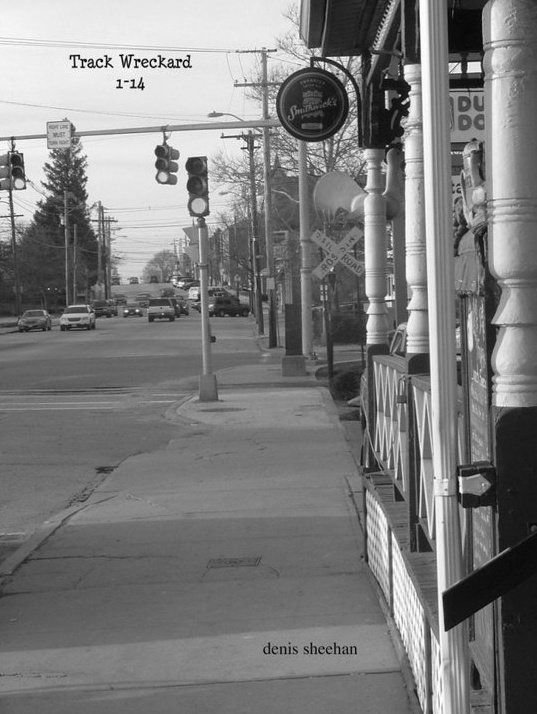
Train Wreckard 1-14 By Dennis Sheehan


A BagelBards Second Look Book Review


“Track Wreckard 1-14”


By Denis Sheehan


Bone Print Press, No price listed


Reviewed 2/13/12, Re-reviewed 2/20/12 by Paul Steven Stone


If it wasn’t a pun, I’d say here’s one for the books! How often does one write a book review one week, then come back the next week with an entirely different interpretation of what he read, and what the author achieved?


For me, this is the first time.


I felt pretty confident when I wrote my original review that the author had taken the easy way out in writing his book (novel, memoir?) by merely writing up 14 consecutive evenings spent in a local Rockland bar. His refusal to edit his writings, or even correct misspellings, made it seem like a labor of lassitude and, here’s the trap, a reflection of blue collar antipathy to the requirements of white collar literature. I’m afraid I wrote my review accordingly.


After all, if Denis Sheehan was going to force me to read about him sitting at a local bar night after night and get stinking drunk half the time, without even crafting his presentation, then I was going to call him out (always politely, of course) for his laziness, his lack of literary focus and, of course, for his obvious inattention to MY needs as an experienced reader with high literary standards.


It was only the next day after I submitted my review, when I was working on a new novel in which I play serious games with the reader’s status as a fly on the wall, that I realized what games Denis Sheehan had been attempting with his book, and that I had fallen into his trap.


If I can steal from my earlier review of Track Wreckard, I wrote…“Aside from developing a drinking problem, or feeling like I did, reading the book did an excellent job of replicating the boredom and pointlessness of a life spent without challenges or significant interests.”


I had hit a bullseye and didn’t even know it. For now I see that Track Wreckard is totally about conveying the blue collar grind of nightly visits to the Pub and daily penance paid at whatever form of grueling employment fueled the author’s need for nightly oblivion. Far from creating a novel that focused on sharing those short ups and deep downs in any literary sense, Denis Sheehan chose to dunk the reader almost bodily in the boredom, repetition, small glories and minor triumphs of his life. Unedited, uninterrupted by literary pretension or Spellcheck, unapologetically served out across 14 evenings of his life!


I apologize to Denis Sheehan for first reviewing his book from my point of view, which caused me to miss how well he had hit the mark from his point of view. By taking exception to the fact that most of the writing was done when the author was half- or wholly-in-the-bag, and not prettied up afterwards, I missed or misinterpreted the author’s ingenuousness in sharing himself and his world when they were at their most vulnerable and unattractive. Rather than accept my immersion in his world, I complained and wished for a world and a protagonist more attune to my tastes.


Whether you’re looking for a non-violent drinking companion or some insight into a world strangely close but ineffably distant, “Train Wreckard 1-14” might be just the cocktail for you.


Don’t be surprised if you find, as I did, that it merits a second sip.

Wednesday, February 22, 2012

Last Call: The Bukowski Legacy Continues


Last Call: The Bukowski Legacy Continues
Editor: RD Armstrong
Lummox Press
ISBN: 978-1-929878-86-4
$18.00

Review by Dennis Daly


Here you will find shit jobs, mad women in miniskirts, junkies, cigar smoke, insomniacs, booze, broads, swollen testicles, and despair.  Sound like the world of the late writer and poet Charles Bukowski. Well it’s not. But it is an anthology inspired by him and Bukowski remains the central reference point throughout.

RD Armstrong edited this ambitious book (apparently his second attempt to get it just right) hoping to lay out the legacy and influence of Bukowski for all to see.  Like their mentor’s own work many of these pieces are angry and defiant in both style and subject matter. One of their repeated targets, and deservedly so, is academia.

Michael Ford’s poem, Not Celebrity Bowling: Cerebrally Bowling, goes right to the heart of it,

spare me the hypocrisy of the gutless rituals of
anthologized poetry; English Department ivory
tower cowards publishing what they have turned
the art of poetry into: bubbles on a fat vat full of
bland oatmeal.

Mark Terrill puts it another way, but no less effective, in his poem Bukowski: 3/10/94,

..there are the
Great Living Poets
the Great Dead Poets
and then there’s me
another two-bit guttersnipe.

In an obscenity- laced poem, appropriate to the book, FN Wright’s Bukowski and Me makes the point that the underside of culture where Bukowski  found his muses is not only alive and well but still a suitable setting for intense poetry,

I attract bad women

drunks
junkies
whores…

catholic girls gone bad
& Baptist minister’s
daughters
are particularly
fond of me

unlike Bukowski
I am not
a great poet
but I’m damn good…

My Comrades, a poem by Joe Speer with a provocative title, needles the literary establishment. Speer allies the underclass, non-elite writers with luminaries such as Sir Thomas Malory, a prisoner, Cervantes, impoverished, Thomas Hardy and Emile Proust, self-publishers, William Faulkner, a rum smuggler, and others. He details his points of comparison thusly:

this one teaches
that one lives with his mother and cat
another pencraft master takes drugs, non-prescription
and cleans house as his wife earns a living.

In other words, here are poets from the real world, not that rarified artificial world of artsy-fartsy elitism.
Poets, who emerge from this seamy world of damaged creative people, have advantages. In order to measure out the truth, they lie better than most. And that is only the beginning of it. Ellaraine Lockie in her clear-eyed telling poem, Poets at Any Price, says,

They’ll exploit
confessor, friend or family …

And,

I tell you
Because I’ve been truth’s victim
Verbal accounts reiterated
verbatim in someone else’s poem
Secrets exposed as sonnets
Composites as transparent
as the silk panties I wore…

Plato was right: never trust poets.
The world of Bukowski and his acolytes is reduced to a piece of bruised fruit in an interesting piece by Doug holder entitled, It Is Late and the Fruit Is Bad. Beware there is a little bit of DH Lawrence’s poem Figs here. Holder’s persona chooses to eat in a way not acceptable in polite society. He says,

I take its flesh
deep into my mouth
digest the ferment
of its rotten skin
cut the lights

Cutting the lights seals the deal. We are among the vulgar. Not just everyman seeking satisfaction and a high, but an artist, who, even in miniature, meticulously records the truth of his appetites. If eating rotting fruit this way seems vaguely licentious, eating rotting fruit in the middle of the night in the dark seems downright obscene. 

Another all-nighter was had by G. Murray Thomas. In his poem, To the Editor Whose Name Will Appear on my Next Rejection Slip, the poet says,

I sat up all night
drinking beer
and going over my
unpublished poems
searching for one written
in the cheap…

The poet tries to match expectations of a Bukowski –like poem. He finally gives up, becomes himself again and writes this poem chronicling the process. I wonder if the rejection letter he expected was from this very anthology.


Breaking the mood, but not the context, the short story by RD Armstrong, Two Drink Minimum, grabs you with its great musically obscene refrain. The refrain breaks up the story of a construction job gone bad. Add the battle of the sexes and the result is a hilarious read.


Another one of the stories is an odd but serious piece by John Macker, called Not Too far From the Maverick Bar. The protagonist has packed his dead dog’s body in dry ice and trekked into the desert to bury him and seek redemption. The story takes a neat and satisfying turn at the end with Bukowski doing a cameo.
I found all the essays interesting, but one was especially memorable, A Buk Remembrance by Michael Meloan. Three quarters of the essay describes the legendary Bukowski alit with booze and on a rampage. The last quarter portrays a thoughtful, workaholic, with more than a touch of irony in his pronouncements.
That Charles Bukowski would really get a kick out of this book.

Tuesday, February 21, 2012

Review of “Are There Zombies in Heaven”


 Review of “Are There Zombies in Heaven”, poetry by Eric “The Moebius Kid” Morlin, Wilder Publications, Inc., PO Box 10641, Blacksburg, VA 24063, 149 pages, 2011


Review by Barbara Bialick


There are some 101 poems with interesting titles listed in the table of contents of this book, 102 if you count the disclaimer as a prose poem. But the title poem boasts a great line in this tome about love and life as a street poet in Little Five Points in Atlanta, who’s currently working on a bachelor’s degree in the University of Central Florida in Orlando.

Morlin, who lists scores of acknowledgments of people who have helped him, writes: “Are there zombies in heaven/are there undead angels waiting for me/when I die?”


Morlin will surely face down the zombies like he does the rest of his life.

He uses blunt, sometimes rough language in a lot of the poems, but in others, if he just edited some lines a bit differently, he can even murmur like a Shakespearian sonnet writer, as in “Anti-dotes and Sequels”: “Love doesn’t abandon when clarity/unravels, it weathers self-hate and intellect/baffles. They stymie detection, of where/the souls scarred in weals, but love is like/braille, where it touches it heals, Love/navigates us to learn to forgive, and in/learning the process, remembers to live...”


In contrast, consider the language in “Blessed Are the Weak,” where he pens, “for they shall go for the kill/every time and tell you/they love you./They shall offer soft words/And watch as you/Hemorrhage,/and they’re still too terrified/to tell you how they frakked/you over with intention…/What prize is there in/beating down someone/who loves you and/ won’t hit you back?”


In the Introduction by Warrine Lapine, the book’s publisher, it reads “”Moebius is a street poet. His work is uncompromising, raw, bold; it takes you to places that you’d probably rather not go. And Moebius is fine with that…truth is beauty” as Keats reminds us…


In his “Disclaimer” and/or prose poem at the end of the book, “Morlin declares “The world is an IQ test. We all fail some of the time. OBVIOUSLY, but that’s part of the point…”


Sunday, February 19, 2012

The Dream of the Black Topaze Chamber by Hugh Fox


The Dream of the Black Topaze Chamber (Skylight Press, Great Britain, England)

www.skylightpress.co.uk

By Hugh Fox


Review by Pam Rosenblatt


In 2011, the late Hugh Bernard Fox published The Dream of the Black Topaze Chamber (Skylight Press, Great Britain). Also, in 2011 – September 4, 2011 – Fox sadly passed away. This short 110 page book reflects Fox’s writing, poetic, and anthropological finesse.

Also, in 2011, Mr. Fox published three other books: e Lord Said Unto Satan (Post Mortem Press, Cincinnati, Spring), Reunion (Luminis Books, Summer),and The Year Book (Ravenna Press, Summer).

Mr. Fox was a writer, a poet, a reviewer, an anthropologist, and, perhaps most importantly, a friend to people. He had friends all over the place. And he often wrote about his friends under different names in his books.

Along with Paul Bowles, Ralph Ellison, Anaïs Nin, Joyce Carol Oates, Mr. Fox co-founded the Pushcart Prize for literature.

He was published in the Small Press arena prolifically. Even though he had been very ill for years, Fox kept up writing reviews and books. Over the years, his book reviews could be seen in the late Len Fulton’s Small Press Review. From time to time, Mr. Fox would visit with the Bagel Bards on Saturday mornings at Au Bon Pain, Somerville.

In 2006, Fox’s Way, Way Off the Road: The Memoirs of an Invisible Man was published by Ibbetson Street Press.

I personally didn’t know Mr. Fox very well. I did often read his reviews in Small Press Review. I became indirectly acquainted with Mr. Fox after he wrote a review of my first chapbook published on The Boston Area Small Press and Poetry Scene. His review showed his love of word economy. And then I actually met him at the Bagel Bards one Saturday morning shortly afterwards. But I had never read any of Mr. Fox’s books. So when Doug Holder asked me to review The Dream of the Black Topaze Chamber last Saturday, February 11, I said “Okay!” I didn’t know what to expect…

What I discovered is that Mr. Fox’s The Dream of the Black Topaze Chamber is a short book about three women – Magda, Nona, and Bernadette – who are in Brazil. They are lovers. Inseparable. Sometimes intellectual. Often times sexual. Often various serious political, health, and social issues are raised and challenged. Here are a few paragraphs from the book that explains the three women’s relationship:


xv.


Sonia took the message, scrawled on a pad on Magda’s desk:


Quero falar com voce urgentamente/I urgently want to talk to you.

Bernadette


It must be Boss Bernadette (who else?) so she calls her office.

“No, I didn’t leave any message, it must be Bernadette Lundardelli, she’s doing an article for Jornal da Semana about ‘foreigners’ in Santa Catarina…”

“OK.”

So maybe I oughta call her Magda thinks, but she doesn’t, the next evening this almost-middle-aged moonface appears at the door.

“I just took a chance you might be home …”

And in she comes, the other Bernadette, and Nona is on Magda’s bed reading (English lesson) Wuthering Heights, toasty (heater) warm, all three of them in black tights and ponchos as if they were a uniform, all these black-veiled thighs.

“How do you like it down here?” Bernadette reporter asks Bernadette and Nona.

“OK, except for the bichos/bugs,” answers Nona.

“We can talk in the living room,” says Magda slightly … the word in Portuguese is ‘exltada’/hysterical-happy.”

“You three live together?”

“Bernadette, the little one, she’s not really ‘living’ with us yet full-time, but she will be … after she leaves Medicine …”

“Oh, she’s a doctor going to leave Medicine? Another American?”

“No, Brazilian …”

“But you and the …”

“We’ve been together for more than ten years now …”

“Together?” She’s shamelessly (reportorially) curious.

“Off the record,” says Magda pointing to Bernadette’s notepad/pen, “I mean really off the record. I don’t want my job jeopardized.”

“Of course, of course,” she answers, her face all solicitously contorted with ‘secrecy’, ‘discretion.’ (p. 31)


A former professor at Michigan State University, Mr. Fox has taken on the job of educating his readers about a different lesbian lifestyle amidst the social and professional conventions of Brazil and the United States.

Mr. Fox has written a book that’s not a passive read. Some people may get uncomfortable with his honesty, his off-the-cuff humor, and his direct approach to relationships that don’t conform to social norms. But the book is well-written, descriptive, and has impact. His poetic muse is often apparent. A darker side is often spoke of by the characters, and Death is often a subject of conversation by these three intelligent woman whose female personas are so realistic that it’s hard to believe that a man could create them, as seen when Magda speaks to Bernadette near the conclusion of the book:


“I don’t want to die slowly. I mean when I do die, I don’t want to face it slowly like peeling an artichoke, becoming less and less inside the awareness that I’m really becoming nothing at all. I can’t stand the idea of consciously unraveling and dissolving. Or being like Hubert Humphrey, you hang on, become transparent, all tubes and sacks, and the bichos/bugs are still inside you like termites in an old house … you know, being gay, you’re outside, crazy … and you see it more fully … visão global/global vision … I mean I never for a moment think that exercise or diet or surgery are going to make any real difference … the only reality is the diss-olving ….” (p. 101)


The Dream of the Black Topaze Chamber is an unusual book, one that has an impact on the reader – positive or negative. And, by the way, Skylight Press has informed us that more books by the late Hugh Fox will soon follow!


Bibliography:


Holder, Doug. “Hugh Fox: Way, Way Off On His Final Road”. Ibbetson Street #30, Ibbetson Street Press, June 2011. p. 22 – 23.


Wikipedia, the free encyclopedia. “Hugh Fox”. http:/en.wikipedia.org/wiki/Hugh_Fox

Friday, February 17, 2012

Secrets No One Must Talk About: Poems by Martin Willitts Jr.


Secrets No One Must Talk About
2011 Dos Madres Press Inc.
Poems by Martin Willitts Jr.
Loveland OH
Softbound, 31 pages, No Price
ISBN 978-1-933675-44-4


Review by Zvi A. Sesling

There are places, like a dust storm, we cannot avoid.
They prick like cactus and sting of scorpion rains.
They hold secrets better than a poker game.
The people in this place have to know how to survive.
It is a scrap-by living, full of possible dangers, yet they survive.
This is such a place.

What a way to begin a book of poetry…this is but the first of six stanzas of Willitts’s Introduction, the first poem in this short, tidy volume the first few of which remind me
in some ways of Spoon River Anthology in that Willitts channels a knife sharpener and a peddler. He echoes the best of the best poets who wrote in Spanish: Vallejo, Lorca and Neruda. He bases poems on the photographs of Consuelo Kanaga. Yet his best poems are those he conjures from the deep within himself like these lines from At the Funeral:

Men fear their own tears
like they were forbidden and
shameful. So they so inwardly like rain.

Or some lines from Joshua Trees:

They reach out into the endless desert skies
for some answer that never comes. The silence
is arid, dry as a belief no one believes.

Willitts’s poems a mostly brought up from his inner self, from his observations of life, of
people and we are left to determine for ourselves whether his “observations” are those he
makes of other people or if they might be autobiographical. We care which because as one line in the Slaughterhouse of the Crows states: “We did not understand this obsession.”

Willitts is a librarian as was Philip Larkin, and while I do not attempt to compare the two, I find it interesting that they both write poetry that cuts a path of enjoyment for the reader.

Martin Willitts Jr. presents us with a strong, fearless volume of poetry that dares to be obvious and mysterious at the same time, that takes mythic songs and captures the heart of experience.

Thursday, February 16, 2012

let it be now by robert collet tricaro


let it be now
robert collet tricaro
Finishing Line Press 2011
ISBN 1-59924-927-8

"Life's theme is accretion, sapling
and fawn. Each seeking to add..."

The poems in "let it be now" is a Spartan chap book of couplets; they
reach for the quiet tones:

"As though taking hold of the ends of a rope
we jump at a pace that builds

as the music gathers. We hear
countless lines of repetitive

interlacing melodies. Piccolos
jump in, as to dismiss notions..."

Most of the poems in this chapbook, read with an expectation
and a loss, but the couplets hold each line in the way only a
good writer can hold the theme, line by line. Tricaro
writes with confidence in what is being put before us, the reader.

"The iris of my mind
becomes a cobalt stillness..."


Irene Koronas
Reviewer:
Ibbetson Street Press

Wednesday, February 15, 2012

Looking Up by Linda Pressman

( Linda Pressman)


Looking Up
Linda Pressman
Available at Amazon.com
$12.67

Review by Rene Schwiesow

Linda Pressman is the adult child of two holocaust survivors. The horrific ordeal that her parents, family, and their friends endured was a constant underlying trauma throughout her childhood.

The number 7 is a sacred number. In Hebrew the number signifies completion. Linda was the sixth female child out of seven girls. “Looking Up” is the memoir of growing up in the fullness of a Jewish, but not too Jewish, household. The war drove God out of her parent’s immediate vision; survival was all. Near the end of the book, Linda describes her family as being a member of “Holocaust Judasim.” This, she says, “consists of the joyous celebration of the food that’s been handed down to us by generations of Jews who believe in the God my parents no longer believe in. There are other tenets, like both a fear of being Jewish and a longing for the lost Judaism of their childhoods, when my parents had been sure that God was out there somewhere, up there somewhere, that if they looked up they’d find Him, but most of it centered around food, especially since they’d had none during the war.”

Pressman’s parents met post-war at a Displaced Person’s Camp. Her father spent the war in Siberia, a fact that explains his belief that Chicago weather was balmy even during the dead of winter. Her mother’s war time childhood was spent hiding in the forests, scavenging for food and knowing that trees were not safe to hide behind after a relative was found behind a tree and shot. Pressman says this about her mother and the traumatic effect of the war: “Mom doesn’t just come out of the war with missing family, with a missing tooth; she was missing other essential things, like a sense of well-being and of being right with the world that the other women had.”

After immigrating to the United States, her father became a self-made man, building a lucrative laundry business, supplying the large family with sufficient means toward a lifestyle that allowed Pressman’s mother to remain at home to raise the children. As a father, however, he was rarely present, though there were exceptions. Her mother is most often described as being tangled perpetually in a phone cord that reached from the base to her downstairs laundry/sewing area where she spent most of her time at the machine and talking to friends and relatives. We are left with the idea that the 7 girls had plenty of time to fend for themselves. As a reader, I had to wonder at the metaphorical reasoning for Pressman’s mother spending so much time on the phone. Of course there is a stereotypical idea that homemakers were cooking, sewing, or spending their lives gossiping via telephone; however, from the metaphorical standpoint one can see the phone cord as umbilical, a cord that kept Pressman’s mother fed by her family – her remaining family.

Pressman weaves the war time story of her parents in and out of her childhood and the world she experienced on Drake Avenue in Skokie, IL, outside of Chicago. On occasion this may leave the reader somewhat disoriented as to time frames.

“Looking Up” is not your typical Holocaust memoir. While Pressman does offer some grisly views of life on the run during the Nazi Regime, she offers it through her own eyes. This point of view distances the story by a generation. What Pressman shows us is a glimpse at the lifelong after effects of having spent one’s life evading death at the hand of a Nazi and a look at the effect that life had on the successive generation – a generation who grew up in a “typical” suburban neighborhood living the “American dream,” but haunted by a war, a bigotry, an atrocity, that will never go away despite the 7 daughters, despite the number 7 representing the seal of God.

*****Rene Schwiesow is co-host of the wildly popular South Shore venue The Art of Words and serves on the committee for the newly inaugurated yearly Visual Inverse event at The Plymouth Center for the Arts – pairing art with poetry.

Tuesday, February 14, 2012

Track Wreckard 1-14 By Denis Sheehan


A BagelBards Book Review

“Track Wreckard 1-14”
By Denis Sheehan
Bone Print Press, No price listed

Reviewed 2/13/12 by Paul Steven Stone

“Track Wreckard 1-14” is the linearly told tale of two weeks in the life of the author, who set himself the literary task of recording 14 consecutive nights down at a local Pub in Rockland, Mass, which is on the South Shore of Boston, for all you snootie urban intellectuals who would swear Cape Cod lies just beyond the southernmost border of Boston.

But not to get distracted, as the author of Train Wreckard often does, since he is religiously recording the minutiae of his life as a barfly in a blue collar town where flies come in larger herds than writers and distractions are as frequent as attractive (or eligible) women moving across the landscape of the author’s blurry vision.

Aside from developing a drinking problem, or feeling like I did, reading the book did an excellent job of replicating the boredom and pointlessness of a life spent without challenges or significant interests. Often the most intriguing question of a chapter (evening?) would be which stranger Fate might send to occupy the next bar stool, or two stools down, with the constant gambler’s prayer that it be some gorgeous, unattached nymphomaniac who could give this book some spontaneous sexual gravitas.

To give you a feel for Sheehan’s approach and a flavor of his writing, here from the beginning of Vol. (chapter?) X is Sheehan reminding us of the rules of the game:

“Tonight’s Scenes from the Local.
Here we are again, at the end of a long drunken night out at the local fav. Another Track Wreckard, number 10 (ten). Unedited and unproofed for your uneasy reading and deciphering. The night is over except for this writing…”

Yes, it’s only a small part of the writer’s conceit, but he has chosen to shoot from the hip in telling his tales, never bothering to go back and proofread or edit his output, and rarely editing the flow of detritus that occupies his mind as a proud Rockland townie and barfly wannabe.

Would I recommend “Track Wreckard 1-14” to a friend? Not unless he was at the beginning stages of alcoholism and needed to see how things look halfway down the slide. I would however recommend reading half a dozen or so of the book’s volumes (chapters?) to anyone who might enjoy wiping the cigarette smoke and boozy film off this window on a world not often portrayed in all its fatigue and (did I already say?) pointlessness.

Of course, every once in a while Sheehan offers both a slice of life and corresponding insights, such as at the end of Vol. (chapter?) XIII…
“At some point, I failed to notice when, a couple came in and sat next to me, though separated by a pole. The man is your average looking dude, but the woman has something about her. She’s a bit older but has that “ouch” thing going for her. The woman is trying to be all over the guy, but he’s way too interested in his cell phone, Keno, and the Celtics game. As time passes, she goes from paying attention to him to paying attention to her hair. Men are fools. I know I certainly am…”

“Train Wreckard 1-14” makes no pretense about reaching beyond its grasp to present literature or a compelling narrative. Just 14 nights at the local Tap with all the usual suspects. If you want to read a book that’s proudly different and highly unpretentious, pull up a stool and grab a pint. You’ve got a drinking companion already waiting for you.

Monday, February 13, 2012

Ariel Freiberg: A Somerville Artist who wants you to inhabit her paintings


Ariel Freiberg: A Somerville Artist who wants you to inhabit her paintings

By Doug Holder

Ariel Freiberg is a 30 something artist who recently moved from across the river (I mean the Charles not our beloved Mystic)in Brookline, Mass. to the Paris of New England, Somerville, Mass. Freiberg said wanted to be closer to her space at the Vernon St. Studios. She reports that she really likes the vibe in our happening burg, and believes it is a good fit . The young artist told me amidst the din of a Saturday morning Bagel Bard meeting at the Au Bon Pain Cafe in Davis Square: " I feel part of the larger connective tissue of art-making disciplines that abound in the city." Freiberg finds that artists and art of all stripes inform her artwork, and I was pleased to hear literature is a component of it as well.

On her website Freiberg writes that her painting "...explores nature and literary based female-centric mythologies...Part of the process of my art is to invite the viewer into a visual and conceptual dialogue with the narrative of my personal experiences and observations."

She told me a recent piece dealt with the death of her grandmother who lived in Israel. The artist also explores themes like the seductions of beauty, the frenzy of consumption and copulation, and sexual fulfillment.

Freiberg, who says her influences are Italian artist Giovanni Tiepolo and Watteau, likes how their work( like her own), invites the viewer into the intimate space of the artwork through use of color and other techniques. She wants the viewer to inhabit the picture. She told me: " I want the person to be actually in the picture." I thought to myself that this reminds me of an old Twilight Zone episode I saw where the person actually entered the picture in order to get away from the insistent press of the flesh of the everyday, and just fade away between the frames. A visceral experience!

And indeed Freiberg's work is visceral. Her mythical woman are all at once innocent and carnal, child-like, and womanly--all the contradictions that make them real.

Freiberg holds a number of gigs to pay the rent and keep her stomach full. She teaches at Bunker Hill Community College (as does yours truly), as well as other venues of higher education in the area. Freiberg has a show coming up at the Laconia Gallery in the South End of Boston, and she will be part of a show at the Arts Armory in Somerville March 2. For information go to her website http://arielfreiberg.com

From The Viewing Stand Poems by Madeline Tiger


From The Viewing Stand
Poems by Madeline Tiger
2011 Dos Madres Press Inc.
Loveland OH
Softbound, 24 pages, No Price
ISBN 978-1-933675-67-1


Review by Zvi A. Sesling


When I open a book of poetry and find favorable comments on the poets previous work by poets such as Alicia Ostriker, Toi Derricotte and Gerald Stern, I naturally expect to find enjoyable, even deep work by the author.

Ms. Tiger lives up to my expectations. Yes, she is an adult, but the poetry is yesterday, written as if she were still a young girl. She brings the past to the present, her childhood brought forth for the reader to understand as an adult. She told of her young girl’s life from the vantage point of adulthood. She brings the past into the reality of the present. You may find that was acceptable no longer is. Fantasies that one discovers in adult years were reality. The Holocaust, for example. A game seen later as potential child abuse or pedophilia? Dark family secrets…are they real or in the child/adult mind?

In Sunday Visit we learn:

Jovial Uncle Eph, that old man
gnarling toward the end of the garden,
gnashing. “Jovial” the grown-ups call him.
They’re having tea on the porch. Do they
see? Is this the game. Is he a gnome?


From The Viewing Stand, the title poem, presents another of familial memory:

I am four. Nobody told me
how to climb this marquee.
Scary heights, all those
empty benches. Sky far
out there and the trees,
I’m almost as high as
those leafy branches
Mommy and Daddy are far
down, they warned me
I must stay up here.
I don’t want to stay
or go. I only know
how far it is between us
and how hard he swings.
Sometimes he misses but
he keeps on
swinging…

What makes this book work so well is the strong, convincing voice that is both disturbing and compelling, that delivers to the reader a collection of poems of her private fears and, in the end, some modicum of hope.

Saturday, February 11, 2012

Wild as in Familiar By Ellaraine Lockie


Wild as in Familiar

By Ellaraine Lockie

Finishing Line Press

Georgetown, Kentucky

www.finishinglinepress.com

26 Pages

$12.00


Reviewed by Dennis Daly

Wild as in Familiar treats nature’s assaults on man and man’s interventions into nature’s processes with a critical eye and an aggressive imagination. To fully appreciate these poems go immediately to page twenty-two and read Ellaraine Lockie’s tone -setting poem, Rebellion. The debilitating rupture of a disc causes the poet’s doctor to order,


Stay away from amusement park rides

Country roads and horses …


The cowgirl-poet spurns this sensible advice and mounts up, riding a middle-aged horse, which had been headed to a dog food factory. She identifies closely with this horse because of their mutual age and vulnerability. She offers that “we were related long before I adopted her.” She describes them in tandem moving


Toward the flames of sunset in front of us

Like sisters following the same trail

Our manes flying free in the prairie breeze.


In Earthworms in My Hand, the poet’s persona again intervenes in nature, rescuing earthworms from a Katrina-like deluge. She

Rescues in the scoop of one hand

The hollow of the other

Back aching and deadline waiting

These missions claim the entire morning.


She, however, is motivated to accomplish her good deeds by sad memories and intense longings:


They don’t see my father’s faraway gaze into grief


Or my want of a man like these elfin lovers

Who slither on their natural lubricants

Over palms and between fingers.


Another earthworm poem entitled, Walk with Earthworms, makes the case that nature is quite unsympathetic to suffering. In fact it is often malicious,


I’m as fragile this morning

As their flushed-vein colored flesh

Rain bruised without buffer

Of umbrella or outerwear

My body italicized

Bending into stings of sorrow


Zeus is having none of it

And claps his thunderous hands…


SAD is actually a pretty funny poem or rather the idea of it is pretty funny. It details a counterattack against the now recognized disease of seasonal affective disorder. An orange robe, a rhinestone brooch, hundreds of burning candles, a snow- white wall, Christmas lights, a blazing fire, and lemons sucked through a peppermint stick all do their part in combatting the dark mask of melancholy. The poet uses martial imagery and strikes a defiant pose,


You attack after two torrential weeks

This time you won’t find me

Wallowing in any river of resignation


This time my skin is steel.


In the poem, Evolution, the poet confronts the coldness of nature and accepts the callous actions of God’s creatures,


The need of a hawk to systematically pull feathers

From a sparrow before eating it alive

Or a kea to attach itself to the back

Of a sheep and hammer beak to kidneys


A deviant rabbit that eats her own young

The pyromaniac and pedophile…


Then,


I surrender to dichotomy

To the world and the obscure wisdom of its creator…


Two poems, which seem to be at odds with one another, are Drawing Breath and Fallout. In Drawing Breath medical science intervenes against nature by providing a contraption to fight sleep apnea. The poet points out the unnaturalness of this by having her persona read a Stephan King novel and by contemplating the three day life cycle of a crane fly. Fallout deals with a much more serious topic: abortion and the multi-generational scars it leaves. The metaphor the poet uses is the bud on a rose bush that confronts her. Unquestionably, anger rises here,


..nor the bite of thorns

Can protect that bud

From prenatal picking..


And,


A small sacrifice to the tiny worm

Still chewing on a leaf

And to a grandchild stolen

By pro-choice


Not for everyone, but intense, honest, and well written.

Staying with this difficult theme, the poem Wings Clipped asks the question, when is it proper to play God? The poet’s persona discusses the fate of a damaged Monarch butterfly with her grandson (yes she does have a grandchild),


Do we hammer him between the newspapers

I mercy killed a mouse last month


Now it gets tricky

Playing God…


The last two poems in the book deal with death, salvation, and homespun religion. They are lovely and uplifting. A Wretch like Me takes you to


An open casket with thick rope handles, pine

The dust to dust kind

With no metal, plastic or satin lining

Displayed under a Madonna tree that has lived

Longer than the woman in the coffin..


The Amazing Grace hymn played by a bagpipe is the backdrop. Lilac balm becomes the aroma of saving grace.

Saying Good-bye, the last poem in the book, identifies a light, which emblazons a madrona tree as the light of salvation. The poet notes that this light is from the natural world, not the interior of a church,


Not in sixty years of Sundays


A searchlight for lost souls

For the downtrodden, the sick, the guilty, the sad…


It is this light, which gives the coldness of the natural world a warm context. Lockie’s poems do likewise. She takes the terrible beauty of nature and touches it up, line by hurtful line, with human love. Amen.

Friday, February 10, 2012

69” S. (The Shackleton Project)/ Phantom Limb/ ArtsEmerson /February 07-12


69” S. (The Shackleton Project)
Phantom Limb
World Première
February 07-12 ONLY
ArtsEmerson
Paramount Center Mainstage
559 Washington Street in Boston’s Theatre District
Tickets online at www.artsemerson.org or by phone at 617-824-8400
Limited Engagement!

Review
By Amy Tighe
artighe@aol.com

I love the Paramount. It feels splendid and yet inviting, comfortably kitschy in places and slightly intimidating in others. The tall splashy paintings of lovers in by-gone eras, the dramatic and grand stairwell and entrance, the spectrum of innovative cultural offerings always allows me to feel like I am completely held in the transformative arms of good art.
So even if I don’t like the performance I am seeing, it doesn’t matter. I am already engaged just by going.


69”S. ( The Shackleton Project) was described to me as watching poetry, or hearing a symphony, but I simply could not find myself in the piece. There is no dialogue, lots of edgey music and stunning visuals projected on the stage. And some technically intriguing performance work. It’s a multimedia and abstract exploration of the thrilling, dangerous and heroic journey of the Antarctic of 1914. Program notes and lots of back story is helpful, but for me, this performance was more enjoyable viewing it on its own devices.


There are nine Tableaux with no clear breaks between them. The Tableaux are written down, but you can’t read your program to see because the theatre is dark, so….


The first was Elemental Dreams: “After an ice age, man returns to earth.” Several dancers in bright red leotards perform against a white stage. It looked like they were having fun, and as usual, the littlest one gets thrown way up in the air a lot. (In my next life I want to come back as the smallest member of a very cool dance troupe.)


In the next several Tableaux, gigantic puppeteers maneuver marionettes, representing the explorers, through abstract and well thought out scenes. I just didn’t understand the thinking behind it. I spent the first 20 minutes of the performance (one third of the evening) wondering if the marionettes were real people or puppets. They seemed to be muttering a lot and they, the marionettes, moved beautifully. The puppeteers wore long white robes and winged head gear, and they looked like angels or lesser gods. The relationship between the marionettes and their masters was tender, careful. I loved watching that. Phantom Limb, a New York -City-based husband and wife team, created the puppets and use many other traditional theatre forms to investigate current perspectives on contemporary issues.


A black skeleton arrived and I have to say, it was a great idea, but just not executed at the same level as the puppets. The skeleton puppet was the same size as the human puppeteer, and you could not make out the skull well. It’s only that the faces of the other puppets, the Shackleton explorers, were so exacting and so mysterious that the black skull was more of a distraction. And the seal puppet seemed like bad comic relief.
The stage was an everchanging canvas upon which arctic weather was projected. Abstract images at times, and then real ghost ships and glaciers, and at one point a lovely beach which flooded the theatre. Deftly, a terrifying crack in the ice floe was projected on to the stage. This “ installation in motion” was fascinating to watch. There was a geological image that was projected several times, in several geological phases, but it was not clear to me. I guess it was a glacier melting, and I guess I am supposed to recognize the shape, but somehow the message got lost in the abstractive art. The video design by Shaun Irons and Lauren Petty was engaging and worked seamlessly with Jessica Grindstaff’s set design.


I guess the skeleton and the lesser gods and the long sheets of ice and shapes changing are meant to have a message. I sat next to a professor of theatre at a pretty good university and asked what she thought- she said “maybe the leotards are red because they didn’t want to do “Blue Man Group”?


The next day in my writing class we discussed the power of dialogue and I realize that the visuals were meant to speak, the silence was meant to be the voice and the little red dancers were the grammar. Then again, maybe not. It’s abstract and we are meant to piece it together.


The music was performed in four locations throughout the theatre, and was also recorded. Skeleton Key creates ice cracking as part of their score, eerie winds and glorious instrumentals, give voice to the elements, dialogue with the shifting images on the stage.


After the show, in the foyer, there were two women excitedly discussing the performance. I asked if I could join them and they invited me to sit. Retired librarians and teachers, they told me the piece was like walking into a poem, or into a symphony. They loved the piece. I loved talking to them—the foyer feels like a living room where good friends can meet.
I walked down the elegant stairwell and felt like I was leaving a beloved shore. Sure, I read all the notes and know there is a statement here about nature and brave humans and larger gods and masters. But mostly what I loved was the dedicated thoughtfulness, created by ArtsEmerson, which brings us together, lets us chat to strangers about topics as large as the very gods, all while being held fully in the poem of the Paramount Theatre.

Thursday, February 09, 2012

826 Boston's free youth writing programs sponsors a Moustache-A-Thon!

Friends, Romans, countrymen, lend me your moustache!


A Moustache-a-Thon works much in the same way as any ordinary walkathon, marathon or telethon fundraiser. Instead of walking, running or answering phones on television, however, Moustache-a-Thon participants, men and women alike, shoulder the mighty job of growing or crafting their own unique moustaches in support of 826 Boston's free youth writing programs, which will reach over 2,000 Boston Public School students this year. Remember- a moustache is more than a crumb catcher. It's a beacon of your love for 826 Boston.


Join us at an upcoming weigh-in! Size up the competition and get some rivalries bristling.

Bald-Lip Barbershop

February 16th @ 7 PM at 826 Boston headquarters, 3035 Washington St., Roxbury 02119

Weekly Weigh-Ins

Wednesday, February 29th @ 7 PM at The Lower Depths, 476 Commonwealth Ave., Boston 02215
Wednesday, March 7th @ 7 PM at The Somerville Theater, 55 Davis Square, Somerville 02144
Wednesday, March 21st @ 7 PM at The Lir, 903 Boylston Street, Boston 02115

The Dead Authors Ball

Thursday, March 29th @ 7 PM at The Burren, 247 Elm Street, Somerville 02144

Saturday, February 04, 2012

Kathleen Bitetti: An artist with one eye on public policy and another on her art.


(For You..., Dec 18th 2011: Airport site, performative action done on Dec 18th to commemorate International Migrants Day by Kathleen Bitetti)


Kathleen Bitetti: An artist with one eye on public policy and another on her art.

By Doug Holder

Like T.S. Eliot who wrote in his famed poem "The Love Song of J. Alfred Prufrock"--I have indeed "measured my life in coffee spoons"...and interviews I might add. So over coffee at the Au Bon Pain cafe in Harvard Square I interviewed artist, curator, Public Policy Advocate, Kathleen Bitetti. Bitetti originally from Quincy, Mass. is a slim, energetic woman who for over twenty years has been advocating and advising on the local, national and state level for the rights of artists. She also happens to be an accomplished visual artist in her own right.

She describes her work as "Conceptually based sociopolitical objects, installations and community based projects.” According to her website "Her work deconstructs the American Dream, fairy tales, nursery rhymes...her work also addresses race/gender assignments, the fragility of family dynamics, domestic violence..." Her art has been displayed in such venues as the permanent collection at the DeCordova Museum in Lincoln, Mass. and the New Bedford Art Museum.

If that is not enough Bitetti is currently an artist in residence for the city of Quincy, Mass. through the Quincy Historical Society and was in residence at the Gozo Contemporary Art Museum in Malta.

Bitetti, who headed the Artist Foundation in Boston for many years, was a project leader for a fall 2009 report titled: "Stand Up and be counted--A Survey on Massachusetts Artists’' Work Lives, Socioeconomic Status, Access to Healthcare and Medical and Non-Medical Debt."

She described and brought attention to the many way artists were falling through the cracks. Even after landmark healthcare legislation was passed in the state, and later nationally, she found that artists did not have access to healthcare, as they are often freelancers and contract workers, with limited incomes and benefits. Bitetti told me: "We found that artists were often paid inadequately. And it seems that people expected that artists would produce work for free." (God knows I know how that works in the poetry world!) Through her strident activism she was appointed to the State House's "Creative Economy Council" in Jan. 2012 that will work to solve inequities in the Independent Contractor Law passed in Massachusetts in 2004.

Bitetti is also involved with the “Medicine Wheel" project in South Boston started by her friend, the visual artist Mike Dowling. Bitetti works as a curator for their art gallery. The program helps connect low income inner city kids with the arts, and artists through poetry, and other creative media to broaden their horizons and enrich their lives.

Bitetti is a rare bird--a talented artist with acumen for public policy. Usually, at least in my experience-the two don't often mix. As we were leaving the cafe Bitetti told me she would soon be leaving for Malta to continue her artistic work linking that country to Massachusetts.


Out on the street
I felt a blast of cold air,
I turned
-- and she was no longer there—
I saw her rushing figure blur and merge,
into the hustlers and bustlers-- of Harvard Square.


go to http://kathleenBitetti.com for more information.

Thursday, February 02, 2012

UNEXPECTED SHINY THINGS By Bruce Dethlefsen


UNEXPECTED SHINY THINGS
By Bruce Dethlefsen
101 pages / 81 poems / $16
ISBN: 978-0-9846568-0-6
Cowfeather Press
PO Box 620216
Middleton, WI 53561
www.cowfeatherpress.com

Review by – Charles P. Ries
Word Count = 514

I was thinking as I read Bruce Dethlefsen’s Unexpected Shiny Things, what makes a poet great? Certainly they have to find the poetic form effortless and created their own distinct voice. They must be able to reveal mysteries, or prompt the creation of more mysteries. And most capable poets can certainly do all or some of that. But as I read Dethlefsen’s latest book of poetry I found myself smiling in bemusement, or nodding in agreement, or amazed at his wisdom, or saddened at his heartbreak. I wondered how does he do that? Not many poets have this effect on me. So how is it that he does? I believe it is a coupling of awareness and deep love of mankind. Awareness without love is tyranny, so too is love without awareness. The great yearning depth I feel in Dethlefsen’s work is his long-lived, hard-earned, deep-hearted wisdom. Not all good poets have this, but all the great ones do.

Unexpected Shiny Things is broken into five sections that broadly define the thematic mood of Dethlefsen’s mind: Stars on Strings, Golden Coffee Sunlight, Sifting Starlight, Unexpected Shiny Things, and Chasing the Moon.

Again and again, he takes us from the common to the sublime, from the ordinary to that transcendent and numinous. There are great and important poems in this collection: Forgotten, Lily Pads, Mountain Dreams, Hummingbirds, Crows Mate for Death, How I Hang On and 1950 to call out just a few. Some of these mind blowing masterpieces. Here is “1950”: “at night / my mother bathed me in a white tub / scrubbed me with white soap / rubbed me in a white towel / hugged and plugged me / into pajamas and the white sheets // an act to kind / so common / it barely even happened”.

His poem “Hummingbirds”: “ flagella move so fast / they think that hummingbirds are dead / hummingbirds know that we are dead / we mostly think that trees are dead / the trees think the water’s dead / the water things the rocks are dead / the rocks thing the mountains and the world are dead / the world thinks the universe is dead / the universe thinks that god is dead / and god who knows what god thinks // you know sometimes though / I think / I make the world go ‘round / simply by walking on it / and pushing backwards just a little / with each deliberate step”.


In Unexpected Shiny Things, Dethlefsen flows from the concrete to ethereal. He orbits around the collective unconscious like a Jungian astronaut - his interior radar big enough to find meaning in both the great moments and the small nuances of life. This is the blessing of the mature poet – one who has lived hundreds of lives and can bring this diversity of experience to us as a cascading pool of images for us to soak in. Dethlefsen is an exceptional poet. His writer’s voice is so common and plain spoken that it lulls the reader down his rabbit hole and out again with a winter fresh mind.
_____________________________________________
Charles P. Ries lives in Milwaukee, Wisconsin. His narrative poems, short stories, interviews and poetry reviews have appeared in over two hundred print and electronic publications. He has received four Pushcart Prize nominations for his writing. He a founding member of the Lake Shore Surf Club, the oldest fresh water surfing club on the Great Lakes (http://www.visitsheboygan.com/dairyland/). You may find additional samples of his work by going to: http://www.literati.net/Ries/

Tuesday, January 31, 2012

The Joy of the Nearly Old by Rosalind Brackenbury


The Joy of the Nearly Old
By Rosalind Brackenbury
Hanging Loose Press
231 Wyckoff Street
Brooklyn, New York 11217
http://hangingloosepress.com
98 Pages
$18.00

Reviewed by Dennis Daly

Rosalind Brackenbury delivers a movable feast of poems in her new book, The Joy of the Nearly Old. These are poems of privilege set in Paris, Nice, Key West, New York, England, Peru, and places in between. A sensuous joy of life drives the poetic movement through themes of aging with its anonymity and uncertainty, emotional pain with its dark moments, and death with its hard questions and seeming finality.
The title poem sets the tone. In it the author mourns a dead poet, who succumbed to a weakened heart. She identifies with him and worries, especially since he was her age,

…a poet
my age exactly, who died this year
on a table in a hospital in Texas
while they were jump-starting
his heart…

Later on in the poem Brackenbury lauds the anonymity that aging bestows,

The world can’t see us.
We are too old to be noticed:
nobody watches us pass.
The nearly old live cloaked in privacy.

Age anonymity, Brackenbury shrewdly observes, can also sharpen the senses,

Alone again in the corner of a café,
invisible, crazy with joy. Oh the taste
of coffee! The sunlight
of this morning, this one day.

The Space Between Years, a poem which deals with the nature of aging, serves up a compelling, echoing image painting an in-between time that

Runs deep like a canyon,
a corridor of dreams;
waking, I wonder
who called me.

Of course, it is in the space between years that life and everything else happens,

In the space between years,
oranges in a white bowl,
black walnuts in a basket,
letters on the table,
flowers, red and white
in a jug.

Mid-life runs at a slower pace. In A Man and a Woman and a Blackbird the young are in a hurry; older people try to conserve time,

It’s so much easier now,
not being young and in a hurry.
Nobody waits, nobody notices,
our time is our own.
It takes a lifetime to get here.

The theme of slowing down time combines nicely with the time in-between in a beautiful poem called The Handkerchief,

we pause to hear the quiet movements
of its shallows.

Small, small the difference
between perfection and what is not,
all the difference there is:

when the world stills,
the center holds…

The poem ends with a comforting and stunning image:

the way his hand,
dragonfly over water,
nearly skims mine.

Very, very nice.
In Vert Galant, another poem delving into the mystery of age, the poet returns to the Paris that she had visied in her younger years and wonders how time changes reality,

I sit on a green bench
and wonder, is it the same
willow fingering the water

and am I the same
girl in love with it all,
who said, one day she’d buy lunch
for herself in a Paris restaurant
not counting the cost
and has just done so?

The poet in her poem Goodbye paints a picture of her father at an advanced age handling his years with almost an athletic grace,

He quit at eighty-six
angry with age, annoyed at each small ache;
stumbled a little on the tennis court but dealt
that half-blind lethal serve, the way

old Chinese painters draw their single curve
of black on white, the brush a thousandth
time trailing its ink exact as grace…

My Parents in the Rose Garden presents a near idyllic remembrance of the poet’s parents. It is the way we all want to remember our mothers and fathers, but only a few actually do. This poet is not only privileged, she is lucky. Her poem works because she shares the joy of this in an honest, unselfish way,

They walk a rectangle, hand in hand,
looking at the roses.

They pause to look, talk, I see
him smile, she straightens
her spine to be up to it, to him,
to their continuing daily
stepping out.

Forever now, or for as long as I
shall live, I see them…

There are also some very memorable love poems in this collection. One of them, Ferry Across the James River, stands out. It creates an interesting metaphor with love happening on a ferry between two banks. The point, of course, is the intense and temporary nature of love. These lines are pitch-perfect,

It wasn’t a dream, but now I see this
again and again, our brief life
together between two banks:
back there the quiet beach
where we searched for scallop shells
and driftwood to carry home,
before us, soon, the landing place
and above us the gulls, their feathers
fiery as angels.’

Three of the poems in this book are essentially anti-war poems and I think that they work less well than most of the others. But I’m quibbling: these kinds of poems are very difficult to write, especially in anger. The poet rages,

the boats rise and fall like breath.
This morning, this Sunday morning,
we heard Falluja was taken.
A thousand dead; they called them all
insurgents.

You can’t, however, argue with her rhetoric and logic.
My favorite poem in this well balanced book is Who Has Seen Our Original Face. It portrays a mother’s first eye contact with her child after birth. Here’s the image:

Startled into air,
your first stare after birth, for me.

That first sharp glance
and afterwards, each time we met,
the recognition.
Is this love, could this stunned meeting
possibly become love?

Poetry lovers, who seek calm reassurance in this troubling life and timeless (if not pain free) joy from the written word will like this book a lot.

Friday, January 27, 2012

The Lamp with Wings: love sonnets by M.A. Vizsolyi


The Lamp with Wings
love sonnets
by M.A. Vizsolyi


Harper Perennial
New York, NY
Copyright © 2011 by M.A. Vizsolyi
ISBN: 978-0-06-206901-6
Softbound, 63 pages, $13.99

Review by Zvi A. Sesling

This book was selected as one of the 2010 National Poetry Series winners, the one selected by poet Ilya Kaminsky and it presents to us the love sonnet in a way that
Galileo or Copernicus presented the solar system to an unprepared world.

When we think of love sonnets we immediately focus on Shakespeare, but Vizsolyi writes love sonnets the way Shakespeare could never have imagined. Perhaps the way J.S. Bach could not have imagined Philip Glass, though connections between the two composers can be hear, the line from one poet to the other can be read.

[hello little one I no longer glue] is one example:

hello little one I no longer glue
the starfish together with direct &
understandable sadness if you want that
go to mcdonald’s where the
romantics supersize everything
everything
if you want the flower which will
walk with you & bear your pain
I recommend angela’s on 3rd she has
such nice flowers there the daffodils
are in & narcissus will barely
raise his head to meet you such
a beautiful girl if I gave you the
heavens you’d tear down the roof such
a beautiful girl if I gave you sea
stars you’d skip them like stones

Love sonnet you say? Absolutely and Vizsolyi notes at the end of the book that the spirit of his wife, Margarita Delcheva’s spirit dances through every poem. So it does. You will find many references to her – without name. For example:

when we find it in the river
without realizing its weight
& you will look at me & I at you
from:[in the heart of pennsylvania there]

Or from [I imagine the knocking of your hooves]

about the cat with a wooden leg who
ran out of the house to save
your life the seventh knock on
the wall was hers the dead are not lonely

What makes Vizsolyi’s love sonnets compelling is a combination of sight and sound. The poems have no punctuation so whether you read them silently, or out loud, you provide the stops and starts. There is also a one & one-half line spacing which also affects your reading and, course no capital letters, only an occasional apostrophe will do for him. Then add the bracketed titles which are always the first line of the sonnet, unexpected language, images, metaphors, and you a poem which shakes you to the core of what you think a sonnet is supposed to be. Forget Petrarch, Shakespeare, or other sonnet writers who you have read in the classical mode. Instead, experience Vizsolyi as you might any writer who has creativity and the willingness to put it out there for readers to absorb.

Kaminsky says, “This book will knock your socks off. This is real poetry.” I agree.

Wednesday, January 25, 2012

Somerville Bagel Bard Zvi Sesling gets Poet Laureate for Brookline


I am a lover of irony. It seems that a Somerville Bagel Bard Zvi A. Sesling( Who resides in Brookline) lobbied and spurred the city on to have a Brookline Poet Laureate. I told him about the lack of interest in our beloved burg and it inspired him to get one for his town...they finally saw the light. The light in Somerville is still way, way at the end of the tunnel...sadly. Here is an article by Sesling about how he did it...


Somerville Bagel Bard Zvi Sesling gets Poet Laureate for Brookline


Back in June 2008 I brought a proposal to the Brookline Board of Selectmen requesting they create a position of Poet Laureate for the Town of Brookline. I suggested the Brookline Council on the Arts, together with a citizen or two and a Selectman take applications, filter them and select one person for a two year term.

I thought the idea was a “no brainer.” I thought, despite the many difficult issues they had to deal with, they would, among their more trivial issues find a few minutes to approve the concept.

However, I guessed wrong. Perhaps they did not know or understand the wisdom, joy and education poetry imparts to readers. I had already explained to them that the cities of Boston and Cambridge have Poet Laureates as does the State of New Hampshire, where the legislature, in the middle of pressing issues of the economy, gay marriage and taxes still found the time to appoint a Poet Laureate.

Yet, Town of Brookline Board of Selectmen could not find even five minutes in one
year of meetings to take an action and could only benefit the town. I wrote letters to the local paper, asked four of the five Selectmen for help and got no where. One Selectman promised my wife to do something and then would not return phone calls.

Then, last year when I went to the polls to vote in a local election, I was telling Selectman Ken Goldstein about the idea and my frustration with the Board. He was in the second year of his first term and he said he would undertake the project. A few months later he and I appeared before the Brookline Council on the Arts with the proposal. The Council then undertook the project and did months of study, including looking into the Boston Poet Laureate contract. They moved forward, meeting, creating a contract and finally having Town Counsel (Brookline’s in house lawyer) review it. Selectman Goldstein and the Council on the Arts then brought it to the Selectmen who voted unanimously to approve the position for an initial two year period with a stipend of $1,000. Two banks, Bay State Federal Savings and Century Bank each contributed $500 to fund the position.

In his presentation Selectman Goldstein even read a poem from Henry Wadsworth Longfellow to Julia Ward Howe which included a reference to Brookline.

The lesson I learned from all this is that it takes a committed city/town official, one who appreciates and supports the arts, who makes commitments and keeps them.

I know that Doug Holder has been trying to get the Somerville City Council to approve a Poet Laureate for the city – and there are some many wonderful poets in Somerville, many of whom, known as the Bagel Bards – meet weekly at the Au Bon Pain in Davis Square.

Perhaps there is a City Councilor out there who will take up the issue and see it to fruition the way Ken Goldstein has done in Brookline.

Sunday, January 22, 2012

Ghazal-Mazal By Linda Zisquit


Ghazal-Mazal

By Linda Zisquit

Finishing Line Press

Georgetown, Kentucky

ISBN: 978-1-59924-914-8

28 Pages

$12.00


Reviewed by Dennis Daly


Poet Linda Zisquit in her twenty-eight page chapbook, Ghazal-Mazal, stretches the usually strict and demanding poetic form of ghazal into a playful set of variations—etudes really—that highlight this kind of poem’s potential in the English language.

Ghazal is an Arabic word that traditionally describes a type of love poem written in Persian, Arabic, or Urdu. It is also used in Uzbek by the legendary fifteenth century poet, Alisher Navoiy. Most ghazals consist of between ten to thirty lines combined in couplets. The first two lines end in the same word or phrase and there is a penultimate rhyme before that word or phrase. This end refrain is then repeated in the second line of each couplet. The couplets exit almost independently in the purer versions. And finally the last couplet is a signature couplet bringing the poem’s authorship in some fashion to the foreground.

In Ghazal: Routine Zisquit both intellectualizes the concept of routine and orders up some stunning images which brings it home. Like most young lovers she rebels against routine. She says,


…I scoffed routine


and while it was offered each stark morning

as I woke next to a graceful man of deep routine


I saw instead the gray offal of old snow

and the Buffalo dread embedded with routine.


Next the poet comes to an understanding of her own routines, which she has picked up from her mother,


my mother’s skin freckled at the public beach,

the way she shifted weight from leg to leg, a routine


I’ve taken on as I wait for the bathwater

to heat and in that movement mimic her routine.


Then the poem takes a surprising turn as the poet realizes the power for good that a routine possesses:


like a boat or barge on the water

that lifts mysteriously, moving rhythmically, in routine


and I, shot-sighted, dismissed its force

its holding power: the tension inherent in routine.


In Ghazal: Ache, Zisquit discusses the penultimate rhyme scheme that she doesn’t always use, and does it by using that rhyme scheme, albeit a bit flawed. She’s does this very well. Here’s a taste:


But the continuing line the couplet

with its penultimate rhyme, more ache


then comfort, especially when you break

the pattern at the start, core ache.


It doesn’t have to be the same each day

you can stare at the page, or go for ache.


Ghazal: Illicit Love matches form and reality with interesting consequences. The ghazel form itself becomes a metaphor,


The night I found you I found the form

for the poems already written! Illicit love


is meant for couplets disconnected

and a refrain at the end repeated: illicit love.


The poet speaks of form becoming essence,


… But illicit love


continued, or more accurately began

as vagrant habits ended. Illicit love


became the essence of my matter,

the single spark to light the fire …


And finally,


…illicit love’s


a filler that, once finished, reveals an empty vessel.

Now I search for subject without illicit love…


Ghazal: Havoc is an angry but deeply touching poem. It seems to be a love poem with mixed feelings about the sometimes- destructive nature of love. The unease with loss of control is telling,


All it takes is for you to appear and—havoc.

My heart, my house, nothing resumes its place, all havoc.


Why is it that your swagger, your foolish happiness

Is my undoing, and I cannot eat or sleep, havoc.


Another poem, which uses the ghazal form as a metaphor is Ghazal: Your Flaws. The poet argues through her poetic images that life’s flaws can be turned into virtues with a dose of awareness,


..your ghazals lack penultimate

rhymes, not to mention disjunctive couplets. For flaws


you are replete. You enjamb the lines as if the form

propelled you. Or unexacting, you respect your flaws.


The poet is literally playing with rhetoric through images and she is good at it.

Zisquit also includes seven non-ghazals in this collection. My favorite is Song for Robert Creeley because of this lovely image,


Early morning wetness

And this emptiness

Not of objects missing

Or someone gone—


As if a light rain

Cleared away dust

And the solemn desire

To embrace what’s at hand


Came shining…


This collection of Zisquit’s work may seem small, but the artistry herein speaks volumes.