Red Letter Poem #318
In the Dream, My Right Breast Returns to Me
assuming I’ll recognize it at the door,
saying we’ve both been wronged.
There’s no purgatory for what’s been cut out.
Or heaven. Yet sometimes it senses a welcoming
back when I stand in front of a mirror,
cup my right hand above my ribs,
imitate symmetry, the new way
I’d carry myself, stand.
There’s no need to say anything.
No need to say close call, my friend.
It asks about my mother, how she’s doing,
remembers how she once told me every morning
I wake up and it’s there staring at me—
her daughter’s biopsied killing machine—
and I couldn’t tell her to stop
because it was always there staring at me too.
I answer she died of old age—
something very few do these days.
Now, disguised as an angel, she rolls dice,
drops bombs on evil, carries the dead
to large medical waste containers
that will hold them until every war ends,
until they can be returned to their fields.
And sometimes, there’s a faint scent
accompanying this work, an unfamiliar
souring breeze passing over rotting apples—
because there is no end to searching out
each first bad, each first diseased.
My breast tells me that’s too dense an analogy,
though other lost limbs have commented
that she could be a saintly jellyfish
in a sea of suffering. And that’s quite
amazing, I say, because my prosthetic
resembles a jellyfish too. My breast and I
chuckle for a moment, then grow silent.
We both realize I won’t invite it in.
I can’t live wondering if it’s an imposter.
And once I’m told I can’t live by holding
onto something, I let go—see—like this,
my hand—open, empty.
––Dzvinia Orlowsky
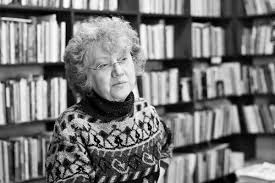
If the subject matter of today’s poem was just too painful, I trust the title warned you away. But those readers who persisted got the chance to experience something that’s increasingly rare in contemporary poetry: an act of imaginative courage. Daring invention, emotional intensity, oases of quiet observation––these are everywhere in the journals, and I’m so grateful for them. But a poem where the psychical ante is this high––where such radical nakedness is a requisite for the language to do its work––that is a much more unique experience. Though she’s an acclaimed poet, Dzvinia Orlowsky confessed to me how much trepidation she experienced, just showing the poem to the first outside pair of eyes: how would the world respond to such a thing? And yet she persisted because, I believe, she was aware that such poems arrive (as dreams do) unbidden and undeniable. No matter how painful, they are a form of gift––and the recipient has a responsibility to share that gift with any who are willing to receive it. October is Breast Cancer Awareness Month, and so I saved this contribution for a time when it might find its most willing reception: from all those who’ve had to suffer through the same experience; and from all of us who have not yet had to sacrifice a piece of our very being just to survive.
The situation of the poem is outlandish and stunning: the speaker’s right breast, taken from her during the cancer surgery, returns like a prodigal daughter, assuming she will be recognized even after this painful estrangement. A small gesture can serve as an ample welcome home: “when I stand in front of a mirror,/ cup my right hand above my ribs,/ imitate symmetry.” When Dzvinia writes these lines, we, too, feel utterly exposed. And yet, after, we cannot help but smile when the breast asks after the poet’s mother, the way a long-lost relative might. Of course, the breast itself is the emblem of motherhood, reminding us of a force that sustains humanity even while the brutal machinery of the world grinds on. Suddenly the poem throws open another door, and all the terrible excisions from disease and war are included in this conversation––not so surprising, perhaps, coming from a Ukrainian-American who keenly feels how much needless suffering is being inflicted on her ancestral homeland. At that moment, I hope you performed––as I did––a little mortal inventory: what has or has not been taken from your body, your life––and when was the last time you offered gratitude for the abundance that remains?
It brought a kind of dark thrill to imagine this mammarial presence as “a saintly jellyfish
in a sea of suffering.” But the poem’s response somehow prompts our hearts to both leap and falter simultaneously: “quite amazing, I say, because my prosthetic/ resembles a jellyfish too.” Still, our protagonist declines to invite the breast into her home, to indulge in the kind of happy reunion that would undercut the honesty. “And once I’m told I can’t live by holding/ onto something, I let go—see—like this,/ my hand—open, empty.” And with that one quiet imperative––“see”, set apart by those em-dash-sutures––the devastating beauty of the poem has worked its spell on us. Because in that moment, we do the one thing we were too afraid, too embarrassed to do: we see, in the mind’s eye, the poet’s body. We imagine, for an instant, what it would be like if this happened to us, or to someone we love. We stand there, naked, before the poem’s full-length mirror, and understand something new about our fragile embodied lives.
Poet, editor, and translator, Dzvinia is one of the founding editors of Four Way Books. She’s authored seven poetry collections with Carnegie Mellon University Press, including: Bad Harvest, a 2019 Massachusetts Book Awards “Must Read”; and her most recent, Those Absences Now Closest, named to Brilliant Book’s ‘Most Brilliant Books of 2024,’ and a finalist for New England Poetry Club’s Sheila Motton Book Prize. Her previous Red Letter contribution, “Шум” was awarded a Pushcart Prize and will appear in their forthcoming anthology. Along with her co-translator Ali Kinsella, Dzvinia has carried over the works of great Ukrainian writers like Halyna Kruk, Natalka Bilotserkivets and, most recently, Oleksander Dovzhenko––and for all that, she was awarded the 2026 David Ferry and Ellen LaForge Prize in Poetry and Poetic Translation (just one of her numerous honors). I return to the line “And once I’m told I can’t live by holding/ onto something…”––and realize that is precisely the awe-full gift of this poem: had life not already instructed us in this lesson, the poet is telling us now. Can we, too, “let go” and extend our empty hand? The poem welcomes this generative openness, and perhaps we can find the courage to do the same.
The Red Letters
* If you would like to receive these poems every Friday in your own in-box – or would like to write in with comments or submissions – send correspondence to:
steven.arlingtonlaureate@gmail.com
* To learn more about the origins of the Red Letter Project, check out an essay I wrote for Arrowsmith Magazine:
https://www.arrowsmithpress.com/community-of-voices
* The weekly installment is also available at
the Boston Area Small Press and Poetry Scene
http://dougholder.blogspot.com
* For updates and announcements about Red Letter projects and poetry readings, please follow me on BlueSky
@stevenratiner.bsky.social
and on Twitter
@StevenRatiner
And visit the Red Letter archives at: https://StevenRatiner.com/category/red-letters/