Interview with Doug Holder
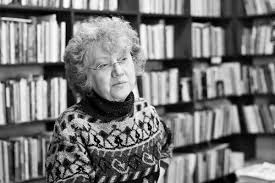
I recently caught up with Sarah C. Beckmann, a font of literary energy and activism in our literary community....
Sarah C. Beckmann is a member of the Somerville Arts Council Board, where she promotes arts initiatives in the Somerville community through a local grant program and the SomerWrites event series. In 2021, she published a poetry chapbook, Naiad Blood, and her first full-length poetry collection, The Race for Daphne, is forthcoming in May 2026. She earned an MFA from Emerson College in Boston and works in research communications at the MIT Media Lab.
How has it been for you as a poet living in Somerville?
I moved to Somerville in 2022 while finishing my graduate degree in creative writing at Emerson College. After completing my degree, I wanted to find new community circles where I could continue practicing my art and network with other writers. Somerville ended up being one of the best places I could have chosen to do that! I applied to be a board member of the Somerville Arts Council, and over the past year, I’ve had a wonderful experience meeting new people and garnering a sense of community through my volunteer work.
You have a new poetry series at Portico Brewery in Somerville. How did you come up with the idea? What distinguishes it from other poetry series in the area?
The SomerWrites series is actually for writers of all genres and backgrounds—not just poets! The idea for this series was born during conversations I had last year with Greg Jenkins (former Executive Director of the Somerville Arts Council) and Somerville Poet Laureate Lloyd Schwartz. I enjoyed brainstorming with them, and also enlisted the guidance of a few other writers in the area, like David Blair (who runs a poetry workshop at the Armory). Before my time in Somerville, there were “salons” organized with similar aims, and Greg highlighted the need for a revitalized programming effort focused on writing in the community. I joined the SAC Board as the primary writer representative, so I was eager to capitalize on the opportunity.
I think what sets SomerWrites apart from other events in the area (I hope) is its accessibility—the fact that it’s open to writers of all kinds, no matter where you’re from in the Boston area. I’ve had people from Cambridge, Brighton, and even Maynard (MA) reach out to me asking if they can attend and participate. Sometimes these types of events can be competitive and daunting—which is why the welcoming, kind, and enthusiastic support everyone has shown during SomerWrites has been so special.
Your new collection of poetry "The Race for Daphne" invokes or is inspired by the mythical figure of Daphne, the daughter of a river god. Why is this figure of particular interest for you? We could say your poems are drenched in water...
My latest poetry book talks a lot about women’s rights, women in athletics (specifically in the sport of rowing, which I’m very passionate about), and women writers. In the Greek myth of Daphne and Apollo, she transforms into a laurel tree to escape his advances. Apollo then takes the laurel as his symbol for poetry, for athletic prowess and victory at the Olympics—but not many people realize the true backstory of that symbol. That’s why I chose to highlight Daphne and her story over the more well-known tale of Apollo and his laurels.
Water certainly does “drench my poems,” as you say. I grew up near the ocean on the north shore of Massachusetts and spent many summers going to the beaches on Long Island, NY. And then learning how to row in college completely changed my perspective of the water, in a new way, which is what my chapbook Naiad Blood is about.
You quote Whitman in the collection. Do you feel your poetry is Whitmanesque? Certainly Whitman would embrace the multitudes of imagery and metaphor in your work.
I quote a few different, well-established writers in my latest poetry collection, Whitman being one of them. I do think my poetry can lean towards list-form, documenting things, which is characteristic of his work. However, I mention him in the beginning of my book more for a shared location: Long Island, NY. He’s from there and as I mentioned, I have a deep connection with the area—particularly the North Fork where my grandparents used to live.
Why should we read this book?
You should read this book to, firstly, support a local author; but also because a lot of voices are being censored right now, in our current social and political atmosphere—in this country, and across the world. Women’s voices have historically fallen and continue to fall under this category. My hope for this book is that it becomes a mouthpiece for not only myself, as a woman today, but also for the women in my family, my friends—amplifying the message that we still have voices and we will not be silenced. Women’s rights are human rights, and uplifting women is only to the betterment of humanity as a whole.
The Single Shell
An oar in each hand, one hull
keeping me afloat, I roll
to the catch, knees to my chest,
arms spread wide—try not to think
of the abyss below as blades glide
flat atop the surface. Not yet confident
to square, hover in air, then hook
that quicksilver. They say women
look more natural on the water.
Our bodies are always changing;
patience, control, rhythm, balance
are what we know best; an alchemical
process. To master the single shell—
both captain and crew—is to master
the soul. My careful strokes leave
puddles, dark and deep; pools whirl
in beats behind the rippling line
of my stern. Even aquatic creatures
can dream of flying. And me?
What might emerge when I shed
the various versions of myself—
something dying inside,
something wiser—monarch,
orange and black—
born.