Saturday, November 14, 2020

Disquiet and Quiet in Brian Mooney’s debut book of poems, Unbidden


Disquiet and Quiet in Brian Mooney’s debut book of poems, Unbidden

article by Michael T Steffen


The poems of Brian Mooney win our skeptical confidence, singing songs of Experience:


Helicopters lift above, pissing red tracers to earth,

as Charlie dives deep underground leaving

one conical hat floating in a rice paddy. [page 20]


Mooney braves that censor, also, risking songs—genuinely cadenced, lyrical—of Innocence,

as in the opening poem:


GREEN WOOD STOOL

(in memory of Grandma Mooney)


I’d climb onto the green wood stool,

my boost to reach the kitchen sink.

She’d take my little hands in hers:

long, thick fingers, an amber ring.

With lathered soap she’d gently rub,

the dark stone bobbing through white suds.

A cool rinse then and dry them nice

on the embroidered Dutchman towel.


It’s important, then, that Mooney’s verse is also capable of happening onto the numbing neutral ground of weirdness in the familiar, getting a haircut from his father:


Sometimes when my father touched my head,

a shock would strike my neck and spring down my back. [page 33]


Son of a mother who recited the verses of Emily Dickenson and Walt Whitman to him,

a Catholic monk for a year in his coming to age, a scholar and teacher of languages and literature, then a soldier in the Vietnam War, coming home to become “intensely involved in the Anti-War movement,” Mooney presents himself with a wide experience, spiritual and worldly, to poetry in his 2020 debut collection, Unbidden (ISBN 978-1-7923-4926-3, self-published and printed by the Harvard Book Store, available for $15).


Along with the undeniable lyrical soul of the poetics comes some artistic and intellectual shrewdness of slanting at the present through the past. Our current national divide between nature and its minimal needy aspect vs society and sophistication and wealth– which is perhaps global – is deftly sketched by Mooney in terms of French philosophy:


My classmate would hold his picture

close to the side of his desk,

and whisper to me “Rousseau”

and I would reply “Voltaire.” [page 20]


Yet managing the particular argument is short of Mooney’s greater purpose. Fred Marchant has generously and perceptively commented: “the unbidden in these poems is most often an earned glimpse of a mystery at the heart of things.” Heart of hearts: the startling realization that the world of experience dawns on our consciousness as—unbidden. In the philosophy of Martin Heidegger the term finds its correspondence in our “being thrown” (geworfen) into this world.

It strikes us as unsettling to the great extent that the makeup of our lives is ultimately beyond our individual control. It precedes and encompasses us, leaving even the most familiar of our surroundings to the scrutiny of questions:


Is it in the backyard where I learned to ice skate,

pushing away from the apple tree?


Is it in the window of the garret room where

the great elm showed its seasonal faces? [page 19]


Yet along with this terrible awakening there is also the grace, despite our ego’s proneness to the delusion of the totality of itself, of finding and knowing how we rely and are bound to a world of otherness and its beckoning to us, in the mergence of the individual and the spherical:


WHISTLES


With two fingers and rolled tongue

she’d send out a piercing call,

the signal for her kids at play to drop the bat and ball.

Sometimes a Red-Tailed Hawk would circle in the sky,

matching mother’s whistle sound with its high-pitched reply.

Whose territory is this, the raptor seemed to ask.

Could it be a brother hawk concealed in human mask?

As the children scurried home to wash before their meal,

both whistles blending in their ears

in Mother Nature’s weil.


The poems in Unbidden by Brian Mooney sing to us with the welcome of spiritual eagerness while, full of the unexpected and at times unsavory, for the differences they make, keep our eyes watchful line by intentional line. Reading the book leaves us both lighter and deeper, better than when we first opened it.


To order a copy through Harvard Bookstore, click on this link: 
Unbidden - Harvard Book Store.


Monday, November 09, 2020

Somerville Artist Jaina Cipriano: Captures the pain within....


"Jaina Cipriano is creating visual metaphors for emotions she has trouble defining. Without the help of Photoshop, she builds physical environments that open her subjects up to become part of something bigger. This primes the space for an authenticity that is so visceral it brings the viewer back to their own memories. " (From her website)

Her photos and films are not for the faint of heart. They go to deep to the marrow-- and slap us with their often visceral imagery. They bring experiences of trauma to the forefront. They explore the painful transition from childhood to adulthood. I was glad to catch up with this Somerville artist.


How has it been for you in Somerville, as a creative person?

Somerville has been great, there is a lot of thought put into artists in this city. Times are tough right now but I feel Somerville has been working hard to support its artists and I am grateful for that. I love the energy of the city - bright and open while also calm somehow.


From what I have seen, a lot of your photography reveals inner turmoil. Do you feel compelled to delve there--is that your artistic essence?


It is the most effective way I have found for working through and processing my turmoil. Terror loses its power when you name it. It loosens its grip when you show it’s face to the light. It’s a process but it’s worth it.


Does your work speak more to women--or is it more universal than that?


Women are universal. As a woman a lot of my work is through the lens of womanhood but I believe a lot of my themes - entrapment, childhood, religious and romantic trauma - are understood and felt by people across the gender spectrum.


I saw a clip of your movie " You Don't Have to take orders from the Moon." The clip had a rather large rat scurrying across the bed. Was that rat a Somerville rat, we have a great supply of them? How does this imagery fit within the full context of your film?


I wish I could say I wrangled some authentic Somerville rats but no, those rats were my sisters pets. Their names are Miso Soup, Sticky Rice and Dumpling and they were very sweet and well behaved. The rats in my film are messengers, helping the audience connect the dots. You’ll have to watch the film to see what the dots are!


Did you formally study film and photography?


I went to NESOP (New England School of Photography) and studied photography but I have no formal training in film - I just jumped in back in 2019 and haven’t looked back. I love learning new things and my favorite way to learn is by doing - getting my hands dirty, failing, trying new things - it is exhilarating and rewarding!


Is your work therapeutic for you?


Absolutely. No matter how dark things get, my work is always there. It’s a home of sorts. I can come back to it whenever I need. It helps me process and connect to myself and the world around me.


If I were to ask you--why we should view your work--how would you reply?


Connection is essential, especially in the COVID era. I have poured my entire essence into my work - I want to connect with you through it.


Any new projects in the works?


I start pre-production for my next short film Trauma Bond in a few weeks which is exciting! It’s about three women, a secret, and an intense night. I am also in the midst of opening up a new artist space - so stay tuned for more information on that!


http://www.jainaciprianophotography.com/


Monday, November 02, 2020

Somerville Photographer Emily Falcigno: Takes inspiration from the neighborhood, people's essence, and even the sexist remarks of Trumpism


Emily Falcigno is a photographer who is about making a strong statement-- she boils people and things  down to their essence. She is not after the sizzle but the steak. I was glad to catch up with her.


 DH: First off-- tell me about your experience as a photographer--here in Somerville. How does it compare to other places you have lived? One person told me if you are taking pictures in the streets of Medford--they think you are an insurance person or a real estate agent--in Somerville they think " Hey just another artist."


EF:Ha ha ha! I never knew that about Medford. My association to Meffa is Italians, fig trees wrapped for the winter, and wine making. I can totally relate to the Somerville analysis.


My first real foray into photography was photojournalism and as they say in that industry, “if you wanna shoot a good story, look in your own backyard.” As a local photojournalist in my hometown, one of the hardest assignments we had was to shoot “enterprise photos”. We had to go around and look for single filler photos for the gray space in the paper. One time I hopped in the back of a landscaping truck to get a shot of the landscapers on the move. Another time, I was walking through a state park, and a ranger who could have been Hagrid’s brother, was carrying a fawn he found alone in the woods. To see the soft side of this huge guy with a little tiny wild animal was so moving. The day was really foggy so it made for a beautifully moody photo.


Somerville is chock-full of eye candy, like the DPW during snowmageddon, unicyclers, School of Honk parading on a snowy day. Festivals galore! Honk and The Independent Film Festival are tied for my favorites. I have been volunteering for IFF since 2011 and got to photograph Dennis Leary, Miranda July, Jason Segel, MIT researcher, Joe Davis (look him up!), etc. It’s a great opportunity to see films people care about deeply, and rub elbows with filmmakers in your own backyard.


I learned that no matter where you are: the more you look around, the more you see.


DH: In my research about you, I read you viewed a sexist video and this propelled you to create " In her Words: A Collective Diary of  Everyday"Women." Tell us about this project?


EF: Yes. In Her Words Diary started the day I heard about Trump’s pussy grabbing video back in 2016. I refused to watch it, I was so angry. Instead, I pulled out my camera, and asked myself, ‘How do I show disgust and anger in a self portrait?’ I have a whole series of me flipping the bird. After that, I decided to illustrate small battles and triumphs of other everyday women to tell a bigger story. We illustrate tiny things that go unnoticed and women brush off. The problem is, those little issues build up and trigger us when they’re not acknowledged and healed. What started as a venting project, became an inspirational one through women’s stories of sisterly support.


We took the project to new heights in 2018 when I got a billboard in Times Square; and photographed AOC and Ayanna Pressley for it.


For 2019’s Women’s History Month, Heather Balchunas and I collaborated on “Visible Voices” for the Inside OUT gallery in Davis Square. We collected battles, triumphs, and supportive stories from all genders around the city to display on paper dolls alongside IHWD photos. Anonymous stories included one on collecting breastmilk for a baby who had lost his mother, and another was about a guy who got a job, had no idea what he was doing, and relied on a female colleague to teach him what she knew. We heard countless stories of body issues. And one of an older single woman who never married and felt outcast from society’s norms. That one hit home for me.


DH: You are the founder of Savvy Singles. You photograph single people for the digital dating era, According to material I read you want to capture people in a natural way. How do you go about capturing the essence and energy of your clients?


EF: Savvy Singles Studio started as a way to help people with their dating profiles. People were posting car selfies. Frankly, those kinds of selfies talk behind your back. All they tell me is: You wear a seatbelt, and you drive distracted.


Remember the point about photographing the story in your own backyard? We help singles pull out the real story they want to tell about themselves, not the story they think they should be telling because it’s convenient.


Over quarantine I deepened my clients’ Roadmap to Savvy by creating The Visionary’s Journey workshop (and podcast on IGTV). I teach people how to get back to their core values, build a vision of their ideal lifestyle, and teach them how to manifest it. By giving singles permission to break society’s rules and make their own, we help them cultivate confidence and enthusiasm.


I specialize in photographing people who don’t typically like how they look in photos. We don’t do styling makeovers, we do soul makeovers.


DH: Do you define yourself as a feminist?

Yes, however, I don’t like to put myself in a box. I don’t like labels. If you ask different generations, you’ll get different responses to what “Feminism” means. I like Gen Z’s definition: Feminism is the equality of all genders.

A Black Lives Matter member once said to me, “Feminism: the White is silent”.


Intersectional Feminism is important to keep in mind. This refers to one person who belongs to more than one oppressed group. For instance: Black + female + LGBTQIA + other-abled. When we do the work to lift up the most oppressed of us, everyone is lifted up.


In all of my work, I lead with compassion, and promote the acceptance of feminine values in our society. Balancing feminine energy (empathy, community, fluidity) and masculine energy (pride, action, efficiency) in our bodies will help us find balance in society.


DH: Did you formally study photography? What photographers are your role models?


I was obsessed with my mother’s Kodak camera in the 80s. I picked up my first photography class in high school, and in college I couldn’t wait to get into the dark room. I was the photo editor on my paper for three years, and started learning Photoshop as soon as it came out. I was mostly interested in photographing people.


When I moved to Boston, I started photographing rock bands. I really loved Liz Linder‘s work, and 13 years later I got to work for her which was incredible! I also loved Annie Leibovitz’s work for Rolling Stone and referenced her in an homage photo I did for In Her Words Diary. I spent a long time with Lorna Simpson’s work at the ICA too.


I am a painter first, so I look to Renaissance painters for inspiration. Caravaggio’s dramatic lighting makes my heart sing.


DH: Any new projects in the works?


EF: I’m really excited about The Visionary’s Basecamp (an intro to TVJ) coming up on November 14th. I’m teaching people how to manifest new opportunities - like I manifested my billboard, my pop up at Bow Market, and small miracles every day. One client got her dream job after piloting TVB. It really is a game changer when you change your mindset.


Beyond that I’m mastering the art of the remote photo session. I am happy to help people who are curious and willing to do the work to upgrade their lives over quarantine and beyond!


Emily@SavvySinglesStudio.com

https://www.instagram.com/savvysinglesstudio/

http://savvysinglesstudio.eventbrite.com/


Sunday, November 01, 2020

High Tide By Ed Meek: Review by Carolynn Kingyens


High Tide

By Ed Meek

Aubade Publishing

www.aubadepublishing.com

ISBN: 978-1-951547-99-8

$14.99

Ed Meek’s latest collection of poems, High Tide, is an exquisite reckoning with one’s self; between one’s past and present, a sort of home coming without a home. There’s a beautiful vulnerability along with a palpable sadness in High Tidethat speaks directly to the human condition. For example, in the poem, “Talking to Yourself,” Meek writes:


You can’t get up, can’t look away, you’re

uncomfortable in your own skin, like a dog in a drought –

if you could move, you’d get a drink or take a bath. Your

throat so dry you can’t swallow. You can’t swallow it all

anymore, the strangers who occupy your house – your wife

and children – as distant as the relatives who raised you.

You knew them all once, long ago, in another country you

called home.


Continuing with the same theme in “Gypsy Moth,” Meek compares the quiet desperation of the moth to our own distress:


Now they’re stressed like the rest of us,

susceptible to fungus and disease.


thwacking into window screens

desperately searching like the rest of us

for the light.


There are political poems, too, that lend thoughtful perspective to the state of American politics.In the poem, “Encomium for the God of Nothingness,” Meek reminds us:


This is where we are – on the verge.

Just over the edge – chaos.


But in the poem, “Make America Great Again,” he examines the disconnect between Trump’s notorious motto, and the reasons why some Americans take offense to it, offering a reminder how problematic earlier times in American history authentically were:


Let’s take America back

to the straitjacket

of the 1950s –

when women knew

their place

and cops let

domestic abuse

slide, divorcees

were outcast

and the church

lied for priests

who brought altar boys

to their knees.


……The good old days

when no women

or Jews were allowed,

Blacks were happier

with their own kind

and America could do

no wrong.


Some poems connect to each other faultlessly such as with “The Poetry Motel” and “In the Poetry Motel.” With these two poems, in particular, there is a slight dread reminiscent of the David Lynch film, Mulholland Drive:


You drew the drapes and sure enough – a view of the mountains –

hazy blue in the distance, peaks lost in white mist. You

had been here before you felt suddenly, as the first rays of

sunlight cut through the haze.


And “In the Poetry Motel,” the plot thickens:


You hear in the back of your ear a faint strain

of music – something so familiar. It seems to be

coming from the back of the room. Then you

notice another door.


You try the key and it opens. A radio on

the desk is playing the music you heard. In the

corner in the shadows someone sits. She beckons

with a crooked finger, come closer. She has

something to tell you. You bend down to listen.

She is old and frail. She whispers in a foreign

tongue. It could be Latin or Greek. You seem to

know some of the words. When she waves you

off you return to the desk in your room. You try

to make sense of it.


Throughout Meek’s book, there are nautical undertones, little reminders that high tide is coming in – fast. It’s when we call it a day at the beach, and begin to pack up all the gear – those old patchwork blankets, rainbow-colored umbrellas, and black scuff coolers with lids that don’t seem to ever want to close.


In the poem, “High Tide,” a young Meek relishes his limited time with his young parents on the beach, before his brother and sisters are born, calling them “those uninvited guests,” who “crashed the party.” He writes:


Before we left we’d weave along

the shore, heads down

in search of shells.

I walked between them –

one on each hand. The three of us

happy as clams at high tide.


In his poem, “Drifting Home,” he resides in a dream state – you know the voice of the clock/ is an echo in a vacuum/ and what’s lost hangs like a broken door. Meek continues:


But it is your mother the ocean

who drifts in waves in your sleep

and years pass by in a dream. The Sioux

called this the shadow world.


In his poem, “Praise for Ponytailed Girls Who Run,” Meek becomes the acute observer:


And the hair, lovely,

surely not dead

but vibrant with life and light

as it sways and bobs

like a rope swing in the wind

above the water.


I read Ed Meek’s High Tide the same day I’d received it. I wasn’t planning to read his latest collection in one sitting, but once I began, I could not put it down. Curled up with his book and a soft, gray blanket, my blonde, beagle-lab mix resting at my side, I could’ve easily been on a New England beach instead of on my bed in Brooklyn. Time and place didn’t matter as I read each poem slowly, savoring one delicious line after the next.


*****Carolynn Kingyens’ debut book of poetry, Before the Big Bang Makes a Sound (Kelsay Books), can be ordered through Amazon, Barnes & Noble, Greenlight, Book Culture, and Berl’s Brooklyn Poetry Shop. In addition to poetry, Carolynn writes narrative essays, book reviews, micro/flash fiction, and short stories. She resides in New York with her husband and children.

Tuesday, October 27, 2020

Owen Lewis’s Field Light (Dos Madres Press, 2020), reviewed by Gregory J. Wolos


Owen Lewis’s Field Light (Dos Madres Press, 2020), reviewed by Gregory J. Wolos


Owen Lewis’s Field Light is more than a collection of thematically connected poems. Using not only verse, but also photographs, historical notes, and dramatic dialogue, Lewis, a doctor of psychiatric medicine, escorts his readers through swirling gyres of time, place, and memory as he explores issues of individual identity. Throughout the volume Lewis examines his personal thirty-year connection to a summer home he rents, then owns, in the Berkshire Mountains of western Massachusetts. This home, which over time has become known as the Dormouse (a diminutive of “dormered house”), inspires Lewis’s contemplation of the area’s history. Historical figures abound: writers like Herman Melville and Stanley Kunitz, artists like Daniel Chester French (sculptor of Abraham Lincoln’s memorial statue) and Normal Rockwell, even heroes of social and racial justice like W.E.B. Dubois established roots in the region, and Lewis reflects upon their lives in juxtaposition to his own.

The collection opens with a poem describing the author waiting in his car at a rail crossing at what we are to take as the present. Yet even in the moment’s intimacy, Lewis portrays himself from a distant third person: “A lone driver stopped in his auto./ . . ./ Stalled, the flashing arm/ before him, he’s held up by the train/ and held in place, this place, how long/ he doesn’t know.” The volume’s next poem moves to first person, as the poet, still waiting for the train to pass, considers his New England surroundings, “White churches and pointed/ steeples of thudding bells” as his “darker light/ drops into the Berkshire air.” Ever more introspective, the poem concludes with a parenthetical, “(And I still think about her), which the reader comes to understand as a reference to Lewis’s ex-wife, whose presence—or absence— haunts the volume.

Central to Field Light is a photograph on the porch of the Dormouse, dated 1922, introduced in prose by the lonely poet: “Dog days of August, the back porch lulls, hours nap-drifting. Dr. Lewis spends the month alone, a sort of sabbatical. He should be used to this un-familied state by now, but he’s not. Not visitors. Not one. His only companions, an old photograph.” Throughout the volume Lewis returns again and again to this photograph, listing the figures within it, searching out their histories, bringing them to life with anecdotes both archival and imagined. Still, the photograph resists him as much as it invites: “He studies the photo, a moment century-old, in the very place he now sits. A town full of history, and he's not part of it. Not even part of his own history. He tries to squeeze into that summer of ’22.”

Lewis recollects his and his young family’s first trip up to the house during a summer thirty years past: of his three children “strapped in” to car seats, listening to Beauty and the Beast ad nauseam; of exiting to Route 23; of contemplating landmarks dating from 1761. Later he recalls narrating Native American creations myths to his vacationing children as bedtime stories. In “(photo as Rorschach)” Lewis contrasts his own identity as a Jew with the Anglicans pictured in the 1922 photograph, concluding that he “would have been barred from colleges of medicine in Boston or New York,” before reimagining a meeting between Freud and Jung in Worcester, where Freud is heard by Jung to whisper, “Wherever I go, a poet’s been before.” As for the figures in his porch photograph, “This group might have envisioned their history conjured in poetry but not by a Jewish physician; this group who saw themselves as history: Greeks, Romans, countrymen, and their crowd. To admire their history, to deny his own?”

Even as Lewis considers the history of the area through figures like W.E.B Dubois, Patty Hearst, and Arlo Guthrie, he returns to thoughts of his own losses, particularly of the dissolution of his marriage, even as he listens to Tanglewood concerts featuring orchestrations based on the poetry of Whitman: “Oh past! Oh happy life! Oh songs of joy!/ In the air—in the woods over the fields,/ Loved! . . . / But my mate no more, no more with me./ We two together no more.” Later, as his ex makes her way into a “dream fragment,” “I dare/ her memory./ It won’t be dared.” The trauma Lewis experiences as a result of his divorce is evident in “(August, 2011)”, which records the courtroom scene of his marriage’s dissolution: “why is she smiling? Lawyers marshal me out of view, advise/ to avert eye-contact five-year flashback: Dr. Lewis’s self-diagnosis:/ Courtroom PTSD , in public, a pilloried sinner . . . (I flee to the house/ in Massachusetts, a great tradition of marital bliss there—/ . . . / She’ll get the city apartment. Am I getting gypped with left-overs,/ a run-down Dormouse?” Though he has nestled himself in a location steeped in history, Lewis cannot escape the fracturing of his personal life—nor can he disconnect himself from his identity as a writer, capturing his divorce in literary terms: “In New York, ‘no fault’ divorce. I do, I do, now and forever/ absolve her not. Vows and ows. A manic raven. Nevermore.”

Lewis depicts his search for self in dramatic dialogues in which he relocates himself in history, imagining himself to be a consulting doctor for those connected to the 1922 photo on the Dormouse porch. But in the process of self-analysis, Lewis comes to realize that his “calling” comes as both a doctor and a poet as he summons the voices of America’s poets through the last centuries: “Call me Whitman/ calling Lincoln all across the country/ . . . / Call MacLeish, lawyer/poet/ public servant/ . . . / A poet should not be mean, but be!/ . . . / Calling Frost calling Kunitz calling Ginsberg/ doctors calling poets calling doctors calling poets/ Call me Williams Call me Gilbert Call me/ doctor-poet/ calling across the field/ call me crazed in this need to write/ call me/ ands I beg the word.”

What awaits the poet-doctor Lewis, he who finds himself bound to duel callings? Perhaps there is hope in the future, he muses as he contemplates the remains of the orchard on the furthest reaches of the Dormouse acreage: “two leggy pears, barren/ except for the year after the Great Divorce. Heartache.’ It was then this pair of trees gave out bushels of fruit, saying/ ‘Sweetness for your unpaired self,/ one day, perhaps, another pair.” And so Field Light ends where it began, Lewis having cycled back to the train crossing, where “The train’s last echo slows, and beyond/ the field, sky, I, he/ walks on, if into the sky. / Closer to. Visions of./ Pulled up, lifted through./ Rise up and hear the bells/ . . . / Get on with you!”


Friday, October 23, 2020

Somerville's Ally Sass: A Playwright Who Thrives in our "earthy, queer and very artful" city.


Interview with Doug Holder


I have always loved the theatre, and over the years I have interviewed a number of aspiring and  accomplished playwrights, actors, directors, etc.. So it was a pleasure to connect to Ally Sass, who despite the pandemic--keeps on keeping on.


Q:  You are originally from Cambridge, but you have lived in New York and now "The Paris of New England," Somerville, MA. As a writer, how has your Somerville experience stacked up?


A: I think Somerville is a really special part of Boston. It actually feels like the Cambridge I grew up in in the late 90s/early 2000s; earthy, queer, very artful. I live near Union Square and love everything the area has to offer. During my first year of grad school, I wrote late at night and as a form of procrastination, I would go to the Somerville Market basket and buy a few different exotic fruits. I don’t know why, but that became a highlight of my first year. I was excited to really explore the area now that I’m in my third year of school and not taking classes, but because of the Pandemic, a lot of the fun stuff has shut down. Finding community is harder right now, but I can still appreciate the liveliness of Somerville.


Q:  Do you feel it is still true that Boston is a tryout town, and a playwright has to go to Broadway to make a name for oneself?


A: Returning to Boston for my MFA in Playwriting, I was actually delighted to experience a really thriving theater scene. Through my awesome professors, I go to see a lot of shows in the area that really blew me away. I know plenty of Boston theater makers who are constantly working here, and feel no need to relocate. And because of the size, you can form community really quickly. That said, one can also take advantage of how close Boston is to New York. The theater scene in New York is of course much bigger, and one can certainly make a name for themselves in both cities. While having a play produced on Broadway is a fun goal to have, Broadway itself it really only one facet of the American theatre and can actually have some limitations in terms of what kind of work can be produced, how “marketable” it is, etc… Some of the best plays I’ve seen have been outside of that community.


Q: You will be on a Zoom conference for the Boston Playwright's Theatre that is based at Boston University. What is this about, and what will you talk about?


A:Yes, on November 24th I will be chatting on Zoom with BPT Artistic Director, Kate Snodgrass, as well as with my thesis director, Erica Terpening-Romeo, about my new play, Very Good Boys, and Other Myths. This is part of a series called “BPT Talks,” where each BU MFA Playwright is given an opportunity to discuss their thesis play, and also present a short excerpt from the play.

Very Good Boys and Other Myths is a story about a mother named Elaine, and her son, Avery. After Avery leaves his high school due to bullying, he takes refuge through online through World of Warcraft, Youtube, and the “incel” community. In attempt to get through to Avery, Elaine makes her own account on World of Warcraft, only to become fixated by the game herself and get lost in the realm that Avery finds himself in. The play then explodes into a modern, mythical journey deep into the underworld of a mother and her son. What starts as an exploration of various internet communities, becomes a surreal exploration of masculinity, gender, and the internet. This play is a continuation of an ongoing fixation I have with masculinity and all that it imposes on a society.


Q: In one of your plays--a pedestrian meatball sub is the smoking gun for conflict among a group of vegetarians. Do you find that the most banal of objects can seed a play for you?


A: Yes, that play was a lot of fun. That was The Cleanout, a one-act play about four vegan artists living together, who essentially implode as a community when someone finds a meatball sub in their fridge. That play stemmed from a prompt I was given to write a play where the central object is a refrigerator. Immediately, this story came out, which I guess was a response to a certain culture/elitism surrounding food that I observed while living in Brooklyn. The meatball sub of course was a metaphor for the the things that aren’t on-brand about us that we keep hidden away. I would say that every-day-objects can spark a lot of inspiration for me. They typically tap into something that I didn’t realize was on my mind, but once I start writing about them, I can’t stop.


Q: My brother Donald Holder is a Tony Award-- winning lighting designer--so I have to ask-- how important is lighting in your plays?


A: Lighting is crucial in any play! One of the best classes I took as an undergrad at the University of Vermont was “Fundamentals of Lighting” taught by John Forbes. We had to make a 10-minute performance just by lighting a certain object to music, and it was one of the coolest projects I had ever partaken in. So many components of technical theater must fuse together in the right way to make a play compelling. Lighting can set the tone in these inexpressible ways—it’s definitely the facet of technical theatre that I’m most interested in.


Q:You are working on your MFA at Boston University. Have you worked with Kate Snodgrass? How has the program fueled your growth as an artist?


A: Yes, I often refer to Kate Snodgrass at the Fairy Godmother of Boston theatre. Kate is amazing. She works endlessly to make this program run smoothly, to give us the opportunities that will help us grow as artists, and has some of the coolest shoes I’ve ever seen. Kate is extremely knowledgeable about the American theatre, and there are many artists in Boston who would say that they are very much indebted to Kate. I certainly feel that way. I have gained an immense amount of knowledge from this program, both artistically and professionally. The opportunities that Boston Playwright’s Theatre provides to graduate students, including our extensive in-class writing workshops, collaborations with professional actors, and most importantly, our third-year thesis productions, are unparalleled. What I consider to be the most impressive aspect of our playwriting program is that, while having only transitioned from an MA to a fully-funded MFA program in the past six years, it’s gained a level of national recognition and alumni success comparable to top MFA programs that have been around for decades. This program has helped me understand who I am, what I write and how I write.


Q: How has the pandemic affected you, and your work?


A: It’s been a bummer. But also weirdly a gift? First, the part of it that has been that hardest is that since this is the third year of our program, our thesis year, we were each set to have a full production run for two weeks; actors, set, costumes, director, everything. These shows of course had to be cancelled and rescheduled for next year (let’s pray). This was a major shock to all of our systems. Much of our schooling was preparing us for these productions in some way or another. We each have spent months sitting with these scripts, priming them for the stage. It’s also unnerving not know what the future looks like for theatre on the whole, but my guess and my hope is that it will be absolutely come back, and stronger than before. I know I personally have been deeply craving the opportunity to sit and absorb a live performance again. I will say though, the extra time to sit with my script has been really illuminating. I’ve had new, unexpected time to dive deep into the story in a way that only this precarious period could have evoked.


Q: Tell us a bit about new projects coming up.


A: Very Good Boys, and Other Myths, which was previously scheduled for January 2021, will happen sometime next year, 2021-2022. I will have a workshop of this production in this spring though, and I believe there will be a Zoom reading of the play, with actors. I’m also working on another play titled, Zygote, which dissects a modern Jewish-American family’s relationship to the Israel-Palestine conflict. I’ve also begun writing a TV pilot. We will see where it all leads!

Check out"

allysass.com !

Tuesday, October 20, 2020

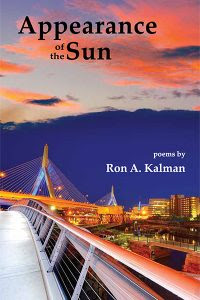
Ron A. Kalman author of the new poetry collection "Appearance of the Sun"


Ron A. Kalman, author of his first poetry collection "Appearance of the Sun" ( Main Street Rag Publishing) will be released in the coming months but can be pre-ordered now. Kalman is a graduate of Emerson College (MFA), a Somerville Bagel Bard, and has been published in numerous publication including Somerville's Ibbetson Street magazine, and the Lyrical Somerville in the Somerville Times.

Interview with John Wisiewski


What was it like growing up in Budapest, Ron?


It’s true that my family is from Budapest, but I wasn’t actually born there. My parents fled Budapest during the Hungarian Uprising of 1956. During that year, there was a period when the borders were loosely guarded, and my parents trudged across the fields from communist controlled Hungary to Austria.


They settled in Israel, and that’s where I was born, though I don’t have any memories of that. My first memory, perhaps appropriately, is of being on a boat as we were heading to Paris. We lived in a house in the suburbs. It had a fenced in yard with lots of fruit trees, and I attended kindergarten where, as I recall, there wasn’t much playtime. I vaguely remember sitting behind a desk and studying trigonometry.


It was only a few years later that we were on the move again, this time via an ocean liner headed for the United States. One morning, my mother dragged me up on deck so I wouldn’t miss seeing the Statue of Liberty as we arrived in New York. The statue didn’t impress me much. But I was only six years old so what did I know?


We stayed in New York just long enough so that I could taste a real New York hot dog from a real New York street vendor. Then we boarded a plane and headed out to Boulder CO where my father was a physics professor at the university. There I attended first grade. Fortunately, there was a girl in my class who spoke French, and I shadowed her for the first couple months until she got sick of me. But by then I’d more or less figured out what was what and managed to survive on my own.


The following year we moved to the Boston area and that pretty much ended our global roving. Still, we continued to move from house to house and from school district to school district. I counted that by the time I reached 7th grade I’d attended 6 different schools. And, if my experiences instilled in me nothing else, it was that being observant was more than just a useful skill. It amounted to something of a survival tactic.


When did you begin writing?


I wrote my first poem in 7th grade for an assignment, and I’m happy to report it was a big hit with both my teacher and my mother. But that pretty much ended my poetry writing for the next fifteen years. I liked reading novels much more than poetry, and in high school I started writing short stories.


After college I had no real plans and bounced around for a few years until, finally, I decided it would be a good idea to write a novel. There was nothing that I’d done up till then that would have led anyone to think I’d be successful. And, in fact, I spent a wretched year living in a moldy basement apartment in Brighton failing to put together anything even remotely coherent.


Right about then, just when I’d pretty much packed it in as far as writing was concerned, I happened to move to Harvard Square and a buddy of mine convinced me I should sign up for a poetry writing class. And Voila! I instantly felt a confidence using the poetic form that had eluded me the previous year.


What may inspire you to write?


I don’t think that’s a constant, though I do have an aesthetic I sometimes like to follow. My poems tend to be autobiographical and outside the academic mainstream. When I was working on the novel, I’d hoped to write something that captured the immediacy and vibrancy of everyday experiences similar to what I’d found in Tropic of Cancer. When I started writing poetry, I was delighted to discover a similar type of thing going on in Frank O’Hara’s I do this I do that poems. So, when I started working on the poems that would become my chapbook Appearance of the Sun, many of the poems were based on whatever was happening at the moment.


. You have done translations as well as poetry. Could you tell us about this.


I started doing translations quite by accident. One day, my father showed me a book that used a short poem by the famous Hungarian poet Attila József as an epigraph, and I thought the translation had completely lost the essential feel of the original. So naturally, I had to try my hand at it. Since my Hungarian is not very good, I do the translations with my father and, over the years, we’ve accumulated a small bunch of translations of József’s work.


Perhaps more interesting is that my translations are very different from my own writing. József’s poems are strictly metered and rhymed. I do the translations, and I try to adhere to the original form as much as possible. People who look at my translations first are often surprised that my own writing looks quite different.


Could you tell us about you latest chapbook just published?


I’ve already alluded to it. It’s called Appearance of the Sun, and it’s being put out by Main Street Rag Publishing. It should be out maybe in January or February of 2021.


The collection contains poems I wrote when I first started writing poetry, and it owes much to the novel I had wanted to write before that. Some of the characters in the longer poems are characters I had wanted to put into the novel. And as for the shorter poems, I wanted for them to have an episodic feel to them even while maintaining the integrity of each poem as a separate entity. I was going for something that might approach an extended narrative in the life of the narrator.


6. You have moved to Boston later in Life. Do the people of Boston inspire you to write?


Yes, of course. I would have never written Appearance of the Sun if I hadn’t fallen in with a great group of friends and acquaintances when I moved to Harvard Square. I lived in a big apartment complex right on Mass. Ave., and I was friends with a bunch of people in the building. Every Friday night, one of them would hold a political/literary gathering in his apartment that would go on well into the early morning hours. Add to that that if I went out of for a walk, I was just as likely as not to bump into someone I knew and end up in an hour-long discussion about Nietzsche or the Beats or politics.


This all changed when rent control was abolished. Rents, of course, started to rise precipitously and that’s when I and just about everyone I knew moved out of Cambridge. And Harvard Square itself has become a shadow of its former self. Gone are most of the things I thought made it such an interesting place, the artists, the eateries, the movie theaters and countless bookstores.


. Any future plans and projects, Ron?


Thanks for the question. What writer wouldn’t want people to be interested in what he or she is working on? And I do have projects lying about in my drawer, some being closer to completion than others. But I think talking about them might be bad luck. It might take away my impetus to actually finish them.


And, John, I’d just like to add that I much appreciate the effort you put into doing this interview with me. It’s been a great experience.


To order go to: https://mainstreetragbookstore.com/product/appearance-of-the-sun-ron-a-kalman/

Friday, October 16, 2020

Library of My Hands By Joseph Heithaus


Library of My Hands

By Joseph Heithaus

Dos Madres Press

www.dosmadres.com

ISBN: 978-1-948017-68-8

121 Pages


Review by Dennis Daly


Illuminated wonder. Musical sparkle. The transcendent light within everyone. These are the objects of Joseph Heithaus’ collection of intimate and ecstatic poems entitled Library of My Hands. The book reads like a revelation of family, nature, birth, and death, but always through humanity’s compassionate lens. It reminds one of Thomas Merton, or, more to the point, Merton’s mystical side. Heithaus covers poetic territory not much dissimilar from Merton, a poet in his own right, who at the corner of Fourth and Walnut streets in Louisville, Kentucky, on a shopping mission for his monastery, observed his fellow passerbys, “shining like the sun.” Merton believed he had seen the goodness and the beauty at man’s core or, perhaps, he had espied the individual hearts of his fellow travelers. Heithaus runs with a kindred metaphor of light, using his own perspectives and experiences as an approach to metaphysical or, at least, visionary phenomena.


A drama of Genesis opens this collection in three of Heithaus’ early poems, Birth of Light, Memorize, and Mother’s Blood. Descriptive cosmological words turn to the mnemonic joy of family birth and then to deeper remembrances of that birth. Listen to these marvelous lines from Mother’s Blood,


Your mother gave you this blood

that’s now become your prism

and mask, your passageway

to the sparkling places

inside yourself. Not tissue

and bone, but memory of memory,

your small fingers once over a flame

to feel the light, light

you first saw from inside

her, she’s leaning over the basket

of wet clothes on a morning

before you were born,

that’s when you opened your eyes

to amnion light, blood light,

the shadow of her spine, her body

your kaleidoscope…

Heithaus’ piece entitled Poetry thrills at the efficaciousness of said subject as well as the aesthetic miracles it surfaces. Poetry lures prizes from the unconscious depths and imbues them with unthinkable artistry. On the other hand, the poet, himself, exhibits flaws and claims no intellectual superiority. He is simply a fisherman. Heithaus explains,


Poetry is how I open

the box with the earth inside

fill it with light

so you see the bait

I bought

to put on a hook

to catch something out

of that box of water

they call a lake,

which, if I’m lucky,

we’ll launch out into

in a jon boat,

that keeled box

of air where we’ll stand

rocking and looking

at something beautiful

and wet…


Cemetery, Heithaus’ poem on abundance amidst emptiness, contrasts the despair of dark umbrellas and rain at a February funeral with considerations of wasteful glut and sun-generated bounty and hope. In the background a soldier plays taps. The poet sees continuance and exultation in the seasonal panoply of future promise and concludes his piece this way,


…faces sudden from

dark umbrellas

and rain


out

of the black branches

come buds, then blossoms

then leaves, come robin-chatter

and bee-light, tulip-light

coochee-coo-light, more life-light,

bury-the-dead-and-move-on-light.


My favorite poem in this collection Heithaus titles Toll. In a way, the piece is a counter meditation to John Donne’s famous poem, For Whom the Bell Tolls. Heithause puts his emphasis on a baby’s coos, trimming the fingernails of an infant, humming a sweet tune to that infant, all things that commemorate especial moments of life. Afflictions are understood and accepted, but not lingered over. The poet tempers the bells’ heavy insistence on doom with his own sense of grace. In Heithaus’ world affliction is not to be obsessed on; any more than a reminder of death is to be obsessed on. The quiet intervals in-between, the celebrations of life—these are the real gems. The poet opines,


… even

in this room with its lamplight

and pillows and coos there will be tolls

to pay, unexpected taxes, like those scenarios

we watch from the windows

of our house: divorce next door,

murder across the street,

the slow death around the block

who limps past each day on the sidewalk.

But why dwell there?

There’s no end to affliction’s treasures

no end to the tolls that hammer

out each hour, nor is there an end

to grace, the bells between the evening’s silences,

this moment here when I whisper back

to the woman I love.


About halfway through his collection Heithaus sets a section of ekphrastic poems he calls Light Studies. All of them are well done, but one of them, What’s Lit, a poetic commentary on Caravaggio’s painting The Conversion of Saul, I think is especially spectacular. The painting itself shows Saul (about to become Paul) flat on his back, defenseless. The poet sees neither Saul nor the converted Paul but the moment in between, the becoming. Saul’s horse seems to be divinity, the center of power, and he reaches toward it and the dangerous radiance it represents. The title of the poem directs our attention to light that reflects off the horses’ flank. Heithaus describes the scene as the poem opens,


muscle of the forearm, fetlock,

heel and the hand of another

soldier holding the reins,

the horse’s barrel, flank, buttock,

and you, between names, splayed

like a baby born out of the night,

the oscuro, the obscure into

the chiaro, the clear and bright,

but your head’s still in the shadow,

your left leg, the back

of your hand, your pinky obscured

by that blackness and your eyes

look closed. We know

what will happen when you

open them…


A blinding light of poetic understanding emanates from this extraordinary collection. Like Merton before him, Heithaus sees and versifies a unique and dynamic vision beyond the pedestrian perceptions of most people. His words simply astonish.