Saturday, September 03, 2022

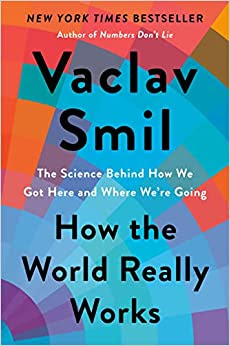
How the World Really Works by Vaclav Smil


 How the World Really Works by Vaclav Smil. Viking, London, 2022, 326 pages.

Review by Ed Meek

Vaclav Smil would like a few words with you about “the science behind how we got here and where we’re going.” He’s had enough with people making outlandish predictions, warning us about the apocalypse and telling us to go green while having little idea of where their energy comes from, how their food is produced, how the world really works.

Smil is the author of over forty books, a fellow of the Royal Society of Canada, a distinguished professor emeritus of the University of Manitoba. He assures us that we have enough, air, water and food to survive as a species for some time to come. Nonetheless, he admits that climate change is a universal problem and so far, we have not been up to the challenge. Smil says we need signed global commitments rather than pledges that may never be fulfilled. At the same time, he goes into some detail to convince us that we are not about to stop using gas, oil and coal anytime soon. In the US, we do not have the infrastructure to do so and in many other places in the world, Africa, India, China for example, people still need inexpensive sources of energy like coal. Moreover, it is fossil fuels that enabled us to develop our economy and affluence, our ability to build and to heat and to air-condition our homes and businesses, to transport people, food and materials, and to feed our growing population.

As Smil points out “a poor understanding of energy has the proponents of a new green world naively calling for a near-instant shift from abominable, polluting, and finite fossil fuels to superior green and ever-renewable solar electricity. But liquid hydrocarbons refined from crude oil … have the highest energy densities of all commonly available fuels, and hence, they are eminently suitable for energizing all modes of transportation.” Smil tells us that airplanes, ships and heavy-duty trucks are not about to be powered by batteries in the foreseeable future.

In addition to fossil fuels providing us with most of our energy, they are integral to our food production. They “power all field machinery.” They are used to transport, store and irrigate crops. They are also used to produce the farm equipment and machinery, the fertilizers and the agrochemicals. Not to mention the construction and powering of greenhouses. Cutting back on eating meat will help reduce carbon emissions but it won’t come close to eliminating them. Even the production of vegetables requires fossil fuels. Take tomatoes, grown in “Plastic-covered…greenhouses,” and shipped by truck to markets. What about fish? Fishing boats are powered by diesel fuel motors.

Smil wants us to understand that ammonia combined with gas in fertilizer has allowed us to increase yields of crops. Plastics, made from fossil fuels, are everywhere. From bottles to packaging to parts of cars to toys to equipment. Nylon, Teflon, medical equipment, electronics. We can’t get away from oil, coal and gas products. Other key elements to the world we’ve created, steel and concrete, are produced by burning fuels at high temperatures. “Another product derived from crude oil is asphalt.” Think of all those roads and highways in the world. Not only current ones, but those that will be created.

All of these elements are tied into globalization and capitalism that result in transporting food and products around the world. During the pandemic we found out how overly dependent we are on products from China and other countries.

Smil goes on to consider the environment and the risks and challenges we face in the coming years. He has a measured confidence that we will eventually deal with the challenges we face but it won’t be easy and there are no guarantees. Smil reminds us how bad we are at predicting the future and how we just don’t know what those challenges will be. In the early 1900s there was a fear that entropy would destroy the world: As Eliot put it in his poem “The Hollow Men”: “This is the way the world ends/not with a bang but a whimper.” In the 1960s we faced the threat of nuclear war and warnings of a population explosion.

Now, climate change is referred to as an existential problem by our President. David Wallace Wells, (Uninhabitable Earth), Extinction Rebellion, Greta Thunberg all seem convinced we are doomed. Even eternal optimist Bill McKibben is losing faith in the future.

In the past couple of years there has been a voice of hope about the future coming from writers like Michael Mann (The New Climate War) and Saul Griffith (Electrify). They make the case that we can engineer our way out of this complex problem. Simon Mundy in Race for Tomorrow sees people all around the globe adjusting and dealing with climate change. Yet the overhauling of the way we live will not come as easily as setting unattainable goals or telling people to just electrify everything.

For a no nonsense look at the world we live in and the challenges we face, Vaclav Smil’s fascinating book is a must read.

Friday, September 02, 2022

Red Letter Poem #126

 The Red Letters


In ancient Rome, feast days were indicated on the calendar by red letters.  To my mind, all poetry and art serves as a reminder that every day we wake together beneath the sun is a red-letter day.


                                                                                                          – SteveRatiner


Red Letter Poem #126


Under Postmodernism, poets often (and gleefully) severed ties with tradition – whether it be cultural, formal, or even familial.  Their collective aim was toward forging a new language and imagination without antecedents.  Certainly, many bracing innovations came about because of those experiments – but also a lot of poetry which, bearing few ties to the shared experience of readers, was often quickly (sometimes disdainfully) forgotten.  And that quality of memorability has long been one of the bedrock experiences of poetry – phrasing and imagery that, once read or heard aloud, insinuate themselves into our consciousness as if they were ours in the first place.  And then, over time, they become just that.


Thank goodness, poets in recent decades have been re-energized by their connection to family history, poetic lineage, cultural legacy.  Case in point: the excellent Boston-area poet George Kalogeris who always writes as if he were rooted in multiple worlds.  There’s the one revolving around his long commitment to contemporary poetry – and not only his own work (for which he was awarded the James Dickey Poetry Prize), but that of the most vital talents in America and abroad.  For example: he’s created dynamic English translations of the Greek Nobelist George Seferis, bringing his poetry to new audiences.  There’s also George’s life as a scholar and educator; currently an Associate Professor at Suffolk University, he teaches English, creative writing, and classics in translation, while also directing their Poetry Center.  This is the proving ground where literature is either rejuvenated, generation after generation, or it withers on the sacred vine.   


But a third realm (and perhaps the one most relevant to today’s Red Letter): he is a vessel for the immigrant experience and the varied stories it engenders.  As a Greek-American, his imagination has long and tangled roots, extending from contemporary New England back to the ‘old country’ of his family, and then deeper still into the ancient Hellenic tradition which became the rootstock of much of Western civilization.  In his recent collection Winthropos, (Louisiana State University Press), I love his portrayals of relatives and family lore – and how, subtly, all three of his worlds come into play.  Today, in a brand new poem, his recollection of visiting for the first time his father’s birthplace, the impoverished village of Akovos, high in the Peloponnese.  In this brief narrative, his aunts somehow manage to school him in both the wellsprings of history and poetry while simultaneously puncturing (with good humor) the pretensions of a young man bearing his own poetic aspirations.  Though it’s hard to pin down, there is a quality in much of George’s work that is, I believe, an essential element in what’s best in contemporary poetry: it’s the gravity that comes from what we love and honor in our lives.  It may sound naïve – and will certainly ruffle the feathers of some academics – but to me it’s one of the truest measures of the work we create.  And what we are most deeply connected to, in turn, connects us to the universal, charges our creative endeavors with more than just our private desires.  It’s tantamount to a sacred wellspring for writers and, to my mind, it cannot help but fortify the ink.


Sisters


Nereidivrisi. “Wellspring of the Nereids.”

At least that’s what it’s called in my father’s village.


Cobblestone shaft whose mossy tremulous darkness

I once looked way down into. Ice-cold water


From melting peaks of the Peloponnese. And me

The shaky balance that tries to keep two buckets


From spilling over as back down the slope I carry

One for witty Evgenikí, the other


For shrewd Yiannoúla, my aunts from Ákovos—

Who never fled their house when Hitler invaded, 


Or during the civil war that was even worse.

My father’s tiny, black-shawled, older sisters,


So eager to know if their young American nephew,

With all those books of poetry in his backpack,


Had seen the lovely ladies swimming up

From the bottom of the well…Before I can answer,


Their elderly elfin kerchiefed heads are already

Bobbing up and down with mischievous laughter.


O murky depths and open upturned faces!

Wrinkled water aglitter in brimming buckets


Whose wire handles carved this line in my palms:

Nereidivrisi. Wellspring of the Nereids.


              ––George Kalogeris


The Red Letters 3.0


* If you would like to receive these poems every Friday in your own in-box – or would like to write in with comments or submissions – send correspondence to:

steven.arlingtonlaureate@gmail.com


To learn more about the origins of the Red Letter Project, check out an essay I wrote for Arrowsmith Magazine:

https://www.arrowsmithpress.com/community-of-voices


Two of our partner sites will continue re-posting each Red Letter weekly: the YourArlington news blog

https://www.yourarlington.com/easyblog/entry/28-poetry/3168-redletter-071522


and the Boston Area Small Press and Poetry Scene

http://dougholder.blogspot.com


For updates and announcements about Red Letter projects and poetry readings, please follow me on Twitter          

@StevenRatiner

Saturday, August 27, 2022

Red Letter Poem #125

 The Red Letters


In ancient Rome, feast days were indicated on the calendar by red letters.  To my mind, all poetry and art serves as a reminder that every day we wake together beneath the sun is a red-letter day.


                                                                                                          – Steven Ratiner


Red Letter Poem #125


“In war, there are no unwounded soldiers.”  The aphorism comes from the Argentinian writer José Narosky.  It hints at what might seem a simple lesson but one that, since the dawn of nations, we seem incapable of learning.  Veterans’ hospitals overflow with men and women for whom the bloody conflict will never end.  Their bodies and minds have been reshaped into a kind of battlefield, and their families and communities share in the lasting effects.  And then there are the cemeteries. . .  The dream of peace remains a distant province.


Two days ago, August 24th, was Ukrainian Independence Day commemorating the time in 1991 when their parliament voted to separate from the Soviet Union. The date this year will also mark six months since the start of the current Russian invasion.  President Zelensky issued a statement requesting no large celebrations this week, fearing “Russia could try to do something particularly ugly, something particularly vicious” in a war that has already been rife with atrocity.  But I would like to honor this Red Letter day (red, in all its implications, terrible and joyous) with two bits of narrative, both coming from the acclaimed Ukrainian poet Yuliya Musakovska.  The first is her powerful piece “The Spartan Boy” which has been making quite a stir in Europe, translated this spring into several other languages including Portuguese, Swedish, Estonian and Czech.  The poem comes from her recent collection The God of Freedom (Old Lion Publishing House, 2021) – rendered here into English by Olena Jennings and the author herself.  I am anxiously awaiting the translation of the entire book so her work will be more fully available to American audiences.  In this poem, Yuliya plays off of an ancient Greek tale featured in Plutarch’s accounts of Sparta and the harsh training their youths underwent, hardening them for battle.  Stealing, for example, was considered an acceptable activity, a necessary survival skill preparing for times of war; being caught was the only crime.  In this story, a young boy found a beautiful fox cub and, not wanting to have it taken from him, hid it beneath his shirt.  But the creature eventually gnawed through his chest, ending his life. 


In Yuliya’s poem, it’s war itself that is the feral animal, eating away at all who must embrace it.  I’d like to believe that, one day, there will be a reckoning within the Russian people because of the brutal crimes committed in their name – but my friends shake their heads, think me naïve.  Sadly, it is undoubtedly true that the Ukrainian men and women currently fighting cannot yet imagine how they will forever be changed by the conflict.  They know quite well what’s made them take up arms – the survival of their families, their homes, their homeland and its freedom – and are assured of their country’s gratitude.  But the price Ukraine is paying is inestimable.


The second little narrative comes from a recent post on Yuliya’s Facebook page: it shows a photo of her young son about to blow out the candles from his birthday cake.  She told me how, unable to gather his school friends for a large party, the family drove out of the city to their grandparents’ house, hoping for a calmer afternoon.  She captioned the post: “Blowing out candles on a birthday cake to the sounds of air raid alarms.  Such is life in Ukraine now.  But you only have your 11th birthday once.”  No respite for this beleaguered nation.  So my wish is that the same blessing will prove true for his 12th birthday, his 13th, his 14th. . .  Did the poet have to keep herself from imagining that fox somehow sneaking its way beneath her son’s black tee shirt?  Or that of her loved ones?  Do we, in America – at this seemingly safe distance – remember the sound of the fox’s claws sprinting up our own streets?


The Spartan Boy


The war that you've been carrying

in your shirt pocket

gnawed a hole in you as if it were a fox.

Your heart keeps falling out.

I am sewing the hole shut,

firmly holding the edges together

with my numb, unbending fingers.

I hope it stays closed a little longer.

When the city falls asleep,

the black caterpillars of scars wake up.

And only death’s head moths will emerge.

The city pours steam out of its nostrils

and sets its hills like horns.

You have a vision of your mates’ faces

at the bottom of the lake —

a dark fairy tale from his childhood that came to life.

Although you were polite, respected elders,

and were easily content.

Actually, there is no such thing as justice.

The scratched steel mug you never part with,

your superficial sleep, and fierce hate of fireworks.

What a lucky one, he could have lost so much more,

he's almost whole, they say.

You have chosen me because of my skillful,

sensitive fingers.

I’m comfortable holding a needle with them.

A fox's muzzle is peering out of your pocket,

licking its lips, recalling what my bird of peace tasted like.


––Yuliya Musakovska


The Red Letters 3.0


* If you would like to receive these poems every Friday in your own in-box – or would like to write in with comments or submissions – send correspondence to:

steven.arlingtonlaureate@gmail.com


To learn more about the origins of the Red Letter Project, check out an essay I wrote for Arrowsmith Magazine:

https://www.arrowsmithpress.com/community-of-voices


Two of our partner sites will continue re-posting each Red Letter weekly: the YourArlington news blog

https://www.yourarlington.com/easyblog/entry/28-poetry/3168-redletter-071522


and the Boston Area Small Press and Poetry Scene

http://dougholder.blogspot.com


For updates and announcements about Red Letter projects and poetry readings, please follow me on Twitter          

@StevenRatiner