Thursday, April 02, 2015

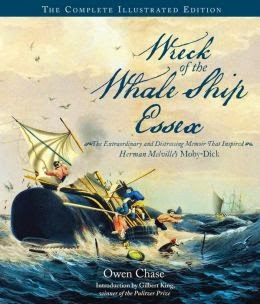
The Wreck of the Whale Ship Essex: Introduction by Gilbert King


The Wreck of the Whale Ship Essex
By Owen Chase
Introduction by Gilbert King
Zenith Press 2015

review by Tom Miller

On November 20, 1820 a small but intrepid ship named the Essex, captained by James Pollard and out of Nantucket was hunting whales in the Pacific Ocean.  She had just dispatched her whale boats which were closing in on a pod of whales when the hunter became the prey.  A bull whale, some eighty-five feet in length, appeared on the surface of the ocean not far off the bow of the ship.  It paused as if studying a target, then started moving toward the ship at great speed and rammed the vessel with its head.  The whale proceeded underneath the Essex, swam some distance, turned and at even greater speed rammed the ship once more holing the opposite side causing it mortal damage.  After salvaging what they could Captain Pollard, First Mate Owen Chase, Second Mate Matthew P. Joy and seventeen crew members left the wreck in three small and less than substantial whale boats.  Thus began an impossible journey towards the western coast of South America some three to four thousand miles distant.  Nearly one hundred days later only seven were still alive to be rescued in three separate encounters.  Toward the end of their trials and in desperation they resorted to cannibalism. 

The Wreck of the Whale Ship Essex is First Mate Owen Chase’s account of the incident and the subsequent ordeals that ensued.  It was first published by Chase in 1821 and has been republished several times in the nearly two centuries that have elapsed since its release.  His account spawned many excellent stories of whaling, sailing, adventure and danger.  Most notable perhaps is Herman Melville’s Moby Dick and Nathaniel Philbrick’s In the Heart of the Sea which is currently in production as a movie directed by Ron Howard.  Melville’s personal copy of Chase’s book has copious handwritten notes in his own hand which indicate how much he may have relied on this original account as he constructed his novel.
Philbrick’s approach is one of an historian.  He researched the history and background of Nantucket, the whaling industry, ship building and sailing and drew both on Chase’s account and that of Thomas Nickerson who was the cabin boy and a mere teenager when the Essex cleared Nantucket in 1819.  Nickerson was finally convinced to put his recollection of the situation to paper nearly fifty years after its occurrence and that account was misplaced until 1960 when it resurfaced and lent a somewhat different perspective to the whole affair than Chase’s.

So the question must be asked, “Why release a book first published in 1821 and republished several times in subsequent years?”  A simple answer is that this edition by Zenith Press is a beautiful book.  But beyond that, Zenith has added texture with an introduction by Pulitzer Prize Winner Gilbert King as well as a number of excerpts from Moby Dick and a variety of other tales of whaling exploits.  Also there are some one hundred and fifty pages of maps, charts and photography that are absolutely stunning.  Many photographs are of the Charles W. Morgan, the last surviving whaling ship of an American fleet of nearly 2,700 ships, which is today berthed at Mystic Seaport in Connecticut.  There is nothing quite like the sight of a three master under sail.

This book then is a collector’s item.  It stands on its own merit for those that have a casual interest in whaling and sailing and the story of the Essex.  However, for the serious collector and historian of seafarers and those who earned their living in such endeavors this is a piece that will enhance and add value to their collection.

Wednesday, April 01, 2015

Červená Barva Press Celebrates 10 Year Anniversary

 
Červená Barva Press Celebrates 10 Year Anniversary


Červená  Barva Press is celebrating 10 years of publishing. There will be a celebration on Thursday, April 16th at the Arts at the Armory in the Cervena Barva Press studio/Basement B8 at 7:00PM, 191 Highland Avenue, Somerville, MA.  Refreshments will be served. Parking is available in the back of the building.

Červená Barva Press has published poets, fiction writers and playwrights from all over the world. Many authors who are in the area will take part in the celebration by reading work from their chapbook/book that was published. The readers include:  Ed Hamiliton, Andrey Gritsman, Irene Koronas, Tim Suermondt, Steve Glines, Doug Holder, Harris Gardner, Jack Scully, Mary Bonina, Timothy Gager, Mark Pawlak, Julia Carlson, Rene Schwiesow, Catherine Sasanov, Zvi A. Sesling, Denise Bergman, Michael T. Steffen, Kathleen Aguero, Pamela Annas, Annie Pluto, Krikor Der-Hohanessian, and more to be added as they are heard from.

Červená Barva Press was founded in April 2005 by Gloria Mindock. The name means “red color” in Czech.  Gloria Mindock chose a Czech name to honor Václav Havel and operates the press with William J. Kelle.  Over the years, they have had interns from numerous colleges and volunteers. In 2014, Flavia Cosma came aboard as international editor and Tim Suermondt and Pui Ying Wong joined Irene Koronas, who has been with the press from the beginning, as book reviewers.
In 2005, Červená Barva Press published 21 poetry postcards, which included Catherine Sasanov, Eric Pankey, Michael Burkard, David Ray, Simon Perchik, Gian Lombardo, Gary Fincke, Susan Tepper, Dzvinia Orlowsky,  and others. Since 2006, the press has published 82 chapbooks and over 52 full-length books of poetry, fiction, plays, and translations, and 7 e-books which are free to read online. Červená Barva Press is one of the most active presses in the country.

The Lost Bookshelf Bookstore was started in 2005 along with the press to sell Červená Barva Press books, books on consignment by other authors and presses and used books. The bookstore is online and has a presence in the Červená Barva Press studio. www.thelostbookshelf.com

The Červená Barva Press Reading Series is held in their studio after many years having the series in the Pierre Menard Gallery in Cambridge, MA. Once that gallery closed, the press found a home in the Arts at the Armory in Somerville, MA. Events are held such as readings, workshops, panels, and a group of women writers meet each month to share new work with each other. Irene Koronas is co-host of the reading series and helps plan many of the events and whatever else the press may need.
Červená Barva Press holds chapbook contests in poetry and fiction every few years. The press also has a monthly newsletter which features interviews with editors and authors, new books by the press, new books by other presses, book reviews and writing news.

For more information, please contact: Gloria Mindock, editor & publisher
editor@cervenabarvapress.com
www.cervenabarvapress.com


The ten year celebration is open to the public, and we hope friends of Červená Barva Press will join us and past readers in our reading series.

A Lot on Our Minds and Hidden Faces of Courage: Written by Mary Driscoll


A Lot on Our Minds
and
Hidden Faces of Courage
Written by Mary Driscoll
Produced by OWLL, On With Living and Learning
Cambridge YMCA Theater
820 Massachusetts Ave.
Cambridge
Thursday, March 26, 7:30
Friday, March 27, 7:30
Saturday, March 28, 4:00 & 8:00

by Wendell Smith

The message of A Lot on Our Minds and Hidden Faces of Courage is being celebrated with standing ovations in the theater of the Cambridge YMCA. At least it was last Saturday night and, according to the friend who urged me to review it, it had also been greeted with enthusiasm the night before. So it is successfully fulfilling the intention of its author, Mary Driscoll and of OWLL (On With Living and Learning,) the organization she founded and which is producing these performances, "to amplify the voices of women and promote social change."

I had come expecting a play, but I was given a dramatized essay, a polemic with a message so compelling that it overwhelms aesthetic considerations. However, my aesthetic considerations hope that Ms. Driscoll is not satisfied with this fulfillment of her intentions, because, if she were to proceed and give this robust skeleton of a play the muscles and nerves it needs to run, then she would have a play capable of filling a theater much larger than the Cambridge Y’s.

The performance is a eulogy for her friend, La Verne, a woman Driscoll met twelve years ago shortly after La Verne had been released from prison. It fulfills a promise  "to tell her story with the hope that it would encourage other women who were facing the challenges of reentry."

The performance begins with Giftson Joseph and Dexter Julian Miller standing behind two music stands reading A Lot on Our Minds. It is straight exposition; presumably their story because they read in the first person about the trials of women in prison and the effects of their mother’s imprisonments had upon them. Giftson makes a joke about how he got his name: his birth was unplanned, a gift, and he was a son. Following this prologue, we are given a loose collection of scenes in which Mabel, who represents La Verne, and a cohort of five women recently released from prison, Destiny, Imania, Amy, Angel and Claire, narrate their histories. Most of what we learn about them comes in expository soliloquies. Fortunately this cast is capable of keeping all this exposition from numbing us.

The production had its excellent moments, enough to keep my critical persona in his seat and wanting more. I'll mention two, because they illustrate that Miss Driscoll has the chops to make this compelling theater if she should choose to do so.

In the first, one of the women is dealing with an overworked social worker/bureaucrat (well done by Johnnie McQuarley, the only male in the cast.) As he gives her a bundle of papers that are supposed to have the information she needs to manage her reentry to the world after prison, the air around her becomes filled with pieces of paper that threaten to bury her in their drift and the dialogue becomes an exchange with the anarchic rhyming rhythm of Dr. Seuss. How much better is the sarcasm of such a sad comedy for the stage than being told, "It doesn't work."?

In another scene Mabel narrates an episode when she was consecutively raped. While her cohort supports her, she starts her tale and, as the raping begins, she dissociates from her violations by reciting the Lord's Prayer. Each recitation represents a rape, the recitations becoming more rapid and muddled; are these sins or trespasses or transgressions or worse? And by whom are they to be forgiven? This is theater; action, words not as information, but as weapons.

Driscoll is dealing with powerful material here and she has an excellent cast, Liana Asim as Mabel; Shalaye Camillo, Theresa Chiasson, Alissa Cordeiro, Chris Everett and Ela Quezada as the cohort of prisoners/freed women; and Johnnie McQuarley as the social worker, other incidental males and Mabel’s son. They are able to lift this performance out of its mass of exposition so that, although it has a way to go to be a play, you can think of your ticket as a Kickstarter donation, and the evening’s entertainment your reward for supporting OWLL’s campaign.


*********Wendell Smith is a retired M.D. and a former reporter for the Boston Phoenix. 

Monday, March 30, 2015

Boston National Poetry Month Festival, 2015 April 9 -12 (Boston Public Library & Fisher College)


By Kirk Etherton   


Denise Provost/Somerville Poet/State Legislator


Somerville is home to so many fine writers, chances are good you may be one them. Even if you aren't on the "official program," perhaps you'll recite a poem at the Open Mic.

The Festival is celebrating its 15th year; 2015 promises to be more diverse and exciting than ever. It begins Thursday evening with a program of Poetry, Music & Dance (produced by Somerville resident & Berklee prof. Lucy Holstedt). Participants include various members of the Berklee community, and electric bassist Ethan Mackler.

Friday afternoon features 13 great "Keynote Poets." Included are Somerville resident & Pulitzer Prize winner Lloyd Schwartz, David Ferry (National Book Award), Kathleen Spivack, Charles Coe, and Diana Der-Hovanessian (recipient of the Barcelona Peace Prize—plus countless other accolades).

Friday evening, it's the Festival's first "High School Slam Poetry Competition." Six teams will compete. The event is hosted by well-known slam poetry organizer "Mr. Hip"; teams represent schools from Brookline, various areas of Boston, plus the North Shore.

I should mention that poet Harris Gardner—who co-founded this annual event— resides here in Somerville. Denise Provost, one of the fine "Featured Poets" on Saturday, lives here as well; of course, she is also a highly regarded State Representative. On Sunday, you won't want to miss award-winning poet Ifeanyi Menkiti (Somerville resident and owner of the world-famous Grolier Poetry Book Shop).

Somerville's Doug Holder, who kindly suggested I write this week's column, is another exceptional poet you'll want to hear on Sunday. Doug's neighbor Bert Stern, a profoundly talented writer, is reading Sunday as well.

In the spirit of full disclosure, I must tell you that I, too, am a "Somervillen"! (I'll be hosting some events, and also performing.)

NOTE: this is a FREE event, and all are welcome. One reason it's free is the generosity of various excellent area businesses. In Somerville, many thanks to The Norton Group (real estate), Master Printing & Signs, Blue Cloud Gallery, and Sweet Ginger Thai Cuisine. Thanks also to Union Square's fantastic Market Basket, for helping with publicity.

In what I call "Greater Somerville," which includes Cambridge and Boston, special thanks also to Harvard Book Store, boloco, and the Middle East & ZuZu Restaurants and Nightclubs.

I can't begin to mention everything and everyone this Festival has to offer (a panel discussion on "Craft & Publishing," a reading by Boston's new Poet Laureate, book tables, etc.), so you should really check out the Festival's website.

It's easy to learn more—including how to sign up for the Open Mic I mentioned at the beginning, plus where and when everything is taking place. Go to: bostonnationalpoetry.wix.com/poetry


Saturday, March 28, 2015

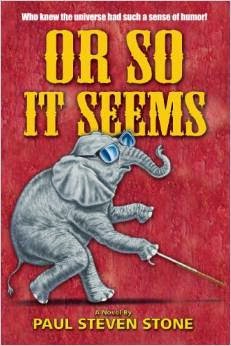
Or So It Seems By Paul Steven Stone


Or So It Seems
By Paul Steven Stone
Blind Elephant Press
Cambridge, Massachusetts
OrSoItSeems.stone@gmail.com
ISBN: 978-1438207698
434 Pages
$20.00

Review by Dennis Daly

Overthinking a book review can be hazardous to both the author and the reviewer. You never quite know where these musings will take you. Here I am, disembodied, settled in a few inches under the ceiling of this book-strewn room where I am consulting with Bapu, a fictoplasmic Hindu holy man that I have borrowed from the pages of Or So It Seems, the very novel that I am reviewing.  Both Bapu and I look down upon my squat physical being, sitting at a large drawless, cherry-stained desk, clad in sweats, feverish and suffering from a head cold. I seem to have come up with an idea and am now typing furiously into my cranky HP computer. My newly-found spiritual companion comments unmercifully on recent changes in my appearance—my baldness, my thickening no-neck carriage, and my toad-like expressions to be exact. Fair enough. But I must admit that his damnable high-pitched giggling does, occasionally, get to me.

Bapu reminds me that Paul Steven Stone created his character as an aid to the reader’s consciousness and as the driving mechanism which moves a charmingly simple and often hilarious story of father and son intimacy and family dysfunction into the exotic realm of karma and time travel. Structured as a do-it-yourself-workshop, the novel’s characters discuss and confront the nature of experience and reality itself. The book’s protagonist, Paul Peterson, responds to life’s hurdles with thoughtfulness, sensitivity, and astute problem solving, and is, of course, duly rewarded with divinely appropriate punishments for each of these positive reactions. Like most humans Peterson experiences missteps and shares his fellow travelers’ befuddlement. And also, like most humans, he makes the best of things and continues on his one-way (or perhaps circular) journey through life.

Did I mention sex and the singles scene? Stone tethers his plotline to a Plymouth Massachusetts second floor apartment and this setting becomes not only the center of feral sexuality, but also the launching pad for his time tripping into past and future adventures. The unbridled cougar who entertains Peterson here doubles as the stressed-out, cynical fourth grade teacher of his earnest and perceptive son, Mickey. Her character type exudes hilarity and danger in a sexual package that our pedestrian reality unfortunately loves to nurture. Unaccountably, I think that I’ve met this woman in a past life. “You have!” giggles Bapu. Oh God, this head cold has impaired my frail judgement.  Stone entitles one of his chapters,

Never Let A
Fourth Grade Teacher
Drink More Than Three
Glasses of Wine.

Pretty funny stuff.

In perhaps more innocent times the Pinewood Derby ruled the day as the yearly ritual of father and son connection. Often it would be overseen by other stalwart organizations of fading (at least in this locale) Americana like the Cub Scouts. Stone uses this event with great effect in chronicling the evolving relationship between the hapless but well-meaning Peterson and his son. Lessons are offered and learned, but they are quite different from any considered pertinent or intended when the game was joined. Peterson unknowingly schools his beloved son in independence, humor, and courage. Without giving away the twisting plot lines and the neat punch lines, there is a terrific scene in which Peterson faces a bully overcome by envy and rage. The humor surrounding the struggle melts away… and the starkness of the real world harshly appears, as it often does. Both protagonist and antagonist grip Mickey’s race car and the universe stands still. The tone is just about right. Don’t miss this section; alone, it’s worth the price of purchase. 

As you read through this novel the texture deepens considerably. Stone includes not only past and future events that support his interwoven plot, but also includes what he call glimmers. These glimmers give insight into roads not taken and the importance of free will in self-discovery. Think Hindu karma, of course. But there’s also the Christian concept of grace. Bapu reminds me that the concept of time changes as the book progresses. Here is another relevant chapter title (Lesson 31 of the workshop),

A Ten Minute
Discussion
On Why
Time Does Not Exist.

Easy for Stone to say, he spent eleven years writing this book.

Having a guiding holy man as prophet and coach to the protagonist condenses the space between thought and action.  Settings and resolutions immediately follow, but not always seamlessly. Early theories in neuroscience (see Julian Jaynes, The Origin of Consciousness and the Breakdown of the Bicameral Mind) considered this phenomenon as wholly internal. Bapu’s very existence was conceived as built in. Call him muse, god, prophet, or disembodied holy man.  As this relationship broke down, space increased and reactions became confused and halted. I can see at this moment my computer has crashed and I’ve walked away temporarily. Giggling still, Bapu cautions me to calm my obvious impatience. Stone’s Peterson will still be there and the review can, in a disconnected sense, be completed. I am sitting back down and complying with necessity now. You need to read this book. It is a bundle of well-built laughs. IT IS WRITTEN for you. So sayeth Bapu.

Thursday, March 26, 2015

BOSTON NATIONAL POETRY MONTH FESTIVAL 2015


Danielle Legros Georges ( Boston Poet Laureate)


BOSTON NATIONAL POETRY MONTH FESTIVAL
                   Boston National Poetry Month Festival, 2015
                        Boston Public Library, Central Library in Copley Square
                        and  Fisher College, 116 Beacon Street 

     April 9th-12th. FREE ADMISSION to all events.
            An Evening of Poetry, Music & Dance.  Dozens of Established Poets.
         High School Poetry Slam Competition.  Emerging Poets and an Open Mic.

Thursday evening, the Festival begins at Fisher College, with a program of Poetry set to Music & Dance.
        This event is produced by Lucy Holstedt, professor at Berklee College of Music.

Friday afternoon, the Festival continues at Fisher College with 13 "Keynote Poets." They include winners of
        the National Book Award. the Ruth Lilly Poetry Prize, and the Pulitzer Prize.

Friday night at Fisher College, we're pleased to host the festival's first high school poetry slam competition.
        
Saturday and Sunday at Boston Public Library, you can enjoy 50 established and emerging poets, incuding         Boston's new Poet Laureate, Danielle Legros George, National Poetry Slam winner Regie O. Gibson, 
         Rep. Denise Provost and professors at area colleges. Saturday features winners of the slam poetry
         competition, and a panel on "Craft and Publishing." Sunday includes an Open Mic.

Fisher College (116 Beacon St.), Alumni Hall (accessible)  all events are FREE
Thursday, April 9th, 7:30pm Poetry, Dance and Music
Friday, April 10th, 12:00 noon-4:45pm,13 Keynote poets
Friday, April 10th, 7:30pm, High school slam competition 

BPL (700 Boylston St.),Commonwealth Salon (accessible) all events are FREE
Saturday, April 11th, 10:15am-4:50pm, 30 published poets, including the former Boston Poet Laureate,
     Sam Cornish, slam poetry finalists, book table/signing, and panel on "Craft and Publishing"


Sunday, April 12th, 1:00-4:00pm, 17 published poets, including the new Boston Poet Laureate, Danielle
      Legros George, Open mic (sign-up starts 1:00), Poetry slide show, and book table/signing.


Boston National Poetry Month Festival is co-sponsored by Tapestry of Voices & Kaji Aso Studio in partnership with Fisher College and in collaboration with Boston Public Library.      
FOR INFORMATION: Tapestry of Voices: 617-306-9484. Library: 617-536-5400.

The Hastings Room Celebrating a Centenary in Print: T.S. Eliot’s The Love Song of J. Alfred Prufrock With Lloyd Schwartz & Jennifer Formichelli

The Hastings Room

Celebrating a Centenary in Print

T.S. Eliot’s

The Love Song of J. Alfred Prufrock

With

Lloyd Schwartz & Jennifer Formichelli

 Wednesday, April 15th, 7:00 pm
First Church Congregationalist
11 Garden Street
near Harvard Square
co-sponsored by The Grolier Poetry Book Shop

***   ***   ***

Lloyd Schwartz


Lloyd Schwartz is Frederick S. Troy Professor of English at the University of Massachusetts Boston and a Pulitzer Prize-winning commentator on music and the arts. He is the author of three books of poetry and his poems have appeared in The New Yorker, The Atlantic, The Paris Review, The Best American Poetry, and The Best of the Best American Poetry.

***   ***   ***


Jennifer Formichelli


Jennifer Formichelli received a BA in Literary History from Boston University, and a PhD in English Literature from the University of Cambridge, where she wrote a doctoral thesis on the epigraphs to the poems of T.S. Eliot. She has written on literary history, epigraphs, Shakespeare, Elizabethan theatre history, William Empson, and T.S. Eliot’s poetry and prose. She currently teaches Humanities and Rhetoric at Boston University, and is a co-editor of The Collected Prose of T.S. Eliot.

Tuesday, March 24, 2015

Where The Meadowlark Sings by Ellaraine Lockie


Where The Meadowlark Sings
Encircle Publications
Farmington, MA
© Copyright 2015, Ellaraine Lockie
ISBN-13: 978-1-893035-23-2
Softbound, $12.95, 26 pages


Review by Zvi A. Sesling

Last I reviewed Ms. Lockie she was sitting mostly in a Starbucks observing people and writing about them.  Many of those poems had a subtle humor and were quite enjoyable. This time we find her in home backyard of Montana Big Sky country.  These poems are more serious, more enjoyable and just as worthy of being read.

These poems can be hard, gritty, excruciatingly honest and that is what makes them so compelling.  For those of us who live in the east, or have never been to Montana where Custer made his last stand  and Glacier National Park is a top tourist attraction, there is much to learn and Ms. Lockie provides a somewhat different, if not personal, education.

In “Godot Goes to Montana” readers learn the basics of farm life:

My farmer father waited to
if crops would hail out or dry up
If coyotes would tunnel the chicken coops
If the price of grain could keep
me out of used clothes
If the bank would waive foreclosure
for another year

After hay bailing and breech delivering
from sunrise to body’s fall
He slept in front of the evening news
Too worn out to watch the world squirm
Too weary to hear warning from ghost brothers
who were slain by bee, bacon and stress
Too spent to move into the next day

when couldn’t afford to forget
how Brew Wilcox lost his left arm to an auger
How the mayor’s son suffocated in a silo
Too responsible to remember the bleak option
my grandfather chose for the rope
hanging over the barn rafters


never too lonely every farmer
had a neighbor to bullshit with
To share an early A.M. pot of Folger’s
To eat fresh sourdough doughnuts
To chew the fat of their existence

Whether Lockie is telling you “How To Know A Prairie Poem”  or about “Witches of the West” or what it is like “On the road After a Record Rain” you will gain insight not only into her psyche, but learn about the west without didactic preaching. For example take the following poem:

Uninhabited

The one-room schoolhouse
is weathered by a hundred years
on the prairie
Emptied of my mother, aunts, uncles
and the bell in the tower that tolled
their welcome to the middle of nowhere

I bring my daughter here
for an optical history lesson
Me to summon ancestor stories
that have been silenced by the din
of decades in cities

She forges in front of me
ever anxious to embrace anything abandoned
And I’m struck dumb by the assault
of some instinct as old and tongue-tied
as those stories

At the doorframe she hears the hiss
before the rattle that roots her
to the cactus-covered earth
As the snake slithers away
And elementary education continues
two generations after it began
in the one-room schoolhouse

It is easy to see why Where The Meadowlark Sings was the winner of the 2014 Encircle Publications Chapbook Contest.  It is an accessible and enjoyable read.
_________________________________________
Zvi A. Sesling
Reviewer for Boston Small Press and Poetry Scene
Author, King of the Jungle (Ibbetson St.) and  Across Stones of Bad Dreams (Cervena Barva)
Editor, Muddy River Poetry Review
Publisher, Muddy River Books
Editor, Bagel Bards Anthologies #7 & #8

Friday, March 20, 2015

NEWTON WRITING AND PUBLISHING CENTER


NEWTON WRITING AND PUBLISHING CENTER
289 Elliot Street, Newton Upper Falls, MA  02459

GRAND OPENING: SATURDAY, MAY 9 FROM 1:00 – 4:00

Welcome to the Newton Writing and Publishing Center – a meeting place for writers who are serious about working hard and getting published. The NWPC provides direction, feedback, support, and inspiration to a dedicated community of writers and poets with intense workshops, lively open mic nights, special literary events, award ceremonies, author appearances, and catered book launching parties. Our affiliation with Big Table Publishing Company, Boston Literary Magazine, and Mockingbird Square Press gives writers easy access to exciting publishing opportunities. We also have a lot of fun!

Please visit us on the web at www.newtonwritingandpublishingcenter.com for all the details, and follow us on Facebook!

Monday, March 16, 2015

Dead Lions by A.D. Winans


( Left to Right: A.D. Winans, Jack Micheline)


Dead Lions by A.D. Winans (Punk Hostage Press)  $16.95
Review by Doug Holder

A.D. Winans, founder of the ground-breaking San Francisco-based Second Coming Press and doyen of the San Francisco poetry scene for the past 40 or 50 years, has a new book of essays out titled: Dead Lions. Winans throws his focus on four writers: screenwriter Alvah Bessie (Bessie was one of the Hollywood Ten, who appeared in front of the House Un-American Activities Committee in the 1950s), Jack Micheline, the poet and Whitmanesque wanderer, Charles Bukowski, the dirty old man of poetry, and Bob Kaufman, one of the great Beat poets to come out of the North Beach scene in San Francisco.


Since I am primarily a poet, I am most interested in Winans’ accounts of Micheline, Bukowski, and Kaufman. Winans aptly starts with Micheline’s death on a San Francisco subway.  A Poetic death in transit, like Lowell’s in the back of the cab— unlike most of men who die undignified deaths from straining on the toilet, or drowning in cancer and heart disease. Winans recounts Micheline’s wanderlust, his prolific trips across the country, and his outrageous behavior fueled by booze. .Micheline, although he published 20 books, was spurned by the City Lights Press,  Black Sparrow and other notable publishers because of his “offensive” behavior. But Micheline never changed his ways. Winans writes:

“He refused to bow to anyone, choosing to write for the people, hookers, drug addicts, blue collar workers and the dispossessed, and he did it from deep inside the heart.”

 Micheline was befriended by Bukowski, but Bukowski did not share the religious fervor he brought to his poetry. Yet Bukowki  respected the man. Winans quotes from a letter Bukowski sent to him:

“ Micheline is all right—he’s one third bull shit, but he’s got a special divinity and special strength. He’s got  perhaps a little too much of a POET sign pasted to his forehead, but more often than not he says good things—in speech and poem—power-flame, laughing things. I like the way his poems flow and roll. His poems are total feelings beating their heads on barroom floors.”

Much has been written about Charles Bukowski, and in fact Winans has written a memoir published by Dustbooks: The Holy Grail: Charles Bukowski and The Second Coming that I reviewed years ago for the Small Press Review. Still--it is interesting to hear Winans’ take on things, even though we might have heard it before. Winans met Bukowski when he was publishing his Second Coming magazine in San Francisco. He even had an issue dedicated to Bukowski. Winans sees many admirable qualities in the BUK—but—he gives us the full view of this man with the pockmarked face:

 “Hank was a man of many virtues, but to see him (as many do) as a man whose motive and actions were in the best interests of the down and out, simply ignores the fact he betrayed and tore apart many former friends, both in short stories, and in vindictive poems, frequently breaking off friendships whenever someone got to close to him, and often on brutal terms.”

Winans points out that besides his poetic acumen Bukowski was a great entertainer. Here,Winans describes Bukowski on stage, before his reading:

“Once on stage, he wasted no time in opening the refrigerator door and popping open a can of beer to the sound of wild cheers. I watched him survey the crowd for several seconds before tilting his head back and drinking half the contents from the beer can. Again this simple act was met with rousing cheers.”

The North Beach section of San Francisco is now more of a tourist destination, as gentrification of the city has forced out many of the poets and writers with astronomical rents. I recently saw some footage from a documentary with Lawrence Ferlinghetti  (Founder of City Lights Book), who talked about the high tech sector coming in and gutting the city—to where he barely recognizes it. But in the 50s and 60s this was a hotbed of creative energy. North Beach is a six block area from lower Grant Ave. to upper Grant Ave. in the city. Poet Bob Kaufman, known as the “American Rimbaud” was a prime player here. He co-edited the well-known lit mag Beatitude with William Margolis. Kaufman was the son of an Orthodox Jew and an African-American mother, brought up in New Orleans. His best known book was published by the noted Avant-Garde Press, New Directions. The book titled: Solitudes Crowded with Loneliness created quite a stir in the local literary community. Winans hung out with Kaufman in the Co-Existence Bagel Shop, a happening spot at the time and he recalls a very dramatic poet:

“Kaufman entered the establishment, climbing on top of the tables, and reciting a newly written poem…The audience hung on his every word.” Later Kaufman got into difficulty with the police and was often hauled to the city prison after he wrote on its walls of the bagel shop: “Adolf Hitler, growing tired of Eva Braun, and burning Jews, moved to San Francisco and became a cop.”


The book is chock full of Winans’fly on the wall accounts of these renegade poets and writers. This is not a scholarly book, there is no real intensive analysis of their work, but it is a lively introduction to these men—and well-worth the read. The book should whet the readers' interest and hopefully they will want to explore these men further.  I also wonder about the women poets of this era— but perhaps that is meant for another book.