|
| The book table at the 2013 Festival |
Sunday, March 23, 2014
14th annual Boston National Poetry Month Festival : April 11th from 11:00 A.M. to 4:00 P.M.
The Boston National Poetry Month Festival
and Old South Church (Thursday)
12:00-1:00 Dan Tobin, Christine Casson, Jim Schley


Wednesday, March 19, 2014
Poems That Make Grown Men Cry: 100 Men On The Words That Move Them. Edited by Anthony and Ben Holden.

Poems That
Make Grown Men Cry: 100 Men On The Words That Move Them. Edited by Anthony and
Ben Holden. ( Simon and Schuster) $25.
Review by Doug Holder
Ben Holden,
who along with his father Anthony Holden ( Both accomplished writers in their
own right) are editors of the new poetry
anthology Poems that Make Grown Men Cry…
Ben Holder points out in the introduction to the book that Charles Darwin was
at a loss to explain “crying,” describing it as that “special expression”
attributed to humans. And this raw, mostly involuntary mode of expression is
something we often try to hide—at least in public. But there is something
blatantly honest about it in a world of artifice that makes us uncomfortable.
We have all been at the oh-so polite poetry readings where people posture in poses
of forced ecstasy and drone the perfunctory ah and um. Here, in this anthology,
the readers of these poems unabashedly cry. And these aren’t just any readers.
This collection is a survey of one hundred men of letters and the arts—poets,
critics, authors, directors, artists, etc… who don’t cry at the first blush of
cheap sentiment thrown at them. Their emotions cannot be bought for the price
of salted peanuts and a cocktail. Such noted men as John Le Carre, Harold
Bloom, Chris Cooper, Clive James, Jonathan Franzen, Billy Collins and many
others shed a well-considered tear here.
As for me I
didn’t cry. But I did have a wistful sigh; I experienced a haunting shudder; I
noticed my hands trembling clandestinely under the table—perhaps a transient
burst of indigestion coming from the depths of my throat.
After
browsing through this volume I found much to recommend to the reader. Terry
George, a Belfast-born screenwriter cites the lamenting poem by Seamus Heaney
“Requiem for the Croppies.” The poem deals with the Irish Rebellion of 1798.
Here the population revolted against British rule. As George writes: “…tramp priest and peasant…they fought with
farm tools against cannons.” The men were heroic; the results were tragic:
Terraced thousands died, shaking scythes at
cannon.
The hillside blushed, soaked in our broken
wave.
They buried us without shroud or coffin
And in August... the barley grew up out of
our grave.
The novelist
Nicholson Baker writes about Stanley Kunitz’s poem “End of Summer.” It deals
with that poignant moment when you realize things have changed—you can’t go
back—the die is cast. Here Kunitz gets a signal from nature:
Blue poured
into summer blue,
A hawk broke
from his cloudless tower,
The roof of
the silo blazed, and I knew
That part of
my life was over.
And as we
all know there is always comedy peppered in tragedy. The poet Jack Mapanje
cites “The Book Burnings” a beautiful piece by Bertolt Brecht with a delicious
dollop of gallows humor. Here the poet in the poem rages at the despotic powers
that did not burn his book with the others:
To his horror, that his books
Had been
forgotten. He hurried to his desk
On wings of
rage and wrote a letter to the powers that be.
Burn me! He
wrote, his pen flying, burn me!
Don’t do
this to me. Don’t pass over me! Have I not always told you
The truth in
my books? And now
I am treated
as a liar!
I order you:
Burn me!
I wonder why
this anthology only had weeping men. Maybe it is because men are perceived as
less emotionally accessible. However I am sure many women will do a discrete
dab with their hankies, when they read these evocative selections.
Highly
Recommended.
“I Will Never Forget” A Daughter’s Story of Her Mother’s Arduous and Humorous Journey Through Dementia By Elane C. Pereira

“I Will Never Forget”
A Daughter’s Story of Her Mother’s Arduous and Humorous Journey Through Dementia
By Elane C. Pereira
iUniverse, Bloomington IN
Reviewed 3/7/14 by Paul Steven Stone
A poignant journey through a life ending cruelly yet surrounded by love, “I Will Never Forget” is the author’s reminiscences, meticulously recorded, of her mother’s gradual diminution through the unstoppable ravages of Alzheimer’s. Well written and copiously recorded, the memoir is particularly powerful in the way the author jumps back and forth in time telling hers and her family’s story, so that by the time we are deep into her mom’s diminishment by Alzheimer’s we have witnessed many of the shared memories that her mom, Bette, will gradually relinquish to the disease.
In recounting her childhood memories, from small victories, like rescuing a baby bunny, to lessons learned when her mom cleverly broke her of the habit of pre-inspecting her Christmas presents, Mrs. Pereira shares with us the threads that make up the tapestry of a normal middle class life, interspersed as it was with the tragedy of death and loss.
As someone whose own mother is currently at the end game of Alzheimer’s I couldn’t help but compare Mrs. Pereira’s efforts to be a thoughtful, consoling caretaker of a struggling parent with those of my own. Frankly, I too often found the comparison uncomfortable. For Mrs. Pereira was a caring daughter, gifted with patience and understanding that ran far deeper than my modest portion.
Patience and understanding are ingredients greatly called upon when dealing with a parent suffering from Alzheimer’s. Especially in the early days when one can’t really be sure what’s going on; whether your mother is just being forgetful or is starting to need extra care and vigilance. Nor are the dangers so easily seen or navigated, as was proven when Bette stumbled out from a ‘secure’ facility into 25 degree weather for hours wearing only her pajamas.
I strongly recommend “I Will Never Forget” for anyone who finds him or herself on the threshold of a situation similar to the author’s. For revealing the stages of decline, the mood swings and roller coaster behavior of someone with Alzheimer’s, and the many challenges and pitfalls for those who are forced to take on a parental role for their parent, “I Will Never Forget” is like a guidebook to a foreign country. It is a story that you, like the author, will never forget.
Tuesday, March 18, 2014
Poet Alan Feldman: A psychologist of the mystery of love.
 |
| Poet Alan Feldman |
Poet Alan Feldman: A psychologist of the mystery of love.
Ah! Ain't love grand! Yes grand, tragic, maddening, evolving... in all its infinite variety. Feldman in his collection Immortality
explores love and its many manifestations, as well as other themes. I
had the privilege to interview Feldman on my Somerville Community Access
TV show Poet to Poet: Writer to Writer recently.
Alan Feldman's A Sail to Great Island (2004) won the Pollak Prize for Poetry from the University of Wisconsin. The Happy Genius (1978)
won the annual George Elliston Book Award for the best collection
published by a small, U.S. non-profit press. His work has appeared in the Atlantic Monthly, the New Yorker, and Kenyon Review, among many other magazines, and included in The Best American Poetry 2001 (edited by Robert Hass) and BAP 2011 (edited by Kevin Young). Feldman's recent work appears in Hanging
Loose, Cimarron Review, upstreet, Southern Review, Yale Review,
Salamander, Southwest Review, Cincinnati Review, Catamaran, Worcester
Review, and online in Boston Poetry Magazine and Cortland Review. His poem "A Man and A Woman" was featured in Tony Hoagland's 2013 article for Harper's, "Twenty Little Poems That Could Save America."
Feldman was a professor and chair of English at Framingham State University, and for 22 years taught the advanced creative writing class at Harvard University's Radcliffe Seminars. He offers
free, drop-in poetry workshops at the Framingham (MA) public library
near his home.
Doug Holder: We were both born in New York City, and moved out to the suburbs of Long Island. I always found the suburbs stifling--how did you find it?
Alan Feldman: I was desperate to get out of the suburbs. But I will tell you something about Woodmere, L.I where I grew up. My mother and Louise Gluck's mother were best friends. Louise grew up in Hewlett and I grew up in Woodmere and so apparently it was a fertile ground for poets. And Louise had an exhibit of her paintings at the Hewlett library when I was in high school. Her paintings were striking. Later -I met her on a bus when I was attending Columbia University. She told me she was taking a very good poetry course with Leoine Adams.And Louise was very beautiful, and so I thought I would sign up for the workshop, and maybe get to know her. But the workshop was not for me so I stopped going. But I forgot to drop the course. So my transcript will show the only course that I took in poetry writing, I failed.
My parents were both teachers and they took me and my sister to Europe for three months in 1952. I remember vividly when we were in Rome, I saw the Protestant Cemetery where Keats and Shelley are buried. It was an experience I will never forget. Here we were visiting the graves of folks long dead and we didn't know personally. I was all of seven years old. Shelley's grave was very well-tended--he came from a well- to- do background. It was covered with ivory. and Keats' grave was essentially bare. And then I remember my mother crying at Keats' grave. I thought:"How could something like this affect a living person?" This planted the idea in my soul that there is a transmission from the dead to the living via poetry. This ... I believe... was a big influence for me becoming an artist and poet. So Woodmere was my home--but it was my particular home and family.
DH: You taught in the South Bronx in the late 60s. That must of been--to say the least--challenging..
AF: It was incredibly difficult. I had a choice to teach or ship out to Vietnam. I think I chose the wrong thing ( Laugh) I was placed in a special services school. This was where the average sixth grader was reading at a third grade level. A third of the staff were brand new-and had never been a teacher in the classroom. I was terrible at it. After the first half year they took me out of the classroom and made me a specialist in Language Arts and Science. I got to teach the same lessons all day long--so I got to learn how to teach. The second year they gave me class 5-1.This class had kids who scored the highest in the math test. They were like little geniuses. Some of them were were reading way above grade-level. And we put on plays and I had them painting. I think I succeeded here. But the idea that you can drop a bright and educated person in the classroom and they can automatically teach is wrong. There is so much technique in classroom management. I wasn't ready to teach kids whose main issue was to stay in their seat.
DH: You sent me some poems from your collection Immortality. Many of the poems deal with the psychology of love. One of the poems is titled " The Rowboat, The Girl, The Light" This poem took place when you were very young. You were out on a rural lake and a young girl swam to your boat. Everything smelled of pine, desire, things were elemental. Now you have gotten older things have changed in this realm. Things are more urgent--there is a deeper appreciation of the world.
AF: As you get older-and I will be 70 soon--your desire becomes generalized. You desire the world and everything in it--as a child you take that for granted.
DH: Your wife Nan Hass is an accomplished artist. Do you guys collaborate?
AF: We understand each others' obsessiveness. We are both infected with this need to make art. Nan works all the time and has an incredible drive. She understands me. If something you are working on gets a hold of you--you are going to be immersed in it. We both give each other space. We are hilariously bad at collaboration. We worked on a book of poems, my poems and her illustrations. We got into such a fight about the binding that it almost destroyed our marriage. (Laugh) So our collaboration are limited and with parameters.
DH: You were a professor at Framingham State University for many years. In your opinion what makes for a good teacher?
AF A really good knowledge of the subject. A love for the subject. A strong desire to be helpful. A sense of organization. I have observed so many shapeless classes. The essential purpose is too vague.
The
Rowboat, The Girl, The Light
Today the pool is
pierced
by sunlight, and
there’s a girl
in my lane, her
flesh lit
by reflected
light from below
to a subaqueous
brightness
the way the water
in our boathouse
(demolished long
ago)
shone in our
faces.
We would lean
over to see the striped
shadowy fish,
their sides
glinting like
belt buckles
or dimes, and the
wood
smelled ancient
and dry,
and probably the
dock
creaked, as my
row boat
thumped against
it,
the boat’s floor
resounding
like a drum when
we stamped.
Unsinkable
because of
compartments
under the seat
like little
ovens, so I could
go out alone,
provided
I stayed in the
cove, our point
in the
star-shaped lake,
and hewed close
to the shore
I wouldn't have
wanted to leave
anyway, because
she lived there––
an unfathomably
pretty girl,
like the Queen of
Heaven.
On the best days
she would hail me
from her landing,
but once
she jumped in,
and swam to me,
her white body
dripping
as she clambered
aboard.
Then everything
smelled of pine.
I think that's
how desire felt then––
like an odor, the
pines
that covered the
hillside
above her house.
Desire these days
feels like desire
for
everything. The air
I strain to
breathe, the white
clouds rumbling
across
the blue outside
the pool’s
picture windows,
and the little
pinpricks of
light
on people’s
fenders
while the traffic
passes.
Alive! Alive! each stroke
like the
clenching of the heart
Sunday, March 16, 2014
Partner, Orchard, Day Moon By Michael Todd Steffen

Partner, Orchard, Day Moon
By
Michael Todd Steffen
Cervena
Barva Press
Somerville,
MA
ISBN:
978-0-9883713-2-3
Cover
Art: Irene Koronas
61
Pages
Review
by Dennis Daly
Poetry
needs concentration. Reading Michael Todd Steffen’s first collection of poems,
Partner, Orchard, Day Moon, demands both presence of mind and a steady
emotional containment. I kept putting the book down and looking behind me.
Footfalls I thought. Perhaps murmurings. Or a pulse in the back of my neck.
Many
of Steffens pieces conjure up small town and rural Americana: holidays,
hunting, board games, table talk, hand-me-downs, views through kitchen windows,
summer adventures, and, of course, baseball. Strangely, the atmospherics that
saturate this collection suggest Igmar Bergman rather than Norman Rockwell. In
the midst of measured well-wrought lines and enticing music, something wicked
this way comes.
Right
from the book’s first poem Steffens has a way of disorientating. In Christmas
in August the poet sets up a juxtaposition of seasonal discomfort. The piece’s
second person protagonist ascends a department store’s escalator in summer garb
into a thinner, much colder mannequin world. To drive his image home the poet
places a mirror beyond the escalator’s railing. The contrast tests reality. The
poem opens this way,
Wandering
lost through the department stores
You
catch a glimpse of yourself in an odd
Mirror
gliding over the escalator’s
Handrest—when
the metal step slips forward
And
you stumble, up walking around the mannequins
Clad
for autumn in pullovers and cords.
Summer
hasn’t ended.
The
understated rhyme and metrics seem to effectively push a chilling definition of
the ambiguous, later-mentioned ”bag people” front and center.
Moody
silence pervades the intelligible, but demonic, chess game of life in one of
the title poems (there are three) called The Partner. Curiously, Steffen drops
the names of two iconic chess grandmasters into this context: Tigran Petrosian,
noted for his remarkable, if interminable draws, and Gedeon Barcza, who played
offense using a defensive strategy. The poem ends in Bergman- like fashion,
Thickening
in the waking winter dark
And
the checker’d go watery beneath the pieces—
Your
knight in stirrups at the toe of his pawn.
You’d
catch yourself up from a nod and swear
He
had left the room. But he kept murmuring at you.
All
the while he sat right there
Across
the table, not saying a word.
Steffen’s
sonnet Thanksgiving becomes a secular or possibly a quasi- religious rite of
guilt and sacrifice in a hushed ceremony of food and family. Words such as
“accused,” “wince,” “pain,” and “hushed” shadow the meal and, perhaps,
foreshadow other troubles. The poem ends ambiguously. The poet says,
One
creature went silent. He went on to live
And
join the toast at the table with its ornaments
For
the holiday, the straw weft cornucopia
Basket
with squash and gourds and native corn,
Auburn
of oat sheaf in the candle’s aura
Hushed
for the dishes my aunt told us to pass
With
sneaky dribs of red wine for my glass.
Another
title poem, The Orchard, Steffen molds into a beautifully compressed piece that
mulls over the phenomena of appearance and promise. His braille metaphor really
hits the mark. Here are the first eight lines,
Trees
stood all winter like cattle in the field
Naked
of their leaves in wind and snow,
Their
extremities advanced like blind men reading
Braille
from the lines of wind that made them tremble.
To
look at them for long you would remember
How
superficial winter’s hardest freeze
Compared
to their roots deep as the cemetery’s
Shelter
where uncles seasoned herring stew.
My
favorite Steffen poem, The Miracle Worker in Work Clothes, pushes through the
fertile clods of page prophesizing the brutish theology of a barnyard universe.
The piece is mythic and absolutely unforgettable. The nitty-gritty of creation
accusingly grabs civilized man by his white-collared throat, and demands that he
collect his illusions and step aside. The poet says,
With
the creases of leather boots clumped in clay
The
miracle worker
Has
raised the dead at Saint Galen’s
While
the family wept and praised the lord their god.
Like
earth stunning
Winter
back into spring, the miracle worker
Tensed,
a body of sweat and breath, breast borne open
To
the holy spirit
With
great concentration pushing, pushing
The
dead back into this life while men
Looking
on stood dumb…
Hand
Me Downs, a sonnet, begins as a meditation of family closeness and work ethic,
evolves into the nature of memory, and ends lightly, yet troublingly,
considering mankind’s shared condition. Steffen explains,
I
was straw for style. Others were remembered.
Beyond
their season things withstood a year
Stretched
to casual, wear tear, raggedy,
Nearly
familiar, for me or anybody.
The
longest poem in this collection Steffen entitles Ghost Man. Reminiscent of
Stephen Crane’s The Red Badge of Courage, Steffen’s persona gathers about him a
ghost companion, a dead man pursuing him in his imagination. One of a bunch of
summertime kids, the poet’s protagonist had come face to face with the dead man,
formerly a hanged man. Sickened by what he saw he ran away with his friends in
search of adults. Later, the unresolved death of this ghost (suicide or
homicide?) gives him power over the poet’s imagination. This indefatigable and
hostile spirit blocks pathways and bridges and pursues the poet, threatening
violence. He becomes the sum of all fears. The paranoia builds in these lines,
Some
days later, he’s be there again
Barring
my passage to the pathway bridge.
For
hours after I’d given up and turned
Away
from that crossing with its graceful camber
Over
the river, he followed me
In
silence, appearing behind a large stone
Or
from a hedge or through a row of trees—
The
knotted hunch over to one shoulder
Sure
sign that he had no fear and would eat anything
Steffen’s
collection of poetry does not have the feel of a first book with its expected
missteps and questionable choices. On the contrary its unmistakable artistry
and mysterious combination of maturity and controlled paranoia belies that
trite canard. There is real power, both mythic and otherwise, in Steffen’s word
images delivered here. The bright future of this ghost-haunted, highly talented
poet seems beyond question.
Saturday, March 15, 2014
Rabindranath Tagore: A Sage In The Dust By Sajed Kamal
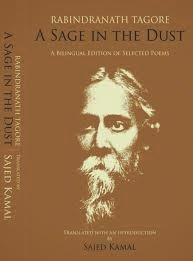
Rabindranath Tagore: A Sage In The Dust
By Sajed Kamal
Bangla Academy Press
$25
2012
By Myles Gordon
When local writer Sajed Kamal decided to translate fifty poems of India’s most revered, admired writer into English, he wasn’t overwhelmed by the difficult task. Maybe that’s because the Bengali-born, now Boston resident, Kamal grew up in the shadow of literary genius.
Kamal’s book, Rabindranath Tagore: A Sage In The Dust, is a heartfelt translation of India’s most acclaimed, beloved writer. Born in 1861, Tagore published thousands of poems, plays, novels, songs, and stories, founded and ran a progressive children’s school, and was an accomplished painter before his death at the age of eighty. One of his poems became Bangladesh’s national anthem, another, India’s, and in 1913, he became the first non-European to win a Nobel Prize for literature.
Kamal decided to attempt the translations a few years ago simply because he loved Tagore’s work and felt a new translation, into a more colloquial English than previous tries, was overdo. A hefty assignment? Certainly. But Kamal hails from high literary pedigree and accomplishment. His mother, Sufia Kamal was also a legendary poet in Bangladesh., of whom none other than the great Tagore said in 1938: Your poetic talent amazes me. You have a high place in Bengali literature, as constant and established as the North Star. Accept my blessings.
Sajed Kanal, who has lived in the Boston area for decades, has written several books of poems himself and is a teacher and noted activist for renewable energy. Having grown up surrounded by the poetry of his mother, he began his translations of Tagore in his kitchen, after work, as a pleasant hobby. As the project took shape, he realized he was onto something with depth and substance that in 2012 was published as a book.
To keep the work fresh, Kamal wrote in an email, about half the poems in the book have never been translated. The rest came out in older translations that he wanted to update unfettered by stifling rhyme and rhythmic schemes of the early twentieth century. The book is a bilingual edition – the poems written in the original Bengali language opposite the pages of their English translations. A Sage In The Dust captures Tagore’s great spirituality and romanticism, and humanist optimism in such poems as “To Civilization”
Give back that wilderness, take this city,
take all the iron, bricks, lumber and stones,
O new Civilization…
I do not want the variety of royal feasts
in the security of your stony cage.
I want freedom. I want to spread my wings,
I want to regain my power within my heart,
I want to break out of my captivity
to let the heartbeat of the universe touch my soul!
The poem evokes Whitman’s scope and grandeur and the awakening of the grand individual in the expanding, modernized world. Tagore was also a political poet who took daring, unpopular stances on staid, Indian tradition. His poem, “Chores,” attacks the caste system, which he detested:
My servant is nowhere to be seen in the morning.
My door’s open, my bath water isn’t ready,
the worthless idiot didn’t come home hast night…
he looks at my face—then says to me
in a voice choked with emotion:
“Last night around midnight my little girl died.”
So saying, in a hurry, with his gamochha on his shoulder,
he goes off alone to do his daily chores.
In his early career, such public stances often brought Tagore rebuke from local government. As his fame and prestige grew, he became a voice of and for the people commenting and advising on matters ranging from politics to spirituality, as in the poem “Renunciation”:
Said a man in the depth of night, renouncing the world,
“I’ll leave home to search for God.
Who is it that keeps me allured here?”
I do, “ said God. But he didn’t hear it…
The child cries out in his dream, clinging to his mother.
God said, “Turn back.” But he didn’t hear the call.
“Alas,” said God with a sigh,
“where is my devotee going leaving me here?”
Obviously these are poems written in another time and another culture, but thanks to Kamal’s tender and thoughtful translation, they are accessible, without being archaic. Some of the poems, like “Circling,” are timeless. It could have been written a hundred years ago. It could have been written yesterday.
Incense longs to unite itself with fragrance,
fragrance longs to pervade in incense.
Melody longs to be caught in rhythm,
rhythm longs to run back to melody.
Essence longs for a body in form,
form longs for freedom in essence.
Infinity longs for the intimate company of finite,
finite logs to lose itself in infinity.
In creation and destruction—I don’t know whose logic this is:
this endless back and forth between essence and form,
bond searching constantly for its freedom,
freedom begging for a home in bondage.
The book launch for A Sage In The Dust took place in January, at the Grolier Poetry Book Shop, in Cambridge. The small room was packed with many of the audience members from India and Bangladesh. The poems were read, first in Bengali, than in Kamal’s English translation. Many in the audience murmured the poems out loud from memory, in Bengali, as Kamal, and others, read. The respect for Tagore as a major literary figure was palpable. Sajed Kamal has spent years making Tagore’s work accessible for an English speaking audience – a labor of love and a wonderful book.
About The Author
Myles Gordon’s book-length book of poetry, Inside the Splintered Wood, was recently published by Tebot Bach (Huntington Beach, CA), as winner of the press’s “Patricia Bibby First Book Competition.” His chapbook, Recite Every Day, was published by Evening Street Press (Dublin, Ohio) in 2009, as winner of the press’s “Helen Kay Chapbook Competition.” He is a past winner of the Grolier Poetry Prize, and honorable mention for an AWP Intro Award – Poetry. He has published poetry in numerous journals including Slipstream and Rattle. He holds a Master of Fine Arts from Vermont College of Fine Arts, and a Master of Education from the University of Massachusetts, in Amherst. He teaches school in Revere, Massachusetts and has previously worked as a television producer for WCVB TV, where he won four New England Emmy Awards for his writing and producing efforts.
Wednesday, March 12, 2014
Sights and Insights by Dennis Daly in Night Walking with Nathaniel, poems of Salem

Sights and Insights by Dennis Daly
in Night Walking with Nathaniel,
poems of Salem
article by Michael Todd
Steffen
Night Walking with Nathaniel by
Denis Daly is a generous book of 95 pages of poetry based on the
poet’s historical town of Salem, home of one of America’s most
beloved authors, Nathaniel Hawthorne, hailed in the collection’s
title poem as Daly’s steward spirit.
Dark lore of the “ghost-glamoured”
city imbues and haunts Daly’s muse, unflinching to name horrors
past and present, “poxed patients” of a convalescing hospital,
“contagion” of lead mills. The poet’s leaning is for the
macabre and dire, giving us fantastic portrayals of local figures in
their memorable agonies, such as this one from “The Death of Giles
Corey”:
Hideous to observe the tongue
grotesque and turgid, protruded
out as if he, intent upon
expelling some poisonous intruder…
(p. 73)
or for the desolation and turbulence of
the northern ocean, as in this opening stanza of “Great Misery
Island”:
Coiling white caps brace the grayness
The salt sea shrieks and shrieks again
Against the unchanging, anxious
Sky-vault, a lone and sorry man… (p.
43)
“The Can Do in Salem Sound,” about
a pilot boat lost in the New England blizzard of ’78, is a gem of a
ballad worth quoting at more length:
Green water engulfs the boat’s bow,
The given grace of God gathers force
Into the carve of gale; the bellow
From blizzard’s blunt maw, a
concourse
Of rolling ice-walls, the slash of
belt,
Knees buckle under it, ripped raw,
blind.
Radar gone, guises dropped, fates
misdealt
Over grim gunnel. Five men entwined,
One life, one ground swell birthed,
rolls out
To another far off strand, ungrudged.
Why, Lord, do men give all, without
doubt,
Ride to the gun’s crack, their lives
judged… (p. 37)
Spondees reminiscent of G. M.
Hopkins’s inscape rhythms, a prophet’s tone of admonishments and
fate echoing Robert Lowell’s early North Atlantic verses, as well
as a modern Celtic lyricism of truncated pentameter and off-rhymes
foist up and resonate through Daly’s persistent music. It is the
supra-literate accent and intuition, however, of a distinct geographical sensibility
that will strike the reader familiar with nearly any North Atlantic
town or village, here in America, over in Ireland, England, France as
the wry and plangeant soul that lives on in its bracing sea weathered
people to this day.
Marked by an intense preoccupation
with place, Daly hovers about and belabors the ancestral phenomenon
of and his attachment to this sea, with a clansman’s love and
bitter argument. The amplitude of Night Walking with Nathaniel
owes much to this enchantment and curse upon Daly. It lingers and
takes up again on the verge of giddiness like porch chimes in a gale.
Amid the moans of ghosts and the
sea’s winds, Daly manages to bring the reader several ordinary
sights of typical small town America on dry land where he grew up,
including landmarks, monuments, historical houses, a row of poplars,
seen in daylight around vacationers and locals, kids out of school
sunbathing and swimming. The place’s characters are not to escape
the endearments of communal derision, not Eddie the wonderful,
ill-fated football hero any more than the nuns – “this harem of
Christ” – who teach at Saint Mary’s school. If the poet can
share a grimace with each of his intimates in these poems, that’s
only how familiar he is with his people. They speak like knocks on
the shoulder and fake jabs to the gut.
Gifted and practiced in poetry,
solid and grainy in sensibility, Daly makes a likely and likeable
companion for both his iconic spirit and the lean-to reader of this
volume full of character, myth and lights, day and night, unsparing
and spectral.
Night Walking with Nathaniel, poems of Salem
ISBN 978-1-939929-07-5
by Dennis Daly
is available from Dos Madres Press,
Inc.
P. O. Box 294, Loveland, Ohio 45140
Sunday, March 09, 2014
Poet Robert K. Johnson's Visit to Endicott College as part of the IbbetsonStreet/Endicott College Visiting Author Series
 |
| Poet Robert K. Johnson |
****Robert K. Johnson is a retired English professor from Suffolk University in Boston. Johnson has been widely published in the small press. He is the author of a number collections of poetry, his latest being: From Mist to Shadow and Choir of the Day. Johnson has also written two critical studies, one of Francis Ford Coppola, and the other of Neil Simon. His poetry has appeared widely in newspapers, and literary journal across the country. He is a winner of the Ibbetson Street Press Lifetime Achievement Award along with other notables such as: Robert Pinsky, David R. Godine, Louisa Solano, and Jack Powers. Johnson was the first poetry editor of Ibbetson Street affiliated with Endicott College.
*********************************************************************************
Poet Robert K. Johnson's Visit to Endicott College as part of the IbbetsonStreet/Endicott College Visiting Author Series
By Emily Pineau
Before Robert K. Johnson read his poetry during his reading at Endicott College, he explained that “allusive elements of the human mind” cannot be described without poetry, and that poetry plays a very important role when it comes to communicating emotions. When one tries to break down feelings into formulas, and attempts to find logic in the unexplainable, something gets lost along the way. I feel like this point highlights what poetry can do for people, and how we can use it as a tool for bringing ideas, raw feeling, and people together. Even though love can be thought of as an abstract idea, or something that is not easily explained, poetry allows us to just feel it and to feel closer to others who also feel and understand it.
In Johnson’s poem, “Lover’s Words”, which is about falling in love for the first time, he begins by saying, “Each gliding gull that tilts sunlight.” This image of the gull and the sun seems to indicate that the bird is not only free, but is also in control of its journey and happiness. By gliding, and tilting sunlight, this shows that the gull knows what it wants, and it immediately gives this poem a feeling of peace and certainty. By starting the poem this way, it really captures what a first love feels like. There is this illusion that someone’s first love is “the one” and that nothing could go wrong. It is that feeling when you love so deeply there is no possible way you could ever let that person fade from your life. They become a permanent fixture, or part of your universe like the sun. Though, the truth is that most of the time someone’s first serious relationship, or first love, is not an ever-lasting one. Then, suddenly, what once was so certain becomes a whole string of questions. Johnson writes, “You ask me and all my answers prove I don’t know.” After hearing this first poem I felt like I was actually watching two people fall in love, and then fall apart. Then, as if to pick up the pieces, Johnson reads his next poem, “The Second Time,” which is about someone falling in love again. Johnson starts by saying, “Like bird wings rising into sunlight,” which instantly reminds of the gull in his poem “Lover’s Words”. By using a similar first line to the his poem about a first love, this demonstrates that when someone falls in love again that initial feeling comes flooding back, and it all feels very familiar. Johnson addresses this reminder by saying, “The first time’s final pain.” Even though the beginning of the new relationship is happy, there is a lingering stab wound that is in danger of reappearing somewhere else in the heart. Though, as this poem goes on, it celebrates the idea of uncertainty rather than dwelling on it. Johnson cleverly ends this poem by writing, “Irreversible flight into a place you know you don’t know.” The word “flight” carries the image of the bird back from the beginning, which makes the whole poem come full circle.
Johnson’s surprising endings are one of my favorite aspects of his poetry, and something that I really admire about his writing technique. In his poem, “After a Breakup,” he invites us into the past to watch him and his girlfriend breakup in front of a library on 42nd street. As they “walked into opposite darknesses”, he then proceeds to get into a cab, in which he meets his future wife. I love how this poem shows how fate can bring people to their next destination, and how when one thing ends, it allows people to be open to something new. Each of Johnson’s poems about love, family, people, and nature read like a story, and this is a quality that I try to incorporate in my own poetry. By writing these little poetical stories, it allows someone to take something important with them, like a portable understanding of the world, how we live, and how we love.
****Emily Pineau is a junior at Endicott College and author of NO NEED TO SPEAK ( Ibbetson Street Press/Endicott College Young Poet Series)
Subscribe to:
Posts (Atom)