Saturday, March 08, 2014

Lynne Savitt Relics of Lust New and Selected Poems


Lynne Savitt
Relics of Lust
New and Selected Poems
NYQ Books
New York, NY
© Copyright 2014 by Lynne Savitt
Softbound, $18.95, 256 pages

Review by Zvi A. Sesling

Sex. Forty or more years of it.  One would think there’s too much of it.  Forget the thought. There’s not enough!  Lynne Savitt, as the blurbs say, has been writing poetry since the early seventies, mostly about women and their sexuality.  In this book, as well-known poet A.D. Winans states, “Savitt is the queen of sensual poetry, with a sense of humor second to none.”   He must have been reading Everything I Know About Life.

Everything I Know About Life

can be summed up
in just one sentence

he forces her legs
open with his knee
and before she can
fantasize about tahiti
it’s over

Or, if you prefer something a bit different, perhaps from someone who is a bit more mature and doesn’t particularly consider herself a cougar but still sexy in a poem try this one:

Your Lover Is Too Young For You If

he puts your pantyhose on his head
doesn’t know the words to You Made Me Love You”
thinks Jack Nicholson is old
drinks any light beer
uses inexpensive condoms
lass as long as you do
was born the same year as your son

Savitt’s view of writing is also a bit different than some might expect, but leaves the reader with plenty to fantasize about, in fact it goes the reader something to write about.

Writing

my friend leo says
it’s okay to get
old & fat
to be remembered
as a blonde
dream carrying a rose
a pink velvet
ass bent over
a car fender
a warm mouth
wet as the tropics
all you need
to write, he says,
is the memory
he continues through
the phone wire
as you put yr
fingers under
the elastic of my
mauve lace panties
memory blazes
poems poems poems


There are also poems entitled “For My Pals, Penises, Poets & Penitents Who’ve Passed In The Nineties,” “No Good Deed Goes Unpunished,”  and many more whose titles belie the serious aspects of her poems.  Take for example

What Do I Tell My Granddaughters
About The Movies & Real Life

husbands punch their wives after beers
with the boys losing at cards or racetrack
the come home smelling like sachet from
lingerie drawer not yours checkbook lost while
kayaking glue themselves to their glasses
cheaters, brutes, idiots, sissies they kiss
or beat the crap out of their respective
spouses who are all unfaithful blondes
with great tits & ass acting cool as blue
plastic ice cube trays or brunettes in
pale pink cashmere & nylon stockings
cheeks peaches as produce from augusta

get grade A education love your limbs like
branches of the weep willow write poems
in linen clouds dance like a vengeful rain
hump like sweet bunnies paint canvases big
as arizona canyons travel the world ten times
over paint yr lips 7 cheeks with pomegranate
kiss the lover back of any human who shares
yr joyful pain & macro photography don’t ever
care what others think of yourselves as warrior
princesses deserving of the universe & own it

Undoubtedly there are those who will (or do) not like Savitt’s poems, but I for one have become a fan of someone who can mix the serious with humor and make sex into the kind of something we can experience through her.  Men are the all-conquering heroes of their sex while Savitt bares the truth.  Her poems can be funny or touching. Playful or serious.  You don’t last some forty years successfully publishing poems unless you have something say.


_________________________________________
Zvi A. Sesling
Reviewer for Boston Small Press and Poetry Scene
Author, King of the Jungle and  Across Stones of Bad Dreams
Publisher, Muddy River Books
Editor, Muddy River Poetry Review
Editor, Bagel Bards Anthologies 7& 8

Thursday, March 06, 2014

New Orleans Variations & Paris Ouroboros By Paul Pines


New Orleans Variations & Paris Ouroboros
By Paul Pines
Dos Madres Press
editor@dosmadres.com
Loveland, Ohio
ISBN: 978-1-933675-92-3
92 Pages

Review by Dennis Daly

Whether crossing the French Quarter in New Orleans with Dancing Jesus (often mistaken for Moses) or flying over Parisian rooftops, circling the Eiffel Tower birdlike, accompanied by the pagan god Hermes the reader of Paul Pines’ new collection of poems, New Orleans Variations & Paris Ouroboros, won’t be burdened and bent by the linear and mundane.

Pines’ unusual techniques ignite magic on the page. He creates surface texture and then mines it for wisdom using ancient myths, singular intellects, artists of seemingly every ilk, and the wife of an astrologer, who wears knee socks.  In a large number of these poems Pines drops allusions citing intellectual and artistic subjects. I‘ve seen a few other poets attempt this sort of thing and it never works. Here it does.  Pines has an obvious and deep understanding of his citations and it shows. Because of his erudite knowledge they flow into his work naturally. There’s joy in these pieces and a lot of it. Pines writes like a lover enamored by the historical wisdom compressed into his recreated people and places. He orders up a truly movable feast. To accommodate the density of his meditative citations Pines composes in short breathable lines and sometimes spreads his poems over the page in what used to be called field poetry.

The first poem in this collection entitled First And Last Things At The Croissant D’Or opens a universal spatial door in oracular fashion. Poems convey theological information; they are physical scars left over after a mystical connection. The poet explains,

another

thinks she must be cold
and wraps her in his arms

to stop the stuttering flesh
he confuses with

the winter light
that shudders in a courtyard

at dawn on Ursuline St.
following 12th Night

knowing that where
a god erupts

into the world he leaves
a scar

visible as a comet
or wake of smoke…

Later in the same poem Pines channels Baltasar Gracian, a seventh century Jesuit, who advocated, among other things, a style of maximum significance with a minimum of form. Pines introduces his citation this way,

Knowledge without courage
is sterile, Gracian

calls out from his Jesuit cell
as if to warn us against

what the age of reason
never realized

that the world might become
so crowded with proofs

there’d be nothing left to feed
its hungry mouths

starving for mystery…

Costuming oneself for Mardi Gras in delirious jest can deliver some interesting undertones. The poem Hello From Nola being a case in point. Pines chronicles his transformation,

I dress up for Mardi Gras
in a costume provided
by my hostess

described
on the package
as
         “Jesus, one size
          fits all.”

containing
a long white gown
a red sash
a wild wig of auburn curls
down to my shoulders
and a beard
I can’t secure
to my ears which
are too small
must finally pin to
my “soft” crown
of thorns

In the poem entitled Walking Down Rampart Street Pines connects his two subject cities by focusing on the raw portrayals and contradictory lifestyle of the artist Edgar Degas, a very great painter and an infamous anti-Semite. Degas was a Parisian, who stayed for a time in New Orleans with family members. Here’s how the poem begins,

Degas the perfect gentilhomme
at home in Montparnasse

and Creole New Orleans
anti-Semite whose best friend

is named Halevi describes
woman as the curse

of wise men but hangs out
in brothels sketching

the hilarity and sadness
of whores sprawled

on a couch in the salon
waiting for patrons in bowlers

sporting trim mustaches
like his own…

Entering Paris Ouroboros, the second half of Pines’ collection, the first section of the first poem Voyage serves as an introduction of sorts. The poet cites Homer and gives a rather good rationale for poetry of place. Specifically explaining the traveler’s raison d’etre Pines says,

We leave home to find ourselves
says Homer
in whom we discover the first rites
                through which individuals
                and civilizations
                must pass
                as birds singing
        in the early morning streets
        of a distant city
        remind us

then why are we surprised
to find a voice
           in foreign stones
           that echoes
           our own

Throughout the fifth section of the same poem Pines paints a lavish tableau of his own reminiscent of Matisse paintings Harmony in Red and Red Studio. The perceptions move from impressionism to almost decorative patterns—the kind commonly found in Islamic Art. Both artist and poet seem to flatten dimensions of space and time. The poet says,

at the Café Fiorelle
in the hotel Leon

        red awnings
        and umbrellas

        over re geraniums
        red napkins

        on red
        tablecloths
as Matisse
might have painted it

everything
flattened under the weight
of a single
color

         immune to time

Dreamtime merges with reality in the second section of the poem entitled Alchemy. The poet’s persona along with Hermes, the classical god of healing and also the god, who invented poetic music, fly through the sky apparently attempting to decode from patterns the meaning of Paris. The concept is breathtaking, the poem equally so. Pine sculpts out the details,

together we fly
over the rooftops
of Paris
          an encoded message
                  of tiles and
          chimneys

          dome of Sacre Coeur
          blinding in
          the sun

                    the Seine
                    snaking
                    through the city

        circle Eiffel’s tower
                and the polished
        brasseries
        along San Michele

Poetic collections that question the very nature of consciousness—its geometry and by implication its ultimate fate though the wisdom and perceptions of fellow travelers are not books to be ignored. Pines serves his sumptuous banquet with eclectic humor and deep sensitivity. Take a chair at his artistic table and marvel.

Sunday, March 02, 2014

Alison Stone delivers a life of poetry in her new book Dangerous Enough


Alison Stone delivers a life of poetry in her new book Dangerous Enough

article by Michael Todd Steffen


Poetry especially finds meaning in realizations of hardship, loss, age, disease, as our experiences tell us we are being dispossessed of the beloved world around us. Though what we find in writing poems, as the machine of our being struggles, is the miracle of the spirit and its attachment to and belonging with the world, upon the amazing grasp of memory, on the reach of words and their arrangements in language to name how we hold and keep, argue with and cherish those beings, their characters and the significant members of creation, frogs, birds, a turtle, a Republican father, that have met and stayed with us particularly and will accompany us forever.

It is this deeper, ongoing appreciation and knowledge of ourselves and of the world, which constitutes being human, this privilege and labor with life and things that Alison Stone’s poems talk about and document.

One of our shining poets Allen Grossman has noted that “Stone is not a ‘literary’ poet… Her text does not depend on other texts.” By the evidence in the poems, Stone has had to struggle to keep her intellect and insights from offending others, potential boyfriends with fragile egos, conservative parents. As for many others, poetry creates a private space for Stone where vital, persistent thoughts that are familiarly suppressed find a place for expression. Maybe the most constraining of her tyrants is censorship itself:

    That’s unacceptable, my father barks
    when I mention my toddler’s
    biting. Well, she’s frustrated

    and can’t… He cuts me off.
Unacceptable. Just
unacceptable. The drumbeat of his voice

pounds, biblical…

Unacceptable to Dad
when I was growing up:
noise, mess, backtalk, any type of lettuce

besides iceberg, lateness,
long hair on male heads
or female armpits,

mentioning the doors
my brother kicked in,
Democrats, dog sweaters, “Women’s Lib.”    (p. 54)
So when we find poems titled “Stripper Rules” and “Twat Ghazal,” it’s Stone’s motivation in the background to undo the severity of censorship that finds riot in the glaring subjects. Not just any poet can handle these materials and somehow keep them okay for readers. Not every street performer in Paris can entertain us by breathing flames.

For her plaintive cause on behalf of single mothers and their difficult lives, her unique scars and resilience, humor and toughness, Alison Stone’s poems in Dangerous Enough engage the reader, give us plenty to reexamine about whatever forming assumptions we may have, but above all these poems light us up and jab us with sincerity that affirms for us that we are in the presence of a genuine life and talent.


Dangerous Enough
poems by Alison Stone
is available for $15.95
from Presa Press
P.O. Box 792
Rockford, Michigan 49341
presapress@aol.com

Thursday, February 27, 2014

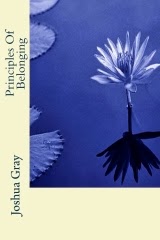
Principles of Belonging By Joshua Gray


Principles of Belonging
By Joshua Gray
Kodailanal International School
Kodailanal, Tamil Nadu, India
Red Dashboard LLC Publishing
Princeton NJ 08540
www.reddashboard.com
ISBN-13: 978-1492993506
101 Pages

Review by Dennis Daly
Audacity and ambition fused to a poetic temperament can get you a long way. Joshua Gray in his second book of poetry, Principles of Belonging, pushes the envelope in his artistic efforts to create a masterpiece of poetic unity. He nears a crescendo, but doesn’t quite get there. Yet he does give us a compelling narrative encompassing national tragedy, dysfunctional families, young love, and an overview of life’s ironies. That ain’t bad. Along the way Gray melds Sanskrit meter, Anglo Saxon verse, Welsh measures, blank verse, free verse (sometimes  rhymed), not to mention sonnets, other rhymed poems and a sympoe ( a strange poetic form invented by Gray).

The Sanskrit lines, the rules of which were developed well before the Homeric Age, soothe you with their subject appropriateness. The lines or padas are four feet of four syllables each, making sixteen syllables on a line. Excessive syllables are sometimes okay, but are not counted. The syllables are considered light or heavy depending on the juxtaposition of consonants and vowels. The rules are really simple and elegant and, in narrative forms, almost prosy. Gray avoids numerical intricacies and high art sophistications, keeping the original rule-based simplicity in his English adaptations.  Keep in mind that virtually all Sanskrit, including law, science, and mathematics, was composed in verse. For those interested in further pursuits of this form I found a book by Charles Philip Brown written in 1869 entitled Sanskrit Prosody and Numerical Symbols Explained (London 1869). It appears to be part of an academic collection and is easily located on the internet.

Here are two padyas (stanzas) from Gray’s poem Village detailing Hindu cultural differences between the sexes,

So honey was kept hidden away. Gan thought of when the man,
the honeywala, left last year: Gan and his brother Jay had wanted
honey; they snuck about the kitchen, but their mother had seen them, grabbed
a log from the fire, then chased the boys around the house as they ran out.

She knew full well the boys would not be back home until late; the law
states that women must not eat before the men (and boys); thus,
she and Devi, her teen daughter, must wait until the three men ate
before either of them could. The boys stayed out past the rise of the moon.

In the poem West Bengal Gray outdoes himself with a haunting political and personal narrative. The poet, using his Sanskrit meter, begins his piece this way,

The next morning the train stopped in some town and everybody got off.
Hindus who rode the train roofs now descended; further off a crowd
of Muslims waited to board the train traveling the other way.
A sole chai-wala called out as he walked, clay cups in hand, hot chai balanced.

The Table of Contents in The Gathering Principle begins in 1947 and ends with an Epilogue in 1994. The poems order themselves around human relationships tracked over the years. Oddly, Gray also orders them by poetic forms. For instance, in a section identified both with a date (1961) and the title Cynghanedd, Gray gives us three poetic adaptations of medieval Welsh verse. Cynghanedd literally means harmony and is a system of assonance and alliterations. The poet ends his piece Wildflowers harmoniously,

On school days she’d wait, anticipating
The weekend, go to the creek and quietly
Harvest the richest hues; sometimes Bluettes
Would even mindlessly find a new future.

With her brothers or alone, her brothers fighting or stoning
Trunks, she plucked not meanly but fondly, green and gold
And white as Fern Hill. The air could be chilling
Or warmed by the sun, the wonderful flora could take her in winter.

Elaborate and elegant both! Gerard Manley Hopkins used this form to great effect and Dylan Thomas was clearly influenced by it.

The sonnets and rhymed poems in this collection are a mixed bag. Some work very well. Others less well. An untitled sonnet example on page 89 that works extremely well deals with childhood’s faulty memories and compensating emotions.  Rhymes fall naturally in place infusing the story with complexity. The poet asks,

How does one tell when another’s truth is wrong
As well? If Devi’s lost her memory
Perhaps it’s mine where truth can truly be.
I will not dance to illusion’s crippling song.

My parents stayed behind, or so I’m told,
And didn’t travel with us on the train.
So where did all that I recall take place?

When Jay took off and left us in the cold,
To prevent myself
From being a child insane,
I must have placed my parents in that space.

But even the poems that clank with obvious and sometimes forced rhymes need only a minor change or two. The last end rhyme of the poem entitled Rick sounds a little off, but the first thirteen lines are perfect. The poem ends this way,

So I went and told her why myself, but she beat
Me to the story’s end and laughed out loud:
This lady of light refused to keep me proud.

May I suggest that Gray needs to edit a few of the rhymed poems in this collection, perhaps with a second set of eyes; and what is clearly a very, very good and interesting collection of poems may turn into a game-changer of a book. Speaking of editorial work, my favorite poem in this terrific collection, Doris/Deb, is placed on the wrong page in the Table of Contents (I’m reviewing from an electronic version). It relates the story of two struggling mothers and it reads wonderfully. Consider these lines, the first half of the poem,

Determined mothers make their children’s clothes.
I find that poverty will likely breed
Necessity. When we could barely feed
Ourselves—our kids—I quickly learned to sew,
And walked a ways for fabric, rain or snow.
I sewed a costume once for Halloween;
The ‘S’ was crooked, the cape a little green.
And later, after Rick and I had split,
The thread and needle helped me quite a bit.
A single mother is often the one who knows;
Determined mothers make their children’s clothes.

Just for its poetic nerve and intrinsic formalist interest this book gets an “A” as in audacious. With a nod to what this book may ultimately become, I celebrate its already significant accomplishments.


***** Originally published in the Fox Chase Review

Tuesday, February 25, 2014

An Interview with Ros Barber, author of The Marlowe Papers


***** Recently, I received a note from Anya Lichtenstein of the St. Martin's Press in NYC. She wondered if I wanted to conduct an interview with a Marlowe scholar, Ros Barber, the author of the critically acclaimed book The Marlowe Papers. I thought it would be a good idea for one of our gifted English majors at Endicott College to take a crack at it. Professor Sam Alexander sent Colby Pastre my way, and I think he has done a fine job!


An Interview with Ros Barber, author of The Marlowe Papers


by Colby Pastre


According to most historians, playwright Christopher Marlowe was murdered on May 30, 1593 by Ingram Frizer who, in self-defense, sent a knife through Marlowe’s right eye and into his brain. According to most historians, Christopher Marlowe was a blaspheming, brawling, sometimes-playwriting, hell-raiser with a taste for violence and booze that could have only brought him to the end it did.


 But what if most historians are wrong? What if Marlowe was not just the brute history makes of him, but a more complex figure; one mature enough to be held in esteem with his contemporaries and even talented enough to be considered their inspiration? What if Marlowe was not murdered on May 30, 1593, but instead faked his death and escaped into exile, where he continued his career as a playwright? What would the exiled Christopher Marlowe have written? Some think Hamlet.

Ros Barber, author of the verse novel The Marlowe Papers and a PhD in Marlowe studies, is one of the many literary and historical critics who question the authorship of the Shakespeare canon and assert that Christopher Marlowe was its more likely author.

Recently, I had the pleasure of interviewing Barber about The Marlowe Papers. As she explained to me, the novel is an experiment in history writing aimed at providing a narrative that is at once factually complete and emotionally compelling. The Stratfordian authorship paradigm is a tough theory to attack. Too much tradition and scholarship stands in the way for there to be an open discourse. Thanks to Barber, The Marlowe Papers provides a less daunting entrance into Marlovian theory, laying the emotional, political, and religious groundwork necessary for one to consider the “impossible” − that William Shakespeare was not who history claims, that Christopher Marlowe was not murdered in 1593, that, in fact, both were the same man, just of a different name.


Colby Pastre: Ros, in your acknowledgements you mention the “light-bulb moment” that inspired you to write The Marlowe Papers. Which came first, your Marlovian turn, or your realization that “the ‘crazy’ idea that Marlowe faked his death and escaped into exile” could be the spark for a “really good novel?”

Ros Barber: The latter.  I’d never questioned the authorship of the Shakespeare canon until I saw Mike Rubbo’s documentary “Much Ado About Something”. From that came the idea for the novel, and from the research for the novel came the realization that it wasn’t the ‘crazy’ idea it might at first seem.

CP: Why did you choose to write in verse and how did you maintain a balance between authenticity and readability?

RB: Iambic pentameter was, for me, the best way of balancing those two things. I needed to create an authentic-sounding voice for Marlowe, but I wanted to use fairly contemporary English, not cod-Elizabethan.  The rhythm reminds us of Marlowe and Shakespeare’s blank verse plays, without having to get all ‘thee’ and ‘thou’ about it. In any case, Anthony Burgess had already written the ultimate Marlowe fiction in prose.

CP: Do you think that either the novel in verse or the play in verse will ever come back in vogue?

RB: Unlikely. People are too terrified of poetry for a verse novel or verse play to be more than a curiosity.

CP: Is the main purpose of The Marlowe Papers scholarly or for entertainment? How did you try to balance scholarship with fiction?

RB: The primary purpose was to tell a good story.  I found the story fascinating and wanted to do it justice.  As a secondary aim I wanted to research it deeply and discover whether it was possible to weave a plausible alternative narrative out of all the evidence, without leaving anything out, as an experiment in writing a (fictional) history.  But if it didn’t entertain and engage I would have considered it a failure.   On the scholarship side I set myself the rule that I would stick entirely to any facts I could discover, and that all evidence must be accounted for in the narrative. Only then would I allow myself to fill in the gaps with fiction.  Sometimes the fiction was extremely helpful in creating a way of accounting for the facts; but of course that doesn’t make it ‘true’.

CP: What was your research process throughout the project and, in general, how did you form your opinions on the Shakespeare authorship question? Did you rely mainly on primary sources, existing scholarship, text analysis, all of the above?

RB: First I got to know the entire canons of Marlowe and Shakespeare and the work of some of their contemporaries (Greene, Watson, Harvey, Nashe).  These - and certain letters and other documents were the primary sources.  I read a lot of texts on Early English Books Online and original documents in the British Library and the Bodleian, got a good 16th century street map of London and books of Elizabethan letters and period recipes. In terms of secondary sources I read a lot of books about the political and religious conflicts of the era, as well as numerous biographies (all of Marlowe’s, several of Shakespeare’s, one each for Elizabeth I and Sir Francis Walsingham), plus a range of scholarship about Marlowe’s life and works, about Shakespeare’s plays and poems, early theatre, sword fighting, executions, masculine values, government intelligence networks etc.   I read a great deal of non-Stratfordian scholarship - Oxfordian and Baconian as well as Marlovian. From the various Marlovian theories I picked out a storyline that felt reasonably well-supported by evidence and made (from my perspective) the most satisfying story arc. The choice of dark lady was the hardest aspect, and I still rather regret that I couldn’t make room for Amelia Bassano Lanier.

CP: Marlowe claims early in the novel that “[a]ll histories are fictions.” Does this mean that scholars have free reign to interpret history as they see it, or something else?

RB: This came out of my reading postmodern historians such as Alun Munslow, Beverley Southgate and others publishing in the journal Rethinking History.  History is not the past; it is ‘Hi[gh]-STORY’ - a story about the past.  It is easy to demonstrate that you can join the dots of historical evidence in numerous ways, many of them potentially valid; but as soon as you introduce narrative (and history is always narrative), elements of fiction begin to intrude. In some ways a fiction like The Marlowe Papers is more honest than those books like Shapiro’s 1599, that are labeled non-fiction; both employ imagination to fill the gaps in the evidence.  When you read an accepted history, it is worth questioning how this version of events evolved as ‘The Truth’ - who first began to lay it down, of what were they ignorant, and what perspective or agenda might have shaped their version of events.  

CP: What advantage is there in fictionalizing Marlovian theory? Do you see any danger in drawing the discourse away from evidence-based history and toward fiction?

RB: The advantage is in enabling the reader to suspend their (dis)belief long enough that they might open their mind to the possibility that not everything they’ve been told (about Shakespeare, or about Marlowe, or indeed about anything else) is necessarily true. A fiction can create a viable world in which such a thing as Marlowe faking his death and writing the works of Shakespeare could have happened.  Coming cold to such a theory, it is tempting to dismiss it outright, but when the emotional, political and religious background has been well-established by a coherent fiction, you can demonstrate there is a degree of plausibility here; it is no longer ‘impossible’. One of the big difficulties people have in believing Marlowe could have written the works of Shakespeare is that our myths about both men have created the dichotomy ‘violent Marlowe’/‘gentle Shakespeare’.   These are simplifications, and very likely untrue.  I used fiction to break down the myths and create (on the bare bones of fact) a version of Marlowe who could believably mature to write Hamlet. 

    The dangers in historical fiction are obvious; people can mistake it for fact. But I try very hard to discourage that.   Evidence-based history is my passion, and I hope that reading this fictional exploration might encourage some readers to look into the evidence for themselves. My take is that evidence is *always* open to interpretation and that anyone involved in Shakespeare scholarship (no matter which candidate they favor, including the traditional one) is fooling themselves if they believe that what they are peddling is the only plausible version of events, or - the most ludicrous idea of all - some kind of certainty.

CP: Why do you think that there are so many theories that debunk Shakespeare’s authenticity? What role does Shakespeare’s lower-class upbringing play in making it unlikely that he was a great author?

RB: None at all. Marlowe had a lower-class upbringing; he came from a near-identical background to Shakespeare, both families being leather-workers: Marlowe’s father making shoes while Shakespeare’s made gloves.  Shakespeare skepticism does not, as is commonly assumed, arise out of some kind of snobbery. Skeptics are well aware that Ben Jonson began life as a brick-layer; that he and other successful writers of the period never went to university. What makes it unlikely that Shakespeare wrote the plays attributed to him is not his upbringing but the stark lack of personal contemporaneous evidence connecting him to writing, other writers, a literary life, and the content of the plays and poems.  This is why the authorship question arose in the first place, and this is why it won’t go away. Pure and simple, it is lack of corroborating evidence.  That the man from Stratford wrote the plays is a claim not substantiated by primary source evidence; a claim that begins with a tenuous link seven years after his death.  If it were any other personage we were discussing, no historian worth their salt would consider this kind of evidence sufficient to establish the theory as some kind of fact.   No other successful writer of the Elizabethan and Jacobean period has such a deficient evidence profile, as Diana Price has demonstrated.  But Shakespeare skepticism is not fuelled purely by the absence of evidence.  There is a whole body of fascinating evidence pointing in the direction of his being a broker, or middle-man, who represented the work of one or more writers - and that this was suspected or even known by certain other writers of the period. There are also peculiar pieces of evidence - such as the inscription on the burial monument in Stratford Church - that even Professor Stanley Wells of the Shakespeare Birthplace Trust, agrees are ‘cryptic’. There are too many anomalies in the data, and the orthodox story simply cannot account for them.

CP: “What does it matter?” How would a Marlovian theory change the way we interpret “Shakespeare’s” works?

RB: The plays and poems read differently when we assume a different author; and some of those differences are enlightening. I demonstrated in an article published in Rethinking History that looking at Shakespeare’s sonnets through a Marlovian lens clears up problems that have plagued Shakespeare scholars for the last couple of centuries; including apparent inconsistencies of tone, and the identity of the Rival Poet. In terms of the plays, a Marlovian reading explains the author’s obsession with the canon’s most prevalent themes: exile, mistaken and double identities, usurpation, and above all, faked death and resurrection. It allows one to see Prospero and Dr Faustus (the pair of magicians whose names, incidentally, both mean ‘Fortunate’) as bookends of a single career.  It explains why Marlowe’s ‘influence’ has been perceived by orthodox scholars as running through the entire Shakespeare canon. 

CP: You focus a lot on the multiple identities that Marlowe assumes throughout his career. Often he is forced to “lie within a lie.” How do you think this affected his writing?

RB: Now you’re talking as if the theory is true, and I try to discourage that!  Let’s say, instead, ‘what if?’   That’s the question a novel can answer.  Let’s say a writer who spoke too freely was arrested on a very serious charge and realized that the only way to continue living was to fake his death and live the rest of his life in hiding under a series of assumed identities.  I imagine he would gain some considerable perspective on human foibles (starting with his own), and increase in wisdom as a result of his very unusual circumstances. I imagine he would find it hard to stop dropping in odd references to his early body of work as an attempt to try and keep the works he wrote under his real name ‘alive’ in the imagination of theatre audiences.  I imagine he would try to tell himself that if people love the work of William Shakespeare, they do indeed love him, because that is his pen-name: “for my name is Will.”  I imagine he would get very clever at expressing his truths with enormous subtlety, so that they would get through the censor unnoticed. I imagine he would write rather a lot about people disguising themselves, exploring the comedy and tragedy of living under other identities, that he would entertain resurrection fantasies, that he would be drawn to source stories that echoed the themes of his existence, and add in his own characters, sub-plots and soliloquies that might in some way speak to his peculiar position.  Stephen Greenblatt, one of the most perceptive readers of the Shakespeare canon says:

“Again and again in his plays, an unforeseen catastrophe … suddenly turns what had seemed like happy progress, prosperity, smooth sailing into disaster, terror, and loss. The loss is obviously and immediately material, but it is also, and more crushingly, a loss of identity. To wind up on an unknown shore, without one’s friends, habitual associates, and familiar network—this catastrophe is often epitomized by the deliberate alteration or disappearance of the name and, with it, the alteration or disappearance of social status.”

That’s a fair description of how Marlowe would write if he had indeed suffered the slings and arrows of outrageous fortune that Marlovian theory suggests.

CP: Do you think that Marlowe will ever be recognized as the author of Shakespeare’s plays? If so, what will it take to shift the paradigm?

RB: It could happen.  Shakespeare skepticism is growing, and orthodox Stratfordianism is backing itself into a corner with logical fallacies (chiefly ad hominems), unscholarly behavior (e.g. insisting that the term ‘anti-Stratfordian’ be replaced with ‘anti-Shakespearian’) and unscholarly claims (like claiming there is no distinction between personal and impersonal testimony). These are the actions of a beleaguered position that isn’t long for this world.  Oxfordians make up the largest number of non-Stratfordians (or as I have heard it recently, post-Stratfordians), so the question might lie open for a while.  To reach the state of affairs where that is possible will simply take those with fixed positions to be replaced with a more flexible generation. Max Planck said ‘science advances one funeral at a time’.  The humanities are much the same.  But I look forward to a more open-minded and collegial future where the authorship question is recognized as a serious (and seriously interesting) area of academic research.  There are plenty of promising archives, particularly in Italy, that have barely been cataloged, let alone researched.  Only properly funded university research projects are likely to turn up the kind of hard evidence one would need to shift the authorship paradigm into a new orthodoxy, so the question has to be accepted as valid first.  If The Marlowe Papers contributes to a move in this direction - as well as being a successful piece of entertainment - then I am doubly happy.


.


***********Colby Pastre is a recent graduate of Endicott College with a B.A. in English Literature.

Monday, February 24, 2014

Rattle Young Poets Anthology 2014 Timothy Green, editor


Rattle Young Poets Anthology 2014
Timothy Green, editor
Studio City, California: The Rattle Foundation
88 pages, $7.95
ISBN 978-1-931307-20-8
http://www.rattle.com/poetry/

Reviewed by David P. Miller

Reading anthologies of poetry by children can be a delight: I often find it so. But attempting a review is a different matter. If you consider this at all, you find that the evaluative goals brought to poetry written by adults are largely irrelevant – the less relevant the younger the children. That sort of assessment might be appropriate for the older classroom, if done with insight and compassion. You also want to avoid the almost opposite approach: sentimentalizing children and their writings, reading it all through a shimmer of words like freshness, innocence, originality. Even though those words are valid enough, there are people behind these writings, not generic “children.” Even the youngest children represented here have individual voices.

The Rattle Foundation, which publishes a quarterly journal in print and online and maintains a web site rich in resources, has published its first annual collection of poems by children. The poems are by people fifteen years old or younger at the time of writing; this collection includes works by children as young as three (most likely spoken?). Three-year-old Frank Colasacco contributes a poem about a bear. Well, of course, cute, you might think, but you might be wrong:

Bob the Bear

bob the bear breaks himself
and some balls come out
and that lamp comes out
and a daddy comes out
and a hammer comes out
and a nail
and bob the bear
hammered the nail
and fixed himself

I sense a dissertation on Surrealism and the Imagination of the Child lurking in the wings. And that might be an interesting dissertation, but I don’t plan to write it. I am simply brought up short by what this toddler saw and said. I don’t understand it. Likewise, I can only ponder this briefest poem in the volume, “Untitled” by Mikey Kelsey (6):

the moon behind the clouds –
all these little old ladies

More concise than a haiku. If you appreciate lacunae in poetry, the electric charge sparking across the empty places, here is one for you. What was Mikey thinking? I have no idea, but I want to compose lacunae like that. Which might take us toward words like spontaneity.

As the writers enter adolescence, the poems almost inevitably become more self-conscious, often more deliberately artful. The sentimentalizer wants to say, “No: don’t try to imitate what you think adult poets do!” But of course, that’s just another way of not-seeing the person behind the writing. You have to let adolescents grow into the writers they become, and follow their focus as they try out adult-like voices. If you give yourself interest in their interests, and push back the impulse to judge as you might the poems of people just a few years older, any of these may be satisfying. One of my favorites by older children is “Grandpa Bob” by Sophia Dienstag (13), which concludes:

Once little children in the park thought he was wearing a disguise.
He told them he wasn’t.
They didn’t believe him.
But he wasn’t exasperated.
He just told the children to try
And take off his nose.

More sobering is “Twine: A Prayer” by Chloe Ortiz (14). Its extended metaphor almost self-destructs:

God is a rope.
Long and thick,
it pulls us out of the water.
The roughness burns our skin.
We continue to climb, the waves
are still splashing. Our hands are red
and we shout to God.
We feel his leniency, strong and continuous.
Then, with a flick of his wrist,
we are flung back into the sea.

Most of the children are represented by “Contributor Notes”, but instead of having bios (“Frank was born just over three years ago and has already been nominated for a Pushcart Prize”), there are answers to the question, “Why do you like writing poetry?” I find that many of these are also reminders to myself:

When I write poetry, I feel like I empty myself and then I can start myself anew. (Elliot L. Armitage, 11)
My favorite part is when the piece of paper is blank because then I get to think. (Raya Gottesfeld, 6)
Poetry allows me to write whatever I want unless I am in school. (James Dailey, 10)
Poetry uses a certain kind of language where you switch words around, not like speaking. It makes it more like a riddle. (Melody Goldiner, 9)

To conclude, from a series of “Haiku” by sisters Bree, Liya, and Anya Miksovsky – a sequence that allows us to think about children’s perceptions and expressions, changing as they get older:

Water gurgling, water splashing
rushing towards me and flowing away
as if it can’t stand to sit still
    – Liya (9)

You know it’s true
because I said it.
Write that down.
    – Bree (5)

Grandma meditates
while Liya and Bree screech
in their falling tent.
    – Anya (11)

I am looking forward to the stimulation and pleasures of the next Rattle Young Poets Anthology.


****** David P. Miller is a librarian at Curry College outside of Boston.

Saturday, February 22, 2014

Song of the Owashtanong: Grand Rapids Poetry in the 21st Century Edited by David Cope


Song of the Owashtanong:
Grand Rapids Poetry in the 21st Century
Edited by David Cope
Ridgeway Press
Roseville, MI
Copyright © 2007- 2013  the poets
179 pages, softbound, $12.95
ISBN: 1-56439-135-3
Review by Zvi A. Sesling

A number of poetry groups print anthologies of their members’ works. In the Boston area for example is Bagel Bards Anthology (in which I have been both included and served as editor twice) and PowWow River Poets Anthology which contain many works of merit. In fact, San Diego, Dallas and other large cities have similar works, so why not Grand Rapids, Michigan.

As editor David Cope points out in his Foreword this volume “…includes poetry that is firmly rooted in the people, soil and rivers of West Michigan, as well as work that ranges from Bucharest and Gdansk to the coast of Ireland, St. Petersburg, the battlefields of the Civil War and the swamps of Vietnam.”

Cope began laboring as a custodial worker for 18 year and retired last year after years as a professor. He has served as Grand Rapids Poet Laureate,  has seven books of poetry to his credit and has a list of awards and credits longer than most books of poetry.  A friend of Allen Ginsberg and other well-known poets he has put together with this offering of 16 poets a fine collection.

Many of the poems are too long to reproduce here and only parts would make little sense, so shorter ones were selected.  For example, David Landrum, who teaches literature at Grand Valley State University, had a number of entries of which this is the most poignant dealing with the dark basement of living:

Life Before Age Twenty-Two

Nightmare after nightmare
but waking up was worse.

The bullies on the street were kinder
than the bullies living in my house.

Life as a bowling pin, life as a cutting board.

Never being called by my own name
and someone threatening to kill my dog.

L. S. Klatt graduated the University of Georgia in 2003 and teaches American literature and creative writing at Calvin College. The “May Day” could apply to any who has experienced troubled times with an ending that may or may not be satisfactory.

May Day

I am adrift in a burned-out canoe
without a helmsman. It was once a birch
straight & narrow made swift. The planets
revolve behind the blue sky but I don’t
witness. The new is good. The willow
has waded into the pond, & the purpose
of the pond is outside of me. The bow
of the boat follows the breezes. Light-
years from Zero.

A past Grand Rapids Poet Laureate, Rodney Torreson is the author of  The Ripening of Pinstripes: Called Shots on the New York Yankees, fine poetics on the players who make up what used to be baseball’s best teamHe has several other books and chapbooks to his credit and teaches elementary and intermediate grades at a parochial school. In this poem, Torreson captures moments in the country that city folks never experience, or is it all a dream?

On a Moonstruck Gravel Road

The sheep-killing dogs saunter home,
wool scraps in their teeth.

From the den of the moon
ancestral wolves
howl their approval.

The farm boys, asleep in their beds,
live the same wildness under their lids;
every morning hey come back
through the whites of their eyes
to do their chores, their hands pausing
to pet the dog, to press
its ears back, over the skull,
to quiet that other world.

For those who enjoy reading poetry anthologies from different areas of the country, produced by those local poets, this is a welcome collection from an area that is not always recognized for the fine poetry written there.
_______________________________________
Zvi A. Sesling
Reviewer for Boston Small Press and Poetry Scene
Author, King of the Jungle (Ibbetson Street Press)
Author,  Across Stones of Bad Dreams (Cervena Barva Press)
Author, Fire Tongue (forthcoming, Cervena Barva Press)
Editor, Muddy River Poetry Review Online Poetry Journal
Editor, Bagel Bards Anthologies 7& 8
Publisher, Muddy River Books

Friday, February 21, 2014

Tea In Heliopolis By Hedy Habra


Tea In Heliopolis
    By Hedy Habra
    Press 53, 2013
    83 Pages
    $14.95
        By Myles Gordon

    Heliopolis once stood as one of the grand cities of the ancient world. Located in what is now Cairo, Egypt, Heliopolis was a center of culture, commerce, and learning, attracting Homer, Pythagoras, Plato and other to its schools of philosophy and astronomy.  Today, the city remains barely visible – a few relics in a northeast suburb of Cairo. Most of Heliopolis lies buried beneath the neighborhoods of Egypt’s capital, the Al-Masalia obelisk, from the Temple of Re-Atum, the largest of its few, visible surviving monuments. After reading Hedy Habra’s Tea In Heliopolis, one understands why this city, largely destroyed and forgotten, is the namesake for her powerful book.


    There can be a solemn perspective gained by those who lose their homes and possessions to natural disasters. While all the things are lost, the people survive and have each other. Things are merely transitory items that can be replaced. But the family and loved ones, and the love shared: these transcend the flood, hurricane or tornado. But for those who have lost their homes and way of life through man’s malice toward man, there is a poignantly, tragic edge to this perspective: things did not have to turn out this way. People did not have to act like this. Habra’s family lost their idyllic home and all they worked for and achieved during Lebanon’s protracted civil war fought from 1975 to 1990. Like a million other Lebanese citizens, Habra and her family fled the country. She ended up in Michigan, where she now teaches Spanish and literature at Western Michigan University. She has already published a short story collection, Flying Carpets, and is an accomplished painter (she painted the lovely motif for this book’s cover). She has achieved great success in her chosen profession, but her poetry is haunted by a once tranquil life lost in war-torn Lebanon, in remnants that emerge like the ruins of Heliopolis, the once-grand ancient city.


    The desire to recapture what was lost emerges again and again, as in “To My Son Upon His First Visit to Lebanon” when the protagonist visits the tenants in the summer home lovingly built then tragically abandoned by his grandfather:

    He called us excited, said he wanted to buy
            the house back.
            We could spend summers there.
    Time regained, he thought…
        eager to relive our dream,
    retrieve its lost broken pieces

but the poet’s perspective is revealed in a hard-gained lesson to her son:

    I tried to explain what does belonging mean exactly?
    And does it really matter?

    This restrained, stoic outlook centers “Lost and Found” where the poet and her mother visit a hall filled with lost items from the recent Diaspora, to see if they
can find any of their sentimental family treasures:

    I’m afraid to go to someone’s home in Lebanon
    and see my life scattered all over,
                 fetishes sold at black markets
    As if I owned a palace
    As if it mattered
    As if anything mattered
        since our children left
        untouched, unharmed

    What matters in the highest sense are one another and the bonds and love that still remain. All well and good, but sometimes the gloves come off. Habra’s usually elegant, measured voice can explode in searing, though justifiable, rant. From “Raoucheh”:

    …we cannot silence
    …the song of the windshields constellated with stars of death
    the song of the driver forced to leave his car at an intersection
    the song of an entire school bus emasculated because they were Maronites
    the song of mothers and children blown up because they were not Maronites
    the song of a town torn apart, its children hanging like heavy fruits from olive
         and almond-trees, nipples and testicles dripping with blood on the
         lower branches…

    Like Heliopolis, Raoucheh was a thriving urban center, a cultural and social neighborhood of Beirut that has become a symbol of violence and loss for Habra, through the displacement and the brutality of Lebanon’s civil war.  Powerful stuff, and her power covers the local and personal as well as the global. Most of Habra’s work evoke family: the father she adores who can turn on her in a heartbeat, most likely because of the national turmoil at hand. In “A Seaside CafĂ©, My First Taste of Fresh Oysters,” the poet’s father teaches her the intricate method of eating the delectable creatures, first slathering them in lemon juice. Then, inexplicably, he bursts into anger:

    Yet one day you chased me
    around the house, menacing,
    a slipper in your raised hand.
    No one recalls what I had done.

    There is the elegant mother who taught life lessons on being an artist and a woman, from “To Henriette”:

    “There’s no such thing as true love,” you’d
    say, “the greatest passion melts like ice.”
    How I wanted you to be wrong. Your canvases’
    message reaches me, muffled by time and
    distance…

    And, in some of the book’s most powerful sequences, there is the poet’s grandmother, also elegant and cosmopolitan, who suffered a freak accident that left her in a wheelchair. From “The White Brass Bed”:

    You live with us, Nonna.
    You are always sitting,
    you push the wheels
    forward, backward,
    one motion, both hands,
    your only exercise.

    You brought your bed along.
    It is too high for you, now.
    You sleep on your couch in a corner.
    The white, brass bed stands
    In the middle, empty, useless.

    Like Heliopolis, the poet’s grandmother retains for the poet the greatness now unseen by the rest of the world. Habra, the painter and scholar sees it as only an artist can. Many of her poems are about her process of painting and sketching, and the subtle nuance of brushstroke fills her work. In “Waiting in a Field of Melted Honey” she actually places herself in a painting by one of her inspirations, Vincent Van Gogh.

    I am waiting in a field of melted honey, hiding behind a blue tree
    that is not really a tree, a root Vincent chose to paint as a tree…

    As in Van Gogh’s paintings, the canvases of Habra’s poems come to life, bringing back worlds that aren’t there anymore, for the reader to embrace.


                Reviewer Biography

Myles Gordon’s book-length book of poetry, Inside the Splintered Wood, was recently published by Tebot Bach (Huntington Beach, CA), as winner of the press’s “Patricia Bibby First Book Competition.” His chapbook, Recite Every Day, was published by Evening Street Press (Dublin, Ohio) in 2009, as winner of the press’s “Helen Kay Chapbook Competition.” He is a past winner of the Grolier Poetry Prize, and honorable mention for an AWP Intro Award – Poetry. He has published poetry in numerous journals including Slipstream and Rattle. He holds a Master of Fine Arts from Vermont College of Fine Arts, and a Master of Education from the University of Massachusetts, in Amherst. He teaches school in Revere, Massachusetts and has previously worked as a television producer for WCVB TV, where he won four New England Emmy Awards for his writing and producing efforts.

Tuesday, February 18, 2014

The Wood That We Carry: Looking Inside A Shed for Wood


The Wood That We Carry:  Looking Inside A Shed for Wood

            Religion, love, death, and nature are more than just themes in Daniel Thomas Moran’s poetry collection, A Shed for Wood; (Salmon Poetry) they are what life is built around.  Moran handles these life subjects with delicacy, while at the same time sprinkling humor in-between the lines.  This refreshing way of looking at poetry and life gives new hope for things that society has lost faith in.  By playing with words with or without a rhyme scheme, comparing animals with God, and using capitalization to enhance a point, Moran is able to show how one can take control of his or her own life and how he or she views it.  Instead of being warped by society’s expectations and opinions of what is around us, we are the ones who get to choose what matters to us. 

            One of the poems that I feel like is at the heart of this collection and speaks for a lot of Moran’s themes as a whole is his poem, “Fiona”.  The poem starts off by describing the narrator’s red cat, and how she sleeps on him in the “long darkness”.  This image gives nighttime a shape, and makes me picture an unseen shadow.  Moran is able to show us this image of a cat that we cannot see, yet we can feel her and imagine her stretched out.  It is immediately evident that the connection between the narrator and the cat is extremely powerful, as are many relationships in nature.  The narrator admits that Fiona is “comforted by things of me I cannot sense”, which shows that this is a spiritual bond that they have.  Although Moran does not mention God in this line, and is not speaking of a conventional religion, it sounds like he is saying that he believes in the intuition between a cat and a man.  It is clear that in this poem and in life animals and humans have their own belief systems when they are together. 

            Another important poem that stood out to me is the one called “Blue Heron”.  Moran cleverly utilizes an elegant animal to make a statement about the way that people live in today’s society.  The narrator of this poem shows that the blue heron wants to be seen, and wants you to pay close attention.  This heron is ready for whatever he is going to be faced with, even if it comes at him fast.  I feel like Moran is saying that we can learn a lot from this heron being in this composed, Zen-like state.  The heron is not moving, unlike people who are constantly running around.  Moran writes:
            In the moving world,
            like the rock which
            is his perch,
             
            He must be the stillness.

Moran’s technique of having some lines stand alone really enhances the simplicity and beauty of this poem.  When lines stand alone it forces the reader the slow down. Each line should be read slowly, because in nature we rush through things and miss what is important.  As the poem moves on, it completely evolves to have a Zen feeling to it.  The heron is now one with the rain, the fish, and his surroundings.  The reader is made to feel that the heron has no worries, and that nothing bad or unexpected could happen to the heron because he is at peace with himself and the universe.  The last line says, “The fish is himself” which shows how the heron knows that by eating the fish they become one entity.  The heron is not cognitively aware of religion, love, death, or even what nature is, but he has the intuition of the earth. 


            Overall, I feel like this poetry collection is called A Shed for Wood for good reason.  For me, the meaning of this title comes from the idea that wood is crucial for housing and heat, which helps us sustain life.  And this book behaves like a storage unit for such life, and everything that it entails.  As readers, it is up to us to make each piece of wood count for something, and to carry it as far as we can go.  We are capable of creating a house of new meaning, and it is important to invite others in.  


Emily Pineau is the author of No Need to Speak( Endicott College/Ibbetson Street Press Young Poet Series)
                                                

Monday, February 17, 2014

Ethics of the Undead By Loren Schechter


Ethics of the Undead
By Loren Schechter
Merrimack Media
Cambridge, Massachusetts


Review by Wendell Smith

The misdirection of Loren Schechter’s first sentence, “Edna LittleHawk hurried after the three young hunters as they raced down the canyon’s slope toward the dying campfire and a midnight meal,” and what followed hooked me. The tempo with which the scene developed set the hook and pulled me into the first chapter of Ethics of the Undead. The anticipated midnight meal that drove these hunters as “Light on their feet and full of confidence, the teens hurdled over brush and used low rocks as if they were trampolines, oblivious to the risks of falling with rifles and packs on their backs …” was not cooking the results of a successful hunt. The midnight meal was the campers by that campfire. Edna and these teens were vampires.


This hunt completed, the chapter continues in a ghoulish, comic vein as Edna slows their attack  “‘Enough, … There’s no need to be cruel,’” and assumes her pedantic duties (she is an ethics instructor).

“I know you are hungry, and I’ve put the cruelty issues on hold, but there’s an ethical question needs to be discussed before you eat – how do three vampires fairly divide up the blood of two humans?”
A muffled cry came from the gagged camper.

On the whole Ethics of the Undead will fulfill the promise of this first chapter. Schechter maintains the pace he has established and the ethical problems created by the demands of loyalty and love will be more complex than this cartoon question of dividing blood.

The book has a dramatic structure with eight Parts, which are roughly equivalent to a TV episode and each episode has 6-10 chapters or scenes. All of the scenes have a emotional tension, and no superfluous exposition slows the pace.   The three teenage vampire hunters of this first scene are students at the Sawtooth Wilderness Academy in Idaho. The Academy is in financial distress and it recruits four “gifted out of state students” so that it can be “diversified” enough to qualify for a federal charter school grant to relieve that distress.

After we meet the vampires, Part I introduces the “normal” recruits beginning with the book’s heroine Kathy Campion-Swink, a 16 year old from the Connecticut shore who keeps dropping out of the boarding schools where her parents store her while they are out do-gooding. She is a library rat reading Thomas Aquinas, John Wesley and Martin Luther. When she hitchhikes “Drivers who were tempted to put a hand in the wrong place were discouraged by an icy stare from her cold blue eyes and the display of a Marine Corps survival knife borrowed from the military academy.”

Kathy has a supporting cast of three other “normals”. Hector Julian Campos is from a barrio in Los Angeles. He tells his sister he has not chosen to go to Idaho, “What I chose is not to go to juvie. There are some very bad dudes in there.” He is travelling in a kaki muscle shirt and faded because “‘It’s a wilderness school. I don’t have to impress the bears.’ but no harm in showing the farm boys that a city kid had the muscles to take care of himself.”

Lionel Worthington is an asthmatic black kid from Chicago who wants to play classical violin. He has a single mom and four siblings and is despondent because he did not get into the Chicago High School for the arts. He is going to Idaho on a scholarship because he has been promised “an individual study program with a world-class violinist who’s been with us a very long time.”  In Part 2 Lionel will discover that “a very long time” means centuries. His world-class violinist is Mr. Vendetta couldn't get enough work as a violinist after he’d been turned into a vampire and “Sucking blood in pre-unification Italy didn’t give him the life style he’d known as a violin virtuoso in Padua. So he retooled in Sicily for the Costa Nostra.”

The last “normal” is Jung Soo, a Korean. We learn less about her in Part I than any of the others but that does not mean that she is less important. Her Tae Kwon Do training will give her an endurance, a strength and a will that is important for the group’s survival.

The diminishing amount I learned about each character through Part 1 actually accelerated me into the book. By the end of Part 1 I was so at ease with Schechter’s technique of presenting details, that I was ready to get on with it, secure in my aroused curiosity that Schechter’s characters would gradually be revealed as they faced each threat that confronted them.

Schechter throws the quartet into a perilous situation that provides plenty of opportunity for action. Will these four be bled to death as the campers in the first chapter, be “Turned” i.e. become vampires themselves (several ”normals” in the book are turned, including Soo’s mother) or escape? That is the question that drives the plot. They are trapped underground because the school is located in an abandoned mine high in the mountains and it’s winter and their boots and other winter gear have been taken and vampires, who are prevented from feasting upon them by the tenuous need to secure the federal grant, surround them.

The vampire community is not uniformly evil in fact it is roughly divided into three groups: the morally indifferent, the amoral Satanists and the morally and ethically troubled. The later group is made up of those vampires who know they have a fate worse than death, i.e. they will not die (unless a stake is driven through their heart or, as it turns out in this book, they are torn apart by wolves) nor will they age.

Schechter writes with wit; these exchanges with the school guidance counselor, Isadore Finkelstein, who laments being turned into a vampire because “blood is never kosher,” are fair examples from early in the book:
“Why did they put your office so far away from Admissions? asked Kathy.
“Why? Because administrators do what administrators do — they suck your blood and piss contempt. In this case whether the contempt is for guidance or for Jews, I’ve never been sure. Probably a little of both.”
“Vampires are prejudiced?” asked Lionel.
“You know anyone that’s not?” said Finkelstein.

“I’ll take Vampires in Art and Literature and Theology.” Kathy said. “Do the Satanists have a formal religion?”
“No. They’re more of a fundamentalist antisocial club.” Finkelstein sighed heavily. “They call it the Satanic Legion and want a new world order based on absolute freedom. How you can have a Legion organized to promote anarchy is beyond my understanding, darlings, but why should faith ever be subject to reason?”

Schechter’s plot does have its romantic twists. A hunk, who is a “nuvie,” someone recently turned into a vampire, (by the school’s English teacher who seduced him) does fall into a doomed love of Kathy. And while his love makes him her protector (a protection that saves her life) it must remain unrequited, because she would have to agree to be “turned” herself which would betray her loyalty to her three fellow normals and dedication to their escape. Our quartet survives with the help of three members of the vampire faculty who are outsiders and have some principles: the Shoshone ethics teacher; the Jewish guidance counselor; and the temperamental artist, Lionel’s violin teacher. However, even as we are aware of a literary convention that should ensure the quartet would survive, they are always in enough peril so to keep us  flipping the page to see what happens next.

However, by the end, our assumption that our four “normals” will escape turns out to be another of the book’s misdirections. Kathy and Soo do get out but to do so they must leave Lionel and Hector behind in an ambiguous ending that hints at more to follow. Soo will return to her Korean family to deal with her mother who has been turned into a vampire. And, because Hector’s self-sacrifice has made their escape possible, Kathy will need to return to The Sawtooth Wilderness Academy. So, even if you are, as I am, 4-5 times the age of the intended audience for Ethics of the Undead, you’ll probably get the next installment know the how and why of her continuing adventure.

Sunday, February 16, 2014

Kirk Etherton & Bridget Galway: Two different artistic visions at the Somerville Public Library.

Painting by Bridget Galway


Work by Kirk Etherton


***Our guest columnist this week is School Street resident Kirk Etherton. http://bagelbards.com

Kirk Etherton& Bridget Galway:
Two different artistic visions at
the Somerville Public Library.

Bridget Galway and I both have exhibits at the Somerville  Public Library (Central Branch) for the month of February. Also, we're both Somerville residents—plus members of the Bagel Bards writing group—so Doug Holder suggested I write up a conversation/review involving our visual art. Bridget liked the idea; we met and talked (quietly, of course!) at the library.

Kirk Etherton: We admire each other's work. It's funny how there's zero similarity. Most of what I'm exhibiting—here, and also at ZuZu, in Central Square—is found pieces of picture frames, glued together, which I've taught myself how to do over the last 10 years. You're a painter, with credentials.

Bridget Galway: Yes, it's interesting. I have a BFA painting & Art Education from UMass Amherst...

KE: ...whereas I have a degree in Political Science from the University of Vermont. As a would-be painter, I appreciate your ability to work with oil, watercolors, ink& acrylic, pastels, anything.

BG: Thanks. Actually, that's made it hard for me to get gallery representation, since I don't have one set style

.
KE: Many of the 21 paintings hanging here are very moving character studies. One of the most striking is you, with your son as a young boy.

BG: The colors are very intense there: I squeezed the paint directly from the tube onto the canvas. No mixing.

KE: I hear people saying your paintings evoke anyone from Diego Rivera and Frida Kahlo, to Matisse or Picasso.

BG: So I'm in good company.

KE: Right. And they remark on your subjects' eyes—maybe soulful, beautiful, troubled, but always clear and memorable.

BG: One of my favorite paintings is Closing Time...
KE: ...where clearly, the subject coming towards us is off-balance, and you also capture something in the yellow from the streetlight, reflected in his eyes.
BG: I've been a bartender on and off most of my life. Growing up in the 1950's and 60's, in places like Key West and Greenwich Village, I was surrounded by people like that. It was part of a "Bohemian Lifestyle" which made a big impact on my art.
KE: Your show here is sort of a 35-year retrospective. What is your artistic focus now?

BG: I want to start doing more three-dimensional work. And recently I've been inspired by a lot of the things you've made.
KE: Really? In what way?

BG: One thing is how you use negative space so it becomes its own composition, like a sibling to the solid form. Then you have these shadows, and all the elements are very interrelated. It's dynamic, but peaceful. There's a certain Mondrian quality, a spirtuality, to your work.

KE: Well, thank you very much. Is there anything else you'd like to say about your current interests?

BG: I should add that I still love working  as a commissioned portrail artist. It's always satisfying to paint the essence of someone.

KE: How can prospective clients get in touch with you?

BG: They can reach me at brie@82gmail.com. I had a great website, but it's being worked on, seriously updated.

KE: OK. Well, this has been fun. Thanks.
BG: To you, too. And to this beautiful library