Tuesday, July 02, 2013

J.D. Scrimgeour: A Writer Who Struggles to Find Just The Right Words.


JD SCRIMGEOUR


J.D. Scrimgeour: A Writer Who Struggles to Find Just The Right Words.


Interview with Doug Holder


I think any serious writer who claims he or she doesn’t spend a lot of time and effort to find just the right word, is either telling a lie or is in serious denial. Poet/Writer/Salem St. University professor J.D. Scrimgeour fits this bill. Whether he is writing a poem about a badly disfigured woman or a passage about a basketball game, he makes sure the words make the writing come to life.

Scrimgeour teaches at Salem State University. He recently published the poetry collection Territories (Last Automat Press). He has published another book of poetry, The Last Miles, and two books of creative nonfiction, Spin Moves and Themes For English B: A Professor’s Education In and Out of Class. With musician Philip Swanson he formed the performance group, Confluence, and released a CD of poetry and music, Ogunquit & Other Works.

I had the pleasure to interview him on my Somerville Community Access TV show  " Poet to Poet: Writer to Writer."


Doug Holder: You collaborated with composer Philip Swanson, etc… to put your poetry to music. Can you tell me about this—the dynamics—difficulties, etc…


J.D .Scrimgeour: I met Phil at some sort of campus event. He is a professor at Salem State University in the music department. We talked about getting our students together to collaborate on something. And we decided to try it first ourselves to see what happened. And so I gave him a couple of pieces of writing and he looked them over. He got really interested in a long poem that I wrote titled: “Ogunquit.” We just started meeting and figuring out things. And we started taking his music and attaching it to my words. He composed some new music. I didn’t actually change my words but I did have to figure out timing—when to come in and when to come out. We talked a lot about when we wanted the music to fade out. A lot of our discussions were about sound and rhythm actually. It was incredibly rewarding.


DH: In your mini-memoir “Spin Moves” basketball seems to be the focal point. You examine your life through your involvement with the game. I have interviewed poets who used boxing and baseball as poetic subjects. Poet Philip Burnham, Jr., described baseball as ripe for poetry of failure. He said if you get 3 hits every for every 10 at bats you are considered doing well. What is it about basketball that allures you?


JS: I was always involved with sports. I played basketball and baseball in high school. Early on I was attracted to the speed of the game. There is also a lot of deception in basketball that is very interesting. As much as it is about grace and power, it is also about setting people up so you are a step ahead of them. I remember the poet Charles Simic came to Salem State and talked about how chess is sort of similar to poetry because you are thinking 3 or 4 moves ahead and setting something up. I am not sure this correlation is exactly for me in poetry but there is an appreciation that the mental and physical are working at a high level, all at once.


DH: In your memoir you wrote that John McPhee’s basetball writing was stilted, too polite, lacking the gusto, the very words that would bring the game to life.


JS: You are picking up on a passage that I feel a little embarrassed about. Probably because I was such a Young Turk at the time. So I brought McPhee down a peg. But McPhee wrote a good book about basketball. I was especially interested in trying to come up with how could language capture the energy, the surprise that is available to a basketball player. How do you set the game on the page? I think the game may need a soundtrack behind the writing to make it come alive. I am also interested with what the writer does with punctuation and how the words are going to sound. So I use sentence fragments, dashes, etc… Punctuation is so valuable to set pacing. What a difference in the feeling between a colon and a dash!


DH: You are interested in the genre of Creative Non-Fiction. This is a relative new category. What exactly is it?


JS: It captures so many genres. It may be a memoir that does not follow a conventional narrative structure. It can be like a prose poem. It is non-fiction that you don’t feel you need a fact checker. You may “expand” the truth. I always indicate to the reader if I am going a bit beyond the exact truth however. Some writers don’t feel the need to.


DH: Charlotte Gordon, a colleague of mine at Endicott College wrote that she believes you mission is similar to that of Walt Whitman, in that you celebrate the common man.


JS: There is no way that I can compare myself to Whitman. I think what she is picking up on is that I’ve always had an interest in writing about other people. My poetry deals with the psychological and the sociological. In my new book “Territories” the first half of the book contains two long dramatic monologues in the voice of a student. The voice is a composite of various students I have known.


DSH “ Terrortories” first half is about a gay man—and at times very graphic. How did you research this? It sounded very authentic.


JS: I had a student that I knew pretty well, that I worked with. And I took a few facts of his life and other students and integrated them. Being involved with the arts you become aware and have to be sensitive to sexual orientation issue. I did informal research. I talked to people. I sent out writing to people to see if it sounded right. There were certain words and phrases that I went back and changed. I once asked a student about how he felt about the term "gay boys" instead of "queens." A couple of students from Salem State performed these monologues under the direction of a Salem State theatre professor. People were compelled by the performance.


DH: I was reading the poem " After the Fire" that deals with a woman's zen-like acceptance of her disfiguring facial burns and her subsequent loses. Can you talk a bit about this powerful piece?


JS: I really like that poem. It was the voice of a woman that was horribly scared by a fire and bad things continued to happen during her life. Her husband leaves her. It is based on someone I knew from my life. She was a friend of my wife's and she was on Oprah. And she said " I want to live." I used that line and the poem came from these things I experienced. Two things were happening in my life at the time. We were having our first child, and if you remember the speaker of that poem, she sort of imagines the children she might of had. Also at the same time a friend of ours Mary discovered that her cancer came back. The possibilities of not surviving colored the poem.


UNDER THE GHOST


If I knelt by my mother’s grave, his

dark shadow followed me even there.

~Harriet Jacobs


Why should a piece of property

kneel at another’s grave?

The whole earth

is red clay. Master won’t stop

slipping me notes.

“I can’t read,” I lied.

He was at the window yesterday,

white shirt a ghost. Some things

don’t even have to be bought.

I’m fifteen. He has a beard,

his shoes are quiet as weeds.

Momma died a long time ago.

She had one dress,

blue. I wear it

when I come here.

Ants crawl up the blank stone—

searching for a name?

Tonight, I will sleep

with grandmother. The stone’s

shadow slowly draws back.

Does it really disappear at noon?

White people are under crosses.

Jesus used to be white.

Property. “You must be subject

to my will in all things.”

To sleep always under a stone.

Brush an ant off my leg. Is

Momma a ghost? To sleep

with Momma, like I used to—

a shadow. To be under a ghost.


---- J. D. Scrimgeour


Saturday, June 29, 2013

Patron Emeritus By Chad Parenteau


Patron Emeritus
By Chad Parenteau
FootHills Publishing
Kanona, New York
71 Pages
$16.00

Review by Dennis Daly

Minimalist poems, like those in Patron Emeritus by Chad Parenteau, imbue each word with a density of meaning that demands resolution and balance. Without careful calibrations stanzas would fall off the page and punctuation could explode. Parenteau not only avoids these pitfalls but successfully plays off the tension created by them. At heart these poems are narrative, although the stories, culled from the common experience of day-to-day living, the poet rubs raw, dices, compresses, and then highly polishes.

Parenteau, who hosts the famous and long-running Stone Soup poetry readings in Cambridge Massachusetts, connects with the deceased originator of that venue, Jack Powers, in his first poem. There is sensitivity here and also a not unexpected validation. The poet says,

Thought I saw you
walking taller, talking clearer

nearby crutches
lady at your table

cowboy hat
ten gallon  paladin

head weighed
nodding toward me.

In the poem entitled Manifesto Parenteau navigates two different venues of performance poetry with unabashed excitement and, interestingly enough, admits to liking the comfort and inclusion of committee work. Of course society is really a set of self-appointed committees so why not. Here are the pertinent lines,

I strafe both sides
one-way streets
run down

running
crop circles
slim pickings.

Committees agree
I do my best work
when in committee

belonging still…

I like the use of the crop circle image. Like some open-mike participants they appear suddenly at night and take surprising shapes.

Even charged language can be funny. In Parenteau’s piece Come Lately the persona-host of a poetry reading venue is at his wit’s end on a particularly bad night. I’m guessing Stone Soup.  Here’s how the poem begins,

Scant showing
only host pays
success insisted on.

Those closest
edge forget
no hands

left to hold
outreach
let alone signal

help
what they know
malady.

Of course the production of a comedic scene is at the host’s expense and due to his very earnestness and caring nature.

Another humorous poem entitled Working Late struts out longer lines and a less compressed syntax. It is one of a handful of exceptions to the poet’s prevailing style. The poet’s persona, making a living like the rest of us, works in a lab. His duties include prepping hamster cages. But in reality our poet thinks subversively and has other agendas. He identifies with the intruder, the outsider. I’m shocked! The poem ends this way,

…the empty cages always need
water freshened, new shavings every week,
more if we have a visit
from the department head.

Sometimes I’ll mess things up,
leave a cage door open, watch eyes,
mouse braving the climb to
the desktop,
pupils growing large
while sniffing my similar stare
before scurry escapes.

Any worker worth his salt knows how to hide from his boss and steal precious moments of humanity through imagination or creativeness. The poet in his piece Passing has chosen one of the most common of all havens—the bathroom. Parenteau describes his sanctuary,

Bosses wait for
bidden bathroom
you rinse meeting off
face,  unsmear specs.

They know you
trespasser
door closing there
they are

talking by door
cordially predatoral…

The poem Air Lines begins with the passengers vaguely fearing discovery and surrendering their metallic implements and ends with their expected arrival in Pittsburgh, the city built on the melting of metals and its own factory-employed citizens. Parenteau catches the unease felt by many air travelers perfectly. In this context even nature’s controls become dangerously businesslike. The poet explains,

travelers cringe at thought
added contact, padded shells
hard complimentary cashews

muttering minor turbulence
as if nature were bureaucracy
bringing us to Pittsburgh

another mill town in search
of purpose its people long
melted down

Another airport terminal. Another flawed city. The poem Not In Denver attributes Parenteau’s unpleasant work experiences to the soullessness of his surroundings. His world weariness is evident. Yet his observations, wry visions, and the way he holds fire at the end seem to imply future hope. Here’s the conclusion,

World like
Pseudo-Denver
forget face
looking between alarm
clock stings
hand smashed poise.

Revolving doors
state soul
water bodies
looked nice
all I’ll say.

Parenteau romps over the page in the poem Phoning In. His sparse wording hits all the right notes. The poet’s persona calls in sick. His attitude mixes anger, wit, imagination, and misery. The misery seems to be more job-related than illness-related. Here’s how the poet starts off,

Calling sick
citing teeth marks,
yesterday’s wolves.

Shoulder bites
sting more recalling
pat shoulders.

The point again? Explain
more they ask your
chewed foot.

The title poem, Patron Emeritus, deserves to be the title poem. It speaks to Everyman. A poet must make do as a citizen of life. He faces internally as an artist must, but he also must deal with the external and, in that realm, hug, revisit, forgive, and remain his own person. A coffee shop represents the universal backdrop of the poet’s existence. As patron emeritus he settles in for the duration in spite of past difficulties. In a steadying voice Parenteau briefs us on how it feels,

Sitting down
finally unfamiliar
feels immune.

The manager said
Your firing was inevitable.

Ask for him
Demand halves
Take everything…

Like gem stones the hard knocks of life shine with intensity from these accomplished poems. Get yourself a coffee. Make sure the boss is not around. Then read this book.

Friday, June 28, 2013

Ibbetson Street Press/Endicott College Young Poet Series Author Emily Pineau reads at Ibbetson 33 Reading

***** Emily  Pineau is the author of   No Need to Speak  (Ibbetson Street Press)

  Clifton Snider of The Small Press Review wrote in his review of Pineau's poetry collection:  " Emily Pineau indeed shows great promise. I congratulate her and wish her well." ( May/June 2013)


Endicott College/Ibbetson Street Press Young Poet Series Author Emily Pineau with Doug Holder ( Photo by Zvi Sesling)
Staff of Ibbetson Street Magazine  ( Right  Doug Holder Center Retired Poetry Editor Robert K. Johnson Left Poetry Editor Harris Gardner  Back  Managing Editor Lawrence Kessenich

Wednesday, June 26, 2013

Somerville Writer Lisa Borders pens new novel “The Fifty- First State"


Lisa Borders


Somerville writer Lisa Borders pens new novel “The Fifty- First State”


By Doug Holder


Rarely do I venture from my home away from home at the Bloc11 Café or the Sherman Café in the Union Square section of town, but for Somerville novelist Lisa Borders I made an exception. After all-- I heard a lot about this talented writer who resides in the Paris of New England, but I never had a chance to interview her. So I journeyed to the hinterlands of Davis Square to speak to her at the famed literary haunt, the Diesel Café.


Borders told me she moved to the Boston area in 1995. She first lived in Belmont, Mass; a town that has the distinction of being voted the most boring burg in the Commonwealth by The Boston Globe. I agree—I have worked in Belmont at the literary landmark McLean Hospital ( Home to Plath, Lowell and Sexton...oh yes and me) for over 30 years. I would take Somerville over Belmont any day. And indeed, Belmont did not prove to be fertile grounds for Borders. She told me: “It wasn’t my scene. It was a suburban place—family orientated—not a place for a single woman.” So Borders picked up stakes in 1998 and moved to the promised land of the “Ville. She found an apartment in a house owned by two sisters, and has lived there ever since. Borders loves the scene here and mentioned such Somerville writers as Pagan Kennedy, Beck Tuch, and Ethan Gilsdorf as folks she admires and is acquainted with.


Borders is the author of the novel “ Cloud Cuckoo Land,” and the soon to be released novel “ The Fifty- First State." She is an accomplished writer. She received grants from the Mass. Cultural Council, the Somerville Arts Council, and the Pennsylvania Council on the Arts. She also has had fellowships at the Millay Colony, the Virginia Center for the Arts, and others. Of her own writing Borders told me “ I don’t want to be pigeon-holed as only writing for women. "My goal is to attract a wide range of readers. I strive to engage the senses and appeal to the intellect. That’s what I feel good writing should do."


Borders told me that her books have been published by small independent presses. Her first book was published by River City Publishing in Alabama. Her latest "The Fifty- First State" will be released in October 2013 by Engine Books in Indiana. Borders said of Engine Books "It is a boutique press. It publishes about 4 titles a year. The bigger presses seem to concentrate on commercial fiction. These are novels that are driven by plot , not language or voice. For instance page turners or thrillers. Literary fiction--the stuff that I write seems to be accepted more frequently by small presses."


Now I have always said that I don't want to go to a writer's retreat because I have been retreating all my life, but Borders begs to differ. She said she gets a significant amount of writing done in places like the Millay Colony, and retreats of that ilk. She reflected: " All the other stuff of life--the distractions fall away. The cat isn't jumping on me and there is not that inopportune knock on the door. You can focus on your work."


Borders grew up in Central New Jersey but she and her mom later moved to South Jersey. This is where "The Fifty- First State" is set. The novel concerns a character Hallie Corsin. After her father's death she moves from New York City back to South Jersey to care for her estranged half brother during his last year of high school. During the course of the novel the pair forms a makeshift family with complications, and gets involved in an environmental sleuthing project that involves frog deformities.


Borders works as a cytotechnician for the health insurance and to pay the bills. Basically she screens Pap Smears. Borders has taught at Grub St. in Boston for many years, as well as on the college level. Borders likes the niche she created for herself in Somerville, and looking forward to many productive years to come.

Tuesday, June 25, 2013

Former Somerville News Editor George Hassett and the " Gangsters of Boston"


Former Somerville News Editor George Hassett and "The Gangsters of Boston"

by Doug Holder

 A number of years ago I had the privilege to work with George Hassett, the baby-faced former editor at The Somerville News. And during his tenure at the paper I became aware of  his interest in crime. He was a student of the Winter Hill Gang, the machinations of Whitey Bulger, and many others of this ilk. Because of Hassett's passion for the ne'er-do-wells of the world it came to no surprise for me that he penned "Gangsters of Boston."


On the back cover of “Gangsters…” it states the book is  “…the first comprehensive account of three centuries of thug life in a city where America began.” That is of course Boston and the immediate environs, including Somerville.


  Hassett goes back to colonial times and explores how gangs helped spark the American Revolution. One early gangster was Ebenezer Mackintosh. According to Hassett this nascent thug went up against the hated Stamp Act. He is described by the author:

 “At various times imprisoned and deemed a drunkard…Mackintosh finally had the chance to prove his dedication to liberty. To attack the British crown he summoned the laborers, fishermen, and seamen from the rough and tumble ranks of the town’s waterfront community. Also members of the town’s perpetually warring street gangs were there. Each of them, however, respected Mackintosh and followed his command as the night wore on.”

Mackintosh, with the help of his hardscrabble band of brothers caused severe havoc when Andrew Oliver--the British appointed official-- was to implement the Act. This colonial thug led a crowd that ransacked and plundered Oliver’s office building.

From the Colonial era Hassett goes on to explore criminals from many of the historical eras of Boston. Hassett's gimlet eye roves over to Malcolm X who resided in Boston, and  who was involved in petty and not so petty crime. Hassett explains how Mr. X used his criminal past to bolster his street credibility during the Civil Rights Era. Hassett also covers the Brinks Job, The Winter Hill Gang, Whitey Bulger, Joe Kennedy, the Chinese gangs, and gives us a fly on the wall view of a Mafia induction ceremony. 

According to Hassett the exacting requirements to join the “family” included killing your own brother if need be, and leaving your mother’s death bed to take care of family business. Hassett is a consummate observer of this pond scum of bookmakers, liars, thieves, murders, and maintains an objective reporter’s viewpoint.

And of course there are all the colorful names that gangs etc... come up with for their partners in crime. Like Charlestown’s Arthur “ Butchy” Doe “Animal” Joe Barboza, the “Cheese Man,” George Mook “The King of the Chinese,” or the drug seeking female thug “ Dotty from Dorchester.” All these characters make for lively reading.


At an event at the Book Shop at Ball Square, Hassett read from his new book and answered questions from the audience. I asked Hassett if the gangsters of Boston could be considered heroic. Hassett opined that perhaps in colonial times when they went against the British, but he would be hard pressed to pin a medal on contemporary gangsters who were and are actively involved in the drug trade.  Hassett, who wrote for the Boston Phoenix before it hit the alternative press dust said that he would not go after Mafia figures after he graduates law school. He feels that the “Mob” is greatly diminished and the significant and savvy characters of the past are now in their dotage. But because of Hassett those bad boys of a bygone era will be remembered for generations to come. And this is important because one thing we can surely learn from this book is that in the end—crime doesn’t pay.


Sunday, June 23, 2013

Review of THE REGRET OF A FLOWER, Selected Poems, by Gail Thornton, Redmund Productions, A Division of PME, LLC, Kershaw, South Carolina, 2013, $12.50


Review of THE REGRET OF A FLOWER, Selected Poems, by Gail Thornton, Redmund Productions, A Division of PME, LLC, Kershaw, South Carolina, 2013, $12.50

Review by Barbara Bialick

In The Regret of a Flower, Gail Thornton shows that even in the adversity of physical and mental illness, the human spirit moves toward love and creativity.  As she writes in the title poem, “You have taught me to accept/compliments gracefully,/because when I cut them/too close to the bud,/what I have is a stem/and a dead plume in my hand/taking up all of the space/where the love should be.” She has had to live with both polio and bipolar illness and yet she points out “I’m as varied as the sea,/words rolling out of me/in a tempest/…The turn of a phrase:/salt tears, refreshing me/as it spills onto the page-my naked world at midnight.”

Indeed she dedicates the collection to “my true love, Frank, without whom my poetry would lose its song in my heart.”

As she has moved through life, she discovered that people can love each other in different ways, even in the bustle of a writing workshop. In “Drunk as Drunk On Neruda” she writes,  “Finally, it was poetry that united us/we worked together on a poem/we both wished we had written/…we made love to the printed page and said goodbye without a touch…”

Indeed poetry is an important part of her life. Creativity trumps the alternative, which is to feel only pain. “Poetry is not horizontal-It grows like the Baobab/into the desert of my heart/groping for last year’s rain.”

In “Bipolar Ballroom” she can only wonder at the “Head bangers in my bedroom,/in my head room;/thoughts pile up like compost/fed by my baby tears./My fears, years of faking it/taking/then losing it, losing it/…Dreams keep five dialogues/in unison/Shouting.”
She also thinks back in “Polio and the Family House” which says, “You held me/captive in your rooms,/stretched taught, like sheets between trees./You held me while I lost my limbs;/The House:/Grinning,/keeps our faces tacked to the past…”

Writing poetry, however, can be a companionable activity. “The inkwell really my/unconscious dream/…reading/each line, as one would/the correspondence/from a faraway friend.”

Gail Thornton lives in a small town in Massachusetts. She has read poetry at the Boston Center for the Arts and at Newton Free Library. She has attended poetry workshops at the Cambridge Center for Adult Education as well as the William Joiner Center for War and Its Social Consequences at the University of Massachusetts Boston. You can read “Gail Thornton’s World” at gailthornton.blogspot.com.

Saturday, June 22, 2013

Sam Cornish Doug Holder


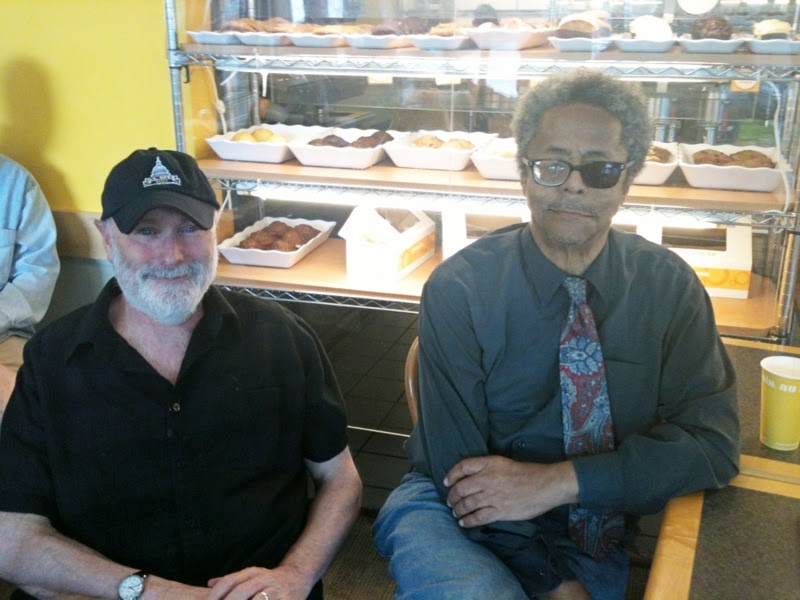
Boston Poet Sam Cornish (Right) Doug Holder (Left) at Bagel Bards  Au Bon Pain  Davis Square, Somerville, Mass.
                                                      (Click on pic to enlarge)

Friday, June 21, 2013

Somerville Artist Christina Tedesco: Ability Amidst Disability


 Somerville Artist Christina Tedesco:  Ability Amidst Disability

By Doug Holder

  Christina Tedesco, a Somerville resident who suffers from cerebral palsy faces many challenges, but she remains a committed artist. Tedesco, who I met at my usual perch at the Bloc 11 Café in Union Square, wrote on her website that her art “…deals with the movement of the human body through space and time. Specifically with the control between balance and imbalance, control and the lack thereof.” “Control and the lack  thereof" are issues that Tedesco faces with her own body, and in her art.

  Tedesco works at the “Mad Oyster” studios on Bradley St. in Somerville. She has lived in Somerville for the past 10 years and she is a graduate of Tufts University and The Museum School in Boston. Of Somerville Tedesco said: “ I love the combination of the city and the suburbs. I find the arts community very down to earth here, certainly more than say the Harrison Ave. crowd in Boston. And Somerville is very easy to get around either by foot or bus.”

  Tedesco said her introduction to art was due to a mistake. She wanted to get into a specific literature class at Tufts but as it turned out it was full so she opted for a photography class.  All this lead to her desire to become an artist. And later, the budding artist moved on to sculpture and painting.

  As for her disability-- it is hardly an asset in the artworld. She said: “ The people I draw have no face. I think people often look at my disability first—not my face or personality.”   But there are advantages according to Tedesco: “ I think I have to observe more closely than the average person. I have to move at a much slower pace. I have to be very conscious of what’s around me, so I don’t fall. And part of being an artist is having the ability to concentrate.”

  Tedesco counts the artist Louise Bourgeois as an influence. She reflected: “ I feel I paint the way she did. She didn’t care about detail, but yet the content is there. Many of her subjects are faceless. She’s like me—concentrating on parts of the body.”

  Tedesco continued: “I draw in a child-like fashion. When I attempt to draw detailed faces—I feel they are not good enough.”

 Tedesco, who works at the Institute of Contemporary Art in Boston has had mixed reactions to her work. She said” Some people like it, others find it sad or scary. My new work for instance incorporates a lot of deep and dark shadows, which may off put folks..”

 Tedesco has participated in a lot of shows in the area. Her work has surfaced at such places as the Harriet Tubman House in Boston, the State House, and Bloc 11 in Union Square, where this interview took place.

 Somerville, Mass. is a home to artists of many types. Tedesco is certainly a unique presence in the Paris of New England.

Thursday, June 20, 2013

Imaginary Planet Poems by Alan Elyshevitz


Imaginary Planet

Poems by Alan Elyshevitz

Cervena Barva Press

Somerville, Massachusetts

editor@cervenabarvapress.com


35 Pages

$7.00

Review by Dennis Daly

Some writers puzzle over words and phrases, positioning them, trimming them, easing them into place. Others, like Alan Elyshevitz, take their poetical wands in hand and, through a kind of grammatical gravity, spin their imaginary worlds into solid being from the dust and debris surrounding their commonplace lives.

Like the orbiting planets they mimic, these poems appear from afar to rotate seamlessly, peacefully, and, above all, with a uniform consistency. But upon closer examination the fragments of broken lives and the awful motes of death and change become quite evident.

In his poem entitled Debris Elyshevitz details the calamities inherent in the dissolution of a civilization,

The smoke won’t clear, nor the waters

recede: the sixteenth calamity

this montha record.

Fences and turnstyles have toppled,

reverting to sour metal

in a reservoir of mud and glass.

Ashes quiver in the updraft;

soggy textiles plug the drains.

The poet, intent upon creation or perhaps restoration, explores this devastated urban landscape and transforms himself into a solicitous healer with practical applications. The poem ends thusly,

… proving himself

indispensable, as his alcoholic

mother always claimed when

he dabbed her elbows, steadied

her finances, and snapped her

memory back from the storm.

Elyshevitz serves up a bit of art theory in his poem This Fragile Planet. He seems to consider both the subjectivity of the reader as well as the essence of the poem itself. He laments his lack of control over his own creation. As artists create they dissipate into their work until they themselves disappear. The poet puts it this way,

it engenders dinosaurs and

burlesque

It cracks

with the slightest quake

of interrogation

Psychiatrists

pull artifacts of shame

from every breach

For years

it cultivates eccentric

rifts

In the end

it fears what we all fear

eclipse

Yes, mortality spares neither poet nor poem. Something to think about.

The poem Hurricane recounts the violence that hits our placid world periodically targeting the weak, the aged, and those who through pride resist. All but the "squat dense things" of life are at risk. Debris is everywhere. Here’s the heart of the poem,

The car horns, the embarrassed medical

team, the fluids bursting from every sewer

In public shelters the dispossessed cough

into their hands like guttering candles

How they yield to the deepening blackout,

jostle, compete, exchange ingratitudes

There is no refastening dislodged pride

Nor the limbs of any man or tree…

Lot’s Wife portrays the great Russian poet Anna Akhmatova in exile. In fact the poem is dedicated to her. Her cottage world that Elyshevitz has spun together comprises chickens, potatoes, eggs, bad memories of her ex-husband, and her dreams of foie gras. Outside she hears only the universe’s white noise, or perhaps something more. In spite of her entrapment and the isolation of her planet, there is some comfort here. Elyshevitz explains,

Outside, the cackle of falling leaves may be

White noise or the very message you desire.

Meanwhile, for dinner you dream of foie gras

And a smuggled morsel of hope from the city

Of your sentiments. By morning the coop may

Produce a few eggs which some say contain the

Biographies of martyrs, for they taste unbearably

Sublime when accompanied by a pillar of salt.

The poet points to the protective cocoon of suburbia and concomitant dangers in his piece entitled August. The denizens of this comfortable world enjoy music, central air and spicy dips. Outside of this zone lurks vagueness and dangers. Here’s how the poem ends,

… If you squint

hard,

you can make out the city.

vague as an un-hyped investment

Hard to imagine people out there

moaning

in slow-motion Spanish. If only they

w plutonium, petroleum, paper:

useful.

A slow

news day. Feel better. No one

you

know has been raped or tripped a land mine.

And the metal detectors are working

just fine.

In Let Us Not Speak Of Legacy Now the poet’s persona spoon feeds his dying father. The claustrophobic scene grows more and more uncomfortable as the poet describes the punctured veins, the thickened eyes, and the strangled muscles. The description is spot on and captures the reader within its sterilized dizzy confines. The semi-private hospital room becomes a spinning planet and only the human connection between father and son allows focus. Here are some neat and also telling lines,

Encrusted in doctors’ orders,

you wear the stigmata of punctured veins,

your muscles strangled by atrophy

in a gown without pockets.

All that remains of your fussy desires

is the dusty flavor of your gums

Last but not least, take a look at the spectacular picture on the front and back covers of this book, courtesy of NASA and Caltech: Out of the Dust, A Planet is Born.

Wondrous cover. Otherworldly book.

Sunday, June 16, 2013

Poet Charles Coe: Forgiving himself. Forgiving his Parents. All Sins Forgiven.


Poet Charles Coe


Poet Charles Coe: Forgiving himself. Forgiving his Parents. All Sins Forgiven.


Interview by Doug Holder


Poet Charles Coe has lost both of his parents, but he still talks with them through his poetry. In his new poetry collection from the Leap Frog Press: All Sins Forgiven: Poems for My Parents he writes about his parents with eloquence and insight. He has been around the block and realizes we are flawed, we love and hurt each other, we sin, and we forgive. In his collection he deals with the complex relations between parent and child in an evocative manner that only a skilled wordsmith could pull off. I spoke with Coe on my Somerville Community Access TV Show Poet to Poet: Writer to Writer.


Doug Holder: E. Ethelbert Miller, author of Fathering Words: The Making of an African-American Writer wrote of your work: "Here is a collection that captures the and intimacy within the black family that sadly goes unnoticed by much of America." Why are these qualities not noticed by society?


Charles Coe: I think a lot groups, cultural groups, ethnic groups, are portrayed by the media in pretty stereotypical ways. A lot of the time when you see a black family portrayed on a TV show or movie, you see them in the context of violence and gangs, domestic discord, sports and music. But I think there is not enough about ordinary life. A lot of the poems in my collection All Sins Forgiven are about ordinary family life.


DH: Your new collection is from the Leap Frog Press. Ownership has changed recently. Can you give me a brief history of the press and your involvement with it.


CC: Leap Frog was started in the 1990's by the marvelous poet Marge Piercy and her husband the novelist and writer Ira Wood. In 1999 they approached me to see if I was interested in submitting a manuscript for publication. A I was very excited to and we worked out a deal for my first poetry collection Picnic on the Moon. Because of my other writing and my full time job it took awhile for the next to come out All Sins Forgiven. Leap Frog was under new ownership when they published All Sins Forgiven.


DH: You have an extensive background as a jazz vocalist. Can you talk a bit about your influences?


CC: That would be a large task. But my platinum standard is Ella Fitzgerald. She is my alltime favorite vocalist.


DH: Do you ever do Scat singing?


CC: I don't focus on that as some jazz singers do. Scat is like peppering a stew. I think scat singing is one of the influences that Hip Hop artists look to for inspiration. I think in some cases the most creative writing around is Hip Hop lyrics.


DH: Your new collection deals with your late mom and dad. How has your view changed about your folks from when you were young to now in your 60's?


CC: When you are young it is very difficult to realize that your parents are actually people and that they are flawed and complex. When you are young they are viewed like your high school teachers. It is as though someone puts them in a closet and unplugs the battery, and shuts the door. And they are awakened just in time to teach the next class. The older you get you realize there are a million questions you want to ask: What were they afraid of? What were they sad about? What were they proud of? I can't have those conversations with them now because they are gone. My book is in a way a route to asking them those questions.


DH: I remember when I was writing my Master's thesis on food in the fiction of Henry Roth, my thesis advisor thought food might be a trivial theme. You use food through out your book: your father cooking pot roast, a Thanksgiving dinner, etc... Through your use of food in your poetry you really get at the texture of life.


CC: I really like to eat food. I love food...perhaps a bit too much. I think food is an incredible way to share time together--bonding, comfort and community. The knuckle heads that told you food is trivial don't know what they are talking about. They practice a form of literary snobbery. There is no subject under the sun under the sun that is trivial. The only thing that is trivial is the mind that approaches the subject. You know great poetry can make the banal profound. Bad poetry can make profound, banal. It is not the subject matter--it is the writer.


DH: Did this poetry collection give you a sense of closure?


CC: Yes and no. I am very glad that I wrote it. I wrote it to understand something about my parents. But it was not just through writing the book, but it was in the process of getting out there, plunging into readings and explore things through the questions people ask me. The idea that I came to some ultimate understanding of my parents is not the case. The people you are closest to can be the most mysterious. We are a mystery to ourselves.


DH: Tell me about your work with the Mass. Cultural Council.


CC: I have been with them for 17 years. I oversee a grant program that gives money to arts organizations. This is not targeted money. The money can be used for many things. This is the hardest money to get. Part of my job involves traveling around the state. I go around the Commonwealth to see what art organizations are doing. Porch sitting I like to call it.


DH: The title of your new collection is All Sins Forgiven. Whose sins are forgiven here?


CC: I am sort of forgiving myself for not helping them more and spending more time with them. But I am also forgiving them, for their shortcomings as well.


TEACHING MY IMAGINARY SON TO FISH


Never take fishing too seriously. Find a shade tree

by a creek bank to lean against on a sunny day with

a mild breeze blowing. Toss your line into the water

and set aside, for awhile, the cares of the day.

Never move too fast; in fact, try to move as little as possible.

And remembe...r; sometimes your best days fishing

will be the ones you go home empty-handed.


These are lessons my father taught me; not in words,

but in the way he’d whistle while unraveling a tangled line,

or laugh when some big catfish slipped the hook. I am

the end of my father’s line, with no one but you to teach

those things I am only now beginning to understand.

And I struggle with his final lesson, the mere fact

of his absence, an the idea that wriggles in my grasp,

like a worm I can’t seem to thread onto the hook.     --- Charles Coe


Some Plum Poems Jane Etzel


Jane Etzel


Some Plum Poems
Jane Etzel
Dove's Wing Press
ISBN: 978-0-578-10317-4
2012  $10.00

“...As the old man prepares to resume his walk,
he sits a moment longer,
amazed to see these solitary birds

gathered together
in a flock on the sides of the dinghy -

a nautical vision
worthy of being called poem.”

This small book of poems plum the depth of what the poet hopes
we may hear. Love for one another:

“...The moon's reflection sparkled
across the water,

and I thought God
had flung a handful of diamonds
to create such a beautiful dazzle!

Now,
looking out over the moonlit ocean,

I believe He still does.”

Etzel's work reflects how she bites into the fruit and tastes
the sweet meat words offer and these poems give thanks:

“...to develop loving relationships
not formed
because of too much solitude

for unexplored decisions
resulting
in colorful consequences...”

We the readers delight in these truthful poetic expressions given
by the poet from her faith. I appreciate the poetry for what it says
and for what is written about gratitude.

“Encircle me Lord
so I may see with Your eyes...”

Irene Koronas
Poetry Editor: Wilderness House Literary Review